
 HQ/EMEAFind out how we can help your business

How a single misconfigured CI/CD token gave attackers access to hundreds of millions of package downloads across PyPI, npm, GitHub Actions, Docker Hub, and OpenVSX.
Between March 19 and 27, 2026, a group called TeamPCP ran through developer toolchains with a level of patience and precision that most threat actors simply do not demonstrate. No zero-days. No phishing campaign. They found a misconfigured GitHub Actions token, waited three weeks, and then let one compromised security scanner do most of the work for them.
Why Target Security Tools?
Before getting into the technical detail, it helps to understand the targeting logic. A CI/CD pipeline at runtime has access to a lot of sensitive materials: cloud credentials, Kubernetes tokens, SSH keys, API keys, GitHub tokens. Most of that material is passed into the pipeline through environment variables or secret stores, and whatever tool runs in that environment can read it.
Security scanners sit at the intersection of all of this. A vulnerability scanner like Trivy runs on every pull request, every merge, and every deployment. It has no legitimate reason to need those secrets, but it runs in the same environment as everything that does. Compromise the scanner and get everything the pipeline touches. That is the insight TeamPCP built this campaign around.
LiteLLM takes it even further. It is an AI API gateway, meaning it proxies requests to OpenAI, Anthropic, Azure, Gemini and others. To do that job it needs to hold the API keys for every provider for its users to configure. Compromising LiteLLM does not just get your CI credentials. It gets you a key for your targets’ entire AI infrastructure.
The group did not pick these targets by accident. Each one was chosen because of what it is allowed to touch. That strategic clarity is what separates TeamPCP from opportunistic supply chain attackers.
Phase 1: The Trivy Compromise
Getting In
In late February 2026, TeamPCP found a misconfiguration in Trivy’s GitHub Actions setup. A long-lived Personal Access Token with write access to release automation was being passed through the workflow environment in a way that allowed it to be extracted during a run. Aqua Security noticed something was off and rotated credentials, but the rotation was incomplete. A secondary credential path stayed open, and TeamPCP kept their access.
They sat on it for three weeks. Long enough for any internal investigation to wind down, long enough for the incident to drop off the team’s active radar.
MITRE ATT&CK T1552.004: Credentials in Files: attacker extracted a privileged PAT from a GitHub Actions workflow environment. Token holds write access to release tags and publishing automation.
March 19, 2026, at 17:43 UTC
When they did move, they hit three distribution channels at the same time using the compromised aqua-bot service account.
Tag Force-Push on GitHub Actions
76 out of 77 version tags in aquasecurity/trivy-action were force-pushed to malicious commits. All 7 tags in aquasecurity/setup-trivy got the same treatment. Any workflow pinned to a tag (which is most of them, since that is the standard guidance) now pulled attacker-controlled code on the next run.
Force-pushing tags is a technique worth understanding. Branch protection rules in GitHub protect branches but not tags by default. Tags are typically treated as immutable by convention, not enforcement. So when TeamPCP force-pushed the tags, the version numbers looked the same to anyone inspecting the repository, but each tag now pointed to a different commit. Unless you are pinning to a full commit SHA, you would not notice until you looked at what actually ran.
Release Binary
A malicious Trivy binary labelled v0.69.4 was published to the GitHub Releases page through the compromised service account’s release pipeline access. The binary was processed through Aqua’s signing workflow, so it carried a legitimate signature. The signing key itself was not compromised. The service account that triggered the signing was.
Docker Hub
Malicious images tagged v0.69.5 and v0.69.6 were pushed to the official Aqua Security Docker Hub namespace. Any pipeline pulling aquasec/trivy:latest or those specific tags got the backdoored image.
MITRE ATT&CK T1195.002 Supply Chain Compromise: three distribution channels poisoned simultaneously. GitHub Action tags, release binaries, and Docker Hub images all hit in the same window.
What the Payload Actually Did
When a pipeline ran the malicious Trivy action or binary, the injected payload executed a sweep of the runner environment. Here is what it collected:
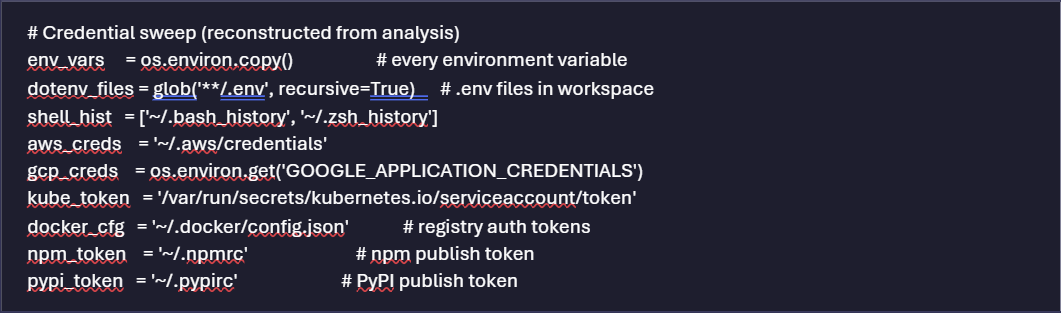
That last pair is important. The npm and PyPI tokens were not just being collected for credential theft. They were being used immediately. Any runner that had a valid npm publish token would have that token used to start pushing CanisterWorm to npm packages before TeamPCP had even manually staged Phase 2. The worm was propagating automatically within hours of Trivy being compromised.
Everything collected was compressed into an archive named tpcp.tar.gz and sent out over HTTPS. That filename shows up consistently across every phase of the campaign. It became one of the cleaner attribution signals once researchers started comparing notes across incidents.
Phase 2: CanisterWorm on npm
At 20:45 UTC on March 20 (about 27 hours after Trivy), malicious publishes started appearing across npm packages in multiple scopes. Researchers named the malware CanisterWorm. The infection mechanism was fairly standard for npm supply chain attacks. What made it technically interesting was the C2 infrastructure.
How It Spread
Affected npm packages had a postinstall hook added to their package.json. When anyone ran npm install and pulled a compromised package, the hook fired a loader script that dropped a Python backdoor to a temp directory and executed it.
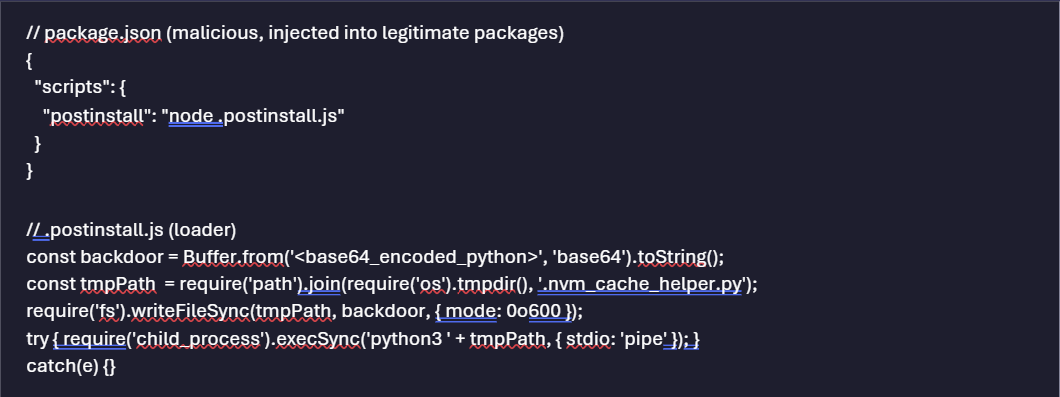
The Python backdoor then queried the ICP canister for a payload URL, fetched and executed the payload, harvested any npm tokens it could find, and used those tokens to publish malicious updates to additional packages under the same publisher account. Each newly infected package became another infection vector. The worm eventually touched 141 malicious artifacts across more than 66 unique packages, spanning scopes including @opengov, @airtm, @pypestream, @teale.io, and @EmilGroup.
The ICP Canister C2
This is the part worth paying attention to if you track C2 infrastructure. TeamPCP did not use a domain or a VPS as their command-and-control endpoint. They deployed a canister on the Internet Computer Protocol mainnet.
ICP canisters are smart contracts running on a decentralized blockchain network. They have a permanent on-chain address, execute in a sandboxed WebAssembly environment, and can be updated by their controller at any time. The Python backdoor queried the canister to get the payload URL:

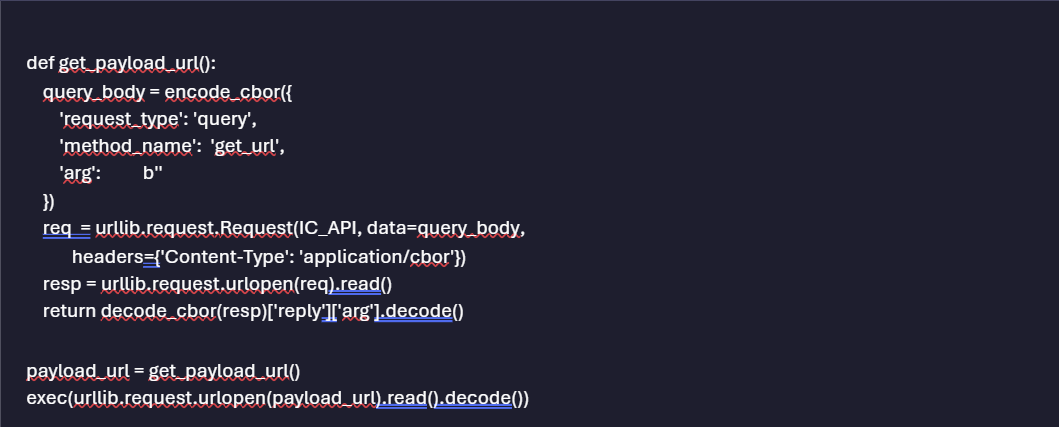
Why does this matter from a defender’s perspective? Traditional C2 infrastructure has obvious intervention points. You can sinkhole a domain, seize a server, or block an IP at the firewall. None of that works against a canister. There is no registrar to contact, no hosting provider to serve with a takedown notice, no IP address to null-route. The canister ID is a content address on the blockchain.
The canister controller can also swap the payload URL at any time, pushing entirely new binaries to every infected host without modifying anything on the endpoint side. No IOC change on disk. No new file to detect. This was the first publicly documented use of ICP infrastructure as a malware C2, and it is a technique that defenders are going to have to think about going forward.
There is no registrar to contact, no hosting provider to serve with a takedown notice, no IP to null-route. The canister just stays up.
MITRE ATT&CK T1102 Web Service C2: ICP blockchain canister used as a decentralized, censorship-resistant dead drop. First documented abuse of ICP infrastructure for malware command-and-control.
Phase 3: Checkmarx GitHub Actions and OpenVSX
March 23 was the Checkmarx phase. The access vector was the same pattern: credentials harvested from a Trivy-infected CI runner that happened to have access to Checkmarx’s release automation. The compromised account was the cx-plugins-releases service account, which had write access to both the Checkmarx GitHub Action repositories and their OpenVSX marketplace publisher account.
GitHub Action Tags
Between 12:58 and 16:50 UTC, all 35 tags of checkmarx/kics-github-action were force-pushed to malicious commits. The checkmarx/ast-github-action repository got the same treatment. Same technique as Trivy: version tags pointing to attacker-controlled commits, invisible unless you check the commit SHA behind each tag.
The stealer injected into the Checkmarx actions was functionally similar to the Trivy payload, with one addition: it made an effort to sweep CI runner memory for secrets that might not be in files or environment variables, specifically targeting in-memory data from authentication agents. The exfiltration bundle was packaged as tpcp.tar.gz again, and sent to an attacker-registered domain: checkmarx[.]zone.
That domain name is worth flagging. It is designed to look plausible in network logs. If you are filtering outbound traffic for connections to anything containing ‘checkmarx’, you would miss checkmarx[.]zone unless you are looking for standalone domain registrations rather than subdomains.
OpenVSX Extension Backdoor
Alongside the GitHub Actions attack, two malicious VS Code extension versions were published to the OpenVSX marketplace:
- ast-results-2.53.0.vsix (Checkmarx AST Results extension)
- cx-dev-assist-1.7.0.vsix (Checkmarx developer assistant)
Extensions are a different attack surface from CI runners. They run on developer workstations, inside the VS Code process, with access to whatever the developer’s machine has: local credential stores, open git repositories, SSH agent sockets, local .env files, browser-accessible tokens. The blast radius per infection is narrower but the access is more persistent and more personal.
Phase 4: LiteLLM on PyPI
On March 24 at 10:39 UTC, litellm 1.82.7 appeared on PyPI. Thirteen minutes later, 1.82.8 followed. LiteLLM’s package sees more than 95 million downloads a month. It is an AI API gateway that proxies calls to OpenAI, Anthropic, Azure, Gemini, Cohere, and a long list of others. To do that it stores and transmits API keys for every provider its users configure. There is no more valuable credential target in the AI infrastructure stack right now.
The .pth Auto-Execution Trick
The delivery mechanism in version 1.82.8 was technically elegant. The malicious package included a file called litellm_init.pth placed in the site-packages directory.
Python’s .pth files are path configuration files, processed at Python interpreter startup to add directories to sys.path. But they can also contain import statements, which Python executes directly at startup. The implication:
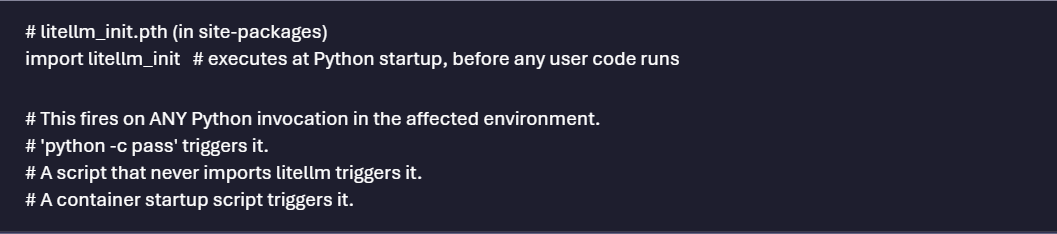
The malware did not need the target application to use LiteLLM. It needed LiteLLM to be installed anywhere in the Python environment. That is a significant difference from most package-based supply chain attacks, which require the target to actually import the compromised package.
The Three-Stage Payload
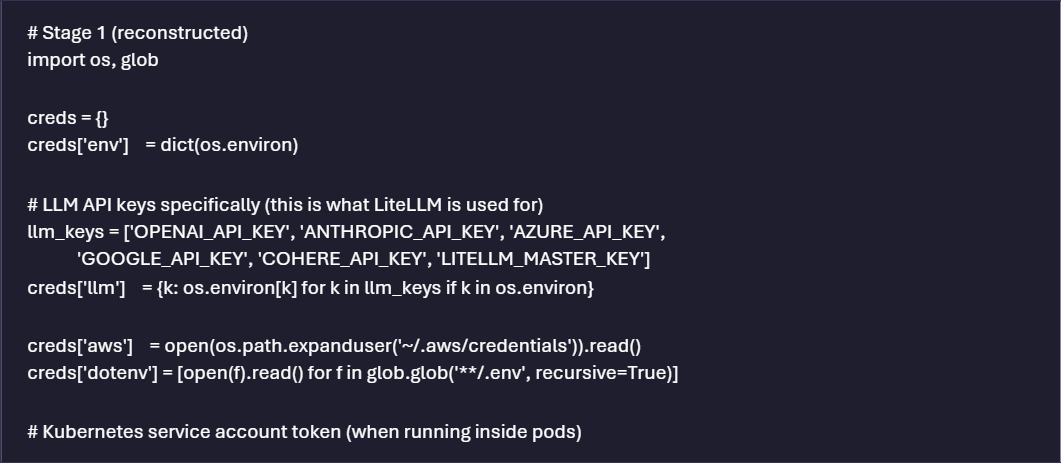
Stage 1: Credential Collection
The first stage swept the host for credentials, going deeper than the Trivy phase:

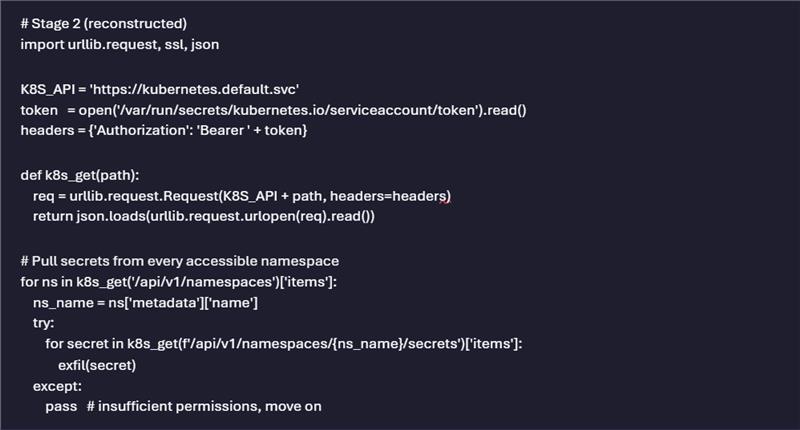
Stage 2: Kubernetes Lateral Movement
If a Kubernetes token was found, the payload tried to use it. This is where the attack moved from a single compromised pod to potentially the entire cluster:
Stage 3: systemd Backdoor
On Linux hosts, the third stage dropped a persistent backdoor disguised as a system service:
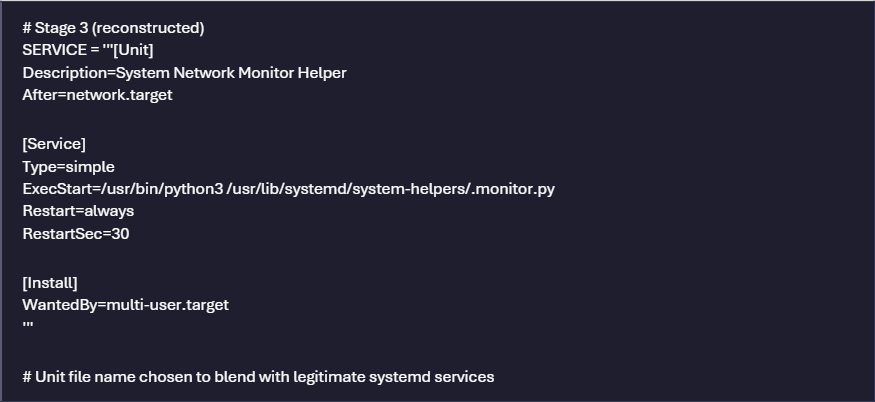

The service name systemd-network-helper and the hidden payload file at /usr/lib/systemd/system-helpers/.monitor.py are both chosen to blend with real system infrastructure. The leading dot on .monitor.py makes it invisible to ls without -a. A quick systemctl list-units would show a name that looks legitimately systemd-ish.
The compromised packages were pulled from PyPI after about three hours. With 3.4 million downloads per day, three hours is still a lot of exposure.
MITRE ATT&CK T1543.002 Systemd Service: persistent unit file installed disguised as a system network service. Payload polls the ICP canister C2 for additional instructions.
Phase 5: Telnyx and WAV Steganography
March 27 brought two more malicious packages: telnyx==4.87.1 and telnyx==4.87.2. Telnyx is a communications API SDK with around 1 million downloads per month. The target credentials were not Telnyx-specific, they were whatever the environments running Telnyx happened to expose. But the reason to study this phase is the delivery technique. TeamPCP hid their payload inside WAV audio files.
The Injection Point
The malicious code went into telnyx/_client.py, the core HTTP client that every other module in the package imports. This guaranteed execution on any import telnyx call. Exactly 74 lines were injected in three spots: imports at the top, a base64 payload variable in the middle of the file between class definitions, and attack functions appended at the bottom. The layout was meant to look like support code on a quick visual scan.
How WAV Steganography Works Here
A WAV file is a structured binary container: a RIFF header, a format chunk describing audio parameters, then a data chunk holding the raw PCM audio samples. Most analysis tools validate the header and format chunk and stop there. They hand the file to an audio decoder or just mark it as valid audio. They do not parse the raw frame data as binary content looking for encoded payloads.
TeamPCP’s payload was XOR-encoded and embedded in those audio frames. The files would play as audio in any media player. They passed format validation. The malicious content was just occupying bytes that would otherwise be PCM sample data:
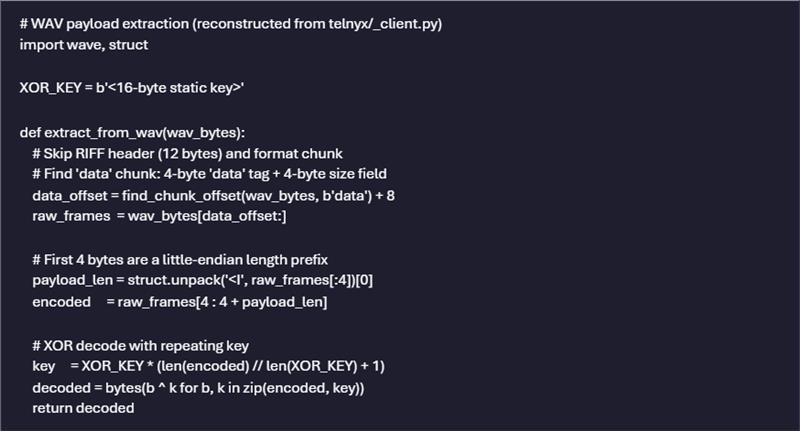
Windows Path
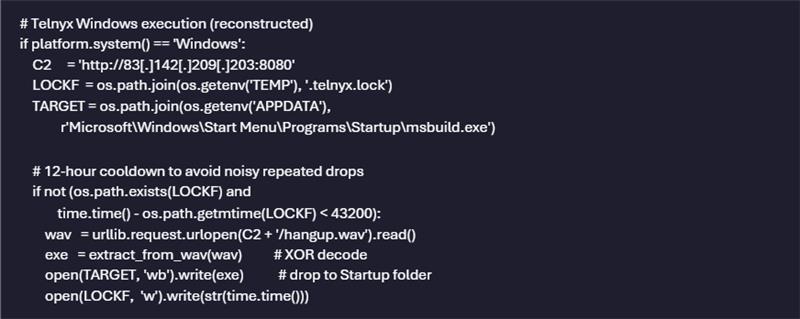
Using msbuild.exe as the filename is a living-off-the-land masquerade. MSBuild is a legitimate Microsoft tool, so that name does not stand out immediately. The Startup folder gives persistence without needing a registry write or admin privileges.
Linux and macOS Path
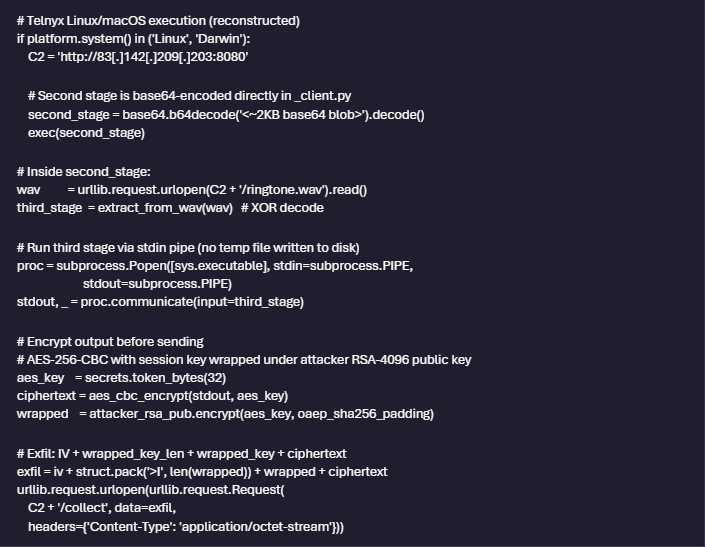
The encryption scheme gives the attacker forward secrecy. Even if defenders capture the exfiltration traffic, decryption requires the attacker’s RSA private key. Defenders can see that data left, but not what data left.
The same RSA-4096 public key was present in the LiteLLM payloads. That is a clean cross-phase attribution link, along with the consistent use of tpcp.tar.gz and the same AES-256-CBC plus RSA OAEP exfiltration scheme across both phases.
Attribution note Identical RSA-4096 public key across LiteLLM and Telnyx payloads. Same encryption scheme, same archive name, same ICP canister referenced in CanisterWorm and the LiteLLM systemd backdoor. High confidence these phases share a single operator.
Attacker Infrastructure
TeamPCP ran a lean infrastructure footprint. Three main components:
83[.]142[.]209[.]203:8080
The Telnyx C2 IP. Served hangup.wav and ringtone.wav and received encrypted credential exfil at /collect. Almost certainly a rented VPS through a bulletproof hosting provider or a compromised relay.
checkmarx[.]zone
Attacker-registered domain, used only during the Checkmarx phase for credential exfiltration. Designed to look legitimate in network logs. The standalone .zone TLD (rather than a subdomain of the real checkmarx.com) is the tell.
ICP Canister on mainnet
The CanisterWorm and LiteLLM Stage 3 C2. Permanent on-chain address, no takedown surface. The canister controller can swap payloads at any time, pushing new binaries to all infected hosts without any endpoint-side change.
Phase 6: What Happened After the Compromises Stopped
By March 27 to 29, no new malicious package publishes were observed. TeamPCP had stopped expanding and started cashing in.
The group announced a partnership with Vect, a ransomware operation, and BreachForums. They set up a mass affiliate program targeting over 300,000 registered forum users, offering access to encryption and extortion tooling built on top of the credential haul. The math is straightforward: 300 GB of compressed credentials from CI/CD pipelines across a large number of organizations, now being turned into a ransomware-as-a-service platform.
Separately, LAPSUS$ claimed a 3 GB breach of AstraZeneca around the same time, citing CI/CD credential material as the access vector. Claimed data includes internal code repositories, AWS and Azure infrastructure configs, Terraform state files, Spring Boot application configs, GitHub Enterprise user records, and employee data. The timing and toolchain overlap put moderate confidence on a link to TeamPCP-sourced credentials.
Organizations that ran the affected packages between March 19 and 27 are likely still sitting inside the group’s target list. The credential acquisition phase is done. The monetization phase is now active.
Detection
Hunt Queries for Pipeline Logs
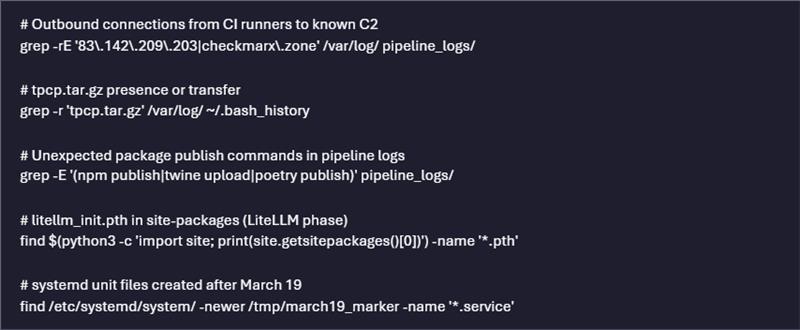
Endpoint Checks
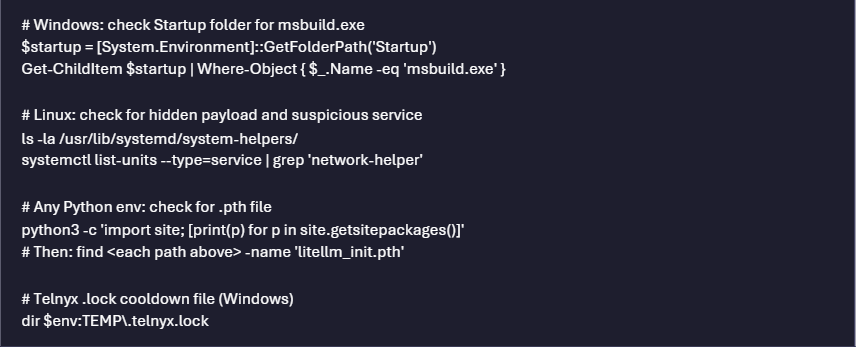
Network Signatures
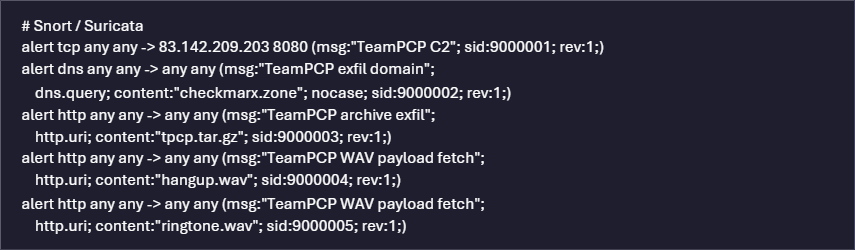
Remediation
If any pipeline ran the affected packages between March 19 and 27: Assume full credential compromise. Rotate everything accessible from those environments before doing anything else.
Credential Rotation (Do This First)
In order of priority: cloud API keys and IAM credentials (AWS access keys, GCP service accounts, Azure service principals), Kubernetes service account tokens, SSH keys used in CI/CD, GitHub Personal Access Tokens, npm and PyPI publish tokens, LLM provider API keys (OpenAI, Anthropic, Azure OpenAI and others), then any other application API keys that were present in the pipeline environment during the affected window.
Safe Package Versions to Pin To
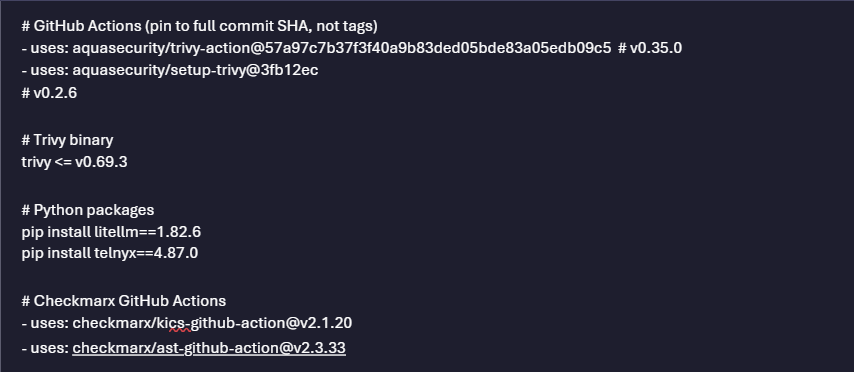
Structural Fixes That Would Have Prevented This
Pin Actions to Commit SHAs

Use OIDC Instead of Long-Lived Tokens
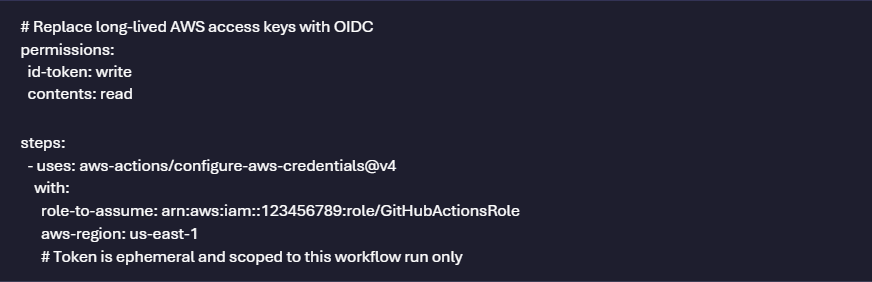
Separate Service Account Scopes
The cx-plugins-releases account had write access to GitHub Action tags, GitHub Releases, and the OpenVSX marketplace. One compromised token gave the attacker three attack surfaces. Separate service accounts for scan, build, and publish operations, each scoped minimally, limits the blast radius of any single token compromise to one surface instead of three.
Closing Thoughts
What makes TeamPCP worth studying is not just the technical innovation, though the ICP canister C2 and WAV steganography are both genuinely new. It is the structural discipline. Every target was chosen because it had privileged access to secrets by design. Every phase was funded by credentials stolen from the previous one. The group did not need a zero-day anywhere in this campaign.
The five phases were not five separate attacks. They were one attack with five stages, each one enabled by the last. Trivy gave them npm tokens. npm gave them more tokens. The Trivy-infected runners gave them Checkmarx credentials. Checkmarx gave them more scope. LiteLLM gave them AI infrastructure keys. Telnyx gave them persistent footholds on developer machines. Each step was a direct consequence of the step before it.
The monetization infrastructure is now live. The Vect affiliate program is running. TeamPCP has roughly 300 GB of credentials from organizations that ran the affected tooling. If your pipelines touched any of the affected packages between March 19 and 27, you are in that dataset. The question is not whether the credentials are gone. They are. The question is what gets done with them and how quickly you can rotate and respond before they are used.
Sources
- CSA Advisory AD-2026-001, Cyber Security Agency of Singapore
- Microsoft Security Blog: Detecting, Investigating, and Defending Against the Trivy Supply Chain Compromise (March 24, 2026)
- SANS Institute: When the Security Scanner Became the Weapon: Inside the TeamPCP Supply Chain Campaign
- SANS ISC Diary: TeamPCP Supply Chain Campaign Updates 002 and 003
- ReversingLabs: Inside the TeamPCP Cascading Supply Chain Attack
- Wiz: Trivy Compromised by TeamPCP Supply Chain Attack
- CrowdStrike: From Scanner to Stealer: Inside the trivy-action Supply Chain Compromise
- StepSecurity: Trivy Compromised a Second Time
- Palo Alto Networks: When Security Scanners Become the Weapon
- Endor Labs: TeamPCP Isn’t Done
- Sonatype: Compromised LiteLLM PyPI Package Delivers Multi-Stage Credential Stealer
- BleepingComputer: Popular LiteLLM PyPI Package Backdoored to Steal Credentials
- BleepingComputer: Backdoored Telnyx PyPI Package Pushes Malware Hidden in WAV Audio
- JFrog Security Research: TeamPCP Strikes Again: Telnyx Popular Library Hit
- Aikido Security: TeamPCP Deploys CanisterWorm on npm Following Trivy Compromise
- Security Boulevard: CanisterWorm: The Self-Spreading npm Attack That Uses a Decentralized Server to Stay Alive
- Socket.dev: CanisterWorm npm Publisher Compromise Deploys Backdoor Across 29 Packages
- Socket.dev: TeamPCP Partners with Vect Targeting OSS Supply Chains
- The Hacker News: TeamPCP Hacks Checkmarx GitHub Actions Using Stolen CI Credentials
- The Hacker News: TeamPCP Pushes Malicious Telnyx Versions to PyPI, Hides Stealer in WAV Files
- Kaspersky: Trojanization of Trivy, Checkmarx, and LiteLLM Solutions
- Arctic Wolf: TeamPCP Supply Chain Attack Campaign Targets Trivy, Checkmarx, and LiteLLM
