
 HQ/EMEAFind out how we can help your business


Public reporting indicates a compromised maintainer account, a staged dependency, and an install-time dropper affected axios releases on npm. This version retains the original structure while distinguishing reported observations from unconfirmed points.
Editorial note: Our review is based on the supplied draft and public reporting referenced by the article. We have not independently reproduced every stage of execution described below.
Axios is widely used across frontend applications, backend services, and CI environments. Public reporting on March 31, 2026 indicated that [email protected] and [email protected] on npm included a malicious dependency. Any system that installed those releases should be treated as potentially exposed until reviewed.
This article reviews the reported timeline, the suspected maintainer-account compromise, the observed role of [email protected], and the response steps organizations should prioritize. Where the available evidence is incomplete, we note that clearly.
Why the Reported Incident Matters
Axios is broadly used across JavaScript development, from application code to automation and internal tooling. That reach means even a short-lived malicious release can affect developer endpoints, CI workers, and downstream applications across many organizations.
Public reporting indicates the malicious behavior was introduced through a dependency change rather than a visible change to axios application logic. In the reported releases, package.json included [email protected], which was described as an install-time package used to execute a postinstall chain.
The wider security lesson is that npm lifecycle scripts run automatically unless organizations explicitly restrict them. That makes dependency changes and install-time behavior as important to review as the application source code itself.
The Attack Timeline
Public reporting suggests the activity was staged over roughly 30 hours rather than published as a single isolated change.
March 30, 05:57 UTC: The Decoy Is Published
Public reporting indicates [email protected] was published about 18 hours before the later reported malicious release. That earlier version has been described as clean and may have helped establish package history before the later activity.
March 30, 23:59 UTC: The Payload Goes Live
Public reporting indicates [email protected] was then published with the obfuscated install-time logic and a decoy package.md file. The package was reportedly flagged quickly by security researchers, but it remained relevant long enough to warrant incident response.
March 31, 00:21 UTC: [email protected] Released
Public reporting indicates [email protected] was published via the npm maintainer account with [email protected] added as a dependency. The reported release path matters because it appears to have occurred outside the project’s normal source-control review flow.
March 31, 01:00 UTC: [email protected] Released
Public reporting indicates [email protected] was published shortly afterward, extending the exposure to users still pinned to the 0.x branch. That branch remains common in older applications and long-lived enterprise environments.
Reported Maintainer Account Takeover
Public reporting indicates the jasonsaayman npm account used to publish axios was compromised. One of the early reported indicators was a change to the account email address to [email protected]. We have not independently validated the full account history.
A changed account email can affect recovery flows, including password resets and other account-management actions. That makes such changes important investigative markers, but the full sequence still depends on platform-side confirmation.
A second account, nrwise, was also mentioned in public reporting. Its exact role remains unclear based on the supplied material. The initial access path into the maintainer credentials has not been publicly confirmed, so phishing, credential reuse, or infostealer exposure should be treated as possibilities rather than established fact.
What stands out in the reporting is that the activity appears to have centered on npm publication rather than visible source-repository changes. That distinction matters because repository review alone may not reveal malicious release activity.
MITRE ATT&CK T1078 Valid Accounts: public reporting indicates a compromised npm publisher account was used to publish unauthorized releases. Any references to account changes should be treated as reported indicators unless confirmed by platform-side evidence.
Reported Behavior of [email protected]
Structure and Obfuscation
Public reporting describes the package as using a setup.js script referenced in the postinstall field of package.json. In that reporting, npm install triggered the execution chain automatically. The dual-layer obfuscation described below is presented here as reported behavior rather than independently reproduced analysis.
- Layer 1 (XOR cipher): All sensitive strings (the C2 URL, shell commands, file paths, platform identifiers) are XOR-encoded using the key “OrDeR_7077”. The effective byte key is [0,0,0,0,0,0,7,0,7,7], derived from the ASCII values of the key characters.
- Layer 2 (Base64 + reversal): After XOR encoding, the result is base64-encoded with string reversal applied before UTF-8 interpretation.
Public reporting described the package as hiding sensitive strings until runtime, which would reduce the value of simple static pattern matching. The following reconstructed logic is best read as an explanatory model of the behavior described in reporting, not as a full independent reverse-engineering record.


The reported use of eval(‘require’) to load modules such as fs, os, and child_process would make simple static import scanning less effective. That approach is consistent with a package trying to delay or hide suspicious behavior until execution.
C2 Infrastructure
According to the supplied reporting, the dropper contacted remote infrastructure to retrieve platform-specific second-stage payloads:

The reported path structure and content formatting were described as resembling npm-related traffic in logs. That does not guarantee the traffic would evade review, but it may have reduced suspicion during fast-moving install activity.
Reported Platform-Specific Payloads
macOS
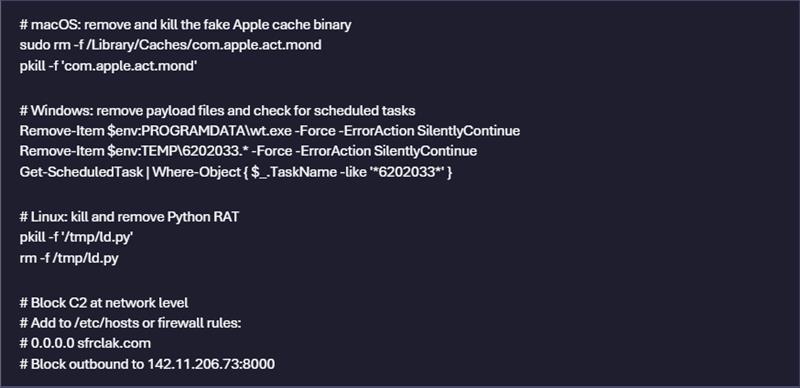
Public reporting described the macOS path as a silent AppleScript-driven download-and-execute sequence writing to /Library/Caches/com.apple.act.mond.
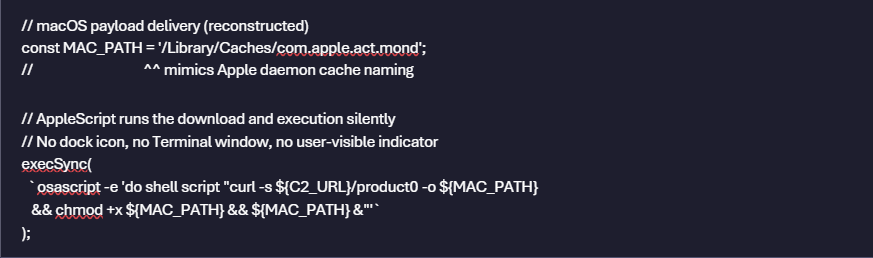
The reported path appears chosen to resemble Apple cache or daemon naming. That sort of masquerading can make quick manual review more difficult.
Windows
Public reporting described the Windows path as a hidden multi-stage execution chain using PowerShell and a VBScript wrapper.

If that behavior occurred as reported, the wrapper and renamed executable would have reduced user-visible signs during execution and complicated simple process review.
Reported artifacts included %PROGRAMDATA%\wt.exe, %TEMP%\6202033.vbs, and %TEMP%\6202033.ps1. Those paths are useful leads for scoping, but responders should validate them against host telemetry rather than rely on any single indicator.
Linux
Public reporting described the Linux path as a simpler download of a Python script to a temporary location, followed by background execution.
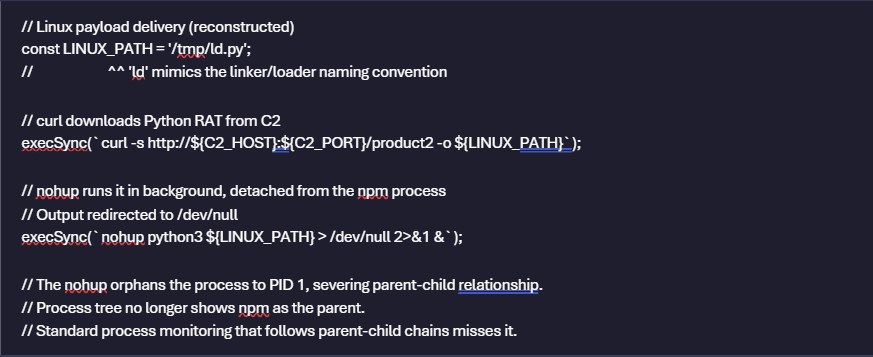
The reported filename and use of nohup suggest an attempt to blend with normal system activity and separate the process from the parent install chain. Defenders should confirm persistence and child-process behavior through endpoint telemetry where available.
MITRE ATT&CK T1059 Command and Scripting Interpreter: the supplied reporting describes macOS, Windows, and Linux execution through OS-native scripting paths. This mapping is a reasonable analytical fit, but it still depends on the underlying reporting being accurate.
Reported Self-Erasure and Forensic Evasion
Public reporting suggests the package attempted to remove or replace local evidence after the payload stage completed. That reported cleanup behavior is one reason post-incident verification may be more difficult than a routine package review.

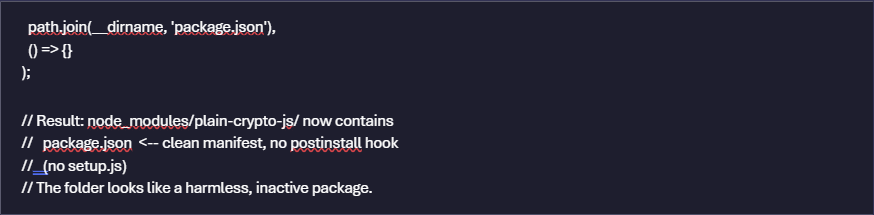
The reported use of a clean decoy file is notable because it would make a later inspection of the package directory look less suspicious. Whether that exact sequence occurred should still be confirmed through artifact review or preserved samples.
One practical takeaway remains useful: the presence of node_modules/plain-crypto-js/ in an axios project is itself unusual and should be investigated. Responders should not rely only on the visible package.json state after the fact.
MITRE ATT&CK T1070.004 Indicator Removal: File Deletion. Public reporting describes cleanup behavior that removed setup.js and replaced the package manifest with a cleaner decoy. Use this mapping as analytical support rather than as standalone proof.
Other Reported Related Packages
Public reporting also linked two additional npm packages to similar behavior as part of the same broader activity:
@shadanai/openclaw
Public reporting described this package as bundling plain-crypto-js directly instead of declaring it as a normal dependency. If accurate, that choice would reduce visibility in standard dependency trees.
@qqbrowser/[email protected]
Public reporting described this package as shipping a modified copy of [email protected] with the same malicious dependency already included.
Taken together, those reports suggest the activity may have used more than one distribution path. That remains an assessment, not a final attribution or complete campaign map.
Detection
Check Your node_modules
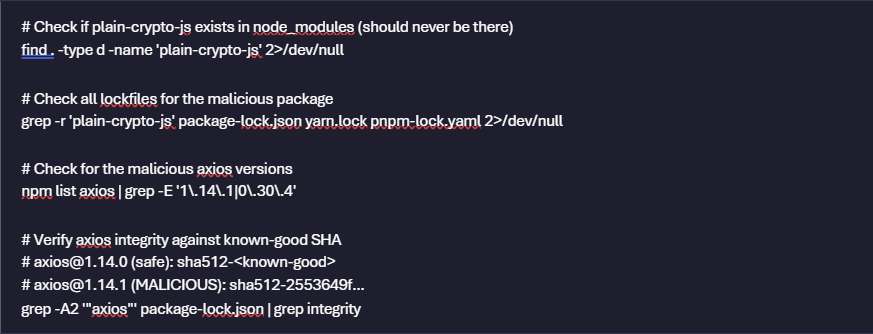
Check for Payload Artifacts

Network Detection
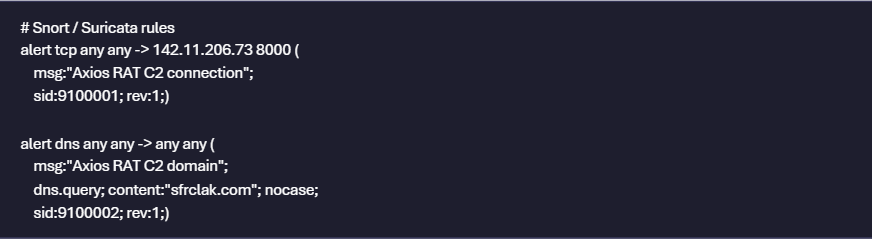
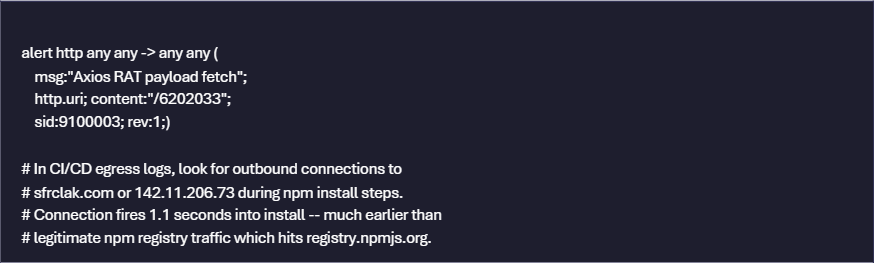
Verify Your CI/CD Logs
If any of your CI pipelines ran npm install during the reported exposure window, review the pipeline logs for:
- Outbound connections to sfrclak.com or 142.11.206.73 during install steps
- An npm install step that resolved [email protected] or [email protected] in the dependency tree
- Any postinstall script execution from plain-crypto-js
- Process spawning patterns: npm -> sh -> node -> sh -> curl/nohup in the process tree
Remediation
If you ran npm install during the reported exposure window, treat the system as potentially compromised until it has been reviewed. Credential rotation should be prioritized early in the response.
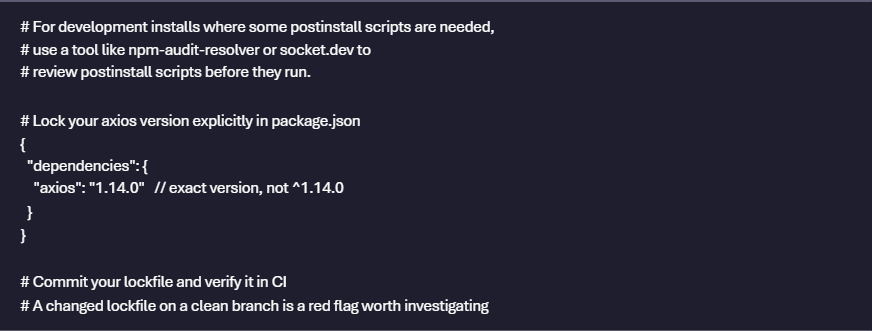
Step 1: Pin to Safe Versions Now
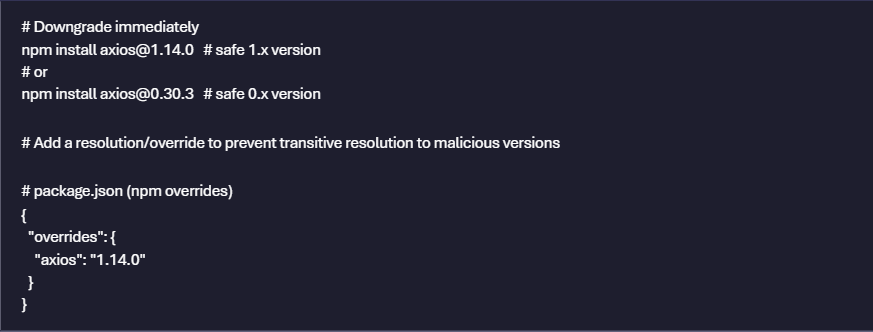
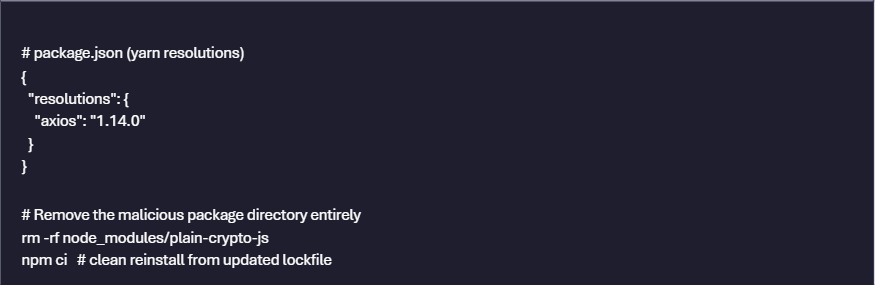
Step 2: Rotate Credentials
Any credentials accessible from a machine or CI runner that installed the affected versions should be treated as potentially exposed. Priorities typically include package publish tokens, cloud keys, source-control tokens, SSH material, database credentials, and application secrets present in environment variables or local files.
Step 3: Kill Persistent Payloads
Step 4: Harden Your npm Install Process

MITRE ATT&CK Mapping (Analytical)
- T1195.002 Supply Chain Compromise: Public reporting indicates a malicious dependency was added to axios through a compromised publisher account.
- T1078 Valid Accounts: Public reporting indicates compromised npm account credentials were used to publish unauthorized package versions.
- T1027 Obfuscated Files or Information: Reported behavior included XOR-based and base64-style string obfuscation prior to runtime decoding.
- T1140 Deobfuscate / Decode Files or Information at Runtime: Reported behavior included decoding module names, infrastructure strings, and command content only during execution.
- T1059.001 PowerShell: Reported Windows behavior included PowerShell execution with policy bypass through a hidden wrapper.
- T1059.006 Python: Reported Linux behavior included dropping and running a Python script from /tmp.
- T1105 Ingress Tool Transfer: Public reporting describes second-stage payload retrieval from remote infrastructure at runtime.
- T1070.004 Indicator Removal: File Deletion: Reported behavior included deleting setup.js and replacing the package manifest with a cleaner decoy.
- T1036 Masquerading: Reported paths and filenames on macOS, Windows, and Linux were chosen to resemble legitimate system artifacts.
- T1071.001 Application Layer Protocol: Reported C2 requests used application-layer traffic patterns intended to blend into normal install activity.
What This Incident Highlights
This incident underscores how much trust software teams place in package-manager lifecycle behavior. A small dependency change in a widely used package can have consequences beyond a single developer workstation, especially when CI runners, secrets, and automation accounts are involved.
It also shows why package publication paths and install-time behavior deserve as much attention as repository commits. Where lifecycle scripts are not essential, reducing or disabling them in CI can materially narrow exposure.
Early public detection helped limit the window, but even short exposure periods can affect automated build systems at scale. For organizations, the most useful lesson is procedural: preserve logs, identify where the affected versions were installed, rotate reachable secrets, and rebuild from known-good state where appropriate.
Source note: Official project statements, platform-side confirmations, and preserved samples should take precedence over secondary reporting where differences exist.
Public Sources Referenced
- StepSecurity: axios Compromised on npm, Malicious Versions Drop Remote Access Trojan (March 31, 2026)
- Socket.dev: Supply Chain Attack on Axios Pulls Malicious Dependency from npm
- SecurityOnline: Axios Under Siege, Critical npm Supply Chain Attack Hijacks Lead Maintainer to Drop Multi-Platform RAT
- CyberSecurityNews: Axios NPM Packages Compromised to Inject With Malicious Codes in Active Supply Chain Attack
- Cyber Kendra: Axios Hack Alert, Malicious npm Versions Drop RAT on macOS, Windows, and Linux
- Feross (Socket.dev founder) on X: Active supply chain attack on axios (March 31, 2026)
- GitHub axios/axios Issue #10590: [email protected] contains malicious dependency plain-crypto-js
- GitHub axios/axios Issue #10604: [email protected] and [email protected] are compromised
- Hacker News discussion: Active Supply Chain Attack on axios 1.14.1
- Hacker News discussion: Axios compromised on NPM, Malicious versions drop remote access trojan
- Loginsoft: sync-axios Supply Chain Attack, What You Need to Know
