
 HQ/EMEAFind out how we can help your business


Source review indicates the claims should be treated as an unverified breach allegation, not a confirmed compromise.
| Field | Assessment |
|---|---|
| Claimed actor | Orcinus Orca |
| Target | FBI-associated web infrastructure and public-facing data sources |
| Status | Unverified breach claim |
| Confidence | Low confidence in confirmed compromise; moderate confidence that several referenced data categories overlap with public government data sources |
| Threat level | Moderate-Low, pending verifiable evidence of non-public data access |
Overview
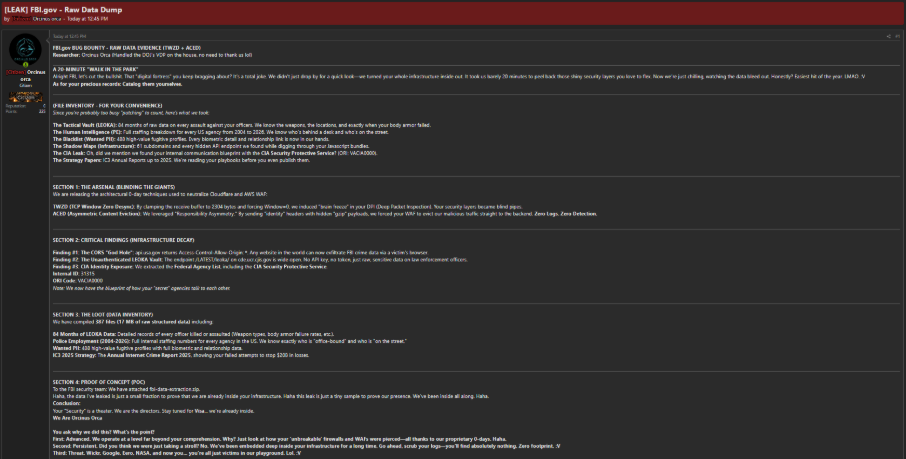
A self-identified actor using the name Orcinus Orca published claims alleging unauthorized access to infrastructure associated with the Federal Bureau of Investigation. The post alleged access to law enforcement datasets, government directory information, subdomain and API inventories, fugitive profiles, IC3 annual reporting information, and documentation connected to inter-agency communications.
Our review found no official public confirmation from the FBI, the Department of Justice, or CISA validating a breach of FBI internal systems at the time of writing. We also did not identify reliable independent reporting that confirms the actor’s technical claims or proves access to non-public FBI infrastructure.
The available evidence supports treating this as an unverified breach claim. The claim may still require monitoring because government breach allegations can create reputational risk, encourage social engineering, and generate follow-on disclosure attempts even when the underlying intrusion remains unconfirmed.
About the FBI and the Data Context
The FBI is a U.S. federal law enforcement and domestic intelligence agency that maintains public-facing resources for crime statistics, wanted-person information, cybercrime reporting, and public safety information. Several data categories mentioned in the actor’s post resemble information that is already available through public FBI or U.S. government reporting channels.
This distinction matters. A public dataset copied from a government portal is not the same as unauthorized access to internal systems. For this reason, any claim involving government data should be evaluated against known public repositories before being classified as a confirmed breach.
Visual Context
What the Actor Claimed
The actor claimed access to multiple categories of law enforcement and government information, including:
- Law Enforcement Officers Killed and Assaulted (LEOKA) data covering approximately 84 months.
- Police Employment staffing records spanning 2004 to 2026.
- Hundreds of fugitive profiles allegedly containing personally identifiable and biometric-related information.
- Government subdomain inventories and API endpoint details.
- Federal agency directory information.
- IC3 annual reporting data through 2025.
- Documentation allegedly related to inter-agency communications.
These claims have not been independently verified. The actor also suggested long-term persistence and possible future targeting of other organizations, but no evidence reviewed for this article confirms ongoing access to FBI systems.
Technical Claims Require Caution
The post attributed the alleged activity to two actor-named techniques: TCP Window Zero Desync and Asymmetric Content Eviction. We found no reliable public technical references establishing either phrase as a documented vulnerability class or recognized exploitation technique.
TCP zero-window behavior is a legitimate network flow-control condition, but the actor’s use of that concept as a claimed WAF or inspection bypass remains unvalidated. Similarly, the term Asymmetric Content Eviction should be treated as an actor-framed label unless reproducible technical evidence becomes available.
The post also referenced a possible CORS misconfiguration. Cross-Origin Resource Sharing controls whether browser-based code from one origin can read responses from another origin. A permissive CORS configuration can increase risk when sensitive unauthenticated data is exposed, but CORS alone does not prove server compromise or authenticated access to internal systems.
Public-Source Overlap in the Alleged Data
Several claimed datasets appear to overlap with public government reporting or public-facing FBI resources. This does not prove the claims are false, but it lowers confidence that the post demonstrates unauthorized access unless the actor can show non-public records, restricted logs, credentials, source code, internal tickets, or other material that could not reasonably be collected through open sources.
| Claimed data category | Public-source overlap | Assessment |
|---|---|---|
| LEOKA and Police Employment data | FBI UCR and Crime Data Explorer resources publish law enforcement and crime-statistics information. | Potentially public-source derived. |
| Fugitive profiles | FBI wanted-person pages and public API resources expose wanted-person profile data for public safety purposes. | Could overlap with public wanted-profile data. |
| IC3 reporting data | IC3 annual reports are public reporting products. | Public report data alone does not indicate compromise. |
| Subdomains and API endpoints | Can often be collected through public reconnaissance. | Reconnaissance data is not breach evidence by itself. |
| Agency directories | Many federal agency directories and contact records are publicly accessible. | Requires validation before treating as exposed internal data. |
| Inter-agency communications information | Could be sensitive if authentic, but no reviewed evidence confirms non-public disclosure. | Unverified. |
Potential Impact if the Claim Is Authentic
If the actor possesses non-public law enforcement data, the potential impact would be more significant. Sensitive operational, personnel, investigation-adjacent, or inter-agency information could support follow-on targeting or harassment against government employees, partner agencies, or individuals connected to investigations.
Potential risks if non-public data is later verified include:
- Social engineering or spear-phishing campaigns against government personnel and partner organizations.
- Doxxing, harassment, or exposure of individuals connected to law enforcement matters.
- Infrastructure mapping and targeted reconnaissance against public-sector systems.
- Credential harvesting attempts using government-themed lures.
- Reputational pressure against the named agency, even before technical evidence is confirmed.
MITRE ATT&CK Mapping
The following mapping is based only on the actor’s claims and the types of information described. It should not be interpreted as confirmed intrusion activity.
| Tactic | Technique | ID | Claim-based relevance |
|---|---|---|---|
| Reconnaissance | Gather Victim Network Information | T1590 | The actor referenced government subdomains, APIs, and public-facing infrastructure. |
| Reconnaissance | Gather Victim Identity Information | T1589 | The actor referenced agency directory and personnel-adjacent information. |
| Discovery | Network Service Discovery | T1046 | The claim includes endpoint and service enumeration, but no validated intrusion evidence. |
| Collection | Data from Information Repositories | T1213 | The claim involves acquisition of datasets and records. |
| Exfiltration | Exfiltration Over Web Service | T1567 | If authentic, data may have been retrieved through web-accessible services or APIs. |
Assessment
At this stage, the evidence supports a cautious assessment: the Orcinus Orca post is an unverified breach allegation, not a confirmed FBI infrastructure compromise.
The claim deserves monitoring because the named target is high-profile and the alleged data categories could be sensitive if authentic. However, the lack of official confirmation, the absence of independently validated intrusion evidence, the actor’s use of unvalidated technique names, and the apparent overlap with public government data sources all reduce confidence in the breach claim.
Threat level: Moderate-Low.
Reasoning:
- No official public confirmation of a breach was identified during review.
- No independently verified evidence of unauthorized access to FBI internal systems was identified.
- The actor-named technical methods remain unvalidated.
- Several data categories resemble public FBI or government data resources.
- The claim may still create reputational, misinformation, and social engineering risks.
The threat level should be reassessed if verifiable non-public records, credentials, internal system artifacts, source code, private communications, or reliable official statements emerge.
Recommendations
Organizations should treat the claim as an intelligence-monitoring item rather than a confirmed incident. Recommended actions include:
- Monitor FBI, DOJ, CISA, and trusted public-sector security advisories for official updates.
- Validate any circulated “leaked” data against public government repositories before escalating it as non-public exposure.
- Watch for phishing or social engineering lures that reference the alleged FBI breach or government datasets.
- Monitor underground forums and paste sites for follow-on disclosures that include verifiable non-public evidence.
- Avoid redistributing unverified screenshots or records that could expose personal information or amplify misinformation.
- Reassess severity if the actor releases internal documents, credentials, access logs, or other verifiable evidence.
What We Are Monitoring Next
- Official statements or advisories from FBI, DOJ, or CISA.
- Any additional disclosures by Orcinus Orca that include verifiable non-public material.
- Whether the claimed data can be matched to public APIs, public reports, or open data portals.
- Signs of phishing, impersonation, or social engineering activity using the breach claim as a lure.
- Evidence of data misuse involving law enforcement personnel, government contacts, or wanted-profile data.
This article is based on open-source review and the materials available at the time of writing. It is intended for cybersecurity awareness and defensive monitoring. The claims described above should not be treated as confirmed unless validated by official sources or reliable independent evidence.
