
 HQ/EMEAFind out how we can help your business

Direct answer: An influencer-retail impersonation attack combines a copied creator identity, an imitated retailer, and a deceptive sales destination. The creator supplies familiarity, the brand supplies commercial credibility, and paid social distribution supplies reach. Together, they form a fraud funnel designed to collect money, personal information, or both.
Executive Summary
Fake social media advertisements are becoming more convincing because they no longer imitate only one person or one company. A single campaign can copy an influencer’s face and voice, borrow a retailer’s logo and product catalog, reference a real mall or store, and then send users to a lookalike website that appears ready to accept an order.
This is an ongoing attack pattern, not merely a fake Facebook Page or an isolated counterfeit storefront. It is a coordinated form of social engineering that targets the trust relationships among creators, retailers, platforms, and their audiences.
The scale of social-media-enabled fraud makes that distinction important. Federal Trade Commission data for 2025 show that nearly 30% of people in the United States who reported losing money to a scam said it began on social media. Reported losses reached USD 2.1 billion. Shopping scams were the most frequently reported category, and more than 40% of people who lost money through a social media scam said the incident began with an item seen in an advertisement.
The reporting data are from the United States, but the attack infrastructure is global. A copied identity can belong to a creator in one country, the imitated retailer can operate in another, the domain and hosting can be registered elsewhere, and the advertisements can be delivered to users across multiple regions. Meta describes the misuse of public figures in deceptive advertisements as “celeb-bait” and has taken legal and technical action against advertisers that use public figures and well-known brands to direct people to scam websites.
For retailers, the damage includes diverted sales, customer complaints, brand erosion, counterfeit confusion, support costs, and repeated takedown work. For creators, the same attack weaponizes reputation and can make followers doubt legitimate endorsements. Consumers face the immediate risk of payment loss, identity exposure, unauthorized charges, counterfeit merchandise, or orders that never arrive.
What Is an Influencer-Retail Impersonation Attack?
An influencer-retail impersonation attack is a social-commerce fraud pattern in which an operator falsely presents a product offer as both a personal recommendation from a recognizable creator and an authorized promotion from a legitimate retailer or brand.
The attacker does not need to compromise either victim. Public photographs, videos, captions, logos, product images, store photographs, and customer comments can be copied and recombined into a new sales narrative. A newly created or repurposed social Page can then distribute that narrative through sponsored posts, coordinated engagement, or direct messages.
The landing destination may be a lookalike online store, an order form, a messaging account, or a payment channel. Some campaigns seek immediate payment. Others collect a name, address, phone number, email address, credentials, or purchase interest that may be useful in later fraud. A campaign can be deceptive and harmful even when no malware or pop-up appears.
Why the Attack Works
The attack succeeds by borrowing three kinds of trust at the same time:
- Human trust. A familiar creator appears to describe a personal experience, store visit, purchase, or limited promotion.
- Commercial trust. A recognized retailer, real product model, official-looking imagery, and familiar physical location make the offer appear legitimate.
- Platform trust. A sponsored placement can create the false impression that the advertiser, product, or destination has already been verified by the platform.
The narrative then removes hesitation. It may explain an extreme discount as a launch event, anniversary sale, clearance, warehouse mistake, flash promotion, or online alternative to a long store queue. Positive comments and customer-style photographs provide apparent social proof. A countdown, limited quantity, or urgent call to action shortens the time available for independent verification.
Each element answers a different question in the buyer’s mind: Why should I trust the recommendation? Why should I trust the product? Why must I act now? Why do other buyers appear satisfied? The fraud funnel becomes persuasive because the user encounters all of those answers in one continuous browsing session.
How the Fraud Funnel Operates
- Asset harvesting. Public creator images, brand logos, product photographs, store images, captions, and reviews are collected from legitimate sources.
- Identity cloning. A new Page, repurposed account, or compromised profile is configured to resemble a creator, retailer, or authorized seller.
- Narrative construction. The operator writes a first-person endorsement, store-visit story, giveaway, product launch, clearance explanation, or customer-service notice. Local language and cultural references make the content feel native.
- Reach acquisition. Sponsored advertisements, fake engagement, affiliate distribution, reposting accounts, or direct messages push the lure beyond the legitimate account’s audience.
- Traffic redirection. The user is sent to a lookalike domain, cloned storefront, web form, messaging conversation, or third-party payment channel.
- Data or payment collection. The campaign requests personal information, account credentials, order details, or money. The public evidence may not reveal which outcome occurs after submission.
- Rotation and reuse. Pages, domains, products, prices, comments, and payment accounts can be replaced while the copied creator and retail assets are reused in another campaign.
This sequence should be treated as a fraud supply chain. Removing one post is useful, but it does not necessarily remove the Page, destination domain, checkout form, payment route, or duplicate campaigns.
Why Retailers, Influencers, and Customers Are Co-Victims
Retailers and Product Brands
Retailers possess valuable trust assets: recognizable names, professional product imagery, physical locations, warranties, customer-service expectations, and established payment behavior. Attackers can copy those signals without investing in the reputation behind them.
The resulting harm reaches beyond one lost sale:
- Customers may blame the legitimate company for transactions it never processed.
- Support teams must investigate orders, receipts, and complaints that do not exist in official systems.
- Counterfeit or low-quality products can weaken confidence in the genuine product and warranty program.
- Authorized dealers must compete with impossible prices and false inventory claims.
- Search results and social feeds become polluted with unauthorized promotions.
- Security, fraud, legal, marketing, and customer-service teams inherit a recurring evidence and takedown burden.
The omnichannel retail model gives attackers additional material. A campaign can mention a real mall, store queue, display, employee, or product launch and then claim that the same promotion is available online. The physical store becomes evidence inside a fabricated story.
Influencers, Creators, and Public Figures
Creators contribute a human relationship that a copied logo cannot provide. Their faces, language, habits, and perceived authenticity can turn a suspicious advertisement into a recommendation that feels personal.
Impersonation can cause reputational damage, complaints from victims, confusion about genuine endorsements, strain with legitimate sponsors, and a continuing need to moderate and report copied accounts. The same identity may also be reused for unrelated retail products, investments, health claims, giveaways, or credential-harvesting campaigns.
Large creators are obvious targets, but local and micro-influencers may be equally useful to attackers because their communities often perceive them as accessible and personally trustworthy.
Consumers and Social Media Users
Users encounter the attack where entertainment, recommendation, advertising, and shopping blend together. A familiar face can lower normal suspicion, while the “Sponsored” label can be misread as a platform guarantee.
Possible outcomes include payment loss, non-delivery, counterfeit goods, unauthorized charges, recurring subscriptions, account compromise, identity fraud, or later targeting based on the submitted contact and purchase information. The advertisement or Page may disappear before the buyer realizes what happened.
Case Study: A Sponsored Facebook Ad Using It’sStefano and Seiko Philippines
On August 6, 2026, I reviewed a sponsored Facebook post from a Page displayed as “It’s Stefano.” The preserved permalink identifies advertiser Page ID 61593228050356. The advertisement used images associated with Filipino content creator It’sStefano and presented a detailed Taglish story about waiting more than two hours at an Ayala mall to purchase a Seiko Prospex SSC813.
The story claimed that store staff had announced an online version of the promotion. It directed users to this defanged address:
hxxps://www[.]seikophilippine[.]store/ssc813
The post offered the watch for PHP 2,250 and displayed favorable comments with customer-style watch photographs. I opened the destination in a controlled, non-transactional review. The page rendered a Seiko-branded storefront, and the address bar retained an fbclid parameter. That parameter is consistent with a Facebook-originated click, but it does not identify the campaign operator.
The product page displayed PHP 2,200 against a struck-through PHP 9,900 price. Selecting “Buy Now” opened an order form that claimed “75% off, free shipping,” displayed a third comparison price of PHP 7,800, and requested a name, phone number, address, and email address.
The public Page view showed the name “It’s Stefano,” an “Entertainment website” category, and a very small follower base. During the same review, the Page’s public About section did not display Page Transparency information. Directly requesting the Page Transparency route returned the standard About view. I therefore could not independently establish the Page’s creation date, previous names, or management locations through the public interface.
I found no corroborating promotion on the established It’sStefano Page, the official Seiko Philippines Facebook Page, or Seiko Philippines’ official online boutique during the review. I did not submit the order form, enter payment information, or complete a payment flow. No pop-ups were observed.
Assessment and confidence: I have high confidence in the identity mismatch, lookalike domain, contradictory prices, imitation of the retailer, and solicitation of personal and order information. I have moderate confidence that the observed assets formed a coordinated influencer-retail impersonation funnel intended to move Facebook users into unauthorized commerce. The evidence does not establish the operator’s identity, campaign reach, data receipt or use, completed payment, delivery outcome, counterfeit fulfillment, or malware.
Observed Evidence
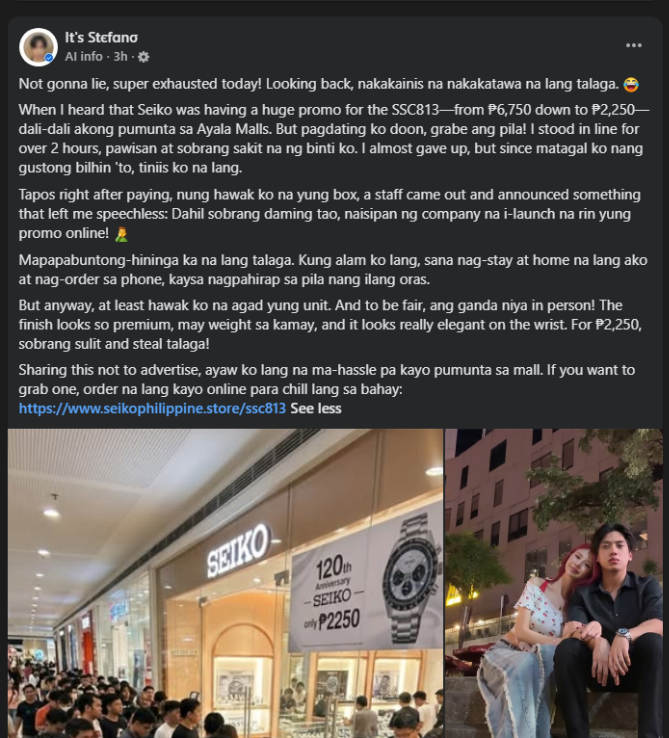
Preserved sponsored Facebook post reviewed on August 6, 2026. The permalink identifies advertiser Page ID 61593228050356, and the lookalike destination is visible in the post.
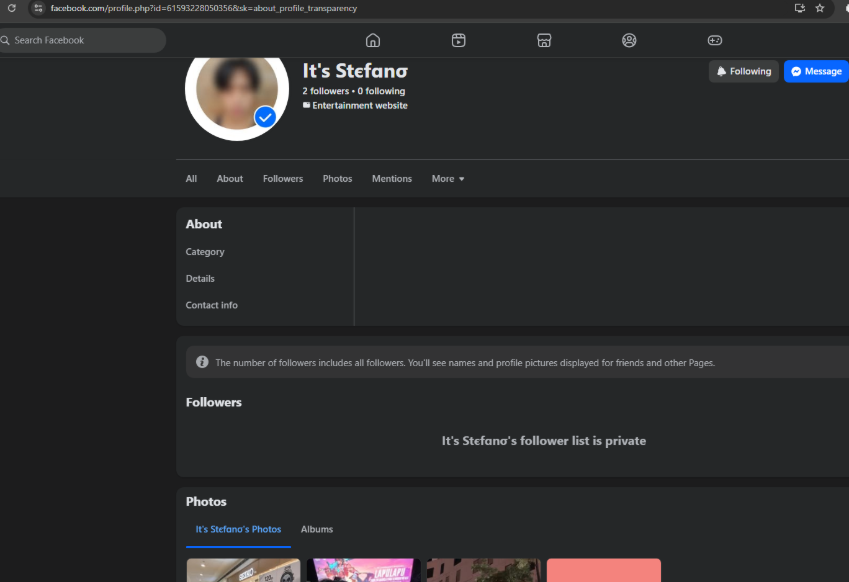
Directly requesting the Page Transparency route returned the standard About view. The Page ID and requested route are visible, but no creation date, former names, or management locations appeared in the captured public view. No conclusion about account verification is drawn from the profile-photo overlay.

Destination address and imitated Seiko header. The retained fbclid parameter is consistent with a Facebook-originated click; it does not identify the operator.
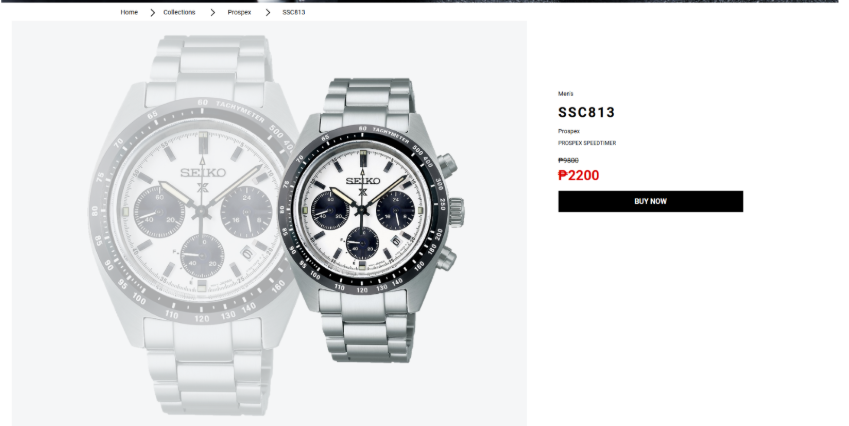
Product offer on the lookalike storefront: PHP 9,900 reduced to PHP 2,200. The sale price differs from the PHP 2,250 amount in the Facebook post.
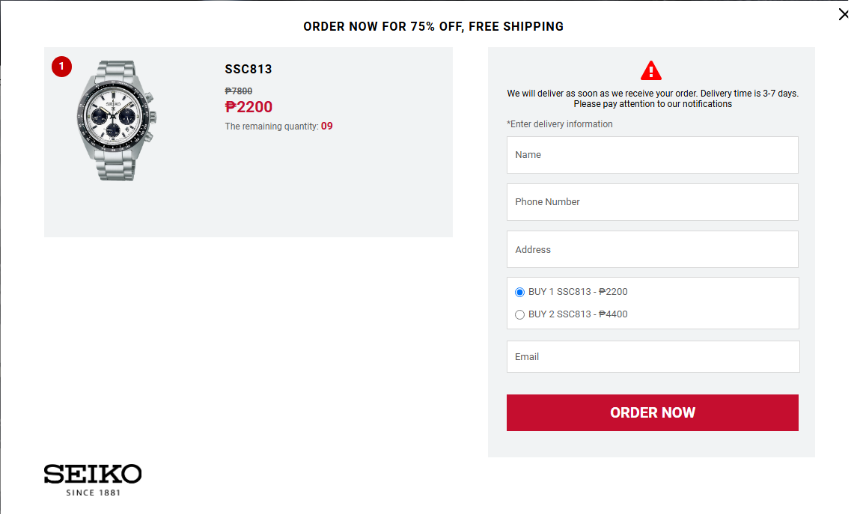
Order form soliciting contact, address, and order information. No form was submitted, no payment flow was completed, and no pop-ups were observed during the documented review.
Case Evidence at a Glance
| Evidence point | What I observed | Security assessment |
|---|---|---|
| Social identity | Sponsored Page displayed as “It’s Stefano”; permalink identifies Page ID 61593228050356 | The established creator Page uses the name “It’sStefano” and the handle itsstefanooo. A display-name difference is only a clue; the handle, Page history, established audience, and corroborating posts are stronger identifiers. |
| Public Page details | “Entertainment website” category and a very small follower base; the direct Page Transparency route returned the ordinary About view | No creation date, previous names, or management locations were visible in the captured public view. Those facts remain unknown and should not be inferred. |
| Retail destination | seikophilippine[.]store; the observed URL retained an fbclid parameter | Seiko Philippines’ official online boutique uses shop.seikoboutique.com.ph. The domains are materially different. The tracking parameter supports the click path, not operator attribution. |
| Brand identity | Seiko logo, navigation, product presentation, and SSC813 imagery | The page imitated the visual language of a legitimate retailer, but I found no verified relationship between the lookalike domain and Seiko Philippines. |
| Product price | Facebook post: PHP 2,250. Product page and order form: PHP 2,200 | The official SSC813P1 listing displayed PHP 39,099 when reviewed. The advertised amounts were approximately 94% below the official price. |
| Discount arithmetic | PHP 6,750 to PHP 2,250; PHP 9,900 to PHP 2,200; PHP 7,800 to PHP 2,200 while claiming 75% off | The actual reductions are 66.7%, 77.8%, and 71.8%. The shifting reference prices and incorrect percentage materially weaken the offer’s credibility. |
| Domain record | Registrar RDAP shows seikophilippine.store was registered July 16, 2026 through Spaceship, Inc.; registrant fields were privacy-redacted | Recent registration and brand similarity are risk indicators, not proof by themselves. They become significant when combined with the copied endorsement, unauthorized branding, and contradictory offer. |
| Data solicitation | Order form requests name, phone number, address, email address, and quantity | This proves that the page solicited personal and order information. It does not prove that anyone submitted the form or that the operator received, stored, or used the data. |
| Social proof | Positive comments and watch photographs appeared beneath the advertisement | The identities, purchases, and relationships of the commenters could not be independently validated from the preserved material. In-ad comments are not independent verification. |
Evidence note: Researcher observations and public references were reviewed on August 6, 2026. The registrar’s RDAP record is the primary registration source. Unavailable Page Transparency fields are recorded as unknown and are not inferred from other Page details.
The Philippine setting is specific to this sample, but the mechanics are portable. The same template can substitute another creator, retailer, product, language, mall, or country without changing the underlying attack chain.
What the Evidence Establishes—and What It Does Not
Strong threat reporting separates direct observation from inference. In this case, the preserved material establishes that:
- A sponsored Facebook post used a Page presented as “It’s Stefano” and linked to a lookalike Seiko-themed domain.
- The destination imitated a Seiko product page and used the real SSC813 model designation and imagery.
- Prices changed between the post, product page, and order form, and the stated discount did not match the displayed arithmetic.
- The order form solicited personal contact, delivery, and order information.
- The domain was recently registered relative to the review date and was not the official Seiko Philippines online boutique domain.
- No corroborating promotion was found through the established creator or official retailer channels reviewed.
The same material does not establish who operated the Page or domain, how many users saw the advertisement, whether anyone submitted information or paid, what happened after submission, whether a product was delivered, whether any delivered item was counterfeit, or whether malware was involved.
Those limits do not make the observable conduct harmless. Copied identity, deceptive endorsement, brand imitation, lookalike infrastructure, contradictory pricing, and personal-data solicitation are independently actionable risk indicators.
How to Detect a Fake Influencer Ad or Retail Store
No single warning sign proves fraud. Risk becomes material when several indicators appear together.
- Verify the account outside the ad. Search for the creator or retailer independently. Compare the exact handle, established posting history, audience, website links, and recent promotions.
- Inspect the full domain. Added words, missing letters, singular or plural changes, hyphens, and unexpected top-level domains can create a convincing near-match.
- Compare the exact product reference. Check the model number, description, price, warranty, authorized seller, and availability on the official site.
- Recalculate the discount. Contradictory reference prices or incorrect percentages are strong signs that urgency is being manufactured.
- Check Page history when available. Page creation date, previous names, and management locations can help, but unavailable transparency data should be recorded as unknown rather than guessed.
- Treat comments as part of the advertisement. Reactions, testimonials, and buyer photographs may be manipulated, copied, or coordinated.
- Look for a verifiable business identity. Confirm the legal seller, returns policy, warranty, address, and customer-service channel through an independent source.
- Be cautious with data requests. A simple order form can collect enough information for follow-up scams even before payment is requested.
- Do not equate “Sponsored” with “verified.” Paid distribution confirms that an advertisement was placed; it is not a guarantee that the endorsement, seller, product, or destination is legitimate.
Verification should happen outside the advertisement. Type the official domain manually, open the established social account directly, and contact the business through information obtained from its verified website.
Response Playbook for Retailers, Creators, and Client Security Teams
Preserve the Full Funnel
Capture the complete advertisement, permalink, Page ID, Page URL, available Page history, ad-library entry, destination URL, redirects, landing pages, order forms, checkout pages, payment instructions, DNS and RDAP data, and timestamps. Preserve both full-page screenshots and small details such as the address bar.
Do not interact more than necessary. Avoid submitting forms, entering credentials, completing payments, downloading files, or testing from an environment that exposes real personal or corporate information.
Validate the Claimed Relationship
Confirm the promotion with the named creator, retailer, brand, marketing team, and authorized dealer. Check official accounts and domains independently. Record who confirmed or denied authorization and when.
Classify Only What the Evidence Supports
Use precise labels such as social media impersonation, deceptive endorsement, brand abuse, lookalike domain, suspected fraudulent commerce, personal-data solicitation, credential collection, malware, counterfeit offer, or non-delivery only when the available evidence supports them.
Avoid collapsing every suspicious store into “phishing” or “malware.” Accurate classification improves takedown requests, internal escalation, customer guidance, and later correlation.
Disrupt in Parallel
- Report the Page, profile, post, and advertisement to the social platform.
- Send an evidence package to the domain registrar, hosting provider, content delivery provider, and form or storefront service.
- Notify payment processors, merchant acquirers, banks, wallets, or marketplaces when payment indicators are present.
- Alert the affected creator and retailer so their public guidance is consistent.
- Consider search-engine, browser, and threat-intelligence submissions when provider requirements are met.
Parallel reporting matters because one provider may disable only one component. A removed Page does not automatically disable the domain, and a suspended domain does not remove copied Pages or advertisements.
Communicate Clearly
Publish the official accounts, domains, authorized sellers, promotion terms, accepted payment methods, and reporting channels in one stable location. Customer-service teams should have a short response script and a path to escalate suspected victims.
Creators should state which partnerships are genuine and whether followers should ever expect direct messages, payment requests, giveaways, or purchase links. Retailers should explain how users can confirm a campaign before buying.
Measure Recurrence
Track time to detect, time to validate, time to disrupt, estimated exposure, victim reports, reused images, repeated Page names, recurring domains, hosting patterns, payment indicators, and relaunches. The goal is not only to remove one page but to identify the repeatable infrastructure and content patterns behind the campaign.
What Users Should Do After Interacting With a Suspicious Offer
If you only viewed the post or page, close it and report the advertisement and Page. Do not return through the same link. Locate the legitimate creator and retailer independently and warn them using their official channels.
If you submitted contact or delivery information:
- Expect targeted calls, text messages, emails, or delivery-themed follow-up scams.
- Be suspicious of anyone who references the product, order, or address to create credibility.
- Do not share one-time passwords, verification codes, account credentials, or additional identity documents.
- Preserve screenshots, URLs, messages, receipts, and timestamps.
If you entered account credentials, change the affected password immediately, replace reused passwords, enable multifactor authentication, and review active sessions and recovery details.
If you paid or entered card information, contact the bank, card issuer, wallet provider, or payment service immediately. Ask about blocking the transaction, replacing the card, monitoring the account, and preserving a fraud report. Report the incident through the relevant national cybercrime or consumer-protection channel. In the Philippines, the government promotes hotline 1326 for cybercrime reports and assistance.
Frequently Asked Questions
Q1. How can I tell whether an influencer advertisement is fake?
Ans: Open the creator’s established profile independently and look for the same promotion. Compare the exact handle, account history, official website link, and partnership disclosures. A familiar photo and display name are easy to copy; corroboration from the established account is much harder to fake.
Q2. Does a “Sponsored” label mean the seller was verified?
Ans: No. “Sponsored” means the content was distributed as paid advertising. It should not be treated as confirmation that the endorsement, seller, product, discount, landing page, or payment route is legitimate.
Q3. Is a familiar brand name in the web address enough?
Ans: No. Lookalike domains often add or remove a word, letter, hyphen, or plural ending. Verify the domain through the brand’s established social Page, official packaging, previous receipts, or independently located website.
Q4. Can a campaign be harmful if it shows no malware or pop-ups?
Ans: Yes. A clean-looking page can still impersonate a brand, collect personal information, redirect payments, sell counterfeit goods, or support non-delivery fraud. Absence of malware does not establish legitimacy.
Q5. What if Facebook Page Transparency information is unavailable?
Ans: Record that it was unavailable and rely on other evidence: Page ID, exact handle, posting history, follower base, official links, destination domain, corroborating promotions, and confirmation from the named parties. Do not invent a creation date, former name, or management location.
Q6. Why are retailers and influencers both victims?
Ans: The attacker borrows the creator’s relationship with the audience and the retailer’s commercial reputation. Victims may then blame either party for a transaction neither authorized. Both inherit reputational damage, support work, and the need to investigate and remove copied assets.
Final Assessment
Influencer-retail impersonation is best understood as a trust-composition attack. The campaign does not rely on one perfect fake. It assembles several believable fragments—a known face, a real product, a familiar store, a local story, visible comments, a sponsored placement, and a polished order form—until the combined experience feels legitimate.
The defensive answer is equally compositional. Users must verify the creator, seller, domain, product, price, and payment route as separate facts. Retailers and creators must monitor and respond together. Security teams must preserve and disrupt the entire funnel, not only the post that first attracted attention.
In the documented Philippine case, the evidence supports a coordinated impersonation and unauthorized commerce assessment. It does not support claims about operator identity, completed fraud, delivery, counterfeit fulfillment, or malware. That distinction is not caution for its own sake; it is what makes threat research credible, reusable, and defensible.
About the author: Michael Jonathan Andres leads security operations and writes about digital risk, fraud, impersonation, and brand abuse. This article is based on his direct review of the preserved campaign evidence and verified public references.
References
Federal Trade Commission. (2026, April). Reported losses to scams on social media are eight times higher than in 2020. https://www.ftc.gov/news-events/data-visualizations/data-spotlight/2026/04/reported-losses-scams-social-media-eight-times-higher-2020
It’sStefano. (n.d.). It’sStefano [Facebook Page]. Facebook. Retrieved August 6, 2026, from https://www.facebook.com/itsstefanooo/
iZOOlogic. (2019, June 7). Social media impersonation: A threat to privacy. https://izoologic.com/financial-malware/social-media-impersonation-threat-to-privacy/
Martinez, O. (2026). Optimizing visibility in generative search: A critical survey of generative engine optimization [Preprint]. arXiv. https://arxiv.org/abs/2607.14035
Meta. (2026, February 26). Meta takes legal action against scam advertisers. https://about.fb.com/news/2026/02/meta-takes-legal-action-against-scam-advertisers/
Philippine Information Agency. (2026, July 2). DICT Caraga reminds public: Report online shopping scam to hotline 1326. https://pia.gov.ph/news/dict-caraga-reminds-public-report-online-shopping-scam-to-hotline-1326/
Seiko Philippines. (n.d.-a). Seiko Philippines [Facebook Page]. Facebook. Retrieved August 6, 2026, from https://www.facebook.com/official.seikophilippines/
Seiko Philippines. (n.d.-b). Prospex SSC813P1. Retrieved August 6, 2026, from https://shop.seikoboutique.com.ph/products/prospex-ssc813p1
Spaceship, Inc. (2026). RDAP record for seikophilippine.store. Retrieved August 6, 2026, from https://rdap.spaceship.com/domain/seikophilippine.store
