
 HQ/EMEAFind out how we can help your business


Overview
A previously unrecorded extortion brand calling itself Vexy Ransomware began publishing victim listings in early September 2026. As of 7 September 2026, its data leak site names eight organisations across six countries, with claimed data volumes ranging from 100 MB to roughly 47 GB, totalling approximately 144 GB, and countdown timers of approximately 12 to 19 days before threatened publication.
Every substantive assertion about these incidents rests on the actor’s own leak site. Multiple threat intelligence trackers have recorded the listings, but that corroboration establishes only that the posts exist. It does not establish that any of the named organisations were compromised, that data was exfiltrated, or that the volumes claimed are accurate. No named victim has confirmed, denied, or otherwise responded publicly at the time of writing, and no regulatory notification tied to these claims has been identified.
For banking and financial services readers, direct exposure is currently none. No financial institution appears on the site. The relevant exposure is indirect: the victim set skews toward small and mid-sized IT services, software development, and hosting providers, which is the supplier tier that many financial institutions rely on for peripheral services and which frequently sits outside tier-one vendor monitoring. The practical question for a bank is not whether Vexy has attacked it, but whether any of these named suppliers appears in its own third-party inventory.
Incident Metadata
| Field | Details |
|---|---|
| Threat actor | Vexy Ransomware |
| Claimed victims | Eight organisations across six countries |
| Sectors claimed | Retail and e-commerce, manufacturing, technology, transportation, hospitality, real estate |
| Countries claimed | India, Brazil, Argentina, Mexico, United States, Ecuador |
| Activity window | 2 to 7 September 2026. Leak site first recorded by public trackers on 3 September 2026 |
| Claim status | Unverified. All victim assertions originate from the actor’s own leak site |
| Financial sector exposure | None claimed to date |
| Status | Active. No victim confirmation, denial, or regulatory filing identified |
| Assessment | Moderate confidence that Vexy is a genuine but immature extortion operation. Low confidence in the accuracy of individual claimed data volumes |
Observed Activity
Between 2 and 7 September 2026, a Tor-hosted leak site branded Vexy Ransomware published listings for eight organizations. The site presents a public landing page with victim cards showing organization name, corporate website, a claimed data volume, a short business description, a publication timestamp, and a countdown timer. Access to any underlying material is gated behind login and registration controls, so the claimed datasets are not publicly downloadable or inspectable.
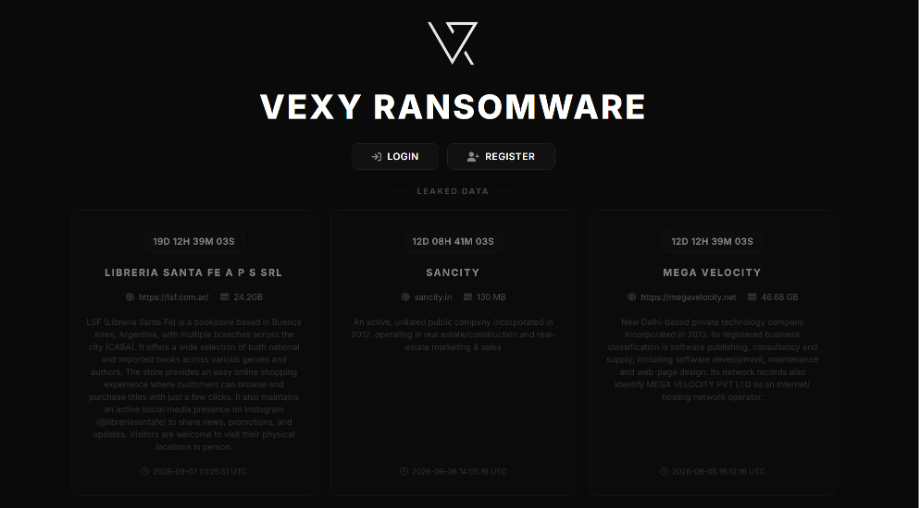
Vexy Ransomware leak site landing page, captured 7 September 2026. Three of the eight listings are shown with claimed data volumes and countdown timers. The site’s Tor address is recorded in the indicators section.
The claimed victims recorded to date are as follows. Every entry is an unverified actor claim.
| Claimed victim | Country | Sector | Claimed volume | Listed |
|---|---|---|---|---|
| Engefitas | Brazil | Manufacturing (tapes) | 27.25 GB | 3 Sep 2026 |
| McDonald’s Ecuador | Ecuador | Hospitality (franchise) | 42.08 GB | 3 Sep 2026 |
| Palsana Enviro (PEPL) | India | Manufacturing (effluent) | 220 MB | 4 Sep 2026 |
| Annapurna Fashion | India | Retail (textiles) | 3.48 GB | 4 Sep 2026 |
| Sancity Soft Touch | United States | Technology (IT services) | 100 MB | 4 Sep 2026 |
| Mega Velocity | Mexico (see note) | Transportation (see note) | 46.68 GB | 5 Sep 2026 |
| Sancity | India | Real estate | 130 MB | 6 Sep 2026 |
| Libreria Santa Fe A P S SRL | Argentina | Retail (bookseller) | 24.2 GB | 7 Sep 2026 |
Two observations on the data itself. The Mega Velocity entry is tagged to Mexico and the transportation sector by at least one tracker, while the accompanying business description and independent reporting both identify a New Delhi software publishing and hosting company. The country and sector tags therefore appear unreliable and should not be used for geographic trend analysis without verification. Separately, two listings share the Sancity name against different domains and different described lines of business, which may indicate related entities, a shared IT provider, or a listing error.
No initial access vector, malware family, encryption behaviour, lateral movement path, or ransom demand has been published for any of the eight claims. No leak site screenshots or file trees accompany the listings. The absence of this material is itself a finding: it means there is currently no basis on which to assess whether Vexy operates its own encryptor, deploys a third-party one, or exfiltrates data without encrypting at all.
Timeline of Events
| Date (2026) | Event |
|---|---|
| 2 September | Estimated attack date associated with the first claimed victim |
| 3 September | Leak site first recorded by public trackers. Engefitas and McDonald’s Ecuador listed |
| 4 September | Palsana Enviro, Annapurna Fashion, and Sancity Soft Touch listed |
| 5 September | Mega Velocity listed |
| 6 September | Sancity listed |
| 7 September | Libreria Santa Fe listed. Victim count reaches eight |
| Mid to late September | Earliest countdown expiries fall due |
Data Exposure Analysis
All eight listings carry a claimed volume, stated as an aggregate size with no description of record types, no field-level detail, and no published samples. Nothing in the available material indicates whether the claimed datasets contain personal data, credentials, financial records, or routine corporate files. At least one commercial tracker has characterised a Vexy listing as referencing an exposed password field, but this is not visible in the primary material reviewed and is treated here as unverified.
The claimed volumes are widely dispersed. Four listings sit above 3 GB, led by Mega Velocity at 46.68 GB and McDonald’s Ecuador at 42.08 GB, while three fall below 250 MB. Volumes in the 100 to 220 MB range are difficult to reconcile with network-wide exfiltration from a compromised enterprise and are more consistent with narrow access, for example a single file share, a web root, or a database export. Whether this reflects genuine variation in access depth, selective staging, or padding of the larger figures cannot be determined from the listings alone.
Countdown timers of roughly 12 to 19 days from listing suggest an intended first publication window falling in the second half of September 2026. Whether Vexy follows through on those deadlines is the single most informative data point available in the near term and has not yet been tested.
Indicators of Compromise
Three indicators and one server fingerprint have been published. No file hashes, IP addresses, or malware samples have been released at the time of writing.
| Type | Indicator |
|---|---|
| Bitcoin address | bc1qqvgke5qyuqu852587gxtz5pwthpn4tmzwckgvf |
| Tox ID (actor contact) | C32355C829A3CC4B320D4E78634FB4113B4B2918B383BB7AEAA48BDAAA4A0 146E99B45A2A4C9 |
| Leak site (Tor hidden service) | vexytsr3chimdz6siwaqi2lvxxwfkxvffkpwyanr2llequ2hkm56jvqd.onion |
| Server banner | Apache 2.4.68 (Debian) |
Threat Actor Profile
| Attribute | Assessment |
|---|---|
| Aliases | Vexy Ransomware, VEXY, Vexy |
| First observed | September 2026 |
| Motivation | Financial. Direct extortion with threatened data publication |
| Model | Publicly characterised by at least one vendor tracker as a data broker style operation using direct and double extortion. Not independently confirmed |
| Victimology | Small and mid-sized private enterprises. Heaviest concentration in India, with single victims across Latin America and the United States. No large enterprise, government, or financial sector targets claimed |
| Infrastructure | A single Tor-hosted leak site served from a Debian Apache stack, with registration-gated access. One Tox handle published for contact. No mirrors, dedicated negotiation portal, or affiliate panel observed |
| Tooling | No ransomware family, loader, or tooling attributed |
| Claim reliability | No track record. The group has no history against which its claims can be weighed |
Two points warrant care. First, there is no evidence that Vexy is a rebrand of, or affiliated with, any established operation. Second, analysts should avoid conflating Vexy with Vect, an unrelated ransomware as a service operation that emerged in late 2025 and has been the subject of published affiliate panel and encryptor research. The names are close enough to cause collisions in keyword-driven tooling and automated feeds, and the two have entirely separate infrastructure and reporting histories.
Analyst Assessment
The operation appears genuine rather than fabricated, at moderate confidence. The listing cadence is consistent, victim descriptions are specific and match real registered companies, domains resolve, and the volumes claimed vary plausibly rather than following a template. A pure fabrication or resale front typically shows more uniformity than this.
Individual claims should be treated as unproven, at low confidence in their accuracy. No samples, screenshots, or file listings have been published for any victim. Registration gating means the claimed datasets cannot be independently inspected, which conveniently removes the usual mechanism by which a new group’s claims are falsified. New brands have a documented incentive to inflate volumes and to recycle data obtained from other sources during their first weeks of operation, and nothing currently available rules that out here.
The likeliest access pattern is opportunistic rather than targeted, at low confidence. The victim set has no coherent sectoral or geographic logic, spanning a bookseller, an effluent treatment plant, a textile exporter, a fast food franchisee, and several small IT firms. Roughly half the claimed victim domains have associated infostealer credential exposure according to one tracker, which is consistent with credential-driven opportunistic access but falls well short of demonstrating it.
What is conspicuously missing. There is no ransom note, no encryptor sample, no named malware family, no negotiation portal, no affiliate recruitment advertisement, and no claim of encryption as distinct from theft. A group operating a genuine locker usually surfaces at least one of these within its first week. The absence is compatible with either an exfiltration-only extortion operation or an immature group that has not yet published its tooling.
MITRE ATT&CK mapping and kill chain analysis are omitted. No technique can be supported by evidence from these incidents, and Vexy has no documented tradecraft history from which techniques could be inferred. A speculative mapping would misrepresent the evidence base.
What would change this assessment. Publication of a victim dataset at the stated deadlines, a recovered ransom note or encryptor sample, a public denial by any named organisation, or a regulatory filing by a claimed victim. Any of these would materially move confidence in either direction.
Recommendations
Prioritised for financial institutions. The first two address the exposure this case actually creates.
- Check the eight named organizations against your third-party inventory, including fourth party and subcontractor relationships. The IT services and software development firms in this list are the entries most likely to hold institutional data or maintain access into customer environments.
- Do not escalate on the listing alone. Treat any supplier’s appearance as a validation trigger, not an incident. Request written confirmation from the supplier and record the claim status accurately in vendor risk systems so that an unverified listing does not propagate as a confirmed breach.
- Add the published Bitcoin address to transaction monitoring and sanctions screening reference data. It is the only financially actionable indicator currently available and is relevant to payment screening obligations if a customer or counterparty transacts with it.
- Set a monitoring checkpoint for the second half of September 2026. Whether Vexy publishes at its stated deadlines is the key test of the group’s credibility and should be revisited before any assessment here is relied upon.
- Prioritise credential hygiene at the supplier boundary, specifically enforced MFA on all vendor and contractor remote access, and infostealer log monitoring for corporate domains belonging to your suppliers. This is directionally supported by the infostealer overlap observed across the claimed victim set, though not proven as the access vector.
- Ensure your own leak site monitoring covers registration-gated sites. Vexy’s access controls mean automated scraping alone will miss dataset contents, and a listing may be the only signal available until publication.
The information provided in this article is based on publicly available open-source intelligence (OSINT). It is intended for awareness and defensive cybersecurity purposes only.
