
 HQ/EMEAFind out how we can help your business


Executive summary
A phishing kit targeting customers of a major Mongolian bank has been recovered and analysed from a live sample. It is not a static credential-harvesting form. The delivered page is an operator console: it polls the attacker’s server every two seconds and reveals additional capture fields a one-time SMS passcode, a card or transaction PIN, and a free-text prompt whose wording the attacker supplies whenever the operator instructs it to.
The infrastructure hides in a way that defeats conventional scanning. The web root of each domain serves a plausible, working business website; the phishing kit sits one path segment deeper. Automated checks that inspect only the front page return a clean verdict on both HTTP status and page content.
The operational consequence is direct. SMS-delivered one-time codes do not protect a customer against this page. The capture field is already present in the delivered markup; only an operator action is needed to display it. Institutions relying on SMS as a second factor should treat that control as bypassable for the duration of this activity.
This report analyses the delivered code. Live phishing addresses, the confirmed domain set and the impersonated institutions are deliberately withheld; see *Scope and evidence handling*.
Key findings
- The page is remote-controlled in real time. After credentials are submitted the page polls the attacker’s backend every two seconds and executes whatever instruction it receives. This is a live session, not a stored form.
- Second-factor capture ships with every copy of the page. Input groups for an SMS one-time code, a PIN and an arbitrary operator-authored prompt are present in the markup of every delivered page, hidden by a single CSS rule.
- A transaction PIN field is present, not only a login form. The kit is built to complete payment authorisation, not merely to collect a password.
- Concealment is by substitution, not absence. The domain root returns a working decoy corporate website, so the domain scores clean on content inspection as well as on status-code checks.
- Failed logins are harvested, not discarded. A rejected instruction clears the username and password fields and re-displays the form with an error, so the customer retypes their credentials believing they mistyped.
- The operation is run as a monetised traffic campaign. Submitted data carries affiliate-style attribution fields, and a social-advertising conversion event fires at the moment credentials are accepted.
- One kit, several targets. The same build serves clones of banks in more than one country, with the URL path selecting which brand is presented. An advisory addressing a single brand leaves the others exposed.
Concealment: what the domain root serves
The defining tradecraft of this activity is where the kit is placed. The phishing page is never served at the web root. It sits one path segment deeper, and the root is used to make the domain look ordinary.
Most domains in the cluster return a complete, working corporate website at the root an invented property firm, advisory practice or contracting business, with navigation, imagery and a cookie banner. Because that page returns HTTP 200 with genuine-looking content, the domain passes both status-code heuristics and root-page content matching. A scanner that inspects only the front page cannot distinguish these domains from legitimate small-business sites.
A minority of domains expose the mechanism through a deployment fault. Their root returns a single line:
document.open();document.write(“);document.close();
This is the kit’s page-blanking routine. Executed in a browser it would clear the document and leave a blank page, suppressing anything a casual visitor or scanner might inspect. On these hosts it was deployed without an enclosing (script) element, so the browser never executes it and renders the source as visible text instead the concealment mechanism printing its own instructions.

A domain front page printing the kit’s page-blanking script as visible text rather than executing it. A broken deployment, and an unambiguous indicator.
Analytically the fault is valuable. The response is a fixed 52-byte body with a constant SHA-256, identical across unrelated hosts. No legitimate site serves it. It is both a zero-false-positive body signature and direct evidence of automated deployment from a single build.
The practical consequence for defenders is that root-level inspection cannot see this campaign at all. Candidate domains must be probed at the concealed path and judged on the content returned, not on what the front page shows.
The cloned login page
The page served at the concealed path is a close reproduction of the genuine internet banking login: correct brand mark, corporate palette, Mongolian field labelling, a language selector offering three languages, and a working link to the corporate banking portal. It would not be distinguished from the real interface by a customer or by branch staff.
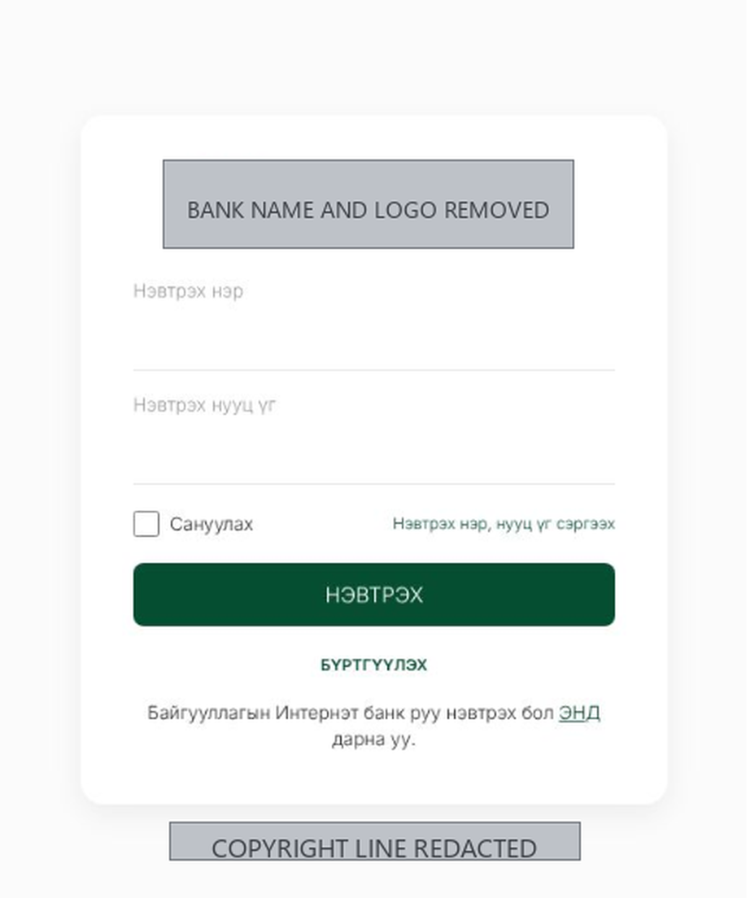
Cloned internet banking login page served at the concealed path. Brand mark and institution name removed; palette, field order and Mongolian labelling are exact copies of the genuine page.
Two behaviours are visible from use alone. The page validates nothing any string is accepted in either field and forwarded to the collector. And a successful submission does not complete: the page enters a loading state that never resolves.
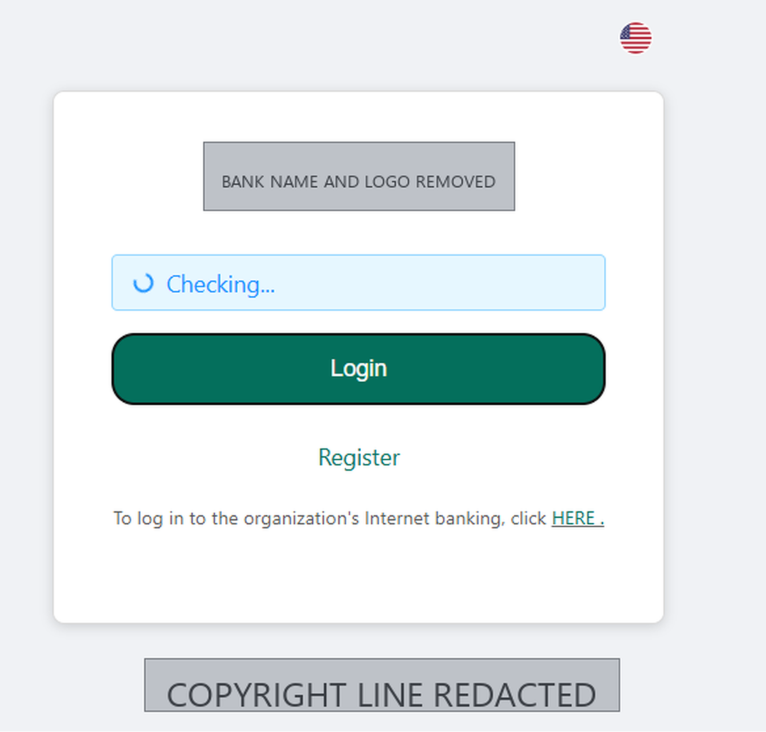
The state after submission. The message does not resolve. This is the page polling for operator instructions. Brand mark and institution name removed.
That unresolving state is not a fault. It is the point at which control of the page passes to the attacker.
The groups themselves are fully constructed labelled, styled and validated and differ only in that the hidden class is applied:
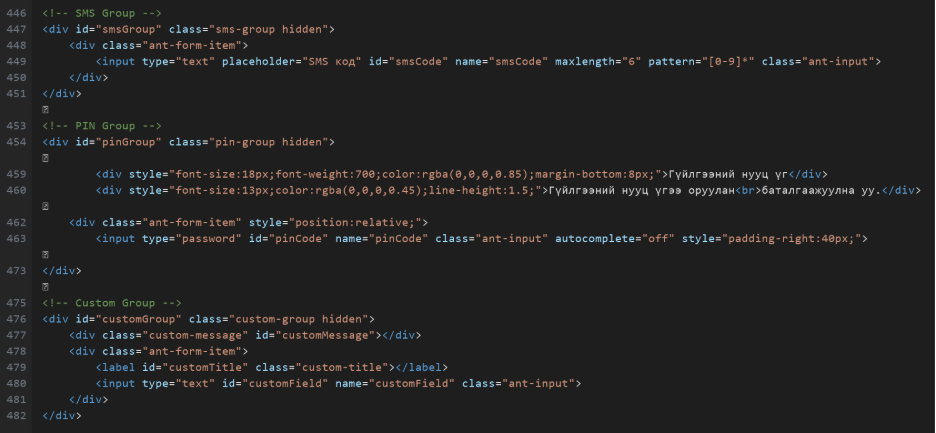
The three hidden capture groups as delivered to every visitor. Inline icon markup omitted at the marked gaps; nothing else altered.
The SMS field is constrained to six numeric characters, matching the format of the genuine institution’s one-time codes it was built for this target, not adapted generically. The PIN field is a masked input beneath the Mongolian heading *Güilgeenii nuuts üg* (“transaction password”), which is the credential that authorises a payment rather than the one that opens an account view. And the custom group carries no fixed text at all: its heading, message and placeholder are empty in the delivered page and populated at runtime from the attacker’s response.
The polling loop
Once credentials are accepted, the page opens a two-second polling loop against the attacker’s backend:
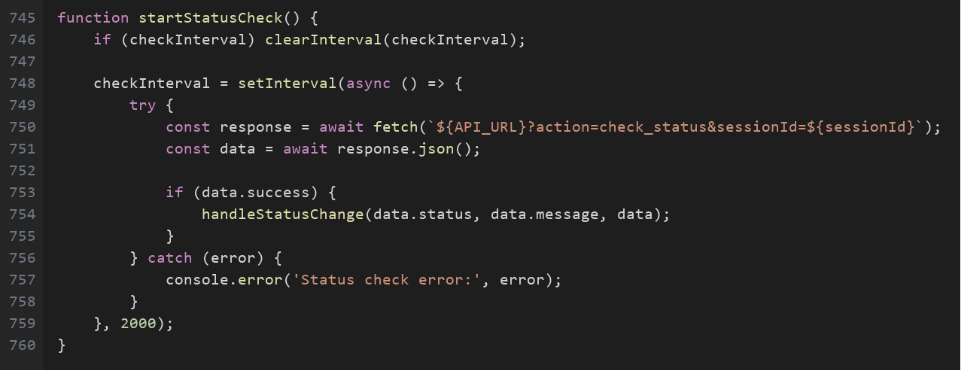
The two-second polling loop. The session identifier is issued by the collector when credentials are accepted, so each victim is individually addressable.
The session identifier is issued by the collector when credentials are accepted, so each victim is individually addressable. The loading state the customer sees is this loop running.
The command handler
The handler below acts on each instruction returned by the server. Three of its cases are reproduced; the command names and element identifiers are the kit’s own.
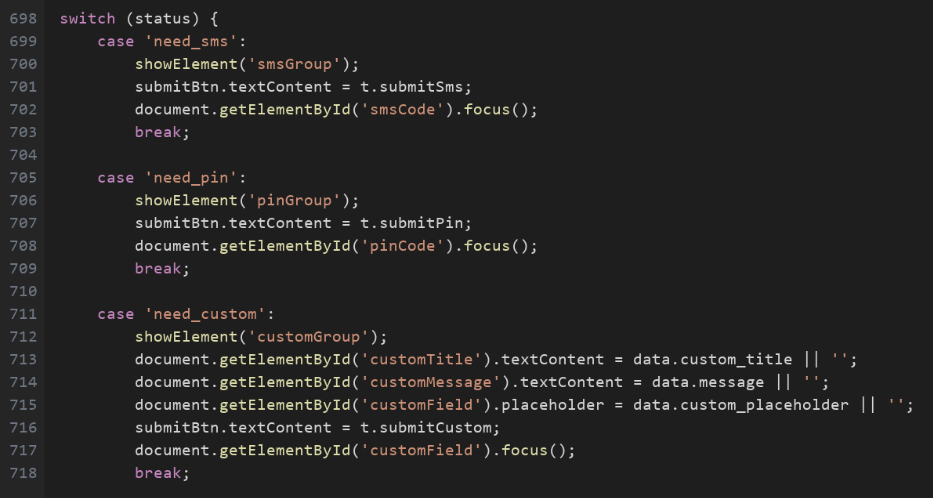
The command handler. Three of its cases are shown; the command names and element identifiers are the kit’s own.
Three points follow directly from it. The fields are revealed, not created showElement only removes the hidden class from markup already delivered, so the capability ships with every copy of the page. The page places the cursor in each field as it appears and relabels the submit button to match, so the escalation is styled to feel like a normal step in the institution’s own login flow. And in the need_custom case the prompt text itself arrives from the attacker’s server, so the operator can ask for whatever the genuine service demands next a security question, a card number, a date of birth without touching the deployed page.
The remaining commands complete the picture: gmail_redirect forwards the customer to a further phishing step targeting their email account, and waiting holds the loading state, which is the default condition a victim is left in.
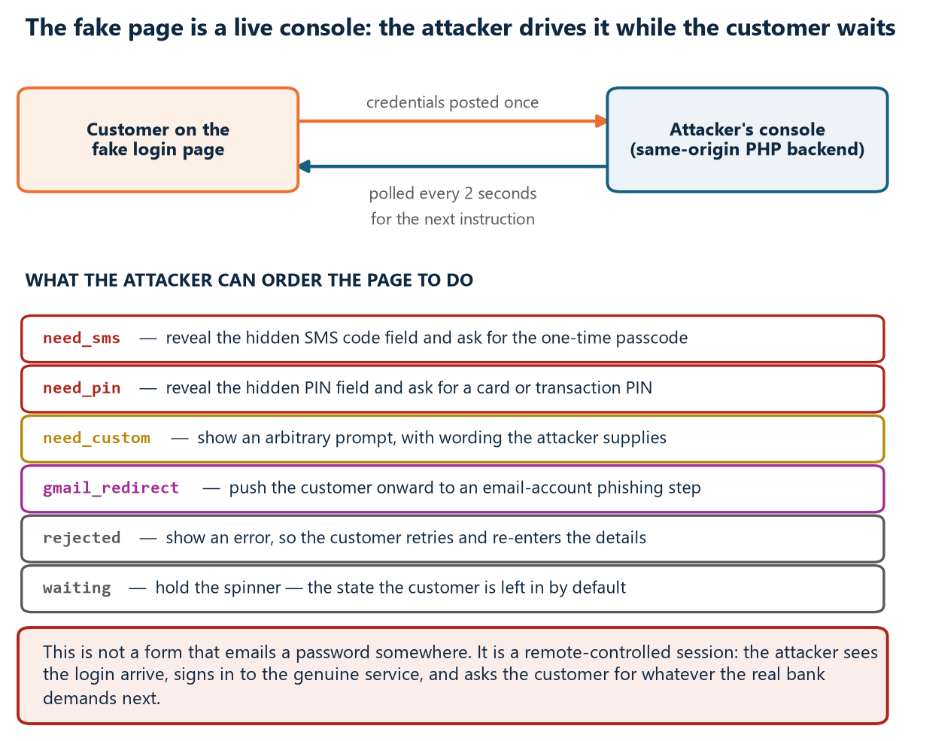
The page polls the attacker’s server every two seconds and acts on the command it receives. These are the commands the delivered code accepts.
Retry harvesting
A rejected instruction does not simply display an error:
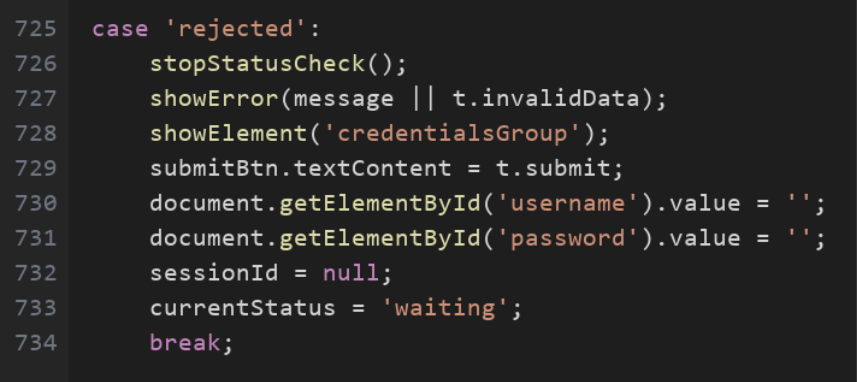
The rejected instruction. Both credential fields are cleared and the form re-displayed with an attacker-supplied error.
Both fields are cleared and the form is re-displayed with an error message the attacker controls. To the customer this is indistinguishable from a mistyped password, so they re-enter their credentials carefully. The operator obtains a second, more accurate attempt without raising suspicion and each attempt is posted to the collector independently.
Campaign attribution and monetisation
Each successful submission is posted to the collector with campaign metadata attached:
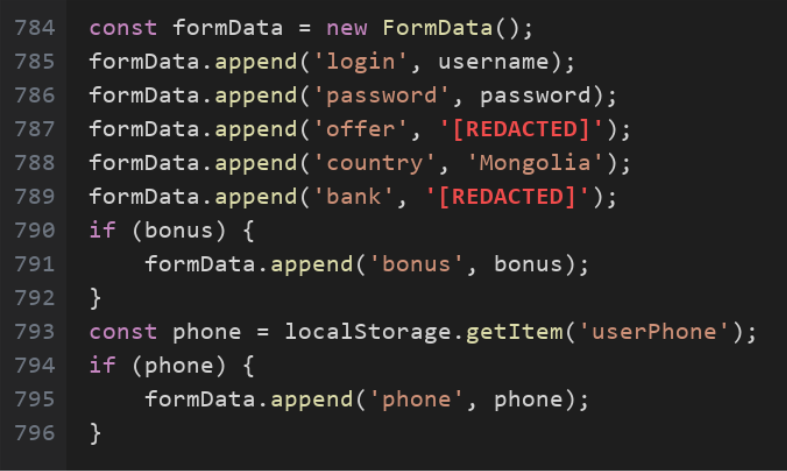
Campaign attribution submitted with every login. Two values carrying the impersonated brand are marked [REDACTED]; nothing else altered.
A separate call fires on every page load, before any interaction:

A visit counter fired on every page load, before any interaction.
The vocabulary is the finding. Offer and bonus are affiliate-marketing terms, not banking ones: an *offer* is a monetised campaign that traffic is driven to, and a *bonus* is a per-visitor attribution tag. Here offer, country and bank are hard-coded constants identifying which campaign this build serves, while bonus is read from the inbound URL and forwarded to the collector so links to the page are tagged per visitor and the tag is tracked through to conversion.
Separately, a social-advertising conversion event is fired at the exact moment the collector accepts a set of credentials, rather than on page load. Conversion instrumentation of that kind exists to optimise an advertising campaign and to report cost per result; it is only worth installing if traffic is being purchased. Taken with the affiliate vocabulary and the funnel counters, this supports paid social advertising as a delivery channel at moderate confidence. It does not evidence spend directly, and message-based delivery remains plausible: no lure message has been captured.
About iZOOlogic
iZOOlogic is a cyber security and threat intelligence organisation focused on helping businesses identify, disrupt and remediate digital risk including phishing, brand abuse, credential theft and online fraud. Intelligence is derived from continuous monitoring of the open, deep and dark web, certificate transparency, and attacker infrastructure.
