
 HQ/EMEAFind out how we can help your business

Executive summary
A financially motivated campaign has drained an estimated ₹300 crore from smaller Indian NBFCs since late summer 2026 by stealing payment API credentials and calling disbursal APIs directly. Around 150 complaints and FIRs have been filed, per The Economic Times (29 October 2026). No consolidated official loss figure has been published.
The tradecraft is confirmed by CERT-In and CSIRT-Fin in advisory CIAD-2026-0046 (9 October 2026, Critical). Attackers compromise internet-facing apps and APIs, harvest gateway and partner-bank credentials, and push IMPS/NEFT transfers to mule accounts from the victim’s own whitelisted servers. This bypasses KYC, sanction, beneficiary and limit checks entirely.
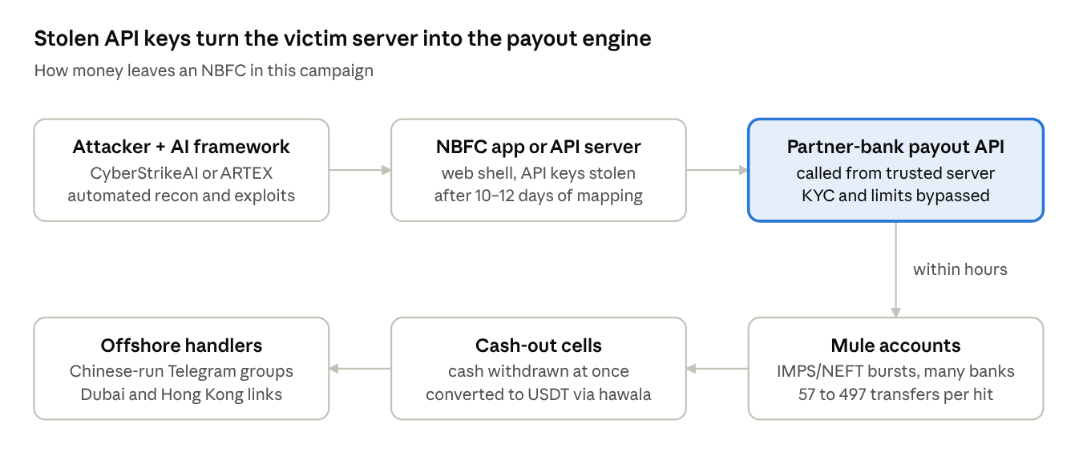
Campaign at a glance · per CERT-In CIAD-2026-0046 and Delhi Police disclosures
The attackers never break the bank’s gateway. They call it with stolen keys from the victim’s own trusted server, then launder the money through mules.
Key judgements
| # | Judgement | Confidence |
|---|---|---|
| 1 | A coordinated payment-API fraud campaign is targeting Indian NBFCs, digital lenders, PSPs and wallets. | High |
| 2 | Smaller NBFCs (turnover ≤ ₹1,000 crore) are the main victims because of weak API, secrets and MFA hygiene. | High |
| 3 | Open-source agentic pentest frameworks (CyberStrikeAI, ARTEX) paired with Chinese LLMs are being used to speed up intrusions. | Moderate |
| 4 | The Indian activity is run by the same operator behind the ARTEX attacks on South Korean banks and Japanese firms. | Low — no public infrastructure overlap yet |
| 5 | Stolen borrower data will fuel follow-on vishing (“Jamtara-style”) against NBFC customers. | Moderate |
The tools being Chinese-developed does not establish the attackers’ nationality or any state role. Treat every attribution claim in public reporting as provisional until IOCs are released.
Incident timeline
Indian payment-API thefts began by mid-September 2026 and accelerated in October, overlapping with ARTEX-driven intrusions in South Korea and Japan. Entries marked “sources say” come from media reporting and are not officially confirmed.
| Date (2026) | Country | Event |
|---|---|---|
| 29 Oct | India | ET reports ~₹300 crore lost by NBFCs in ~2 months, ~150 complaints/FIRs; agencies link completed probes to CyberStrike (Elets) |
| 27 Oct | India | Delhi Police IFSO discloses ₹3.93 crore theft from an unnamed NBFC; cash-out suspects from Rajasthan arrested (MoCA) |
| 26 Oct | South Korea | Seoul police say an ARTEX-assisted crew breached 90+ organisations and stole ~8.2 million records; leader arrested 15 Oct (Daily Security Review) |
| 19 Oct | Japan | GMO Cybersecurity confirms ARTEX on infrastructure targeting ~20 Japanese firms; six more AI attack servers found (Impress Watch) |
| 19 Oct | India | Hyderabad-based lender: ~₹3.34 crore, 183 transfers in under 90 minutes (sources say) |
| 15 Oct | India | CERT-In advisory CIAD-2026-0049 reportedly warns of open-source agentic attack tools cutting access-to-impact to hours (per media reports) |
| 9 Oct | India | CERT-In/CSIRT-Fin issue critical advisory CIAD-2026-0046 on payment and disbursal API abuse |
| 7 Oct | South Korea | CrowdStrike publishes ARTEX infrastructure analysis and IOCs (CrowdStrike) |
| 6 Oct | Global | AhnLab reportedly counts ~600 IPs hosting ARTEX instances worldwide (Yonhap) |
| 5 Oct | India | Unnamed NBFC loses ₹3.93 crore in 149 debits after server malware infection, around 11:00 |
| 2 Oct | India | Navi Mumbai-based firm: ₹1.98 crore, 57 transfers in 90 minutes, gateway bypassed without OTP (sources say) |
| Late Sep–early Oct | South Korea | Multiple banks breached, incl. a broker loan-inquiry service and an employee mobile system |
| 13 Sep | India | Noida-based payment-tech firm: ~₹2.42 crore, 497 API transactions to 58 accounts at 28 banks (sources say) |
| 31 Aug | South Korea | Korean suspect reportedly begins using ARTEX; 60 firms breached by 13 Oct |
One outlet (The420) puts the ₹300 crore over 18 months rather than two. Most coverage follows ET’s two-month framing.
Victimology
The Indian victims are mainly NBFCs with annual turnover of about ₹1,000 crore or less, plus payment-tech firms that hold partner-bank API access. Investigators cite gaps in security infrastructure, audit cycles and controls at these entities.
India — sector and geography
- Sectors: NBFCs, digital lenders, payment service providers, wallet operators, payout/API platforms (CERT-In scope).
- Complaints by city (ET via Elets): Mumbai ~30, Delhi 25+, Chennai 15–16, others elsewhere. Reported cases add Noida, Navi Mumbai and Hyderabad.
- Exposure base: 8,502 NBFCs registered with RBI as of 15 October 2026.
- Repeat victimisation: one Delhi NBFC lost ₹7.5 crore, then ₹7.25 crore days later. CERT-In says partly patched victims were re-hit within days.
Reported Indian incidents
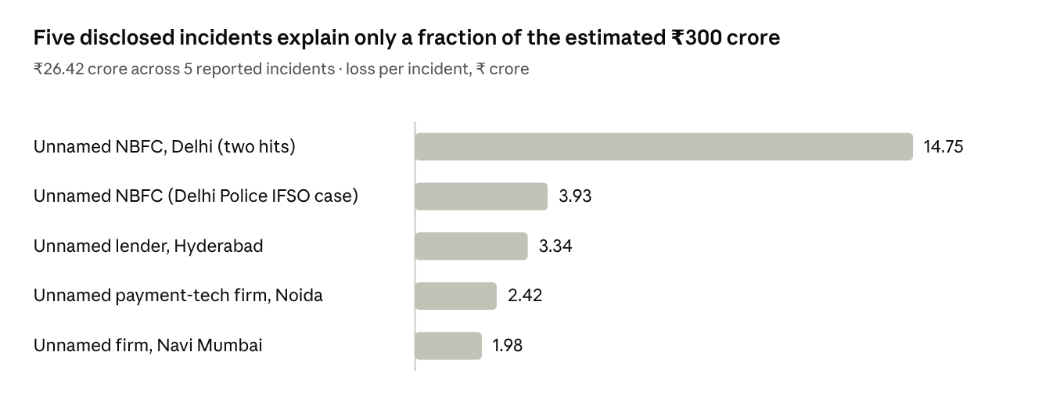
Police disclosures and media reports, Aug–Oct 2026 · amounts marked ~ in reporting are approximate
Publicly reported cases total under a tenth of the sector-wide estimate, so most affected lenders have not been named.
| Victim | City | Pattern |
|---|---|---|
| Unnamed NBFC | Delhi | Hit again within days of the first breach |
| Unnamed NBFC (Delhi Police IFSO case) | Not disclosed | 149 debits in one morning after server malware |
| Unnamed lender (media reports) | Hyderabad | 183 transfers in under 90 minutes |
| Unnamed payment-tech firm (media reports) | Noida | 497 API transactions to 58 accounts at 28 banks |
| Unnamed firm (media reports) | Navi Mumbai | 57 transfers in 90 minutes; gateway bypassed without OTP |
Regional pattern. The same tooling class hit South Korean financial institutions (loan-inquiry and employee mobile systems) and about 20 Japanese firms in retail, finance and logistics. Korean and Japanese intrusions centred on data theft and extortion. Indian intrusions centre on direct fund theft, a different monetisation path.
Attack chain and TTPs
The core trick is abusing trust, not breaking the gateway: once attackers hold valid partner-bank API credentials on a whitelisted server, the bank sees legitimate payout calls. Officials say operators spend 10–12 days mapping payment flows and whitelisted IDs before cashing out, then complete the theft in hours.
Kill chain (per CERT-In CIAD-2026-0046 and police disclosures)
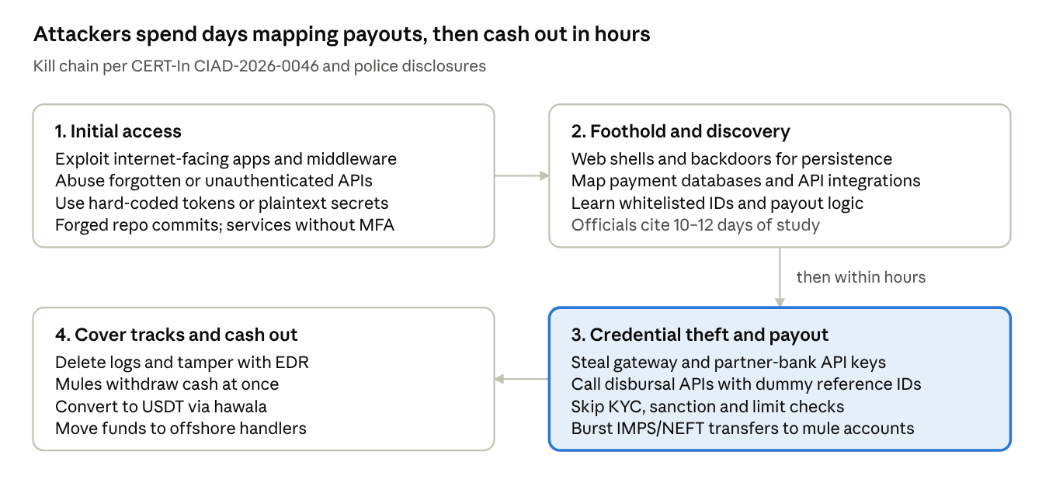
Kill chain · CERT-In CIAD-2026-0046, Delhi Police IFSO, ET
Stage 3 is where defenders can still stop the loss: a payout with no matching approved record should never leave the server.
MITRE ATT&CK mapping
| Tactic | Technique | Observed behaviour |
|---|---|---|
| Resource Development | T1588.007 Obtain Capabilities: Artificial Intelligence | Agentic pentest frameworks (CyberStrikeAI, ARTEX) with LLM backends |
| Resource Development | T1583.003 Acquire Infrastructure: VPS | Attacker IPs mostly in hosting ranges |
| Initial Access | T1190 Exploit Public-Facing Application | Vulnerable apps, middleware, unauthenticated APIs with file upload |
| Initial Access | T1195.002 Compromise Software Supply Chain | Forged commits to source-code repositories |
| Initial Access | T1078 Valid Accounts / T1133 External Remote Services | Stolen tokens; remote access without MFA |
| Execution | T1059 Command and Scripting Interpreter | Large numbers of custom scripts |
| Persistence | T1505.003 Server Software Component: Web Shell | Web shells and backdoors on app servers |
| Credential Access | T1552.001 Unsecured Credentials: Credentials in Files | Plaintext and hard-coded API keys in code and config |
| Credential Access | T1528 Steal Application Access Token | Gateway and partner-bank API credentials |
| Collection | T1213 Data from Information Repositories | Recon of payment databases and API integrations |
| Defense Evasion | T1070 Indicator Removal | Log deletion and truncation |
| Defense Evasion | T1562.001 Impair Defenses: Disable or Modify Tools | EDR tampering |
| Command and Control | T1090 Proxy | Rotating proxy IPs (observed in ARTEX operations) |
| Impact | T1657 Financial Theft | Unauthorised disbursals to mule accounts |
The follow-on risk is social engineering: attackers who hold borrower name, lender and loan amount can make convincing collection or “refund” calls.
Tooling profile
Both named tools are open-source agentic pentest frameworks that let one low-to-mid-skill operator run recon, exploitation and post-exploitation through natural-language prompts. Neither is malware in the classic sense; they are dual-use orchestrators, so detection should target their infrastructure and behaviour, not file hashes.
| Attribute | CyberStrikeAI | ARTEX |
|---|---|---|
| Developer | GitHub handle Ed1s0nZ (display name 公明); repo created Nov 2025 | Li Puhua, alias “Autumn” (per WSJ via Herald Corp) |
| Distribution | Public on GitHub, Apache-2.0, ~5k stars, release v1.6.51 (Jul 2026) (DEV.co); many forks | Was open source; developer halted distribution and updates after abuse surfaced |
| Build | Go backend, web UI, YAML tool recipes, native MCP (HTTP, stdio, SSE) | Agentic pentest agent; simplified-Chinese UI (GMO screenshots) |
| Capability | 100+ integrated tools across scanning, web/API testing, exploitation, credential and post-exploitation; 20+ “skills” incl. API security and SQLi | Autonomous vulnerability discovery and intrusion via LLM backends |
| LLM backends | Any OpenAI-compatible endpoint; ships configured for DeepSeek | DeepSeek v4.1-flash primary; GLM-5.3 and Grok 4.6 in supporting Claude Code sessions (CrowdStrike) |
| Prior abuse | Linked by Team Cymru to the 600+ FortiGate compromise (Jan–Feb 2026) via a banner on port 8080 (Barrack) | South Korean banks (Sep–Oct 2026), ~20 Japanese firms, a 90+ org Korean extortion spree |
| Footprint | 21 servers tracked Jan–Feb 2026, mostly China, Singapore, Hong Kong | ~600 IPs hosting instances worldwide (AhnLab, per Yonhap) |
| Indian link | Named by agencies in completed NBFC probes (ET) | Named by experts and CERT-In red-team guidance; no published Indian IOC |
Developer context. Team Cymru linked Ed1s0nZ to Knownsec 404’s StarLink project and a CNNVD reward listing that was later removed from the profile. That ties the author to China’s vulnerability ecosystem. It does not show that the NBFC operators are state-linked.
Why it matters for API fraud. These frameworks automate exactly the weaknesses CERT-In lists: unauthenticated or forgotten APIs, file-upload flaws, exposed admin panels and secrets in code. Speed is the change: CERT-In says access-to-impact dropped from days to hours.
Attribution assessment
Our best assessment is that several financially motivated crews are using commoditised AI pentest frameworks, with intrusions feeding a Chinese-run Telegram mule and USDT cash-out ecosystem (moderate confidence). Public evidence does not support a single actor across India, Korea and Japan, and nothing points to state direction.
| Hypothesis | Evidence for | Evidence against | Assessment |
|---|---|---|---|
| H1. One operator (the CrowdStrike ARTEX actor) expanded from Korea to India | Same weeks, same tool class, financial targets; that actor researched where to sell breach data | Korea monetised by data theft and extortion, India by direct transfers needing Indian mules; no shared IOC published | Low |
| H2. Multiple independent crews using freely available frameworks | CyberStrikeAI on 21+ servers and public GitHub; ARTEX on ~600 IPs; a separate crew arrested in Seoul used ARTEX on 90+ orgs | Agencies name specific tools, which could suggest a narrower set of operators | Likely |
| H3. Chinese-run fraud syndicates buying or running intrusions, with Indian cash-out cells | Delhi Police NBFC cases: Chinese Telegram groups, a Hong Kong (+852) contact, USDT conversion, a Dubai handler | Police have not shown who did the server intrusions; arrests so far are cash-out only | Moderate (complements H2) |
| H4. State-directed operation | Tool author has ties to China’s vulnerability ecosystem | Purely financial monetisation; mule and hawala cash-out is criminal tradecraft | Unlikely |
Investigative leads. CrowdStrike recovered possible operator persona details from the Korea actor’s AI session files but could not confirm they belong to the operator. We do not reproduce them here.
Caveat. Tool origin is weak attribution evidence: CyberStrikeAI and ARTEX are public, and the Seoul case shows non-Chinese criminals using them too.
Indicators and hunting leads
No IOCs have been published for the Indian NBFC intrusions. The indicators below come from related ARTEX and CyberStrikeAI operations; use them for retro-hunting and infrastructure pivots, not as proof of involvement. Many are hosting or proxy IPs and will age quickly.
Network indicators (defanged)
| Indicator | Type | Context | Source |
|---|---|---|---|
| 38.244.50[.]120 | IPv4 | ARTEX host; open directory on port 18899 with .claude/CLAUDE.md |
CrowdStrike |
| 101.53.80[.]20 | IPv4 | Proxy used in ARTEX operations | CrowdStrike |
| 205.214.59[.]31 | IPv4 | Proxy | CrowdStrike |
| 124.155.252[.]63 | IPv4 | Proxy | CrowdStrike |
| 154.201.79[.]246 | IPv4 | Proxy | CrowdStrike |
| 23.248.249[.]90 | IPv4 | Proxy | CrowdStrike |
| 23.158.220[.]98 | IPv4 | Proxy | CrowdStrike |
| 103.248.148[.]84 | IPv4 | Proxy | CrowdStrike |
| 203.160.133[.]172 | IPv4 | Proxy | CrowdStrike |
| 209.209.85[.]38 | IPv4 | Proxy | CrowdStrike |
| xcai[.]pro | Domain | Likely LLM API proxy/reseller used to reach DeepSeek | CrowdStrike |
| 212.11.64[.]250 | IPv4 | CyberStrikeAI host in FortiGate campaign (historical, Jan–Feb 2026) | Barrack / Team Cymru |
| 185.196.11[.]225 | IPv4 | FortiGate campaign infrastructure (historical) | Amazon via Barrack |
Team Cymru’s full list of 21 CyberStrikeAI servers (Jan–Feb 2026) is reproduced in the Barrack write-up.
Infrastructure hunting pivots
- CyberStrikeAI web banner, historically on TCP 8080; operators may change or suppress it.
- ARTEX strings in served HTML, and exposed .claude/ directories, CLAUDE.md or agent session files on attacker hosts.
- Hosting ASNs repeatedly seen: Tencent, Alibaba, Huawei Cloud, DigitalOcean, Vultr; plus Hong Kong VPS ranges.
- Outbound traffic from production servers to LLM APIs or resellers (DeepSeek, Zhipu, xAI, xcai[.]pro) that the business does not use.
Behavioural detections for victims (high value, tool-agnostic)
- Disbursal or payout API calls whose reference ID has no matching sanctioned loan record.
- Burst patterns: 50+ IMPS/NEFT payouts within 90 minutes, especially to newly seen beneficiaries across many banks.
- Payout calls that skip the preceding validation stages in the transaction flow.
- New web shells or file writes in upload directories of API or app servers.
- Log truncation, gaps in API gateway logs, or EDR agents stopped or tampered with.
- Bank-side alerts on unusual debits from the disbursal account.
Defensive recommendations
The single highest-value control is server-side payout validation: reject any disbursal whose reference ID has no approved record, and enforce limits at the API layer. That alone defeats the core technique even if credentials are stolen. Priorities below follow CIAD-2026-0046, ordered by loss prevented per unit of effort.
| Priority | Control | Stops |
|---|---|---|
| P0 | MFA on payment platforms, admin portals, bank APIs and remote access | Credential-only entry |
| P1 — 30 days | Full API inventory; decommission deprecated and unauthenticated endpoints, especially with file upload | Main initial-access path |
| P1 | Replace long-lived static tokens with per-session or short-lived credentials (mTLS for partner calls) | Token replay |
| P1 | Cryptographically bind multi-stage flows so debit APIs cannot run without prior validation steps | Stage-skipping |
| P1 | Maker-checker plus penny-drop and name-match beneficiary validation | Mule payouts |
| P1 | Egress allow-listing from production servers | Exfiltration, unsanctioned LLM calls |
| P2 — 90 days | Centralised logging with 180-day retention; EDR with tamper protection | Anti-forensics |
| P2 | Near-real-time reconciliation with bank and aggregator statements | Late detection |
| P2 | Repo hygiene: signed commits, branch protection, secret scanning | Forged commits, leaked tokens |
| P2 | Isolate dev, test and prod; remove internet exposure of internal apps | Lateral access to payout servers |
| P2 | API-focused VAPT, testing against agentic tools like those above | Gaps attackers will find fast |
Incident response. On detection: suspend affected APIs, disable compromised accounts, preserve forensic evidence, rotate every credential, and report to CERT-In/CSIRT-Fin ([email protected]) and RBI within six hours. Ask the partner bank to freeze recipient mule accounts immediately; police froze ₹1.7–1.8 crore in two cases this way.
Customer protection. Warn borrowers before vishing starts: tell them the lender will never ask for OTPs or payments to new accounts, and publish an official verification number.
Intelligence gaps and next collection
The biggest gap is technical: no public IOC, malware family or initial-access CVE ties the Indian thefts to a specific operator or tool instance. Closing it will need infrastructure analysis, underground monitoring and the release of investigative findings.
Open questions
- Which CVEs or products gave initial access at Indian victims? CIAD-2026-0046 names none.
- What evidence did agencies use to name CyberStrike in completed probes?
- Is the ₹300 crore figure for two months or 18 months, and how many distinct institutions sit behind ~150 FIRs?
- Are borrower datasets from victim NBFCs being sold or used for vishing?
What we are monitoring
- New CyberStrikeAI and ARTEX infrastructure, especially hosts touching Indian networks.
- Underground and Telegram sales of Indian NBFC borrower data, payment-API keys and mule accounts.
- Payment-gateway and bank API keys leaked in public code repositories.
Sources
- CERT-In Advisory CIAD-2026-0046 — CERT-In/CSIRT-Fin, 9 Oct 2026
- Small NBFCs lose an estimated ₹300 crore… — Elets BFSI (citing The Economic Times), 29 Oct 2026
- Unknown Threat Actor Uses AI-Driven ARTEX to Target South Korean Finance — CrowdStrike, 7 Oct 2026
- Malware attack on NBFC server drains ₹3.93 crore — Ministry of Cyber Affairs (independent news site), 28 Oct 2026
- CyberStrikeAI: the AI attack platform behind the 600+ FortiGate breach — Barrack AI (synthesising Amazon, Team Cymru, Cyber and Ramen), 4 Mar 2026
- CyberStrikeAI project page — DEV.co
- 日本企業への不正アクセス、中国のAIツール「ARTEX」使用を確認 — Impress Watch (GMO findings), 20 Oct 2026
- Seoul police identify 7 suspects in ARTEX AI-assisted hacking spree — Daily Security Review, Oct 2026
- Chinese AI models under scrutiny as cyberattacks target Indian financial firms — The420.in, Oct 2026
This report is based on open-source information available as of 30 October 2026. Figures attributed to media reports have not been independently verified by iZOOlogic. Indicators are shared for defensive hunting and may include shared or reassigned infrastructure.
