
 HQ/EMEAFind out how we can help your business


Executive Summary
SilverRoute is a coordinated, financially motivated Windows intrusion campaign that impersonates Malaysia’s Inland Revenue Board (LHDN) to deliver a trojanized application carrying a hidden downloader. Victims are lured with a fake LHDN tax audit notice distributed as an executable; despite its Malaysian branding, the file itself is named and formatted after a US IRS “CP14” notice, indicating the actor is reusing a phishing kit built for a different market rather than designing one from scratch. Execution silently side-loads an obfuscated loader DLL disguised as a legitimate CD/DVD burning application, True Burner, which retrieves a second-stage payload through a GitHub Releases dead-drop and a dedicated command-and-control domain, and manages infected hosts through an administration panel branded “TankRAT.” Both carrier executables also carry a genuine, Microsoft-chained code-signing certificate obtained under the identity of a real CD/DVD burning vendor, BurnAware, consistent with successful enrollment in Microsoft’s Trusted Signing service rather than a forged or self-signed certificate.
Technical analysis confirms a professionally engineered loader featuring control-flow flattening, single-byte XOR string and API obfuscation, dynamic API resolution, and a layered anti-sandbox and anti-debug gate, with outbound traffic disguised as legitimate Windows Update activity. The retrieved payload is executed through process hollowing into a suspended, legitimately named RuntimeBroker.exe process and is also written to disk as settings.dat inside a disguised staging folder, where persistence is reinforced through a matching registry Run key entry. OSINT correlation links the campaign’s hosting infrastructure to a Mandarin-speaking operator base and a footprint of only four live command-and-control panels worldwide, confirming SilverRoute as an actively maintained intrusion operation rather than an opportunistic, low-skill scam, one that separately appears to impersonate the Devin AI coding assistant to reach a second population of victims.
Introduction
Malaysia’s digital tax administration infrastructure, centered on the Lembaga Hasil Dalam Negeri (LHDN) and its MyTax portal, has become an attractive target for threat actors seeking to exploit public trust in government communications. Threat actors increasingly weaponize official notice formats, audit terminology, and urgency driven language to deliver malware under the guise of legitimate regulatory correspondence.
This report documents an active malware campaign, dubbed SilverRoute, that systematically abuses GitHub as a payload hosting platform, distributes a renamed LHDN tax notice executable, and infects Windows systems through DLL side-loading into a legitimate-looking Delphi carrier application. The campaign demonstrates mature tradecraft, including social engineering lure design, control-flow-flattened native obfuscation, dynamic API resolution, persistence-state tracking, and centralized operator control through a dedicated “TankRAT” command-and-control panel authenticated via OpenID Connect (OIDC).
Key Findings
- The campaign distributes a malicious executable disguised as an official LHDN tax audit notice; the file itself is named and formatted after a US IRS “CP14” notice despite its Malaysian branding, a template-reuse artifact useful for detection and attribution.
- Victims who execute the lure unknowingly launch a legitimate, feature-rich Delphi/VCL application, trojanized with a single injected stub that silently side-loads a malicious sibling DLL, badata_x64.dll.
- Both on-disk malicious files carry a forged version resource and reproduce the export table of “True Burner,” a legitimate CD/DVD burning application by Glorylogic, so the side-load succeeds without the trojanized host application crashing.
- Both carrier executables also carry a genuine Authenticode signature chaining to a real Microsoft root, issued under the identity of BurnAware, a real CD/DVD burning vendor unrelated to the Glorylogic branding claimed elsewhere in the same binary. The certificate’s three-day validity window matches Microsoft’s Trusted Signing service, indicating the operators enrolled a fraudulent identity through Microsoft’s own verification process rather than forging or self-signing the certificate.
- The loader DLL uses control-flow flattening and single-byte XOR obfuscation (key 0xE4) to hide all sensitive strings and API names from static analysis, and pads its string table with over 300 fabricated log and debug strings that serve no executable purpose beyond camouflage.
- Execution is gated behind a layered anti-analysis routine combining a manual module-list walk with hand-parsed PE export tables, an NtQueryInformationProcess debugger-port check, a timing-based anti-debug test, and a hashed blocklist comparison; the loader never proceeds to the download and hollowing step if any check fails.
- A background thread spawned via CreateThread displays a decoy “Application Error (0xc0000142)” dialog that explains away side-loading glitches as a generic technical problem while explicitly nudging the victim to run as administrator and keep all files together in one folder, directly motivating the elevation-tracking and co-location behavior documented elsewhere in this report.
- A second-stage payload, wrapped in a custom container prefixed with a 4-byte “PGBS” magic header, is fetched via a GitHub Releases dead-drop, with devin-us.com hardcoded as a fallback command-and-control domain, over outbound traffic disguised using a spoofed Microsoft-Delivery-Optimization/10.0 User-Agent.
- Independently retrieving the hosted payload, devin-us.dat, found a 7.5 MB file that does not pass the loader’s own PGBS validation and measures at 7.99998 bits of entropy per byte, essentially indistinguishable from random noise; this is consistent with either infrastructure rotation since the loader sample was built or the dead-drop now serving inert filler once the campaign element is treated as exposed, and this file is not treated as a confirmed, currently functional payload.
- The payload is executed via process hollowing into a freshly spawned, suspended RuntimeBroker.exe process, and a decrypted copy is also written to disk as settings.dat inside a disguised staging folder.
- Host persistence is established via a HKCU\SOFTWARE\Microsoft\Windows\CurrentVersion\Run entry pointing at %LOCALAPPDATA%\Microsoft\Windows\Explorer\thumbcache_<random>\, a staging folder that mimics genuine Windows thumbnail cache artifacts and holds copies of both malicious files plus the payload noted above; elevation and persistence state are additionally tracked via hidden .admin_elevation and .admin_persist marker files.
- A dedicated command-and-control administration panel, branded “TankRAT,” authenticates operators via OpenID Connect and contains Mandarin-language HTML artifacts.
- The GitHub payload hosting account (mariauyrnq) is a disposable profile with a generic default avatar and no activity beyond the hosting repository, and internet-wide scanning located only four TankRAT panel instances worldwide, in Spain, Hong Kong, Singapore, and Ukraine.
- The naming pattern across devin-us.com, devin-update, and devin-us.dat suggests the campaign separately impersonates Devin, the AI coding agent, to reach a second population of victims.
Operations And Tactics
The SilverRoute campaign follows a complete cybercrime lifecycle beginning with infrastructure preparation, where the threat actor registers a cluster of LHDN and MIDA themed phishing domains (hasilgov-my.my.id, hasilgov-my.shop, mhftee.my.id, mida.cam) and stages payload hosting on GitHub under a dedicated, low-history account.
Upon execution, the lure launches a legitimate, feature-rich Delphi/VCL application that has been modified with a single injected stub explicitly loading a same-directory DLL, badata_x64.dll, via classic DLL side-loading. The DLL’s core logic is entirely hidden behind control-flow flattening and runtime XOR string and API decryption, ensuring maximum stealth against static analysis and signature-based detection.
For persistence and operational continuity, the loader drops hidden marker files, .admin_elevation and .admin_persist, to track whether elevation or persistence has already been achieved, avoiding repeated UAC prompts that could alert a victim. It further employs anti-debugging primitives (vectored exception handling with a setjmp checkpoint) and a control-flow-flattened main dispatcher, a single-state-variable loop that replaces ordinary branching throughout the loader’s core logic.
The malware performs covert payload retrieval and command-and-control communication, including:
- Dynamic, encrypted resolution of WinHTTP APIs to avoid static import-table detection
- Retrieval of a second-stage payload from GitHub Releases, with devin-us.com as a hardcoded fallback
- User-Agent spoofing (Microsoft-Delivery-Optimization/10.0) to disguise outbound traffic as legitimate Windows Update activity
- Operator management through a dedicated “TankRAT” command-and-control panel authenticated via OpenID Connect
All retrieved payloads and operator commands flow through this centralized infrastructure, enabling straightforward delivery of further malicious modules to infected hosts.
Analysis And Evidence
Initial Attack Through Phishing
The attack begins with a lure document (Figure 1) impersonating LHDN (Lembaga Hasil Dalam Negeri Malaysia), styled as an official “NOTIS HASIL AUDIT DAN PENETAPAN CUKAI” (Notice of Audit Findings and Tax Assessment), reference LHDN/CP.08/WP.05/ST.03/2026, dated Kuala Lumpur, 21 October 2026. It alleges specific, concrete findings, including under-reported taxable income of RM 50,000.00, RM 50,000.00 in disallowed expenses, fixed-asset depreciation adjustments, and an underpayment of PCB (Potongan Cukai Bulanan). These details are designed to create urgency and pressure the recipient into opening the attached file.
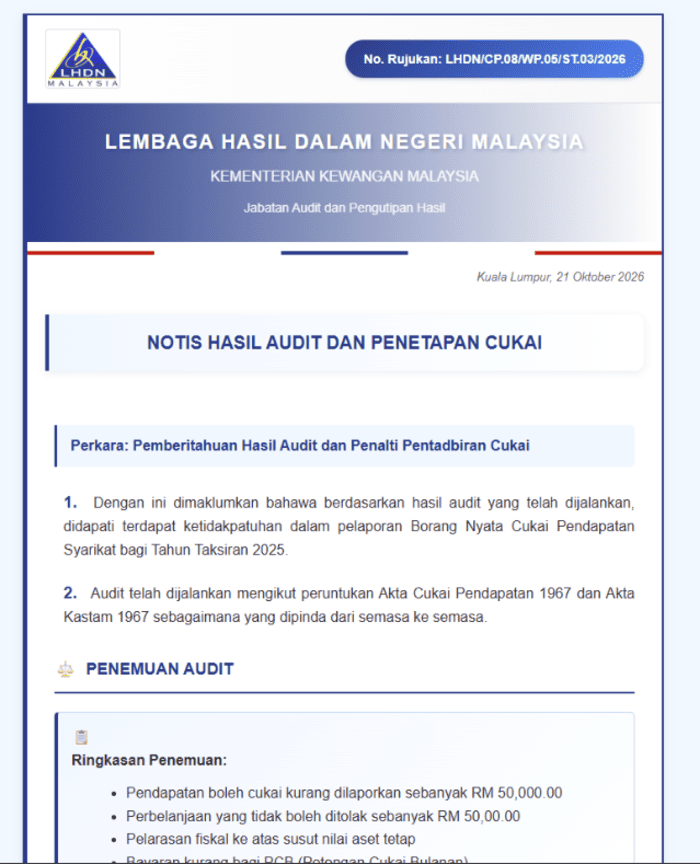
Figure 1: LHDN phishing lure titled Notis Hasil Audit Dan Penetapan Cukai, reference LHDN/CP.08/WP.05/ST.03/2026.
Operational security inconsistency: despite the document’s LHDN and Malaysian branding, the malicious executable itself was distributed and saved as CP14_Notice_D2921116870_2025_2026-10-27.exe. “CP14” is a notice designation used by the US IRS, not LHDN, strongly suggesting the actor is reusing a phishing kit or builder template originally built for US-targeted campaigns and simply re-skinning the lure for Malaysia. This is a useful detection and attribution artifact.
Static Analysis
This section documents the findings from independent static and code-level analysis of all three recovered artifacts: the distributed lure executable, its re-dropped copy, and the side-loaded DLL. The relationship between the three files is summarized below.
| Artifact | Role in Chain | Key Evidence |
|---|---|---|
| CP14_Notice_D2921116870_2025_2026-10-27.exe | Stage 0: distributed lure | Byte-identical to ExplorerBroker.exe; carries a US-IRS “CP14” filename on a Malaysian LHDN-branded lure (template reuse artifact). |
| ExplorerBroker.exe | Stage 1: side-loading carrier | Trojanized “True Burner” application; injected 32-byte stub loads badata_x64.dll by name. |
| badata_x64.dll | Stage 2: obfuscated loader | Masquerades as True Burner’s burn engine DLL; XOR-0xE4 obfuscation; downloads, validates, and executes the stage-3 payload via process hollowing, with a confirmed copy also written to disk. |
Carrier Binary Identification
Static and code-level analysis confirms the distributed lure file and its re-dropped copy are byte-identical:
| File | MD5 | SHA-256 |
|---|---|---|
| CP14_Notice_D2921116870_2025_2026-10-27.exe | 1432ce9587f2dbda35 f0e75a4640d54d | e0ee8df47283ea4b1db 8662dc7409b9069753de147542 58b761c40b4e0cb19c2 |
| ExplorerBroker.exe | 1432ce9587f2dbda 35f0e75a4640d54d | e0ee8df47283ea4b1 db8662dc7409b9069753de14754258b 761c40b4e0cb19c2 |
Both files were analyzed independently, with no shared state between the two, and compared at the function level rather than by hash alone. The injected loader stub exists at the identical address in both files, byte for byte, confirmed separately inside CP14_Notice_D2921116870_2025_2026-10-27.exe’s own copy of the analysis (Figure 2), confirming the two are the same artifact rather than a hash collision. The binary itself is a large (5.8 MB) Delphi/VCL application: entry-point and RTTI symbols (TMethodImplementationIntercept, __dbk_fcall_wrapper) and VCL component string literals (DBNavigator, MediaPlayer, CategoryPanelGroup) indicate this is a legitimate, feature-rich third-party application being abused purely as a DLL side-loading carrier, with its own functionality incidental to the attack.

Figure 2: Independent analysis of CP14_Notice_D2921116870_2025_2026-10-27.exe showing the identical injected stub at address 0x779B50, confirmed separately from ExplorerBroker.exe.
RTTI entries for TFoxBurnerSDK/EFoxBurnerSDK and TrueBurnerData/TrueBurnerBoot path strings confirm this burning functionality is built on a real, licensed commercial Delphi SDK component, not another decoy layer, plausibly explaining the two hardcoded license-key assignments shown beside the injected stub below. The carrier’s embedded manifest (Figure 3) also sets requestedExecutionLevel level=”asInvoker”, requesting no UAC auto-elevation; the loader’s own .admin_elevation marker file therefore tracks a separate, manual elevation attempt rather than anything manifest-driven. The same manifest whitelists a handful of system DLLs (mpr.dll, netapi32.dll, version.dll, wsock32.dll, and others) to load only from %SystemRoot%\system32\, a genuine anti-DLL-hijacking mitigation that, notably, does not and cannot cover badata_x64.dll, which is loaded via explicit application code rather than the manifest-governed search path.
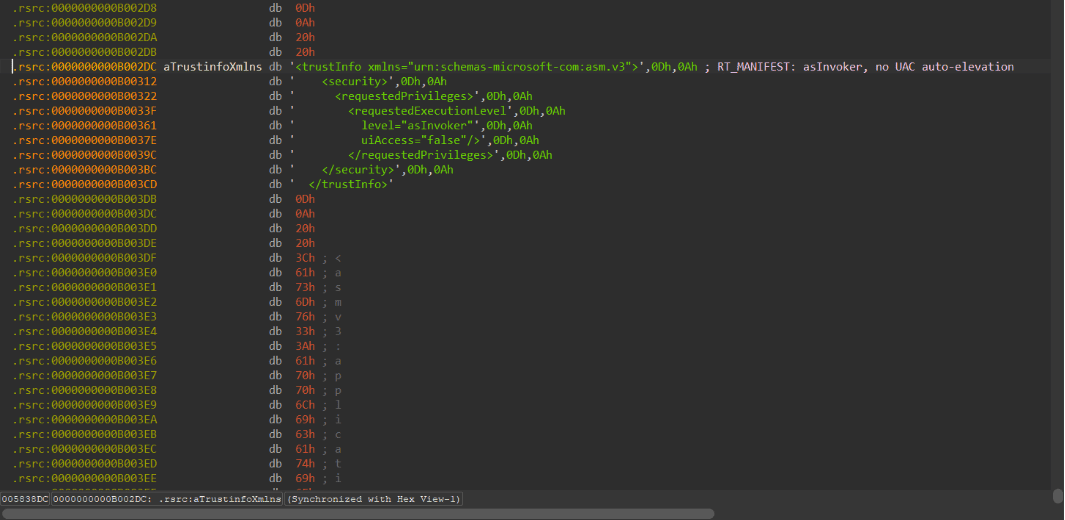
Figure 3: ExplorerBroker.exe embedded RT_MANIFEST resource, showing requestedExecutionLevel=”asInvoker” (no UAC auto-elevation requested).
Injected Loader Stub
The only injected code found in the carrier binary is a small (32-byte) stub function, sub_779B50, which does nothing but reference the literal string “badata_x64.dll” and is called from two locations (sub_7784F0, sub_77BBC0) elsewhere in the application. This confirms the binary was deliberately modified to explicitly load a same-directory sibling DLL by name, a classic DLL side-loading and search-order hijacking technique that hands execution to the attacker-controlled badata_x64.dll. A full structural sweep of the carrier’s roughly 18,800 functions found no additional injected code anywhere else in the binary, confirming the patch is limited to this single stub.
Decompiled code (Figure 4) shows the exact call site inside the carrier’s own main object constructor, sitting directly beside two hardcoded, commercial-style license keys that are part of the genuine True Burner application. This illustrates how small the actual malicious patch is against the surrounding legitimate code:
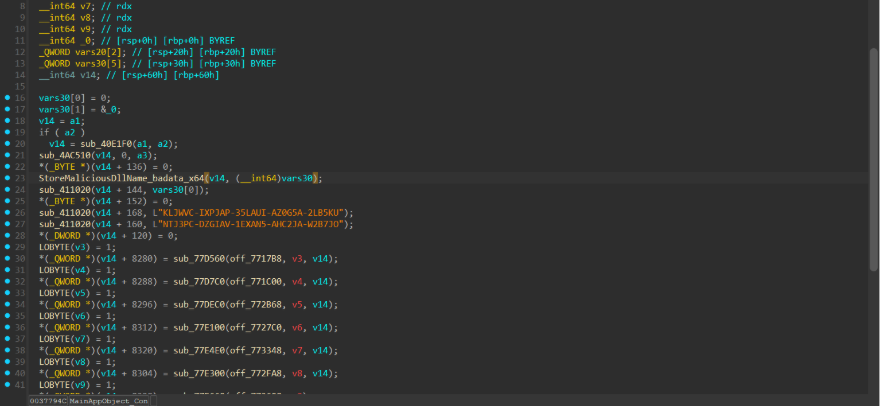
Figure 4: Decompiled constructor code showing the single injected call (highlighted) beside two genuine, unrelated True Burner license key assignments.
Obfuscation and Anti-Analysis
badata_x64.dll (MD5 8d7543cca0e3da65caa54a9781fd2850, SHA-256 78714f6f57c5177201837ce7a6185a2b2bb00a074883fc6cf03b8ade192a20ba) exports a large, irrelevant CD/DVD/ISO burning SDK API (BurnISO, DACreateImage, GetASPI) as decoy exports with no relationship to its real behavior. Its real logic is protected by control-flow flattening, where core routines are compiled into a numeric state-machine dispatch instead of ordinary structured branching, and by runtime string and API decryption, where every sensitive string is stored as a byte blob and XOR-decoded at runtime with a single-byte key, 0xE4, then resolved dynamically via GetModuleHandleA and GetProcAddress rather than imported statically, which explains why WinHTTP and ntdll calls are absent from the DLL’s static import table. Both techniques are visible directly in the decompiled code: the main dispatcher’s core loop (Figure 5) is driven entirely by a single integer state variable compared against arbitrary numeric constants, replacing ordinary branching, and the complete string decoder (Figure 6) is a four-line byte-XOR loop applied to every obfuscated string and API name in the DLL.
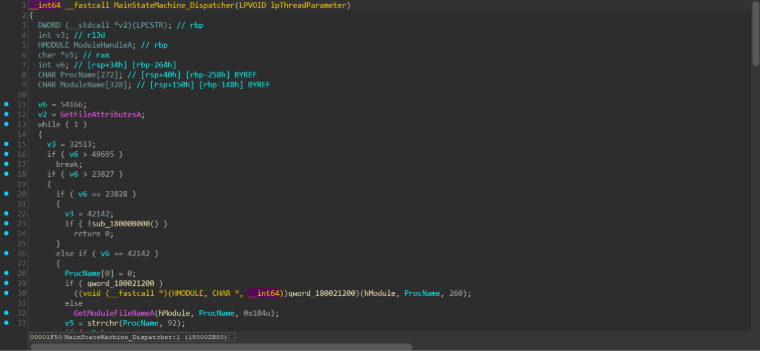
Figure 5: MainStateMachine_Dispatcher’s control-flow-flattened main loop, driven by a single state variable (v6) instead of ordinary branching.
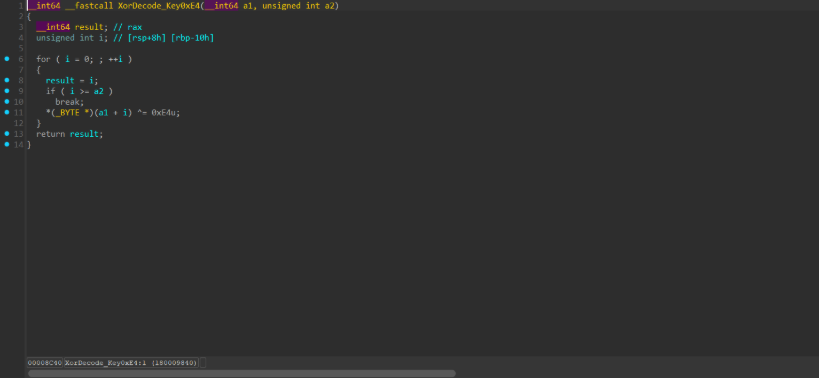
Figure 6: The complete XorDecode_Key0xE4 routine, the single-byte XOR loop that recovers every obfuscated string and API name in badata_x64.dll.
On each run, the loader also checks for two marker files dropped beside itself, <path>.admin_elevation and <path>.admin_persist, to determine whether a prior run already achieved persistence or elevation and avoid repeated UAC prompts. A full listing of the strings extracted from the binary (Figure 7) shows these genuine malicious markers sitting interleaved among hundreds of fabricated log-style strings belonging to the decoy string table described later in this report, exactly the camouflage effect the obfuscation is designed to produce.
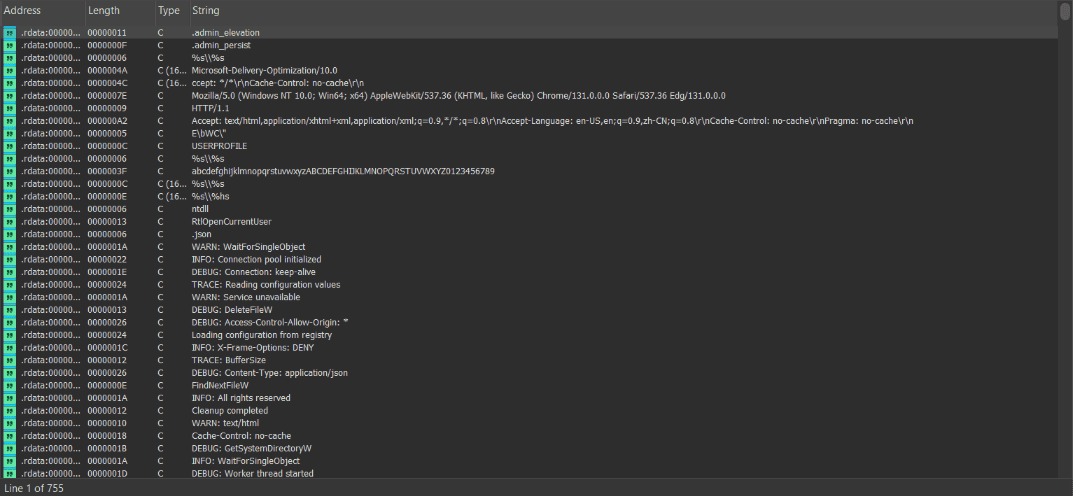
Figure 7: Extracted string listing (755 entries) showing real malicious markers interleaved with decoy log and debug strings.
Decoy “Application Error” Dialog
A background thread spawned via CreateThread from the main dispatcher does not run any download or injection logic. Decoding its two embedded, 0xE4-XOR-encoded byte buffers (Figure 8) recovers a fake Windows error dialog, displayed via a dynamically resolved MessageBoxA call: the title “Application Error” and the text “The application was unable to start correctly (0xc0000142). A required component is missing or access was denied. Please extract all files to the same folder and run as administrator.” 0xC0000142 is the genuine Windows NTSTATUS code for a DLL initialization failure, chosen specifically to read as a believable, mundane error. The dialog serves three purposes at once: it explains away any visible glitch during the side-load and process-hollowing sequence as an unrelated technical problem, it explicitly nudges the victim to run as administrator, directly motivating the .admin_elevation tracking documented above, and it tells the victim to keep all files together in one folder, reinforcing that badata_x64.dll must stay beside the carrier for the side-load to keep working, all disguised as generic troubleshooting advice.
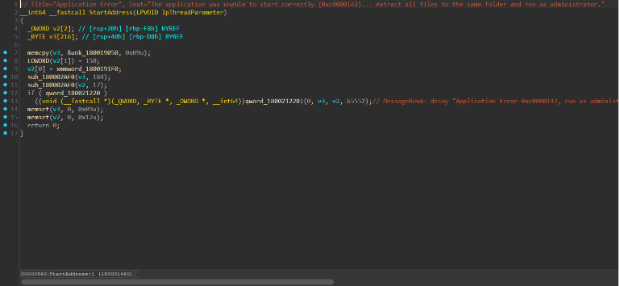
Figure 8: The decoy-dialog thread’s complete logic: two XOR-decoded buffers passed straight into MessageBoxA, with the recovered title and text shown in the leading comment.
Carrier Provenance: Trojanized “True Burner”
Both the carrier executable and the malicious DLL carry an identical, forged Windows version resource identifying them as True Burner version 10.7.0.0, a legitimate freeware CD/DVD burning application published by Glorylogic. The recovered resource values, and the complete forged VS_VERSION_INFO block extracted from badata_x64.dll’s resource section (Figure 9), are shown below:
| Version Resource Field | Forged Value |
|---|---|
| CompanyName | Glorylogic |
| ProductName / FileDescription | True Burner |
| FileVersion / ProductVersion | 10.7.0.0 / 10.7 |
| LegalCopyright | Copyright © 2026 Glorylogic |
| OriginalFilename (DLL) | badata_x64.dll |
| Reference URL | www.glorylogic.com (legitimate vendor) |
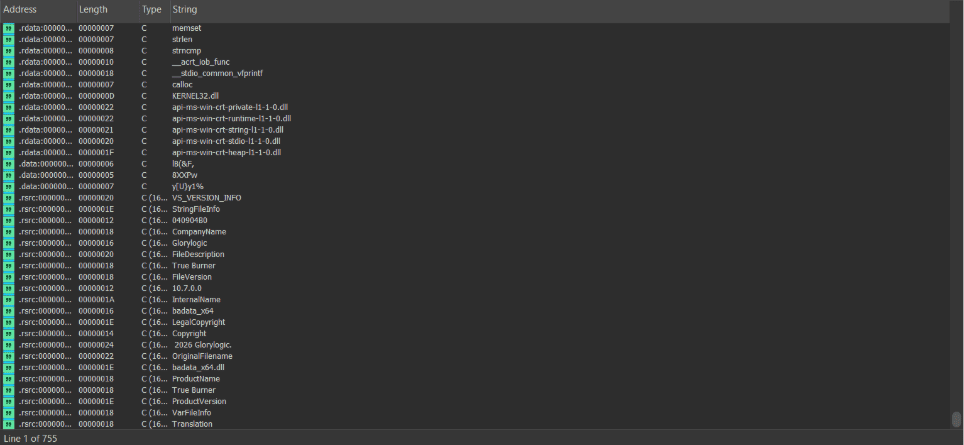
Figure 9: Extracted string listing showing the complete forged VS_VERSION_INFO block recovered from badata_x64.dll’s resource section.
The malicious badata_x64.dll is purpose-built to impersonate True Burner’s genuine burning engine DLL, reproducing its large CD/DVD/ISO burning export table (BurnISO, DACreateImage, GetASPI, and roughly 230 others, shown in Figure 10). These decoy exports are not incidental padding: they are the exact dependency interface the legitimate True Burner host expects, which is precisely what allows the side-load to succeed without the host application crashing. The attacker took a real, signed-looking freeware product and replaced its engine DLL with a malicious look-alike of the same name and export surface.
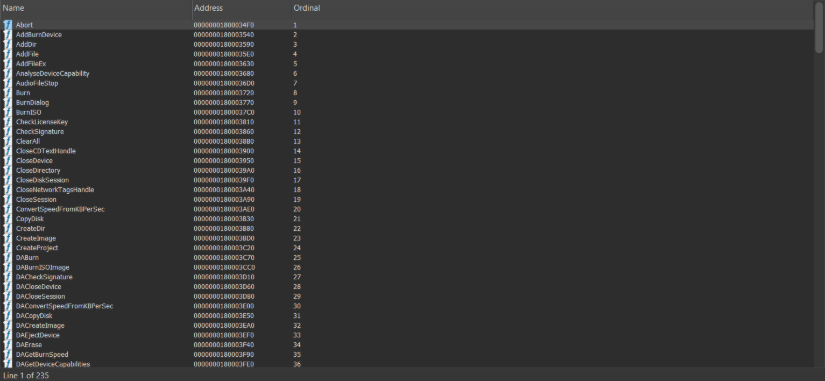
Figure 10: Extracted export listing showing 235 CD/DVD/ISO burning exports reproduced verbatim from the legitimate True Burner engine DLL.
Fraudulently Obtained Code-Signing Certificate
Beyond the forged version resource, both carrier executables carry a genuine Authenticode signature in the PE certificate table, chained up to a real Microsoft root rather than self-signed or absent. The signed artifact is the carrier only; badata_x64.dll itself carries no certificate table at all. The recovered chain is summarized below:
| Field | Recovered Value |
|---|---|
| Signed artifact | CP14_Notice_D2921116870_2025_2026-10-27.exe / ExplorerBroker.exe (identical) |
| Leaf certificate subject | CN=BURNAWARE SL, O=BURNAWARE SL, L=MARBELLA, ST=Malaga, C=ES |
| Leaf certificate issuer | CN=Microsoft ID Verified CS AOC CA 02 |
| Validity window | 2026-02-03 23:27:51 UTC to 2026-02-06 23:27:51 UTC (3 days) |
| Certificate chain | Microsoft ID Verified Code Signing PCA 2021, under Microsoft Identity Verification Root Certificate Authority 2020 |
| badata_x64.dll signature | None (no certificate table present) |
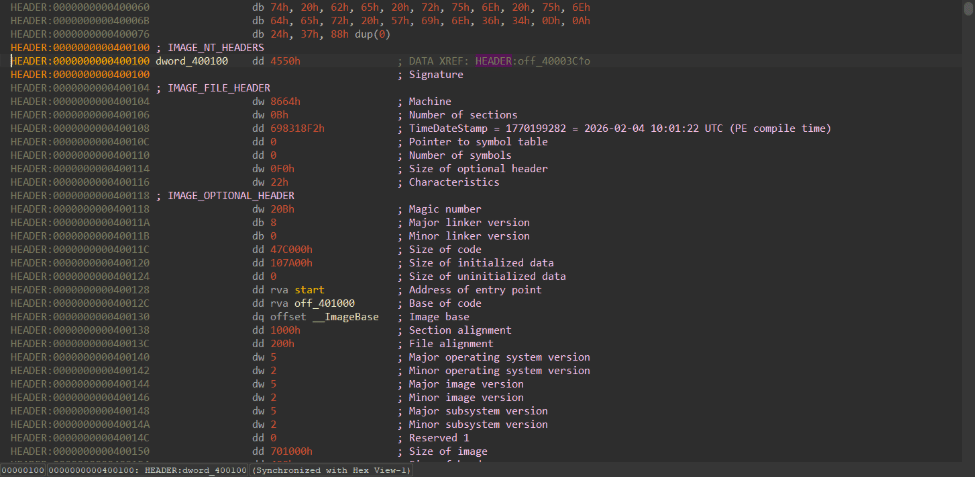
Figure 11: Carrier PE header (IMAGE_FILE_HEADER) showing the TimeDateStamp field, decoded to 2026-02-04 10:01:22 UTC.
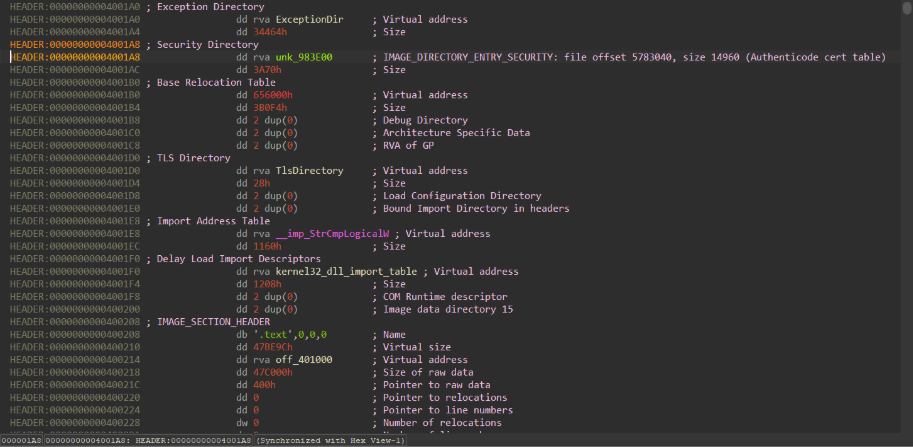
Figure 12: Carrier Optional Header Data Directory, showing the Security Directory entry pointing at file offset 5,783,040, size 14,960 bytes, matching the recovered certificate table exactly.
Both the compile timestamp and the Security Directory entry pointing at the certificate table are visible directly in the carrier’s own PE header (Figures 11 and 12), independently cross-checked against the recovered certificate values above. A three-day validity window on a leaf certificate issued by “Microsoft ID Verified CS AOC CA 02” is the signature of Microsoft Trusted Signing, the Azure cloud code-signing service that issues short-lived, per-signing certificates only after identity-verifying the enrolling business. This is materially different from forging a version resource string: the operators appear to have successfully enrolled an identity resembling BurnAware, a real CD/DVD burning software vendor unrelated to the Glorylogic/True Burner branding claimed elsewhere in the same binary, through Microsoft’s own verification process, and obtained a certificate that genuinely chains to a trusted Microsoft root. A carrier signed this way does not trigger the SmartScreen and unknown-publisher warnings that an unsigned or self-signed binary would. Only the SmartScreen-checked carrier is signed; the side-loaded badata_x64.dll, which Windows does not subject to the same execution-time trust prompt, is left unsigned, a minimal-effort design that signs only what needs to pass the gate. Its own compile timestamp (2025-09-09) sits roughly five months before the carrier’s (2026-02-04, within hours of the certificate’s issuance window), consistent with the loader being a stable, reused tool while carrier executables are freshly built and re-signed close to each deployment.
Second-Stage Container Format “PGBS”
After a successful download, the loader validates the retrieved bytes directly, with no decryption step beforehand, against a 4-byte magic header (Figure 13): the first four bytes must equal the ASCII values for “PGBS” (80, 71, 66, 83). Only content beginning with this signature is accepted; the loader then advances past the 4-byte header and treats the remainder as the real second-stage payload. A payload packaged this way is therefore not a raw executable but a custom container produced by the operator’s own packaging toolchain, which lets the attacker serve inert or benign content to automated crawlers and sandboxes that fetch the URL without reproducing the expected container handling.
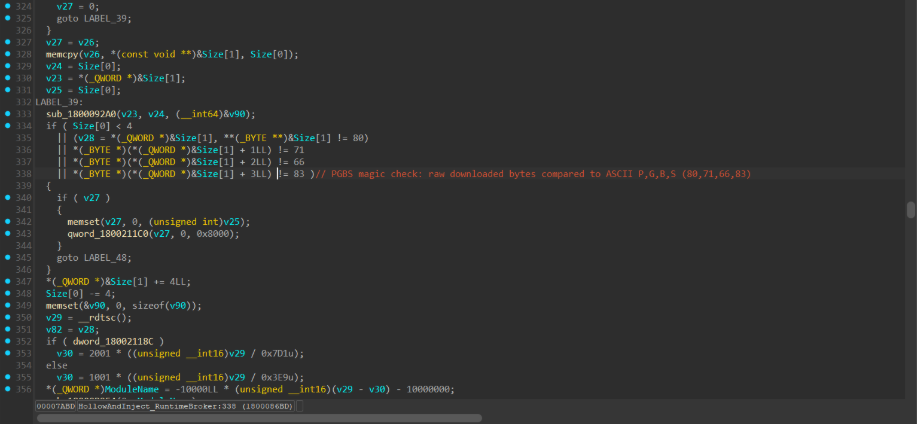
Figure 13: Decompiled code showing the loader’s PGBS validation, a direct byte-by-byte comparison against 80, 71, 66, 83 with no decryption step first.
Second-Stage Payload Artifact: devin-us.dat
To verify the delivery chain directly, this analysis independently retrieved the exact asset served from the primary dead-drop, https://github.com/mariauyrnq/devin-update/releases/download/v1.0.01/devin-us.dat, with a dedicated attacker-registered fallback domain, https://devin-us.com/api/file-share/9fce4cf6-4ef6-4de1-9990-62f057c93c15/download (port 443), observed in the loader’s own retry logic as the secondary source. The retrieved file is 7,513,302 bytes (MD5 e1fa3916cd7faf3d92e884066b9d04ed, SHA-256 493a99e679eb26d7be631fee3956b2cec4fe1e384f58ba8b65d80d0661ab1ee4).
This retrieved file does not pass the loader’s own validation described above: its first four bytes are not “PGBS”, the string does not appear anywhere in the file, and measured byte-level entropy across the entire 7.5 MB is 7.99998 out of a maximum of 8.0, essentially indistinguishable from uniform randomness, with no recognizable archive or executable structure at any offset. A sample this close to maximum entropy is consistent with strong encryption, though it could not be decrypted with the 0xE4 single-byte XOR scheme used elsewhere in the loader. Two explanations are equally plausible from this evidence alone: the operators have rotated the hosted release asset since the loader sample analyzed in this report was built, breaking compatibility with it, or the endpoint now serves inert, maximally random filler data once a campaign element is treated as exposed, a common operational-security move once an attacker suspects a payload URL has been discovered. This analysis cannot distinguish between the two without an earlier, time-matched capture of the same URL, and does not treat this specific file as a confirmed, currently functional second-stage payload.
Process Hollowing Execution Mechanism
Rather than writing the decoded second stage to disk as an executable and launching it directly, the loader injects it into a second, legitimately named process using a classic process hollowing technique, reconstructed here from the analyzed code and illustrated step by step below:
- CreateProcessA spawns C:\Windows\System32\RuntimeBroker.exe with CREATE_SUSPENDED | CREATE_NO_WINDOW, so the new process exists but has not yet executed any code.
- An anonymous, committed, executable-capable memory section is created (SECTION_ALL_ACCESS, SEC_COMMIT, PAGE_EXECUTE_READWRITE), implemented as the loader’s own lightly wrapped equivalent of NtCreateSection.
- That same section is mapped twice: once into the loader’s own process as PAGE_READWRITE, so the validated payload bytes can be copied in with a plain memcpy, and once into the suspended RuntimeBroker.exe process as PAGE_EXECUTE_READ. These are the same physical pages, shared between both processes, which avoids calling WriteProcessMemory altogether, a common EDR and antivirus hook point.
- The loader’s own view is unmapped (NtUnmapViewOfSection), GetThreadContext and SetThreadContext are used to redirect the suspended thread’s execution context toward the newly mapped region, and ResumeThread releases it. The payload then runs inside a process that the operating system and most tooling will show simply as RuntimeBroker.exe.
- A final GetExitCodeProcess check confirms the hollowed process is still STILL_ACTIVE; otherwise the loader terminates it with TerminateProcess, tears down, and retries the download loop, alternating between the GitHub and devin-us.com sources.
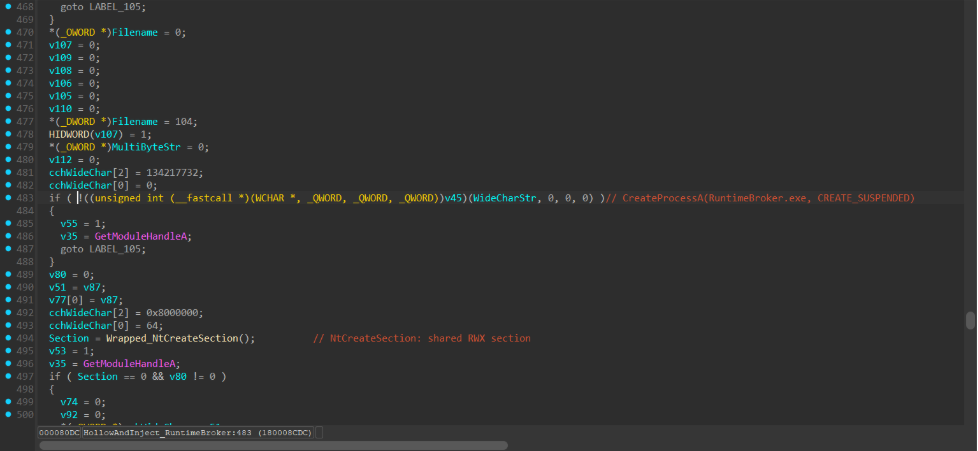
Figure 14: Step 1, CreateProcessA spawns RuntimeBroker.exe with CREATE_SUSPENDED and CREATE_NO_WINDOW.
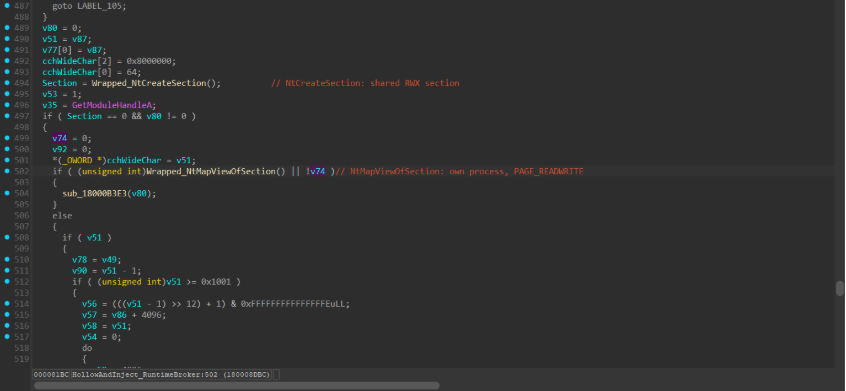
Figure 15: Steps 2 and 3, the shared section is created and mapped first into the loader’s own process as PAGE_READWRITE.
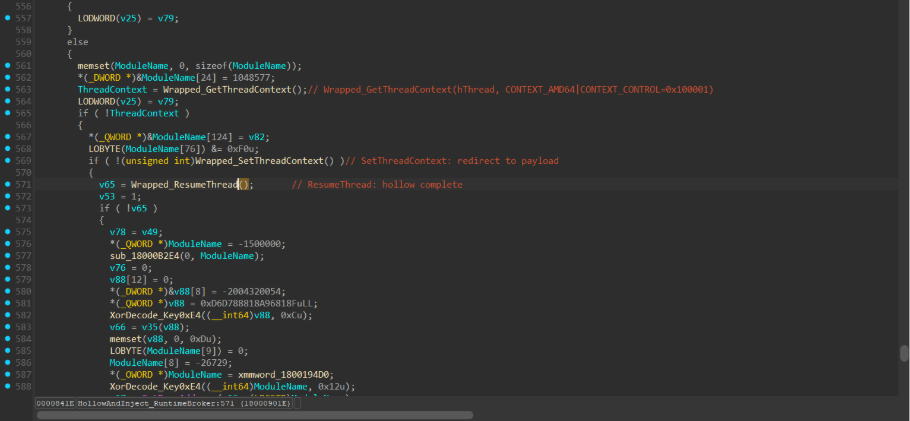
Figure 16: Steps 4 and 5, GetThreadContext and SetThreadContext redirect execution, ResumeThread completes the hollow, and GetExitCodeProcess verifies success.
Because the injection target is a real, genuinely signed Windows binary name rather than a suspicious or arbitrary process, simple process-name allowlisting is defeated, and avoiding WriteProcessMemory altogether removes a common EDR hook point. The same PGBS-validated payload can also come from an embedded PE resource inside badata_x64.dll itself, selected by an internal build flag, with both paths converging on the identical hollowing routine above; in this sample the DLL’s resource section is only 4 KB, consistent with just the forged True Burner version resource, so the embedded-payload path is almost certainly inert here, though its presence shows the loader is a configurable, reusable builder rather than a one-off script.
Anti-Analysis and Sandbox Evasion Gate
Before the dispatcher advances to the download and hollowing step, the loader runs a dedicated gating routine whose result is cached and checked on every subsequent call. If any check fails, execution never proceeds past this gate. The gate combines several independent techniques:
- A vectored exception handler (AddVectoredExceptionHandler) combined with setjmp and longjmp is installed (Figure 17) so that an unexpected exception during the checks below is caught and treated as a detection signal rather than crashing the process.
- The loader manually walks the Process Environment Block’s module list to locate kernel32 and ntdll, and hand-parses their PE export directories to resolve the functions it needs. This bypasses GetModuleHandle and GetProcAddress entirely, defeating the most common API-monitoring hook points used by EDR and sandbox products.
- A direct NtQueryInformationProcess(ProcessDebugPort) call detects an attached kernel debugger.
- A timing check measures the elapsed time of a short operation and aborts if it exceeds roughly 2.5 milliseconds, a classic single-step and breakpoint detector, since instrumented or debugged execution is measurably slower.
- The running binary’s own name and path is hashed with a DJB2-style algorithm and compared against a small set of hardcoded hash constants rather than plaintext strings. This is almost certainly a blocklist of sandbox, antivirus, or analysis-tool process and file names, chosen specifically so the blocklist itself cannot be recovered by searching the binary for readable strings.
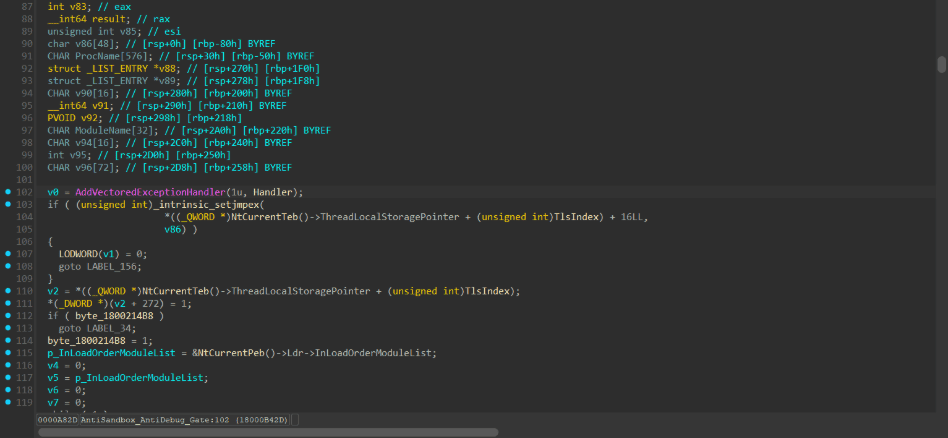
Figure 17: VEH installation and setjmp checkpoint at the start of the anti-sandbox gate.
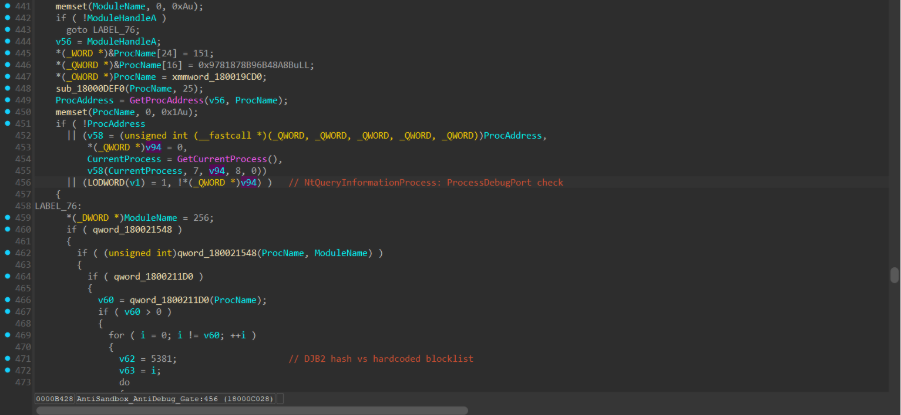
Figure 18: Decompiled code showing the NtQueryInformationProcess ProcessDebugPort check immediately followed by the DJB2 hash blocklist loop, both annotated.
Taken together, this is a deliberately layered, defense-in-depth anti-analysis gate. Defeating any single technique, such as patching out the timing check, is not sufficient on its own, since the module-walk and debug-port checks operate independently of it.
Persistence: Registry Run Key and a Disguised Staging Folder
A separate routine, invoked only on a non-persisted run, establishes durable persistence using exclusively low-level ntdll APIs rather than the higher-level advapi32 registry functions, again avoiding the most commonly hooked API surface. Recovering and decrypting its embedded strings exposes the exact mechanism:
| Element | Recovered Value |
|---|---|
| Staging directory | %LOCALAPPDATA%\Microsoft\Windows\Explorer\thumbcache_<random8>\ |
| Dropped files | ExplorerBroker.exe and badata_x64.dll, copied from their original location |
| Registry key (HKCU) | SOFTWARE\Microsoft\Windows\CurrentVersion\Run |
| Registry value name | WindowsUpdate_<random4> |
| Registry value data | Path to the staged copy under thumbcache_<random8>\ |
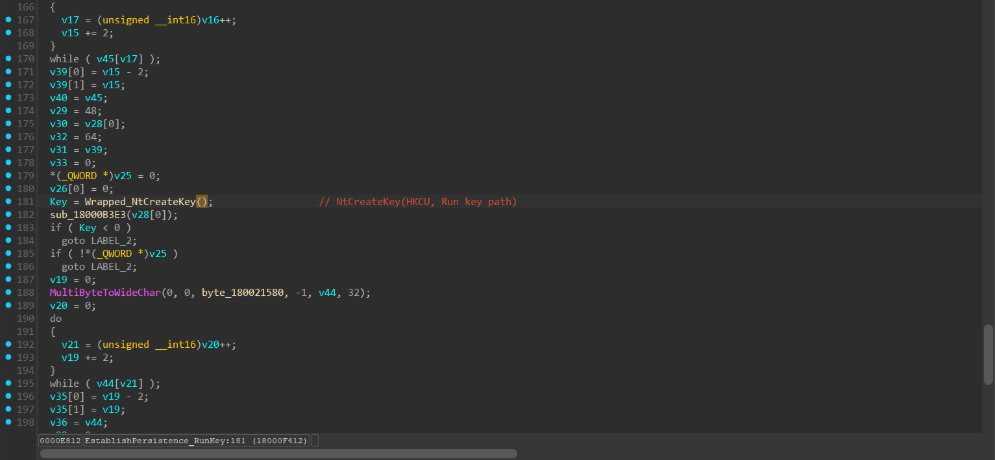
Figure 19: Decompiled code showing the registry key creation call establishing HKCU\SOFTWARE\Microsoft\Windows\CurrentVersion\Run, annotated with the recovered subkey path.
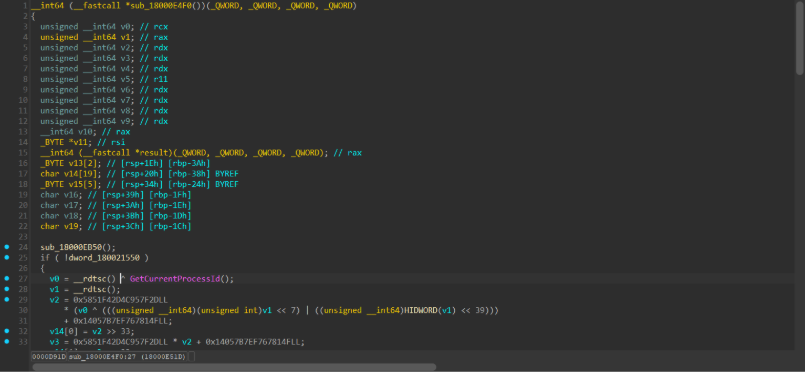
Figure 20: The PCG32 seeding (RDTSC xor GetCurrentProcessId) and multiply-increment step that generates the per-infection random suffixes.
The random components in both the staging folder name and the registry value name are generated by the PCG32-style pseudo-random number generator shown above (recognizable from its exact multiplier and increment constants, 0x5851F42D4C957F2D and 0x14057B7EF767814F), seeded from RDTSC ^ GetCurrentProcessId(), and rendered through the base62 alphabet a-zA-Z0-9. The same per-infection random value feeds both the folder suffix and the registry value suffix, so the two are correlated for a given victim but differ across victims, and both disguises are chosen to be unremarkable to a human reviewing autoruns or Explorer: %LOCALAPPDATA%\Microsoft\Windows\Explorer genuinely holds thumbcache_*.db files on every real Windows installation, and a WindowsUpdate_ prefixed Run key entry reads as an operating system component rather than third-party software. The per-victim randomization also means there is no single static string to blocklist for either artifact; detection needs to match the pattern rather than a literal value.
Second-Stage Payload Persisted to Disk as settings.dat
A helper function, renamed PersistPayloadCopy_ToStagingFolder for this analysis, is called from the hollowing routine immediately before the in-memory downloaded payload buffer is wiped and freed. It independently rebuilds the same thumbcache_<random8> staging path described above and appends a decoded filename, settings.dat, recovered by applying the same single-byte XOR key used throughout the DLL to the relevant embedded bytes.
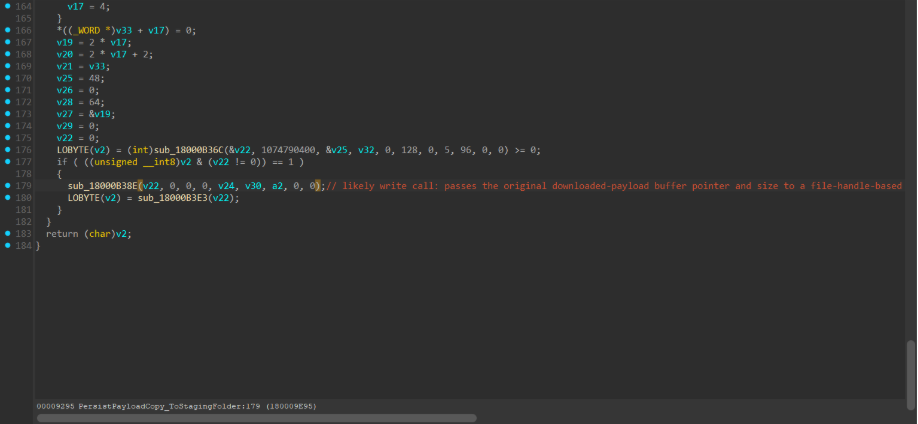
Figure 21: Decompiled code showing the payload persistence call, where the original downloaded-payload pointer and size are passed alongside a file handle obtained from the staging path.
The two calls that create and populate this file match the parameter count and argument order of the standard Windows native file-creation and file-write routines exactly: the first call requests write access and supplies a full set of file-creation parameters consistent with opening or creating settings.dat for writing; the second call supplies the file handle together with the original downloaded-payload buffer pointer and its exact size, in the argument positions a native write call expects for the buffer and its length. This parameter-level correspondence confirms the decrypted second-stage payload is written to disk as %LOCALAPPDATA%\Microsoft\Windows\Explorer\thumbcache_<random8>\settings.dat, alongside the copies of ExplorerBroker.exe and badata_x64.dll already placed there for persistence. This is in addition to, not instead of, the in-memory process hollowing established above: CreateProcessA, section mapping, and ResumeThread independently and conclusively establish in-memory execution regardless of the on-disk copy. Incident responders should treat settings.dat inside the staging folder as a recoverable copy of the second-stage payload for forensic collection.
String-Table Camouflage via Decoy Log Strings
A single, unusually large function in badata_x64.dll (over 1,300 lines of decompiled code) declares more than 300 local string constants that read exactly like the internal logging of a legitimate caching or HTTP server component, for example “INFO: Configuration loaded successfully”, “DEBUG: RegOpenKeyExW”, “Copyright (c) 2025 Microsoft Corporation”, “Runtime v14.32.2704”, fabricated HTTP and TLS traffic lines such as “HTTP/1.1 200 OK”, “Content-Type: application/json”, and “TLS handshake completed”, and plausible configuration keys including CacheDirectory, MaxRequestSize, and ThreadPoolSize.
The decompiled code confirms these are not inert declarations: each decoy string is walked byte by byte into a running accumulator immediately after being assigned, which is real code that executes on every call, consistent with deliberate CPU-cycle padding in addition to string-table pollution (Figure 22). None of this is functional command-and-control logic; it exists purely to pollute the DLL’s string table, so an analyst, antivirus string scanner, or machine-learning classifier that samples strings from the file sees hundreds of benign-sounding log lines for every genuinely malicious one, such as a URL, a registry path, or an obfuscated API name, diluting the signal that static detection relies on and reinforcing the “ordinary internal service component” cover story established by the True Burner masquerade. The function’s own accumulator is written to a single global variable that cross-reference analysis confirms is never read anywhere else in the binary, ruling out any functional checksum, anti-tamper, or configuration role beyond camouflage and CPU-cycle padding.
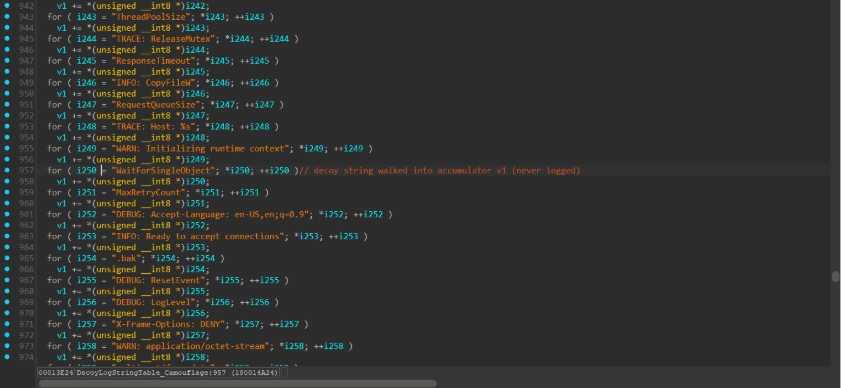
Figure 22: Decompiled code showing a representative slice of the 300-plus decoy strings, each summed byte by byte into an accumulator that is never logged anywhere.
Network and Command-and-Control
Recovering and applying the 0xE4 XOR key to the obfuscated byte blobs inside badata_x64.dll’s core worker function reveals two hardcoded download targets, retried in a bounded loop until one returns HTTP 200 with a valid payload header: a primary GitHub Releases dead-drop and a dedicated, attacker-registered fallback domain, devin-us.com (both URLs and the retrieved asset itself are detailed in “Second-Stage Payload Artifact: devin-us.dat” above). The naming pattern across devin-us.com, devin-update, and devin-us.dat strongly suggests this campaign also impersonates Devin, the AI coding agent, likely through a fake Devin AI installer or update lure aimed at developers, chained behind the unrelated LHDN tax notice theme used for the initial download.
Outbound requests use a dual User-Agent strategy: the session-level WinHttpOpen call passes a genuine Chrome/Edge-on-Windows string (Figure 23), while a second, request-level string, Microsoft-Delivery-Optimization/10.0, deliberately impersonates legitimate Windows Update delivery traffic. The same request also sets real, non-decoy headers (Figure 24), including an Accept-Language value listing zh-CN alongside en-US, an independent corroboration of the Mandarin-speaking operator base already evidenced by the TankRAT panel’s placeholder text. The loader never sets WINHTTP_OPTION_SECURITY_FLAGS or any certificate-bypass flag on this connection, so standard Windows certificate validation applies to its HTTPS traffic.
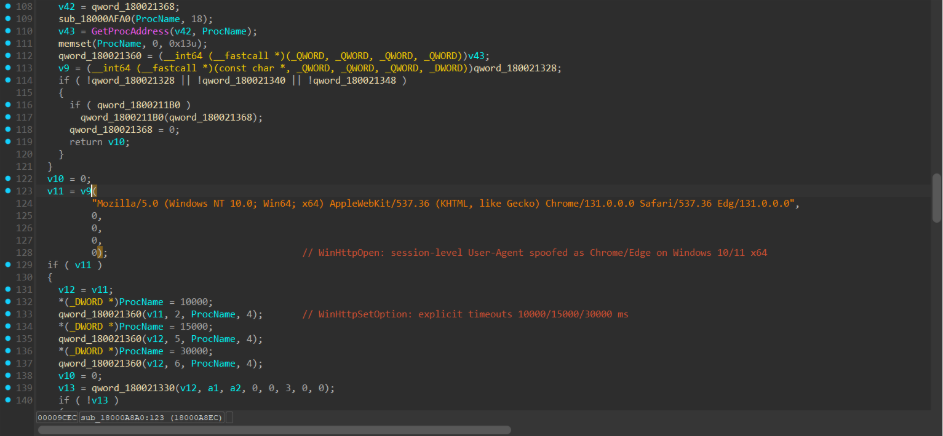
Figure 23: Decompiled code showing the genuine Chrome/Edge User-Agent passed to WinHttpOpen and three explicit WinHttpSetOption timeout calls (10/15/30 seconds).
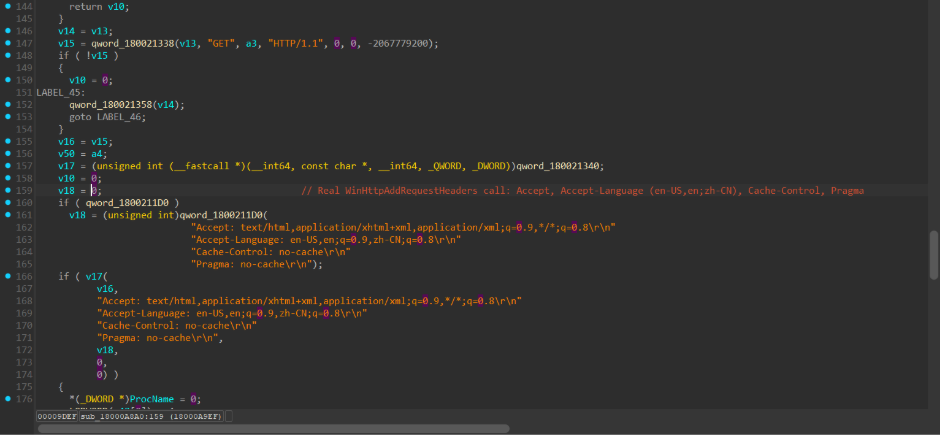
Figure 24: Decompiled code showing the real WinHttpAddRequestHeaders call, including an Accept-Language header listing zh-CN, distinct from the decoy string table.
TankRAT Command-and-Control Panel
The backend administration panel for this infrastructure is branded “TankRAT” (Figure 25): a dark-themed login page with a crown icon and username and password fields.
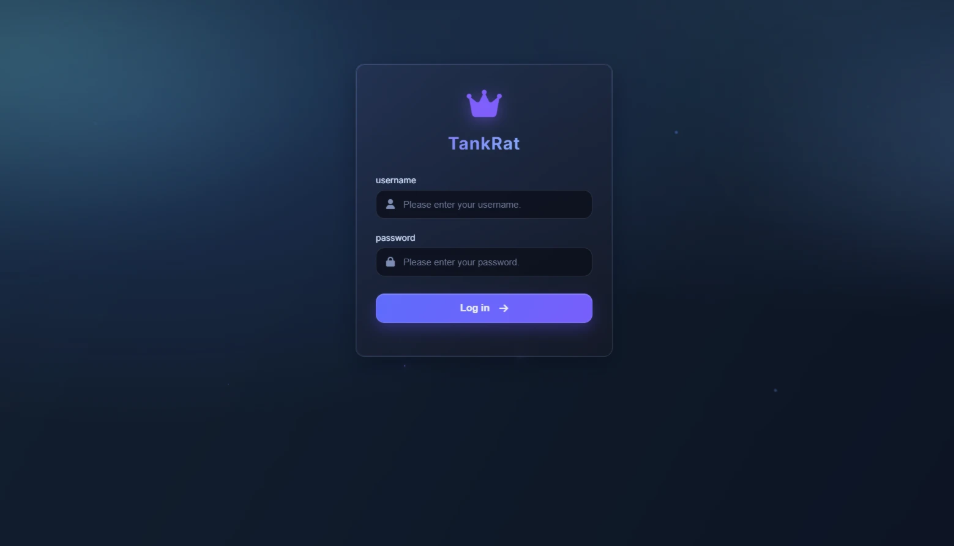
Figure 25: TankRAT command-and-control administration panel login screen.
Inspection of the panel’s HTML source shows the input placeholder attributes are written in Mandarin Chinese: 请输入用户名, meaning “Please enter username,” and 请输入密码, meaning “Please enter password,” even though the rendered panel chrome is in English (Figure 26). This is direct template-level evidence that the panel was built by a Mandarin-speaking developer. The panel authenticates administrators via OpenID Connect (OIDC) rather than a simple local username and password store, an engineering choice more typical of a maintained, possibly multi-tenant platform than a one-off campaign tool.
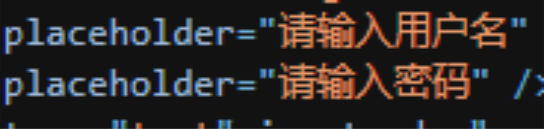
Figure 26: HTML source of the TankRAT login form, showing Mandarin-language placeholder attributes.
OSINT Analysis: Hosting Account Characteristics
The threat actor hosts the second-stage payload on GitHub Releases (github.com/mariauyrnq/devin-update, release v1.0.01, asset devin-us.dat), under a dedicated, low-history account. Hosting the payload this way lets the download blend into trusted-domain traffic and survive basic domain-reputation blocking, since the URL resolves under github.com rather than attacker-owned infrastructure. The account’s own GitHub profile page (Figure 27) shows the non-dictionary handle mariauyrnq with a generic, non-identifying default avatar and no bio, follower, or activity history beyond the devin-update repository itself, consistent with a disposable account created specifically to host this payload rather than a long-standing developer identity. No corroborating account on another platform has been confirmed for this handle; this remains a single-platform observation rather than a cross-platform OSINT pivot.

Figure 27: The mariauyrnq GitHub account’s own profile page, showing a generic default avatar and no identifying information beyond the hosting repository.>
An internet-wide fingerprint search for the TankRAT panel returned only 4 total results worldwide (Figure 28):
| Country | Instances |
|---|---|
| Spain | 1 |
| Hong Kong | 1 |
| Singapore | 1 |
| Ukraine | 1 |
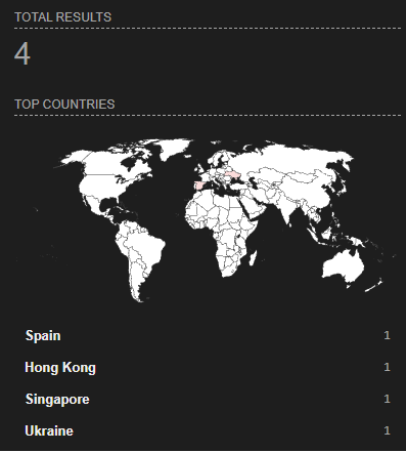
Figure 28: Fingerprint scan results for the TankRAT panel, showing 4 hosts across Spain, Hong Kong, Singapore, and Ukraine.
This small, geographically dispersed footprint is consistent with an operator using low-cost, disposable VPS hosting spread across multiple jurisdictions to reduce the impact of any single takedown, rather than a large, centralized hosting operation.
Phishing Infrastructure
The following domains were identified in connection with this campaign’s phishing infrastructure, all following Malaysian government-themed naming conventions:
| Domain | Likely Impersonation | Notes |
|---|---|---|
| hasilgov-my.my.id | HASIL / LHDN | Hosted on Indonesia’s .my.id subdomain service, commonly abused for low-cost, low-friction phishing registration |
| hasilgov-my.shop | HASIL / LHDN | .shop gTLD, low registration cost and minimal vetting |
| mhftee.my.id | Unclear, possible decoy or staging subdomain | .my.id subdomain service |
| mida.cam | MIDA (Malaysian Investment Development Authority) | .cam gTLD, frequently abused as a visual lookalike for .com |
This pattern of cheap ccTLD and gTLD registrations typosquatting Malaysian government bodies is consistent with a campaign built for rapid, disposable infrastructure turnover and designed to evade simple domain blocklists.
External Threat Landscape Management
This campaign demonstrates a complete and actively maintained external threat lifecycle, beginning with attacker reconnaissance and infrastructure preparation using GitHub Releases and mass-registered Malaysian government-themed phishing domains. During the weaponization phase, the threat actor developed a control-flow-flattened, XOR-obfuscated Windows loader DLL, a DLL side-loading carrier built from a trojanized legitimate Delphi application, and a dedicated OIDC-authenticated command-and-control panel.
Delivery is achieved through a fake LHDN tax audit notice executable distributed to victims, who are socially engineered into executing the file by the urgency and official appearance of the alleged tax findings. Exploitation occurs the moment the executable runs: the carrier application silently side-loads the attacker’s DLL with no further user interaction required. Installation and persistence are reinforced through hidden marker files that track elevation and persistence state across runs, vectored-exception-based anti-debugging, and a decoy error dialog that nudges victims toward the administrator access those marker files are tracking.
The final operational phase includes dynamic, encrypted resolution of networking APIs, retrieval of a second-stage payload from GitHub and a dedicated fallback domain, and User-Agent spoofing designed to disguise malicious traffic as legitimate Windows Update activity. Continuous availability across a GitHub dead-drop and a dedicated command-and-control domain, combined with a small but internationally distributed TankRAT panel footprint, supports long-term campaign survivability and resistance to single-point takedowns. This lifecycle-driven execution pattern confirms the operation is financially motivated, operationally mature, and engineered for sustained exploitation rather than a short-term opportunistic attack.
Because the loader’s own build flag already supports swapping the retrieved payload between a network download and an embedded PE resource, and the carrier/loader pairing is a reusable side-loading template rather than a purpose-built one-off, the same infrastructure is well positioned to pivot to new lures with minimal engineering effort. The LHDN and Devin AI themes observed here are consistent with a toolkit capable of rapid re-skinning for other institutional or technology brands, so the near-term risk is less about this specific lure persisting and more about the same loader, panel, and hosting pattern reappearing under a different impersonated identity once current indicators are blocked.
Conclusion
The SilverRoute campaign represents a mature, professionally engineered Windows intrusion operation that combines phishing, DLL side-loading, native-level obfuscation, and centralized command-and-control into a unified attack framework. The use of control-flow flattening, runtime string and API decryption, persistence-state tracking, traffic-disguising techniques, and fraudulent enrollment in Microsoft’s own code-signing identity verification process places this campaign well beyond the capabilities of a low-skill scam actor.
By impersonating a national tax authority (LHDN) and, separately, a well-known AI coding assistant brand, the operators exploit both institutional and technology-industry trust to maximize victim reach. The use of GitHub as a payload-hosting platform further complicates takedown efforts and highlights a broader trend of legitimate infrastructure being weaponized for malware distribution.
This campaign should be treated as a credible financial and intrusion threat requiring coordinated response from national CERTs, GitHub’s abuse team, and affected organizations’ security teams. Prompt takedown of hosting infrastructure, blocking of identified command-and-control domains, and public advisories regarding fraudulent LHDN communications are strongly recommended.
Yara Rules
The following four rules are scoped separately by artifact type: the trojanized loader binaries, the dropped second-stage payload container, the phishing domains used for initial delivery, and the fraudulent code-signing certificate found on the carrier. The loader rule requires a PE header plus at least two independent indicators, so the legitimate True Burner application (which contains only the True Burner string and nothing else) does not trigger a match.
import "pe"
rule SilverRoute_Badata_Loader
{
    meta:
        description = "Detects the SilverRoute loader (badata_x64.dll) and its trojanized True Burner carrier"
        date = "2026-11-05"
        sha256_carrier = "e0ee8df47283ea4b1db8662dc7409b9069753de14754258b761c40b4e0cb19c2"
        sha256_loader = "78714f6f57c5177201837ce7a6185a2b2bb00a074883fc6cf03b8ade192a20ba"
    strings:
        $c2_domain = "devin-us.com" nocase
        $dll_name = "badata_x64.dll" nocase
        $marker1 = ".admin_elevation" nocase
        $marker2 = ".admin_persist" nocase
        $persist_file = "settings.dat" nocase
        $fake_ua = "Microsoft-Delivery-Optimization/10.0" nocase
        $dead_drop = "github.com/mariauyrnq/devin-update" nocase
        $true_burner = "True Burner" wide ascii
    condition:
        uint16(0) == 0x5A4D and
        2 of ($c2_domain, $dll_name, $marker1, $marker2, $persist_file, $fake_ua, $dead_drop, $true_burner)
}

rule SilverRoute_Stage3_PGBS_Container
{
    meta:
        description = "Detects the PGBS-tagged second-stage payload container (devin-us.dat / settings.dat) dropped by the SilverRoute loader"
        date = "2026-11-05"
    strings:
        $magic = { 50 47 42 53 }
    condition:
        $magic at 0
}

rule SilverRoute_Phishing_Domains
{
    meta:
        description = "Matches domains registered for the SilverRoute LHDN/MIDA-themed phishing infrastructure"
        date = "2026-11-05"
    strings:
        $phish1 = "hasilgov-my.my.id" nocase
        $phish2 = "hasilgov-my.shop" nocase
        $phish3 = "mhftee.my.id" nocase
        $phish4 = "mida.cam" nocase
    condition:
        any of them
}

rule SilverRoute_Fraudulent_BurnAware_Signature
{
    meta:
        description = "Matches PE files signed with the fraudulent BurnAware SL code-signing certificate used on the SilverRoute carrier"
        date = "2026-11-05"
    condition:
        for any i in (0..pe.number_of_signatures - 1):
            (pe.signatures[i].subject contains "BURNAWARE SL")
}
Recommendations
Strategic Recommendations
- Establish continuous endpoint monitoring for DLL side-loading behavior: flag legitimate applications loading same-directory DLLs they did not originally ship with, especially followed by outbound network activity.
- Launch public awareness campaigns educating taxpayers that LHDN does not issue audit notices as unsolicited executable attachments, and that official notices are accessible via the MyTax portal.
- Report the fraudulent BurnAware-identity certificate to Microsoft’s Trusted Signing abuse and revocation process and to the real BurnAware vendor, since a genuine business identity was impersonated to obtain it, and share the certificate details with industry threat-intelligence sharing groups.
- Extend brand-protection and typosquatting monitoring beyond LHDN-themed domains to cover other institutional and technology brands, given this toolkit’s demonstrated ability to be re-skinned for a parallel Devin AI coding-assistant lure.
Management Recommendations
- Develop incident-response playbooks specific to loader and downloader malware and DLL side-loading, including isolation, memory capture, and forensic imaging of affected hosts.
- Scope code-signing allowlisting to specific known-good publisher identities and certificate thumbprints rather than simply “signed versus unsigned,” since this campaign’s carrier holds a valid, Microsoft-chained certificate obtained under a fraudulently verified identity; pair allowlisting with behavioral detection rather than relying on signature validity alone.
- Mandate EDR telemetry retention and hunting playbooks specifically covering process hollowing into legitimate system binaries such as RuntimeBroker.exe, since both static signature detection and code-signing checks are deliberately defeated by this loader’s camouflage and valid signing.
Tactical Recommendations
- Isolate and reimage any confirmed infected host; do not rely on deleting the dropped files alone, since persistence markers may remain.
- Block known infrastructure at DNS, proxy, and firewall level: devin-us.com, hasilgov-my.my.id, hasilgov-my.shop, mhftee.my.id, mida.cam, and the GitHub path github.com/mariauyrnq/devin-update.
- Hunt across endpoints for the file hashes listed in the indicator table, for the presence of .admin_elevation and .admin_persist marker files anywhere on disk, and for settings.dat files located inside thumbcache-named folders under %LOCALAPPDATA%\Microsoft\Windows\Explorer, which should be collected for forensic analysis as a recoverable copy of the second-stage payload.
- Flag outbound HTTPS traffic claiming the Microsoft-Delivery-Optimization/10.0 User-Agent that does not originate from the legitimate Windows Delivery Optimization service or process.
- Alert on RuntimeBroker.exe processes created with CREATE_SUSPENDED whose parent process is not a standard system service host, such as svchost.exe or services.exe. This is the loader’s process-hollowing injection point.
- Hunt HKCU\SOFTWARE\Microsoft\Windows\CurrentVersion\Run for value names matching the pattern WindowsUpdate_[A-Za-z0-9]{4} whose data points outside %WINDIR%, and for any folder matching %LOCALAPPDATA%\Microsoft\Windows\Explorer\thumbcache_[A-Za-z0-9]{8}\ containing executable files. Legitimate thumbcache_* entries are .db files directly in that folder, never subfolders or settings.dat files.
- Hunt endpoint and proxy telemetry for executables signed by the certificate subject CN=BURNAWARE SL issued within the 2026-02-03 to 2026-02-06 validity window; do not treat a valid Microsoft-chained signature alone as sufficient grounds to trust an unfamiliar CD/DVD burning utility.
Appendix 1
MITRE ATT&CK Mapping
| Tactic | Technique | ID | Description |
|---|---|---|---|
| Resource Development | Acquire Infrastructure | T1583 | Phishing domains (hasilgov-my.*, mida.cam) and command-and-control domain (devin-us.com) registered ahead of the campaign. |
| Initial Access | Phishing: Spearphishing Attachment | T1566.001 | LHDN tax audit notice themed executable delivered as the initial lure. |
| Execution | User Execution: Malicious File | T1204.002 | Victim manually executes the fake tax notice executable, triggering the infection chain. |
| Persistence / Defense Evasion | Hijack Execution Flow: DLL Side-Loading | T1574.002 | The carrier executable explicitly loads a malicious sibling DLL, badata_x64.dll, by name. |
| Defense Evasion | Obfuscated Files or Information | T1027 | Control-flow flattening, single-byte XOR (0xE4) obfuscation of strings and API names, and 300 plus fabricated log and debug strings used to camouflage the string table. |
| Defense Evasion | Dynamic API Resolution | T1027.007 | GetModuleHandleA and GetProcAddress used on decrypted names instead of static imports, hiding sensitive APIs. |
| Defense Evasion / Masquerading | Match Legitimate Name or Location | T1036 .005 | Both malicious files carry a forged True Burner and Glorylogic version resource and reproduce True Burner’s real export interface. |
| Defense Evasion | Subvert Trust Controls: Code Signing | T1553.002 | Carrier executables carry a genuine, Microsoft-chained Authenticode signature obtained under the identity of BurnAware, a real CD/DVD burning vendor, consistent with fraudulent enrollment in Microsoft Trusted Signing rather than a forged or self-signed certificate. |
| Defense Evasion | Virtualization/Sandbox Evasion | T1497 | Dedicated gate combining module-list walk, manual PE export parsing, timing checks, and a hashed name blocklist before execution is allowed to reach the download and hollowing step. |
| Defense Evasion | Debugger Evasion | T1622 | NtQueryInformationProcess ProcessDebugPort check, vectored exception handling with setjmp and longjmp, and the timing-based check above. |
| Discovery | Security Software Discovery | T1518.001 | The running binary’s own name and path is hashed (DJB2) and compared against a small set of hardcoded hash constants, almost certainly a blocklist of sandbox, antivirus, and analysis-tool process and file names kept as hashes rather than plaintext strings. |
| Defense Evasion / Execution | Process Injection: Process Hollowing | T1055.012 | CreateProcessA with CREATE_SUSPENDED spawns RuntimeBroker.exe; a shared memory section is mapped read-write into the loader and read-execute into the target, avoiding WriteProcessMemory; GetThreadContext, SetThreadContext, and ResumeThread complete the hollow. |
| Persistence | Registry Run Keys | T1547.001 | HKCU\SOFTWARE\Microsoft \Windows\CurrentVersion\ Run, value WindowsUpdate_<random>, pointing at a staged copy under a disguised thumbcache_<random> folder. |
| Collection | Data Staged | T1074.001 | Decrypted second-stage payload written to disk as settings.dat inside the same disguised staging folder used for persistence. |
| Persistence | Marker-File State Tracking (custom) | N/A | .admin_elevation and .admin_persist sentinel files let the loader skip re-running the hollowing and persistence routine on subsequent executions. |
| Command and Control | Ingress Tool Transfer | T1105 | Second-stage payload downloaded from GitHub Releases and the devin-us.com fallback. |
| Command and Control | Application Layer Protocol: Web Protocols | T1071.001 | WinHTTP-based download and command-and-control traffic carried over HTTPS (port 443). |
| Command and Control | Masquerading | T1036 | Microsoft-Delivery-Optimization/10.0 User-Agent spoofing to mimic legitimate Windows Update traffic. |
| Command and Control | Web Service | T1102 | GitHub Releases used as a payload dead-drop and content delivery channel. |
Indicators Of Compromise
| No. | Indicator | Type | Remarks |
|---|---|---|---|
| 1 | devin-us[.]com | Domain | C2 and fallback payload host (HTTPS, port 443) |
| 2 | github[.]com/mariauyrnq/devin-update | URL | Primary payload dead-drop (GitHub Releases) |
| 3 | hasilgov-my[.]my[.]id | Domain | Phishing infrastructure (LHDN impersonation) |
| 4 | hasilgov-my[.]shop | Domain | Phishing infrastructure (LHDN impersonation) |
| 5 | mhftee[.]my[.]id | Domain | Phishing infrastructure |
| 6 | mida[.]cam | Domain | Phishing infrastructure (MIDA impersonation) |
| 7 | 1432ce9587f2dbda 35f0e75a4640d54d | MD5 | CP14_Notice…exe and ExplorerBroker.exe (identical) |
| 8 | e0ee8df47283ea4b1db8 662dc7409b9069753de1475 4258b761c40b4e0cb19c2 | SHA-256 | CP14_Notice…exe and ExplorerBroker.exe |
| 9 | 8d7543cca0e3da65caa54a9781fd2850 | MD5 | badata_x64.dll (side-loaded loader) |
| 10 | 78714f6f57c5177201 837ce7a6185a2b2bb00a074883 fc6cf03b8ade192a20ba | SHA-256 | badata_x64.dll |
