
 HQ/EMEAFind out how we can help your business

In This Issue
01. Threat Landscape
Trusted tools were turned against their users again this week. On 16 November an attacker exploited a flaw in the account signup of Optimizely, a website experimentation platform, and added malicious code to the customer projects of 178 organizations, so that Optimizely’s own servers delivered a crypto address swapper, a card skimmer and iPhone exploit loaders to their visitors for about 16 hours. Thirty two of the affected organizations are in banking and finance. In the same days a toolkit called SCKit used a weakness in a ScreenConnect extension to install rogue remote access clients on the customers of managed service providers and tried to trap the technicians who came to fix them, and attackers began exploiting N-able’s N-central again, this time on servers that already had the first hotfix.
Machine speed is now official. On 13 November the FBI issued a FLASH advisory saying that multiple actors have used ARTEX, the agentic AI penetration testing framework covered in earlier issues, since at least August, with some intrusions going from first targeting to privileged access in under three hours. A cloud provider’s threat team reported that Russian speaking actors have built agent pipelines that compare software before and after a patch, infer the flaw and write working exploits. Two disclosures that landed within a day of each other, Java4Shell in OpenJDK and NGINX2Root in the nginx web server, hit the runtime and the front door of a large share of financial applications. Both are memory corruption flaws that need tailored exploits, and neither had known exploitation on 18 November.
On the intelligence side, Star Blizzard, a Russian FSB linked group, was shown using data stolen from one organization’s cloud suite to impersonate an employee and breach a second organization with no malware at all. A separate report describes Chinese state linked clusters going after banks around the world for intelligence, using Microsoft 365 accounts to watch economic activity. AoQin, a ransomware group that appeared on 4 November, has listed at least seven victims in two weeks, including a Pakistani airline, and we analysed its encryptor this week.
We tracked 10 incidents, listed under Breached Organizations below. Three began with a compromised supplier platform or management tool, one with stolen cloud data used to impersonate staff and one with an inherited legacy system. Two have no disclosed entry path, and three are claims by the AoQin group that the organizations have not confirmed. The largest by reach is Optimizely, whose compromised scripts ran on 178 organizations’ sites.
What changed this week
- OPTIMJACK. Optimizely’s Web Experimentation platform served attacker code to visitors of 178 organizations on 16 November, including 32 in banking and finance. The code swapped crypto wallet addresses, skimmed payment cards and tried to load iPhone exploit kits. Optimizely says it fixed the flaw, in its account signup, and removed the code the same day.
- SCKit. A 16 file toolkit used a weakness in a third party ScreenConnect extension to install rogue clients on endpoints managed by MSPs, and was built to hijack the technician’s session when a support connection was made. At least six MSPs and more than 286 endpoints were hit in the first reports. Details are under Credential and Account Exposure.
- N-central. A new exploit chain called 4EverAble2Shell is being used to install cryptocurrency miners on N-central servers, including servers on the first hotfix. A follow-up hotfix from N-able is still needed.
- The FBI issued a FLASH advisory on ARTEX on 13 November. Actors across financial, government, technology, defense and healthcare sectors have used it since at least August, and agents added credentials to OAuth applications, created SSH keys and read LAPS passwords.
- Java4Shell (CVE-2026-114938), a flaw in OpenJDK’s Base64 decoder on AVX-512 processors, was disclosed on 17 November. Pre-authentication code execution was shown in default configurations of Jira, Confluence, Jenkins, Keycloak, Kafka and other products. Fixed builds are out, and no exploitation had been reported on 18 November.
- NGINX2Root, five nginx remote code execution flaws led by CVE-2026-123007 in HTTP/2 handling, was disclosed on 18 November. Fixed releases are 1.31.9 and 1.30.7, and Debian and Ubuntu packages were not yet out. No exploitation has been reported.
- Star Blizzard. A Russian FSB linked group used identities and data stolen from one organization’s cloud suite to impersonate an employee and breach another, and kept access for months with rogue multifactor devices, passkeys and backup codes.
- AoQin ransomware. A new Windows encryptor and leak portal, with listings since 4 November, including a Pakistani airline (710 GB claimed) and a Latin American retail software company. Its claims are unverified.
- Maersk confirmed on 11 November that an attacker took data from a legacy system inherited in an acquisition, while the WhiteArmor group demands $5 million. A US mortgage servicer, Mr. Cooper, said attackers had access from 30 October to 1 November and took customer files.
Confidence in this assessment
Most of this issue rests on vendor, government and company statements and carries high confidence. Where it does not, the text says so. The main open points are:
- OPTIMJACK: the count of 178 organizations comes from a scan of 1,611 scripts, not from Optimizely, which describes a subset of customer projects. The flaw is described only as being in account signup, and whether one access path or many accounts were used is not public.
- SCKit: reports differ on scale, from at least six MSPs and 286 endpoints to 288 endpoints across 48 organizations and, in one report, more than 400 MSP environments. The technician pivot was built but, according to the responders, never succeeded.
- ARTEX: it is a tool, not an actor. The FBI describes several groups, and its three hour figure is for some intrusions, not all.
- Java4Shell: severity differs by source (8.1, 9.2 and 9.8), exploitation needs a tailored exploit for each product, and one estimate puts the share of Java processes at risk of code execution below 0.12 percent.
- NGINX2Root: code execution is as the nginx worker, root needs a separate Linux kernel flaw that has no CVE and no patch, and fixed packages for some distributions were not yet released.
- Star Blizzard: the attribution to Russia’s FSB is a US government assessment. The case study names two US organizations without identifying them and does not describe any malware.
- AoQin: it is a new group and every victim listing is a claim. The ransom note’s wording about income and insurance documents looks recycled, since it makes little sense for corporate victims.
How the breaches happened
The 10 incidents fall into five groups by what let the attackers in or, for the claims, by what is known. Shared tools and platforms account for the largest known group.
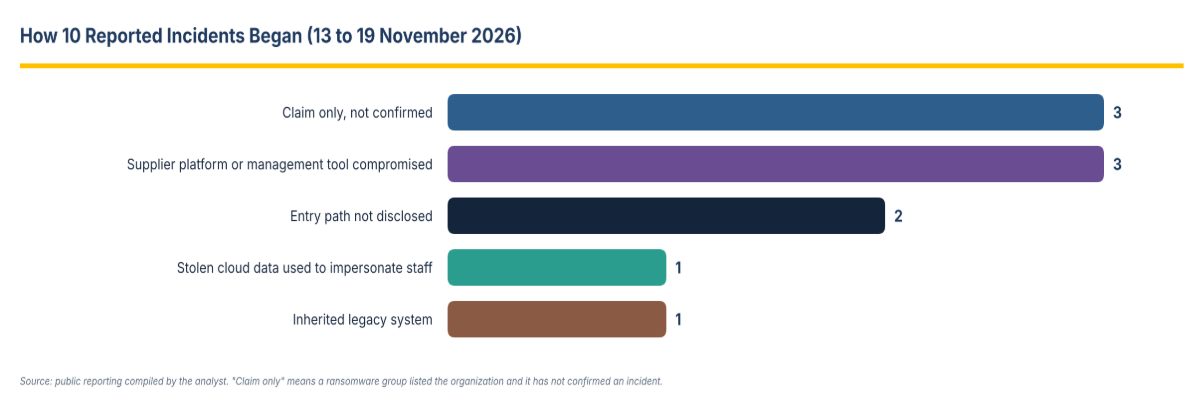
Figure 1. Initial access across 10 incidents first reported or updated between 13 and 19 November 2026.
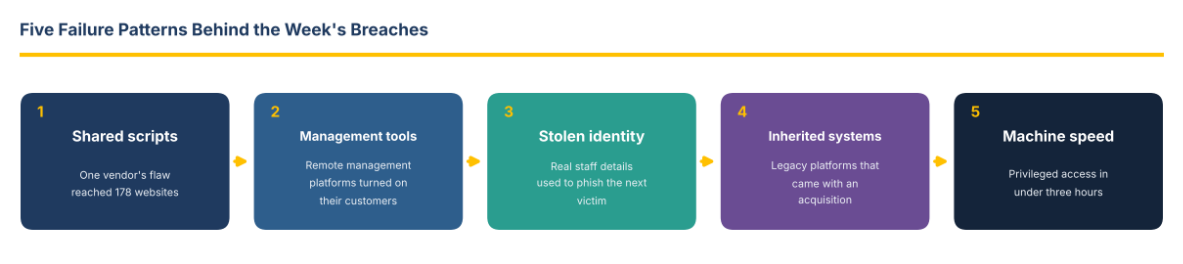
Figure 2. Five failure patterns behind the week’s breaches.
Shared scripts
Optimizely customers add one snippet to their pages and let the vendor manage the rest. When an attacker exploited a flaw in the vendor’s signup, 178 organizations ran attacker code on every page without a single deploy, using code that came from the vendor’s own domain and certificate. The same shared script pattern ran through the Convertr skimmer two weeks ago and the Polymarket drainer before it. A shared script is a shared failure.
Management tools
SCKit, N-central and the BroadWorks case from last issue all hit tools that exist to manage other systems. A remote monitoring platform holds authenticated, privileged access to hundreds of customers’ machines, which makes one compromise as valuable as hundreds. In the SCKit case the attackers went further and tried to turn the support session itself against the technician. Attackers are systematically targeting this class of tool.
Stolen identity
Star Blizzard did not need malware. It stole a staff directory and files from one organization, posed as one of its employees on a secure messaging app, and phished cloud credentials from a second organization that trusted that name. It then registered its own multifactor devices, passkeys and backup codes so that a password reset would not end its access. A real colleague’s name is the best lure there is.
Inherited systems
Maersk’s breach was in a legacy system that came with an acquisition it made in 2022, and the group claiming the theft says the data came from that platform. Maersk says the system was isolated, no customer or partner connections were compromised and, so far, no sensitive data was disclosed, and it disputes the claim that passwords were stored in plaintext. The FBI’s advisory on ARTEX makes a similar point from the other side: the framework is most effective against overlooked systems such as partner and supplier portals, mobile backends, sales tools, legacy services and third party integrations.
Machine speed
The FBI says some ARTEX intrusions went from initial targeting to privileged access in under three hours, and the techniques are ordinary: forged SAML responses, XML external entity flaws, server side request forgery, Kerberoasting and DCSync, chained without a human at the keyboard. Separately, reports describe pipelines that build exploits from patch differences, which shrinks the time between a fix and the first attack. Exposed and forgotten systems are found and tested immediately.
Questions to ask your own team
- Which third party scripts, tags and testing tools run on your login, payment and account pages, who can edit what they load and how would you know if one changed?
- Which remote management tools do you or your managed service providers run, are their extensions and plug ins reviewed, and can a technician session be hijacked?
- If an attacker knew a real employee’s name and role, what would stop them using it to reach a colleague or a partner, and how would you spot a rogue multifactor device?
- Which systems inherited from acquisitions or retired projects still hold live data, and who owns their security?
Breached organizations
Organizations are named as in public reporting. The list covers incidents first reported or materially updated between 13 and 19 November 2026. Attacker claims are marked as claims, and counts are those reported by the organization unless marked otherwise. Check each name against your own suppliers and their suppliers.
| Organization | Sector, country and date | How it happened | Scale and status |
|---|---|---|---|
| Optimizely (and 178 customer organizations) | Web experimentation platform, global. 16 Nov | Attacker exploited a flaw in account signup and added malicious JavaScript to customer projects, which the vendor’s CDN served on every page | Visitors to 178 organizations, 32 of them in banking and finance; crypto address swapper, card skimmer, cookie and screenshot theft and iPhone exploit loaders; cleaned by 23:11 UTC the same day |
| Customers of MSPs using ScreenConnect | Managed service providers and their customers, global. Reported 11 to 16 Nov | SCKit toolkit installed rogue ScreenConnect clients through a weak third party extension, and was built to hijack technician sessions | At least six MSPs and more than 286 endpoints in first reports; counts vary; ConnectWise disabled the extension and fixed a related flaw |
| N-central servers | Remote monitoring platform, global. Reported by 16 Nov | New exploit chain used to install XMRig cryptocurrency miners | At least 21 visible servers, 19 of which reported being on the first hotfix; follow-up hotfix pending |
| A.P. Moller-Maersk | Shipping and logistics, Denmark. Confirmed 11 Nov | Attacker reached a legacy system inherited through an acquisition and took data; WhiteArmor group listed the company on 7 to 8 Nov | Claim of about 100 GB and a $5 million demand with a 30 day deadline; Maersk says the system was isolated, operations are unaffected and no sensitive data has been disclosed |
| Mr. Cooper | Mortgage servicing, US. Update 12 Nov | Attackers had access to certain systems from 30 Oct to 1 Nov; entry not disclosed | Files with customer personal information taken; investigation confirmed customer data was affected; count not disclosed |
| Vanderbilt University | Education and health, US. Announced 9 Nov | Active cybersecurity incident that disrupted campus Wi-Fi and restricted most systems; a ransomware group has claimed it; entry not disclosed | Claim not confirmed by the university |
| Two US organizations (names not published) | Not disclosed. Case study 17 Nov | A Russian FSB linked group used a first organization’s stolen cloud data to impersonate an employee and phish a second organization; no malware | Cloud storage and employee lists taken from the first; persistent access for months through rogue MFA devices and passkeys |
| Airblue | Airline, Pakistan. Listed 12 Nov | Listed on the AoQin leak site; entry path unknown | Claim only: 710 GB including contracts, client, banking and personal records; publication date 23 Nov; not confirmed by the airline |
| TopGroup | Retail software, Argentina. Listed 18 Nov | Listed on the AoQin leak site; entry path unknown | Claim only; data publication date 25 Nov; not confirmed by the company |
| Culinary Specialties, Anmat Technology for Trading and Esco Optics | Food (US), trading (Saudi Arabia) and optics. Listed 16 to 17 Nov | Listed on the AoQin leak site; entry path unknown | Claims only; 70 GB and 6 GB claimed for two of them |
Notes. The AoQin listings are claims from leak site tracking, and the tracker flags the group as new, so its claims should be treated with caution until confirmed. The SCKit counts differ by source and are given as a range. The Optimizely count comes from an outside scan. We include the Star Blizzard case as one incident although it involves two organizations, because the case study describes one campaign.
02. Emerging Threats and Campaigns
OPTIMJACK: a vendor script platform turned on 178 organizations
Optimizely Web Experimentation lets website owners test changes to their pages. Each customer loads a small JavaScript snippet from the vendor’s content delivery network, and the snippet includes a field called Project JavaScript, in which a customer can write custom code that runs on every page. On 16 November an attacker exploited a vulnerability in Optimizely’s Experimentation account signup, which the company confirmed in an incident notice, and wrote a small loader into that field in 188 snippets belonging to 178 organizations. The first infected snippet was seen at 04:21 UTC. Because the file still came from the vendor’s own domain and certificate, browsers ran it as trusted. Researchers who checked 1,611 snippets found the code in 188. The vendor’s own marketing and login pages carried it too, which suggests a shared access path and not 178 separate account takeovers.
The payload changed during the day. The first stage swapped cryptocurrency wallet addresses on pages where a visitor was about to pay, a card skimmer was added at 13:43 UTC, and the code also stole cookies and page screenshots and tried to load iPhone exploit kits from domains registered that day. Optimizely says it fixed the vulnerability and removed the injected code, and researchers saw every infected snippet clean by 23:11 UTC. Of the 178 organizations, 32 are in banking and finance. Customers who use the platform should treat cards entered on affected pages on 16 November as potentially exposed, review the Project JavaScript field of every project and rotate credentials and tokens. For issuers, the risk is card fraud that traces to pages that were affected that day.
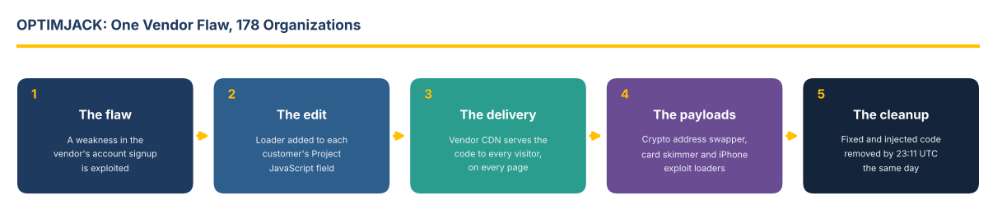
Figure 3. The OPTIMJACK compromise (after the vendor notice and outside research).
| Field | Detail |
|---|---|
| Platform | Optimizely Web Experimentation (A/B testing), JavaScript snippets served from the vendor’s CDN |
| Date | 16 Nov 2026; first infected snippet 04:21 UTC; skimmer added 13:43 UTC; all clean by 23:11 UTC |
| Entry | Vulnerability in Experimentation account signup, per the vendor; used to edit customer Project JavaScript |
| Scale | 188 infected snippets across 178 organizations out of 1,611 scanned; 32 in banking and finance |
| Payloads | Crypto address swapper, card skimmer, cookie and screenshot theft, iPhone exploit kit loaders |
| Fix | Vendor fixed the flaw and removed the code on 16 Nov; customers should audit Project JavaScript |
Recommendations
- Inventory every third party script on pages that handle logins, payments or account changes, including testing, analytics, chat and tag management tools, and remove the ones you do not need.
- Use a content security policy that limits where scripts can load from and send data to, add subresource integrity where scripts are static, and alert on changes to script content on payment pages.
- Restrict who can edit custom code fields in third party tools, require multifactor authentication on those accounts and log changes.
- If you use the platform, review Project JavaScript for 16 November, check card fraud against that date and tell customers if card entry was exposed.
ARTEX: the FBI issues a warning
On 13 November the FBI published FLASH 20261113-001, Threat Overview of ARTEX Autonomous Penetration Testing Framework. It says a variety of malicious actors have used ARTEX since at least August 2026 against organizations in financial services, government, technology, defense, semiconductor, energy, healthcare, manufacturing, telecommunications and legal sectors, and that some intrusions went from initial targeting to privileged access in under three hours. Analysis of attacker controlled instances shows that Chinese models are most commonly used, because of their cost and lack of observable guardrails when requests are framed as penetration testing. The advisory cites the ConnectWise supply chain compromise of Microsoft 365 customers and a Chinese speaking actor’s campaign against South Korean financial institutions, in which about 67,000 people’s data was exposed.
The tradecraft is ordinary, which is the point. The FBI describes agents that forge SAML responses, abuse XML external entity and server side request forgery flaws, run Kerberoasting and DCSync, add credentials to existing OAuth applications, create SSH key pairs, dump database credentials through SQL injection and read LAPS passwords. The framework is most effective against overlooked systems such as partner and supplier portals, mobile backends, employee and sales support tools, legacy services and third party integrations. It also lowers the skill needed, so that actors with minimal expertise can run complex operations against many targets at once. The advisory carries indicators of compromise and a detection pack, and asks organizations to report activity to the FBI or IC3. Separate research counted 1,608 publicly reachable ARTEX instances earlier this month. See also the separate iZOOlogic threat advisory on ARTEX, which covers the infrastructure behind the South Korean banking and Japanese campaigns.
A cloud provider’s threat team added a related finding on 16 November: threat actors have moved from manual prompting to autonomous multi agent frameworks, including ARTEX and others, and Russian speaking actors have built a pipeline, called exploit_agent, that compares software code before and after a vendor patch, infers the flaw, writes a working exploit and carries out the intrusion without a person. Its victims were mostly French media, entertainment and education sites. The pipeline also included scripts that removed other attackers’ web shells. The time from patch to attack, which defenders count in days, is being counted in hours.
- Treat partner and supplier portals, mobile backends and legacy services as primary targets, and test them with the same agents an attacker would use before they do.
- Review OAuth applications and service principals for credentials you did not add, new SSH keys, unusual access to LAPS passwords and bulk SAML or directory activity.
- Patch internet facing systems in hours when a fix and a public exploit exist together, and use compensating controls such as isolation while you do.
- Review the FBI indicators and detection rules, and report any ARTEX related activity.
Chinese state linked groups target banks for intelligence
A report published on 17 November describes Chinese state linked clusters going after banks and financial technology companies around the world, mainly in the Americas, the Middle East and Southeast Asia, for intelligence on economic activity and not for money. Five clusters, tracked under a vendor’s panda naming scheme, are described. They use remote access tools such as ShadowPad and Vshell and a network scanner called Fscan, and a cluster that attacked a financial institution in Southeast Asia and a fintech company in North America used Vshell and Fscan. Researchers counted 64 ShadowPad and 115 Vshell command servers between 1 January and 1 June 2026, and found an open directory on a Vshell server holding the two tools. The groups also spy on Microsoft 365 accounts to monitor economic activity.
- Hunt for ShadowPad and Vshell in your environment, for Fscan like internal scanning and for unusual access to Microsoft 365 mailboxes and files by service accounts and new applications.
- Review conditional access, legacy authentication, mailbox audit and OAuth consent in Microsoft 365, and alert on bulk mailbox access and new mailbox rules.
- Share indicators with sector bodies, since the same infrastructure is used against several institutions.
N-central: exploited again, on patched servers
Last issue covered the 33 alleged N-central flaws published as Able2Shell and N-able’s first hotfix, build 2026.4.1.26. This week a new chain, tracked as 4EverAble2Shell, was reported exploited to install XMRig cryptocurrency miners. Researchers saw at least 21 visible N-central servers compromised, and 19 of them reported that they were on Hotfix 2, so the first hotfix did not close the new route. The campaign installs miners today, but the same access in other hands would allow takeover of every endpoint the server manages. N-able has said further security updates will follow. Keep every N-central server, hosted or on premises, at the latest build, treat any server exposed to the internet as potentially compromised and ask your managed service providers what they have done.
Refrigeration controllers: more flaws
A Dutch security consultancy reported six unpatched flaws in Danfoss AK-SM800A refrigeration controllers that could let a remote attacker take over a controller without logging in, and sensors recorded probing of newly disclosed flaws in controllers made by another manufacturer within days. This follows the French attribution of the October sabotage to an Iranian IRGC unit, covered last issue. The practical advice has not changed: take controllers off the internet, change default credentials and use independent alarms. Treat unpatched controller flaws as likely to be probed.
03. Threat Actor Activity
Star Blizzard (COLDRIVER, Callisto)
Star Blizzard is a Russian espionage group that the US Justice Department has tied to the Federal Security Service, the FSB. Other researchers track it as COLDRIVER, COLD RELIC and Callisto. It is known for long running spear phishing of government officials, think tanks, journalists, defense and technology staff, and for document theft malware used in separate 2025 campaigns. It is not the SVR group APT29, also known as Midnight Blizzard, that was covered in an earlier issue, although both are Russian and both favour credential and cloud account attacks over exploits. Its method is patient and personal: it builds a relationship with a victim, often by posing as someone they know, and then steals their credentials.
A case study published on 17 November shows how far that has gone. In late 2025 the group broke into a US organization’s cloud office suite, stole its staff directory and cloud files, downloaded the entire cloud storage drive, exported employee lists in a domain wide export, and used the admin console to fingerprint the defenses and remove evidence of the first intrusion. It kept access for several months by registering rogue multifactor devices, passkeys and backup codes, so a password reset would not have removed it. In 2026 it used what it had taken to impersonate an employee of the first organization, contacted people at a second US organization through a secure messaging application and phished their cloud credentials. The group also took emails and cloud drive documents. The case study identifies no malware in either breach. It was the stolen identity, the unauthorized authentication methods and a convincing approach that did the work. Researchers saw fresh phishing activity as recently as November 2026.
For financial institutions the lesson is about trust. If a supplier, law firm or partner is compromised, an attacker may know the names, roles and ongoing conversations of the people who deal with you, and a message from that person may be real in every detail except its sender. The attribution is a US government assessment, and the case study does not name either victim.
| Attribute | Detail |
|---|---|
| Names | Star Blizzard; COLDRIVER, COLD RELIC and Callisto in other research |
| Assessed origin | Russia; tied to the FSB by the US Justice Department |
| Motivation | Espionage: documents, email, contacts and credentials for later targeting |
| Typical targets | Government, think tanks, journalists, defense and technology staff, and organizations connected to them |
| Initial access | Spear phishing for cloud credentials, often through impersonation of a known contact on email or a secure messaging application |
| Persistence | Rogue multifactor devices, passkeys and backup codes; admin console changes |
| Data targeted | Cloud storage, email archives, staff directories, credentials and employee lists |
| Status | Active; fresh phishing seen in November 2026; case study published 17 Nov 2026 |
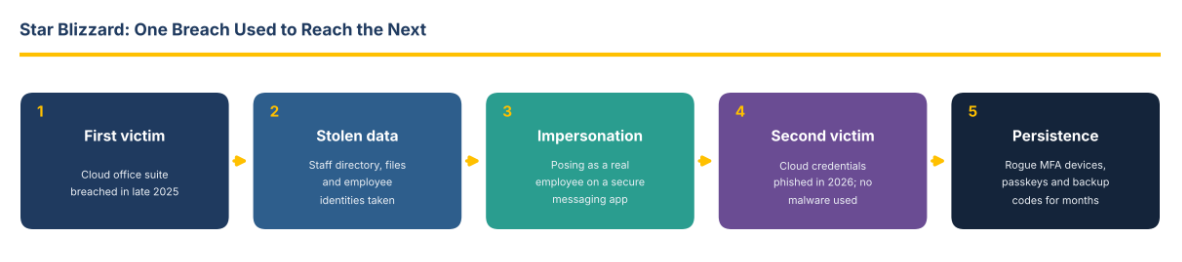
Figure 4. Star Blizzard using one breach to reach the next (after the published case study).
Hunting guidance
| Signal | Where to look | Why it matters |
|---|---|---|
| New multifactor devices, passkeys or backup codes registered outside normal enrolment | Identity provider and cloud suite audit logs | The group used these to keep access after a password reset |
| Sign ins to cloud accounts followed by large exports of storage or directory data | Cloud audit and data loss logs | Whole drives and domain wide exports were taken |
| Admin console changes that alter or remove security settings or logs | Admin audit logs | The group fingerprinted defenses and removed evidence |
| A new contact on a messaging application claiming to be a known colleague or partner, followed by a link or a request to sign in | Staff reports and security awareness feedback | The second victim was approached by an impersonator |
| Sign in from an unfamiliar address using valid credentials that the user says they did not use | Identity provider risk and sign in logs | No malware was used; credentials were the entry |
MITRE ATT&CK techniques
Technique IDs are our own mapping from the published case study.
| Tactic | ID | Technique | Observed procedure |
|---|---|---|---|
| Initial Access | T1566.002 | Phishing: Spearphishing Link | Phishing of cloud credentials through a trusted contact |
| Defense Evasion | T1656 | Impersonation | Posing as an employee of the first victim |
| Initial Access | T1078.004 | Valid Accounts: Cloud Accounts | Stolen cloud credentials used to sign in |
| Persistence | T1098.005 | Account Manipulation: Device Registration | Rogue multifactor devices registered |
| Persistence | T1556.006 | Modify Authentication Process: Multi Factor Authentication | Passkeys and backup codes added |
| Discovery | T1087.004 | Account Discovery: Cloud Account | Staff directory and employee list exports |
| Collection | T1530 | Data from Cloud Storage | Entire cloud storage drive downloaded |
| Collection | T1114 | Email Collection | Email archives targeted |
| Defense Evasion | T1070 | Indicator Removal | Admin console used to remove evidence of the first intrusion |
Recommendations
- Alert on any new multifactor method, passkey or backup code, and require a second approver or a verified in person or phone check for enrolment after a reset.
- Treat a message from a known contact that asks you to sign in or open a link as untrusted until verified through a separate channel, particularly on messaging apps outside the company.
- Warn suppliers, law firms and advisers that an attacker with their directory can use it against you, and agree on how you will verify requests that come in their name.
- Review who can export cloud drives, directories and mailboxes, set alerts for bulk exports and keep audit logs where administrators cannot delete them.
- After any cloud account compromise, remove all multifactor methods, passkeys and backup codes and re-enrol, not only the password.
04. Ransomware and Data Leaks
AoQin Ransomware (new group, aggressive anti recovery)
AoQin is a ransomware group that first appeared on leak site trackers on 4 November 2026. Its Windows encryptor appends the .AOQIN extension, drops a note called HELP-SUPPORT.txt and sets a wallpaper that repeats the note. The note is signed AoQin Group and says the victim has been attacked and is offered a deal. It describes the group as not politically motivated and interested only in money, says the group always keeps its word and gives seven days to join a chat room and start negotiations. It tells victims to download Tor Browser, and gives a leak portal address, a chat room address and an authentication code to register in the chat. After joining, the victim may request a test decryption of a file and a list of the files stolen, and at the end the two sides agree a price. Victims are told not to try to recover files with third party programs, not to turn off or restart the computer and not to procrastinate.
The group’s claims are unverified, and trackers describe it as an emerging group whose listings should be treated with caution. Within two weeks of its first listing it had posted at least seven organizations in Slovenia, China, the United States, Saudi Arabia, Pakistan and Argentina, in electronics, food, retail software, trading and airline sectors, with claimed volumes from 6 GB to 710 GB. The wide spread of victims suggests opportunistic targeting, or an affiliate model, and not a sector focus. One sentence in the note does not fit: it says the group has the victim’s income and insurance documents, which makes sense for an individual but not for a company, so the wording looks recycled from a template aimed at private victims. That is a caution against reading the note as evidence of what was taken.
The encryptor’s technical behaviour is more careful than its note. The sandbox shows it deleting shadow copies and using the Volume Shadow Copy COM API, deleting the backup catalog with wbadmin and disabling use of System Restore points, which removes the usual routes to recovery. It enumerates connected drives (23 locations in the sandbox), so mapped and secondary drives are in scope. It writes a file to the Startup folder, adds a Run key, uses the Task Scheduler COM API and runs PowerShell, and it uses NTFS alternate data streams on 64 items, a way of hiding or marking data inside files. It reads browser profile data, a credential theft behaviour, and drops a file in the Windows directory. We saw no data exfiltration in the sandbox, so the claim of stolen files rests on the group’s leak portal listings.
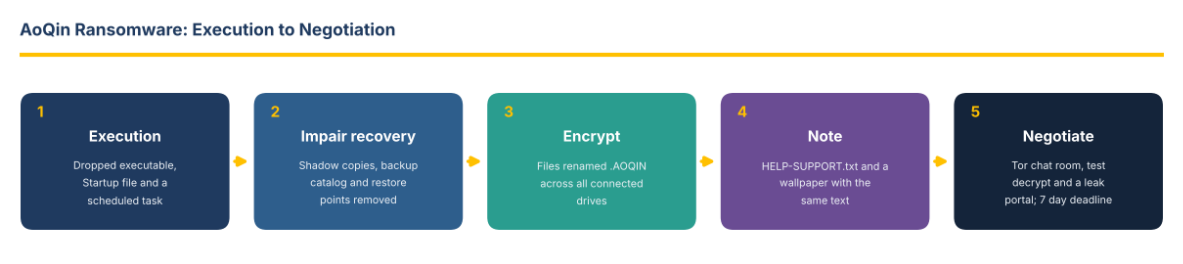
Figure 5. AoQin flow from execution to negotiation (assembled from sandbox behaviour signatures and the note).
Observed evidence
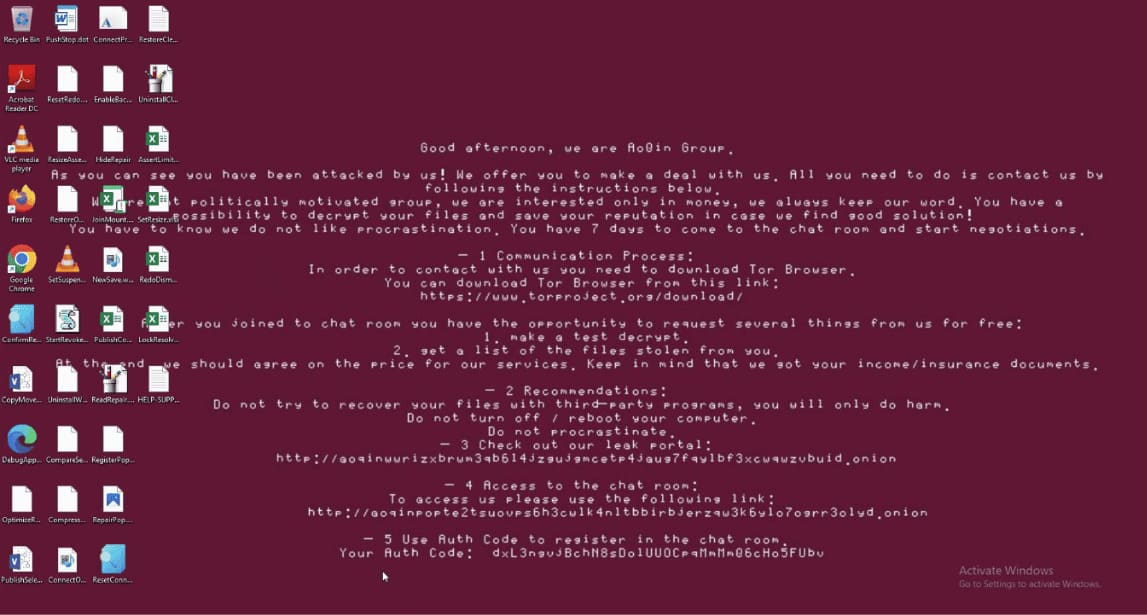
Figure 6. The sandbox desktop after execution, with the AoQin note repeated as the wallpaper.
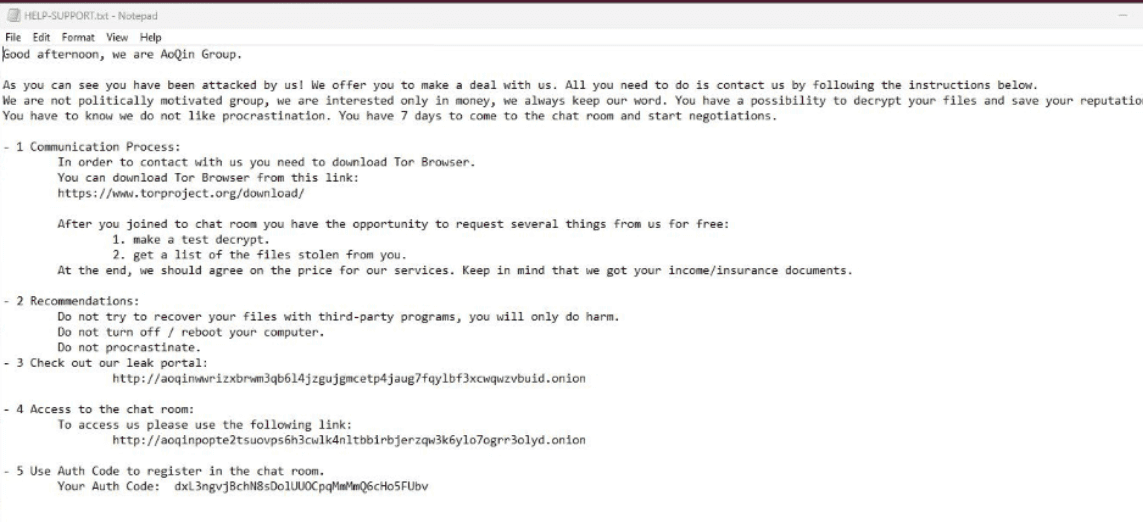
Figure 7. The HELP-SUPPORT.txt ransom note in the sandbox, with the leak portal, chat room and authentication code.
Recent AoQin listings
| Organization | Country and sector | Listed | Claim and status |
|---|---|---|---|
| Nextron Technology | China, electronic components | 4 Nov | Claim; publication date 10 Nov; not confirmed |
| SILIKO d.o.o. | Slovenia | 4 Nov | Claim of 230 GB; not confirmed |
| Airblue | Pakistan, airline | 12 Nov | Claim of 710 GB (contracts, client, banking and personal records); publication 23 Nov; not confirmed |
| Culinary Specialties | United States, food | 16 Nov | Claim of 70 GB; not confirmed |
| Anmat Technology for Trading | Saudi Arabia, trading | 16 Nov | Claim; not confirmed |
| Esco Optics | Optics | 17 Nov | Claim of 6 GB; not confirmed |
| TopGroup | Argentina, retail software | 18 Nov | Claim; publication 25 Nov; not confirmed |
MITRE ATT&CK techniques
The first group of rows is the sandbox mapping. Rows marked as added are our own, for behaviour the sandbox report shows but its mapping leaves out.
| Tactic | ID | Technique | Observed procedure |
|---|---|---|---|
| Execution | T1059.001 | Command and Scripting Interpreter: PowerShell | Runs PowerShell |
| Execution | T1047 | Windows Management Instrumentation | Uses WMI |
| Persistence | T1547.001 | Boot or Logon Autostart: Registry Run Keys or Startup Folder | Adds a Run key and a Startup folder file |
| Privilege Escalation | T1547.001 | Boot or Logon Autostart: Registry Run Keys or Startup Folder | Startup persistence |
| Defense Evasion | T1006 | Direct Volume Access | Accesses volumes directly |
| Defense Evasion | T1564.011 | Hide Artifacts: Ignore Process Interrupts | Ignores hangups and interrupts when running commands |
| Defense Evasion | T1070.004 | Indicator Removal: File Deletion | Deletes shadow copies and the backup catalog |
| Defense Evasion | T1112 | Modify Registry | Sets the wallpaper and disables System Restore points |
| Credential Access | T1555.003 | Credentials from Web Browsers | Reads user and profile data of web browsers |
| Credential Access | T1552.001 | Unsecured Credentials: Credentials In Files | Sandbox flagged reads of credential material in files |
| Discovery | T1120 | Peripheral Device Discovery | Enumerates connected drives |
| Discovery | T1012 | Query Registry | Reads system settings |
| Discovery | T1082 | System Information Discovery | Enumerates system information |
| Discovery | T1016 | System Network Configuration Discovery | Reads the hostname and domain |
| Collection | T1005 | Data from Local System | Collects local data |
| Impact | T1491 | Defacement | Replaces the desktop wallpaper |
| Impact | T1490 | Inhibit System Recovery | Deletes shadow copies, the backup catalog and restore points |
| Impact (added) | T1486 | Data Encrypted for Impact | Encrypts files and appends .AOQIN |
| Defense Evasion (added) | T1564.004 | Hide Artifacts: NTFS File Attributes | Uses NTFS alternate data streams |
| Discovery (added) | T1497.001 | Virtualization/Sandbox Evasion: System Checks | Checks SCSI registry keys |
Indicators of compromise
| Indicator | Type | Context |
|---|---|---|
| 96427e3c825f279ceba93232 b7620536e8adb0a7cfd1b4 055b4bb9f4e3956858 | SHA256 | AoQin sample |
| .AOQIN | File extension | Appended to encrypted files |
| HELP-SUPPORT.txt | Filename | Ransom note |
| aoqinwwrizxbrwm3qb6l 4jzgujgmcetp4jaug7fqylbf3 xcwqwzvbuid[.]onion | Tor address | Leak portal (transcribed from the note; verify) |
| aoqinpopte2tsuovps6 h3cwlk4nltbbirbjerzqw3k6 ylo7ogrr3olyd[.]onion | Tor address | Chat room (transcribed from the note; verify) |
| dxL3ngvjBchN8sDolUU OCpqMmMmQ6cHo5FUbv | Auth code | Printed in the note for this sample; expected to differ per victim |
| Good afternoon, we are AoQin Group | Note text | First line of the note and wallpaper |
Other ransomware and extortion activity
The WhiteArmor group listed Maersk on its leak site over the weekend of 7 and 8 November and demands $5 million in Bitcoin within 30 days for about 100 GB it says it took from the OCF and LF Logistics platform, which Maersk acquired in 2022. Maersk confirmed on 11 November that an attacker had accessed a legacy system and extracted data, says the system was isolated, does not mention encryption in its statement, and disputes the group’s claim of plaintext passwords. Mr. Cooper, a US mortgage servicer, said attackers had access to some systems from 30 October to 1 November and took files holding customer personal information. Vanderbilt University announced a cybersecurity incident on 9 November that disrupted campus Wi-Fi and restricted most systems, and a ransomware group has claimed it. Ransomware leak claims remain claims until the organization confirms.
Recommendations
- Keep offline or immutable backups and test restoration. AoQin removes shadow copies, the backup catalog and restore points, and covers every connected drive.
- Alert on wbadmin delete catalog, shadow copy deletion, changes that disable System Restore, new Startup folder files and Run keys, PowerShell launched by unexpected parents and bursts of alternate data stream writes.
- Assume browser stored passwords on an infected machine are stolen. Reset credentials, revoke sessions and review mapped drives that the machine could reach.
- Do not rely on the wording of a note to judge what was stolen. Ask the supplier or incident responders for evidence, and check the leak site for samples.
- Review inherited and legacy systems for live data, isolate them and decide who owns their security, since the Maersk case turned on one.
05. Credential and Account Exposure
SCKit: a toolkit that turns the support session against the technician
SCKit is a 16 file toolkit used in an active campaign against managed service providers that run ConnectWise ScreenConnect, the remote support platform. Responders first raised the alarm on 11 November, when they were tracking six compromised MSPs and more than 286 affected endpoints, and the numbers kept climbing. They traced the entry to a possible authentication weakness in RMM+, a third party extension that lets other management tools issue commands through ScreenConnect without technicians using its console. ConnectWise disabled rogue RMM+ extensions and later released a fix for CVE-2026-84869, a flaw in the client side component that technicians use, which blocks the part of the toolkit that spreads to technician workstations.
The chain is simple and effective. The attacker uses the MSP’s own ScreenConnect instance to direct a managed endpoint’s client to start cmd.exe as SYSTEM. The commands create Microsoft Defender exclusions, stop the legitimate ScreenConnect client and install a second client that connects to an attacker controlled ScreenConnect instance, which gives a remote access channel separate from the MSP’s approved one. Persistence comes from a scheduled task named TrapWatch and from registry Run entries, so that the toolkit is available for a later support connection. The toolkit also deploys RelayTrap, a component designed to deliver a malicious payload to a technician who connects to the infected machine, and to collect local browser session data and authentication cookies. The aim is to use a technician’s trusted sessions against other customers they manage, which could turn one MSP customer into every customer. The responders say that part of the attack never succeeded.
Several reports give different numbers. Early reports counted six MSPs and 286 endpoints, another counts 288 endpoints across 48 organizations in 90 minutes, and one claims more than 400 MSP environments in four days. A separate report counts at least 688,000 guest file run requests across 42 MSP ScreenConnect servers between 20 October and 16 November, which are attempts and not confirmed compromises. Defenders should investigate technician workstations and downstream endpoints, because removing the unauthorized client does not remove the toolkit’s persistence or invalidate exposed web sessions. For financial institutions the exposure is through their MSPs, since a single compromised provider can reach every client it serves.
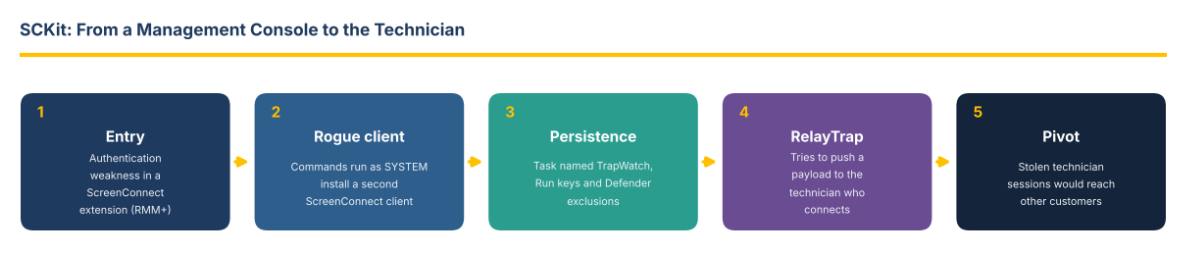
Figure 8. The SCKit chain from a ScreenConnect extension to the technician (after the published research).
| Attribute | Detail |
|---|---|
| Type | Remote access toolkit with a technician targeting component; 16 files; worm like by design |
| Platform | ConnectWise ScreenConnect, with a third party RMM+ extension as the entry |
| Flaws | Possible authentication weakness in the RMM+ extension; CVE-2026-84869 in the technician client component (fixed) |
| Persistence | Scheduled task TrapWatch; registry Run entries; Defender exclusions; legitimate client stopped |
| Components | Rogue ScreenConnect client enrolment; RelayTrap; local browser session collection |
| Scale | At least six MSPs and more than 286 endpoints in early reports; other counts are higher; counts vary |
| Technician pivot | Built, but responders say it did not succeed |
MITRE ATT&CK techniques
Technique IDs are our own mapping from the published research.
| Tactic | ID | Technique | Observed procedure |
|---|---|---|---|
| Initial Access | T1199 | Trusted Relationship | The MSP’s management instance used to reach customer endpoints |
| Execution | T1059.003 | Command and Scripting Interpreter: Windows Command Shell | cmd.exe started as SYSTEM through ScreenConnect |
| Persistence | T1053.005 | Scheduled Task/Job: Scheduled Task | Task named TrapWatch |
| Persistence | T1547.001 | Boot or Logon Autostart: Registry Run Keys | Run entries |
| Defense Evasion | T1562.001 | Impair Defenses: Disable or Modify Tools | Defender exclusions created |
| Command and Control | T1219 | Remote Access Software | Second ScreenConnect client to an attacker instance |
| Credential Access | T1539 | Steal Web Session Cookie | Technician cookies collected by RelayTrap |
| Lateral Movement | T1021 | Remote Services | Intended pivot through technician sessions |
Indicators of compromise
| Indicator | Type | Context |
|---|---|---|
| TrapWatch | Scheduled task | Persistence for SCKit |
| A second ScreenConnect client pointing to an unfamiliar instance | Software | Rogue client enrolled by the toolkit |
| Defender exclusions created through remote commands | Configuration | Added before the toolkit is staged |
| RMM+ extension installed or enabled without approval | Configuration | The reported entry route |
| Guest run file requests to a ScreenConnect server from unfamiliar addresses | Network | Pattern reported across many MSP servers |
Recommendations
- If you run ScreenConnect, audit installed extensions, remove RMM+ and any extension you did not approve, apply the vendor’s fixes including CVE-2026-84869, and review the guest access setting.
- Search for the TrapWatch task, a second ScreenConnect client, new Defender exclusions and unexplained commands in the ScreenConnect command history. Remediate through a separate management route, not through the compromised instance.
- Invalidate technician sessions and cookies, rotate credentials used from technician workstations and investigate those workstations and downstream endpoints, not only the infected ones.
- Ask your managed service providers what remote tools they use, which extensions they run, how they would tell you of a compromise and whether technician access to your systems is limited and logged.
- Do not let a management tool’s own console be the only way to check it. Keep an independent way to see what the tool has done on your endpoints.
Multifactor methods as a way to stay in
Star Blizzard’s case, under Threat Actor Activity, shows a quiet way to keep an account. Instead of keeping a stolen password, the group registered its own multifactor devices, passkeys and backup codes, which survive a password reset and look like normal security settings. Organizations that respond to an account compromise by resetting the password and the active sessions may leave the attacker’s second way in untouched. Treat every authentication method on a compromised account as suspect.
- After any cloud account compromise, list and remove every multifactor method, passkey and backup code, then re-enrol the user from a verified channel.
- Alert on new authentication methods for administrators and users with access to payments, directories or sensitive storage.
- Limit who can register passkeys and backup codes, and require a verified channel for enrolment after a reset.
06. Vulnerability Intelligence
Two disclosures from the same two days are covered here, plus a management flaw that matters for MSPs. Java4Shell and NGINX2Root are memory corruption flaws in the Java runtime and the nginx web server, which together sit under a very large share of financial applications. Neither had known exploitation on 18 November, but both have working demonstrations, and the history of recent flaws suggests the gap will be short.
| Priority | CVE | Product and severity | Exploitation and fix |
|---|---|---|---|
| 1 Immediate | CVE-2026-114938 (Java4Shell) | OpenJDK Base64 decoder, out of bounds write on AVX-512 processors; CVSS 9.2 (v4.0), 8.1 (v3.1), 9.8 elsewhere | Pre-auth code execution demonstrated in several products; no exploitation reported; fixed in 17.0.21.1, 21.0.13.1, 25.0.5.1, 27.0.1.1 |
| 2 Immediate | CVE-2026-123007 and four more (NGINX2Root) | nginx, remote code execution in HTTP/2 and other handling; CVSS 9.2 (v4.0) | No exploitation reported; fixed in 1.31.9 and 1.30.7; chain to root needs an unpatched kernel flaw |
| 3 Immediate for MSPs | CVE-2026-84869 | ScreenConnect technician client component, used in the SCKit chain | Attempts reported; fixed by the vendor |
CVE-2026-114938: Java4Shell, OpenJDK Base64 Decoder Out of Bounds Write
Java4Shell is a memory corruption flaw in the hand written x86-64 assembly that OpenJDK’s JIT compiler uses to decode Base64 on processors that support the AVX-512 VBMI instruction set. A short, malformed Base64 string is enough to write past the end of a heap buffer, and Base64 is decoded before authentication in many applications, in login headers, tokens, cookies and uploads. Researchers disclosed it on 17 November, and OpenJDK and Oracle released fixes the same day. The flaw is in the Java runtime itself, so scanners that read application dependencies will not find it, and the fix is a new Java runtime and a restart of every service that uses it. It affects Java 17 from 17.0.6, where the decoder was backported, and Java 21, 25 and 27. Java 8 and 11 are not affected, except for one Oracle Java 8 performance build.
The researchers demonstrated pre-authentication code execution in default configurations of Apache Kafka, Atlassian Confluence and Jira, JFrog Artifactory, Jenkins, Keycloak, Gerrit, PingFederate and Spring Boot applications, and post-authentication execution against Elasticsearch. These are the products that hold keys, tokens, identities and build pipelines, which makes a successful attack more than a single server compromise. Each demonstration needs an exploit tailored to the product, and no public exploit or exploitation had been reported on 18 November. One analysis estimates that fewer than 0.12 percent of Java processes are at risk of code execution, though many more can be crashed. Severity labels disagree: the OpenJDK and Oracle scores are 8.1 with high attack complexity, the researchers score it 9.2 under CVSS 4.0 and Red Hat scores it 9.8, so a low score on one list should not be read as low risk for an identity or build server. Red Hat’s builds were still being prepared on the day of disclosure, and a JVM option can disable the intrinsic until the fixed runtime is installed.
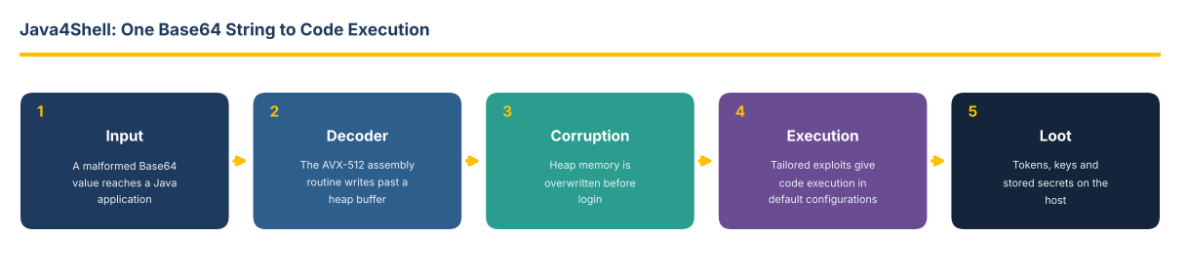
Figure 9. How Java4Shell turns a Base64 value into code execution (after the published research).
| Field | Detail |
|---|---|
| CVE ID | CVE-2026-114938 (Java4Shell) |
| Affected product | OpenJDK and builds from Oracle and other vendors; the Base64 decoder intrinsic on x86-64 CPUs with AVX-512 VBMI |
| Affected versions | Java 17 from 17.0.6, Java 21, 25 and 27; Java 8 and 11 not affected, except an Oracle Java 8 performance build |
| Fixed versions | 17.0.21.1, 21.0.13.1, 25.0.5.1 and 27.0.1.1; vendor builds vary; some vendors still pending |
| Severity | CVSS 9.2 (v4.0); 8.1 (v3.1, high attack complexity); 9.8 in some vendor records |
| Vulnerability type | Out of bounds write on the Java heap in the Base64 decoder |
| Exploitation status | No exploitation or public exploit reported as of 18 Nov 2026; pre-auth code execution demonstrated against several products |
| Interim measure | Set the JVM option -XX:-UseBASE64Intrinsics; revoke secrets held by exposed Java services |
Recommendations
- Find every Java runtime on x86-64 hosts with AVX-512, including those bundled with products such as Jira, Confluence, Jenkins, Keycloak, Kafka and Artifactory, and apply fixed builds, then restart the services.
- If you cannot update at once, set the JVM option to disable the Base64 intrinsic, and limit network access to identity, build and artifact servers.
- Treat secrets, tokens and keys held by exposed Java services as at risk, and rotate them after patching if the service was reachable from untrusted networks.
- Ask your suppliers which Java version their products bundle and when they will ship fixed builds, because the runtime is often inside the product.
CVE-2026-123007 and four more: NGINX2Root, nginx Remote Code Execution
NGINX2Root is a set of five remote code execution flaws in nginx disclosed on 18 November, found independently by several research teams that reported them to F5. Each lets an unauthenticated remote attacker run commands with the privileges of an nginx worker process, in different configurations. The lead flaw, CVE-2026-123007, is an integer overflow in HTTP/2 flow control that affects every official release from 1.9.5 through 1.31.8 when HTTP/2 is enabled. CVE-2026-123633 is a use after free that occurs when nginx closes an HTTP/2 connection and frees a request that is still opening an upstream connection, and CVE-2026-121810 is the same pattern on HTTP/3. CVE-2026-123634 needs a resolver and a variable proxy_pass with mirroring, which is rare, and CVE-2026-113425 is in the mail proxy with auth_http. The researchers chained any one of them with a separate Linux kernel SCTP flaw to gain root on the host, including from inside a Docker container. That kernel flaw has no CVE and no patch yet, so patching nginx removes the remote entry point but not the step to root.
Fixed releases are nginx 1.31.9 for the mainline branch and 1.30.7 for the stable branch, with reports differing on whether they were available on 18 or 19 November. Ubuntu and Debian had not shipped fixed packages on 18 November, so check your distribution’s advisory. Disabling HTTP/2 mitigates CVE-2026-123007 and CVE-2026-123633, but services that need HTTP/2, such as gRPC, will stop working, and it does not cover the mail proxy flaw. For the resolver flaw, point proxy_pass at a fixed upstream group. No exploitation has been reported. The flaw is in nginx’s own code, so no application behind it has to be at fault, and nginx often fronts payment and login pages and runs inside ingress controllers and containers.
| Field | Detail |
|---|---|
| CVE IDs | CVE-2026-123007, CVE-2026-123633, CVE-2026-121810, CVE-2026-123634, CVE-2026-113425 |
| Affected product | nginx open source and related builds; the lead flaw affects 1.9.5 through 1.31.8 with HTTP/2 enabled |
| Fixed versions | 1.31.9 (mainline) and 1.30.7 (stable); distribution packages vary |
| Severity | CVSS 9.2 (v4.0) for each; code execution as the nginx worker; root needs a separate kernel flaw |
| Vulnerability types | Integer overflow (HTTP/2), use after free (HTTP/2 and HTTP/3), resolver and mirror handling, mail proxy authentication |
| Exploitation status | No exploitation reported as of 18 Nov 2026 |
| Interim measure | Disable HTTP/2 where possible (covers the two HTTP/2 flaws); fixed proxy_pass upstreams; restrict exposure |
Recommendations
- Inventory nginx instances, including those inside containers, ingress controllers and appliances, and upgrade to 1.31.9 or 1.30.7 as soon as your distribution or vendor provides them.
- Where you cannot patch, disable HTTP/2 on exposed servers after testing, remove request time DNS from proxy_pass and restrict who can reach the server.
- Patch the Linux kernel when the SCTP flaw is fixed, and disable SCTP where you do not need it, since it is the step from worker to root.
- Watch for worker crashes and unusual child processes from nginx, and for HTTP/2 connections with abnormal flow control behaviour.
Also this week
Attackers have chained the PHP2Shell flaws from earlier issues with a root privilege escalation, CVE-2026-123039, against the remote access and security gateway appliances of a leading firewall vendor, so patch status on security gateways that run PHP management interfaces needs checking. The ScreenConnect flaw CVE-2026-84869 is covered under Credential and Account Exposure. An exploited UnrealIRCd flaw (CVE-2026-114713) and unpatched GeoVision camera software used to deploy miners were reported, and browser and Windows zero days were patched this week, although we have not reviewed the details. Last issue’s SAP, BroadWorks and GPUStack flaws remain urgent.
07. Darkweb and Underground Activity
AoQin: a new leak portal and its countdowns
AoQin’s leak portal is built the way established groups build theirs: victim listings with a description, a revenue estimate, the volume of data claimed, a status that says not paid and a countdown to publication. Airblue’s entry says 710 GB and a publication date of 23 November, and TopGroup’s gives 25 November. The portal and its chat room are on Tor, and the note includes a one time authentication code that lets the victim register in the chat, where they may request a test decryption and a list of the stolen files. Trackers flag the group as new and its claims as unverified, and the sample’s note language suggests a template. The first checks for a victim are the list of files and the test decrypt, which the group offers for free, and whether the listing’s description matches your real business.
WhiteArmor and the Maersk listing
WhiteArmor listed Maersk over the weekend of 7 and 8 November, asked $5 million in Bitcoin and set a 30 day deadline, which gives a pressure date in early December. It claims about 100 GB, driver and device records and super administrator accounts from a platform Maersk inherited, and Maersk says the platform was isolated and disputes the claim of plaintext passwords. The case shows how extortion groups scan acquisitions for old platforms with weak controls and then build their story around them. For anyone who has acquired a business, the first question is what legacy systems came with it and whether they hold live data.
OPTIMJACK infrastructure and iPhone exploit loaders
The OPTIMJACK payloads came from infrastructure registered on the day of the attack: a loader domain that served the first stage and several throwaway domains for the iOS stage, all registered on 16 November. The attacker also included code that tried to load iPhone exploit kits, which is unusual in a card skimming operation and suggests either a second buyer for the access or a group that has both skimming and mobile exploitation skills. The code was removed within a day, but the infrastructure pattern is familiar: fresh domains, a crypto address swapper first and a skimmer added later in the day. Expect copycat attempts against other script platforms.
08. Key Takeaways
- Know every script on your payment and login pages. A flaw in one vendor’s signup put attacker code on 178 organizations’ sites for about 16 hours, 32 of them in banking and finance. Use content security policy, restrict who can edit custom code and watch for changes.
- Management tools are a path to every customer. SCKit used a ScreenConnect extension and tried to hijack technicians, and N-central is being exploited on servers with the first hotfix. Audit extensions, keep platforms at the latest build and ask your MSPs what they have done.
- Machine speed is documented. The FBI says some ARTEX intrusions reached privileged access in under three hours, and other agents build exploits from patch differences. Patch exposed systems in hours, and test your partner portals, mobile backends and legacy services yourself.
- Patch the runtime and the front door. Java4Shell and NGINX2Root hit Java and nginx. Neither had known exploitation on 18 November, but both have working demonstrations. Update, disable the features that give mitigation and rotate secrets held by exposed services.
- A real colleague’s name is the best lure. Star Blizzard used one organization’s stolen directory to impersonate a staff member and breach another, with no malware, and kept access through rogue multifactor methods. Alert on new authentication methods and re-enrol after any compromise.
- Inherited systems are live risks. Maersk’s breach was in a platform from a 2022 acquisition, and the FBI says overlooked systems are where agents succeed. Inventory legacy systems, isolate them and give them an owner.
- Do not judge ransomware claims by the note. AoQin’s note makes claims about income documents that do not fit corporate victims, and its listings are unverified. Ask for evidence and use the group’s test decrypt offer only through incident responders.
- Keep claims separate from evidence. The AoQin listings, WhiteArmor’s Maersk claims, the SCKit scale and the Star Blizzard attribution all rest on a single source or on unpublished evidence.
Priority actions this week
| Priority | Action | Why now |
|---|---|---|
| Immediate | Update Java to 17.0.21.1, 21.0.13.1, 25.0.5.1 or 27.0.1.1 (or vendor equivalents) and restart; use -XX:-UseBASE64Intrinsics if you cannot; revoke exposed secrets | Java4Shell gives pre-authentication code execution in default configurations of identity, build and collaboration products |
| Immediate | Upgrade nginx to 1.31.9 or 1.30.7 when packages are available; disable HTTP/2 on exposed servers after testing where you cannot | NGINX2Root is five remote code execution flaws in a web server that fronts many applications |
| Immediate | If you run ScreenConnect, remove RMM+ and unapproved extensions, apply the fixes, hunt for TrapWatch and a second client, and invalidate technician sessions; ask your MSPs the same | SCKit hit MSPs and their customers and was built to hijack technicians |
| Immediate | Update N-central to the latest build and treat any internet facing server as possibly compromised | 4EverAble2Shell is exploited on servers that had the first hotfix |
| This week | Inventory third party scripts on payment and login pages, enable content security policy, restrict editing of custom code and check card fraud for 16 November | OPTIMJACK put a skimmer on 178 organizations’ sites, 32 in banking and finance |
| This week | Alert on new multifactor devices, passkeys and backup codes; after any cloud account compromise remove and re-enrol all methods | Star Blizzard kept access for months with rogue authentication methods |
| This week | Review the FBI ARTEX FLASH indicators, test partner portals and legacy services, and review OAuth applications, SSH keys and LAPS access | The FBI says ARTEX intrusions reached privileged access in under three hours |
| This week | Verify offline backups and alert on wbadmin catalog deletion, shadow copy deletion, restore point changes and new Startup files or Run keys | AoQin removes every recovery route and covers all connected drives |
Disclaimer
This Report is provided for informational and security-awareness purposes only. The information presented is based on intelligence collected from publicly available sources, underground forums, dark web sources, third-party feeds, and other available data at the time of analysis.
Threat intelligence may be incomplete, outdated, unverified, or subject to change. References to threat actors, organizations, vulnerabilities, indicators, or incidents represent observed or reported information and should not be considered definitive attribution unless explicitly stated and supported by reliable evidence.
The information contained in this report should be independently validated before being used for security, operational, legal, or business decisions. iZOOlogic does not guarantee the accuracy, completeness, or timeliness of the information and shall not be held responsible for any actions or decisions taken solely based on this report.
This report is intended for authorized recipients and should be handled in accordance with applicable organizational security, confidentiality, and information-sharing policies.
