
 HQ/EMEAFind out how we can help your business


Executive Summary
Three separate Android BMS controller apps – BMS‑TOOL (PeiCheng), BMS Meta (Xundian), and Lithium Valley were statically reverse‑engineered. All three exhibit the same class of defect identified in the original Operation BlueShock advisory against BAT‑BMS/com.bms.grenergy: every safety‑critical Battery Management System command is transmitted as a plaintext GATT write over an unauthenticated, unencrypted, unpaired Bluetooth Low Energy link, protected only by a non‑cryptographic checksum.
Any attacker within BLE radio range (~10-30 m, extendable) can connect without pairing, subscribe to the notify characteristic, and issue fully‑privileged control frames that:
- Cut drive power by opening the discharge MOSFET (immediate loss of propulsion),
- Force shutdown / restart the pack (denial of service / stranding),
- Restore factory defaults (wipe all protection configuration),
- Overwrite over‑voltage / over‑current / over‑temperature protection thresholds,
- Corrupt voltage / current / temperature calibration (so protections stop tripping),
- Flash unsigned firmware (persistent device takeover).
The only access control is a client‑side “password,” which in apps B and C defaults to 123456 (with a 201501 developer backdoor in app B) and which never authorizes the actual BLE write on the device - an attacker crafting frames directly is subject to no password at all. All three apps additionally ship hardcoded cloud/API secrets, plaintext MQTT broker credentials, and a globally‑permissive cleartext‑traffic policy.
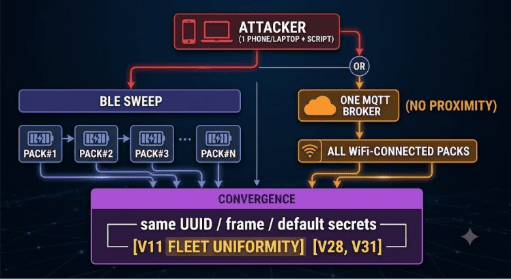
Because the two shared‑codebase apps (B and C – BMS Meta and Lithium Valley) share a byte‑for‑byte protocol, register map, and GATT profile differing only in branding and hardcoded backend keys – a single attack script scales across every rebrand of the platform, exactly mirroring the fleet‑uniformity conclusion of the original advisory. The underlying JBD/XiaoXiang‑derived BMS design is the de‑facto standard board in low‑cost e‑rickshaws, e‑bikes, and light EVs; the original BAT‑BMS app alone reports 100K+ Play Store installs, and these three siblings are additional distributions on the same hardware lineage so the affected population is best measured in fleets of vehicles, not app installs. (Exact deployment counts are not derivable from static analysis; this is a scale indicator, not a precise figure.)
Beyond the Bluetooth safety‑of‑life defect, deeper static review surfaced a second, independent compromise path in the apps’ account and cloud layer. All three apps store the user’s login password and WiFi passphrase in cleartext on disk, log session tokens, the MQTT password, and raw device‑control frames to the system log, and (App A) persist the entire log to shared external storage. Apps B and C additionally accept a server‑controlled API base URL that a single on‑path attacker can repoint permanently, and App A contains a SQL‑injection sink in its local database. These findings (V12-V27) require no Bluetooth proximity: any malicious app with storage permission, any device backup, or one network interception yields full account takeover and a firmware‑tamper foothold. The full catalogue below is organised into four tiers - Bluetooth safety‑of‑life (V1-V11), credential & data exposure (V12-V19), platform / hygiene (V20-V27), and remote / spoofing / extended control (V28-V38) - with each finding tagged by impacted app.
Real‑World Attack Scenarios (Business & Safety Impact)
Scenario 1 – Street / Parking‑Lot Attack (single vehicle).
An attacker near a parked or slow‑moving e‑rickshaw connects over BLE and writes discharge‑FET‑OFF. Outcome: immediate loss of propulsion; the rider is stranded, or – in traffic – abruptly loses power. Findings: V1, V2, V7, V29.
Scenario 2 – Fleet Depot / Overnight Yard.
An attacker walks a depot where dozens of packs sit within radio range and scripts a sweep of sleep / shutdown / restore‑defaults commands. Outcome: a fleet that will not start the next morning; restore‑defaults also wipes protection configuration. Findings: V1, V3, V11.
Scenario 3 – Public Charging Station.
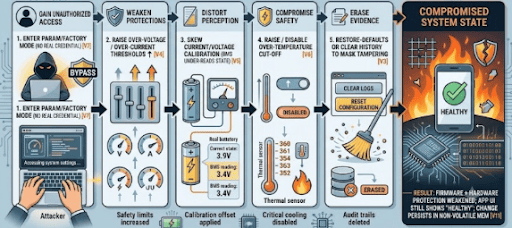
While vehicles charge unattended, the attacker raises over‑voltage/over‑current thresholds and skews current/voltage calibration. Outcome: the pack can continue drawing charge past safe limits with protections weakened and the app still showing “healthy.” This is the highest‑consequence, lowest‑visibility scenario. Findings: V4, V5, V6, V11.
Scenario 4 – Delivery‑Fleet Disruption (targeted DoS).
A competitor or extortionist triggers shutdown/restart during peak delivery windows. Outcome: missed SLAs, spoiled perishable loads, contractual penalties – a purely financial attack with no hardware damage. Findings: V3, V11, V28.
Scenario 5 – E‑Rickshaw Stand Attack.
The publicly‑reported abuse: someone at a rickshaw stand issues a stop command to a rival’s vehicle. Outcome: the vehicle will not move; matches circulating field reports. Findings: V1, V2.
Scenario 6 – Firmware‑Persistence (“sabotage and walk away”).
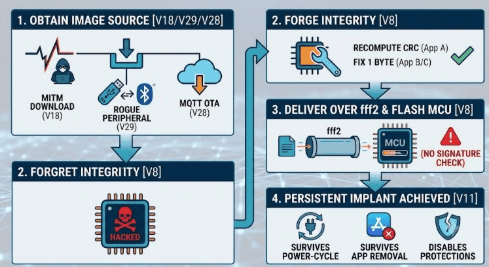
The attacker flashes a modified image (or writes NV‑config sabotage), then leaves. Outcome: the pack becomes a latent hazard that manifests during a later ordinary charge/ride, with the attacker gone and nothing obviously wrong in the app. Findings: V8, V4-V6, V11, V21.
Scenario 7 – Remote Cloud/MQTT Fleet Attack (no proximity).
Using hardcoded/forgeable broker credentials and guessable productKey/deviceName topics, the attacker publishes SetProperty control frames to WiFi‑connected packs over the internet. Outcome: proximity is no longer required potential region‑wide simultaneous disruption. Findings: V10, V28, V31.
Scenario 8 – Supply‑Chain Attack Against BMS Vendors.
The apps embed static cloud API secrets, MQTT device secrets, and an unsigned‑OTA pipeline. An attacker who obtains these (any APK download) can target the update/cloud infrastructure rather than one vehicle. Outcome: a single foothold potentially reaches many downstream fleets. Findings: V8, V10, V18, V19, V28.
Fleet‑wide attack model:
Battery‑protection‑bypass sequence (Scenario 3/6):
Firmware compromise chain (Scenario 6):
Introduction
This research extends the public reports that a Bluetooth BMS application could remotely stop electric rickshaws. The original advisory validated the root cause on BAT‑BMS (com.bms.grenergy). This 2.0 investigation asks whether sibling BMS apps distributed on the same JBD/XiaoXiang‑derived ecosystem share the defect. Objectives:
- Can the unauthenticated‑BLE‑control finding be reproduced on other shipping BMS apps?
- How does each app communicate with the BMS (protocol reconstruction)?
- Are authentication / encryption / authorization implemented anywhere on the control path?
- Which safety‑critical functions are remotely reachable?
- Do protocol/config weaknesses create physical‑safety risk?
- What must manufacturers fix?
Methodology is purely static: each APK was decompiled with JADX; every command‑builder class and the BLE transport were read by hand; each dangerous command was traced from the UI action that triggers it to the write() sink to confirm reachability (not dead code); and hardcoded byte frames/strings were decoded to recover embedded secrets.
Research Scope & Limitations
This assessment is based on static reverse engineering of publicly available Android Battery Management System (BMS) applications. The analysis involved manual inspection of application logic, protocol reconstruction, Bluetooth Low Energy (BLE) communication paths, configuration handling, firmware update workflows, and cloud communication components to determine code reachability and potential attack surfaces.
No dynamic testing was performed against production vehicles, live battery packs, or operational fleets, and no destructive testing was conducted. All security findings are derived from observed application behavior, reachable code paths, embedded configuration, and protocol implementation within the analyzed applications. Actual real-world impact may vary depending on the deployed hardware, firmware revision, manufacturer-specific implementation, and any additional security controls present on production devices.
Target Identification & Attribution
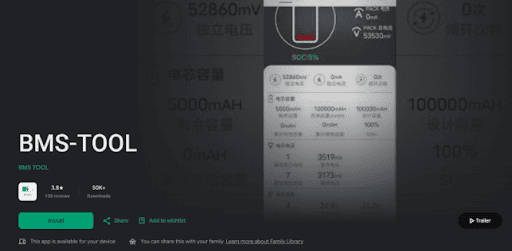
BMS-TOOL (PeiCheng)
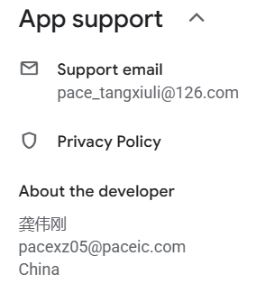
The application’s official Google Play listing identifies it as “BMS-TOOL”, published under the developer BMS TOOL, with 50K+ downloads and approximately 150 user reviews, confirming that the analyzed APK corresponds to a publicly distributed Battery Management System (BMS) application rather than an internal or test build. The Play Store metadata further lists the developer support contacts [email protected] and [email protected], with the developer location specified as China, providing direct attribution to the software publisher responsible for distributing the application. The application’s branding, package functionality, and reverse-engineered code identify it as a controller interface for lithium battery management systems deployed across light electric mobility platforms including e-rickshaws, e-bikes, scooters, energy storage systems, and other BLE-enabled lithium battery packs.
BMS Meta (Xundian)
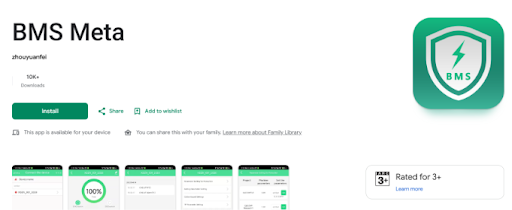
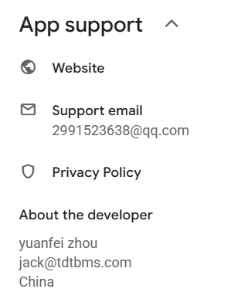
The official Google Play listing identifies the application as “BMS Meta”, published by zhouyuanfei, with 10K+ downloads, confirming that the reverse-engineered package represents an actively distributed production application. The Play Store developer information attributes the software to yuanfei zhou, provides the support email [email protected], developer contact [email protected], and identifies the publisher as operating from China. During reverse engineering, the application was found to implement the same BLE GATT profile, register map, protocol structure, and battery-control architecture observed across the Xundian/JBD-derived ecosystem, indicating that it targets lithium battery packs used in low-cost electric vehicles such as e-rickshaws, e-bikes, electric scooters, wheelchairs, and other light EV platforms rather than consumer mobile devices.
Lithium Valley
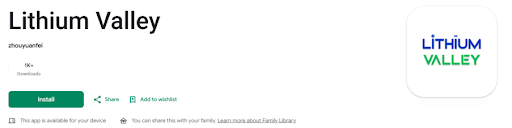
The application’s Google Play listing identifies it as “Lithium Valley”, also published by zhouyuanfei, with 1K+ downloads, confirming that it represents another commercially distributed BMS controller application within the same vendor ecosystem. The Play Store metadata lists the support email [email protected], while the developer attribution again identifies yuanfei zhou, [email protected], and China, demonstrating common developer ownership with the BMS Meta application despite different branding. Static analysis further confirms that Lithium Valley is a rebranded implementation of the same underlying codebase, sharing identical BLE services, command protocol, register definitions, and control logic with BMS Meta, indicating that both applications target the same family of lithium Battery Management Systems deployed across electric mobility platforms including e-rickshaws, e-bikes, light electric vehicles, and energy storage battery packs.
How the Apps Work (Architecture)
The BMS‑TOOL mobile app (App A) – end‑to‑end
BMS‑TOOL is an Alibaba‑Cloud (ilop) “demo shell” with vendor BMS logic bolted on. It talks to the physical BMS two ways: (1) directly over BLE using a proprietary binary protocol, and (2) through the Aliyun Link‑Kit IoT cloud for WiFi devices.
- Entry / shell: com.aliyun.iot.ilop.demo.* (login, cloud binding, OTA host). Launcher = FirstActivity.
- Vendor BMS logic: PeiCheng.* holds the binary command protocol (PeiCheng/data/DataVolume.java, CreateCtrDataHelper.java, FirstDataAnalysisHelper.java, SecondDataAnalysisHelper.java) and control UIs (SinglePackInfoActivity, TongYongInfoActivity, CanShuFragment, ScanBLEByCtrActivity).
- BLE transport: third‑party com.inuker.bluetooth.library (“BluetoothClient”) wrapped by smartyigeer/bleTool/ClientManager.java, driven from the global DemoApplication.
Data flow: scan (match device name/SN) -> connect (no bonding) -> discover service fff0 -> subscribe (notify) fff1 -> write commands to fff2 (firmware transfer on fff2/fff3). The device streams telemetry frames on fff1; the app reassembles and decodes them, trusting a CRC‑16 match only.
The Xundian / Lithium Valley apps (Apps B & C)
Same Aliyun ilop shell, but the BMS protocol is a Modbus‑RTU‑over‑BLE dialect in com.inuker.bluetooth.data.* (BaseVolume, CreateCtrDataHelper, DataAnalysisHelper), driven by presenter/NewControlPresenter and the NEWBLE.* / activity.* / xundians.* screens. They additionally carry an MQTT cloud path (com.smart.mqtt.*, com.smart.mqqtcloutlibrary.*) for WiFi‑connected packs. App C is a fork/rebrand of App B (identical protocol, different branding + backend keys, plus pairip licensing).
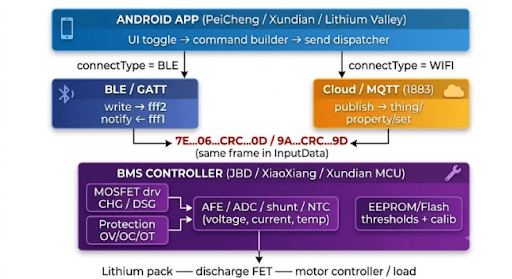
End‑to‑End Stack (architecture view)
The same command frame can originate from the app UI and reach the pack over two transports; the physical actuators sit behind both.
The top box is the phone app – one user action produces one command frame. The app sends that frame down either the BLE path (left) or the cloud/MQTT path (right), depending on how the pack is connected, but both arrive at the same BMS controller whose MOSFET driver, protection logic, and EEPROM are what physically switch power and enforce safety. The point: two entry doors, one unprotected room.
GATT profiles observed
| App | Service | Notify (device -> app) | Write (app -> device) | Extra |
|---|---|---|---|---|
| A | 0000fff0 | 0000fff1 | 0000fff2 | 0000fff3 (OTA/PID) |
| B | 0000fff0 (+000Off00 for WiFi-config) | 0000fff1 (0000ff01) | 0000fff2 (0000ff02) | 0000fffa (“HiLink” check) |
| C | 0000fff0 | 0000fff1 | 0000fff2 | 0000fffa |
Technical Findings
V1 – Unauthenticated, Unencrypted BLE Command Channel (BlueShock core)
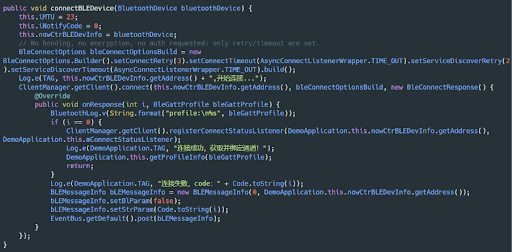
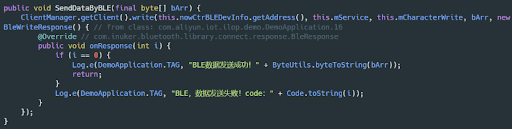
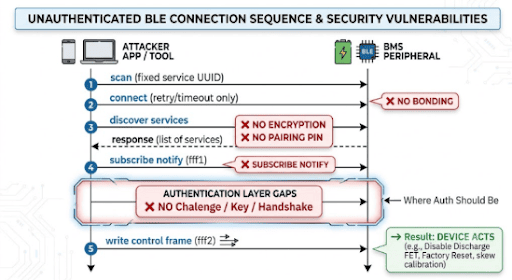
All three apps open the GATT link with only retry/timeout options no createBond(), no encryption requirement, no application challenge/response. Immediately after connect they subscribe to the notify characteristic and enable the write characteristic, then issue control frames. The trust boundary (the device) authenticates nothing.
App A
App A – write sink
App B
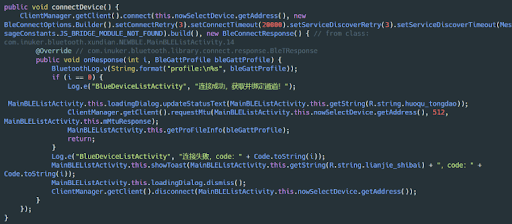
App B – bind notify fff1 / write fff2
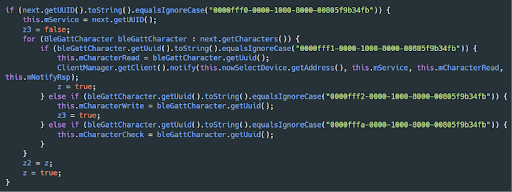
App B – write sink
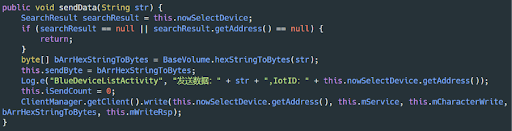
App B/C – the only “secret key” is a static ASCII token, not link encryption

App C – open connect
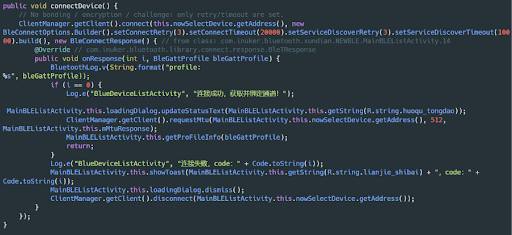
App C – write sink
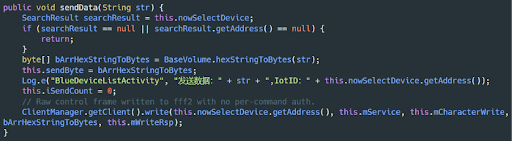
BLE session flow
V2 – Instant Drivetrain Kill (Discharge MOSFET OFF)
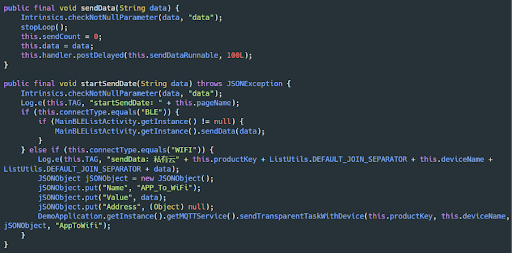
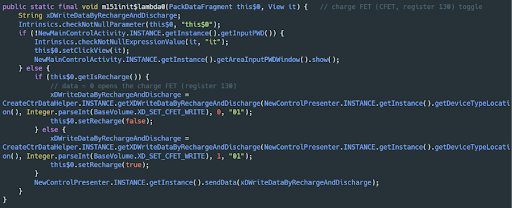
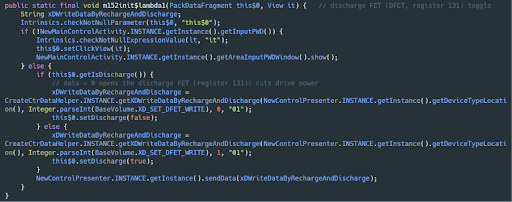
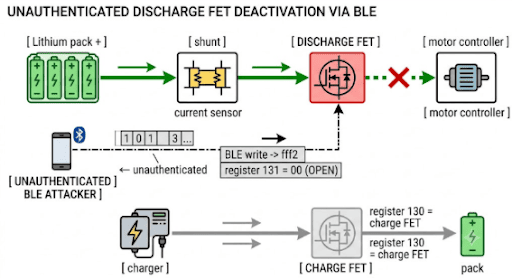
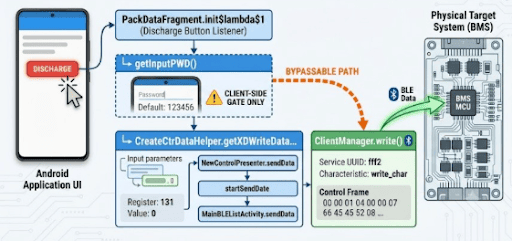
The discharge MOSFET sits in series with the motor controller. In App A the discharge toggle sends switch command 0801; in Apps B/C it writes Modbus register 131 (XD_SET_DFET_WRITE) with value 0 (open) / 1 (close). The UI handler builds the frame and calls the write(fff2) sink directly.
App A – op‑codes

Apps B/C – register constants

App B – discharge toggle UI -> build -> send
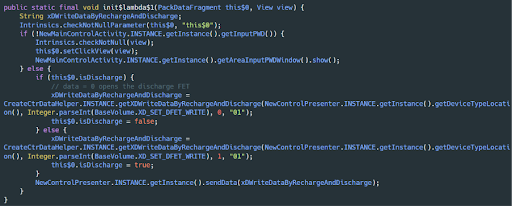
Apps B/C – frame builder
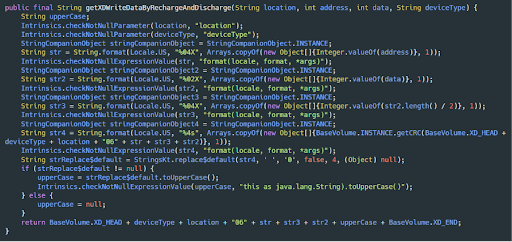
Apps B/C – send path to radio
Apps B/C – send path to radio
App C – same discharge/charge toggle
Physical topology – why opening the discharge FET cuts propulsion:
Reachability chain (UI tap -> radio), Apps B/C:
V3 – Remote Shutdown / Restart / Factory‑Reset (DoS + config wipe)
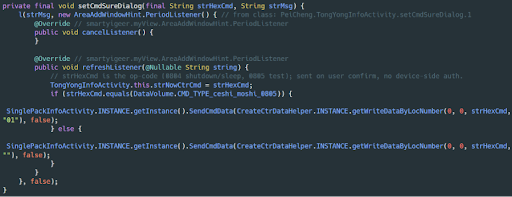
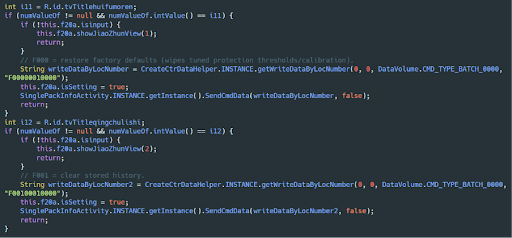
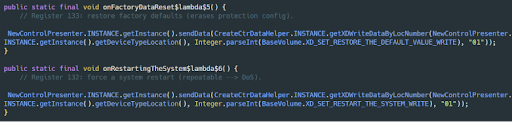
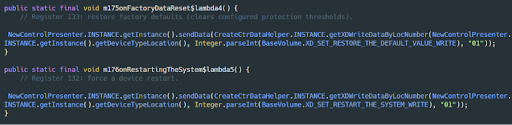
App A exposes 0804 (shutdown/sleep) and F000/F001 (restore defaults / clear). Apps B/C expose Modbus registers 132 (restart) and 133 (restore defaults) – the latter wipes all protection thresholds/calibration. All are single unauthenticated writes gated only by a UI confirmation dialog.
App A – shutdown/test confirm dialog
App A – restore defaults / clear history
App B – restart / restore defaults
App C
V4 – Overwriting Protection Thresholds (over‑voltage / current / temperature)
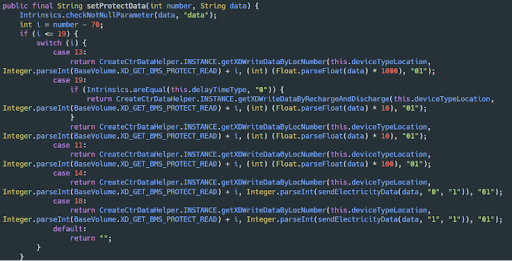
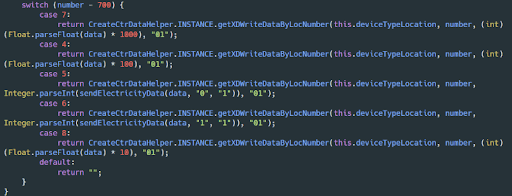
The protection set‑points are ordinary writable registers. App A’s CanShuFragment exposes charge/discharge over‑current, per‑cell over‑charge/discharge, pack total over‑charge/discharge, cell/ambient/MOSFET over‑temperature. Apps B/C write the 71/77/80/84/86/88 (voltage/current) and 02-11 (temperature) register families via setProtectData. No range clamping is enforced on the wire.
App A – writable protection fields: edviewchongfangdianguoliu* (charge/discharge over‑current), edviewdantiguochongfang* (single‑cell over‑charge/discharge), edviewzongtiguochongfang* (pack total over‑charge/discharge), edviewdianxingaodiwen* (cell high/low temp), edviewhuanjinggaodiwen* (ambient high/low temp), edviewmosgaowen* (MOSFET over‑temp).
Apps B/C – protect register table

Apps B/C – threshold write builder

App C
V5 – Corrupting Sensor Calibration (Blinding the BMS)
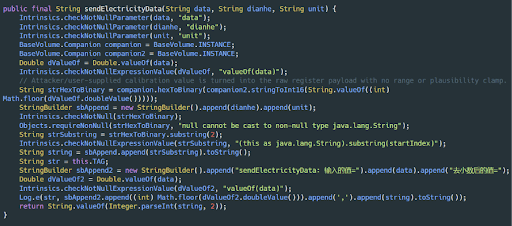
The current/voltage/temperature calibration and “current‑zero” registers (57 = XD_SET_CALIBRATION_CURRENT_WRITE, 134 = XD_SET_CURRENT_ZERO_WRITE in B/C; the Current*Adjust/VoltageAdjust/TempAdjust/SenseResistor parameters in A) are writable through the same unauthenticated channel. Skewed calibration makes the BMS under‑read true voltage/current while the app UI still shows healthy values.
Apps B/C – calibration constants

App B – current‑zero calibration write

App C

V6 – Temperature‑Protection Tampering
Over‑temperature thresholds (ChgOverTemp/DisOverTemp in A; registers 02-11 in B/C) and the temperature calibration value are writable, with no range clamp in the value builders. Raising over‑temperature thresholds or skewing temperature calibration so the pack always reads “cold” disables the thermal cut‑off.
Apps B/C – temperature register constants

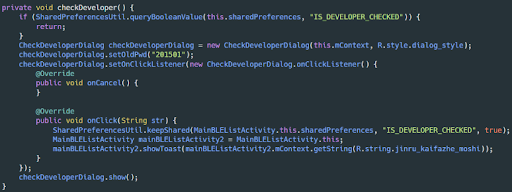
V7 – App‑Side‑Only “Password”, Default 123456, Developer Backdoor 201501
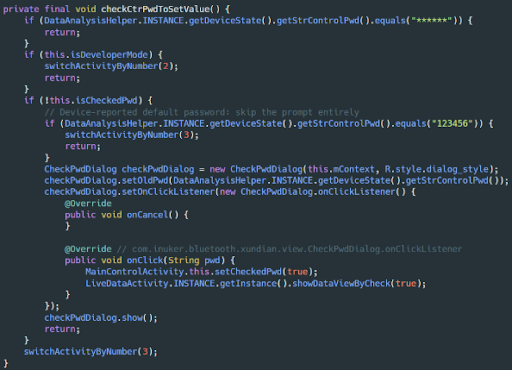
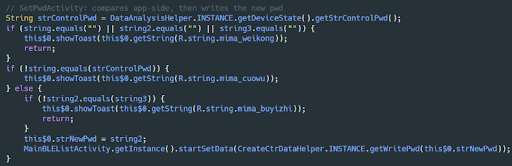
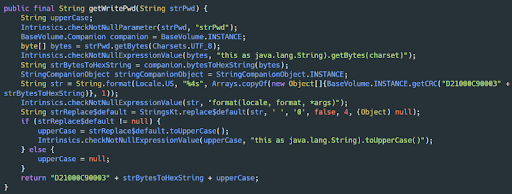
The control “password” in Apps B/C is a client‑side UI gate compared against a value the device broadcasts in cleartext – it never authorizes the device write. It defaults to 123456, and when the device reports that value the app skips the prompt entirely (auto‑unlock). App B also contains a hardcoded developer‑mode backdoor 201501. The password itself, when changed, is sent as a plaintext register write over the unauthenticated link.
Apps B/C – hardcoded default

Apps B/C – default auto‑unlock
App B – developer‑mode backdoor
Apps B/C – client‑side check, then plaintext password write
V8 – Unsigned Firmware OTA over BLE
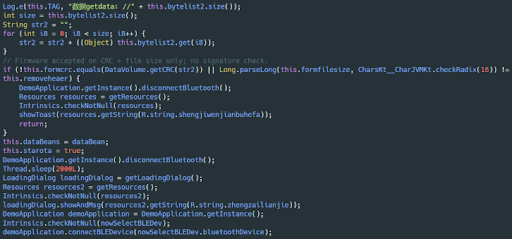
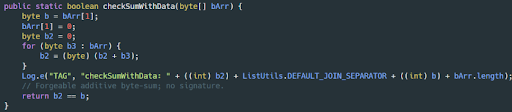
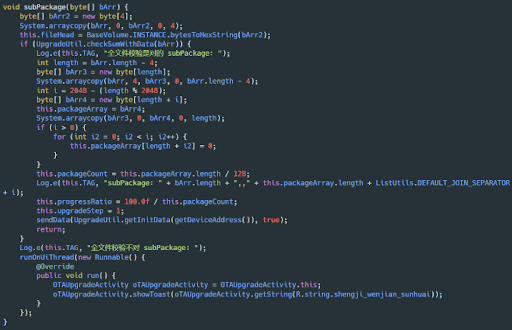
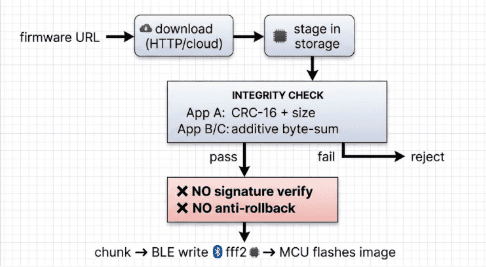
Firmware images are validated only by a CRC‑16 + size (App A) or a forgeable additive 8‑bit checksum (Apps B/C). There is no digital signature, hash‑verify, or anti‑rollback anywhere. Combined with V1, an attacker can flash arbitrary firmware.
App A – “firmware valid?” = CRC + size only
Apps B/C – whole‑image check is an additive byte‑sum
Apps B/C – the checksum is the sole gate before flashing
OTA validation workflow – the missing signature gate:
V9 – Inbound Frames Trusted on Checksum Only (spoofing + replay)
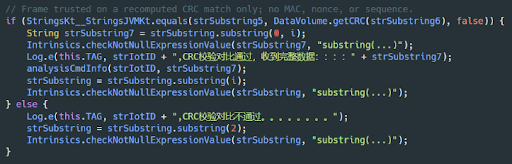
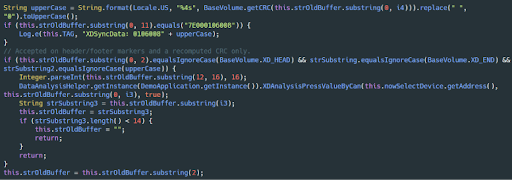
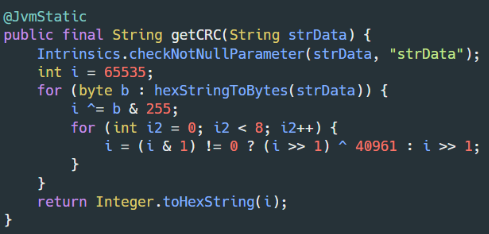
Inbound notifications are accepted if the framing markers match and a locally‑recomputed checksum equals the received one. No MAC, nonce, or sequence number exists, so a spoofed peripheral can inject arbitrary telemetry/status (e.g. report strControlPwd = “123456” to auto‑unlock, or fake safe voltages), and recorded frames replay.
App A – accept‑on‑CRC
Apps B/C – accept‑on‑CRC
Apps B/C – non‑cryptographic CRC
V10 – Hardcoded Cloud/API Secrets, Plaintext MQTT & Cleartext Traffic (IoT back‑end)
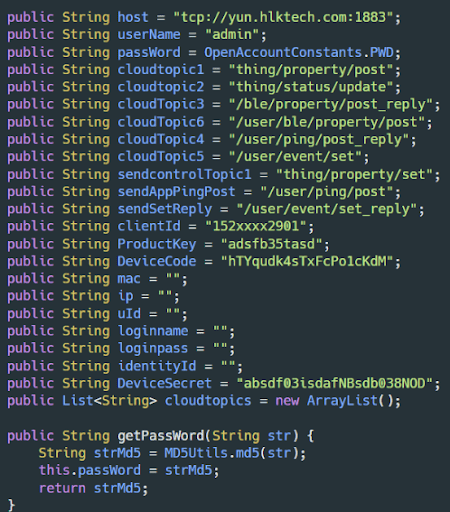
Beyond BLE, the apps connect to vendor clouds. All three ship hardcoded server signing secrets and permit cleartext traffic globally; Apps B/C additionally connect to a plaintext MQTT broker with default admin/password credentials and embedded device‑identity secrets, and derive the device key from the (public) MAC using in‑app constants (reversible).
All apps – cleartext allowed globally

App A – hardcoded API signing secret + cleartext endpoint

App B – hardcoded API secret + cleartext endpoint

App B – plaintext MQTT + hardcoded device secrets
App B – reversible MAC -> key derivation
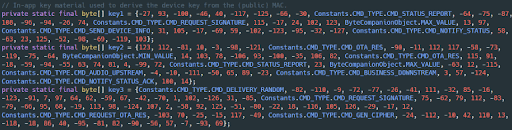

App C – Aliyun IoT app credentials + debug build

V11 – Persistence, Exported Components & Fleet‑Scale Uniformity
Config writes (V4-V6) target the BMS non‑volatile memory, so sabotage survives reboot. Both Xundian apps export a BLE‑config activity with no permission, widening local attack surface. Most importantly, Apps B and C are the same codebase - identical protocol, register map, GATT UUIDs and default secrets – differing only in branding and backend keys, so one script targets every rebrand.
Apps B/C – exported BLE‑config activity, no permission/filter

App C – pairip licensing (anti‑tamper only)

App A – over‑broad FileProvider + exported components

Extended Vulnerability (V12-V27) – The Second Attack Path
This tier requires no Bluetooth proximity – it is a second, independent compromise path. Where V1-V11 and V28 need an attacker within BLE radio range or reachable through the cloud broker, the findings below are reached by any malicious app holding storage permission, any device backup, or a single network interception. Together they yield full account takeover and a firmware-tamper foothold on the same fleet, without an attacker ever touching the Bluetooth stack.
Four findings are detailed below because they chain into the safety and persistence story (V17, V18, V20, V21). The remaining data-at-rest, logging,and platform-hygiene findings (V12-V16, V19, V22-V27) are summarised in the table that follows.
V17 – Whole Logcat Self‑Persisted to Shared External Storage
App A does not merely log to the transient ring buffer – on startup it spawns a logcat shell pipe and writes the entire process log to a file on external storage, converting every transient leak in V15/V16 into a durable, exfiltrate credential file.
App A

Impact: account passwords, WiFi PSKs, session tokens, forgeable API signatures, and raw device-control frames accumulate in Android/data/…/files/Logcat/logcat.log. A single storage-reading app harvests them all – no root, no BLE, no network position required. This is the durable-storage amplifier for every transient leak in V15/V16.
V18 – Server-Controlled Base URL (GetHost) – MITM / Redirect Pivot
Apps B/C

Impact: a single MITM of the GetHost response (or a compromised host server) permanently repoints login, token, and device traffic to an attacker endpoint – and the redirect survives app restarts. This is the persistence-without-proximity pivot: combined with the unsigned OTA path (V8/V21), one interception can steer every future update and cloud command for that install.
V20 – SQL Injection in Local Push-Message DAO
Impacted apps: A. A server/account-derived identifier is concatenated directly into a raw SQL string with no binding or escaping.
App – A

Impact: a crafted msgAccountID alters the query and can read or modify arbitrary rows in the local push database. Because the identifier originates from server/account data rather than local UI, a compromised or malicious backend (reachable via the V18 redirect) can drive the injection.
V21 – Firmware Staged in World-Readable External Storage (pre-flash tamper)
OTA firmware is downloaded to a fixed external-storage path – readable and writable by any app under these apps’ requestLegacyExternalStorage=”true” – then flashed through the weak-checksum OTA flow (V8). This opens a classic local tamper window between download and flash.
App A
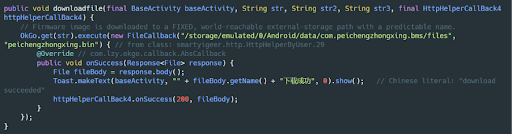
Apps BC – the download stages the image in the app cache dir
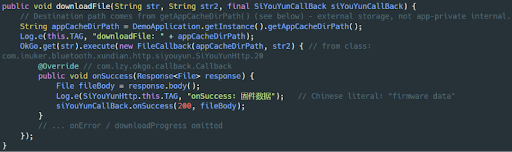
Apps B/C – the cache dir resolves to shared external storage

Apps B/C – the only integrity gate is an additive 8-bit byte-sum
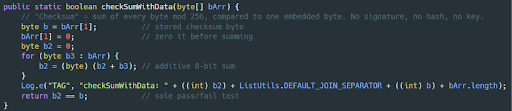
Apps B/C - checkSumWithData is the sole check before the image is packaged and flashed
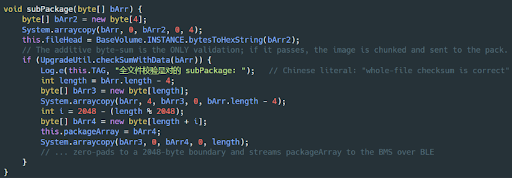
Impact: on all three apps a local malicious app (any app with storage access, under requestLegacyExternalStorage=”true”) can swap the .bin after download but before it is flashed. Because the only gate is a size-independent additive byte-sum (Apps B/C) or a CRC+size (App A) – no signature, hash, or anti-rollback – a tampered image that re-matches the checksum passes validation and is streamed to the BMS controller, yielding a persistent device implant that survives app removal and power cycles. This is V21 chained with the unsigned-OTA validation of V8.
V28 – Remote Command Injection via the Cloud/MQTT Transparent Channel (no BLE proximity)
The command dispatcher builds one BMS frame and sends it either over BLE or over the cloud, depending on connectType. For a WiFi‑bound pack the identical MOSFET/threshold/calibration frame (V2-V6) is published to an MQTT topic – so every physical‑safety primitive is reachable from the internet, not just from 10-30 m away.
Apps B/C – the WIFI branch routes the same frame to MQTT
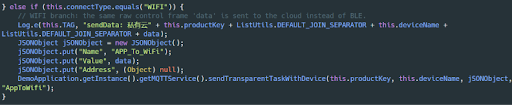
Apps B/C – publish to a fixed, guessable control topic


MQTT attack path:
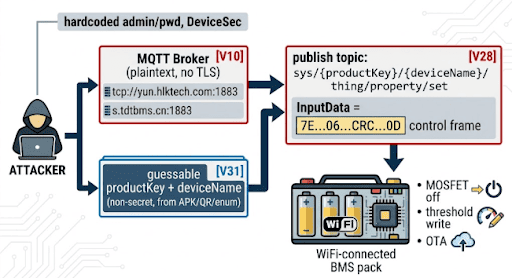
Why this is Critical. The broker is plaintext tcp://…:1883 with a hardcoded admin/password and a hardcoded DeviceSecret (V10). The topic is derived only from productKey + deviceName - both non‑secret and recoverable from the app, QR labels, or cloud enumeration. An attacker who reaches the broker can publish SetProperty control frames to arbitrary devices over the internet, with no Bluetooth range requirement and no per‑device key. This converts V2 (discharge‑FET‑off) and V3 (shutdown) from a proximity attack into a potential remote, fleet‑wide one.
V29 – BLE Peer Selected by Advertised Name Only (Evil‑Peripheral / Device Spoofing)
When auto‑connecting from a scanned QR/serial, the app selects the peripheral by string‑matching the advertised name and immediately connects – with no verification of the MAC address, no bonding identity, and no cryptographic device attestation.
Apps B/C

Impact: An attacker peripheral that advertises the same (non‑unique, guessable) name is auto‑connected by the victim’s app. Combined with V9 (checksum‑only inbound trust) the rogue device can feed spoofed telemetry – e.g. report strControlPwd = “123456” to satisfy the client‑side gate (V7), or report falsely safe voltages/temperatures – and, in the OTA flow, act as a malicious update source.
V36 – Extended Unauthenticated Control Surface: SOC / Capacity / Balance / Board‑ID Falsification
Beyond MOSFET switching (V2) and protection/calibration (V4-V6), the same unauthenticated 06‑write channel exposes a broad set of operational‑integrity registers: design capacity (51), state‑of‑charge (52), cell‑balance start/voltage (54/55/83), board count (31) and board address (32), unique device ID (33), sleep‑wait time (56), and date/time (149). These are written by NewControlPresenter.setBatteryData(…) and reached from the “set battery” UI.
App B/C – Register constants
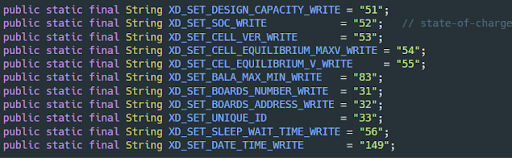
App B/C – Write dispatcher

App B/C – Reachable from UI

The batteryArgumentsAddress table (NewControlPresenter.java:167) begins [508, 51, 52, 522, 53, 54, 55, 56, 57, …], confirming capacity/SOC/balance are addressable slots.
Impact. These writes attack operational integrity, complementing the safety‑protection attacks: - SOC / design‑capacity falsification - the BMS mis‑reports remaining range, so a vehicle can lose power without warning mid‑ride (stranding), or a falsified capacity can mask how full the pack really is during charging. - Cell‑balance tampering – disabling/skewing balancing drives cell imbalance over time, degrading and stressing the pack. - Board count/address + unique‑ID overwrite – reconfigures multi‑pack addressing (disrupting or partitioning a battery bank) and can clone/spoof device identity. – Sleep‑wait / date‑time - nuisance/DoS and log‑timestamp corruption.
All are single unauthenticated 7E…06…CRC…0D writes gated only by the client‑side password (V7).
V38 – Function‑Toggle Control: Silence Buzzer / Disable Charging / Force Sleep (BAT‑BMS V2 parity).
The “General Setup” screen exposes a row of boolean function toggles at registers 1001-1007 - Emergency, Monitor‑State, Intelligent‑Sleep, Disable‑Charging, Indicator‑Light, Buzzer, and Conventional‑Hibernation – each flipped by a single unauthenticated 06 write. This is the Modbus‑dialect equivalent of the original BAT‑BMS FunctionConfig 0x2D bitfield, including the buzzer/audible‑alarm silence.
Apps B/C – Toggle inventory

Apps B/C – UI tap -> write

Impact. An attacker can silence the buzzer (removing the audible warning the pack raises during an unsafe condition) and disable charging / force sleep / trigger emergency over the unauthenticated link – the exact “disable protection functions and the audible alarm” capability the original advisory flagged as V2, now confirmed with verbatim register‑level evidence in the xundian apps. Combined with V4-V6 (threshold/calibration) this lets the pack be pushed toward an unsafe state with no audible warning; being a config write, it persists.
Summary – Remaining Data-at-Rest, Logging & Platform Findings (V12-V16, V19, V22-V27)
These are real but lower-drama findings in the same no-proximity tier; they are catalogued here for completeness and feed the same account/cloud-compromise chain.
| ID | Finding | App(s) | Impact |
|---|---|---|---|
| V12 | Account password stored in plaintext SharedPreferences | A, B, C | Device access -> full account takeover |
| V13 | WiFi PSK stored in plaintext SharedPreferences (keyed by SSID) | A, B, C | Home/depot WiFi credential theft |
| V14 | WiFi SSID+password sent over BLE in cleartext during provisioning | A, B, C | Passive BLE sniff recovers WiFi creds |
| V15 | Session tokens (access/refresh) persisted and/or logged in cleartext | A, B, C | Token theft -> session hijack |
| V16 | Pervasive sensitive logging (tokens, MQTT pwd, raw BLE frames, WiFi pwd) | A, B, C | Log reader harvests credentials + protocol |
| V19 | Weak request signing (MD5/SHA-1 + predictable Random nonce) + extra hardcoded secrets | A, B, C | Forge/replay signed cloud-API requests |
| V22 | Mass over-export of first-party activities | A (B, C: ConfigBLEListActivity) | Any installed app launches internal screens |
| V23 | No FLAG_SECURE on credential screens; SYSTEM_ALERT_WINDOW overlay risk | A (B, C: no FLAG_SECURE) | Screen capture / tapjacking of credentials |
| V24 | First-party WebView with JS enabled loading cleartext http:// | B, C | MITM script injection into WebView |
| V25 | Excessive / dangerous manifest permissions (READ_LOGS, etc.) | A, B, C | Amplifies blast radius of any compromise |
| V26 | HTTP logging interceptor at Level.BODY (full req/resp to logcat) | B, C | Full request/response bodies leaked to log |
| V27 | Bundled trust-all TLS manager present (overridden – no pinning is the live gap) | A, B, C | No cert pinning; informational |
Why This Research Matters (Industry & Ecosystem Impact)
Analyzing three apps was a deliberate choice: it moves the finding from “one vendor shipped an insecure app” to “an entire product category shares a broken security model.” Five structural factors make this an industry‑level concern rather than three isolated defects.
Same protocol reused across vendors. The JBD / XiaoXiang‑derived BMS protocol – unauthenticated GATT writes, a non‑cryptographic checksum, fixed service UUIDs – is the de‑facto standard for low‑cost lithium packs in e‑rickshaws, e‑bikes, wheelchairs, and light EVs. The original BAT‑BMS advisory documented it on one app; this research shows the same control primitives (MOSFET switching, threshold/calibration writes, unsigned OTA) reappearing in unrelated‑looking products. Fixing one app does nothing for the shared design.
Shared codebase / white‑label products. Apps B and C are byte‑for‑byte the same code under two brands, differing only in logos and backend keys. This is the classic white‑label / OEM pattern: a single reference app (or SDK) is reskinned by many downstream sellers. A vulnerability in the reference implementation is silently inherited by every rebrand – and a patch must be pushed to all of them simultaneously, which rarely happens in practice.
IoT ecosystem risk (the cloud makes it worse, not better). Adding a cloud/MQTT tier did not add security; it added a second unauthenticated control path (V28) that removes the Bluetooth‑proximity limit entirely. Plaintext brokers, hardcoded device secrets, and guessable topics mean the “smart” connectivity converts a local RF issue into an internet‑reachable, fleet‑scale one. This is a recurring anti‑pattern across consumer IoT: bolt‑on cloud connectivity that inherits, rather than fixes, device‑layer weaknesses.
Supply‑chain implications. The apps embed static cloud API secrets, MQTT DeviceSecrets, and an unsigned‑OTA pipeline. Extracting these requires only downloading an APK. An adversary who targets the update or cloud infrastructure - rather than one vehicle – can potentially influence many downstream fleets at once. Unsigned firmware over an unauthenticated channel is the single highest‑leverage supply‑chain weakness here, because it grants persistence that survives app removal and power cycles.
Public‑safety and regulatory dimension. Unlike a data‑confidentiality bug, a BMS weakness touches physical safety: propulsion, over‑charge, and thermal protection. The affected population is best measured in fleets of vehicles operating in dense urban traffic, not app installs. That combination – safety‑critical function, shared insecure design, white‑label distribution, and a cloud amplifier – is exactly the profile that warrants coordinated vendor disclosure, supply‑chain (e.g. BIS‑style) certification of BMS boards, and regulator awareness.
Root Cause Analysis
The vulnerabilities originate from architectural decisions, not a single implementation bug. All three apps implicitly trust any BLE device capable of establishing a connection. Safety‑critical operations – MOSFET switching, EEPROM/register configuration, factory‑reset, calibration, and firmware flash – are exposed over the same unauthenticated channel with no device‑identity validation, no encrypted session, and no firmware‑enforced command authorization. The checksum (CRC‑16 or additive) is treated as if it were a security control; it is only an error‑detection code. “Passwords,” “factory mode,” and static tokens (HiLink) are client‑side theatre that the device never enforces. Hardcoded cloud secrets and plaintext MQTT extend the same trust‑everything posture to the IoT back‑end.

Threat Model & Attack Scenarios
Precondition: a phone/laptop with a standard BLE radio within ~10-30 m. No pairing, credentials, or prior access. The attacker simply reproduces the app’s own startup: scan for the fixed service UUID, connect without bonding, enable notifications, begin writing commands.
- Scenario 1 – Remote vehicle stoppage. Connect to an in‑range pack, write discharge‑FET‑OFF (0801 / register 131); if the firmware acts, propulsion is lost – a public‑safety hazard in traffic.
- Scenario 2 – Fleet‑wide DoS. In a depot/charging station, sequentially restart / restore‑defaults / shut down every pack in range (0804, 132, 133). Because UUIDs, frame format, and default secrets are shared, one workflow repeats across all units.
- Scenario 3 – Persistent configuration sabotage. Raise protection thresholds and corrupt calibration (V4-V6) in non‑volatile memory, then leave. The driver keeps operating with no visible indication; the hazard manifests during a later ordinary charge.
- Scenario 4 – Firmware implant. Flash a CRC/checksum‑valid malicious image (V8) for persistent takeover surviving app removal.
- Scenario 5 – Cloud/MQTT compromise. Extract hardcoded APPSECRET/device secrets and connect to the plaintext MQTT broker with admin/password to eavesdrop or inject thing/property/set commands (Apps B/C).
End‑to‑End Attack‑Flow Diagram
The diagram traces both the proximity (BLE) and the remote (cloud/MQTT) paths converging on the same physical‑safety primitives, then persistence.

Vulnerability Summary
All 38 findings across the three apps (BMS-TOOL = App A, BMS Meta = App B, Lithium Valley = App C). CVSS v4.0 Base scores are analyst-assigned for prioritisation; findings whose terminal physical outcome is firmware-dependent are scored on demonstrable technical impact, not on unproven ignition (see Limitations).
| ID | Vulnerability | CWE | Estimated CVSS (v4.0) | Severity | Primary Impact |
|---|---|---|---|---|---|
| V1 | Unauthenticated, unencrypted BLE command channel | CWE-306 | 8.7 | High | Full privileged control channel with no auth, pairing, or encryption |
| V2 | Instant drivetrain kill (discharge MOSFET OFF) | CWE-306 | 8.8 | High/Critical | Immediate loss of propulsion on a moving/parked vehicle |
| V3 | Remote shutdown / restart / factory-reset | CWE-306 | 8.3 | High | Denial of control + wipe of all protection configuration |
| V4 | Overwriting protection thresholds (OV/OC/OT) | CWE-306 / CWE-863 | 8.2 | High | Over-voltage/current/temperature limits raised or disabled |
| V5 | Corrupting sensor calibration (blinding the BMS) | CWE-306 | 8.2 | High | Pack mis-reads true V/I/T; protections stop tripping |
| V6 | Temperature-protection tampering | CWE-306 | 8.2 | High | Thermal cut-off disabled; pack always reads “cold” |
| V7 | App-side-only password, default 123456, backdoor 201501 | CWE-602 / CWE-1188 | 7.1 | High | Client-side gate that never authorizes the device write |
| V8 | Unsigned firmware OTA over BLE | CWE-347 | 9 | Critical | Arbitrary firmware flash → persistent device takeover |
| V9 | Inbound frames trusted on checksum only | CWE-345 / CWE-294 | 6.9 | Medium | Telemetry spoofing + frame replay (no MAC/nonce) |
| V10 | Hardcoded cloud secrets + plaintext MQTT + cleartext traffic | CWE-798 / CWE-319 | 8.7 | High | Broker eavesdrop/inject; forge signed cloud-API requests |
| V11 | Persistence, exported components & fleet-scale uniformity | CWE-926 | 7 | High | One script scales across every rebrand; sabotage survives reboot |
| V12 | Account password stored in plaintext SharedPreferences | CWE-312 / CWE-522 | 8.5 | High | Device access → full account takeover |
| V13 | WiFi PSK stored in plaintext SharedPreferences | CWE-312 | 6.8 | Medium | Home/depot WiFi credential theft |
| V14 | WiFi SSID+password sent over BLE in cleartext | CWE-319 / CWE-532 | 6.5 | Medium | Passive BLE sniff recovers WiFi credentials |
| V15 | Session tokens persisted and/or logged in cleartext | CWE-312 / CWE-532 | 8.5 | High | Token theft → session hijack |
| V16 | Pervasive sensitive logging (tokens, MQTT pwd, BLE frames) | CWE-532 / CWE-200 | 6.1 | Medium | Log reader harvests credentials + full protocol |
| V17 | Whole logcat self-persisted to shared external storage | CWE-532 / CWE-200 | 6.8 | Medium | Durable credential/protocol file readable by any app (App A) |
| V18 | Server-controlled base URL (GetHost → BASE_URL) | CWE-601 | 7.2 | High | One MITM permanently repoints all cloud traffic (B/C) |
| V19 | Weak request signing (MD5/SHA-1 + predictable nonce) | CWE-327 / CWE-330 | 6.5 | Medium | Forge/replay signed cloud-API requests |
| V20 | SQL injection in local push-message DAO | CWE-89 | 6.8 | Medium | Read/modify arbitrary local DB rows (App A) |
| V21 | Firmware staged in world-readable external storage | CWE-494 | 7 | High | Local .bin swap before unsigned flash → implant |
| V22 | Mass over-export of first-party activities | CWE-926 | 5.1 | Medium | Any installed app launches internal screens |
| V23 | No FLAG_SECURE on credential screens; overlay risk | CWE-1021 | 5.9 | Medium | Screen capture / tapjacking of credentials |
| V24 | First-party WebView with JS enabled loading cleartext HTTP | CWE-749 / CWE-319 | 4.8 | Medium | MITM script injection into WebView (B/C) |
| V25 | Excessive / dangerous manifest permissions | CWE-250 / CWE-276 | 4.6 | Medium | Amplifies blast radius of any compromise |
| V26 | HTTP logging interceptor at Level.BODY | CWE-532 | 6.1 | Medium | Full request/response bodies leaked to logcat (B/C) |
| V27 | Bundled trust-all TLS manager (present but overridden) | CWE-295 | Low (info) | Low | No cert pinning is the live gap; informational |
| V28 | Remote command injection via cloud/MQTT transparent channel | CWE-306 / CWE-862 | 9.3 | Critical | Every BLE safety primitive reachable over the internet, no proximity |
| V29 | BLE peer selected by advertised name only (evil-peripheral) | CWE-290 | 7.3 | High | Rogue peripheral auto-connected; spoofed telemetry / rogue OTA |
| V30 | No anti-brute-force / lockout on BLE control password | CWE-307 | 6.9 | Medium | Unlimited client-side password guessing |
| V31 | Predictable MQTT topics + static broker identity | CWE-306 | 7.7 | High | Cross-device control/eavesdrop over the broker |
| V32 | Command/telemetry frames recoverable from on-device artifacts | CWE-200 | 6.2 | Medium | Full protocol grammar + live IDs without RF capture |
| V33 | Predictable MQTT clientId + shared broker credentials | CWE-384 | 6.9 | Medium | Session hijack / forced-disconnect DoS |
| V34 | Inbound cloud/MQTT messages consumed as trusted device state | CWE-345 | 7 | High | Forged cloud state drives app/user decisions |
| V35 | Bundled BLE-provisioning crypto uses a fixed IV (3rd-party) | CWE-329 | 3.1 | Low | Weakened provisioning confidentiality (informational) |
| V36 | Extended control surface: SOC/capacity/balance/board-ID | CWE-306 / CWE-863 | 7.6 | High | Operational-integrity falsification (stranding, imbalance, ID spoof) |
| V37 | Additional hardcoded Aliyun app credentials | CWE-798 | 8.1 | High | Cloud-platform appKey/appSecret recoverable from APK |
| V38 | Function-toggle control: silence buzzer / disable charging / force sleep | CWE-306 / CWE-862 | 7.6 | High | Audible alarm silenced; charging/sleep forced (BAT-BMS V2 parity) |
MITRE ATT&CK Mapping (ICS / Mobile)
Indicative mapping of the finding classes to MITRE ATT&CK for ICS tactics/techniques.
| ATT&CK Tactic | Technique | Relevance |
|---|---|---|
| Initial Access | T0860 Wireless Compromise / T0886 Remote Services | Unauthenticated BLE connect; internet-reachable MQTT broker (V1, V28, V31) |
| Execution / Impair Process Control | T0855 Unauthorized Command Message | Plaintext control writes to fff2 / MQTT property/set (V2-V6, V28, V36, V38) |
| Impair Process Control | T0836 Modify Parameter | Threshold, calibration, SOC/capacity and function-toggle tampering (V4-V6, V36, V38) |
| Inhibit Response Function | T0800 Activate Firmware Update Mode / T0857 Firmware | Unsigned firmware flash over BLE (V8, V21) |
| Inhibit Response Function | T0878 Alarm Suppression | Buzzer / audible-alarm silence via function toggle (V38) |
| Evade / Spoofing | T0856 Spoof Reporting Message | Checksum-only inbound trust; evil-peripheral; forged cloud state (V9, V29, V34) |
| Collection | T0887 Wireless Sniffing / T0801 Monitor Process State | Cleartext BLE/WiFi provisioning; protocol recoverable from artifacts (V14, V32) |
| Impact | T0813 Denial of Control / T0826 Loss of Availability / T0828 Loss of Productivity | MOSFET-off, shutdown, fleet-wide DoS (V2, V3, V28, V33) |
| Impact (safety) | T0879 Damage to Property / T0880 Loss of Safety | Protection/thermal conditioning toward an unsafe state (V4-V6, V38) |
CWE Mapping
| CWE | Name | Applies to |
|---|---|---|
| CWE-306 | Missing Authentication for Critical Function | V1-V6, V28, V31, V36, V38 |
| CWE-862 / CWE-863 | Missing / Incorrect Authorization | V4, V28, V36, V38 |
| CWE-347 | Improper Verification of Cryptographic Signature (unsigned OTA) | V8 |
| CWE-345 | Insufficient Verification of Data Authenticity (CRC-as-security) | V9, V34 |
| CWE-294 | Authentication Bypass by Capture-Replay | V9 |
| CWE-290 | Authentication Bypass by Spoofing | V29 |
| CWE-307 | Improper Restriction of Excessive Authentication Attempts | V30 |
| CWE-602 | Client-Side Enforcement of Server-Side Security (app-side password) | V7 |
| CWE-1188 / CWE-1391 | Insecure Default / Use of Predictable Credential (123456, 201501, HiLink) | V7 |
| CWE-798 | Use of Hard-coded Credentials | V7, V10, V37 |
| CWE-319 | Cleartext Transmission of Sensitive Information | V1, V10, V14, V24 |
| CWE-311 / CWE-1104 | Missing Encryption / Reliance on Untrusted Components | V10 |
| CWE-312 / CWE-522 | Cleartext Storage / Insufficiently Protected Credentials | V12, V13, V15 |
| CWE-532 | Insertion of Sensitive Information into Log File | V14, V15, V16, V17, V26 |
| CWE-200 | Exposure of Sensitive Information | V17, V21, V32 |
| CWE-601 | URL Redirection to Untrusted Site | V18 |
| CWE-494 | Download of Code Without Integrity Check | V21 |
| CWE-327 / CWE-330 | Broken/Weak Crypto / Insufficiently Random Values | V19 |
| CWE-329 | Generation of Predictable IV | V35 |
| CWE-89 | SQL Injection | V20 |
| CWE-926 | Improper Export of Android Components | V11, V22 |
| CWE-1021 | Improper Restriction of Rendered UI Layers (tapjacking/screen capture) | V23 |
| CWE-749 | Exposed Dangerous Method or Function (WebView) | V24 |
| CWE-250 / CWE-276 | Execution with Unnecessary Privileges / Incorrect Default Permissions | V25 |
| CWE-295 | Improper Certificate Validation (no pinning; trust-all present) | V27 |
| CWE-384 | Session Fixation / predictable session identity | V33 |
Recommendations for the BMS Manufacturers
- Firmware-level trust boundary (the root fix). The device must stop trusting any frame simply because the checksum matches. Implement mutual authentication and an encrypted session on the BLE control link (e.g. BLE LE Secure Connections pairing plus an application-layer challenge/response keyed by a per-device secret provisioned at manufacture). No safety-critical write – MOSFET, threshold, calibration, restart, factory-reset, OTA – should execute without a verified, authorized session. (Addresses V1-V7, V9, V28-V31, V36, V38.)
- Signed, anti-rollback firmware. Replace the CRC/byte-sum OTA gate with a digital signature verified on-device against a manufacturer public key, plus monotonic version enforcement. Stage images only in app-private storage and verify the signature before flashing. (Addresses V8, V21.)
- Remove client-side security theatre and hardcoded secrets. Delete the default 123456 password, the 201501 developer backdoor, and the static HiLink token. Move every “password” check to the device. Rotate and remove all hardcoded cloud API secrets, MQTT DeviceSecrets, Aliyun appKey/appSecret pairs, and signing salts from the APK; derive per-device keys server-side, never from the public MAC. (Addresses V7, V10, V19, V37.)
- Secure the cloud/MQTT tier. Enforce TLS (mqtts/8883), per-device broker credentials, and topic ACLs so one device’s identity cannot publish to another’s property/set. Treat inbound cloud messages as untrusted input, not authoritative device state. (Addresses V10, V28, V31, V33, V34.)
- PApp-hardening. Store no account password or WiFi PSK on disk (use Keystore / EncryptedSharedPreferences + server-issued refresh tokens); strip all sensitive logging and the logcat-to-external-storage dumper in release; pin and validate the GetHost bootstrap URL; parameterise all SQL; set FLAG_SECURE on credential screens; prune dangerous permissions and exported components; enable cleartext-traffic blocking + certificate pinning. (Addresses V11-V27, V32, V35.)
- Ecosystem obligation (white-label reality).Because Apps B and C are one codebase under two brands, fixes must be applied to the shared protocol layer and pushed to every rebrand simultaneously, with an OTA-remediation program for already-deployed packs. Patching one app leaves the fleet exposed.
Recommendations for National Cybersecurity and Transport Authorities
Treat this as a safety-of-life class, not a data-privacy bug. The defect touches propulsion, over-charge, and thermal protection on vehicles operating in dense urban traffic. The affected population is best measured in fleets of vehicles, not app installs, and the same insecure design recurs across unrelated-looking brands on the shared JBD/XiaoXiang-derived lineage.
- Coordinated disclosure & CERT tracking. Open a coordinated-vulnerability-disclosure track (e.g. via the national CERT) with the vendors and OEMs, and issue an advisory to fleet operators covering the indicators and interim compensating controls.
- Supply-chain / type certification for BMS boards. Require firmware-level authentication, encrypted BLE control, and signed OTA as a condition of BIS-style certification for BMS boards sold into e-rickshaws, e-bikes, and light EVs. An app-store restriction alone is only harm-reduction – the durable fix is at the firmware/board layer.
- App-store measures as interim harm-reduction. Where an app exposes unauthenticated safety-critical control (as documented here and in the original BAT-BMS advisory), app-store review/restriction is a defensible interim step, paired with a mandated firmware remediation timeline.
- Evidence-based, defensible framing. Any regulatory citation should reflect that the unauthorized-control capability is statically verified and reproducible, while the terminal physical outcome (e.g. ignition) is firmware-dependent and should be confirmed on hardware during the disclosure window. Do not overstate proven physical harm; the demonstrable capability and risk elevation are sufficient basis for action.
- Fleet-scale monitoring guidance. Given fleet uniformity (V11) and the remote MQTT path (V28), advise operators on the watch-list signs of tampering (unexpected shutdowns, protection-config changes, unexplained firmware versions) and on network-level monitoring of the plaintext 1883 brokers.
Immediate Recommendations for Owners (Riders & Fleet Operators)
These are interim steps until a firmware fix is available – they reduce exposure but do not remove the root defect.
- Keep the pack’s Bluetooth/WiFi off when not actively using the app. An attacker needs the radio advertising; a pack that is not discoverable is not reachable over BLE, and a pack not on WiFi is not reachable over the cloud/MQTT path.
- Change any default app password immediately (away from 123456) – understanding it is only a client-side gate, not real protection, but it stops casual/opportunistic misuse.
- Do not connect the pack to untrusted or public WiFi, which enables the remote (no-proximity) attack path and the GetHost redirect.
- Install the app only from the official store, keep it updated, and remove it from shared/rooted devices. Because credentials and control frames are stored/logged in cleartext, any other app or backup on the phone can harvest them.
- Watch for tamper indicators: unexplained loss of power or shutdowns, the app showing “healthy” while range/behaviour is abnormal, silenced buzzer/alarms, or an unexpected firmware version. Report these to the fleet operator/vendor rather than dismissing them.
- Fleet operators: physically secure vehicles during overnight/charging windows (the depot and charging-station scenarios), monitor for the BLE/MQTT indicators, and press vendors for a firmware update that adds device-side authentication and signed OTA before large-scale procurement.
Conclusion
Static reverse engineering of three shipping Android BMS controllers: BMS-TOOL (PeiCheng), BMS Meta (Xundian), and Lithium Valley confirms that all three reproduce the core defect of the original Operation BlueShock advisory against BAT-BMS: every safety-critical Battery Management System command is a single plaintext GATT write over an unauthenticated, unencrypted, unpaired Bluetooth Low Energy link, protected only by a non-cryptographic checksum. Charge/discharge MOSFET switching, shutdown and factory-reset, over-voltage/over-current/over-temperature threshold writes, sensor-calibration corruption, and firmware flashing are each reachable by any attacker in radio range, with no password, pairing, or account. The only access control – a client-side “password” defaulting to 123456, with a 201501 developer backdoor and a static HiLink token never authorizes the write on the device, so an attacker crafting frames directly is subject to no check at all.
This 2.0 investigation extends the original finding in three consequential ways. First, it establishes breadth: the same control primitives reappear across three unrelated-looking products on the shared JBD/XiaoXiang-derived lineage, moving the conclusion from “one vendor shipped an insecure app” to “an entire product category shares a broken security model.” Second, it documents a second, independent compromise path in the account and cloud layer plaintext credential storage, pervasive logging, a server-controlled base URL, unsigned OTA, and hardcoded secrets (V12-V27) that yields full account takeover and a firmware-tamper foothold with no Bluetooth proximity at all. Third, and most significant, it identifies a remote escalation: for WiFi-connected packs the identical safety-critical frame is published to a plaintext MQTT broker with default credentials and guessable topics (V28), converting a 10-30 m radio attack into a potential internet-reachable, fleet-wide one.
The fleet-uniformity thesis is the through-line. Because BMS Meta and Lithium Valley are one codebase under two brands identical protocol, register map, GATT UUIDs, and default secrets - a single attack script scales across every rebrand, and any patch must reach every downstream distribution simultaneously to matter. This is the white-label pattern the original advisory warned about, now confirmed with verbatim, register-level code evidence across 38 findings.
A deliberate note on scope keeps the conclusion defensible: the unauthorized-control capability documented here is statically verified and reproducible, but the terminal physical outcome – a fire, thermal runaway, or a moving vehicle abruptly losing power is firmware-dependent and was not proven on hardware. This report frames its conclusions in terms of demonstrable capability and risk elevation, not asserted physical harm, and that distinction should be preserved in any onward citation.
That said, the combination is serious on its own terms: unauthenticated safety-critical BLE commands, an insecure firmware-update mechanism, embedded secrets, a remote command path, and a shared design distributed under many brands affecting a population best measured in fleets of vehicles in dense urban traffic, not app installs. Until these issues are remediated at the firmware and board level, the applications warrant coordinated vendor disclosure, review by app-store operators and OEMs, and the attention of relevant cybersecurity and transport authorities with the durable fix being firmware-enforced authentication and signed OTA, backed by supply-chain certification, rather than any single app-store action
