
 HQ/EMEAFind out how we can help your business


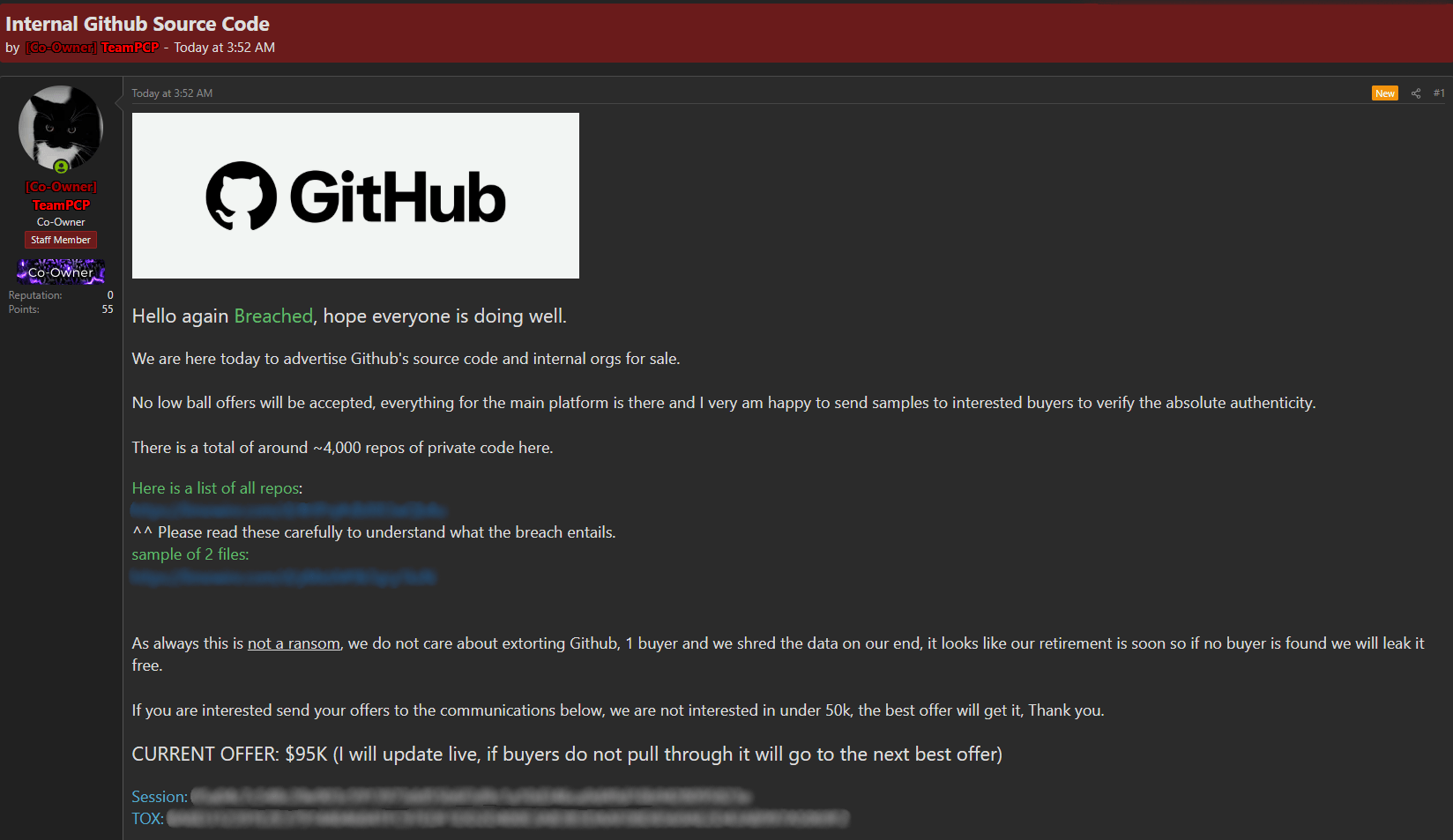
Threat actor TeamPCP claims to be selling alleged internal source code and private repositories associated with GitHub.
The actor advertised the alleged data on a dark web forum, claiming possession of approximately 4,000 private repositories tied to the platform’s internal environment.
The threat actor also distributed a LimeWire-hosted archive allegedly containing repository listings associated with the claimed dataset.
ABOUT GITHUB
GitHub is a cloud-based software development and version control platform owned by Microsoft. The platform is widely used for source code hosting, collaborative software development, CI/CD workflows, and enterprise repository management across commercial, open-source, and government environments.
GitHub supports millions of developers and organizations globally and serves as critical infrastructure within the modern software supply chain ecosystem.
POST METADATA
- Threat Actor: TeamPCP
- Target: GitHub
- Activity Type: Alleged source code sale
- Claimed Data: Approximately 3,800–4,000 internal repositories
- Monetization: Underground sale / auction
- Current Highest Claimed Offer: $95,000 USD
- Supporting Material: LimeWire-hosted archive + sample files (including OrganizationsController.rb and PullRequestsController.rb)
- Independent Validation: None at the time of writing
- Confidence Level: Moderate
ALLEGED EXPOSED MATERIAL
According to the advertisement, the alleged dataset includes:
- Internal GitHub organization repositories
- Private source code repositories
- Platform controller files
- Backend application logic

Referenced sample filenames include:
- pull_requests_controller.rb
- organizations_controller.rb
TECHNICAL ANALYSIS OF REFERENCED FILES
> pull_requests_controller.rb

Purpose: Serves as the backend for virtually every pull request-related operation: viewing, reviewing, commenting, merging, applying suggestions, bulk triage, conflict resolution, and integration with code scanning and workflows.
Based on the exposed snippets and structural references, the controller appears designed to manage nearly the entire pull request lifecycle, including:
- Pull request creation and viewing
- Code review workflows
- Commenting and review suggestions
- Merge operations
- Conflict resolution
- Bulk triage actions
- Integration with CI/CD workflows
- Security and code scanning interactions
Observed architectural characteristics include:
- Extensive depends_on_clusters declarations spanning numerous database clusters such as:
- IssuesPullRequests
- Repositories
- Spokes
- Copilot
- Ballast
- Heavy use of feature flags for staged deployment and progressive rollout management
- Deferred loading mechanisms and read-replica strategies intended to optimize high-volume query operations
- React payload construction and hybrid frontend/backend rendering integration
- Route management between legacy paths (/files, /commits) and newer unified /changes workflows
- Timeout recovery orchestration associated with merge execution handling
Assessment:
The controller reflects characteristics consistent with a mature large-scale application architecture supporting high concurrency and globally distributed development operations.
Criticality:
Extremely high. Pull Requests represent one of GitHub’s most business-critical and operationally sensitive platform features. Exposure of internal implementation details may provide insight into backend workflows, deployment logic, scalability architecture, or undisclosed application behaviors.
> organizations_controller.rb
Based on the referenced code structure, the controller appears responsible for:
- Organization creation and onboarding
- Profile and settings management
- Organization updates and deletion workflows
- Billing and subscription orchestration
- Enterprise onboarding processes
The controller’s create workflow allegedly coordinates multiple operational processes, including:
- Plan selection:
- Free
- Business
- Business Plus
- Enterprise Cloud trials
- Seat licensing and subscription billing
- Coupon and payment handling
- Trade compliance and OFAC sanctions screening
- Terms of Service validation
- Address validation and VAT processing
- CAPTCHA enforcement for suspicious activity
Observed architectural characteristics include:
- Use of layered authorization filters such as:
- org_creators_only
- org_admins_only
- org_members_only
- Integration with service objects such as:
- Organization::Creator.perform
- Dependency declarations across multiple infrastructure clusters including:
- Billing
- Collab
- IAM
Assessment:
The controller reflects enterprise-oriented account provisioning and compliance management functionality commonly associated with SaaS onboarding systems.
Criticality:
Highly critical. Organization onboarding and billing workflows represent a direct operational dependency for enterprise customer acquisition, subscription management, regulatory compliance, and revenue operations.
Side-by-Side Comparison:
| Aspect | OrganizationsController | PullRequestsController |
|---|---|---|
| Size | ~450 lines | 124KB+ |
| Primary Focus | Onboarding, billing & compliance | Core collaboration & product features |
| Key Challenges | Regulatory & commercial logic | High traffic + rich feature set |
| Architecture Patterns | Service objects, layered authorization | Feature flags, sharding, deferred loading |
| Role in Platform | Business & enterprise enablement | Foundational user experience |
POTENTIAL SECURITY IMPLICATIONS
If authentic, exposure of internal source code repositories may introduce several security concerns, including:
- Discovery of undisclosed vulnerabilities
- Exposure of internal development logic
- Identification of authentication workflows
- Risk of supply chain targeting
- Potential leakage of internal tooling or configuration data
Source code exposure does not automatically indicate compromise of customer repositories or hosted projects.
ASSESSMENT OF PROVIDED EVIDENCE
The two sample files provided (OrganizationsController.rb and PullRequestsController.rb) appear to be authentic based on their structure, coding style, naming conventions, and technical content, which are consistent with GitHub’s known Ruby on Rails architecture.
GitHub has publicly acknowledged unauthorized access to a limited number of internal repositories. However, the currently available evidence does not independently confirm:
- The full scope or total number of repositories accessed (~3,800 claimed)
- Whether the leaked samples represent the complete claimed dataset
- Any compromise of GitHub production systems or customer data
- Broader infrastructure impact
At present, the claims are supported by partially corroborating samples shared by the actor, combined with GitHub’s own admission of limited internal repository access. Full independent verification of the complete dataset is still pending.
OSINT STATUS (as of May 20, 2026)
- GitHub has publicly acknowledged the incident and is actively investigating unauthorized access to its internal repositories.
- The actor’s claim of ~3,800 affected repositories is described by GitHub as “directionally consistent” with their findings so far.
- GitHub states the breach involved a compromised employee device (via a malicious VS Code extension). They have isolated the device and begun rotating secrets.
- No customer data, customer repositories, or production systems appear to have been impacted.
- No full leaked archive has been publicly released or independently verified at this time.
- The authenticity and completeness of the claimed data being sold remains unverified by independent third parties.
ASSESSMENT
The claims made by TeamPCP have gained partial credibility due to the circulation of what appear to be authentic internal GitHub source code samples, including files such as OrganizationsController.rb and PullRequestsController.rb.
GitHub has publicly confirmed unauthorized access to approximately 3,800 internal repositories via a compromised employee device (malicious VS Code extension). However, independent validation of the full claimed dataset is still lacking, and no complete archive has been publicly released or forensically verified as of this writing.

While the leaked samples are technically consistent with real GitHub Rails code, there is currently no evidence of customer data exposure, production system compromise, or broader platform impact.
Threat Level: Low to Moderate
(Unverified but partially corroborated claim of internal source code exfiltration. GitHub confirms limited unauthorized access to internal repositories but explicitly states no customer data or production impact was observed. The primary value to threaten actors would be reconnaissance and long-term research rather than immediate exploitation.)
RECOMMENDATIONS
For Organizations
- Monitor for downstream leaks involving GitHub-related codebases
- Review repository access controls and authentication security
- Enforce MFA across development platforms
- Audit privileged access to source code management systems
For Security Teams
- Monitor underground forums for additional proof releases
- Watch for emergence of authentication tokens, secrets, or CI/CD credentials
- Track potential weaponization of leaked development artifacts
- Review exposure risks associated with third-party integrations
The information provided in this article is based on publicly available open-source intelligence (OSINT). It is intended for awareness and defensive cybersecurity purposes only.
