
 HQ/EMEAFind out how we can help your business

THREAT SNAPSHOT: AT A GLANCE
| Field | Assessment |
|---|---|
| Campaign name | GasTrap |
| Threat type | Android banking trojan (SMS/OTP interception, USSD call-forwarding fraud) |
| Delivery vector | Direct APK transfer inside WhatsApp Business chat (no phishing URL) |
| Impersonated brands | Indraprastha Gas Limited (IGL, Delhi-NCR); publicly reported sister campaigns impersonate Mahanagar Gas (Mumbai/Thane) under the identical Gas Bill Update APK name |
| Secondary impersonation | HDFC Bank (via Firebase project “hdfc-sachin” used as C2 infrastructure) |
| Target geography | India (Android users, UPI/net-banking customers) |
| Target sector | Retail banking / UPI payments customers; gas-utility (PNG/LPG) consumers |
| Motivation | Financial fraud (OTP/SMS theft, call-forwarding hijack of bank verification) |
| Malware architecture | Two-stage: obfuscated dropper + banking-trojan payload, shared commercial-grade packer |
| C2 infrastructure | mranon.duckdns.org (Dynamic DNS) + Firebase RTDB project hdfc-sachin |
1. EXECUTIVE SUMMARY
At iZOOlogic, we continuously monitor and analyze malware and phishing operations that abuse trusted Indian brands and payment ecosystems to defraud consumers. GasTrap is a financially motivated Android malware campaign that impersonates Indraprastha Gas Limited (IGL), a major Indian city-gas utility, to trick victims into installing a two-stage banking trojan. Unlike web-hosted phishing and dropper campaigns, GasTrap’s initial access vector is entirely social. A WhatsApp Business account branded “IGL” (advertised through Facebook and Instagram ads, per WhatsApp’s own “this chat started from an ad” label) collects victim PII under the pretext of a “gas bill update” and then hands the victim an APK, Gas_bill_update.apk, directly inside the chat. This is a delivery channel that sidesteps app-store review, URL and domain reputation filtering, and most conventional anti-phishing controls at the same time.
Technical analysis of the dropper and its bundled second stage (package dev.axis.personal.monitor, labelled “Gas Bill Update”) reveals a professionally engineered, packer-protected malware framework. A shared commercial-grade Android packer, identified internally via a decoded meta-data key that references a known app-protector naming convention, hides all meaningful logic inside AES-CBC encrypted, gzip-compressed code that is decrypted and loaded in-process at runtime. In a technique not previously documented for this campaign family, the dropper carries a complete, digitally signed copy of the second-stage payload APK smuggled inside a steganographic PNG image, unlocked with a key stored in a small sibling file. This means the malware requires no reachable download server to complete infection.
Once installed, the payload requests full SMS control (read, receive, send), phone-call permissions, and boot persistence. Recovered runtime code shows a local database that stores every intercepted SMS with a banking-message classifier, a background process that forwards these messages to a hardcoded command-and-control endpoint (https://mranon.duckdns.org/api), and a dedicated routine that dials GSM USSD codes (*21*
Open-source correlation confirms this is an active, currently prosecuted campaign, not a theoretical risk. IGL itself issued a public fraud advisory naming this exact APK-delivery method, Delhi Police arrested four operators of an interstate syndicate in June 2026 using this technique, and a materially identical Gas Bill Update APK, impersonating Mahanagar Gas in Thane, defrauded 22 victims of approximately ₹31.43 lakh. This places GasTrap within a broader, multi-city Indian gas-utility impersonation fraud wave that iZOOlogic assesses with high confidence is financially motivated and operationally mature.
This report documents the full infection chain from the WhatsApp lure through both malware stages, presents the operational method and keys used to recover the hidden payloads, correlates the findings against public reporting and law-enforcement action, and provides indicators of compromise, YARA rules, a MITRE ATT&CK for Mobile mapping, and prioritized recommendations.
2. INTRODUCTION
India’s digital payments ecosystem, including UPI, net banking, and the utility-billing apps that sit alongside them, has become a high-value target for financially motivated threat actors. Rather than compromising banks directly, these actors increasingly target the weakest link: the end user, using trusted-brand impersonation (gas, electricity, and transport utilities), messaging-platform delivery (WhatsApp Business, which carries an implicit trust signal for many Indian users), and commercially available Android protector and crypter tooling to keep malware ahead of static detection.
This report documents GasTrap, a live two-stage Android malware pair recovered by iZOOlogic as a matched dropper and payload set, together with the original social-engineering lure used to deliver it. The analysis was performed entirely statically. Decompiled Java and Kotlin sources, Android manifests, and packaged assets were reviewed by hand and with purpose-built analysis tooling, and where the samples’ own source code revealed a usable decryption key, the corresponding encrypted assets were decrypted offline as a pure data transformation. At no point was any sample installed, executed, or granted permissions on a device or emulator.
3. KEY FINDINGS
- A WhatsApp Business account branded “IGL” (observed numbers +91 98197 01854 and +91 92176 85497), advertised via Facebook and Instagram, is used to harvest victim PII (name, address, consumer number, date of birth) before delivering the malicious APK directly inside the chat as a 3.7 MB file named Gas_bill_update.apk.
- This delivery method matches an active, publicly documented, and law-enforcement-prosecuted fraud wave. IGL’s own official fraud advisory, a Delhi Police syndicate bust (June 2026, 4 arrests), and a near-identical Mahanagar Gas and Thane case (22 victims, ₹31.43 lakh in losses) all describe the same “gas bill” WhatsApp APK delivery pattern.
- The dropper and the payload (package dev.axis.personal.monitor, label “Gas Bill Update”) share the same underlying application wrapper, confirming both were produced by the same builder and packer toolchain.
- Both samples hide their real logic inside AES-CBC encrypted, gzip-compressed code loaded at runtime through a standard Android in-memory class loading mechanism. The AES key and IV are hardcoded in the visible packer source and were used in this investigation to decrypt both hidden code packages offline.
- Previously undocumented for this campaign family: the dropper carries a complete, digitally signed copy of the dev.axis.personal.monitor payload APK hidden as a steganographic append to a PNG image, unlocked with a key, IV, and length value stored in a 36-byte sibling file. The dropper does not need network access to obtain its second stage.
- The dropper’s fake “Update Available” and “Install Update” screen walks the victim through enabling “Install unknown apps,” then silently installs the bundled payload using a packaged copy of Google’s own APK-signing library and the standard Android package installer session interface. No browser or file manager step is needed.
- The payload requests permission to read, receive, and send SMS, and stores every intercepted message, with a banking-message classifier, in a local database, exfiltrated to a hardcoded command-and-control server (https://mranon.duckdns.org/api) by a background job. A Firebase Realtime Database project named hdfc-sachin, impersonating HDFC Bank, is present as a secondary channel.
- A dedicated background routine dials GSM USSD codes (*21*
# to enable, ##21# to disable) to toggle unconditional call forwarding on demand, silently redirecting the victim’s incoming calls, including bank OTP and verification calls, to an attacker-controlled number. - Firebase Cloud Messaging is not just a heartbeat channel. Full decompilation of the recovered payload code reveals an eight-command remote-control protocol delivered over push messaging (activating or deactivating call forwarding, dialing arbitrary USSD codes, placing calls, sending SMS, forcing an SMS upload, updating the stored admin number, and relocating the command server), giving the operator real-time remote control equivalent to a lightweight remote access trojan.
- The dropper additionally requests the standard Android VPN consent prompt and gates its entire install flow behind that consent, activating a bundled VPN and traffic-proxy component before installing the payload.
- Both samples implement matching anti-analysis logic: emulator, BlueStacks, Nox, and Genymotion detection; Frida, Xposed, and substrate detection; a hidden-API-restriction bypass; and a dormancy gate requiring three or more app launches and 48 or more hours since install before any malicious behavior activates.
- Dozens of asset files with misleading extensions (.json, .xml, .db, .bz2, .gif) are bundled purely as anti-scanning padding. None are referenced anywhere in the recoverable code of either sample.
- Both samples are digitally signed with distinct, fabricated self-signed certificates issued 9 seconds apart, and the dropper’s own recovered code contains a built-in routine that generates a fresh key pair and a new self-signed identity from scratch, evidence of an automated build pipeline designed to give every distributed sample a unique, non-reused signing identity.
4. MODUS OPERANDI
GasTrap’s operational lifecycle begins with paid social media advertising that funnels prospective victims into a WhatsApp Business conversation impersonating IGL customer support. The operator, or a scripted auto responder, requests the victim’s personal and consumer details under the pretext of processing a “gas bill update,” then transmits the malicious APK directly through the chat. This is a delivery channel that bypasses app store review, URL and domain reputation filtering, and most email and SMS link based phishing defenses at the same time, because the payload never touches a URL or a browser. A closely related variant of this same pattern additionally requests a small card verification payment before the APK is sent, monetizing the lure step itself in addition to the eventual account takeover.
Once the victim installs the APK, a packer stub performs environment checks before revealing any malicious behavior. It fingerprints the device against known emulator and analysis tool signatures, and gates activation behind a minimum install age and launch count. If these checks pass, it decrypts a hidden code package from its own bundled assets and loads it in memory, handing control to a fake “Update Available” screen. This screen walks the victim through enabling installation from unknown sources and then silently installs a second, complete APK, not downloaded, but decrypted out of a steganographic image already bundled in the dropper, using a legitimate copy of Google’s own APK-signing library and the standard Android package installer session interface.
The installed payload persists across device reboots and requests ongoing SMS and telephony permissions. Two data theft routines then operate continuously in the background. A high-priority listener captures every inbound SMS, classifying likely OTP and banking messages, into a local database that is periodically synchronized to a hardcoded command server; and a second routine issues USSD dial codes to silently enable call forwarding, redirecting voice-based OTP and verification calls away from the victim. Device check-ins and registration data are sent to the same server, giving the operator a live inventory of infected devices and the ability to issue further remote commands, including activating or deactivating call forwarding, dialing arbitrary USSD codes, sending SMS, forcing an on-demand SMS upload, and relocating the command server itself.
Both the dropper and the payload share identical anti-analysis engineering: the same emulator, root, and hooking-tool detection routines, the same string obfuscation cipher, and the same encryption key pair for the bundled assets. This is strong evidence that both stages were produced from the same commercial or semi-commercial Android protector and crypter builder pipeline rather than being independently developed.
5. ANALYSIS AND EVIDENCE
5.1 Initial Access: The WhatsApp IGL Lure
The lure document supplied alongside the samples contains no text and no macros, only three screenshots documenting the live social-engineering chain used to deliver the dropper. WhatsApp itself labels the conversation as originating from a paid ad: “This chat started from an ad on Facebook or Instagram.”
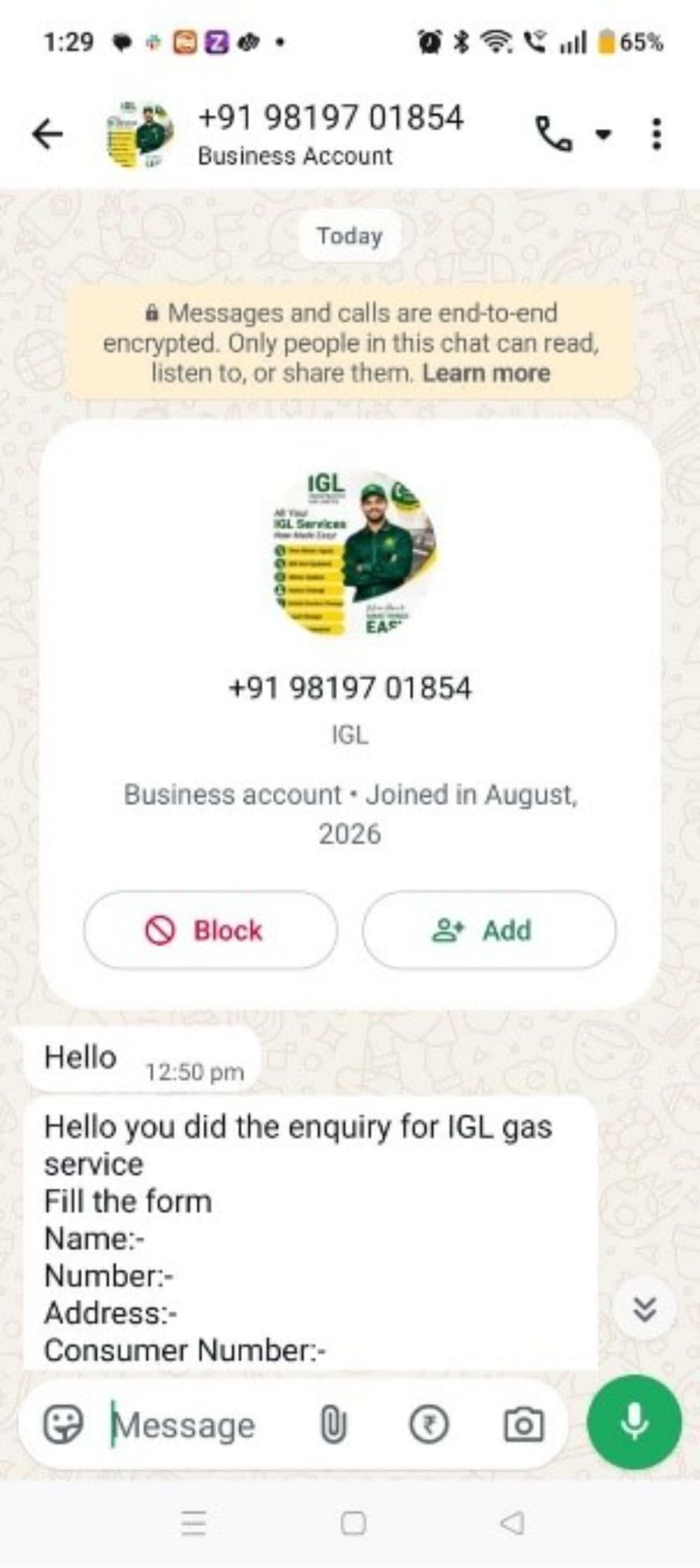
WhatsApp Business account “IGL” (+91 98197 01854), branded with the real IGL logo, opening the conversation.
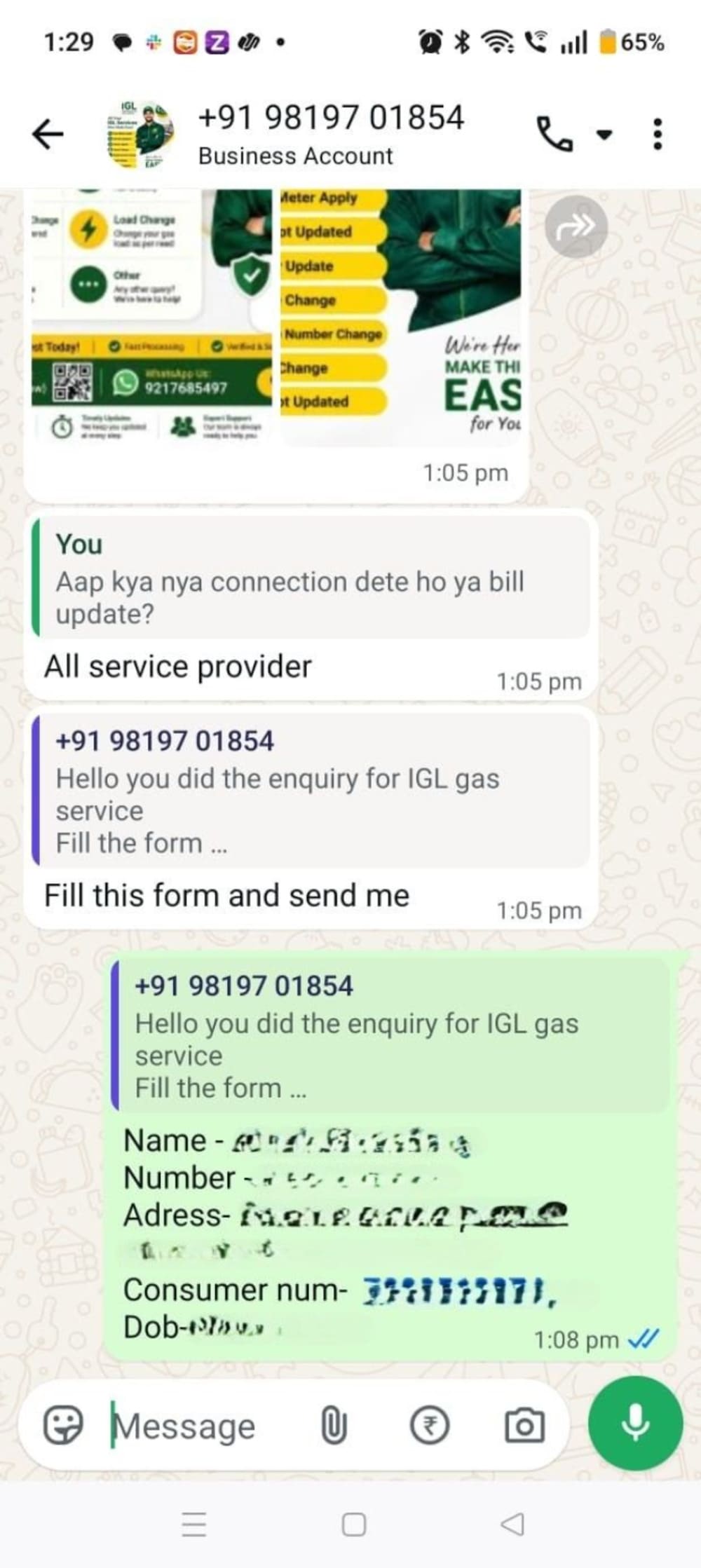
The account requests Name, Number, Address, Consumer Number and DOB in chat before continuing.
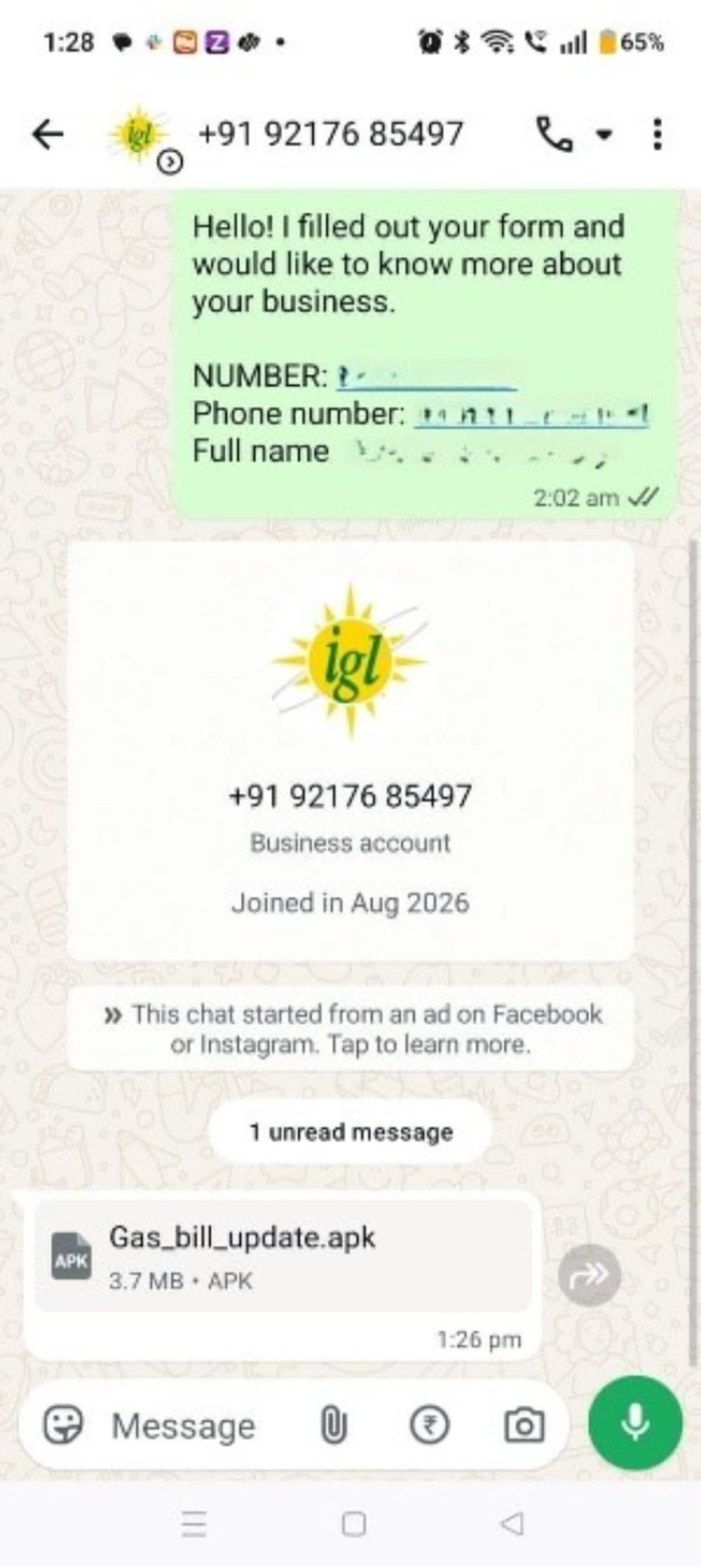
A second “IGL” WhatsApp Business number (+91 92176 85497, “Joined in Aug 2026”) sends the payload directly in chat: Gas_bill_update.apk, 3.7 MB.
This delivery model has two consequences for defenders. First, there is no phishing domain or download URL to blocklist, since the file moves entirely inside an end-to-end encrypted chat. Second, the PII collected in the chat form (full name, address, date of birth, utility consumer number) has independent value for identity fraud and can be used to make later social-engineering steps, such as a follow-up verification call, more convincing.
5.2 Static Analysis: Dropper (Gas_bill_update)
Manifest permissions and components
The manifest declares several high-risk permissions that, together, let the app silently obtain and install a second APK without the user ever visiting an app store.
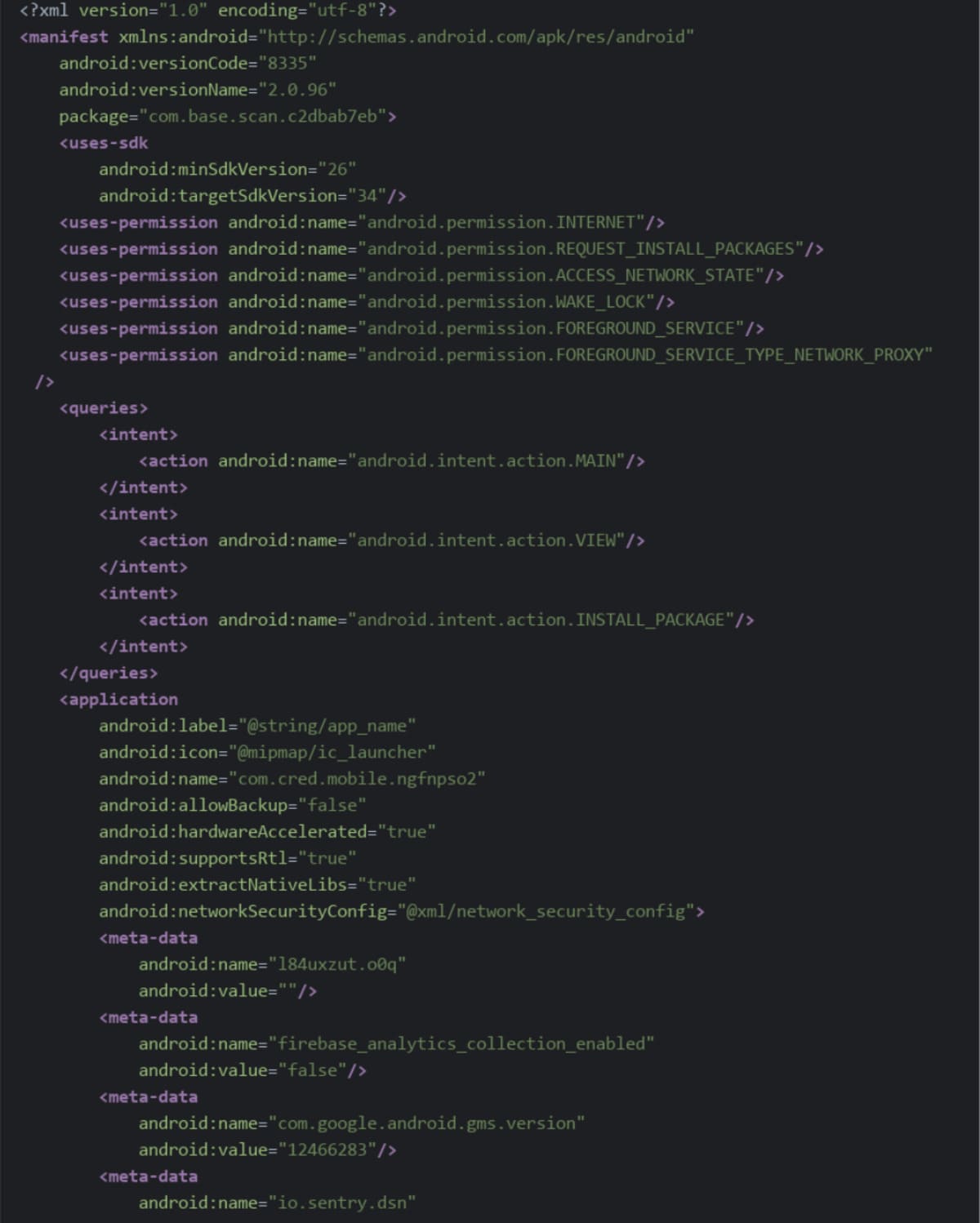
High-risk permission and component declarations in the dropper’s application manifest, including permission to request package installation, a package-install visibility query, the shared packer’s application wrapper, and a bundled VPN service component.
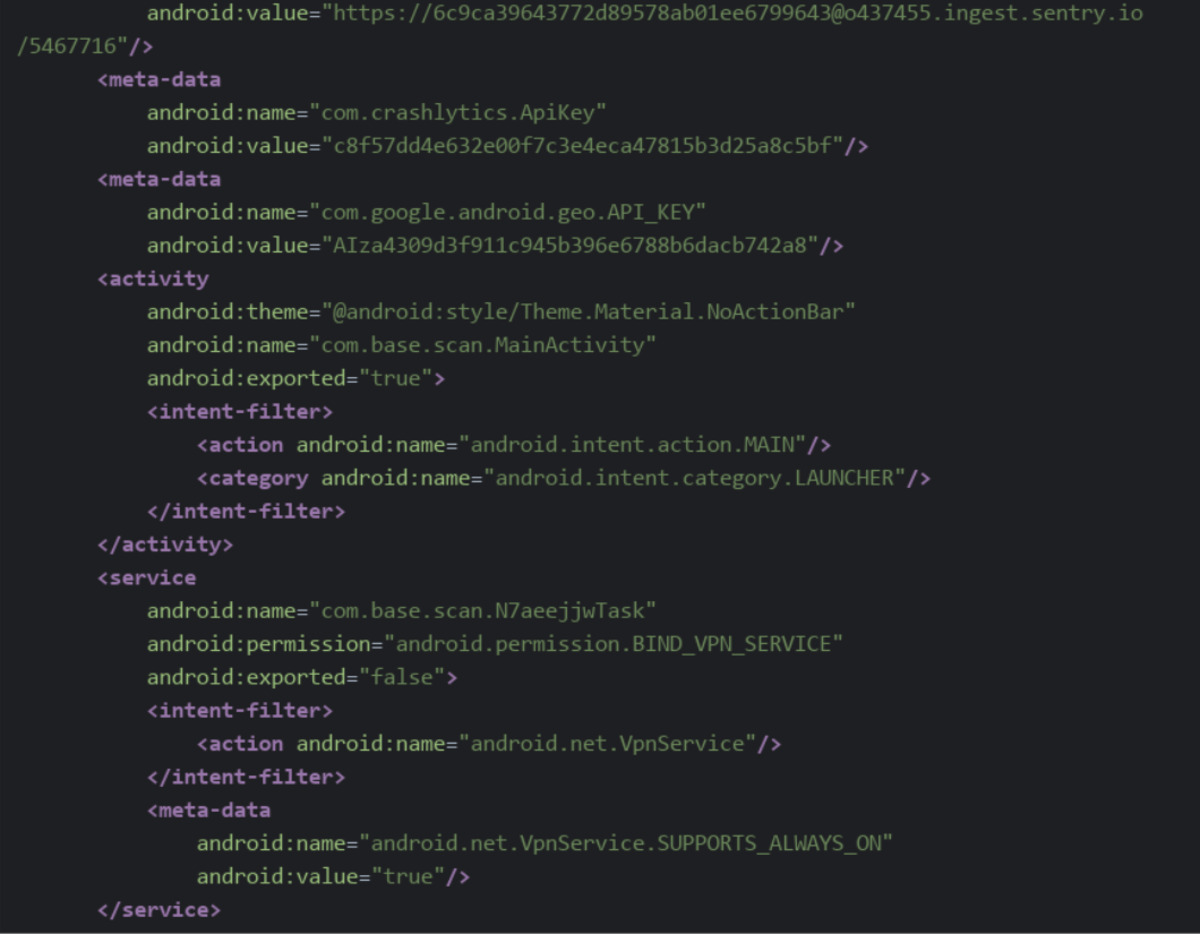
High-risk permission and component declarations in the dropper’s application manifest, including permission to request package installation, a package-install visibility query, the shared packer’s application wrapper, and a bundled VPN service component.
| Permission / Component | Significance |
|---|---|
| REQUEST_INSTALL_PACKAGES | Lets the app request installation of a second APK without going through Google Play |
| Foreground network-proxy permission plus a bundled VPN service component | A standards-compliant Android VPN service used for on-device traffic proxying, gated behind the standard Android VPN consent prompt (see below) |
| Package-install visibility query | Required on modern Android versions to interact with package-install intents and handlers |
| Single exported launcher screen | The only exported component; shows the fake update screen |
| Third-party crash-telemetry and maps keys | Legitimate SaaS-vendor keys present as camouflage, not command-and-control infrastructure |
Packer stub shared by both samples
The application wrapper named in the manifest is not part of the app’s own package. It sits in a separate, shared library package that is byte for byte identical in both the dropper and the payload, confirming a shared build pipeline. Every sensitive string literal inside it is obfuscated with a trivial per-class cipher, decoded at runtime.
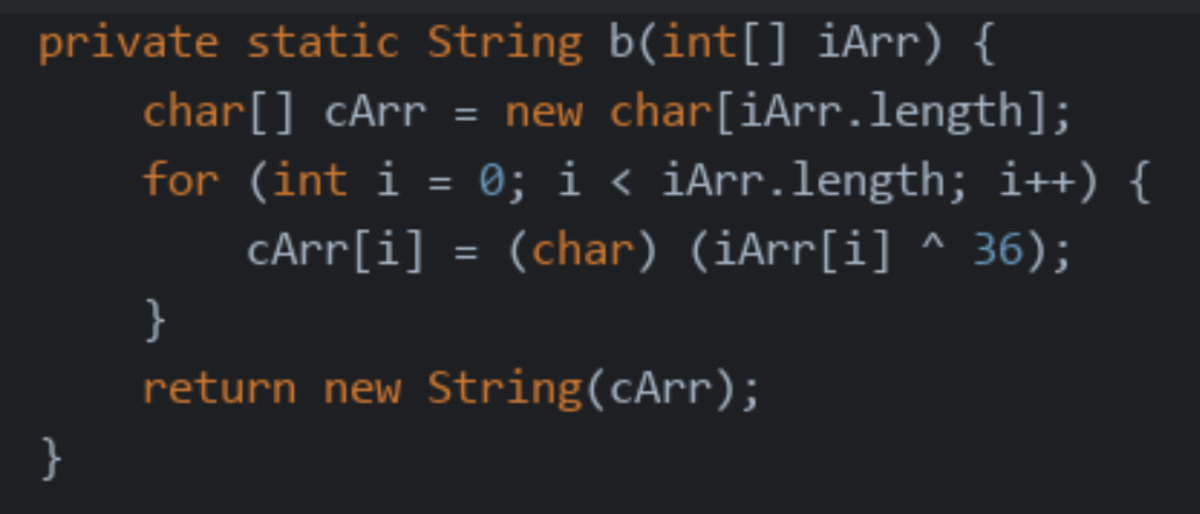
The string de-obfuscation routine shared across the packer’s internal classes.
Decoding every obfuscated literal with this cipher recovers the strings the packer hides from casual static review.
| What was hidden | Decoded value | Purpose |
|---|---|---|
| A meta-data key | apkshield.app | Read to find the real payload’s application class name. This is the naming convention of a commercial Android app-protector product; no public product page was located under this exact name during open-source review, suggesting a private-label or renamed build |
| A brand-name check | genymotion | Emulator brand check |
| A brand-name check | bluestacks | Emulator brand check |
| Hooking-tool names | frida / xposed / substrate | Detection via the running process’s memory-map listing |
| A system class name | an in-memory code loader | Reflectively resolved so the literal class name never appears as plain text |
| A cipher mode name | AES/CBC/PKCS5Padding | Cipher transformation used to decrypt bundled assets |
Anti-emulator, anti-hooking and dormancy gating
One routine fingerprints the device against known emulator and analysis-tool build properties before any malicious behavior is allowed to run.
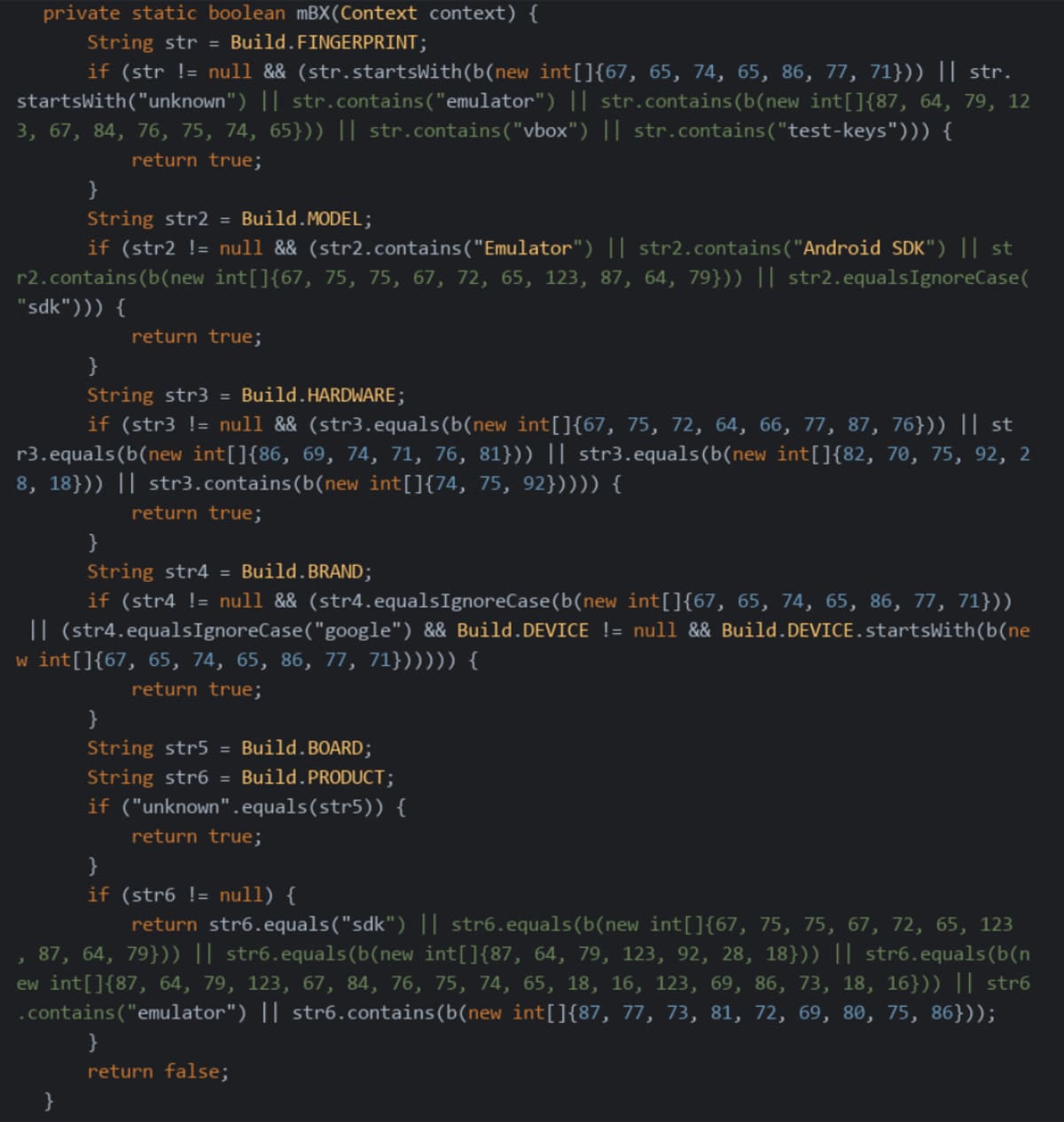
Device build properties checked against Genymotion, BlueStacks, generic emulator, VirtualBox, and test-signed build signatures. Companion checks extend this to manufacturer strings, the process memory map (for hooking frameworks), and known emulator marker files.
A second, independent gate withholds activation until the app has been opened repeatedly and has aged past 48 hours since install, a deliberate defeat of short-lived automated sandboxes.
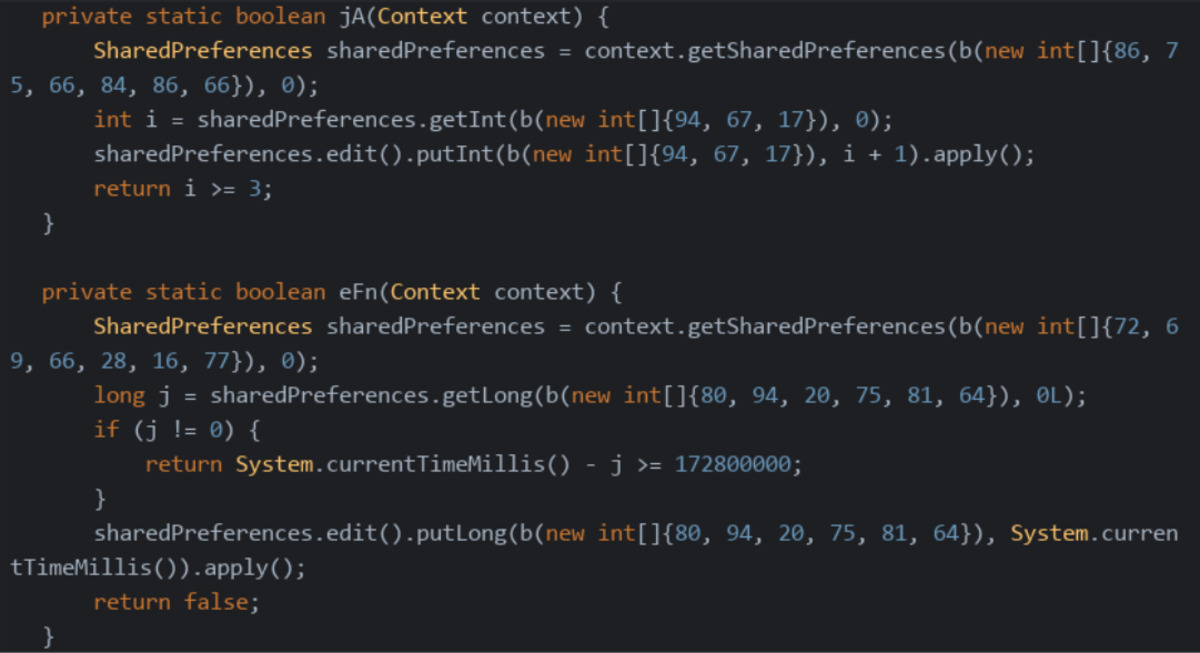
A launch counter requiring three or more opens, and a 48-hour since-install timer. Both must pass before the packer will hand control to the real payload.
The combination of the environment checks with the launch-count and time-since-install gating means the payload will not reveal malicious behavior to a sandbox that runs the sample once, immediately after unpacking.
Hidden-payload decryption method, reproduced and verified in this analysis
The packer’s real logic never appears in the visible, top-level compiled code. It is stored encrypted inside a bundled asset and decrypted at runtime by a routine that strips a 48-byte disguise header, runs AES in CBC mode with PKCS5 padding, then decompresses the result into a raw block of executable code.
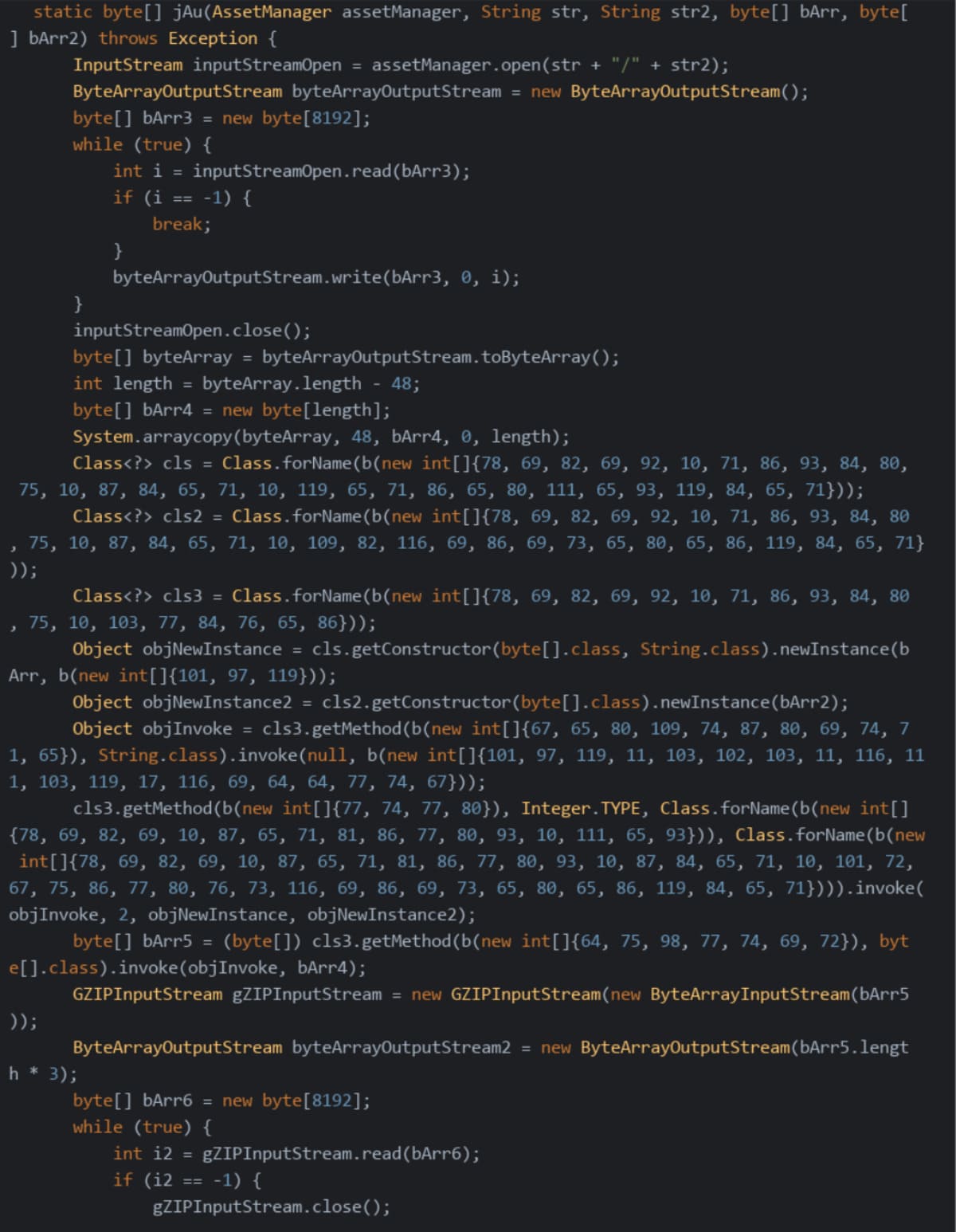
The full asset-decryption routine, reflectively invoking the standard Java cryptography API to avoid literal class-name strings.
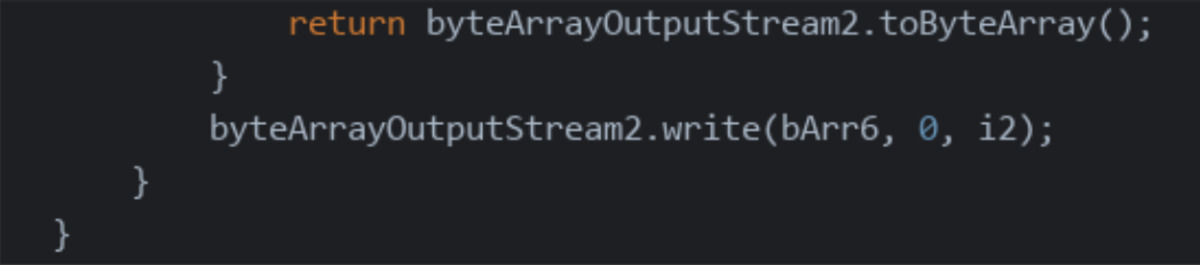
The full asset-decryption routine, reflectively invoking the standard Java cryptography API to avoid literal class-name strings.
The recovered code is then loaded in process without ever touching disk on modern Android, by splicing its classes into the app’s own running class loader.
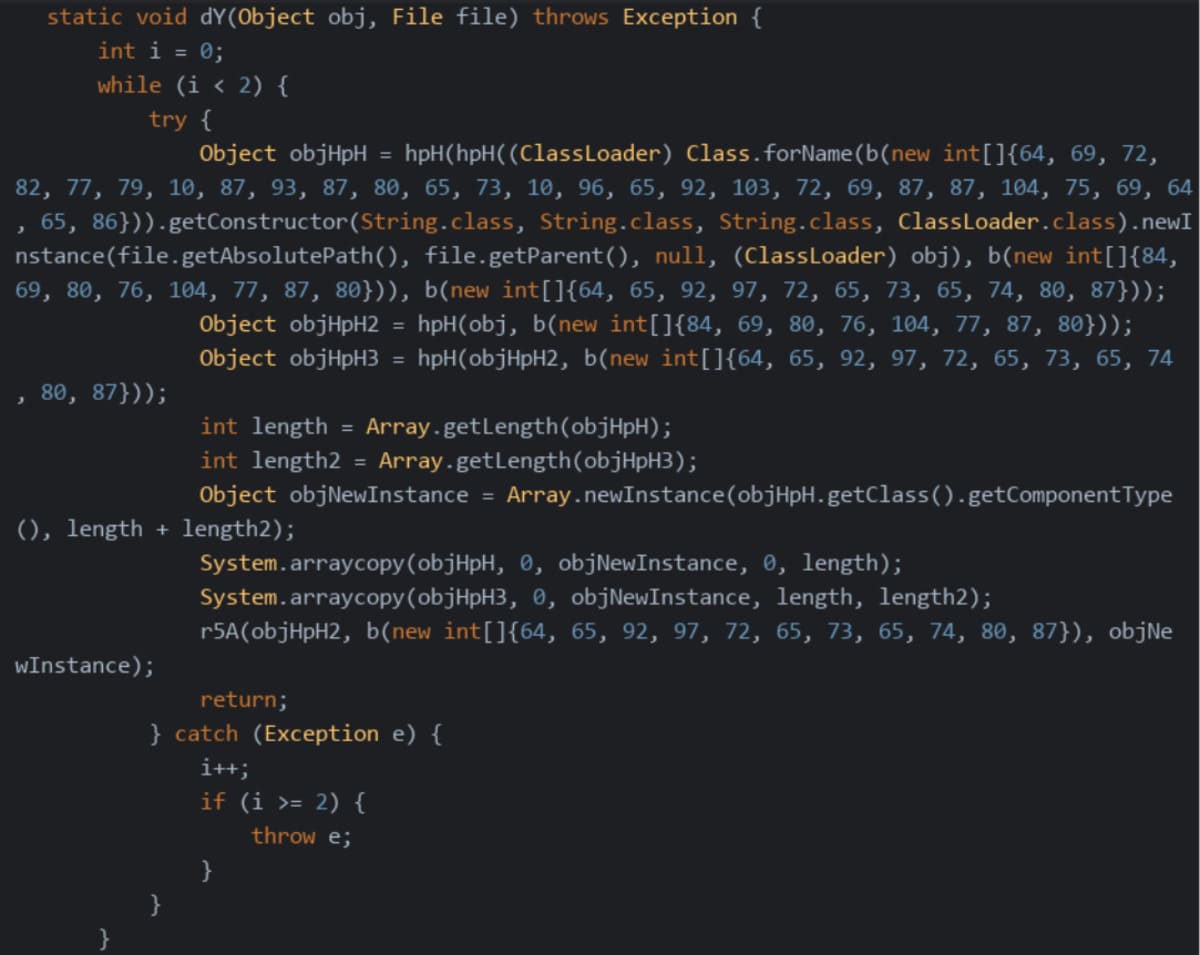
The routine that merges a newly constructed class loader’s contents into the original app’s class loader through reflection.
The dropper’s recovered code contains its real launcher screen, its VPN service component, and a complete bundled copy of Google’s own APK-signing library. Decompiling this recovered code, again purely offline against static bytes, reproduces the real, victim-facing fake-update screen, built entirely in code rather than from a visual layout file.
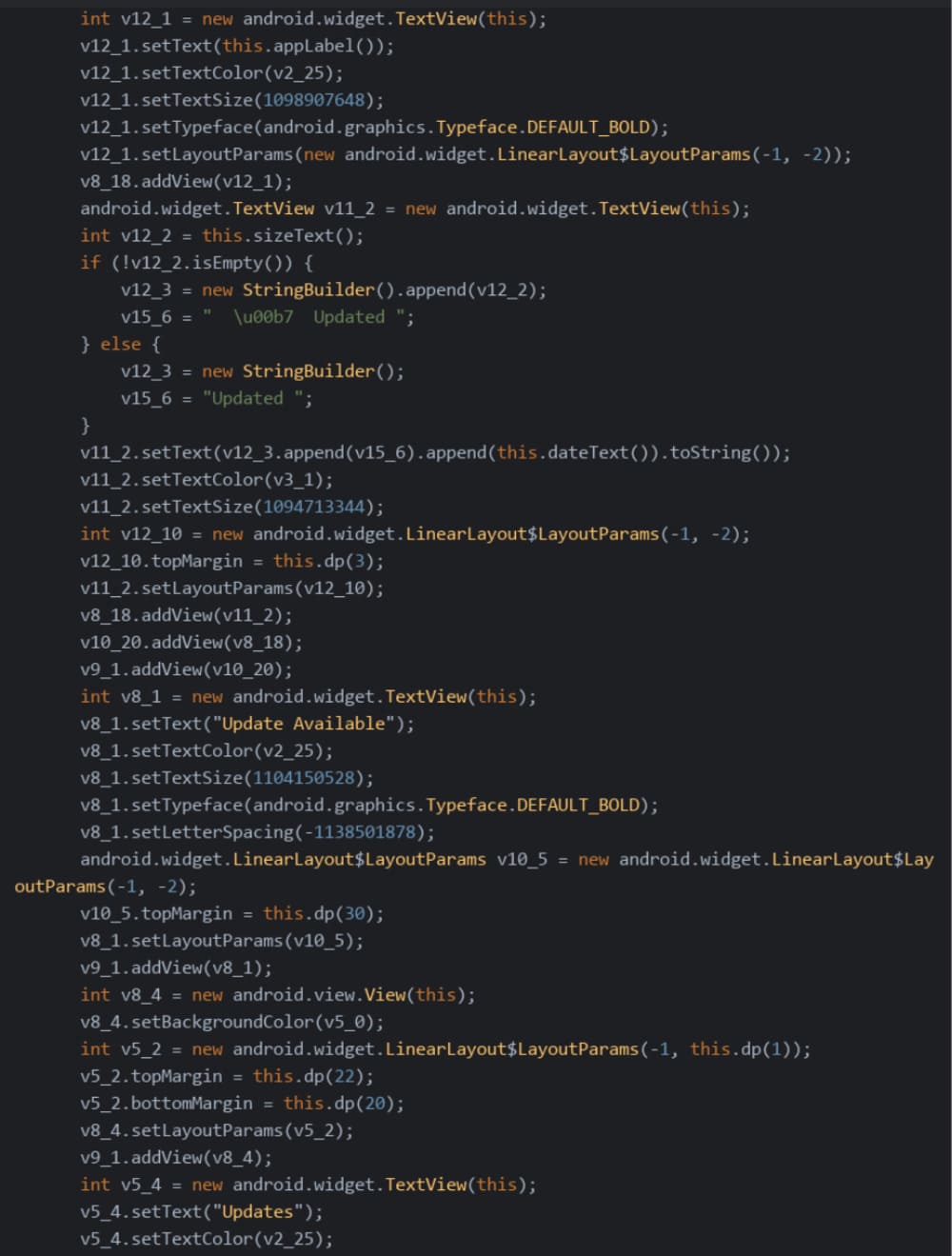
The routine that programmatically constructs the fake Update Available screen: a spoofed app icon and label row, invented changelog bullets, a progress bar, and an Install Update button.
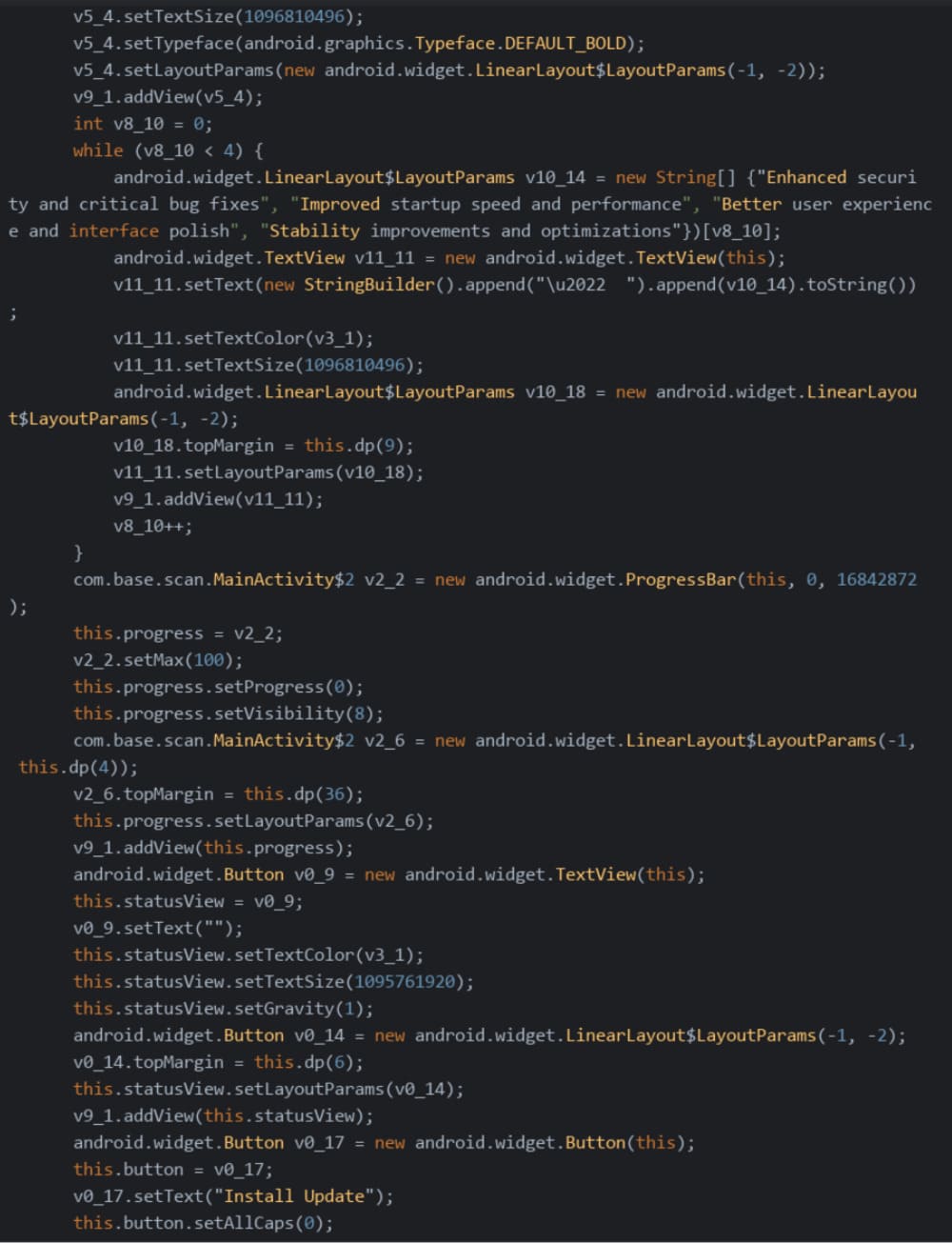
The routine that programmatically constructs the fake Update Available screen: a spoofed app icon and label row, invented changelog bullets, a progress bar, and an Install Update button.
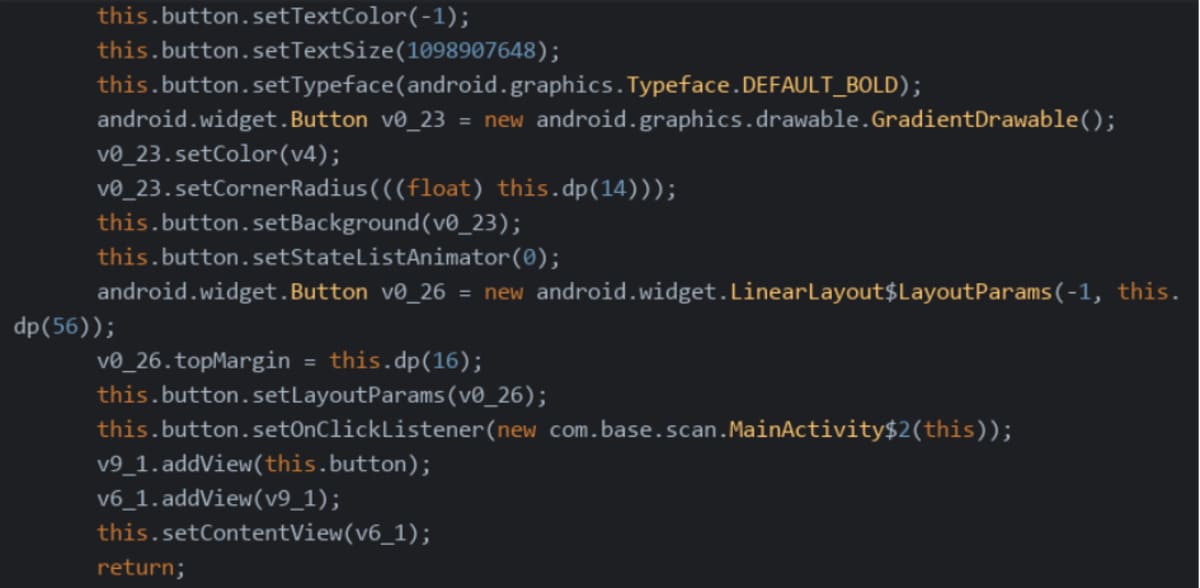
The routine that programmatically constructs the fake Update Available screen: a spoofed app icon and label row, invented changelog bullets, a progress bar, and an Install Update button.
Tapping the button triggers the install routine, which streams the already-bundled, already-decrypted payload APK into a standard Android package-installer session and commits it. No browser, file manager, or second download is involved.
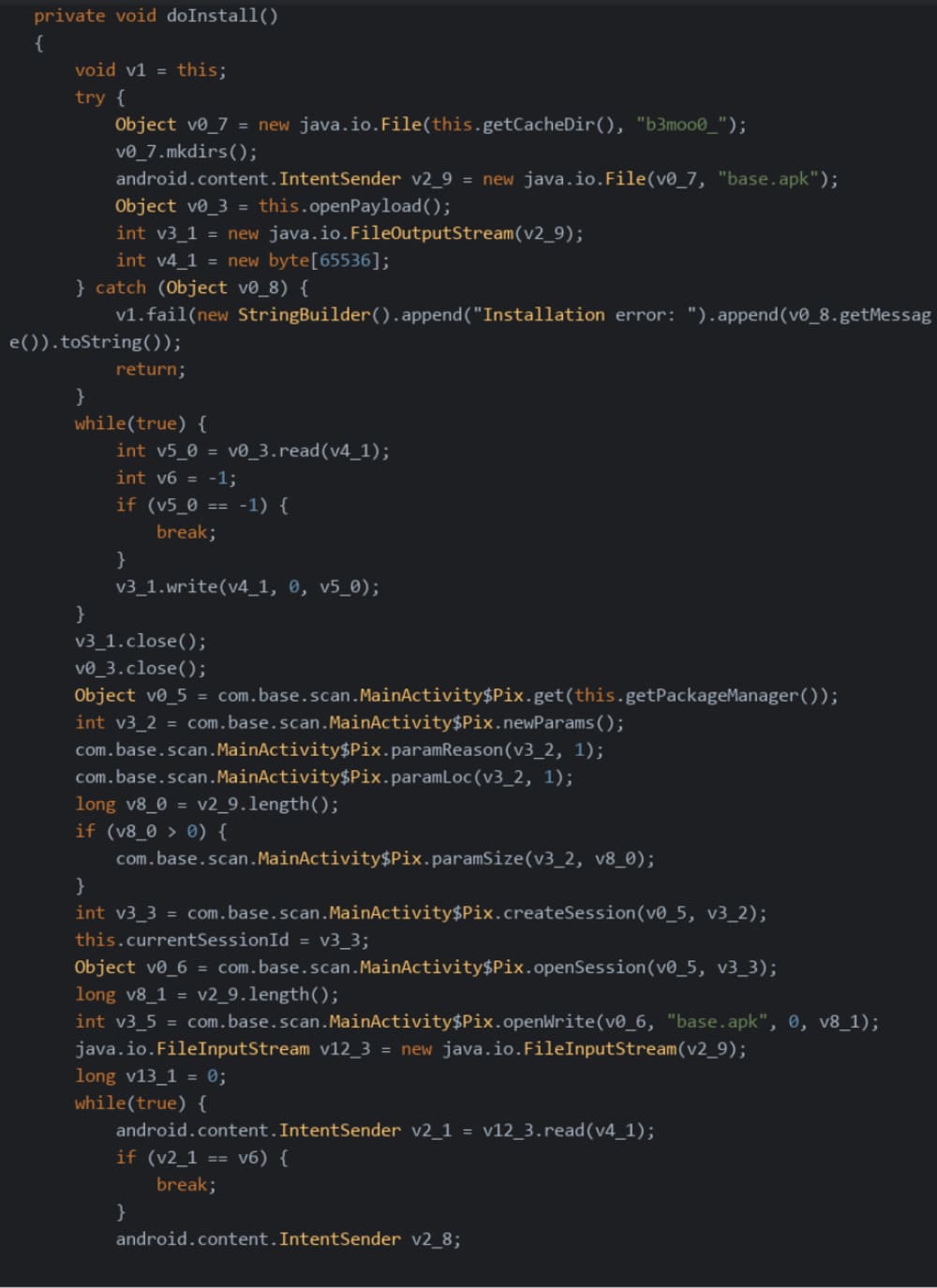
The install routine: writes the payload to a private cache location, opens a package-installer session, streams the APK into it, and commits the install.
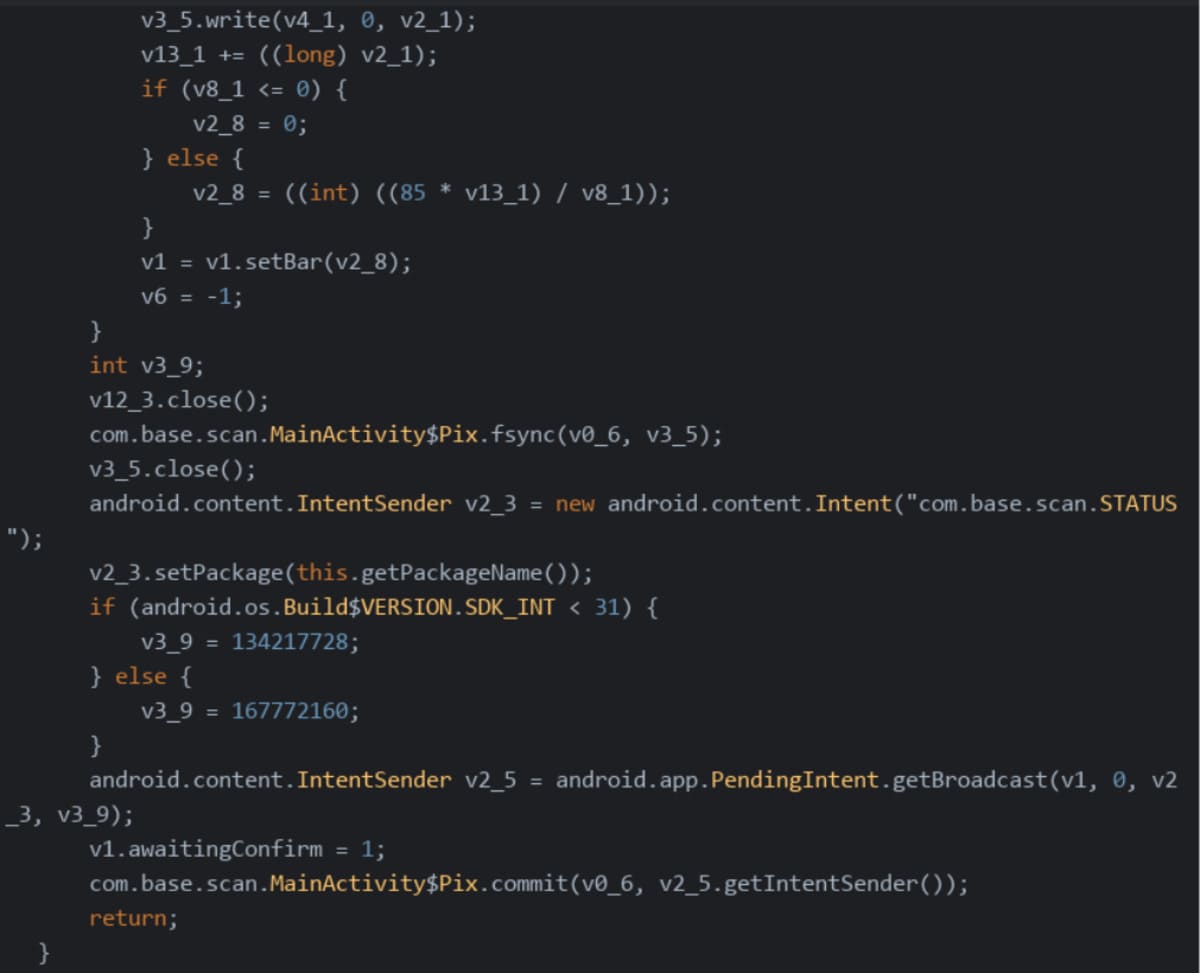
The install routine: writes the payload to a private cache location, opens a package-installer session, streams the APK into it, and commits the install.
Before this can happen, the app also silently walks the victim through two consent steps in sequence. First, the standard Android VPN consent dialog, needed to activate the bundled VPN and traffic-proxy component, and only then the Install Unknown Apps settings screen, polling in the background until permission is granted so installation resumes automatically the moment the user flips the switch and returns to the app.
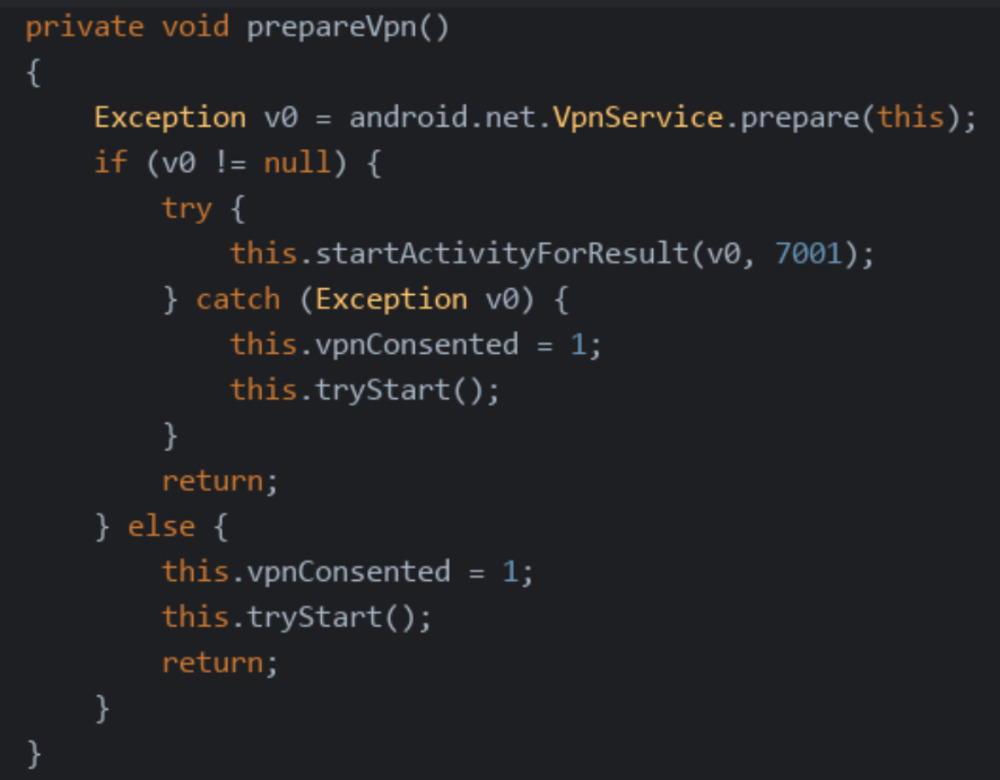
The routine that requests standard Android VPN consent before any install activity begins.
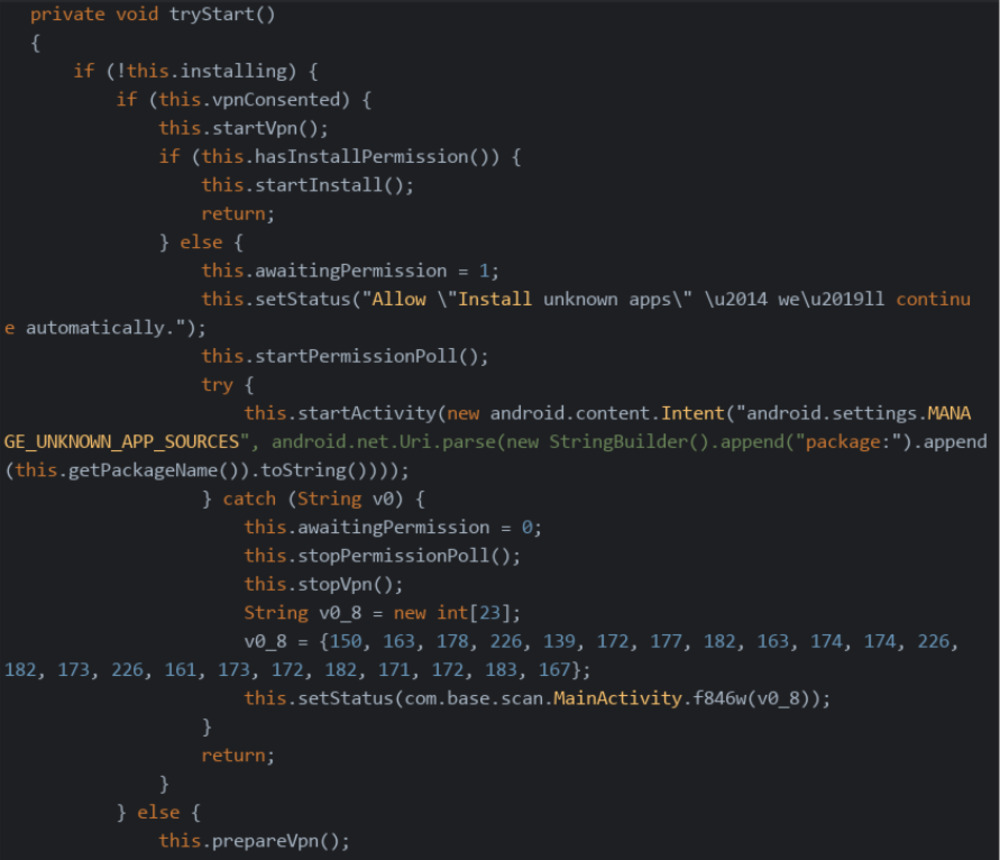
The routine that gates the install step behind both VPN consent and the unknown-sources permission. If unknown sources is not yet enabled, it shows the message “Allow Install unknown apps, we will continue automatically” and opens the relevant settings screen, then polls until the permission appears.
A small plaintext asset at Gas_bill_update/resources/assets/update.txt contains only the payload’s package name, the value the dropper checks for before it will hand off to the installed payload.
Novel finding: the payload APK is smuggled as a steganographic image, not downloaded
Gas_bill_update/resources/assets contains a 3,082,246-byte image file and a 36-byte sibling file that is not referenced anywhere in the visible decompiled source. Reading the sibling file’s raw bytes shows it is a plaintext key record.

The 36-byte sibling file in full: 16 bytes of AES key, 16 bytes of IV, identical to the packer’s own hardcoded constants, and a 4-byte length field.
The trailing length field decodes to 6,662, exactly the byte offset at which the image file’s real picture data ends, as verified by parsing its chunk structure. Everything after that offset (3,075,584 bytes) is not part of the image. Decrypting it with the recovered key and IV under AES-CBC, with no header strip this time since the split point is the image’s own length, yields a valid archive starting with a standard ZIP signature, whose first entry is the compiled resource table.
Unpacking the recovered archive shows it is a complete, installable APK containing a manifest, compiled code, and every resource and asset already catalogued in the payload sample provided for analysis.
This is conclusive. The dropper does not need network access to obtain its second stage. A complete, signed copy of the payload travels inside the dropper itself, disguised as ordinary image data, and is only unlocked at the moment of installation. This materially changes takedown strategy, since blocking a command server or download URL has no effect on this delivery path.
5.3 Static Analysis: Payload (dev.axis.personal.monitor_4.2, label “Gas Bill Update”)
Manifest permissions and components
| Permission | Capability granted |
|---|---|
| SMS receive, read, and send | Full inbound and outbound SMS control |
| Phone state, phone numbers, call, and own-calls management | Telephony state and call control, used for USSD dialing (below) |
| Boot completed | Persistence across device reboot |
| Ignore battery optimizations | Prevents Android from suspending the background components |
| Cloud-messaging receive permission plus a bundled messaging service | Push messaging used as a remote command channel |
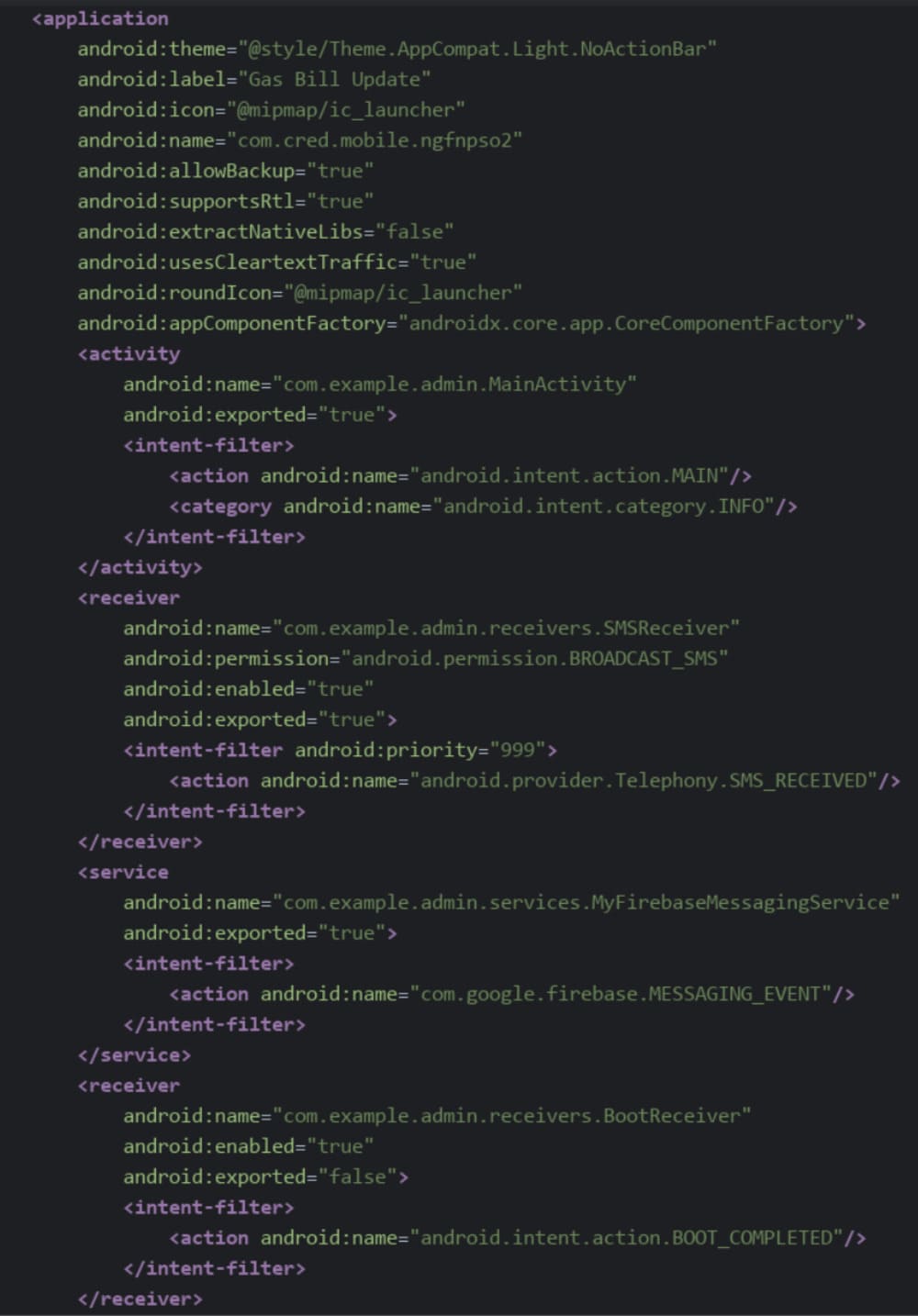
The payload’s application manifest: a high-priority SMS listener, an icon-hiding launcher entry, a boot-completed listener, and a bundled push-messaging service.
The very high priority set on the SMS listener lets it intercept, and if desired abort, the broadcast before the device’s default SMS app ever sees the message. The launcher entry uses an uncommon intent category rather than the standard launcher category, a known Android icon-hiding trick: the entry point remains valid but the app does not appear in the app drawer.
None of the components named in the manifest exist anywhere in the visible decompiled sources. Only the shared packer stub does. As with the dropper, this is because their compiled code is supplied entirely by an encrypted bundled asset. Beyond decrypting it, this investigation went one step further than a plain text-string dump: the recovered code, roughly three megabytes in size, was decompiled class by class using an offline decompiler, against already-decrypted static bytes only, recovering genuine, readable source for every malicious component. All evidence below is drawn from that recovery.
SMS interception and exfiltration
The SMS listener hands every incoming message broadcast off to a background routine for processing, using a standard Android mechanism to keep itself alive past the point where the initial callback returns.
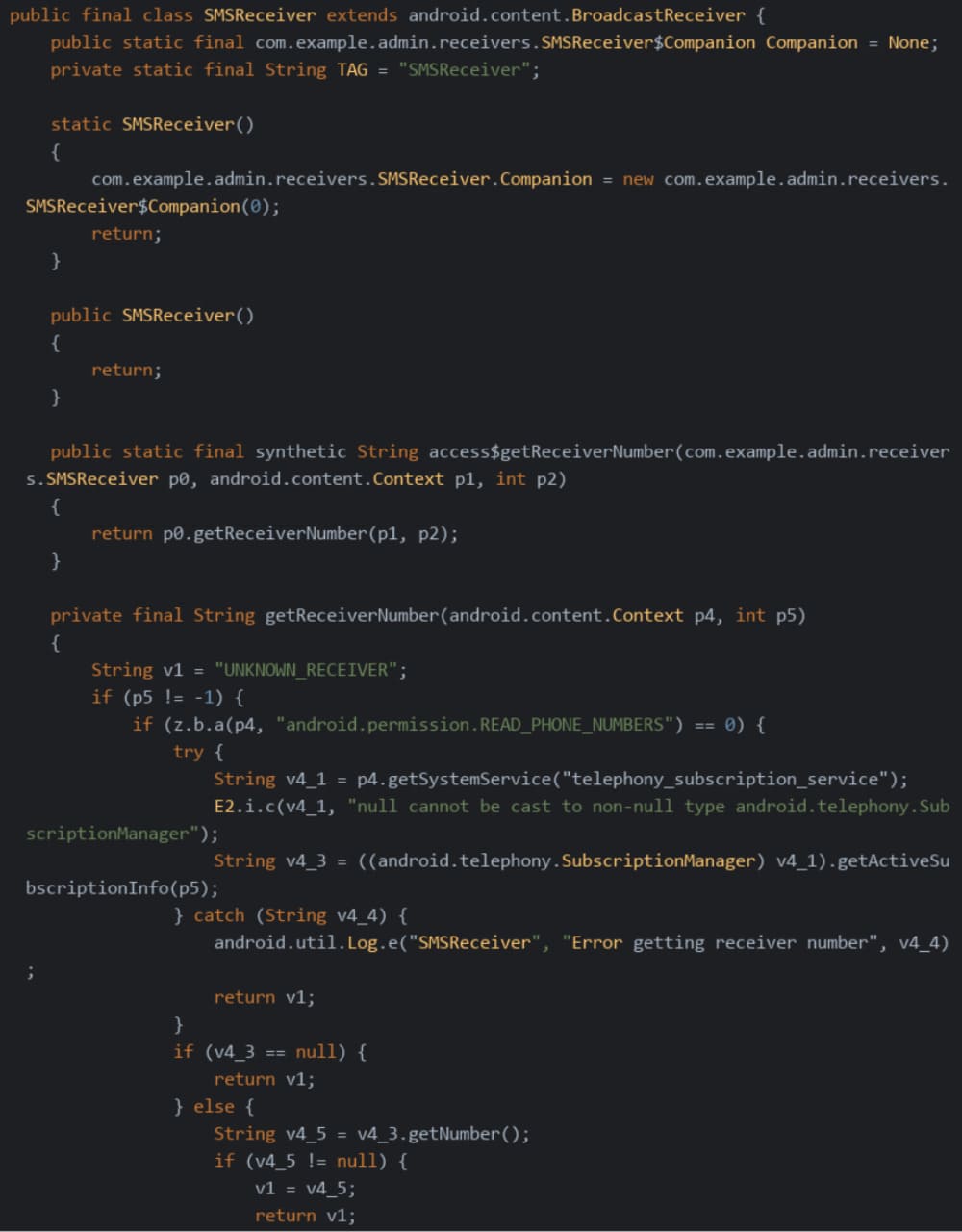
The SMS listener component, recovered in full from the decrypted code.
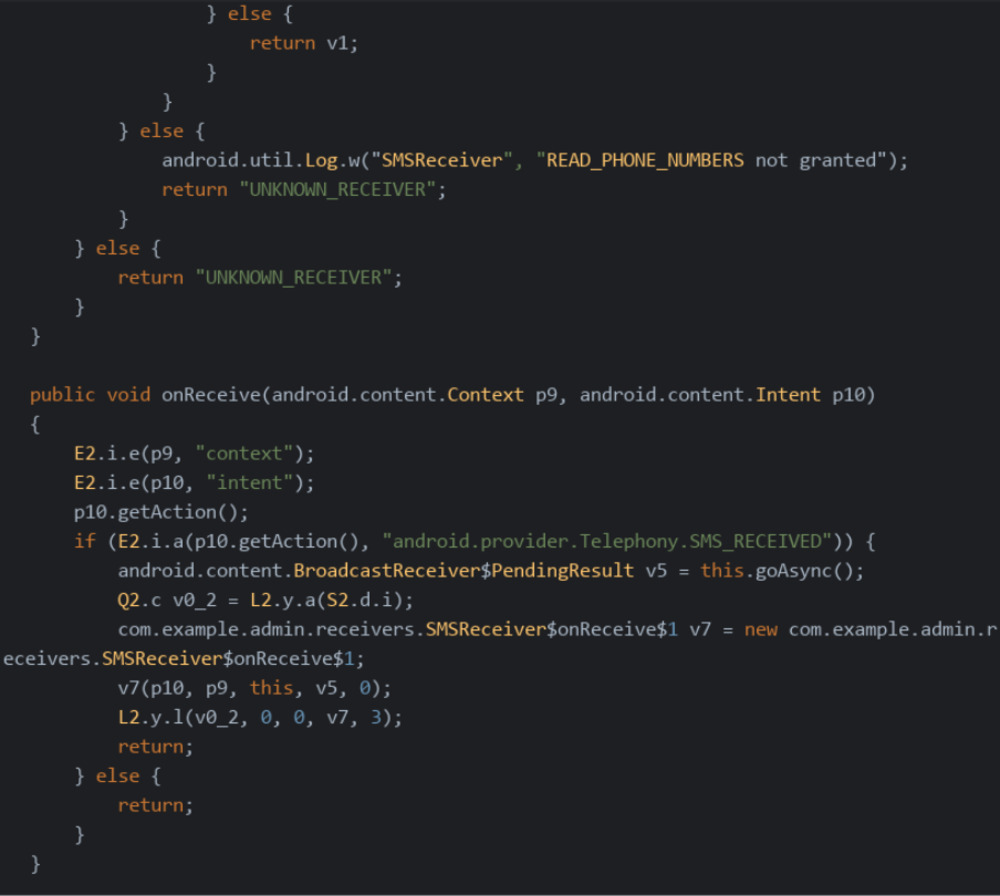
The SMS listener component, recovered in full from the decrypted code.
Figure 19: The SMS listener component, recovered in full from the decrypted code.
The associated local database record stores every message with an explicit banking-message classifier flag, and a separate flag intended to track delivery through a messaging-bot channel.
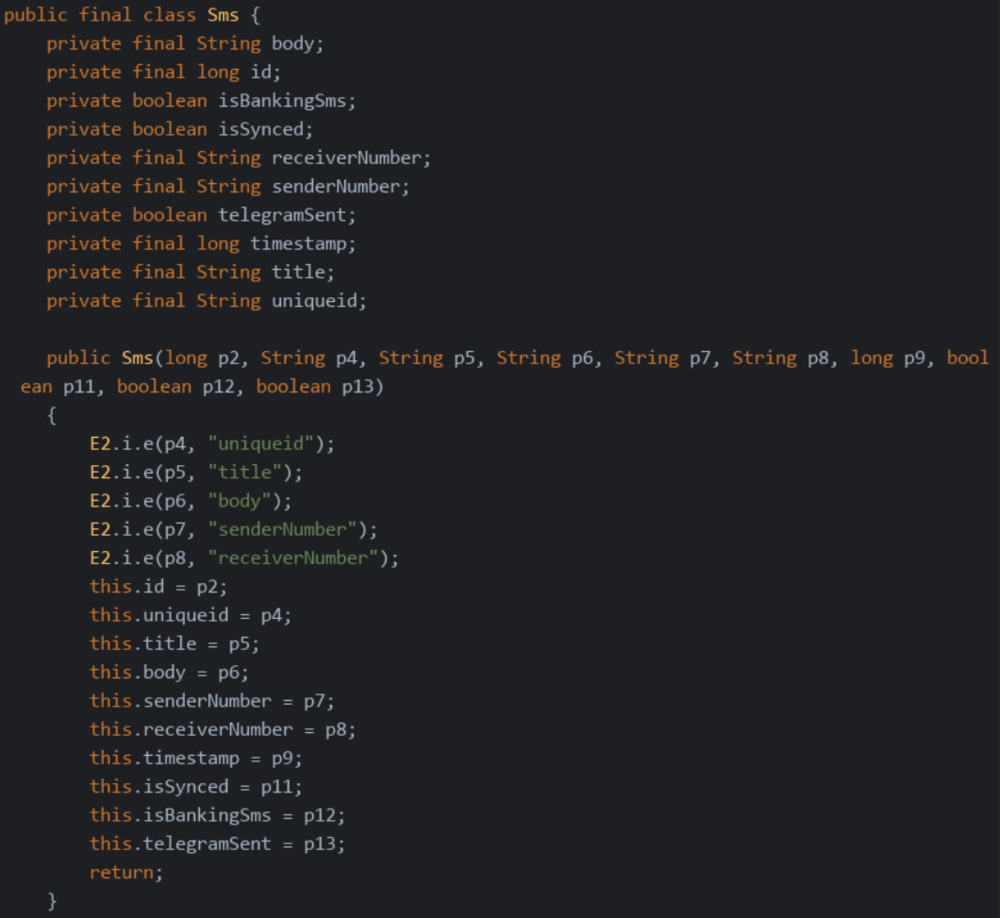
The local database record’s fields, including the banking-message classifier and a dormant messaging-bot delivery flag.
No code path anywhere in the recovered components was found that ever sets that second flag to true. Searching every decompiled component for the routine that would set it returns only the field’s own default accessor logic. This field is therefore assessed as a dormant, or build-disabled, secondary exfiltration channel: present in the data model, but not wired to any active code path in this build.
Outbound synchronization is handled by a separate background job that reads the device’s message inbox, batches a small number of unsynced messages per run, and uploads each one to the command server; a companion job separately lets the operator direct the device to send arbitrary outbound SMS.
Command and control
The networking component hardcodes both a device-identifying application ID and a default backend address, and persists any operator-supplied override locally so the backend can be relocated remotely.
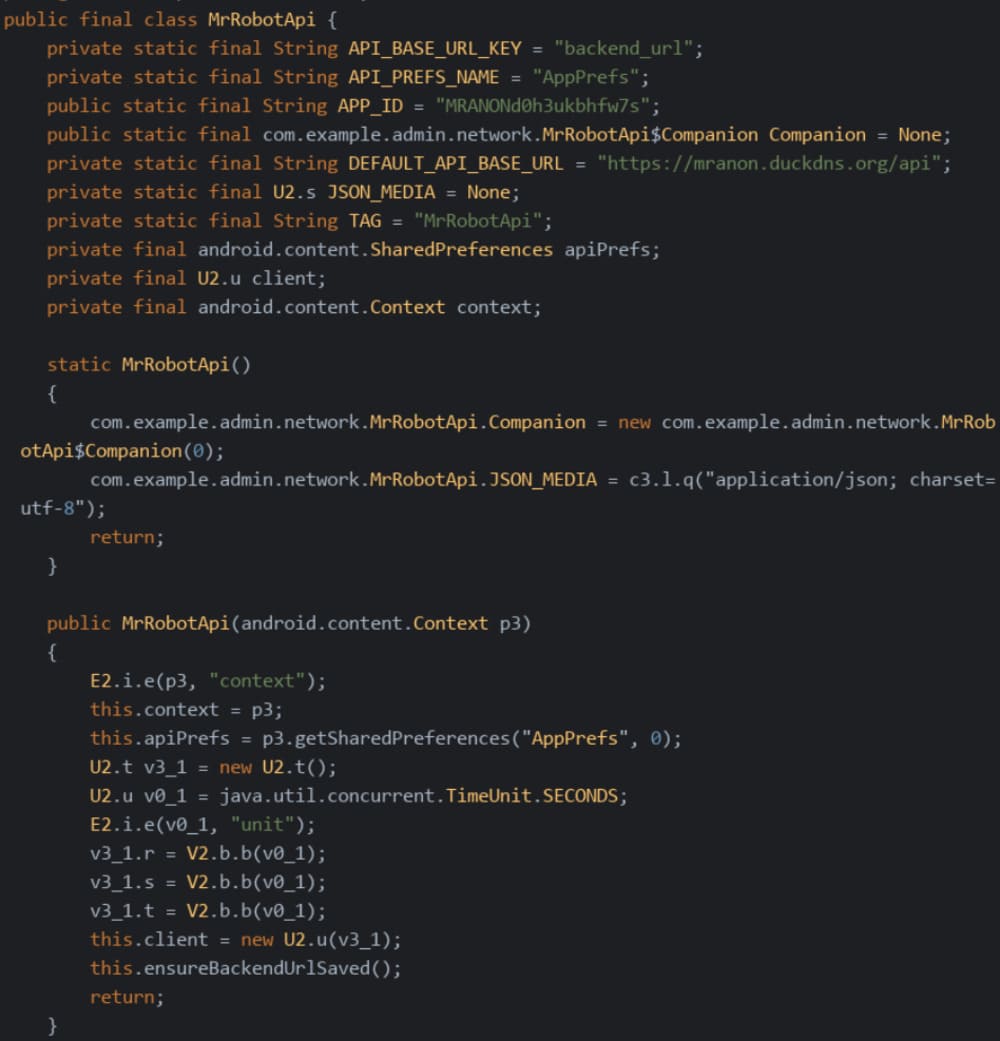
The networking component’s header, showing its application ID constant and its hardcoded default command-server address, https://mranon.duckdns.org/api.
Every intercepted SMS is packaged into a structured message keyed by a device-derived identifier and submitted to the command server’s messages endpoint.
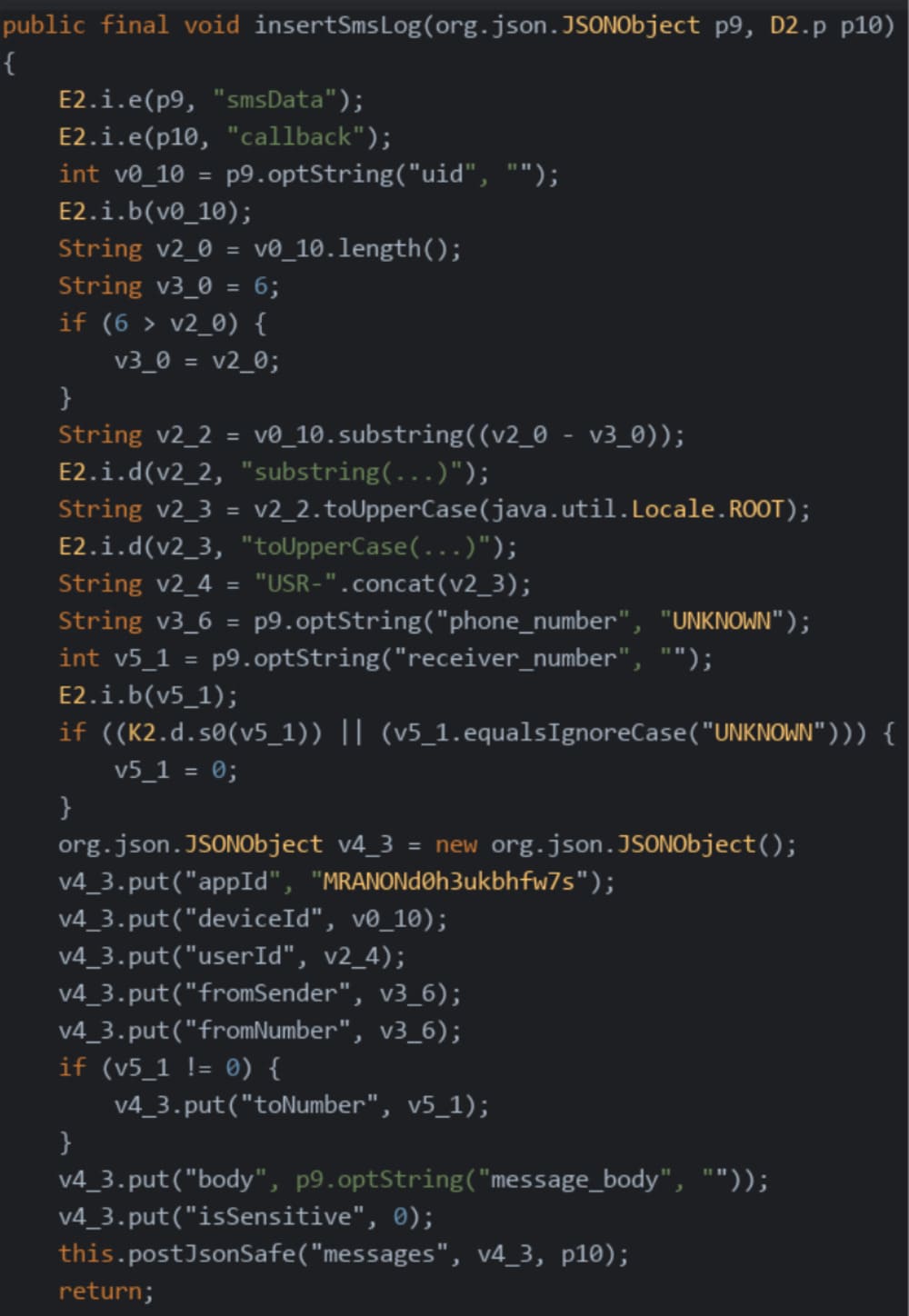
The routine that builds and submits the exfiltrated SMS record to the command server.
The command-server hostname is a free dynamic DNS address, a low-cost, easily re-pointed command-and-control technique common to commodity Android malware. Open-source review found no prior public malware reporting indexed against this exact hostname at the time of writing. A secondary channel is present in the payload’s own configuration:

A secondary command channel configuration bundled with the payload.
Naming this secondary channel after a major Indian private bank is a deliberate impersonation, and it provides a push-messaging channel independent of the dynamic DNS host, giving the operator resilience if the primary address is taken down. Critically, this push channel is not just a heartbeat pipe. The component that receives push messages implements a full remote command dispatcher, keyed on a type field in the incoming message.
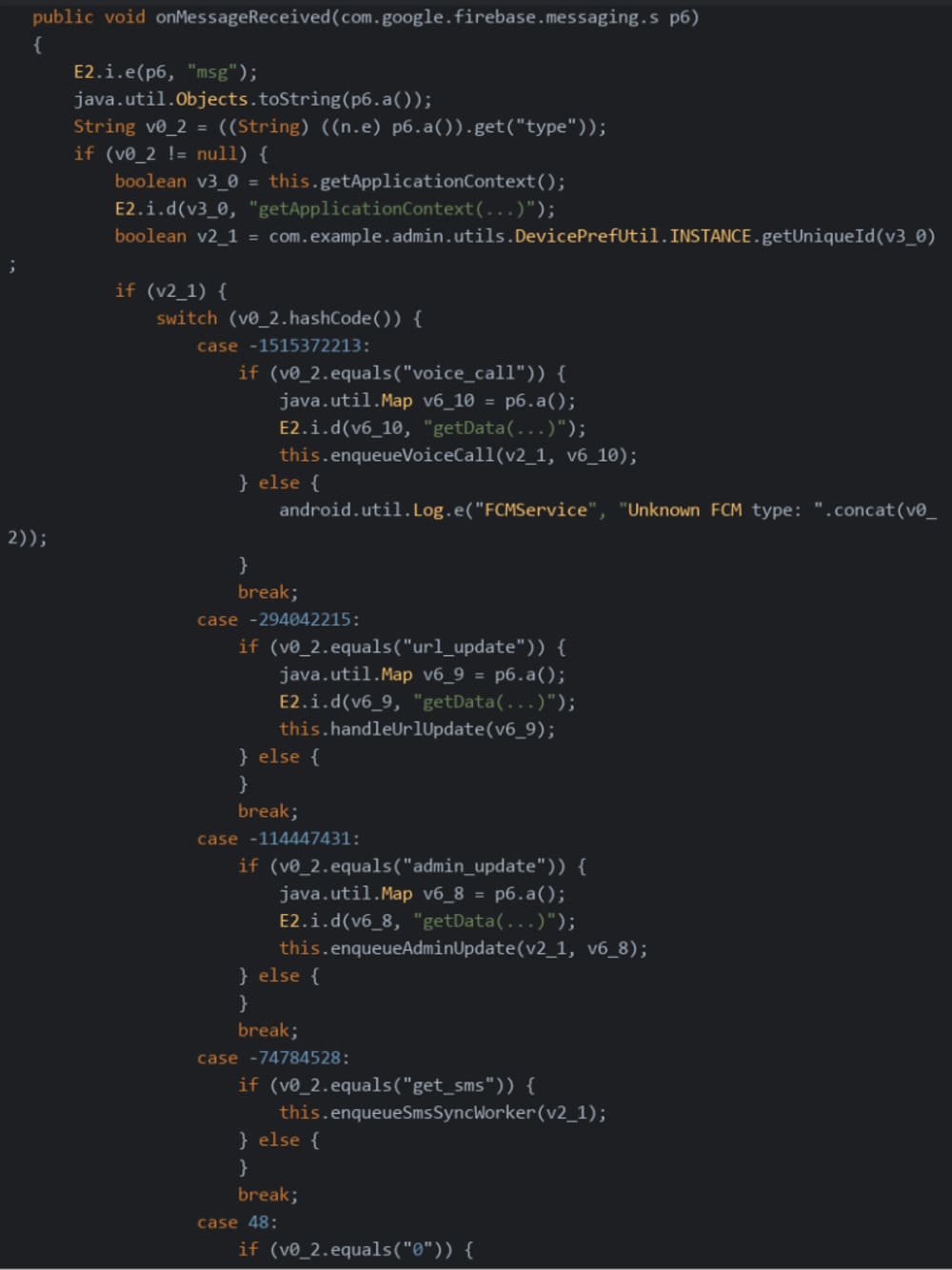
The complete remote-command dispatcher that processes incoming push messages.
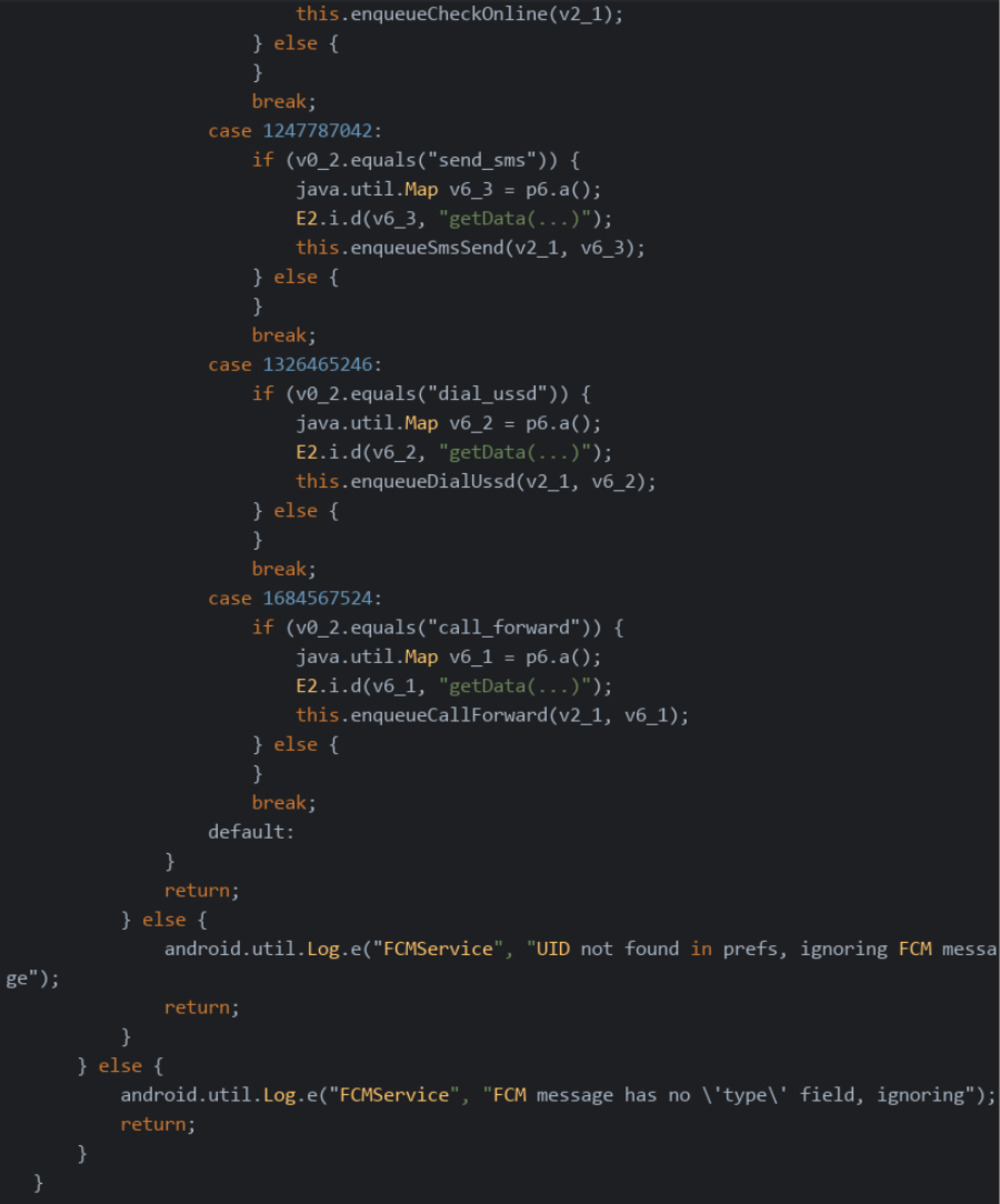
The complete remote-command dispatcher that processes incoming push messages.
| Command type | Action taken |
|---|---|
| Call forwarding | Enables (*21*) or disables (##21#) unconditional call forwarding to an operator-supplied number |
| USSD dialing | dials an arbitrary operator-supplied USSD code, or places a voice call if a response value is already supplied |
| Voice call | Places a silent outbound call to an operator-supplied number |
| SMS send | Sends an arbitrary SMS body to an operator-supplied number from the device |
| SMS fetch | Forces an on-demand upload of the latest inbox contents |
| Admin update | Overwrites the locally stored admin phone number and status used for forwarding and SMS-relay decisions |
| Server relocation | Overwrites the stored backend address, a full remote command-server relocation |
| Liveness check | Confirms the device is online and reachable |
The call-forwarding command is built directly from the operator-supplied number carried in the push message.
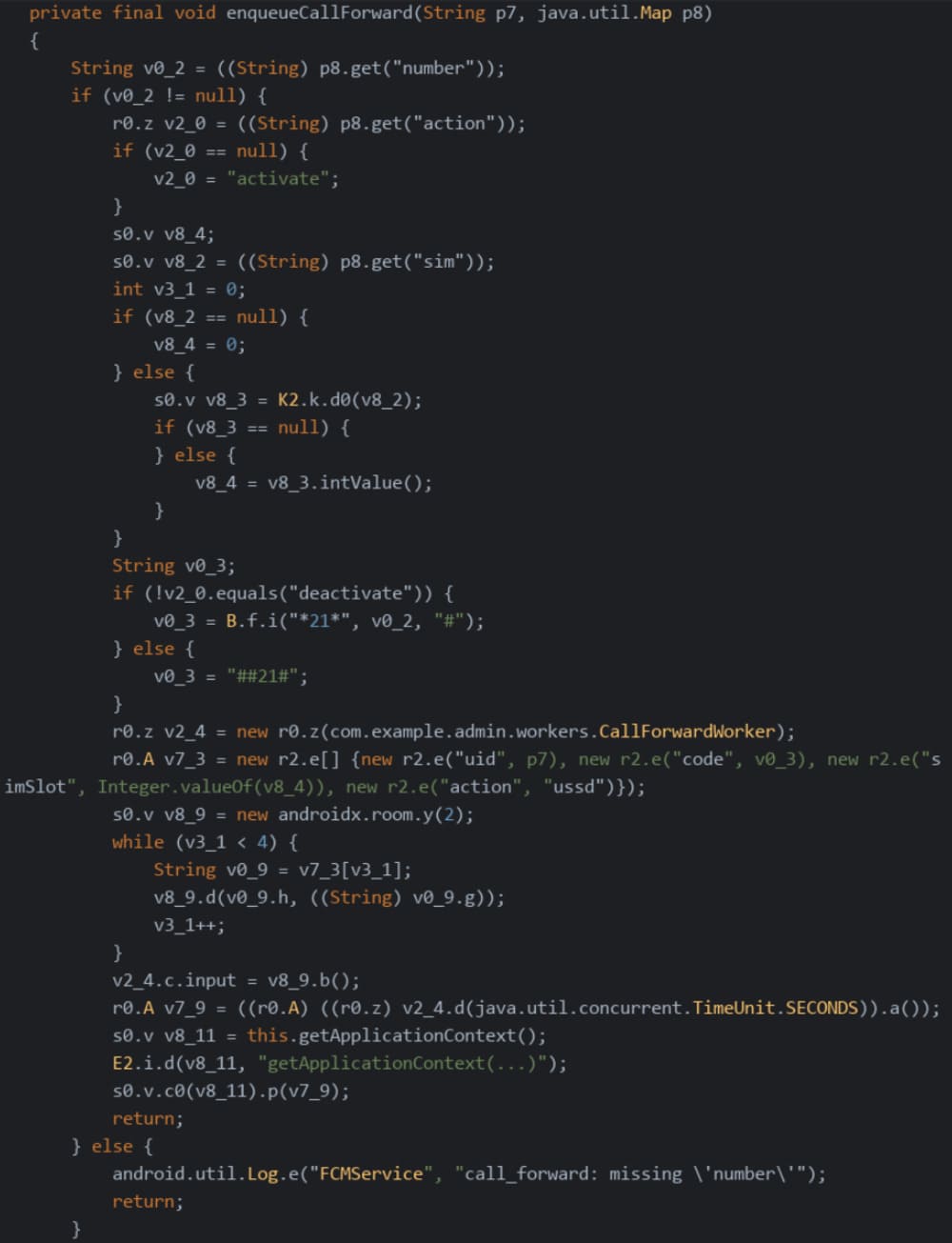
The routine that builds the activation code *21*
These are the standard GSM codes for enabling and erasing unconditional call forwarding respectively. A remote operator who can reach this device over push messaging can therefore redirect all of its incoming calls, including any bank call-back verification for large transactions, to a number they control, with no indication to the victim, and later restore normal call routing to avoid detection. This is a materially more powerful capability than SMS or OTP theft alone, since it also defeats voice-call-based OTP delivery.
Finally, the app’s main screen enables scripting, local storage, and file access inside an embedded browser view and loads a bundled local page, injecting a small bridge object that exposes the device’s identifier and command-server address to that page’s script. This is a locally bundled interface layer, not a remotely served phishing page. No evidence of a remote-page load was found in the recovered code.
The command-server address itself is never hardcoded in a way that cannot be changed. It is read from, and can be overwritten in, local device storage at any time, either by the server-relocation command above or by a remote configuration fetch performed at every app launch.
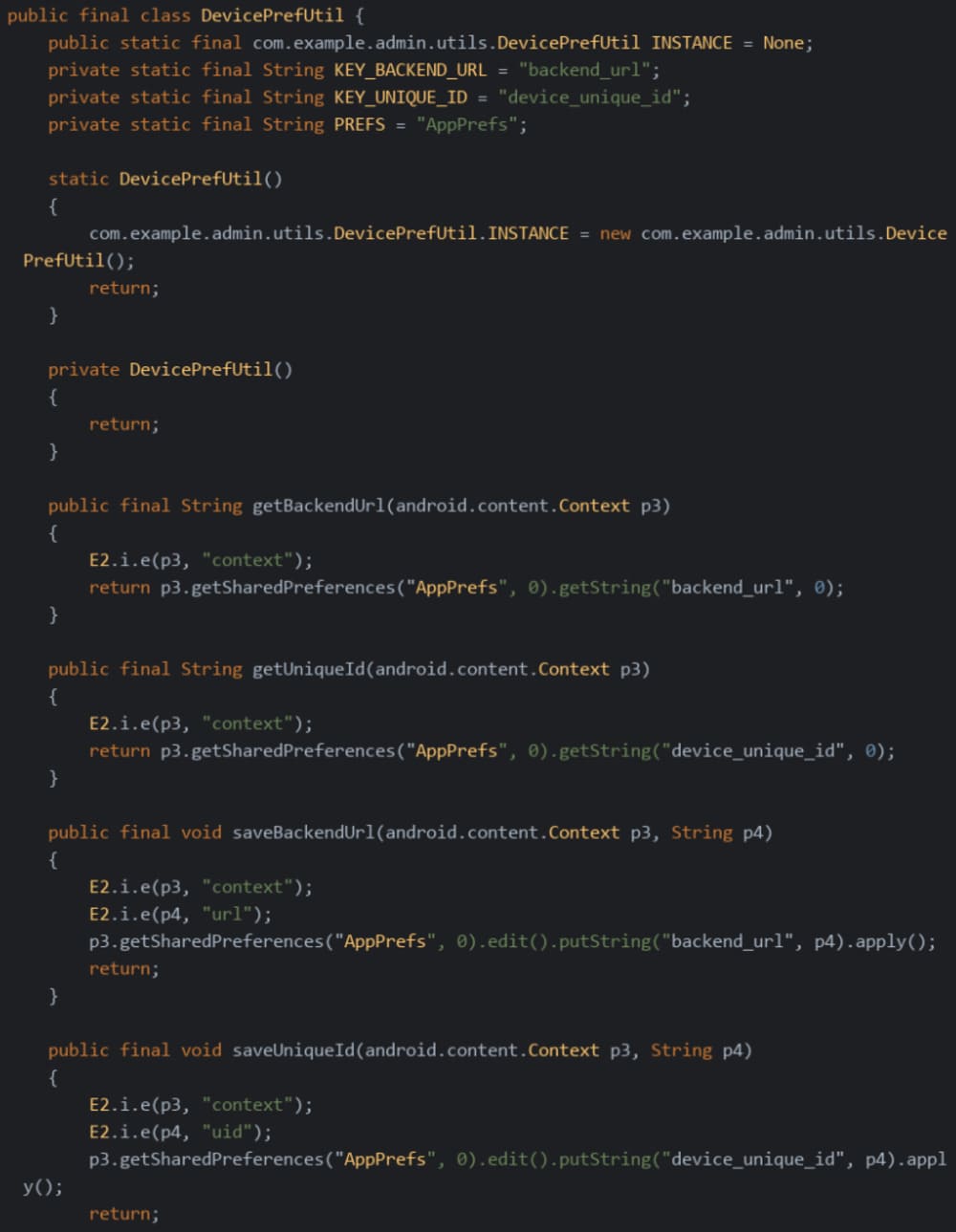
The component responsible for reading and remotely overwriting the stored command-server address.
Persistence
A minimal boot listener re-arms the malware’s liveness check on every device reboot without requiring the user to relaunch the app.
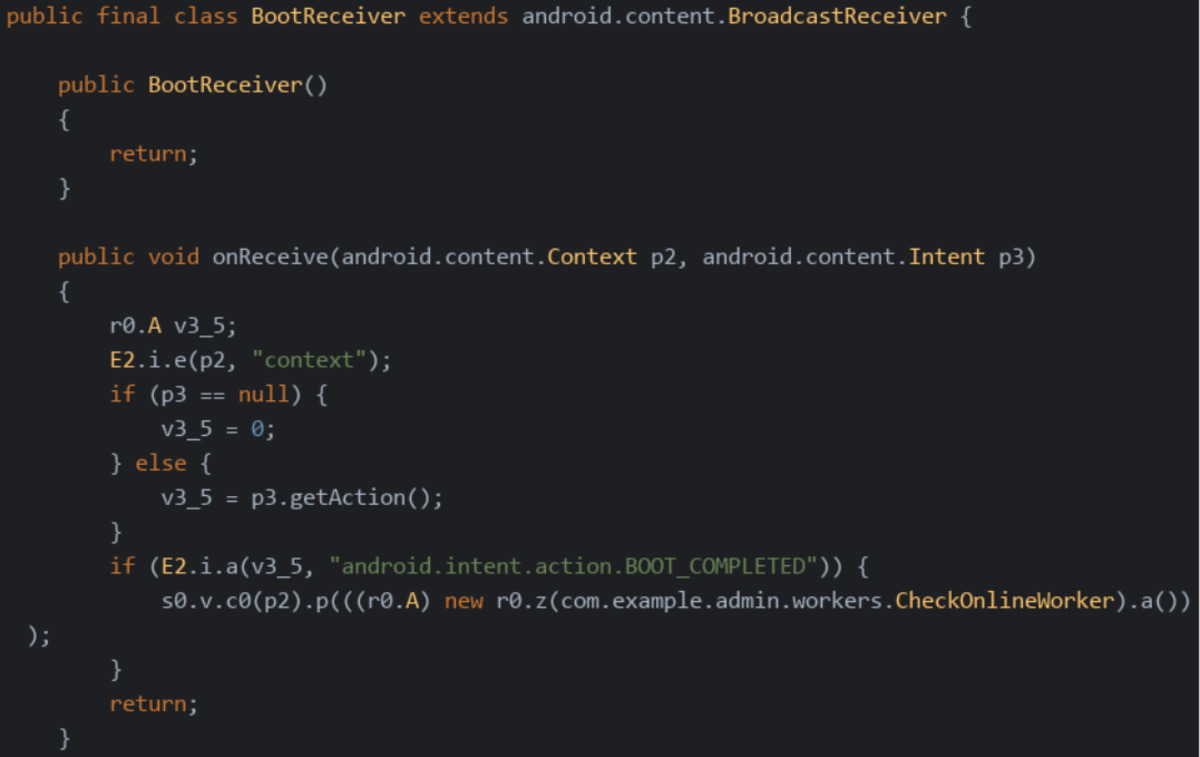
The boot listener, which schedules a liveness check on every device restart.
Anti-scanning padding (decoy assets)
The payload’s resources/assets folder contains over 30 additional files under cryptically named subfolders, with names suggesting session, backup, and configuration data. Each was tested against the recovered AES key and IV across multiple header offsets, an alternate cipher mode, and a prepended-IV scheme. None decrypted to a recognizable format. Cross-referencing every one of these folder and file names against the full decompiled packer source, and against the complete text extracted from the recovered payload code, returns zero matches. No code path in either sample references them.
These files are inert padding generated by the packer or builder tool to inflate the asset tree and defeat suspiciously small or simple APK heuristics used by some static scanners, not functional malware components. This mirrors the equivalent decoy-asset padding independently confirmed in the dropper.
5.4 Native Libraries and Signing Certificates
Bundled native library
The payload bundles one native library, compiled for all four Android processor architectures (64-bit ARM, 32-bit ARM, 32-bit Intel, and 64-bit Intel). Each build was reviewed directly, reading its binary header, its exported function table, and every embedded text string. All four are consistent with each other and were built with a stock Android NDK toolchain.
| Check performed | Result |
|---|---|
| Exported functions | Four Java Native Interface entry points matching the public AndroidX DataStore library’s shared counter helper: create, read, and increment a shared counter, and truncate a file |
| Internal C++ namespace and helper routines | Consistent with the same public library’s published source |
| Toolchain signature embedded in the file | Android NDK Clang 14.0.7 with the LLD 14.0.7 linker, a standard, unmodified Android build toolchain banner |
| A distinctive embedded string | A known workaround marker for a documented hardware quirk on a specific Samsung processor model, present in the genuine open-source version of this library |
| External library dependencies | Only the three base Android system libraries (core C library, math library, dynamic linker); no networking, cryptography, or process-execution imports of any kind |
| Consistency across all four architecture builds | All four export the same four functions, carry the same toolchain banner, and show no divergent or suspicious content |
iZOOlogic assesses with high confidence that this is a genuine, unmodified copy of a public, open-source Android library, bundled here only because it is a routine dependency of the AndroidX DataStore component used elsewhere in the app, and not a malicious or repurposed native component. The dropper carries no native libraries of its own.
Signing certificate analysis
Beyond the decompiled source trees, iZOOlogic also examined the two samples’ original, complete APK container files directly, specifically the digital signing certificate each one carries. This is a distinct piece of evidence from anything recovered through decryption: it reflects how the attacker’s own build tooling packaged and signed the final files, not what the packer’s code does at runtime.
| Field | Dropper (Gas bill update) | Payload (dev.axis.personal.monitor_4.2) |
|---|---|---|
| Certificate holder name | Nikhil Infotech Pvt Ltd | Ankur Innovations Pvt Ltd |
| Claimed business unit | Rajesh Apps | Sanjay Apps |
| Claimed organization | TechLabs | InfoSys |
| Claimed city and state | Kolkata, West Bengal | Jaipur, Gujarat |
| Serial number | 0x1d0ab9c7c6ab25e8 | 0x7305b713ef214bcb |
| Certificate fingerprint (SHA-256) | 1f63a6ac403359959cee650 fe6f269534d5780a445905a70 0295474b9b68782 | a64d608756e50aceb64a8537 6f56ea6219f2ca80762478a5f 7a4bcb4f1134cf5 |
| Certificate fingerprint (SHA-1) | e1144fd391cd1f686284 1ad59a456f6138ccf5cf | c5622e2bc3cf47a5661 00c2264824e3c78998c8b |
| Valid from | 2026-09-04 05:49:19 UTC | 2026-09-04 05:49:10 UTC |
| Valid until | 2054-01-20 05:49:19 UTC | 2054-01-20 05:49:10 UTC |
Several details stand out. Both certificates are self-signed, with no relationship to any recognized certificate authority, and both carry an unusually long validity period of roughly 27 and a half years, typical of disposable certificates generated by build tooling rather than a real business. Both identities are almost certainly fabricated: the payload’s certificate claims the organization name InfoSys, closely resembling the real Indian technology company Infosys, while listing a city and state combination (Jaipur, Gujarat) that does not exist. Jaipur is the capital of Rajasthan, not Gujarat, a basic geographic error consistent with a low-effort, generated identity rather than a genuine registered company.
Most notably, the two certificates were issued 9 seconds apart on the same date. This is strong evidence that both stages were signed by the same automated build run, immediately before distribution, and that the toolkit mints a fresh, differently named, self-signed identity for every build rather than reusing one fixed certificate. Reusing a single certificate across builds would let defenders cluster and block every sample sharing it; generating a new one each time defeats that approach.
This capability is directly confirmed in the dropper’s own recovered code, which contains a small, purpose-built component that generates a fresh 2048-bit RSA key pair and hand-encodes a minimal self-signed certificate from scratch, byte by byte, rather than relying on a higher-level certificate library. The encoded signature algorithm identifier embedded in this routine was checked byte for byte and confirmed to match the standard identifier for SHA-256 with RSA, the exact algorithm used on both real certificates above. The routine then hands the result to a bundled copy of Google’s own APK-signing library to produce a signed output file.
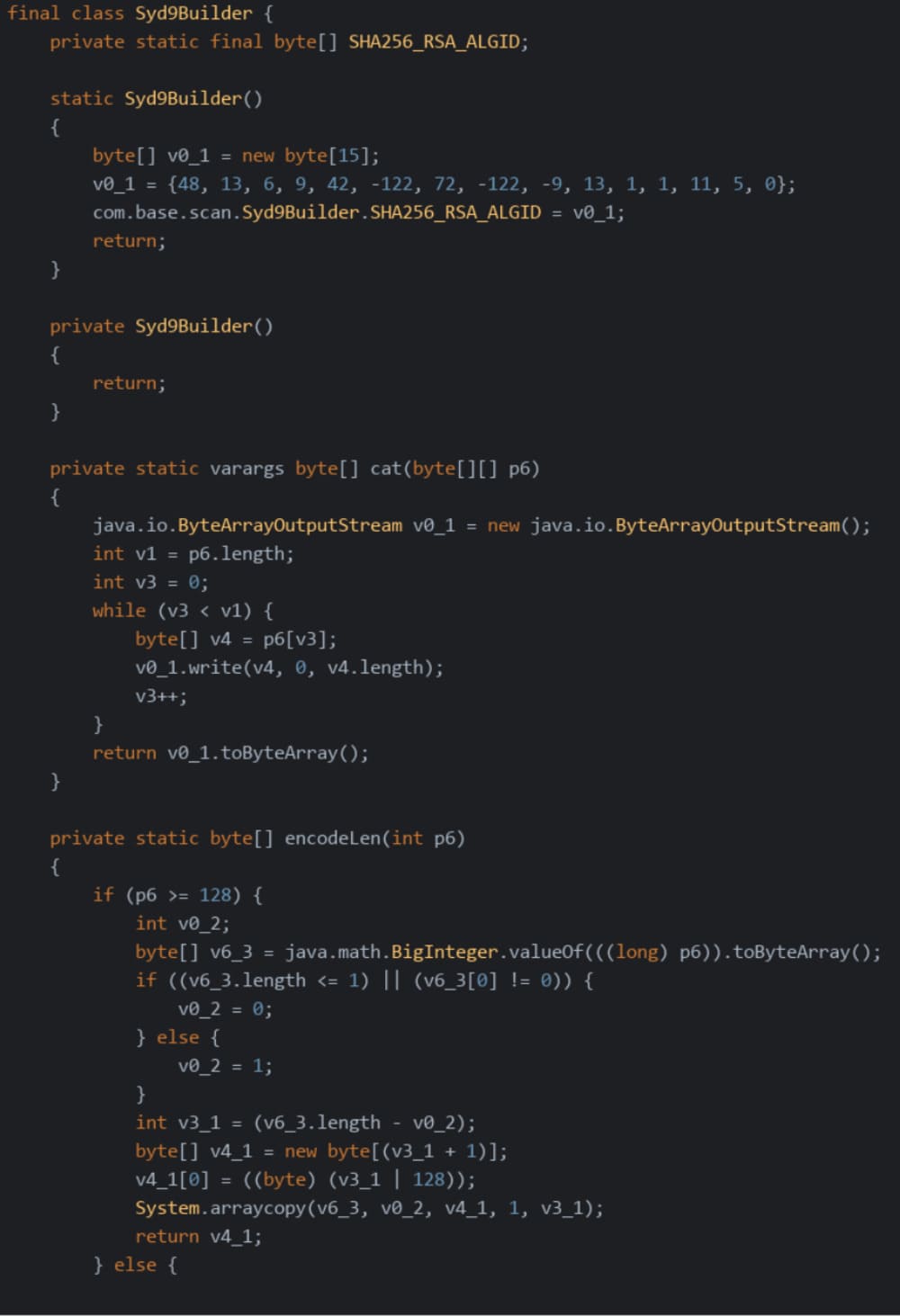
The dropper’s on-device certificate and signing routine, recovered in full from the decrypted hidden code. It generates a fresh RSA key pair, hand-encodes a minimal self-signed certificate, and signs an output APK with it.
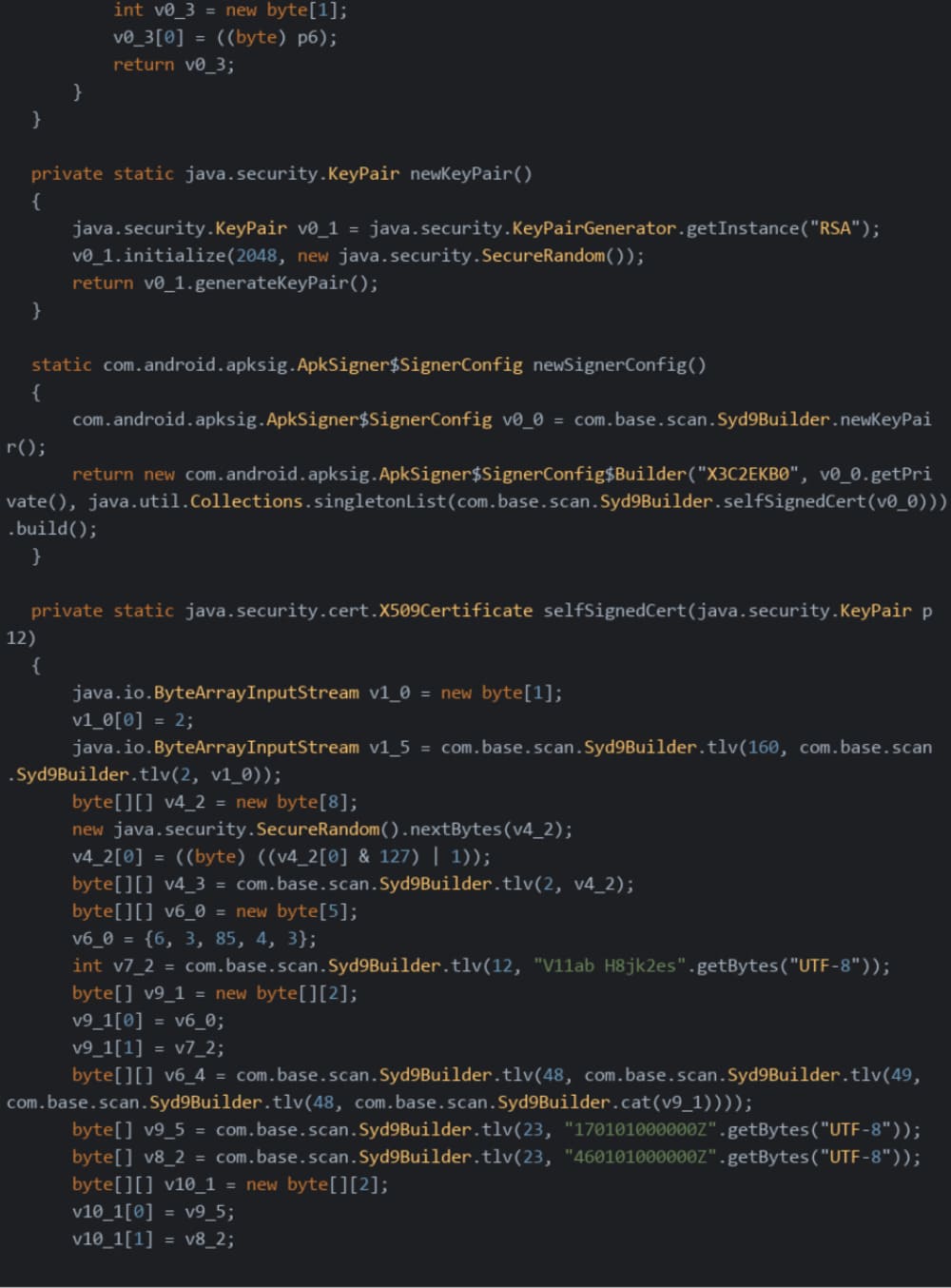
The dropper’s on-device certificate and signing routine, recovered in full from the decrypted hidden code. It generates a fresh RSA key pair, hand-encodes a minimal self-signed certificate, and signs an output APK with it.
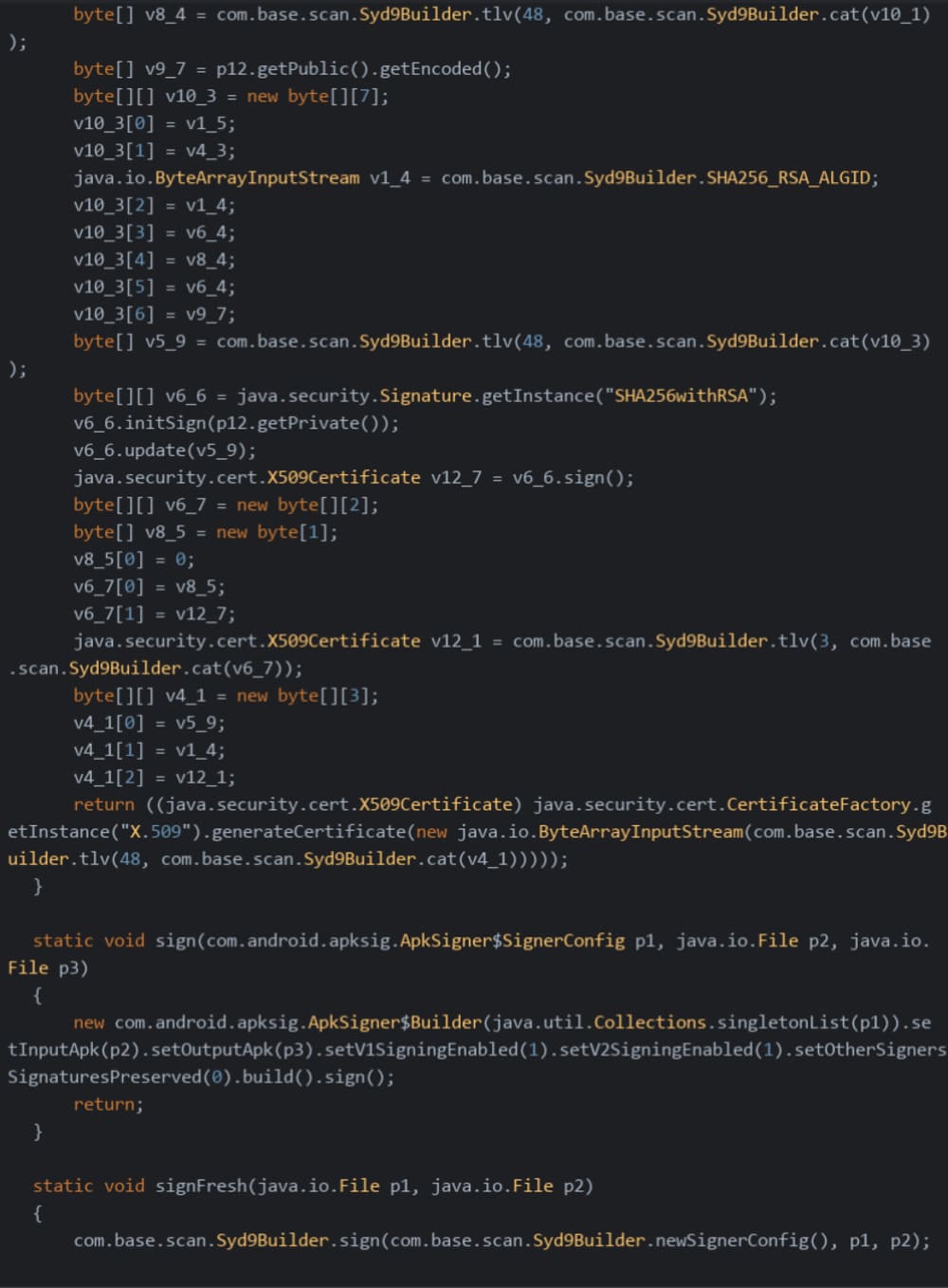
The dropper’s on-device certificate and signing routine, recovered in full from the decrypted hidden code. It generates a fresh RSA key pair, hand-encodes a minimal self-signed certificate, and signs an output APK with it.
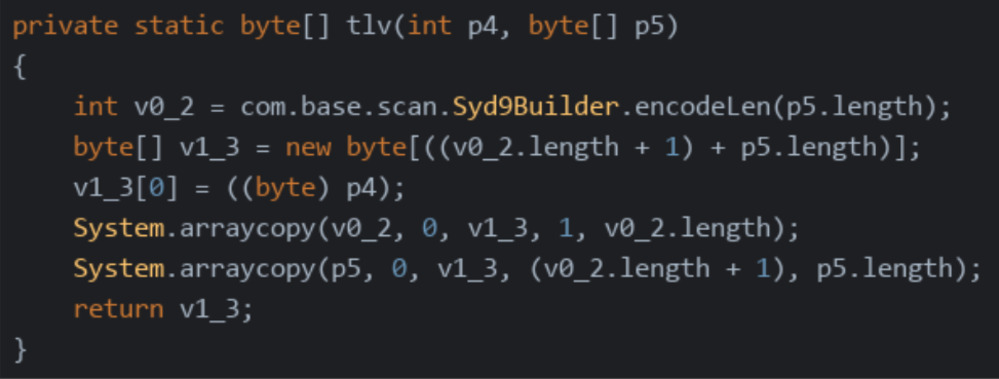
The dropper’s on-device certificate and signing routine, recovered in full from the decrypted hidden code. It generates a fresh RSA key pair, hand-encodes a minimal self-signed certificate, and signs an output APK with it.
One honest caveat: the single placeholder name hardcoded inside this specific recovered routine is a short, meaningless string, not a multi-field fake company identity, and does not literally match the fuller identities seen on the two real certificates above. iZOOlogic therefore assesses that the richer, business-style identities are most likely produced by a separate, more complete generation step elsewhere in the operator’s toolkit, plausibly at build time on the operator’s own infrastructure, while the on-device routine documented here demonstrates the same underlying design choice shared across the toolkit: never reuse a fixed, traceable signing identity.
6. OSINT CORRELATION AND ATTRIBUTION ASSESSMENT
This section documents the open-source research conducted to place GasTrap within the wider threat landscape and to test whether any developer, packer, or infrastructure artifact could be pivoted into a broader attribution. Unlike some malware families that embed a developer’s personal contact details, such as a hardcoded crash-reporting email address, no such artifact was found in either GasTrap sample. The crash and telemetry configuration present points to third-party SaaS vendors, not to an attacker-controlled mailbox.
| Artifact | OSINT result | Assessment |
|---|---|---|
| A packer meta-data key | No public product page or repository was located under this exact name at the time of writing. | Likely a private-label name for a commercial or semi-commercial Android crypter and protector service, or an internal build tag. Not conclusively attributable to a named public tool. |
| The command-server host | The root domain resolves to a live, unauthenticated login page for a branded control panel, not a bare API stub. The dynamic DNS provider itself is a legitimate free service widely abused for disposable command-and-control hosting. | The panel is an actively maintained, versioned product, not an improvised script, raising confidence that this is shared or resold infrastructure rather than a single operator’s private build. |
| The Firebase project name | Project naming directly references HDFC Bank. Firebase project IDs of this form are attacker-registered, free-tier projects and are not associated with the bank itself. | Confirms brand impersonation used purely for command-and-control plausibility and resilience, not a compromise of HDFC infrastructure. |
| The APK naming convention | Identical naming independently reported in a Thane and Mahanagar Gas fraud case and consistent with IGL’s own advisory. | High confidence that this naming convention is shared across multiple, city-specific fraud crews or affiliates using a common builder and toolkit, rather than unique to a single operator. |
| The shared packer toolchain | Identical toolchain artifacts across the dropper and payload samples analyzed here. | High confidence both stages were produced by the same build pipeline. Insufficient evidence in this static-only review to determine whether that pipeline is operated in-house or purchased as a service from a third-party crypter vendor. |
6.1 Live Control-Panel Discovery: “MR ANON Dashboard”
Following up on the hardcoded command-server address found in the payload’s networking component, iZOOlogic navigated to the domain’s root in a controlled, read-only browser session. No credentials were entered, no PIN was guessed or brute-forced, and no other application IDs were probed. The root path alone resolves to a fully branded, live operator login screen.
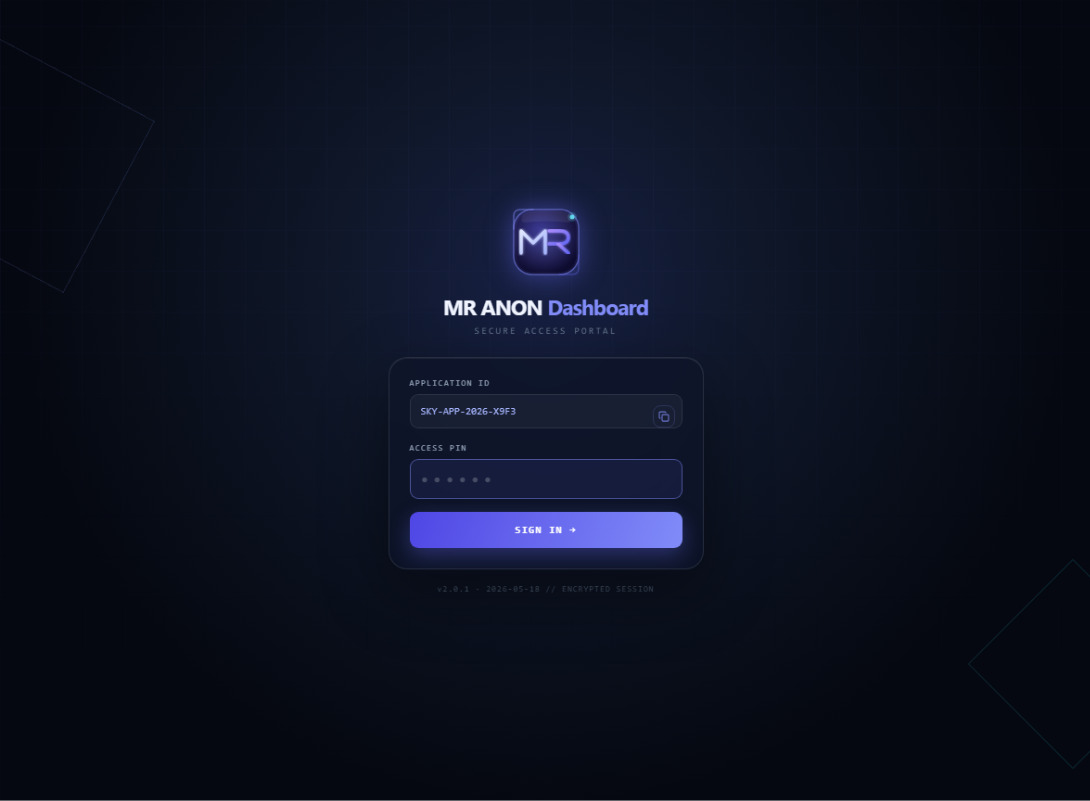
The command-server domain’s operator login screen, captured read-only on 2026-09-17. No credentials were entered.
The page’s own HTML confirms the product name and purpose in its page title, meta description, and social-sharing tags. The operator has evidently prepared this page to be link-shared and even indexed by search engines.
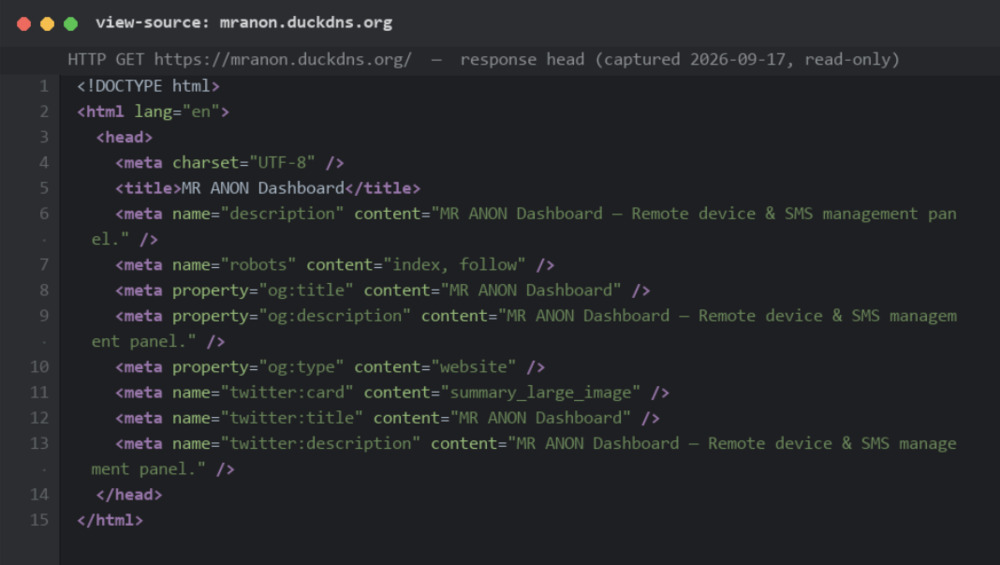
The response returned for the command-server domain’s root address, fetched read-only. It confirms the panel’s self-declared name and purpose: a remote device and SMS management panel.
The login page’s own front end additionally fires two unauthenticated background requests before any PIN is entered, which iZOOlogic observed passively, as ordinary page-load network traffic, not by constructing or guessing a request. The first of these returned the following data without authentication:
{"id":1,"appId":"SKY-APP-2026-X9F3","name":"Uco","status":"active",
"createdAt":"2026-08-20T21:43:08.688Z","deleteProtectionEnabled":false}
A passively observed, unauthenticated response from the panel’s own application-lookup endpoint. No victim data was present in, or is reproduced from, this response.
This is a materially important finding for three reasons. First, it is an operational security failure in the panel itself, since application metadata such as name, status, and creation date is retrievable without the access PIN shown on screen. Second, the application ID pre-populated on this login screen (app name “Uco,” created 2026-08-20) is a different tenant identifier from the one hardcoded in the GasTrap payload analyzed in this report, meaning this dashboard is a multi-tenant platform serving more than one distinct app, and by implication plausibly more than one distinct malware build or operator, not infrastructure built for GasTrap alone. Third, the bundled front-end script is served under a cache-busted filename whose query parameters reference both an APK build channel and a bot-link channel, consistent with a messaging-bot integration under active, versioned development, and a plausible explanation for the dormant messaging-bot delivery flag found earlier on the payload’s local SMS record: a feature that exists in this platform’s roadmap or in other tenants’ builds, but was not enabled in the specific payload build analyzed here.
iZOOlogic assesses with high confidence that this domain hosts a maintained, semi-commercial Android remote-access and SMS-management control panel product, version 2.0.1 as of 2026-05-18, used to operate GasTrap and, plausibly, other unrelated malware builds sharing the same platform. This is directly analogous to the multi-tenant spyware and remote-access marketplaces documented in other Android banking-trojan investigations.
iZOOlogic’s overall attribution assessment is that GasTrap is best characterized as a campaign, or a family of closely related campaigns, run by a financially motivated fraud operation, or a small set of affiliated crews sharing a common Android packer and builder, targeting Indian gas-utility customers across multiple cities, rather than a single individual developer, and operating on top of a shared, multi-tenant control-panel product rather than bespoke back-end infrastructure. No nation-state indicators, no non-financial objective, and no targeting outside the retail-banking and utility-fraud pattern were observed.
7. INFRASTRUCTURE ABUSE: MESSAGING-PLATFORM DISTRIBUTION
Unlike GitHub-hosted or web-hosted dropper campaigns, GasTrap’s distribution infrastructure is a messaging platform account, not a domain or repository. This has direct implications for defenders.
- No phishing domain exists to sinkhole or blocklist. The APK is a WhatsApp chat attachment, transmitted end-to-end encrypted.
- The “IGL” WhatsApp Business identity (logo, name, business-account badge) is trivially re-creatable. Takedown of one number does not prevent re-registration under a new number.
- Meta’s own ad platform is the traffic-generation layer, since WhatsApp itself labels the chat as originating from a Facebook or Instagram ad. Reporting the underlying ad campaign to Meta is a more durable disruption point than pursuing the WhatsApp number alone.
- Because the second-stage payload travels bundled inside the dropper rather than being fetched from a server, there is no download URL whose removal would stop an already-distributed copy of the dropper from fully infecting a device.
- Public reporting confirms this distribution model is reused city to city with a re-skinned utility brand, indicating a repeatable, low-cost franchise-style operating model rather than bespoke tooling per target.
8. EXTERNAL THREAT LANDSCAPE MANAGEMENT
GasTrap demonstrates a complete, self-contained cybercrime lifecycle. Reconnaissance and weaponization occur off-platform. The actor builds, or purchases access to, a commercial-grade Android packer, wraps a banking-fraud payload in it, and embeds a complete signed copy of that payload inside a steganographic carrier file in the dropper, removing any dependency on a reachable download endpoint for the most critical delivery step.
Delivery and initial access ride entirely on a trusted messaging platform. A paid social media ad funnels victims to a branded WhatsApp Business account, which performs both PII harvesting and payload delivery in a single encrypted conversation, a channel most enterprise and telecom web-filtering controls cannot inspect.
Exploitation and installation depend on standard Android sideloading social engineering, automated by the dropper’s own bundled signing and install code rather than requiring a second manual install action from the victim. Persistence is achieved through a boot listener and background jobs. Defense evasion combines commercial-grade packing, string and asset encryption, emulator and hooking-tool detection, and time and launch-count gated dormancy.
The operational, or impact, phase is financial: SMS and OTP interception, classification of banking messages, and, more unusually, direct GSM-level call-forwarding fraud through USSD, which defeats voice-based OTP delivery as well as SMS-based delivery. A dual-channel command infrastructure, a dynamic DNS domain plus a bank-impersonating Firebase project, provides redundancy against single-point takedown. Real-world financial impact has already been documented in a closely related case, approximately ₹31.43 lakh across 22 victims in Thane, confirming this lifecycle-complete design translates directly into realized victim losses rather than remaining theoretical.
9. RISK AND IMPACT ASSESSMENT
| Risk | Likelihood | Impact | Overall Rating |
|---|---|---|---|
| Financial fraud through SMS and USSD-enabled account takeover | High | High | Critical |
| PII exposure through WhatsApp chat harvesting | High | Medium | High |
| Brand and reputational harm to IGL, Mahanagar Gas, and HDFC Bank | Medium | Medium | Medium |
| Detection evasion defeating signature-based mobile antivirus | High | Medium | High |
| Re-infection after takedown, given the bundled payload and disposable WhatsApp numbers | High | Medium | High |
10. CONCLUSION
GasTrap combines a low-tech, highly effective initial-access channel, a branded WhatsApp Business impersonation of a real Indian gas utility, seeded through paid social media ads, with a genuinely professional-grade Android malware toolchain: commercial-style packing, encrypted dual-stage code loading, a self-contained steganographic second-stage delivery mechanism that removes any network dependency for installation, dual-channel command infrastructure, and both SMS-level and voice-call-level OTP interception through USSD-based call forwarding.
The shared packer, shared encryption key, and shared anti-analysis code across the dropper and payload confirm both were produced from a single build pipeline, consistent with a maintained criminal tooling operation rather than an improvised scam. Open-source and law-enforcement correlation, including IGL’s own fraud advisory, a Delhi Police syndicate takedown, and a financially quantified Mahanagar Gas and Thane case with 22 confirmed victims, demonstrates this is an active, currently harmful, multi-city fraud wave rather than an isolated or theoretical sample.
The impersonation of a real public utility, and internally of a major bank, also risks reputational harm to those brands independent of the direct financial fraud against victims. iZOOlogic assesses with high confidence that this threat will continue to recur under new utility brands, WhatsApp numbers, and command-server hosts unless the underlying packer and builder toolchain and its distribution playbook are disrupted, not merely the current set of indicators.
This campaign should be treated as an active financial-fraud threat targeting Indian mobile banking and UPI users. Recommended actions include reporting the identified WhatsApp Business numbers and the underlying Meta ad campaign, sinkholing and monitoring the command-server domain and the bank-impersonating Firebase project, and distributing the indicators in this report to mobile threat-defense and banking-fraud detection teams, CERT-In, and the affected utilities’ and banks’ fraud and security functions.
11. YARA RULES
rule GasTrap_Android
{
meta:
author = "iZOOlogic Threat Research Team"
description = "Detects GasTrap Android dropper/payload samples and the associated steganographic APK-in-PNG delivery technique"
date = "2026-09-17"
sha256_dropper_hidden_dex = "def9ddea6e9de86e80c0a191f7676d91f72b8b00c776c543381cfffa61a8039e"
sha256_payload_hidden_dex = "c482fe0dd5faf8fc8fbcb472fbf51ab42d19bf61029629472a9c01650582b80c"
strings:
$pkg1 = "com.cred.mobile.ngfnpso2" ascii
$metakey = "apkshield.app" ascii
$c2_1 = "mranon.duckdns.org" ascii nocase
$firebase_1 = "hdfc-sachin" ascii nocase
$cls_sms = "com/example/admin/receivers/SMSReceiver" ascii
$cls_call = "com/example/admin/workers/CallForwardWorker" ascii
$cls_api = "com/example/admin/network/MrRobotApi" ascii
$ussd_code = "*21*" ascii
$aes_key = {
E7 BF EC B8 17 F9 BE CE
CA 60 34 C5 D9 01 24 EE
}
$aes_iv = {
B7 6B 05 65 28 3F A9 3C
1C A3 BE F6 9E A5 A0 5F
}
$lure_pkg = "dev.axis.personal.monitor" ascii
// PNG / appended payload indicators
$png_magic = {
89 50 4E 47 0D 0A 1A 0A
}
$iend = {
49 45 4E 44 AE 42 60 82
}
$zip_magic = {
50 4B 03 04
}
condition:
(
(
uint32(0) == 0x0A786564
and
(
2 of (
$pkg1,
$metakey,
$cls_sms,
$cls_call,
$cls_api,
$ussd_code
)
or ($aes_key and $aes_iv)
or
(
1 of ($c2_1, $firebase_1, $lure_pkg)
and
1 of (
$pkg1,
$metakey,
$cls_sms,
$cls_call,
$cls_api,
$ussd_code
)
)
)
)
or
(
$png_magic at 0
and $iend
and filesize > 500KB
and
(
$zip_magic in (@iend[1] + 8 .. filesize)
or
(
filesize - (@iend[1] + 8) > 200KB
)
)
)
)
}
12. RECOMMENDATIONS
- Restrict APK sideloading and disable installation from unknown sources on managed Android devices.
- Enforce application allowlisting and investigate unauthorized or newly installed applications.
- Monitor applications requesting SMS, call-management, accessibility, notification, or device-administration privileges without a legitimate requirement.
- Detect suspicious SMS interception, call-forwarding activity, and unauthorized USSD operations.
- Deploy the provided GasTrap YARA rule across malware repositories, sandboxing, endpoint analysis, and threat-hunting workflows.
- Inspect PNG files for anomalous data appended beyond the IEND chunk and investigate large residual or embedded APK/ZIP content.
- Monitor DNS and outbound network traffic for suspicious dynamic-DNS domains and newly observed command-and-control infrastructure.
- Correlate application installation, execution, permissions, DNS activity, and network connections to identify malicious applications exhibiting coordinated behavior.
- Reduce reliance on SMS-based authentication for sensitive accounts and use stronger authentication mechanisms where available.
- Correlate package names, hashes, certificates, class names, encryption artifacts, Firebase identifiers, and infrastructure to identify campaign variants and avoid duplicate threat records.
- Continuously update YARA rules, IOCs, DNS controls, and behavioral detections as new GasTrap samples and infrastructure are identified.
- Isolate suspected devices, preserve the original APK and forensic artifacts, review authentication activity, and conduct environment-wide hunting for related indicators.
APPENDIX 1: MITRE ATT&CK MAPPING
| Tactic | Technique and ID | Evidence in this campaign |
|---|---|---|
| Initial Access | T1476: Deliver Malicious App via Other Means | The APK was sent directly as a WhatsApp chat attachment, not through an app store |
| Initial Access | T1660: Phishing | WhatsApp Business “IGL” impersonation harvests PII before payload delivery |
| Execution | T1204: User Execution | Victim manually installs the APK after enabling Install Unknown Apps |
| Persistence | T1624.001: Broadcast Receivers | A boot listener and a high-priority SMS listener maintain execution |
| Persistence | T1603: Scheduled Task/Job | Background jobs handle heartbeat, SMS sync, call forwarding, and liveness checks |
| Defense Evasion | T1407: Download New Code at Runtime | An encrypted secondary code package is decrypted and loaded through in-memory class loading |
| Defense Evasion | T1407: Download New Code at Runtime (variant) | A complete secondary APK is smuggled inside a steganographic PNG and installed without any network fetch |
| Defense Evasion | T1627: Obfuscated Files or Information | A custom string cipher, AES-encrypted assets, disguised file headers and extensions, and decoy padding files |
| Defense Evasion | T1523: Evade Analysis Environment | Emulator and hooking-tool detection, plus a launch-count and time-since-install dormancy gate |
| Credential Access | T1412: Capture SMS Messages | A high-priority SMS listener with a banking-message classifier and background exfiltration |
| Collection | T1616: Call Control | A background routine dials USSD codes to enable unconditional call forwarding |
| Command and Control | T1437: Application Layer Protocol | HTTPS to a hardcoded command server, plus Firebase Cloud Messaging and Realtime Database as a secondary channel |
| Exfiltration | T1020: Automated Exfiltration | Background jobs periodically upload device and SMS data without user interaction |
APPENDIX 2: INDICATORS OF COMPROMISE
| No. | Indicator | Remarks |
|---|---|---|
| 1 | com.base.scan.c2bdab7eb | Dropper Android package name |
| 2 | dev.axis.personal.monitor | Payload Android package name (app label: “Gas Bill Update”) |
| 3 | com.cred.mobile.ngfnpso2 | Shared packer application wrapper class name (both samples) |
| 4 | apkshield.app | Decoded packer meta-data key (commercial-protector fingerprint) |
| 5 | e7bfecb817f9becec a6034c5d90124ee | Hardcoded AES-128 key (hex) used for all bundled asset decryption |
| 6 | b76b0565283fa93c 1ca3bef69ea5a05f | Hardcoded AES-128 IV (hex), paired with the key above |
| 7 | https://mranon.duckdns.org/api | Primary command-and-control endpoint |
| 8 | hdfc-sachin | Firebase project ID, used as secondary command channel (impersonates HDFC Bank) |
| 9 | hdfc-sachin-default-rtdb.firebaseio.com | Firebase Realtime Database hostname |
| 10 | +91 98197 01854 | WhatsApp Business number used in the “IGL” lure |
| 11 | +91 92176 85497 | Second WhatsApp Business number, delivered the APK payload |
| 12 | Gas bill update.apk | Dropper filename as delivered over WhatsApp (approximately 3.7 MB); also reported publicly under “Gas Bill Update” against Mahanagar Gas customers |
| 13 | db62315fcd4e84a14183d4 77289d32a1ee9e0feb8b8a0bd3 e4b18834aa22fef6 | SHA-256, dropper’s encrypted asset at Gas bill update/resources/assets/obbs5si/pba6dz6ei |
| 14 | def9ddea6e9de8680c 0a191f7676d91f72b8b00c776c5 43381cfffa61a8039e | SHA-256, dropper’s decrypted hidden code package |
| 15 | 5fe16f9ac95c01c cc7cddbcc694e07b31d2a669c33f 6e1f36109d81a156dc752 | SHA-256, payload’s encrypted asset at dev.axis.personal.monitor_4.2/resources/as sets/obbs5si/pba6dz6ei |
| 16 | c482fe0dd5faf8fc8fb cb472fbf51ab42d19bf6102962 9472a9c01650582b80c | SHA-256, payload’s decrypted hidden code package |
| 17 | a1dd8298dd06770b64 50eda4d956cab508e39e1c924 b241f8fe894cfdce00af0 | SHA-256, steganographic payload carrier image at Gas_bill_update/resources/assets/vzehjvp.png |
| 18 | 88c582c77d4bf75ca24 52685efb5da4955b25639 c984fe230bfcc5e996cfeeb8 | SHA-256, 36-byte key and offset file at Gas_bill_update/resources/assets/vzehjvp.png.b7d |
| 19 | de2ce88e2578b8380a 82b15a16aac868ce8628b24880 9391036861172631cdd6 | SHA-256, full payload APK recovered from inside the carrier image |
| 20 | com/example/admin/ receivers/SMSReceiver | SMS interception component (priority-999 receiver) |
| 21 | com/example/admin/ workers/CallForwardWorker | USSD call-forwarding fraud component |
| 22 | com/example/admin/ network/MrRobotApi | Command-and-control client component |
| 23 | *21*<number># | GSM USSD code used to enable unconditional call forwarding |
| 24 | ##21# | GSM USSD code used to deactivate unconditional call forwarding |
| 25 | MR ANON Dashboard | Live, branded operator control-panel product hosted at mranon.duckdns.org (version 2.0.1, 2026-05-18) |
| 26 | MRANONd0h3ukbhfw7s | GasTrap’s own tenant and application ID on the MR ANON Dashboard platform |
| 27 | SKY-APP-2026-X9F3 | A second, distinct tenant and application ID observed live on the same panel (app name “Uco,” created 2026-08-20), evidence of multi-tenant shared command infrastructure |
| 28 | Serial 0x1d0ab9c7c6ab25e8 | Dropper’s self-signed certificate serial number (holder name: Nikhil Infotech Pvt Ltd) |
| 29 | 1f63a6ac40335959cee650f e6f269534d5780a445905a 7002954744b9b68782 | SHA-256 fingerprint of the dropper’s signing certificate |
| 30 | e1144fd391cd1f6862841 ad59a456f6138ccf5cf | SHA-1 fingerprint of the dropper’s signing certificate |
| 31 | Serial 0x7305b713ef214bcb | Payload’s self-signed certificate serial number (holder name: Ankur Innovations Pvt Ltd) |
| 32 | a64d608756e50aceb64a853 76f56ea6219f2ca80762478a 5f7a4bcb4f1134cf5 | SHA-256 fingerprint of the payload’s signing certificate |
| 33 | c5622e2bc3f47a566100 c2264824e3c78998c8b | SHA-1 fingerprint of the payload’s signing certificate |
About iZOOlogic
iZOOlogic is a cybersecurity threat intelligence and malware analysis organization that specializes in monitoring, dissecting, and disrupting financially motivated cybercrime operations targeting the Indian digital payments and utility ecosystems. As demonstrated in their analysis of the GasTrap campaign, iZOOlogic employs a rigorous, purely static analysis methodology decrypting and decompiling malware artifacts offline without ever executing them on a device or emulator to ensure safe, containment-focused research. The organization combines deep technical reverse engineering with controlled, read-only OSINT correlation and active tracking of real-world law-enforcement actions to validate their findings. Our standard intelligence deliverables include comprehensive infection chain breakdowns, actionable Indicators of Compromise (IOCs), custom YARA detection rules, MITRE ATT&CK for Mobile mappings, and prioritized strategic mitigation recommendations for enterprise defenders, financial institutions, and affected brands.
