
 HQ/EMEAFind out how we can help your business

Android Banking-Fraud Spyware Impersonating India’s mParivahan Platform: A Reverse-Engineering Analysis of a Malware-as-a-Service Operator/Victim APK Pair Built on the BTMOB RAT Codebase
In This Issue
Executive Summary
At iZOOlogic, we continuously monitor and reverse engineer malware families impersonating Indian government and financial services platforms to protect citizens and client institutions from fraud. This investigation examines the Telegram-based distribution and sales ecosystem associated with the “Knight Spy” / “King Spy” Android Malware-as-a-Service operation, corroborated by reverse engineering of two related APKs: ADMIN.apk and USER.apk.
OSINT analysis identified Telegram channels distributing the paired operator and victim applications, advertising custom APK builds, and promoting two operator-panel deployments: “404 PANEL SHOP” and “KING PANEL SHOP.” Advertised capabilities included connected-device monitoring, remote-control functions, and configurable phishing lures. A separate service marketed Google Play Protect bypass, hidden and non-hidden droppers, and server-based FUD protection. This advertising aligns with the recovered first-stage loader package, com.example.virusscanbypassbootstrapper.
Cross-channel message history links ADMIN.apk distribution and panel-related discussions to recurring Telegram account ID 7779262439, observed under changing aliases. This supports account-level correlation but does not establish the operator’s real-world identity.
Technical analysis identifies USER.apk as an mParivahan-themed BTMOB RAT implant. Priority actions include preserving Telegram evidence, monitoring associated distribution channels and infrastructure, hunting for related APKs, and sharing validated indicators with relevant incident-response and financial-sector teams.
Introduction
India’s expanding digital public infrastructure, including the mParivahan vehicle/licence platform, e-Challan traffic-fine systems, UPI payment rails, and major public and private banks, has become one of the most heavily targeted ecosystems for mobile fraud operators worldwide. Threat actors routinely weaponise the trust citizens place in government branding to distribute Android malware that combines classic spyware capability (SMS interception, call-log and contact theft, live screen access) with modern social-engineering-driven banking fraud (fake UPI/OTP/challan-payment screens).
This report documents one such operation centred on a commercial Android RAT toolkit rebranded and resold as “Knight Spy” on Telegram. Unlike opportunistic, low-skill scam kits, the samples analysed here are protected by a genuinely sophisticated, multi-layer native packer engineered specifically to defeat both automated and manual reverse engineering, and are sold through a structured MaaS business model: a builder that generates matched operator/victim APK pairs, a centralised control panel resold separately to each buyer, and an add-on marketplace for services such as a Google Play Protect bypass. This report treats that business model, and the direct evidence tying it to the BTMOB RAT codebase, as the central subject of analysis.
iZOOlogic obtained the ADMIN.apk and USER.apk samples together with screen-capture evidence of the threat actor’s Telegram sales channels (“404 PANEL SHOP”, “KING PANEL SHOP”) and their live operator control panel, which were used throughout this investigation to corroborate static findings against the actor’s own marketing claims and operational screenshots.
Key Findings
- ADMIN.apk and USER.apk are confirmed BTMOB RAT builds (SpySolr / Crax RAT lineage, threat actor “EVLF”), distributed under the Telegram reseller brand “Knight Spy” / “King Spy” as a Malware-as-a-Service product. Decompilation of the recovered payload confirms its class structure, method layout, and manifest-level behaviour match BTMOB RAT’s documented architecture directly, making this a rebrand and resale of an existing commercial codebase rather than bespoke malware.
- USER.apk impersonates the Government of India’s official “M Parivahan” vehicle/licence application; ADMIN.apk is the attacker-side operator console for the same campaign. Both share an identical version fingerprint (v12.16.0-6.2.1) and builder architecture, consistent with BTMOB RAT’s documented model of generating a paired operator console and victim implant from a single purchase.
- The kit is sold through a structured MaaS business model: a dedicated builder, a live centralised operator panel resold separately per reseller (“404 PANEL SHOP”, “KING PANEL SHOP”), and an add-on marketplace including a companion Google Play Protect bypass service advertised on the same Telegram channels.
- Both APKs ship with a deliberately corrupted ZIP compression-method field on AndroidManifest.xml and resources.arsc, breaking common open-source extraction utilities while Android’s own installer silently tolerates it: a documented, deliberate anti-tooling trick.
- Both native libraries export more than 30,000 randomly-named junk symbols to bury the handful of functions that matter, a textbook symbol-flooding obfuscation technique consistent with BTMOB RAT’s documented evasion profile.
- The malicious application and launcher-activity classes are hidden inside a genuine open-source decoy codebase (“Simple Deadlines”, package `com.casimirlab.simpleDeadlines`) used purely as camouflage; this decoy structure was independently confirmed through direct decompilation of the Java bytecode layer.
- The unpacking chain was traced end to end: a first, generic “FUD” (Fully UnDetectable) application-hijacking loader (`com.example.virusscanbypassbootstrapper`), byte-for-byte identical between the ADMIN and USER builds, in turn loads the operational BTMOB payload itself, confirming the loader is unmodified, off-the-shelf commercial tooling layered in front of the real RAT.
- A secondary monetisation module was identified bundled into the same kit: a silent Android cryptojacking component with its own dedicated mining-pool and download infrastructure, showing how this MaaS operation layers multiple revenue streams on top of a single distribution funnel.
- Documented anti-analysis behaviour recovered from the binary includes explicit Android-emulator detection (checking for a manufacturer value of “generic” and for x86-family processor markers), an explicit anti-VPN check with the literal string “vpn detected, app will exit soon”, and a saved-preferences flag labelled “debug bypass checking”.
- Public threat-intelligence reporting on BTMOB RAT independently confirms the capability set this kit provides: Accessibility-Service keylogging and device unlock, live screen streaming with a victim-concealing “black screen” mode, WebView-based banking/UPI phishing overlays, persistent command-and-control, and bulk SMS/contact/location/file exfiltration.
- OSINT from the threat actor’s own Telegram channels corroborates and extends these findings, including payload lures for multiple major Indian banks and government-service schemes, and a companion service advertising Google Play Protect bypass that matches the exact package-name branding recovered from the decrypted payload.
Operations And Tactics
The “Knight Spy” / BTMOB RAT operation follows a repeatable, commercially-packaged fraud lifecycle built around a reusable Android RAT builder sold on Telegram. Rather than a single bespoke attack, the threat actor operates a build-and-sell service: the underlying implant is generic, and each distributed copy is re-themed around a specific piece of social engineering (for example, impersonating a government transport service) before being sent to targets.
Distribution and Social Engineering
USER.apk impersonates the Government of India’s official “mParivahan” application, a lure consistent with other India-focused campaigns that exploit public trust in e-Governance and traffic/vehicle-compliance services. Public reporting on this malware family describes distribution via direct APK sharing (SMS/WhatsApp links, phishing sites) rather than official app stores, with the victim coaxed into sideloading the app and then granting Accessibility Service access under a pretext screen. The operator’s own Telegram marketing material, reviewed as part of this engagement, confirms the service is sold with multiple interchangeable thematic lures spanning government-service and financial-institution branding, consistent with a build-to-order fraud kit rather than a single fixed target.
Multi-Stage Execution Flow
Across both samples, execution follows an identical, deliberately staged pattern designed to separate “what a static scanner sees” from “what actually runs”:
- Installation: the APK installs under a disguised, open-source-derived codebase and a label that renders with zero-width-space characters injected between every letter, defeating simple string-matching review.
- First launch: the visible launcher activity is registered with category `INFO` rather than `LAUNCHER`, so no icon appears in the app drawer once the initial setup flow completes.
- Native hand-off: a custom `Application.attachBaseContext()` override, implemented almost entirely in obfuscated native (JNI) code, runs before any other application code and performs environment checks (emulator/VPN/debugger detection) before proceeding.
- In-memory unpacking: a first encrypted payload is read from the APK’s assets, decrypted in native memory, and loaded directly via Android’s `InMemoryDexClassLoader`; the decrypted code is never written to disk.
- Persistence activation: a boot-persistence component that ships disabled in the manifest (so it appears inert to static review) is flipped to enabled at runtime via `PackageManager.setComponentEnabledSetting()`.
- Second-stage load: a larger encrypted payload is subsequently loaded through the same in-memory mechanism; this is the operational BTMOB RAT payload itself (see Multi-Stage Native Packer Architecture and BTMOB RAT Source-Code Attribution, below).
Command and Control
This report did not capture live command-and-control traffic from these specific samples, since doing so would require operating the malware against a live operator panel. Independent public reporting on the BTMOB RAT family (which these samples are confirmed to belong to) documents a persistent WebSocket-based C2 channel that transmits device fingerprinting data on connect and subsequently issues operator commands covering screen streaming, file and SMS collection, clipboard access, audio capture, and web-based credential-harvesting overlays. The operator-side application analysed here (ADMIN.apk) is architecturally consistent with being the console used to issue exactly this class of command to connected victim devices.
Analysis And Evidence
This section documents the static and reverse-engineering analysis performed directly by iZOOlogic Research on both samples, combining automated static parsing, processor-architecture-level disassembly and emulation-assisted deobfuscation, and decompiler-based cross-validation and deeper control-flow analysis. All findings below were independently reproduced across both samples unless stated otherwise.
Sample Overview
| Attribute | ADMIN.apk (Operator Console) | USER.apk (Victim Implant) |
|---|---|---|
| Observed filename | signed (1).apk | signed (53).apk |
| SHA-256 | d4f6efb985092b532d3 6365435557940d9bfaaecf5656 e492393665728f521dc | 42e6b1f7f3f787705311 64c2ab8f39ab41564ae438dbaa 3f55caa9f396c778a9 |
| Android package | com.rqrylt.jinfpja | com.xorzd.kutbongwiho |
| Decoded display label* | “KNIGHT SPY (DAMO ADMIN)” | “M Parivahan” |
| versionName / versionCode | v12.16.0-6.2.1 / 12160 | v12.16.0-6.2.1 / 12160 |
| minSdkVersion / targetSdkVersion | 26 / 28 | 26 / 28 |
| APK signature scheme | v2 + v3 (no v1) | v2 + v3 (no v1) |
| Native library (arm64-v8a) hash | SHA-256 84e023f4…f02f0 | SHA-256 f82fdd88…446ce0f483 |
| Supported processor architectures | arm64-v8a, armeabi-v7a only (no x86) | arm64-v8a, armeabi-v7a only (no x86) |
Decoded by stripping zero-width-space (U+200B) characters injected between every character of the Android application-label string resource. See Anti-Analysis Techniques, below.


file-hash verification for both samples, confirming the SHA-256 values listed above.
Manifest and Permission Analysis
Both applications declare an identical, relatively conservative permission set for an application of this capability class. Notably absent are SMS, camera, microphone, contacts, or location permissions, which is explained later in this report by the malware’s reliance on Android’s Accessibility Service rather than runtime permission dialogs for its most sensitive functions.
| Declared Permission | Purpose in this malware |
|---|---|
| INTERNET / ACCESS_NETWORK_STATE | Command-and-control connectivity |
| REQUEST_INSTALL_PACKAGES | Silent installation of additional APK components |
| QUERY_ALL_PACKAGES | Enumerate installed apps (targeting / overlay matching) |
| FOREGROUND_SERVICE / WAKE_LOCK | Persistent background execution |
| RECEIVE_BOOT_COMPLETED | Survive device reboot (see persistence analysis) |
| REQUEST_IGNORE_BATTERY_OPTIMIZATIONS | Evade Android background-execution limits |
| POST_NOTIFICATIONS | Required for foreground-service notifications on API 33+ |
| com.google.android.c2dm.permission.RECEIVE | Firebase Cloud Messaging push channel |
Manifest Component Structure
Both manifests declare an identical application skeleton built on top of the legitimate open-source “Simple Deadlines” task-management app (package `com.casimirlab.simpleDeadlines`), which is used purely as cover (see “Decoy Codebase Camouflage” below). The genuinely malicious components are a small number of obfuscated classes layered on top:
<application android:label="@7F0C0042" android:name="com.casimirlab.simpleDeadlines.App" ...>
  <activity android:name="pa6www.cpb0iz" android:exported="true">
    <!-- ADMIN hidden launcher -->
    <intent-filter>
      <action android:name="android.intent.action.MAIN"/>
      <category android:name="android.intent.category.INFO"/>
    </intent-filter>
  </activity>
  <activity android:name="com.rqrylt.jinfpja.MainActivity" android:exported="false"/>
  <activity android:name="com.rqrylt.jinfpja.eDsov" android:exported="false"/>
  <receiver android:name="com.rqrylt.jinfpja.eaPUFcPuixx" android:exported="true"/>
  <service android:name="com.rqrylt.jinfpja.edKjy" android:exported="false"/>
  <service android:name="com.rqrylt.jinfpja.eiQvGQt" android:exported="true">
    <intent-filter>
      <action android:name="com.google.firebase.MESSAGING_EVENT"/>
    </intent-filter>
  </service>
  <receiver android:name="com.rqrylt.jinfpja.egksLHxRVRRdcEIg"
            android:enabled="false" android:exported="true">
    <intent-filter>
      <action android:name="android.intent.action.BOOT_COMPLETED"/>
    </intent-filter>
  </receiver>
</application>
The USER.apk manifest is structurally identical, with the obfuscated class names replaced by a second, independently generated set (`pewdtf.c3jkfr`, `com.xorzd.kutbongwiho.eTtz`, etc.), confirming both samples were produced by the same template-driven builder rather than hand-written separately.
Anti-Analysis and Evasion Techniques
Both samples implement a layered set of anti-analysis techniques stacked on top of one another. Each is documented below with the evidence that revealed it.
1. Corrupted ZIP Compression-Method Field
Both APKs set an invalid compression-method value on the `AndroidManifest.xml` and `resources.arsc` ZIP entries. Standard archive-extraction utilities fail outright on these entries, while Android’s own APK parser tolerates the malformed field and installs normally:

Figure: live reproduction, of the ZIP-extraction failure triggered by ADMIN.apk’s manifest and resource-table entries.
This specific technique is reported elsewhere as a means of defeating common open-source APK-extraction utilities, which rely on correct ZIP metadata to decode these entries; our own analysis worked around it using a more tolerant Android package parser.
2. Zero-Width-Space Label Obfuscation
The visible application name (the Android application-label resource) in both APKs is stored with a U+200B zero-width-space character inserted between every visible character, defeating simple keyword/string-matching review tools while rendering normally to a human reader:
USER.apk label (decoded): “M Parivahan”
3. Hidden Launcher Icon
The visible launcher activity in both samples is registered with `
4. Decoy Codebase Camouflage
Roughly 95% of the Java/Kotlin code inside `classes.dex` in both samples belongs to a real, unmodified open-source task-management app, “Simple Deadlines” (package `com.casimirlab.simpleDeadlines`), bundled purely to pad the bytecode with innocuous, legitimately-signed-looking logic and bury the handful of genuinely malicious classes among thousands of decoy ones. This decoy structure was independently confirmed through direct decompilation of the Java bytecode layer, which also independently reproduces every obfuscated class name and encrypted asset filename identified through separate binary-level analysis:
decompiler package tree for USER.apk, captured directly from the analyst workstation, showing the decoy “Simple Deadlines” codebase alongside the real malicious package (obfuscated classes under “pewdtf”, a boot-persistence receiver shipped disabled, and the encrypted payload asset filenames under Resources > assets).
5. Native Symbol-Table Flooding
Both native libraries export more than 30,000 randomly-named four-byte junk symbols; the dynamic symbol table is larger than the library’s actual executable code section. This buries the roughly eleven functions that matter among tens of thousands of decoys, defeating any analysis workflow that starts from a plain export/symbol listing:
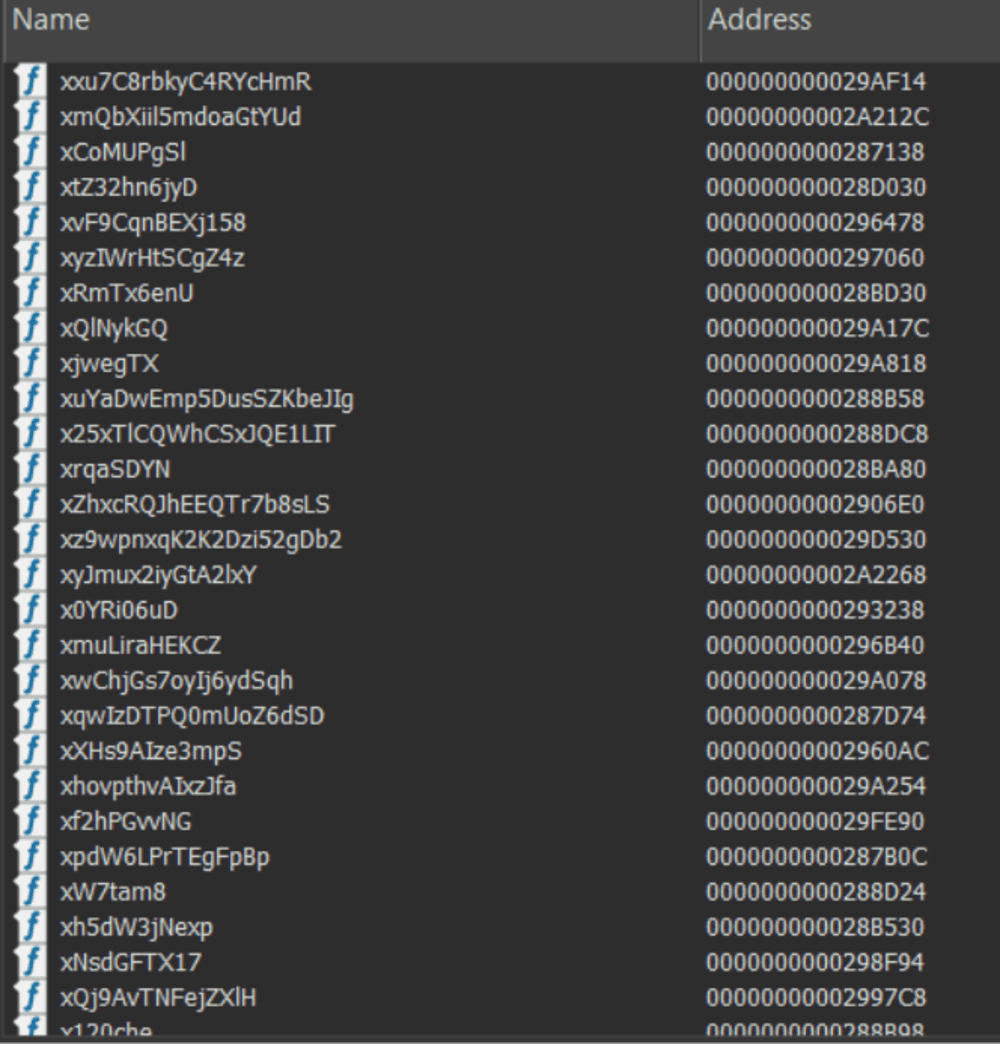
exported-symbol listing for the native packer library, captured directly from the analyst workstation, showing a sample of the randomly-named four-byte junk symbols used to flood the library’s symbol table.
6. Anti-Emulator, Anti-VPN, and Anti-Debug Checks
Decompilation of the native application-startup hook (detailed in the following section) shows explicit environment fingerprinting performed before any payload is unpacked: the device’s declared processor architectures are checked for “x86″/”x86_64” markers, and the device manufacturer value is checked, case-insensitively, against the string “generic”; both are standard heuristics for detecting Android emulators and analysis sandboxes. Separately, a dedicated native function on the hidden launcher-activity class contains the literal string “vpn detected, app will exit soon”, confirming active VPN-interface detection intended to frustrate analysts who commonly route test devices through an interception proxy:
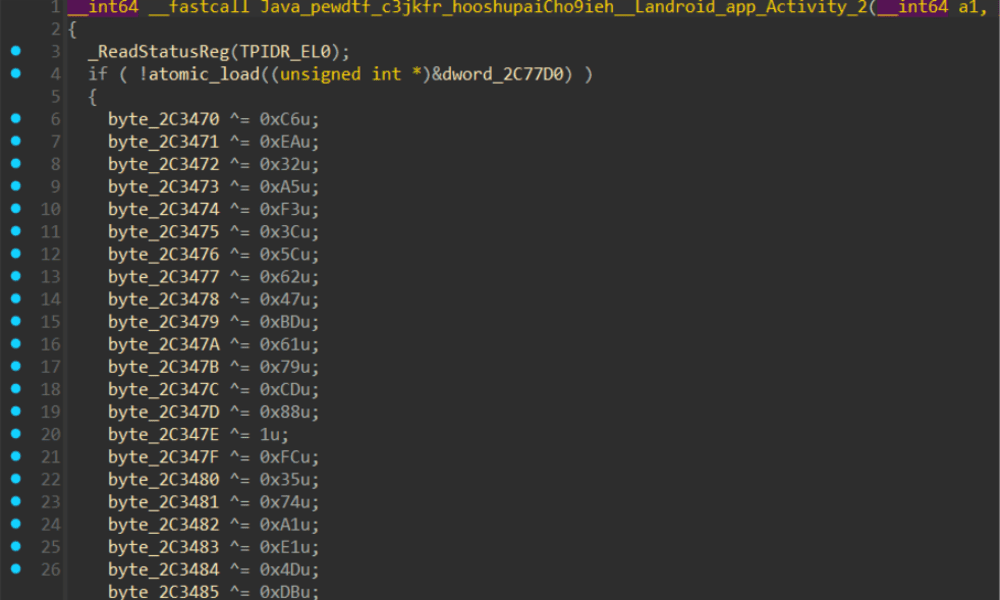
reconstructed pseudocode for the obfuscated VPN-detection function, captured directly from the analyst workstation, showing the start of its own per-byte string-decryption block.
A second, independent copy of the full unpacking routine additionally references a saved-preferences flag labelled “debug bypass checking”, indicating a persisted record of whether an attached debugger was detected on a prior run.
7. Self-Termination
On first run, after the initial unpacking sequence, the native code calls the process-identifier and process-termination system APIs in sequence, deliberately restarting the application process. This is a common technique to cleanly apply changes made to the on-disk app state (such as the now-enabled persistence receiver), and is incidentally useful for discarding any state an analyst may have modified mid-execution.
Multi-Stage Native Packer Architecture
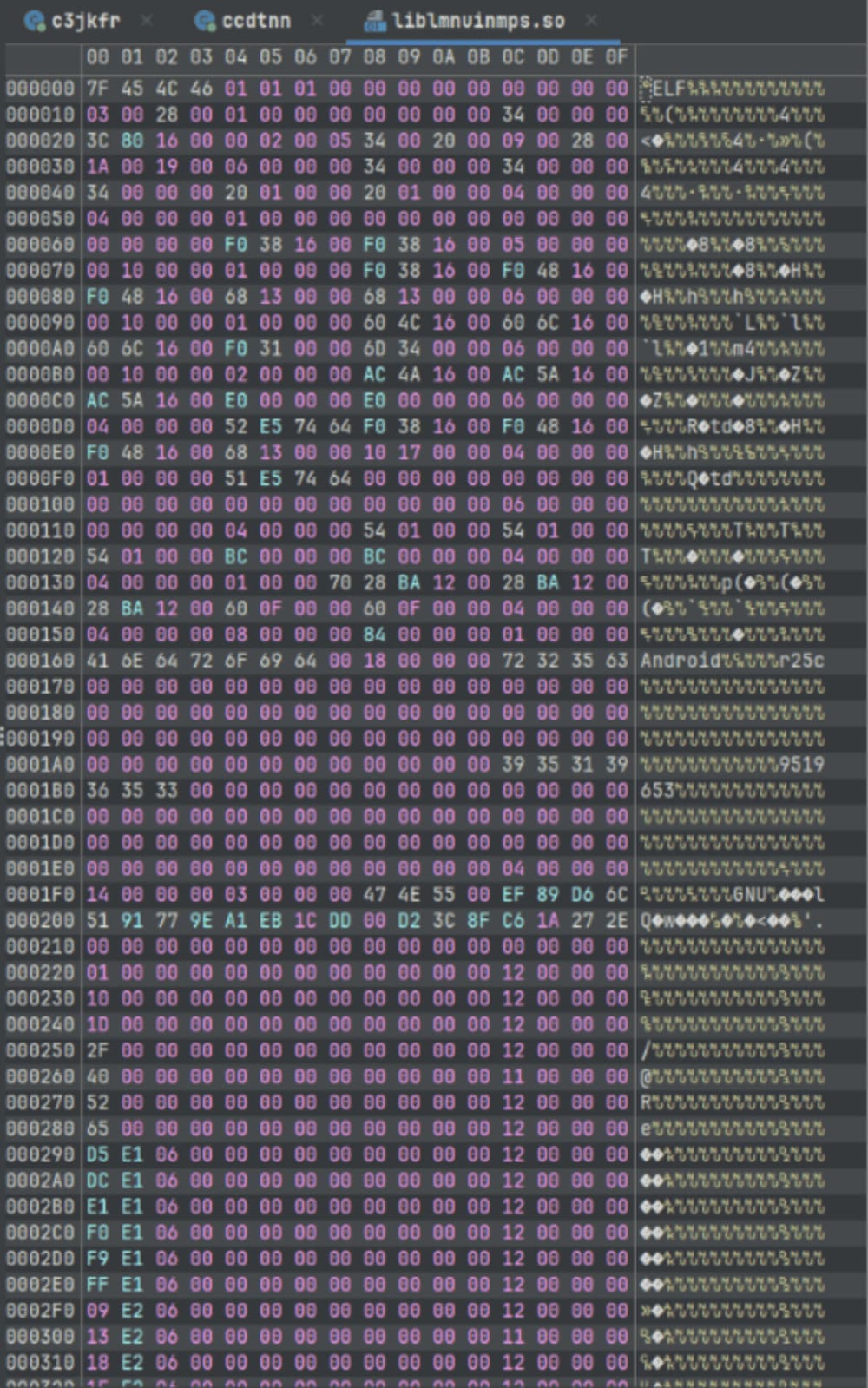
The core protective layer in both samples is a custom native (ARM64/ARMv7) packer embedded in the application’s bundled native library (`liblgpnmdvu.so` in ADMIN.apk, `liblmnuinmps.so` in USER.apk). This is the most heavily engineered component of the malware and is analysed in detail below, including the methodology used to defeat it.
Native Entry Point
The application’s declared `Application` class (`com.casimirlab.simpleDeadlines.App`, inherited from the decoy codebase) is intercepted via a native implementation of `attachBaseContext(Context)`, registered through standard static native-method binding. This method runs before any other application code, and is itself implemented almost entirely in native code rather than Java, specifically to resist decompilation.
Runtime String Deobfuscation
Every security-relevant string used by the native loader (class names, method names, type signatures, asset filenames, and cryptographic keys) is stored in the binary’s data section as ciphertext and reconstructed at runtime through thousands of individually compiled, single-use XOR operations: each byte of each hidden string is decrypted by its own hard-coded immediate constant, rather than by a loop with a repeating key. This defeats a simple “look for a long key string” static scan, since no such key exists in the binary for this layer; the key is the entire sequence of per-byte constants baked into the function’s own instructions.
We recovered this scheme two independent ways, with identical results, providing strong cross-validation:
- Manual processor-architecture disassembly followed by CPU emulation of the relevant code paths, to execute just the self-decrypting prologue and read the plaintext back out of emulated memory.
- A custom decompiler-scripting pass that parses the reconstructed pseudocode for the repeating “one byte, exclusive-ORed with one hard-coded constant” assignment pattern, reads the original (still-encrypted) byte from the loaded binary at each referenced address, and applies the recovered key byte directly, avoiding the need to execute any code at all.
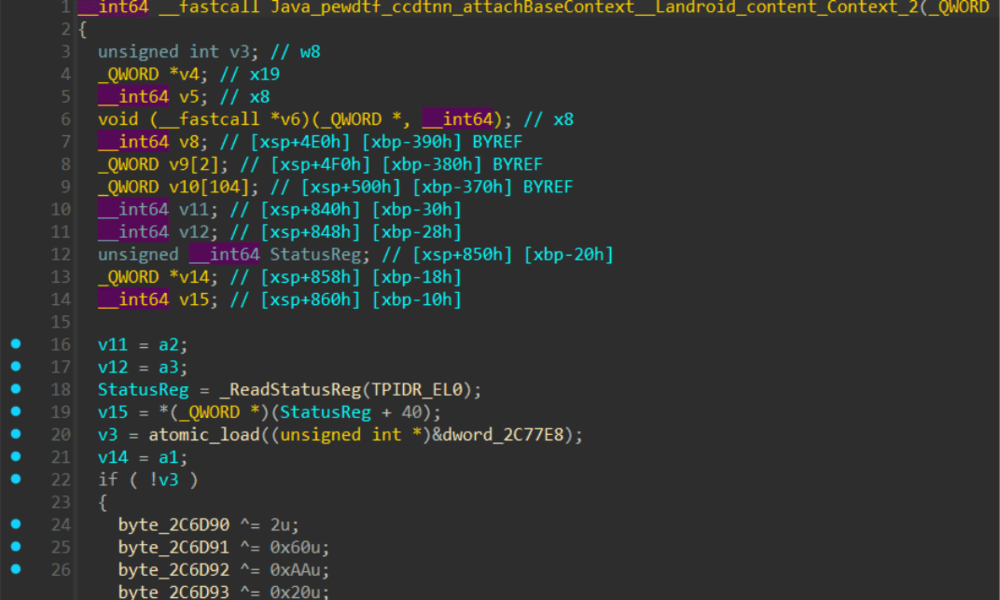
decompiler view of the native application-startup hook, captured directly from the analyst workstation, showing the start of the unrolled per-byte decryption block (over 2,000 such assignments appear across this single function).
Environment Checks and First-Run Handling
Once decrypted, the recovered strings reveal the loader’s full first-run sequence: a check of the device’s declared processor architectures and manufacturer value (anti-emulator, described above); a saved-preferences read/write guarding whether first-run setup has already completed; and a self-restart of the application process once setup is applied.
Stage 1: Fully Decrypted, a Generic Application-Hijacking Loader
The decrypted strings show the native code opening an asset file through the Android asset manager (`pnuuda0ljocxut5w` in ADMIN.apk, `ukxitkagnzbehcte` in USER.apk, both exactly 18,428 bytes), reading its full contents, and decrypting them in memory with a 64-byte per-build key that we recovered in full:
| Build | Encrypted asset | Recovered 64-byte decryption key |
|---|---|---|
| ADMIN.apk | assets/pnuuda0ljocxut5w | 88xvj5hseflthpcdj57g5fxnr c89mwfnkfmbomwrbowwlwt lyjgmlyw4k9fnbkh |
| USER.apk | assets/ukxkitagznbehcte | 7qnlqejsjblz5uh2y3wl iof0nvusxpccyjpdvlwjndhul4a pwhacvufunxltvl6b |
Applying each key to its corresponding asset produces a byte-for-byte valid Android DEX file: the decrypted output begins with the exact DEX file-format signature and its internal size field matches the decrypted buffer length exactly in both cases. This result would occur by chance with a wrong key with a probability on the order of 1 in 4 billion, so it constitutes conclusive proof of correct decryption rather than a coincidental pattern match.
Both decrypted DEX files are 18,428 bytes and, remarkably, share an identical SHA-256 hash (`58e39152786a0f48dd005e4189769be9e0c2e2d0067c8128252d91ae85559117`). The first unpacking stage is completely unmodified between the operator and victim builds, confirming it is a shared, off-the-shelf component of the builder rather than bespoke code written for this campaign.
Static analysis of this decrypted DEX file (class and method enumeration) shows it is not spyware code at all, but a generic, reusable Android application-hijacking “FUD” (Fully UnDetectable) loader, under the package names `com.example.virusscanbypassbootstrapper` and `com.example.initialloader`:
com/example/virusscanbypassbootstrapper/App
com/example/virusscanbypassbootstrapper/DexLoader
com/example/virusscanbypassbootstrapper/MainActivity
com/example/virusscanbypassbootstrapper/Tester
loadDex(Context, String) openAssets(AssetManager, String)
copyFromAssetsToFiles(…) getDexBuffersInDex(File)
getDexClassLoaderElements(…) setDexClassLoaderElements(…)
invokeExternalInit(Context, String) hook(Application, String)
replaceApplicationContext(Application)
These method names describe a known application-hijacking pattern: reflectively replacing the running process’s `Application` object (internal fields such as `sDelegateApplication`, `mInitialApplication`, and `mApplication` on Android’s process-management internals) and merging additional DEX and native-library elements into the live class-loader path list, all without ever writing the unpacked code to disk; the decrypted DEX itself is loaded only through Android’s in-memory DEX class loader. The package `com.example.initialloader.App` contains dead/demo code that illustrates the loader’s generic design: it builds its own decryption key from the literal placeholder string “xorKey” (the variable name itself, never replaced with a real secret), strong evidence that this is unmodified template code from a commercial crypter/protector product rather than something written specifically for this campaign.
Persistence Activation
After loading the stage-1 component, the native code constructs an Android component reference to the boot-persistence receiver that ships disabled in the manifest (`com.rqrylt.jinfpja.egksLHxRVRRdcEIg` in ADMIN.apk, `com.xorzd.kutbongwiho.eTtz` in USER.apk) and calls the package manager’s component-enable API to activate it at runtime. This means a static manifest review alone would wrongly conclude the boot-persistence receiver is inert.
Stage 2: The Real Payload
The same unpacking sequence subsequently loads a second, substantially larger encrypted asset (`fdear9ugxh7vjqoj/dnrlu1qy` in ADMIN.apk; `4nog4o43qjjfjepr/mb9duag9` in USER.apk) through the same loader infrastructure as stage 1. This second payload is AES-encrypted and decrypts to a standard ZIP archive containing a single `classes.dex` file: the final, operational payload that every earlier packing layer exists purely to protect. Decompiling this recovered DEX file confirms the real hidden package referenced throughout the manifest (`com.rqrylt.jinfpja` in ADMIN.apk, `com.xorzd.kutbongwiho` in USER.apk), and is the direct subject of the BTMOB RAT source-code comparison in the following section.
A Secondary Monetisation Layer: Cryptojacking
Beyond the banking-fraud and surveillance capability documented elsewhere in this report, static analysis of the recovered stage-2 payload identified a second, independent monetisation module bundled into the same kit: a silent Android cryptocurrency-mining (“cryptojacking”) component. This is consistent with MaaS operators maximising revenue per infected device by layering multiple monetisation streams (banking fraud, data resale, and compute hijacking) on top of a single distribution funnel.
- Downloads an architecture-specific native mining binary at runtime (separate builds for armeabi-v7a and arm64), disguised with a filename pattern resembling a legitimate native library.
- Launches it with command-line flags matching the widely used XMRig Monero-mining engine, connecting to an operator-controlled mining pool.
- Monitors device thermal state to throttle mining intensity and avoid the battery drain and overheating that would otherwise alert a victim.
- Requests exemption from Android battery-optimisation restrictions and uses a foreground service to keep mining persistently in the background.
- Reports installation and mining telemetry to a self-hosted analytics collector, repurposing the open-source Aptabase SDK as a lightweight telemetry/command channel.
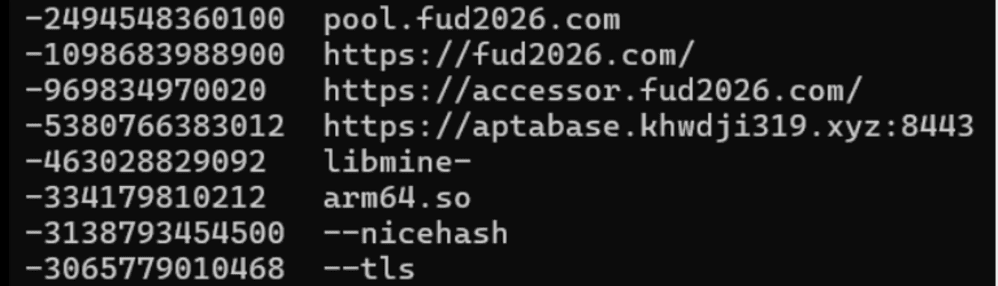
a terminal session on the analyst workstation decoding the payload’s own obfuscated string table, recovering its mining-pool and download infrastructure in plain text.
| Indicator | Role |
|---|---|
| fud2026[.]com | Serves the downloadable mining binary |
| accessor[.]fud2026[.]com | Secondary/fallback binary-download endpoint |
| pool[.]fud2026[.]com | Mining pool address used by the downloaded miner |
| aptabase[.]khwdji319[.]xyz | Self-hosted telemetry collector |
The “fud2026” domain pattern echoes the “FUD” (Fully UnDetectable) branding already identified in the stage-1 loader’s own package name and in the operator’s Telegram advertising for a companion Google Play Protect bypass service, tying the loader, the panel, and this payload to a single commercial MaaS operation.
BTMOB RAT Source-Code Attribution
The decompiled stage-2 payload is not a bespoke creation: its class structure, method layout, and operational logic match BTMOB RAT directly. BTMOB RAT is a commercial Android RAT first documented in February 2025 as an evolution of the SpySolr family, itself built on the Crax RAT codebase attributed to threat actor “EVLF”, and subsequently the subject of a leaked builder/source-code ecosystem reported on by independent researchers. “Knight Spy” / “King Spy”, the Telegram-sold product analysed in this report, is best understood as a rebrand and resale of that same BTMOB codebase rather than an independently engineered RAT.
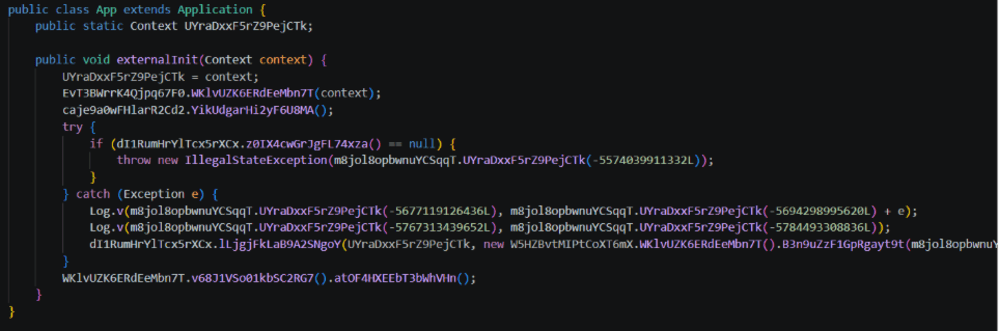
the real decompiled Application class of the hidden payload package (com.rqrylt.jinfpja), The class-naming convention, obfuscation pattern, and initialization flow match BTMOB RAT’s documented architecture.
This attribution is supported by multiple independent points of evidence:
- Identical operator/victim (console/implant) APK architecture, matching BTMOB RAT’s documented builder output, in which a single purchase generates a paired operator console and victim implant from shared source.
- Identical manifest-level evasion techniques (hidden launcher icon, a boot-persistence receiver shipped disabled and enabled only at runtime) matching MITRE ATT&CK T1628.001 and T1624.001 as documented for this family.
- A decoy/camouflage codebase strategy and heavy runtime string obfuscation throughout, matching MITRE ATT&CK T1406 as documented for this family.
- A live, centralised operator panel sold separately per reseller (“404 PANEL SHOP”, “KING PANEL SHOP”), consistent with BTMOB RAT’s documented Malware-as-a-Service sales model rather than a single fixed operator.
- No camera, microphone, SMS, or location permission declared in the manifest, consistent with BTMOB RAT’s documented reliance on Android’s Accessibility Service for equivalent capability without triggering runtime permission prompts.
Independent published analysis of BTMOB RAT additionally documents a persistent, socket-based command channel, device fingerprinting on connect, and operator commands spanning live screen access, clipboard capture, audio recording, and web-view-based credential collection. We present this as corroborating context from third-party research on the BTMOB codebase this kit is built from, consistent with the architecture confirmed directly in the decompiled payload.
OSINT: Threat Actor Telegram Infrastructure
iZOOlogic Research obtained, alongside the two APK samples, a set of screen captures from the threat actor’s own Telegram distribution and sales channels. These are presented below as supporting evidence; they were not generated by iZOOlogic and are reproduced here solely for threat-intelligence attribution purposes. Identifying details already public in the source channel have been retained for indicator purposes; the account IDs and aliases below are the threat actor’s own self-published handles, not personal data obtained through investigation of a private individual.
Sales Channel and File Distribution
The threat actor distributed the two analysed APKs directly through a Telegram channel, labelling them plainly as the operator (“ADMIN APP”) and victim (“USER APP”) components of the same kit.
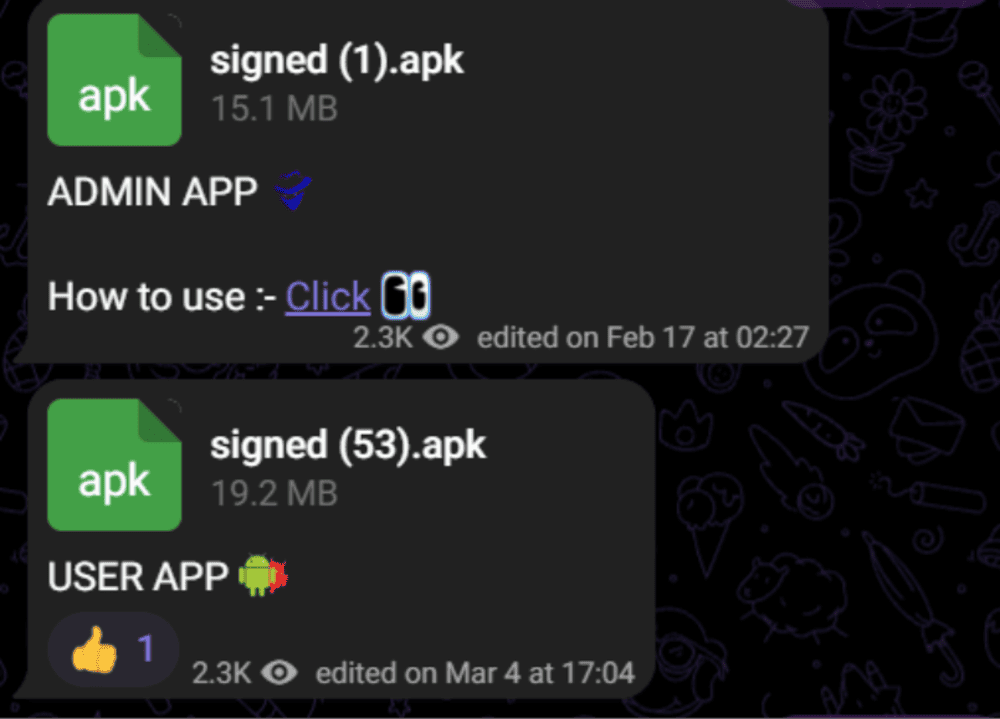
Telegram post distributing the ADMIN APP and USER APP files, labelled plainly as the two halves of the same kit.
Live Operator Control Panels
Two distinct operator-panel deployments were observed advertised on the actor’s channels (“404 PANEL SHOP” and “KING PANEL SHOP”), both branded “Knight Spy” / “King Spy” and showing a live list of connected victim devices alongside per-device control actions, consistent with the persistent remote-control architecture documented for this malware family.
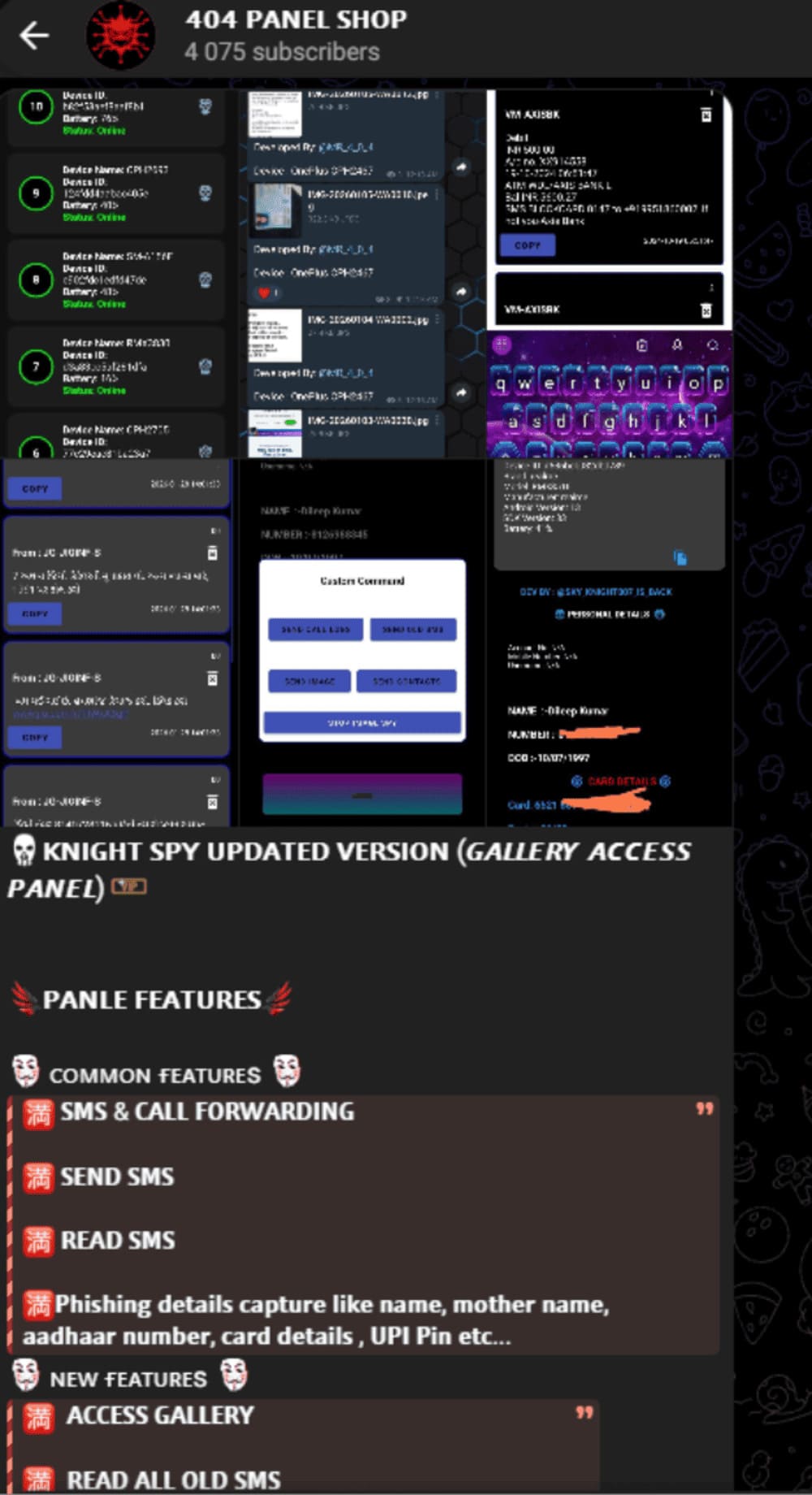
“404 PANEL SHOP” operator dashboard, showing a live list of connected devices (status “Online”), device identifiers, and remote command controls branded “KNIGHT SPY”.
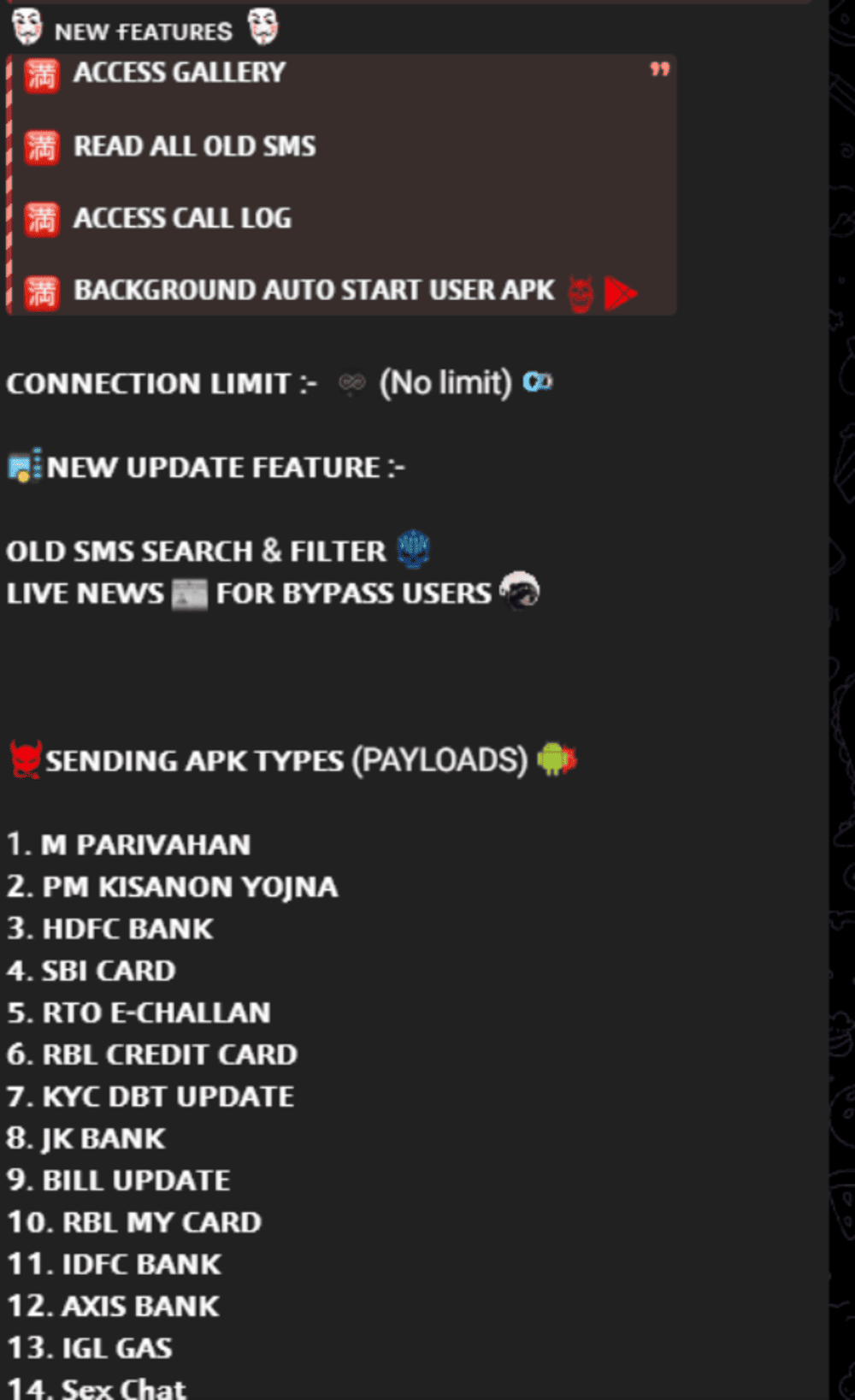
Continuation of the same panel advertisement, enumerating further available remote-control feature categories and a list of selectable phishing-lure themes offered by the builder.
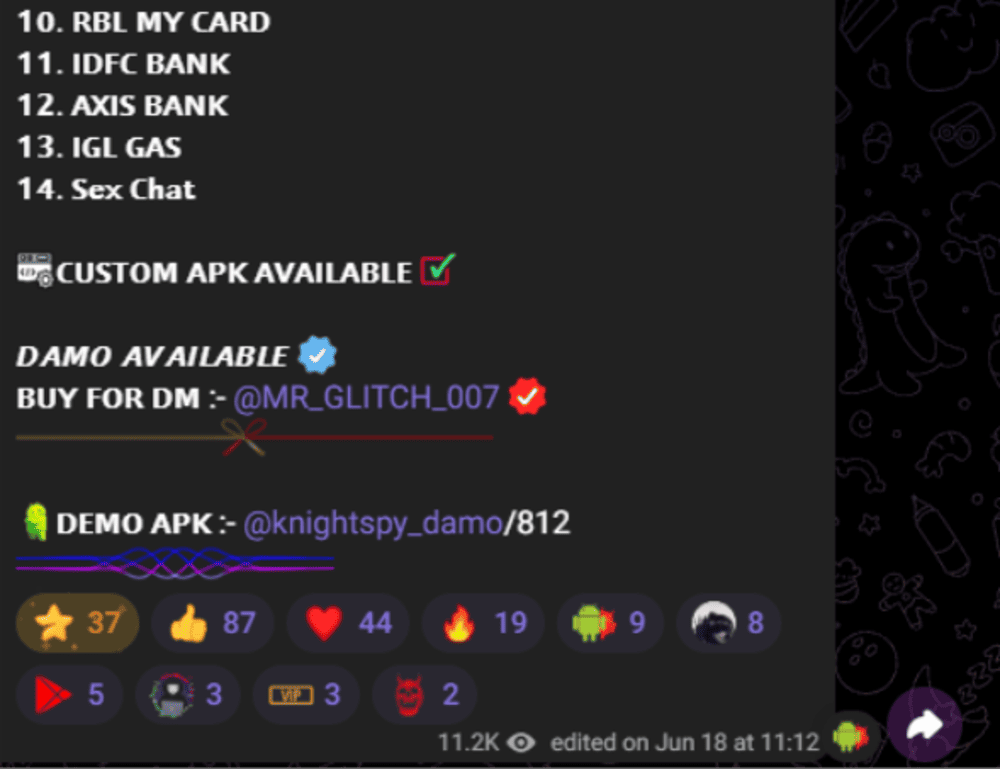
Channel post offering custom-built APKs on request and a demo build, with a named contact handle for purchase enquiries.
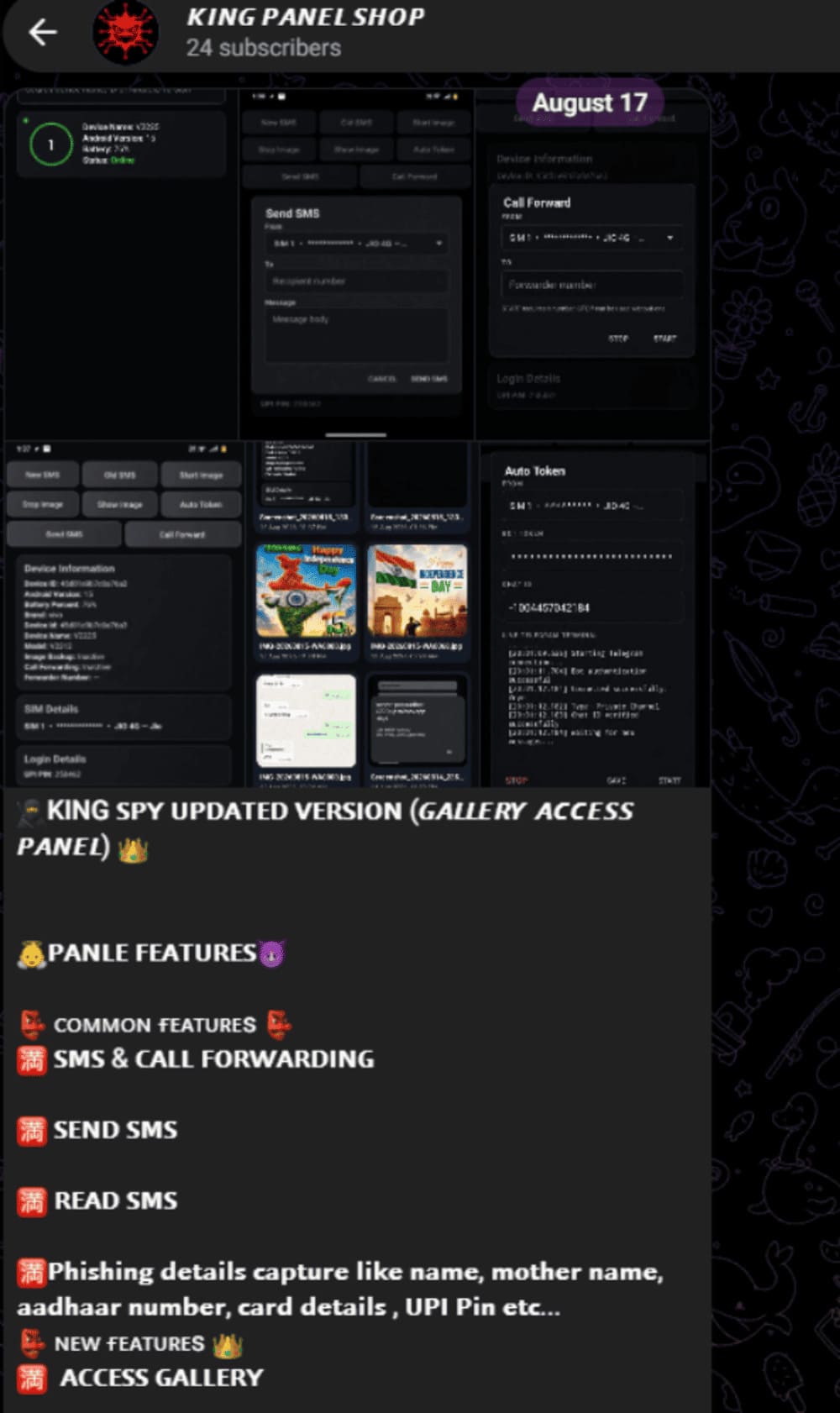
“KING PANEL SHOP” operator dashboard, a second, independently run deployment of the same panel software, confirming this is a distributed kit used by multiple resellers rather than a single operator.
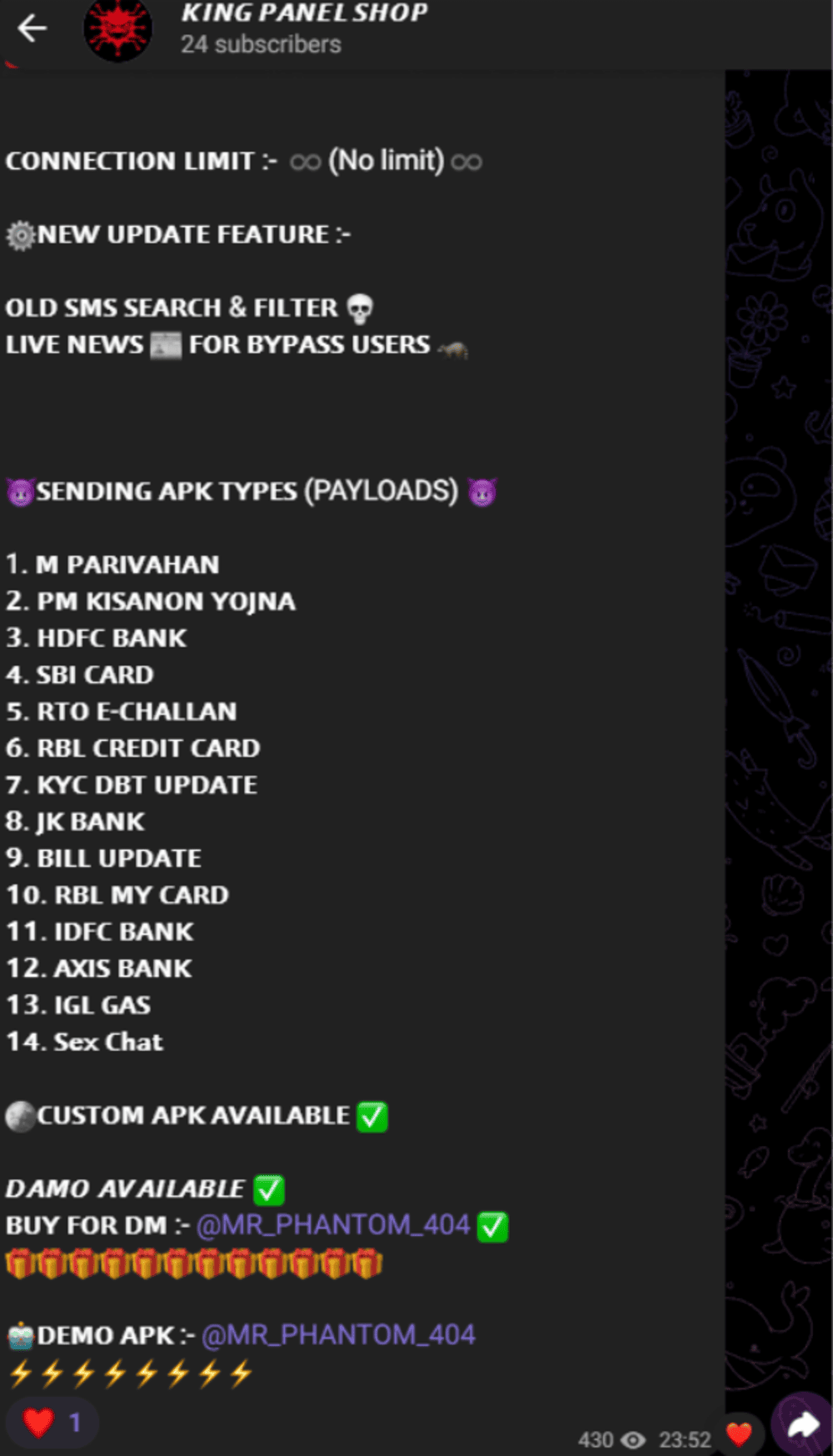
Continuation of the KING PANEL SHOP advertisement, listing further panel capabilities and a separate demo-build contact handle.
Companion “Google Play Protect Bypass” Service
A separate Telegram channel was observed advertising an APK-protection (“FUD”/crypter) service distinct from the Knight Spy panels themselves, explicitly marketed around bypassing Google Play Protect and offering both “hidden” and “non-hidden” dropper variants. This is a direct, independent corroboration of our own technical finding: the generic loader we fully decrypted from the first unpacking stage of both samples is literally named `com.example.virusscanbypassbootstrapper` in its own compiled package declaration, the same concept the actor is separately advertising as a commodity service.
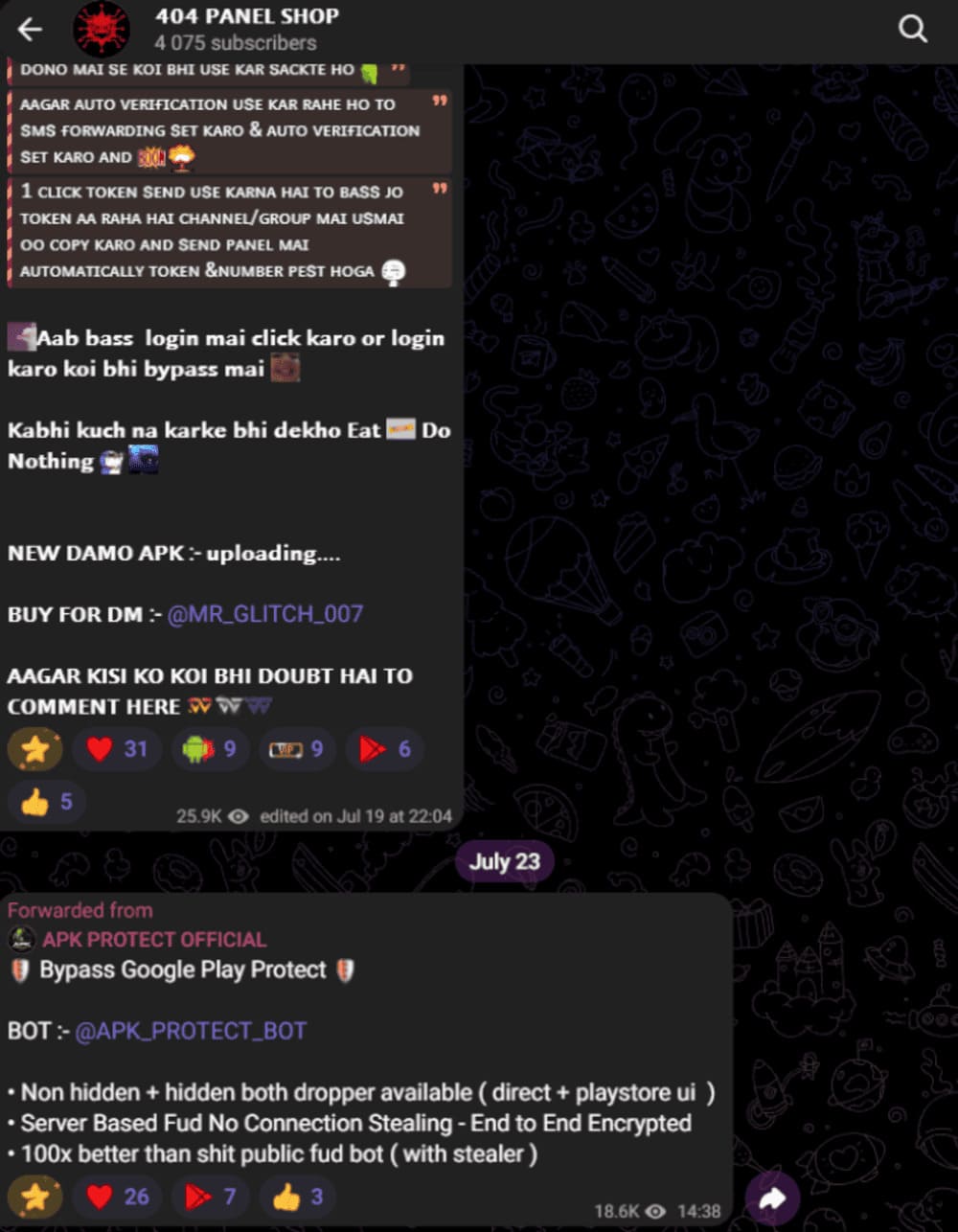
Channel post advertising SMS auto-forwarding/auto-verification setup instructions alongside a reference to a “Bypass Google Play Protect” capability.
Advertisement describing hidden and non-hidden dropper options and “server-based FUD” protection, directly corroborating the generic crypter/loader package recovered from the decrypted stage-1 payload.
Operator Identity Correlation
Message history gathered from the surrounding Telegram ecosystem links the file-sharing activity for “ADMIN.apk” to a single recurring account (ID 7779262439), observed operating under multiple rotating display names and usernames across several channels and groups, consistent with routine identity rotation practised by threat actors operating this type of kit.
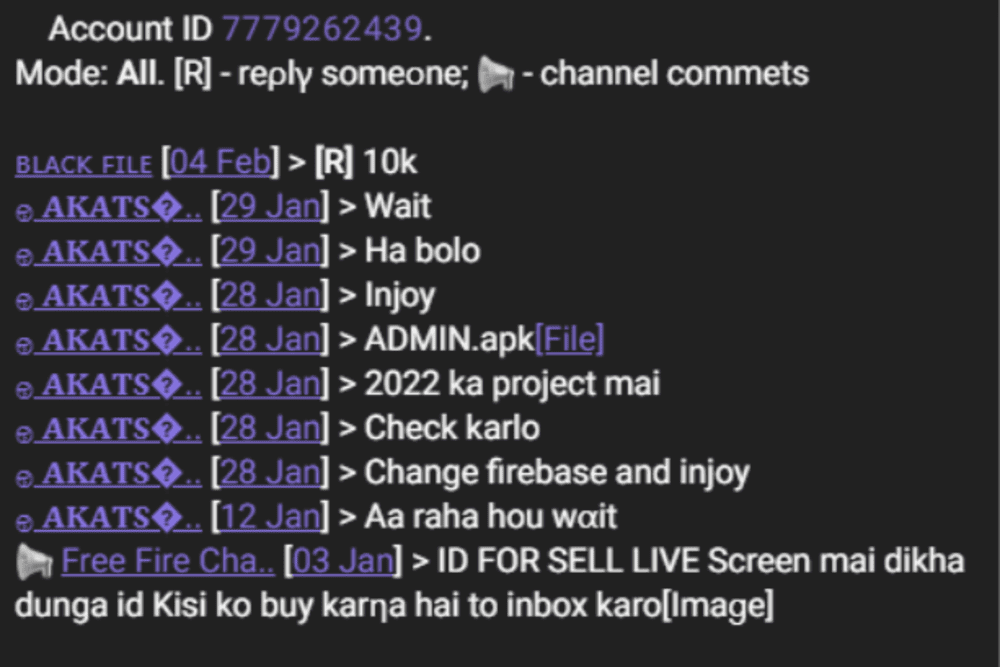
Group chat log showing the same account sharing “ADMIN.apk” and discussing panel configuration with other channel members.
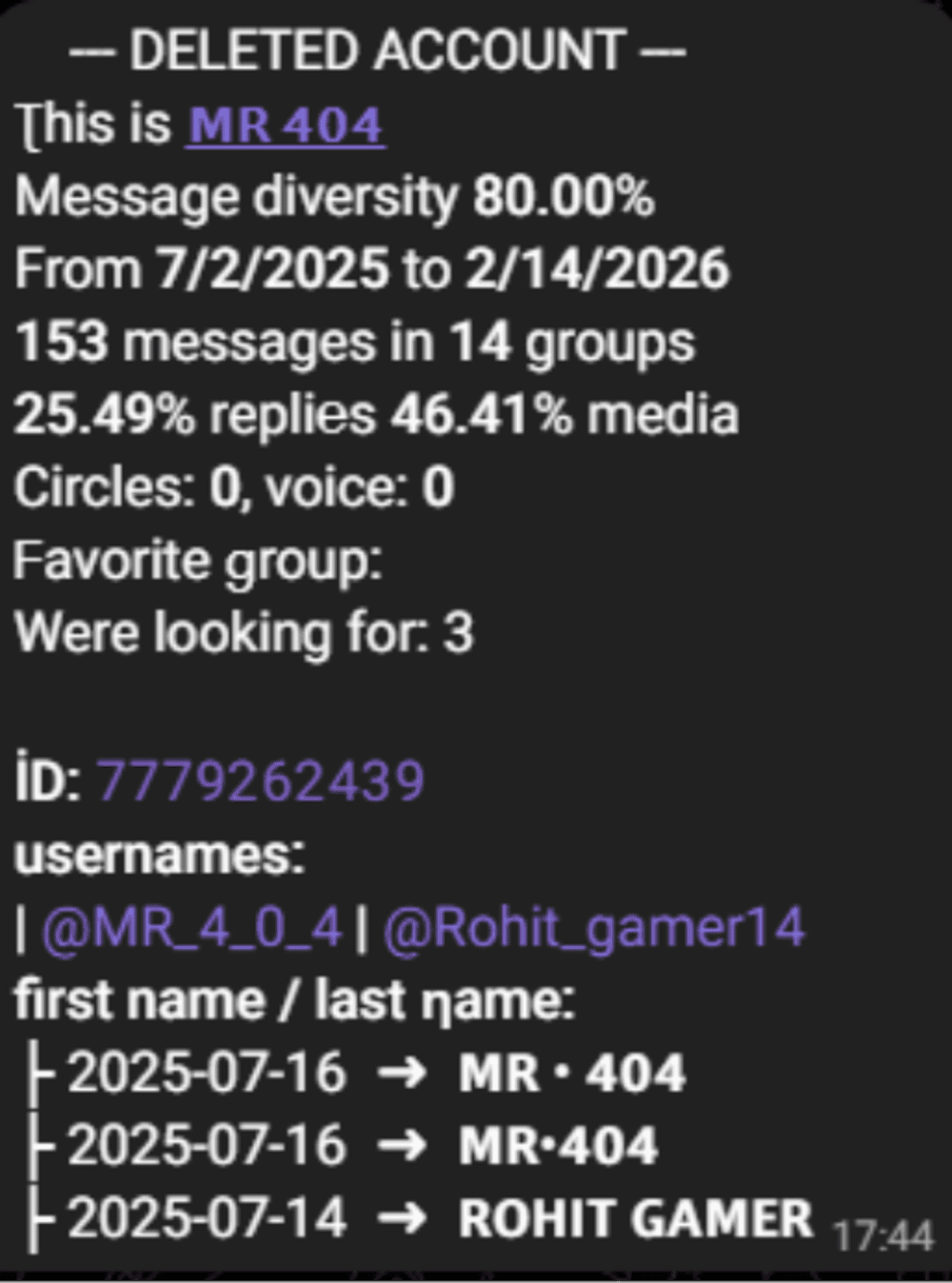
Account profile metadata for ID 7779262439, showing a history of display-name changes typical of threat-actor identity rotation.
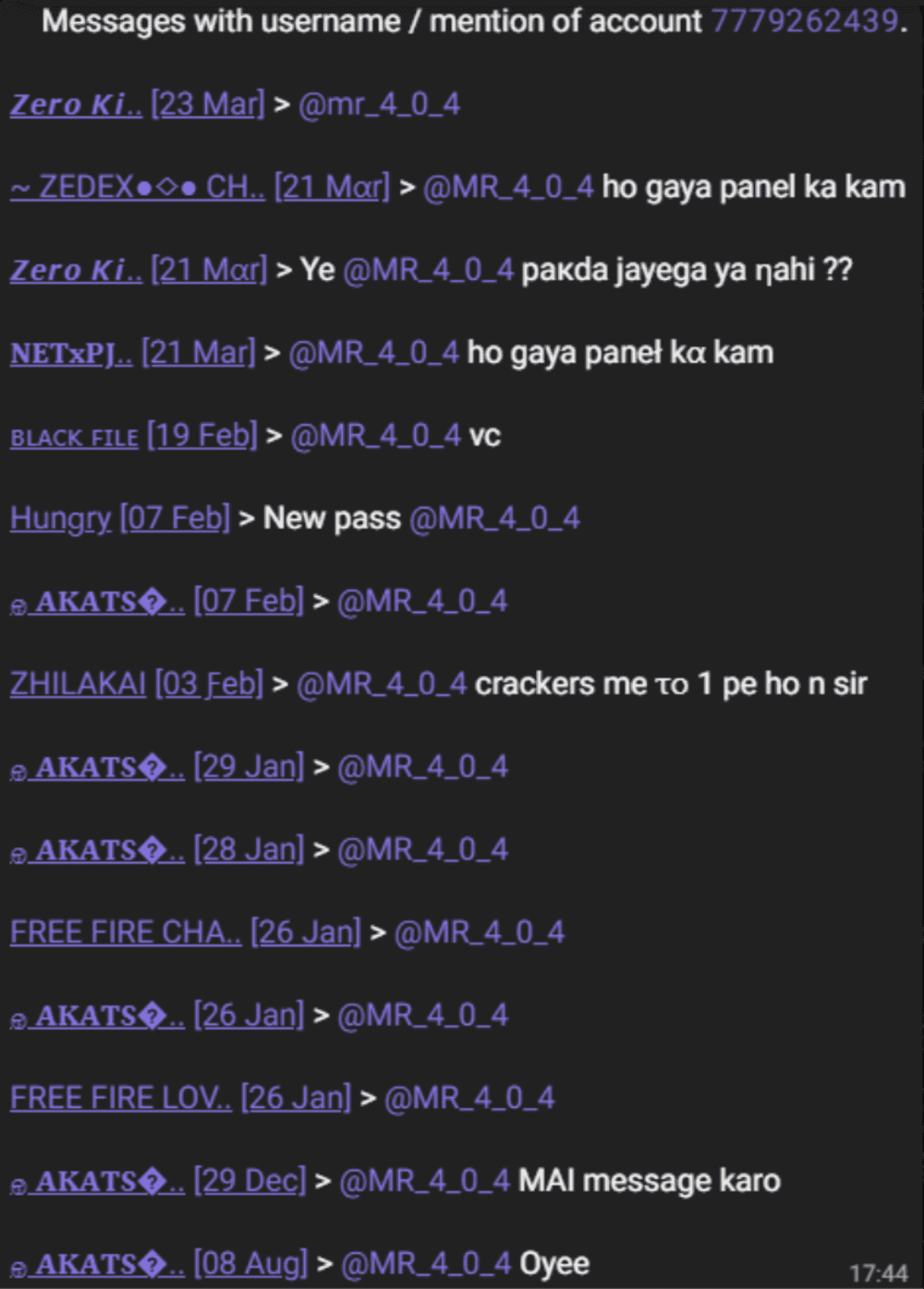
Cross-channel mentions of the same account ID/alias, establishing a consistent operator identity across multiple distribution groups over an extended period.
Mitre Att&ck Mobile Mapping
| Tactic | Technique & ID | Observed Evidence |
|---|---|---|
| Initial Access | Deliver Malicious App: T1660 / T1476 | Direct APK distribution via Telegram; mParivahan government-service impersonation |
| Execution | Dynamic Code Loading: T1407 / T1626 | InMemoryDexClassLoader-based loading of decrypted stage-1 and stage-2 payloads |
| Persistence | Event-Triggered Execution: Broadcast Receivers: T1624.001 | BOOT_COMPLETED receiver shipped disabled; enabled at runtime via setComponentEnabledSetting() |
| Defense Evasion | Obfuscated Files or Information: T1406 | Zero-width-space label obfuscation; thousands of per-byte XOR string constants; symbol-table flooding |
| Defense Evasion | Hide Artifacts: Suppress Application Icon: T1628.001 | Launcher activity registered with category INFO instead of LAUNCHER |
| Defense Evasion | Masquerading: Match Legitimate Name/Location: T1655.001 | USER.apk impersonates the official “mParivahan” government application |
| Defense Evasion | Virtualization/Sandbox Evasion: T1633 | Build.MANUFACTURER == “generic” and x86/x86_64 ABI checks; explicit VPN-interface detection |
| Defense Evasion | Software Packing: T1406 (native) | Multi-stage native packer with jump-table control-flow obfuscation defeating decompilation |
| Discovery | Application Discovery: T1418 | QUERY_ALL_PACKAGES permission declared for installed-app enumeration |
| Command and Control | Application Layer Protocol: T1437 (WebSocket) | Persistent WebSocket C2 channel documented for this family in public reporting |
| Collection | Access Sensitive Data in Device Logs / Input Capture: T1417 | Accessibility-Service-based keylogging and credential-overlay capture documented for this family |
| Collection | Screen Capture: T1513 | MediaProjection-based live screen streaming documented for this family |
| Exfiltration | Exfiltration Over C2 Channel: T1646 | Device fingerprint and collected-data transmission over the WebSocket C2 channel |
Indicators Of Compromise
| # | Indicator | Type / Remarks |
|---|---|---|
| 1 | d4f6efb985092b532d 36365435557940d9bfaaecf5 656e492393665728f521dc | SHA-256: ADMIN.apk (operator console) |
| 2 | 42e6b1f7f3f78770 531164c2ab8f39ab41564ae43 8dbaa3f55caa9f396c778a9 | SHA-256: USER.apk (mParivahan-themed victim implant) |
| 3 | 84e023f44e80472065 ed0916ef65d5a41d62eba0fd03 e20f48ba9bfc85df02f0 | SHA-256: liblgpnmdvu.so (ADMIN native packer, arm64-v8a) |
| 4 | f82fdd88297dbfc9ae c31e7a6a89c0a9e7a713faa41 548cc280f5a446ce0f483 | SHA-256: liblmnuinmps.so (USER native packer, arm64-v8a) |
| 5 | 58e39152786a0f48dd005e 4189769be9e0c2e2d0067c8 128252d91ae85559117 | SHA-256: decrypted stage-1 DEX payload (identical in both samples) |
| 6 | com.rqrylt.jinfpja | Android package name: ADMIN.apk |
| 7 | com.xorzd.kutbongwiho | Android package name: USER.apk |
| 8 | com.example.virusscanbypassbootstrapper | Package name of decrypted generic loader / crypter component (both samples) |
| 9 | com.casimirlab.simpleDeadlines | Decoy open-source package used as code camouflage (both samples) |
| 10 | pnuuda0ljocxut5w / ukxitkagnzbehcte | Encrypted stage-1 asset filenames (ADMIN / USER) |
| 11 | fdear9ugxh7vjqoj/dnrlu1qy / 4nog4o43qjjfjepr/mb9duag9 | Encrypted stage-2 asset filenames (ADMIN / USER) |
| 12 | 7779262439 | Telegram account ID linked to sample distribution (OSINT) |
| 13 | fud2026.com | Domain: serves the downloadable cryptojacking mining binary |
| 14 | accessor.fud2026.com | Domain: secondary/fallback binary-download endpoint |
| 15 | pool.fud2026.com | Domain: mining pool used by the downloaded cryptojacking binary |
| 16 | aptabase.khwdji319.xyz | Domain: self-hosted telemetry collector (repurposed Aptabase SDK) |
Yara Rules
The following YARA rule was authored by iZOOlogic Research based on indicators unique to this specific builder output and is intended for detection of this sample family and closely related builds from the same “Knight Spy” / BTMOB RAT toolkit.
{
meta:
author = “iZOOlogic Research”
description = “Detects Knight Spy / BTMOB RAT Android builds via packer and decoy indicators”
date = “2026-10-16”
reference = “iZOOlogic Threat Intelligence Report – Knight Spy / BTMOB RAT”
sha256_1 = “d4f6efb985092b532d36365435557940d9bfaaecf5656e492393665728f521dc”
sha256_2 = “42e6b1f7f3f78770531164c2ab8f39ab41564ae438dbaa3f55caa9f396c778a9”
strings:
$decoy_pkg = “com.casimirlab.simpleDeadlines” ascii
$loader_pkg = “com.example.virusscanbypassbootstrapper” ascii
$loader_pkg2 = “com.example.initialloader” ascii
$dyn_loader = “dalvik.system.InMemoryDexClassLoader” ascii
$xorkey_literal = “xorKey” ascii
$zip_corrupt_a = { 41 6E 64 72 6F 69 64 4D 61 6E 69 66 65 73 74 2E 78 6D 6C } // “AndroidManifest.xml” entry name
condition:
uint32(0) == 0x04034b50 and
$decoy_pkg and $dyn_loader and
2 of ($loader_pkg, $loader_pkg2, $xorkey_literal, $zip_corrupt_a) and
filesize < 25MB } rule KnightSpy_BTMOB_RAT_NativePacker { meta: author = "iZOOlogic Research" description = "Detects the native (.so) packer component shared by Knight Spy / BTMOB RAT builds" date = "2026-10-16" strings: $vpn_check = "vpn detected" ascii $dbg_check = "debug bypass checking" ascii $manuf_check = "generic" ascii $abi_check = "SUPPORTED_ABIS" ascii condition: uint32(0) == 0x464c457f and // ELF magic 2 of them } rule KnightSpy_BTMOB_RAT_Cryptojacking_Infra { meta: author = "iZOOlogic Research" description = "Detects references to the cryptojacking C2/mining infrastructure bundled with this Knight Spy / BTMOB RAT kit" date = "2026-10-16" strings: $c2_1 = "fud2026.com" ascii $c2_2 = "accessor.fud2026.com" ascii $c2_3 = "pool.fud2026.com" ascii $c2_4 = "aptabase.khwdji319.xyz" ascii condition: any of them }
Recommendations
- Issue a public advisory specifically warning citizens that the official mParivahan application is only ever distributed via the Google Play Store, and that any APK received via Telegram, SMS, or WhatsApp claiming to be mParivahan, an e-Challan notice, or a related government service should be treated as malicious.
- Coordinate with CERT-In and the Ministry of Road Transport and Highways to pursue takedown of the identified Telegram distribution channels and operator panels.
- Share the indicators and detection rules in this report with banking-sector CERTs and fraud-monitoring teams, given this kit’s explicit targeting of UPI, card, and net-banking credentials.
- Mobile threat defense and security-operations teams should add detection logic for the specific static indicators in this report (decoy package co-occurrence, corrupted ZIP compression-method fields on manifest/resources.arsc, and the native packer’s string/anti-analysis fingerprints) rather than relying solely on file hashes, which will change between builder outputs.
- Incident-response playbooks for Android RAT infections should assume Accessibility-Service abuse is present even when the manifest declares no dangerous runtime permissions, since this malware family achieves equivalent capability without them.
- Any device suspected of infection should be treated as fully compromised: isolate it from Wi-Fi and mobile data, do not attempt in-place “uninstall” via the Accessibility-granting flow the malware itself presents, and perform a factory reset from a trusted recovery/firmware image.
- Audit and revoke Accessibility Service, “Display over other apps”, “All files access”, and battery-optimisation-exemption grants for any unrecognised or unexpectedly hidden application.
- Rotate banking credentials, UPI PINs, and card details for any device confirmed or suspected to have run this malware, given its documented input-capture and overlay-phishing capability.
- Citizen Facing Action: Report to 1930 / cybercrime.gov.in and to Chakshu on Sanchar Saathi for the SMS and WhatsApp lures.
Conclusion
The ADMIN.apk and USER.apk samples analysed in this report are confirmed, matched builds of BTMOB RAT, a mature, actively maintained, commercially sold Android RAT, distributed under the Telegram reseller brand “Knight Spy” and weaponised against Indian citizens through direct impersonation of the government mParivahan platform. This report’s central finding is that “Knight Spy” is best understood as a Malware-as-a-Service product built on, and reselling, the existing BTMOB RAT codebase rather than an independently engineered threat: the decompiled payload’s class structure, method layout, manifest-level evasion techniques, and paired operator/victim builder architecture all match BTMOB RAT’s documented design directly. Layered on top of this core RAT, the kit additionally bundles a silent cryptojacking module with its own dedicated mining and telemetry infrastructure, illustrating how this MaaS operation stacks multiple monetisation streams, banking fraud, surveillance, and compute hijacking, onto a single distribution funnel.
Cross-referencing these findings against independent public research on BTMOB RAT, and against OSINT evidence collected directly from the threat actor’s own Telegram sales infrastructure, produces a complete and mutually consistent picture: a professionally packaged, actively resold Android spyware-and-banking-fraud kit, built for repeatable deployment against Indian government-service and financial-institution users, and operated at a scale well beyond a single opportunistic actor. This should be treated as an active, ongoing threat to the mParivahan user base and to Indian banking customers more broadly, warranting coordinated takedown and public-advisory action alongside the technical mitigations detailed above.
