
 HQ/EMEAFind out how we can help your business

Technical Analysis of a Registry-Resident Loader, Trusted Driver Abuse and Datagram-Based Command Infrastructure
A tax notice lure delivers a disc image. Inside it sits a validly signed commercial program and a hidden unsigned library. Running the signed program loads the library, and from that point attacker code runs inside a trusted, signed process. We decrypted all three payloads the library carries, recovered the full command interface of both kernel drivers it can install, and proved that no command server address exists anywhere in the files. Nothing was executed at any point.
Contents
- Executive Summary
- Key Findings
- What Happened
- The Programme That Loads It
- The Loader
- Encryption
- The Kernel Drivers
- The Payload in the Registry
- Running Inside Another Programme
- The Network Channel
- Obfuscation
- MITRE ATT&CK Mapping
- Indicators of Compromise
- Detection and Response Guidance
- Conclusion
Executive Summary
iZOOlogic identified and reverse engineered a government-themed tax notice campaign targeting recipients through United Arab Emirates- and India-themed tax assessment lures. The campaign uses official-looking tax notices, specific payment demands, legal references, short response deadlines, and a single download button to persuade recipients to open a malicious disc image.
The disc image contains a legitimate, validly signed commercial executable alongside a hidden, unsigned malicious DLL. The signed executable is an unmodified component of a genuine commercial product. When executed, it loads the malicious DLL through a relative library path without validating the DLL’s signature, allowing attacker-controlled code to execute within a trusted signed process. This makes abuse of software trust and DLL side-loading the central mechanism of the campaign.
The malicious DLL acts as a loader and establishes multiple execution and persistence mechanisms. Analysis identified privilege requests associated with kernel-driver loading, an elevation mechanism capable of obtaining administrator privileges without the normal consent prompt, copies of the malware in temporary and system-wide directories, and a batch script that restarts the payload every 60 seconds.
The loader contains three encrypted payloads. Two decrypt to legitimately signed kernel drivers from unrelated commercial products, while the third is a persistence script. Reverse engineering confirmed that the same 16-byte keystream is reused across the payloads, exposing a cryptographic weakness that may assist analysis of future samples using the same implementation.
A significant component of the infection is the registry-resident second stage. The loader retrieves data from a per-user registry value, separates configuration from executable content, places the payload into writable/executable memory, patches its configuration, stores the configuration in a machine-wide registry value, and executes the resulting memory-resident code. This means the final working payload does not need to exist as a conventional executable on disk, increasing the importance of registry and memory-based investigation.
The malware also contains process-injection functionality and a datagram-based command channel. The injection capability can execute payload code within another process, while the network component avoids conventional web protocols and uses distinctive message structures that provide opportunities for behavioral detection.
Two legitimately signed kernel drivers were recovered from the encrypted resources. One contains a kernel-level process termination capability, while the second registers callbacks for process creation and image loading. These capabilities are present but were not reached in the analyzed build and should therefore be treated as latent capabilities rather than observed security-software-disabling activity.
No command-and-control server address was identified within the analyzed files. Evidence indicates that the server configuration is supplied through a machine-wide registry value that was not available in the collected material. The analysis confirms the delivery, side-loading, privilege escalation, persistence, payload execution and communications mechanisms, but does not establish whether the ultimate purpose is data theft, credential collection, remote access or another activity.
From a defensive perspective, organizations should prioritize the malicious unsigned DLL and associated behavioral indicators rather than blocking the legitimate signed executable, preserve the identified registry values during investigation, monitor for the distinctive temporary-directory and 60-second restart behavior, and correlate signed-process execution with unsigned module loading, executable-memory allocation, registry-resident execution, suspicious process injection, and driver installation.
Overall, the campaign demonstrates a layered trust-abuse architecture combining government-themed social engineering, signed-software abuse, DLL side-loading, privilege escalation, persistence, registry-resident execution, optional process injection, trusted-driver abuse, and non-web command communications.
Key Findings
- Government-themed phishing is used as the initial access vector. The campaign uses tax assessment notices themed for the United Arab Emirates and India, incorporating reference numbers, claimed amounts due, legal provisions, required documents, and short deadlines to create urgency.
- The delivery container deliberately conceals the malicious component. The campaign delivers a disc image containing a visible legitimate executable and a hidden unsigned DLL. The hidden attribute causes the victim to see only the trusted executable while the malicious library remains alongside it.
- The attack abuses a legitimate software trust relationship through DLL sideloading. The signed host dynamically loads a companion library using a relative name without a fixed path or signature validation. The malicious DLL therefore executes within a validly signed and trusted process, making conventional signature- and reputation-based controls less effective.
- The selected signed host already provides a powerful execution framework. The legitimate program functions as a remote instruction daemon and contains handlers capable of downloading and executing files, running batch commands, terminating processes, deleting files, updating components, and collecting logs. The malicious DLL inherits this functionality by executing inside the host process.
- The malicious library uses multiple execution and persistence mechanisms. Analysis identified administrator-level execution through a registry-based elevation mechanism, deployment to temporary and system-wide working directories, and a hidden batch script that restarts the payload every 60 seconds.
- Three encrypted payloads are embedded in the malicious library. Two decrypt to legitimately signed kernel drivers, while the third decrypts to the persistence script. The payloads were fully recovered and matched the corresponding published hashes.
- The payload encryption contains a significant keystream-reuse weakness. The same 16-byte keystream is restarted from byte zero for each encrypted resource. The analysis demonstrated identical ciphertext where plaintext is identical, meaning future samples using the same implementation may potentially be analyzed without recovering the original key.
- The embedded kernel drivers are trusted but introduce significant latent risk. One driver provides a kernel-level process termination primitive, while the second registers callbacks for process creation and image loading. Both drivers are legitimately signed; however, the analyzed build does not reach the code that invokes the kernel termination capability.
- The final working payload is stored in the Registry rather than as a conventional file. The loader retrieves the second stage from a per-user registry value, separates configuration from executable content, places the payload into writable/executable memory, patches configuration into it, and executes the resulting memory region.
- The malware contains process-injection functionality designed to execute code under another process identity. It can create a suspended process, allocate executable memory, write the payload, modify the paused thread’s instruction pointer, and resume execution. The required thread-control APIs are resolved dynamically and deliberately hidden from the import table.
- The command channel uses datagram traffic rather than conventional web protocols. The network component creates a datagram socket, and message handling relies on message length and fixed byte markers. This reduces visibility through conventional proxy monitoring but provides precise behavioral characteristics for detection.
- No command-and-control address is embedded in the analyzed files. The server configuration resides in a machine-wide Registry structure populated outside the supplied sample set. Recovering the actual infrastructure therefore requires acquisition from a live infected host.
- The final post-compromise objective cannot be established from the available evidence. The analysis confirms the delivery and execution framework but does not establish whether the campaign ultimately performs data theft, credential collection, remote access, or another mission because the actual second-stage working code and live server configuration were unavailable.
- The campaign is characterized by trust abuse rather than exploitation of a conventional software vulnerability. The attacker combines a genuine signed executable, genuine, signed kernel drivers, legitimate software functionality, and Windows components with an unsigned malicious library and registry-resident payload.
Attack Chain
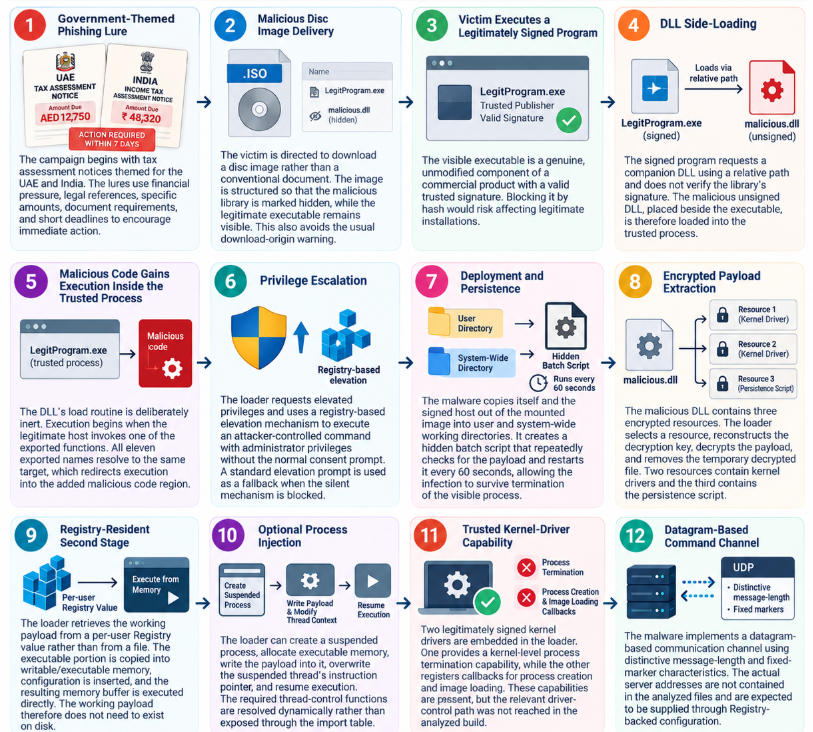
The campaign follows a multi-stage execution chain designed to move from social engineering to trusted-process execution, privilege escalation, persistence, and fileless payload execution. The sample analyzed also contains process-injection and kernel-driver capabilities, although some of these capabilities were not reached during analysis.
What Happened
The campaign opens with a document imitating an official tax assessment. One version is themed for the United Arab Emirates, the other for India. Both quote a reference number, a specific sum due and plausible legal provisions, both list documents the recipient must supply, both give a short deadline, and both offer exactly one route to the paperwork: a large download button. The design turns official looking financial pressure into a single click, and it targets whoever has to answer tax correspondence quickly. That is usually the person with access to accounting records, banking credentials and internal correspondence.
Lure infrastructure
Supplied with the source research data. None appears inside any analysed file.
- x6k3[.]click
- r1ff[.]click
- nasjdbed[.]cc
- 78gn0[.]icu
- zdgaery[.]web[.]id
- zxcdfr[.]shop

The assessment notice themed for the United Arab Emirates. The sum demanded, the cited provisions and the short deadline all exist to create urgency.

The parallel notice themed for India. Structure, numbering style and required documents closely mirror the first.
What is inside the container
The download is a disc image, and that choice is deliberate. Downloaded files carry a hidden marker recording that they came from the internet, and security prompts depend on it. Files run from inside a mounted image do not inherit it, so the warning never appears. That removes the last point at which a cautious user could stop.
Parsing the container shows a second deliberate choice. It is an optical disc file system despite its disk image extension, and the directory record for the malicious library is marked hidden while the signed program is not. The victim sees one trusted file. The unsigned library that does all the damage sits invisibly beside it, which is exactly where the loading routine looks.
| Container property | Confirmed value |
|---|---|
| True format | Optical disc file system, despite a disk image style extension |
| Volume identifier | CD_ROM |
| Build tool in the volume header | A common operating system image utility, dated 2005 |
| Volume size | About 6.7 MB, across 3,439 sectors |
| Volume created | 18 August 2026 at 08:00:00 |
| Directory record times | 18 August 2026 at 04:08:26, at plus eight hours from coordinated universal time |
| Malicious library flags | Hidden attribute set |
| Signed program flags | Visible |
| Unused space | System area, directory slack and trailing padding are all zero, so nothing additional is concealed |
File inventory
| Artefact | What it is |
|---|---|
| The disc image | Delivery container, about 6.7 MB. Strips the download marker and hides the library |
| The signed program | A validly signed background component of a real commercial product, about 1.2 MB, built April 2024. Unmodified. This is what the victim runs |
| The malicious library | Unsigned, about 5.5 MB, built 17 August 2026, hidden in the container. This is the correct blocking target |
| Encrypted resource one | About 30 KB. Decrypts to a signed kernel driver from a maintenance suite, built 2018 |
| Encrypted resource two | About 38 KB. Decrypts to a signed kernel driver from a process monitoring product, built 2023 |
| Encrypted resource three | About 1.4 KB. Decrypts to the batch script that restarts the payload every sixty seconds |
Abusing a valid signature
We submitted the signed program to the operating system for verification and it reported the signature valid and trusted. The file is the publisher original. Automated tooling often calls this program tampered because a checksum field in its header does not match a freshly computed value. We confirmed the mismatch, and it means nothing: that field is excluded from the signature calculation by design and a stale value is very common in legitimately signed software. Both carried drivers show the same harmless mismatch. The authoritative test is to ask the operating system, and it succeeds for all three. Concluding that the signed file is malicious would be wrong.
The chain, stage by stage
| Stage | What happens |
|---|---|
| 1 | A tax notice with a download button leads the victim to a disc image |
| 2 | The image is mounted. One visible program, one hidden library |
| 3 | The victim runs the signed program. No download warning appears |
| 4 | At start up it asks for a companion library by relative name and loads the attacker file carrying that name, with no fixed path and no signature check |
| 5 | Any of eleven exported names will do. All resolve to one address whose body is a single jump into the added region |
| 6 | The payload idles about seventeen seconds, takes a system wide lock, requests five privileges including the right to load kernel drivers, and deletes its own cached configuration |
| 7 | It gains administrator rights silently by hijacking a per user handler and starting an auto elevating system component hidden |
| 8 | It copies itself and its signed host into a folder named from the account security identifier, and into a second folder under the all users data directory |
| 9 | It writes a batch script and launches it through a hidden command interpreter. The script restarts the payload every sixty seconds |
| 10 | It reads a per user registry value, keeps the leading part as configuration and copies the rest into memory marked executable |
| 11 | It patches a configuration block into that buffer at a plain text marker, caches the block to a machine wide registry value, and calls the buffer as code. From here the working payload exists only in memory and the registry |
| 12 | Optionally it injects the same payload into a separate process created suspended, resolving the thread control functions at run time so they never appear as imports |
The last three stages were not visible from delivery analysis. The sections that follow prove them.
The Programme That Loads It, and Why This One
How the side load happens
The program never names the malicious library as an import. Its import table lists eight system libraries and none of them is the attacker file. Instead it resolves the library at run time by plain relative name, its own folder first and then the folder above, and Windows searches the application directory first. A file with the right name beside the program wins. Six individual functions are then resolved by name.
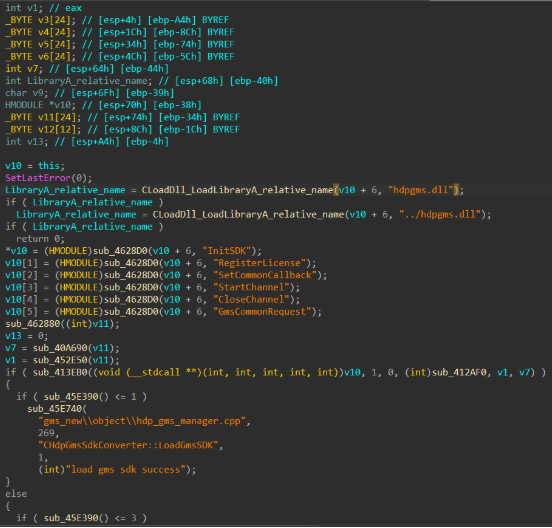
The load. The library is requested by plain relative name, first from the program folder and then one level up, then six functions are resolved by name. No fixed path and no signature check, so a correctly named file placed beside the program is loaded in preference to the genuine one.
The token naming the library appears seventy two times across forty nine distinct internal symbols in the signed program, spanning six classes whose whole purpose is to drive it. The host does not merely load this library once. It depends on it.
The host is a remote instruction daemon in its own right
This is what changes how the chain should be read. The program creates a window, hides it immediately, and runs an ordinary message loop. It accepts structured instruction records over the standard inter process copy data message, which appears at eight sites in its code, alongside five custom message numbers. Each record is parsed into three named fields, and the record type decides what happens next.
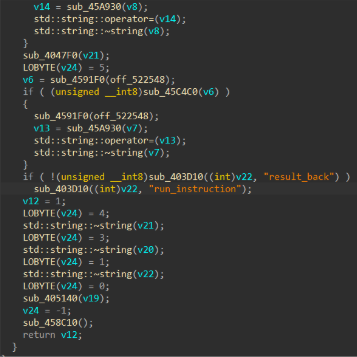
The instruction dispatcher in the signed program. An incoming record is parsed, three named fields are extracted, and the record type selects between relaying a result and executing an instruction.
The instruction names sit in seven pointer tables in the data section, one per handler class, matching the seven handler source files whose paths the program still records. All nine tokens are present in the signed program and none of them appears anywhere in the malicious library.
| Instruction token | What the handler does |
|---|---|
| BASE_RUN_BAT | Runs a file with supplied parameters through the shell, window hidden |
| BASE_DOWNLOAD_FILE | Fetches a package, checks it, executes it and relaunches |
| BASE_PROCESS_KILL | Opens a process and terminates it |
| BASE_DELETE_FILE | Deletes a named file |
| BASE_UPDATE_VERSION | Starts a launcher to apply a version update |
| BASE_BACK_VERSION | Rolls a version back |
| BASE_CLEAR_CACHE | Clears cached data |
| BASE_SHOW_MSG | Displays a message to the user |
| SALVAGE_LOG | Collects and submits logs |
Two of these are worth showing, because they are what attacker code inside this process inherits directly. Both are defensible features of a maintenance framework. Both become something else once unsigned code shares the process.
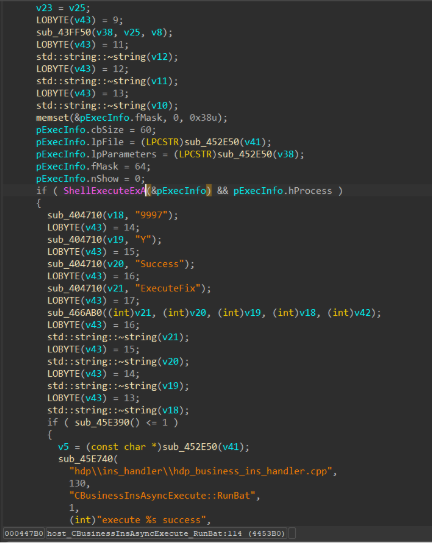
The batch execution handler in the signed program. The file to run and its parameters come from the instruction record, the window is hidden, and the shell runs it. Success is reported back through the same channel.
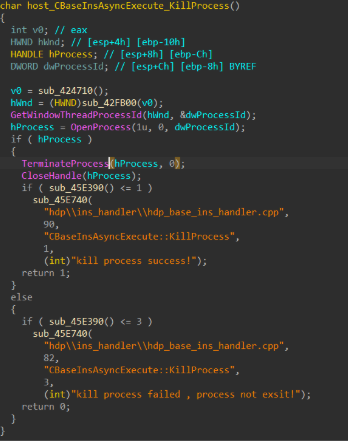
The process termination handler in the signed program. The target is opened and terminated, and the outcome is logged as success or as a process not existing.
The operating system functions behind all of this are imported openly: process enumeration, open and terminate, two shell execution routines, process creation, both file deletion routines, and configuration file read and write. None of that is suspicious in a maintenance daemon. All of it is available to whatever code is running in the process.
The Loader: The Malicious Library
Four identities in one file
The metadata gives the game away before any code is read. Four places record what this file is, and none of them agree with the others. In ordinary software all four match.
| Where the name is recorded | What it says |
|---|---|
| Filename as shipped in the container | HDPgms.dLL |
| Version resource, original and internal name | InstallerExtension.dll |
| Version resource, product and description | A graphics hardware installer interface extension, version 2.1002.438.0 |
| Export table, recorded library name | NvPluginWatchdog.dll |
| Debug path left by the compiler | F:\iProject\NvPluginWatchdog\Release\NvPluginWatchdog.pdb |
| Signature | None. Unsigned, and its checksum field was never computed |
How it hides in plain sight
The library is about 5.5 MB, far larger than its function needs, and holds 878 resources including a complete commercial interface framework with several hundred images. That bulk is camouflage: a real application was taken and an extra executable region added to it, so the file looks like a large legitimate product rather than a small purpose built tool.
The added region is about 1 MB, marked executable, and sits between the thread storage and resource areas. The writable data area matters more: it declares about 70 KB of space but only 32 KB is stored in the file, leaving roughly 38 KB that exists only once the program runs. That gap holds the configuration and the command server list.
| Region | Declared | Stored in file | Only exists at run time | Randomness |
|---|---|---|---|---|
| Main code | 1.7 MB | 1.7 MB | none | 6.60 |
| Read only data | 425 KB | 425 KB | none | 5.33 |
| Writable data | 70 KB | 32 KB | about 38 KB | 4.73 |
| Added executable region | 1.0 MB | 1.0 MB | none | 7.27 |
| Resources | 2.1 MB | 2.1 MB | none | 7.47 |
Where execution actually begins
Loading the library does nothing. Its load routine is an empty stub that returns success, and the thread callback table is empty. Nine initialisers do run, and each only prepares state: starting the networking subsystem, creating an event, decoding a registry value name, registering an internal object. None creates a thread, touches the network, reads the registry or executes anything.

The routine Windows calls when the library is loaded. It returns success and does nothing else, which is why merely loading this file produces no behaviour worth scoring.
Execution begins only when the host calls one of the eleven exported functions, and it does not matter which. All eleven names resolve to a single address whose body is one jump into the added region. We confirmed this twice: once in the tooling, and once by parsing the export table directly, which gives eleven names and exactly one distinct target.
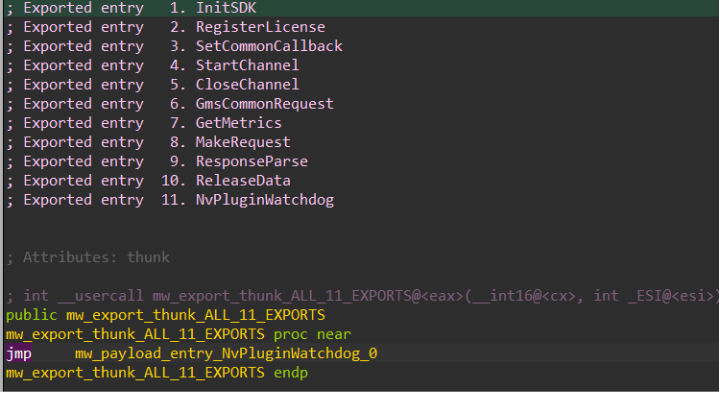
The export thunk. All eleven exported entries share this one address, and the body is a single jump into the added region. That is what makes the side load reliable whichever function the host calls first.
So a sandbox that loads this file and watches it will score it clean. Triage must call an exported function, and a clean verdict from loading alone should be discarded. It also explains why some tools report only one export: they collapse the aliases and understate the technique.
Timing, locking and covering its own tracks
Once called, the payload waits. It idles two seconds in short sleeps, sets a five second timer and acts only on the third tick, giving about seventeen seconds before anything meaningful happens, then waits again for a period taken from configuration. It takes a named system wide lock so only one copy runs, and deletes the registry value holding its own cached configuration before continuing. The delay defeats short analysis windows, the lock keeps the infection quiet, and the deletion leaves an investigator one artefact short.
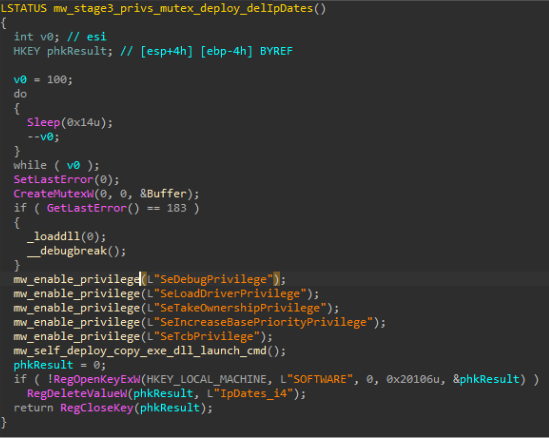
The third initialisation stage in one view: the two second idle loop, the named lock and its already exists check, five consecutive privilege requests including the right to load kernel drivers and to act as part of the operating system, the deployment call, then deletion of its own cached configuration value.
The privilege list is a statement of intent on its own. Alongside routine debugging rights it asks for the right to load kernel drivers and the right to act as part of the operating system. No ordinary application component needs either.
Administrator rights without a prompt
Some Windows components may elevate automatically without prompting, and some of those decide what to run by consulting a per user registry handler. The malware writes its own command into that handler, adds a companion value that stops the system re checking what it launches, and starts the auto elevating component with its window hidden. The component elevates as designed and runs the attacker command as administrator.
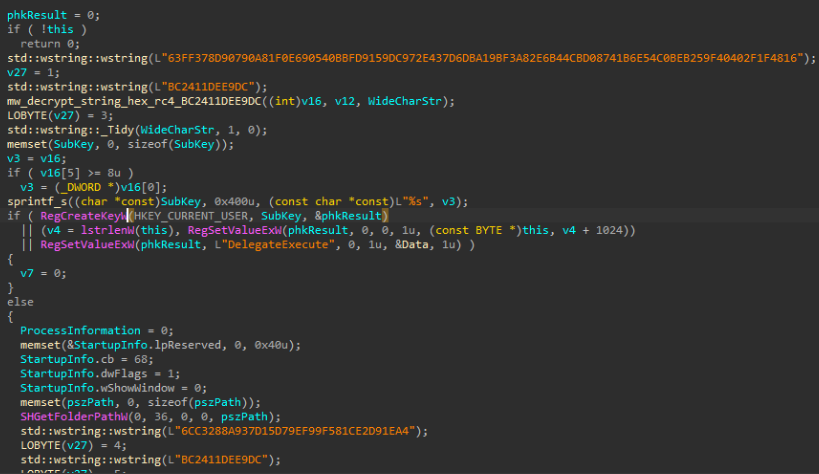
The elevation routine. Two encrypted strings and the short decryption key are at the top, the hijacked per user handler key is created, the companion value that suppresses re checking is written immediately after, and the launched window is hidden.
There is a louder fallback. Where the silent route is blocked, the code requests elevation through the normal verb, which prompts. So on a default machine the escalation is invisible and leaves no prompt in any log, while on a hardened machine a consent dialog naming an unfamiliar executable in a temporary folder is a genuine, reportable symptom.
Installing itself and staying alive
A mounted disc image disappears when ejected, so the malware copies both halves out. It builds a folder under the per user temporary directory named from the account security identifier, copies the signed program and itself into it, writes a batch script, and launches the script through a command interpreter using the flag that suppresses window creation.
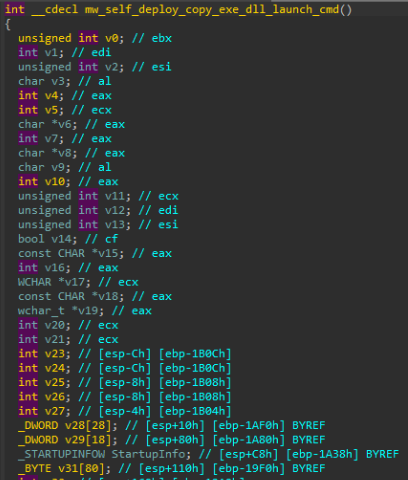
The deployment routine. The per user temporary path is assembled, the folder name is derived from the account security identifier, and both copies are written with deliberately irregular capitalisation in their names and extensions.
Two details defeat naive rules. The copies use irregular capitalisation, which is valid on Windows but breaks any case sensitive match, and the library is written under two different spellings in the two destinations. The launch goes through a nested interpreter with the no window flag, so nothing appears on screen and the visible parent is an ordinary command interpreter.
The persistence script
The third payload is not a program. Decrypted it is a batch script of about 1.4 KB containing 429 lines, of which 410 are blank, behind eight bytes of binary junk. Opened in a text viewer it looks empty. Only nineteen lines carry logic.
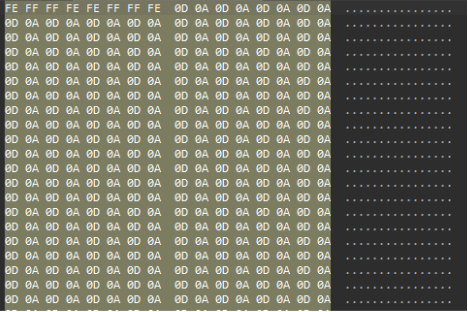
The decrypted script from its first byte. Eight bytes of padding are followed by an unbroken run of carriage return and line feed pairs, which is why the text column is empty and why a text viewer shows nothing.
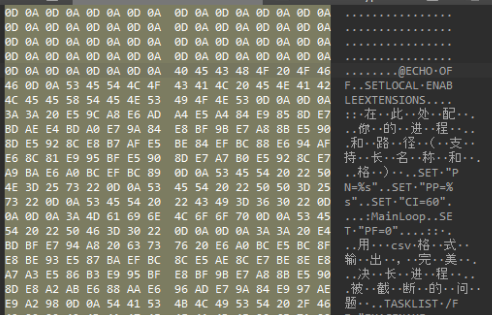
The same file where the padding ends and the script begins. The transition happens inside one row, the opening directives read across the text column, and the comments that follow are Chinese characters stored in a double byte code page.
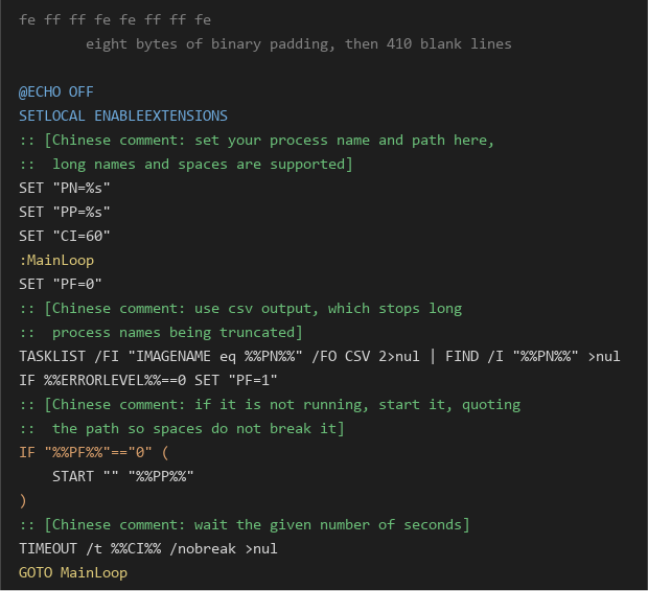
The nineteen content lines, reconstructed as text. The doubled percent signs are because the script is stored as a template whose two placeholders are filled in when it is dropped.
Three things follow. Killing the payload alone achieves nothing, because it returns within a minute. The pairing of a process listing filtered by image name in comma separated output with a sixty second wait is a distinctive, detectable pattern. And the author is a Chinese speaker thinking about reliability, since all four comments address a practical failure mode rather than describing the code.
The Encryption, and the Author Mistake
The three payloads are carried as encrypted resources. The handling routine rebuilds a sixteen byte key in memory from eight stored numbers and a fixed value, selects a payload by a two letter tag, writes it to disk with a configuration file extension so it looks harmless, decrypts it, then deletes the intermediate file. The misleading extension matters: a rule watching for dropped executables will not fire.
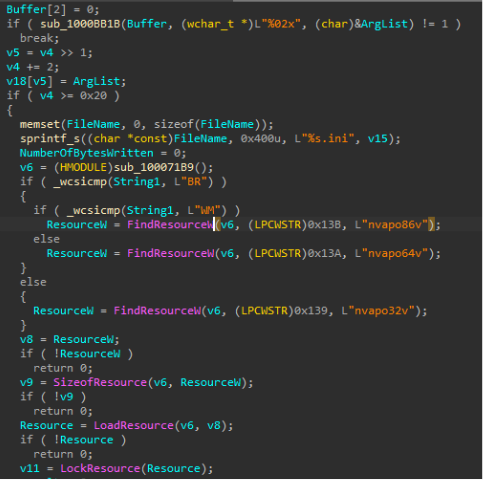
The resource extraction routine. A two letter tag selects between the three embedded payloads, the chosen one is located and sized, and the output path carries a configuration file extension rather than an executable one.
The cipher is a standard stream cipher, confirmed by reading the key setup directly. A two hundred and fifty six byte state table and a key index taken modulo sixteen fix the key length at sixteen bytes with no ambiguity. Recovering this made everything else possible.
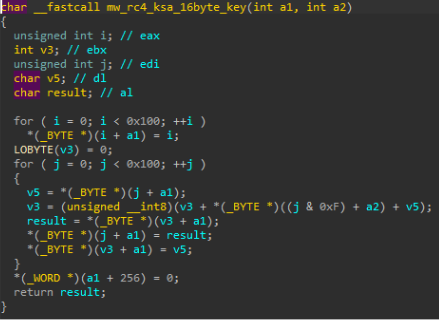
The key schedule of the stream cipher protecting the payloads. The state table is initialised across two hundred and fifty six entries and the key index is taken modulo sixteen, fixing the key length at sixteen bytes.
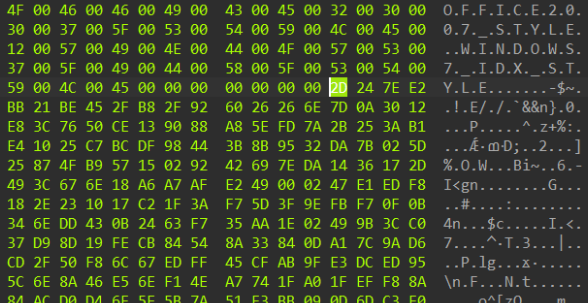
The start of the first encrypted payload inside the resource area. The rows above the cursor are the tail of an ordinary resource and read as plain text. At the cursor the encrypted blob begins and every byte after it is high entropy. Its first sixteen bytes matter below, because the second payload begins with exactly the same sixteen.
One keystream encrypts all three payloads
This cipher combines a keystream with the data, and it is only safe if that keystream is never reused. Here it restarts from byte zero for every payload. We tested it: the keystream recovered from the first payload is identical to the other two across their whole shared length. So wherever two plaintexts agree, the ciphertexts must agree too. Two payloads are Windows programs and open with the same sixty byte header, and across those sixty positions the two ciphertexts match on every byte.
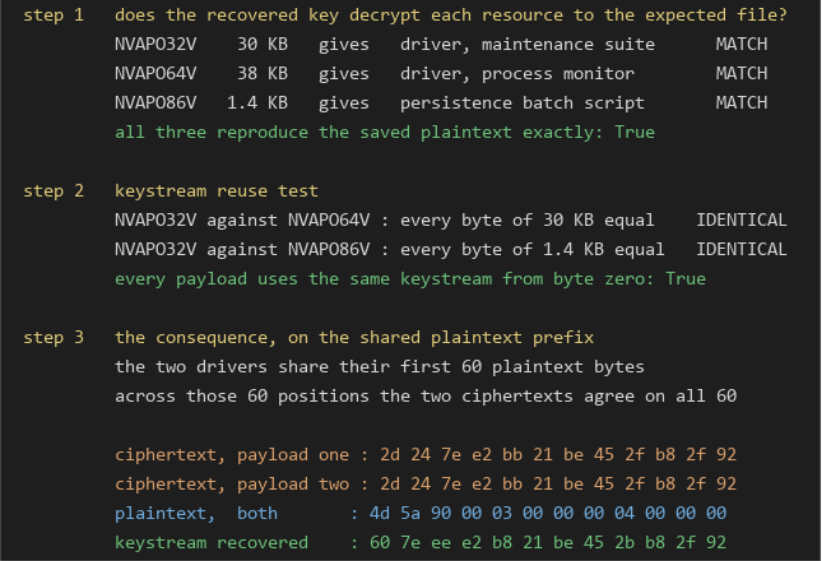
Verification of the decryption and of the keystream reuse, from our own tooling. Each payload decrypts to the file whose hash we publish. The two ciphertext rows are identical because the plaintexts are, which is exactly the weakness.
This is useful rather than academic. A future sample from the same builder can very likely be decrypted without recovering its key at all, because any one payload that is a Windows program supplies enough known plaintext to expose the keystream the others share. The keystream is also a fingerprint, so its recurrence identifies the same builder.
The Kernel Drivers, and How Security Software Could Be Shut Down
Decrypting the first two payloads gives two 64 bit kernel drivers. Kernel drivers run at the highest privilege on the machine, which is why Windows only loads signed ones. Neither is the attacker work. Both are genuine, validly signed products from unrelated companies: one a boot repair component of a maintenance suite built in 2018 with Chinese resources, the other a process monitoring component of an endpoint protection product built in 2023 with Brazilian Portuguese resources.
That is the whole technique. The attacker signs nothing and defeats nothing, because these drivers are already trusted. They only need installing and then asking to do something they were never meant to be asked. The library imports the full set of service controls to do exactly that, openly, alongside the function used to send them commands.
| Property | Driver one | Driver two |
|---|---|---|
| Decrypted size | About 30 KB | About 38 KB |
| Built | January 2018 | February 2023 |
| Signature | Present and valid | Present and valid |
| Resource language | Chinese, Simplified | Portuguese, Brazil |
| Framework | Plain kernel driver | Kernel mode driver framework |
| Kernel imports | 25 functions | 37 functions |
| Command codes accepted | One | Ten |
| Notable extras | Can force a machine stop error, and write registry keys from kernel context | Registers callbacks on every process start and image load |
The termination primitive
The first driver has one job that matters. Its command handler compares the incoming code against a single value, requires the input to be exactly four bytes, and passes those four bytes straight on as the only argument. There is no allow list, no validation of which process is named and no check on who is asking.
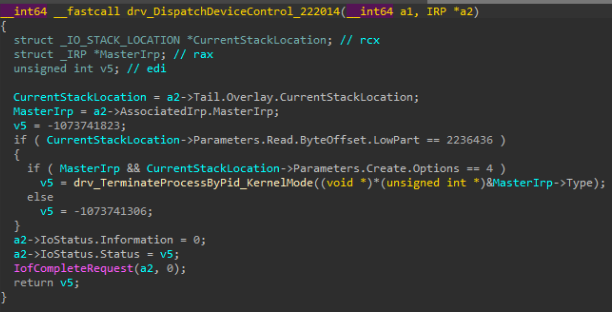
The command handler of the first driver. Exactly one command code is accepted, the input must be exactly four bytes, and those four bytes are handed to the termination routine unchecked.
The routine it calls is the significant part. It looks the process up by identifier, opens it from inside the kernel with full access rights, and terminates it. The detail that matters is the access mode argument, set to zero, meaning kernel. When a driver opens an object and declares the request as coming from the kernel rather than a user, Windows skips the security check it would otherwise apply. That single zero is what lets this command terminate a hardened security service no user mode program could touch. The object type argument is left empty too, so there is no type validation either.
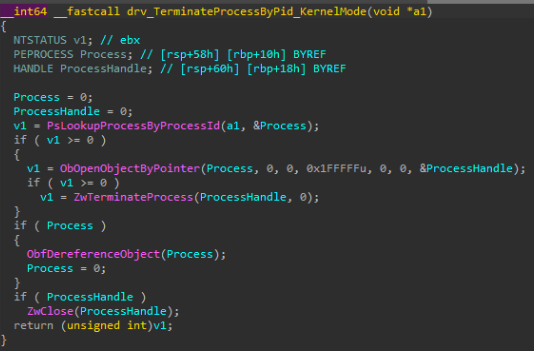
The termination routine of the first driver, complete in a few lines: look the process up by identifier, open it with full access declared as coming from the kernel, then terminate it. That declaration is the entire mechanism.
Why searching for the second driver command codes fails
The second driver is more capable and harder to enumerate. Searching the file for command codes finds only three, because the dispatch does not compare against a list. It loads the code, checks one upper bound, then walks a chain of subtractions testing for zero after each. Seven of its ten accepted codes never appear in the file as literals at all.
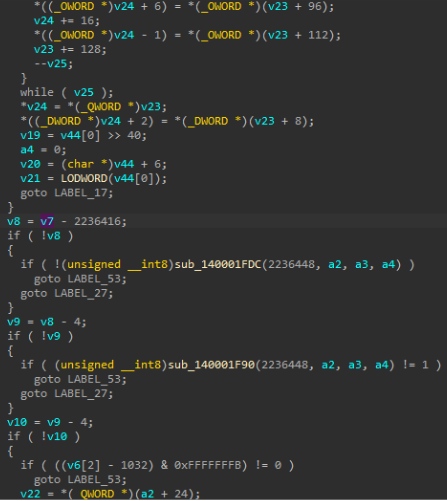
The computed dispatch of the second driver. After one bound check the code is reduced by a chain of subtractions, each testing for zero, so most accepted values exist only as the result of arithmetic and cannot be found by searching.
It also registers callbacks that fire whenever any process starts and whenever any image is loaded. That gives whoever controls it the ability to interfere with security software as it launches, rather than only afterwards, and to keep it down without being asked again.
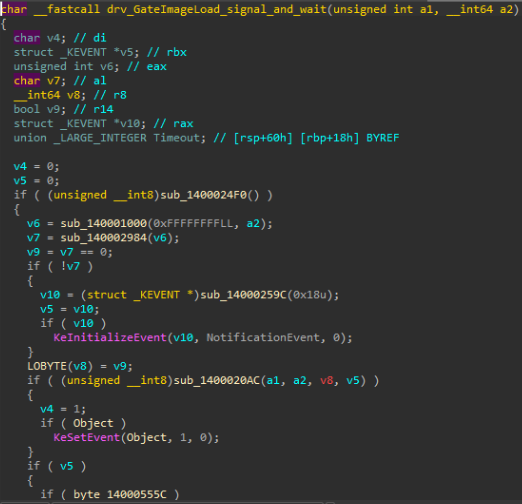
The image load gate in the second driver. It receives every image being loaded and can act before the image finishes loading, which is what makes a callback more dangerous than a one shot termination command.
An important qualification
The library side of this path exists and is complete: it opens the service manager, creates and starts a service for the driver, then sends commands to the device. It is also never reached.
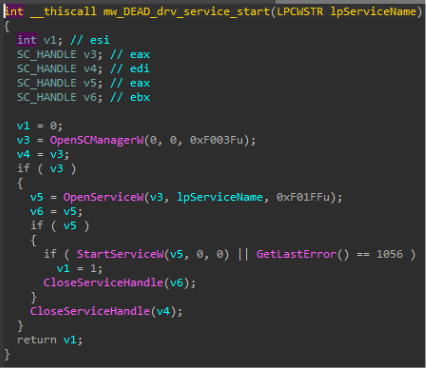
The driver service start routine in the library. The service manager is opened, the service is opened and started. Complete, functional, and unreachable in this build.
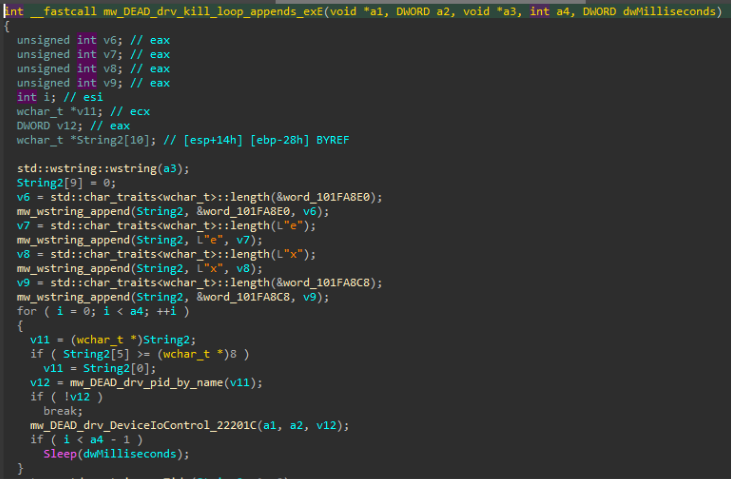
The termination loops in the library. A target name is assembled, then the command is sent to the device. This is the code that would drive the kernel primitive, and nothing calls it.
The Payload Lives in the Registry, Not on Disk
The most consequential design decision here is that the real working code is not in the file. One routine opens a per user registry key, reads a value, and proceeds only if it exceeds about 2.6 KB. It keeps exactly that leading amount as configuration, then allocates memory with both write and execute permission and copies everything past that point into it.
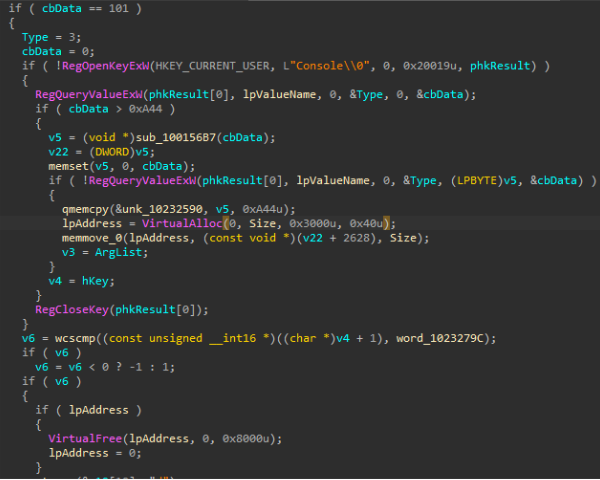
Retrieval of the second stage. The value is read only if it exceeds the threshold, the leading part is kept as configuration, and everything beyond it is copied into memory allocated with both write and execute permission. The payload never exists as a file.
A second routine searches that block for a short plain text marker, copies a configuration structure of about 4.7 KB into the block at that position, saves the same structure to a machine wide registry value so it survives a restart, and calls the block as code. The marker is a placeholder the second stage was compiled with, so the loader patches its configuration directly into the code it is about to run.
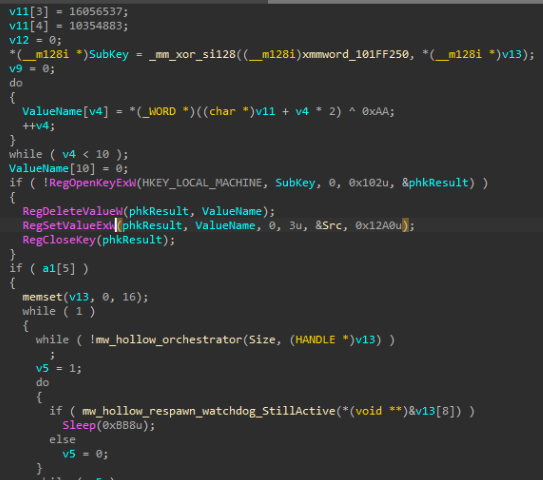
Storage and execution. The marker is located, the configuration structure is copied into the executable block at that position, the same structure is written to a machine wide registry value, and the block is then called directly as code.
Three consequences for a victim. The working payload never exists as a file, so file scanning, integrity monitoring and disk forensics have nothing to examine. Its capability can be changed at any time by rewriting a registry value, so what it does today is not what it does tomorrow. And recovery is not about deleting files: leave those two registry values and the payload is intact.
No command server address exists in the files
The routine that picks a server alternates two entries by inverting a flag, advances a counter, and selects a third entry when the counter reaches two hundred. All three addresses are read from a fixed data area.
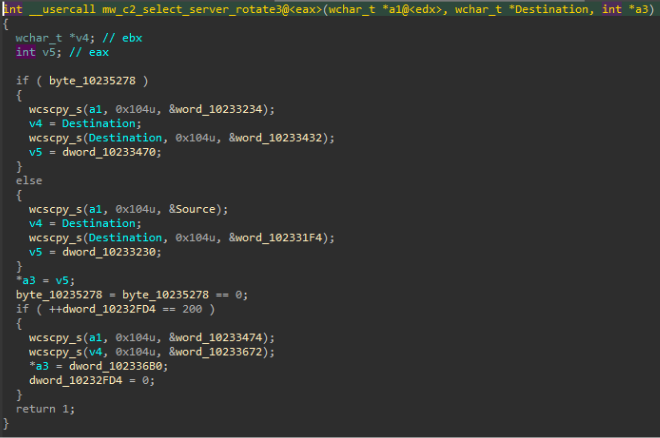
The server selection routine. Two entries alternate by inverting a flag, a counter advances, and a third is selected when the counter reaches two hundred. Every source sits in an area of the file that carries no stored bytes.
That area holds no stored bytes. The writable data region declares about 70 KB but only 32 KB is in the file, and the configuration sits past the end of the stored part, so those addresses come into existence only at run time. We tested this rather than assuming it: every instruction whose operand falls inside the configuration region was decoded and classified as a read or a write.
The result is decisive. The configuration structure is about 4.7 KB at one fixed address in the unstored area. The routine that hands configuration to the second stage copies exactly that much from that address, and the server selection routine reads its addresses and ports from the same structure at fixed offsets. Those offsets and that length match the cached registry value exactly, which makes them the same object. Ten instructions read server entries out of it. Not one writes to them. The only writes anywhere in the region are a one byte flag and a four byte counter, both runtime state.
So this is a positive finding, not a failure of analysis. The library is a middle stage that expects an earlier component to have written its server list into the machine wide value. On a clean machine that value does not exist, the lookup gets an empty string, and no server can be reached. Recovering the real addresses means taking the two registry values off a live infected machine. It also explains, far better than any timing argument, why a sandbox run records no malicious network contact.
Running Inside Another Programme
The loader can also place its payload inside a separate process. It creates a process suspended with its window hidden, allocates memory inside it with execute permission, writes the payload in, reads the paused thread state, replaces the field holding the address of the next instruction with the address of the written buffer, applies the state and releases the thread. The code then runs under the identity of whatever program was launched, so process listings, parent and child relationships and any allow list keyed on program name all show something legitimate.
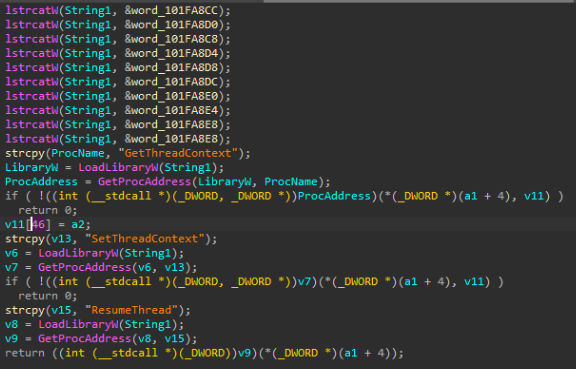
Completion of the injection. The paused thread state is read, the field holding the address of the next instruction is overwritten with the address of the written buffer, the state is applied and the thread released. All three thread control functions are looked up by name at run time, and the library name they come from was assembled one character at a time above.
Two details defeat a common shortcut, and we verified both independently. The three functions that perform the injection are not in the import table at all, so judging capability by reading imports shows no sign of thread manipulation. Each name is written into a local buffer when needed, and the system library they are resolved from is assembled one character at a time from twelve separate places, so it never exists as a searchable string.
The second detail confirms intent. The overwritten field sits at the exact offset of the instruction pointer in the thread state structure for this architecture. A watchdog checks periodically whether the injected host is still alive and repeats the whole procedure if it has exited, so killing the visible process does not end the infection.
The Network Channel
The channel is not what its own internal naming suggests. Class names imply a stream connection, but the socket is created as a datagram socket and the option applied immediately after only exists for datagram sockets. Detection written for stream traffic will not see this at all, and because the channel avoids web protocols entirely, none of it appears in proxy logs. Anyone monitoring only web traffic has no visibility of this command channel.
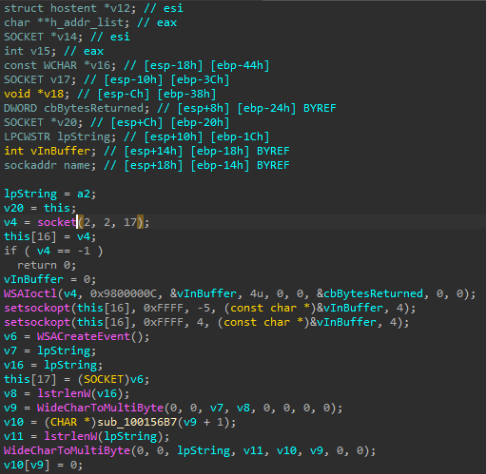
Creation of the channel. The socket is created with the datagram type and protocol, and the control code applied immediately after only exists for datagram sockets. The class naming elsewhere suggests a stream connection, which is misleading.
Above that sits a well-known open-source reliable delivery protocol, identified from its header size, its command byte values and its unmodified diagnostic strings. That protocol is legitimate and used by ordinary software, so its presence is not evidence of malice. The fixed markers around it are. Messages are separated purely by length, and a sixteen byte message is compared against a fixed sixteen-byte value stored in the file, which gives a precise signature.
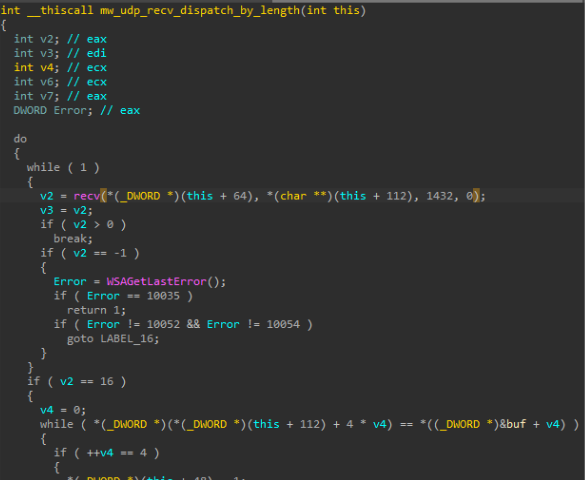
The receiver. Messages are read into a fixed buffer then classified by size alone: sixteen bytes is compared against a stored constant, twelve is treated as control, and twenty-four or more goes to the reliability layer.
The twelve-byte control message is equally specific. It is accepted only when its first two bytes match a fixed marker, the third byte equals one, and only the lowest bit of the fourth byte is set, with the remaining eight bytes carrying two session identifiers. That is narrow enough to write a high confidence rule against.
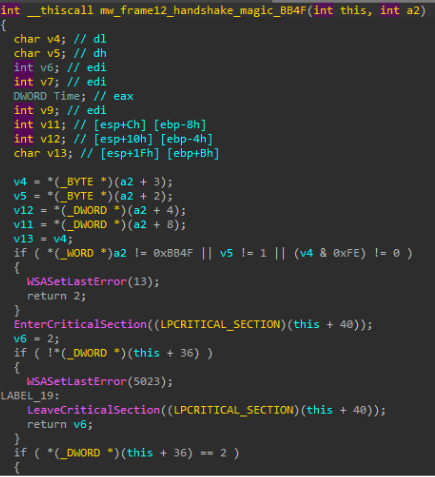
The control message handler. The message is rejected unless the first two bytes equal a fixed marker, the third byte equals one and only the lowest bit of the fourth is set. The two following fields carry the session identifiers.
Obfuscation, and Why Automated Tools Misread It
The added region scores high on statistical randomness and has an unusual instruction mix, so several tools report the file as packed and start hunting for a decompressed payload. That is wrong and chasing it wastes time. The region holds ordinary machine code rewritten into a deliberately confusing but equivalent form, using arithmetic identities, scattered across about a megabyte. Every measurement below came from examining the whole region, not a sample.
MITRE ATT&CK Mapping
The techniques this campaign actually uses. Those supported only by a latent capability rather than a reachable code path are marked.
| Tactic | Technique | ID |
|---|---|---|
| Initial Access | Phishing: Spearphishing Link | T1566.002 |
| Execution | User Execution: Malicious Image | T1204.003 |
| Execution | Command and Scripting Interpreter: Windows Command Shell | T1059.003 |
| Execution | Native API | T1106 |
| Persistence | Boot or Logon Autostart Execution | T1547 |
| Persistence | Modify Registry | T1112 |
| Privilege Escalation | Abuse Elevation Control Mechanism: Bypass User Account Control | T1548.002 |
| Privilege Escalation | Event Triggered Execution: Component Object Model Hijacking | T1546.015 |
| Privilege Escalation | Access Token Manipulation | T1134 |
| Privilege Escalation | Process Injection: Process Hollowing | T1055.012 |
| Defense Evasion | Hijack Execution Flow: DLL Side Loading | T1574.002 |
| Defense Evasion | Subvert Trust Controls: Code Signing | T1553.002 |
| Defense Evasion | Subvert Trust Controls: Mark of the Web Bypass | T1553.005 |
| Defense Evasion | Masquerading: Match Legitimate Name or Location | T1036.005 |
| Defense Evasion | Masquerading: irregular case and double extension | T1036.007 |
| Defense Evasion | Obfuscated Files or Information | T1027 |
| Defense Evasion | Obfuscated Files or Information: Fileless Storage | T1027.011 |
| Defense Evasion | Deobfuscate or Decode Files or Information | T1140 |
| Defense Evasion | Virtualization or Sandbox Evasion: Time Based Evasion | T1497.003 |
| Defense Evasion | Indicator Removal: File Deletion | T1070.004 |
| Defense Evasion | Reflective Code Loading | T1620 |
| Defense Evasion | Impair Defenses: Disable or Modify Tools, latent only | T1562.001 |
| Defense Evasion | Exploitation for Defense Evasion, vulnerable driver, latent only | T1211 |
| Discovery | Process Discovery | T1057 |
| Discovery | System Owner or User Discovery | T1033 |
| Command and Control | Application Layer Protocol, custom over datagrams | T1071 |
| Command and Control | Non Application Layer Protocol | T1095 |
| Command and Control | Encrypted Channel: Symmetric Cryptography | T1573.001 |
| Command and Control | Ingress Tool Transfer | T1105 |
YARA Rule:
import “pe”
rule Government_Tax_Notice_Loader
{
meta:
description = “Detects the malicious DLL loader associated with the government-themed tax notice campaign”
author = “iZOOlogic”
date = “2026-08-27”
reference = “Government-Themed Tax Notice Campaign”
severity = “High”
confidence = “High”
strings:
$watchdog = “HDPGMS Shared Watchdog Window” ascii wide
$marker = “FaCai2024” ascii wide
$buildpath = “NvPluginWatchdog.pdb” ascii wide
$name1 = “HDPgms.dLL” ascii wide nocase
$name2 = “InstallerExtension.dll” ascii wide nocase
$name3 = “NvPluginWatchdog.dll” ascii wide nocase
$device1 = “\\Device\\::BootRepair” ascii wide
$device2 = “\\DosDevices\\BootRepair” ascii wide
$msg1 = { B3 19 }
$msg2 = { 0A 1E }
$msg3 = { 61 22 }
$msg4 = { B8 26 }
$msg5 = { 05 11 }
condition:
uint16(0) == 0x5A4D
and pe.is_pe
and
(
3 of ($watchdog, $marker, $buildpath, $name1, $name2, $name3)
)
and
(
1 of ($device*)
)
and
(
2 of ($msg*)
)
}
Indicators of Compromise (IoCs)
File hashes
| Artefact | Role | SHA 256 |
|---|---|---|
| Disc image | Delivery. Strips the download marker and hides the library | 5219e24ba755352a00f3a5b3c7924592d59efedf91d5689e5b3aecf10ab7ca5a |
| Malicious library | The correct blocking target | 4b9a1f52ae83a0f9020fb580eca0f4d7352a326a7a36b9381aec46f2090e0999 |
| Signed program | Legitimate, signature verified valid. Do not block by hash | 233a7de23438d09cbb277a0ebb11f71a2af9c53d2cf5ac9e4af368de0bf20a3f |
| Kernel driver one | Trusted driver carried for kernel level termination | eb57b6db9b6876a51c7bc05ef011adcf0909a7351da8a329d6a1aee52a286459 |
| Kernel driver two | Trusted driver carried for process and image callbacks | 381dbc9012d02b3a42916813b99e481b1cc89d15da918b58db40ce330cc13fca |
| Persistence script | Sixty second restart loop, padded to look empty | 363e5db207bcc5702a61917991a1647e5a0cab822ae19440248bacc8c52791b8 |
Lure infrastructure
| Domain | Theme |
|---|---|
| x6k3[.]click | Government, United Arab Emirates |
| r1ff[.]click | Government, United Arab Emirates |
| nasjdbed[.]cc | Government, United Arab Emirates |
| 78gn0[.]icu | Government, India |
| zdgaery[.]web[.]id | Government, India |
| zxcdfr[.]shop | Government, India |
Conclusion
The analysed campaign demonstrates a sophisticated trust-abuse-based infection chain that combines government-themed social engineering with legitimate signed software, DLL side-loading, privilege escalation, persistence, registry-resident execution, process injection capability, trusted kernel drivers, and a non-web command channel.
The campaign’s most significant characteristic is its deliberate use of legitimate and trusted components to conceal malicious execution. The victim executes a genuinely signed commercial executable, which subsequently loads an unsigned malicious DLL through an unvalidated relative library path. This enables attacker-controlled code to operate within a trusted process and reduces the effectiveness of security controls that rely primarily on publisher reputation or file signatures.
The investigation recovered and analysed all three encrypted payloads embedded within the malicious library, including two legitimately signed kernel drivers and a persistence script. The reuse of the same keystream across the encrypted resources also exposes a cryptographic weakness that may assist the identification and analysis of future samples using the same implementation.
The loader demonstrates multiple layers of stealth and persistence. It copies components outside the mounted disc image, establishes a 60-second restart mechanism, stores the working payload in the Registry, and reconstructs executable content directly in memory. These characteristics make Registry, memory, process, module-load, and driver telemetry important complements to traditional file-based detection.
The recovered kernel drivers introduce additional security risk because they are legitimately signed and provide capabilities associated with process termination and process/image monitoring. However, the analysis determined that the code responsible for invoking the relevant kernel functionality was not reached in the analysed build. This capability should therefore be treated as latent risk rather than reported as observed security-software disruption.
The command-and-control configuration remains incomplete. No server address was identified within the analysed files, and the evidence indicates that the relevant configuration is supplied through a Registry value that was not available in the supplied material. As a result, the ultimate post-compromise objective remains undetermined. The analysis confirms the delivery, execution, privilege escalation, persistence, payload-loading, and communication mechanisms, but does not establish whether the final objective is data theft, credential collection, remote access, or another activity.
From a defensive perspective, organizations should prioritize detection of the unsigned malicious library and its associated behaviours, rather than indiscriminately blocking the legitimate signed host. Investigations should preserve the identified Registry values before remediation and correlate signed-process execution with unsigned DLL loading, distinctive temporary-directory creation, 60-second restart behaviours, executable-memory allocation, process injection, and installation of the identified drivers.
Overall, the campaign illustrates how attackers can weaponize software trust without compromising the trusted software itself. The legitimate executable remains genuinely signed, the embedded drivers remain genuinely signed, and the attacker instead uses those trusted components as execution infrastructure. The evidence therefore supports classifying this as a multi-layered trust-abuse campaign, while maintaining a clear distinction between confirmed behaviour, latent capabilities, and aspects that remain unresolved because the required live configuration or final second-stage payload was unavailable.
About iZOOlogic
At iZOOlogic we detect, mitigate and prevent threats arising from data breaches, phishing, malware and online brand abuse. This report presents the results of fully reverse engineering a government themed tax notice campaign and the complete payload set it delivers, including all three encrypted payloads recovered by decryption.
