
 HQ/EMEAFind out how we can help your business

In This Issue
01. Threat Landscape
A supplier’s platform was the way into a bank this week. Crédit Mutuel Arkéa confirmed on 4 November that attackers reached it directly through the platform of one of its service providers and made fraudulent transfers from the bank’s own accounts to other banks. The amount is reported at about €118 million, the bank calls that the right order of magnitude without confirming it, and says customers were not affected. On-chain tracing shows part of the money converted from stablecoins into Ether within about four hours. The provider has not been named, and how the attackers used its platform has not been explained.
The second story is state sabotage. On 9 November France formally attributed the October attacks on refrigeration controllers at more than 700 grocery stores to Shahid Kaveh, a unit of Iran’s Islamic Revolutionary Guard Corps that also operates under the name CyberAv3ngers. The attacks started at least 15 fires and destroyed food worth tens of millions of euros. A second wave hit stores in at least seven other European countries and three French blood storage facilities on 2 November, and has not yet been formally attributed. Paris has summoned Iran’s ambassador, issued arrest warrants for the unit’s leadership and is pressing for EU sanctions.
Three flaws in widely used platforms dominated vulnerability reporting. SAP’s November patch day fixed four maximum severity flaws, including a Gateway default setting that treats outsiders as internal servers. A Cisco BroadWorks flaw patched in August was added to the CISA catalog after researchers tied it to an AI agent campaign against a European telecom provider. And a remote monitoring platform, N-able N-central, was pulled offline after an uncoordinated release of 33 alleged zero days. Around them sat the same pattern seen in earlier weeks: unprotected or default settings, fixes that waited months, and agents working faster than defenders.
We tracked 10 incidents, listed under Breached Organizations below. Three began with a compromised supplier platform or update channel, two with internet exposed controllers used for sabotage, one with a misconfiguration that exposed a system and one with an AI agent assisted intrusion. Three have no disclosed entry path. The largest by value is Crédit Mutuel Arkéa, at a reported €118 million.
What changed this week
- Crédit Mutuel Arkéa. Attackers reached the bank through a service provider’s platform and moved a reported €118 million from its own accounts. The bank says no customer account or data was affected. Details are under Emerging Threats.
- France attributed the October refrigeration sabotage to Shahid Kaveh, an IRGC unit also known as CyberAv3ngers, on 9 November. A second wave struck stores in other European countries and three French blood storage sites on 2 November. Details are under Threat Actor Activity.
- SAP patched four CVSS 10.0 flaws on 10 November, including CVE-2026-89103 (named PROXYGATE by its finders), a Gateway default that treats an external caller as an internal application server. No exploitation has been reported.
- Cisco BroadWorks flaw CVE-2026-20320 was added to the CISA catalog on 10 November. Researchers say a Chinese speaking actor used it, with a jailbroken language model driving the attack, against a European telecom provider and 13 organizations that it hosts.
- GPUStack flaw CVE-2026-102895 was added to the CISA catalog on 9 November with a deadline of 12 November. Any request that looks local is treated as the administrator, and attackers are using it to run commands on GPU worker hosts.
- N-able took hosted N-central offline on 9 November and told on-premises customers to shut down after a researcher published exploits for 33 alleged zero days. A hotfix for seven CVEs followed on 10 November and hosted servers were restored on 11 November.
- Fraud, a new Windows ransomware built from Python, appeared. It registers a Netsh helper DLL for persistence, reads browser and wallet data, and leaves a note with a victim ID but no way to contact the operator or pay.
- VOLTA-AUTODOXER, a self deleting Windows stealer that asks language models to rank victims by value, was documented on 31 October and is covered in detail this week.
- ARTEX, the agentic penetration testing framework covered in recent issues, was documented in more than 1,600 publicly reachable instances, and one case shows an agent going from a leaked secret to a key vault in five minutes.
- The Linux kernel TCP flaw CVE-2026-98432 now has fixed kernels from Red Hat, Debian, SUSE and Amazon, Ubuntu’s fix remained in testing as of 5 November, public proof of concept code exists and no exploitation has been confirmed.
Confidence in this assessment
Most of this issue rests on vendor, regulator, government and company statements and carries high confidence. Where it does not, the text says so. The main open points are:
- Crédit Mutuel Arkéa: the bank has confirmed the attack and the route through a provider’s platform but not the amount, which comes from an on-chain investigator and press reports. The provider, the exact weakness and the identity of the attackers are not public.
- Refrigeration attacks: the attribution is the French government’s own. It has not published its evidence, it covers the first wave on 11 and 12 October, and it does not yet cover the 2 November incidents. CyberAv3ngers is a persona name that has been used for several operations, and the US government has not attributed the earlier water system attacks to a named group.
- Fraud ransomware: no victims, operator or delivery method are known. The note’s date is the sandbox’s clock and the sample reads like an unfinished or test build.
- VOLTA: the researchers say the stealer is mature, but sales of it are unconfirmed, and the model step is optional.
- N-able: the researcher claims 33 flaws, N-able has published seven CVEs and has not mapped them one to one, and no confirmed exploitation has been reported, only scanning.
- BroadWorks: the agent campaign rests on one research report. CISA lists the flaw as exploited, and its CVSS score of 7.5 understates its use as a first step in a chain.
- SAP PROXYGATE: the CVE record calls it an incorrect authorization flaw while the finders describe unauthenticated command execution. SAP note numbers differ between sources, so check SAP’s own notice.
How the breaches happened
The 10 incidents fall into five groups by what let the attackers in or, where that is unknown, by what has been disclosed. A supplier’s platform is again the largest known route.
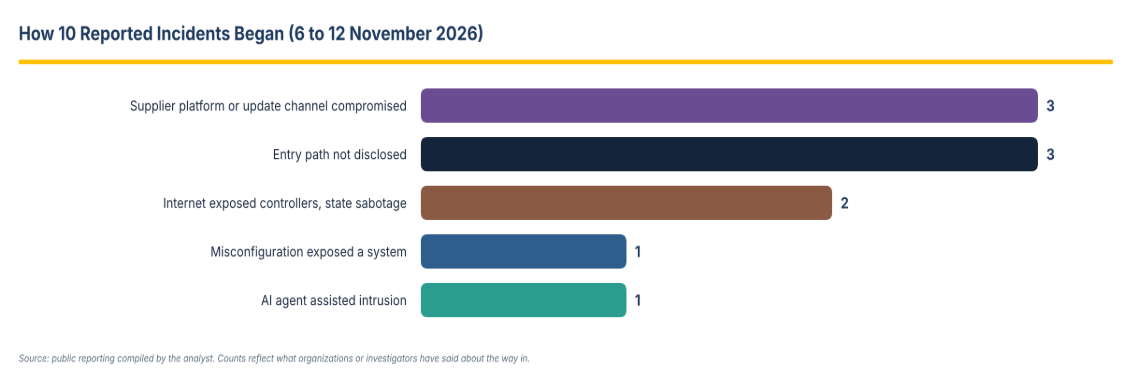
Figure 1. Initial access across 10 incidents first reported or updated between 6 and 12 November 2026.
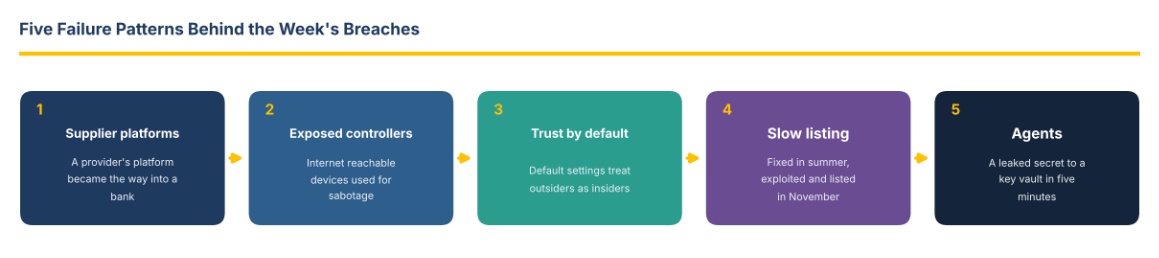
Figure 2. Five failure patterns behind the week’s breaches.
Supplier platforms
Crédit Mutuel Arkéa’s treasury was reached through a provider’s platform and not through its own online banking or customer accounts, and the bank has rejected claims that its online subsidiary was the entry point. A cloud data platform’s trusted access to customer AWS accounts was abused to steal stored secrets and data between 14 and 26 October. A hosting control panel’s own update channel delivered a data stealing backdoor to web servers. N-central, the platform that managed service providers use to manage their customers, was taken offline worldwide. In each case customers inherited a supplier’s weakness and a supplier’s level of access.
Exposed controllers
Refrigeration controllers made for convenient remote maintenance were reachable from the internet, ran old or unpatched software and in some cases were no longer supported. French investigators say the attackers used Farsi and addresses linked to Iran, used the same infrastructure to scan Schneider Electric equipment at small energy and water sites, and manipulated defrost settings. Outside experts call the attacks technically unsophisticated, which is the point: a nation state can cause fires and food losses worth tens of millions of euros with a scanner and weak or default access.
Trust by default
Two of this week’s exploited or maximum severity flaws are the same kind of mistake. SAP Gateway ships with an access control list that treats an external caller as an internal application server. GPUStack, an AI cluster manager, treats any request that appears to come from the same machine as the administrator, and a same host reverse proxy makes every remote request look local. A default that is safe only when the network is trusted turns into an open door as soon as the service is reachable.
Slow listing
The BroadWorks flaw was fixed in August, was added to the CISA catalog on 10 November and was used in an attack that ran for more than two weeks. GPUStack fixed its flaw in June, published the CVE on 4 November and saw it listed as exploited five days later. The Linux TCP flaw was fixed upstream on 5 October, and some enterprise distributions waited until November. The fix existed and the exploitation followed the calendar of the listing, not of the patch.
Agents
One report shows an ARTEX agent going from a leaked secret on a public code hosting site to exfiltration from a cloud key vault in five minutes. The BroadWorks case involved an agent that ran for two weeks against a telecom provider and the organizations it hosts. A Taiwan based attacker used AI agents to pull emergency dispatch records covering seven Taipei districts. Rotation schedules measured in days or months cannot limit the use of a secret that is found and used in minutes.
Questions to ask your own team
- What can each supplier platform do inside your environment, including moving money, and what stops a transfer from a supplier’s platform being paid at once and without a second approval?
- Which building, refrigeration, energy or access controllers do you or your landlords run, who maintains them remotely and are any of them reachable from the internet?
- Which systems you run trust the local machine, a reverse proxy or an internal address range by default, and have you tested what happens when a stranger arrives from there?
- Could you revoke a leaked secret within minutes, and would you know it had leaked?
Breached organizations
Organizations are named as in public reporting. The list covers incidents first reported or materially updated between 6 and 12 November 2026. Attacker claims are marked as claims, and counts are those reported by the organization unless marked otherwise. Check each name against your own suppliers and their suppliers.
| Organization | Sector, country and date | How it happened | Scale and status |
|---|---|---|---|
| Crédit Mutuel Arkéa | Banking, France. Flagged 2 Nov, confirmed 4 Nov | Attackers reached the bank directly through an unnamed service provider’s platform and made transfers from the bank’s own accounts to other banks; customer accounts and the online bank subsidiary were not the entry point, per the bank | Reported about €118 million, the bank calls that the right order of magnitude; part frozen; about $63 million of stablecoin converted to Ether in four hours; customers not affected; some transfers delayed |
| Customers of Qubole | Cloud data platform, global. Attack 14 to 26 Oct, reported 9 Nov | The platform’s trusted access to customer AWS accounts was abused | Stored secrets and data stolen from multiple customers; reporting is limited |
| French supermarkets (Casino, E.Leclerc, Coopérative U, Metro, Carrefour, Intermarché) | Retail, France. 11 to 12 Oct, attribution 9 Nov | Internet exposed refrigeration controllers on old software, remotely manipulated; attributed by France to Shahid Kaveh, an IRGC unit | More than 700 stores, at least 15 fires, food losses in the tens of millions of euros; arrest warrants for the unit’s leadership |
| Retailers in other European countries and three French blood storage sites | Retail and health, Europe. 2 Nov | Refrigeration systems again manipulated; stores in Belgium, Sweden, Ireland, Luxembourg, the Netherlands, Estonia, Finland and others | Dozens of stores and a food distribution hub; three blood storage facilities; not formally attributed |
| A major certificate authority (name withheld) | Certificate issuance, global. Confirmed 19 Oct, disclosed 5 Nov | A server migration left an internal business system reachable from the internet since February 2025; an unassigned account read archived data between 27 Jun and 2 Jul | Names, business contacts and, for a minority, identity documents; issuance systems and certificates were not affected; count not disclosed |
| DreamHost | Web hosting, US. Disclosed early Nov | Deliberate attack; entry not disclosed | Credentials for File Manager and webmail may have been accessed, with email and files on the FTP and SFTP server; no sign of control panel logins or billing data |
| York University | Education, Canada. Disclosed 9 Nov | A threat actor stole personal information submitted through online forms; entry not disclosed | Records back to 2007; count not disclosed |
| Queens Public Library | Public library, New York, US. Early Nov | Ransomware attack that encrypted systems; entry not disclosed | Public computers, Wi-Fi and checkout disrupted for a system serving about 2.3 million residents |
| Web hosts running Control Web Panel | Hosting software, global. Reported 9 Nov | Supply chain compromise of the cPGuard security product: versions 5.88.12 to 5.88.19 delivered a data stealing backdoor through the product’s own update channel | Number of servers not disclosed; operators should check for the published file artifacts |
| Taipei emergency dispatch | Government, Taiwan. Reported early Nov | A single Taiwan based attacker used AI agents to pull records | Emergency dispatch records covering seven Taipei districts |
Notes. We withhold the name of the certificate authority because it is a security supplier. The Arkéa amount is a press and on-chain figure that the bank has not confirmed. Counts of stores differ by source, from more than 350 to about 500 in earlier reports and more than 700 in the French government’s report. The Qubole row rests on limited reporting.
02. Emerging Threats and Campaigns
Crédit Mutuel Arkéa: a bank treasury drained through a supplier
On 2 November an independent on-chain investigator flagged more than $106 million of suspicious withdrawals from an unnamed western European entity, and raised the figure to about $133 million (€118 million) two days later and named Crédit Mutuel Arkéa as the likely victim. The bank confirmed on 4 November that it had been the target of an attack that enabled fraudulent transactions. In its statement the group said the attackers reached it directly through the platform of one of its service providers, not through customer accounts at its federations or subsidiaries, and moved money from the bank’s own accounts to other banking institutions. It rejected rumours that its online bank, Fortuneo, was the way in or that human error inside the group was to blame. The bank reported the incident to the Banque de France, suspended some transactions, which delayed some wire transfers, and said the intrusion was contained and services largely back to normal by the next morning.
On-chain analysis suggests that part of the money moved through cryptocurrency. One firm traced about $62.98 million of stablecoins converted into 27,553 Ether in about four hours on a decentralized exchange. The bank has not confirmed the amount and calls the figure of €118 million of the right order of magnitude. It says some funds have been blocked and recovery work is under way, and that no customer data was compromised. The group has some 5.6 million customers and has warned them to expect phishing and never to share passwords, card numbers or text message codes. The bank has not named the provider or said how the attackers took over its platform, and who is responsible has not been established. A treasury function aimed at, instead of customers, is the part that matters for other banks: these are the systems that move the institution’s own money, and they are often connected to suppliers that sit outside the bank’s own controls.
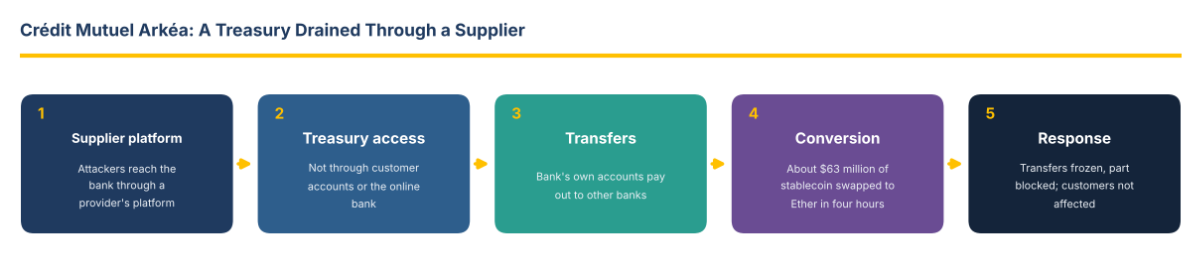
Figure 3. The Crédit Mutuel Arkéa theft (after the bank’s statements and on-chain tracing).
| Field | Detail |
|---|---|
| Victim | Crédit Mutuel Arkéa, a French cooperative banking group with about 5.6 million customers |
| Dates | Flagged 2 Nov; bank confirmed 4 Nov 2026; services largely restored the next morning |
| Entry | Unnamed service provider’s platform; direct access to the bank’s own accounts; not customer accounts or the online bank, per the bank |
| Loss | Reported about €118 million (about $133 million); not confirmed by the bank |
| Movement | Transfers to other banks; about $63 million of stablecoin converted to Ether in about four hours |
| Customer impact | None to funds or data, per the bank; some transfers delayed; phishing warning issued |
| Unknowns | Provider identity, the weakness used, attacker identity and how much has been recovered |
Recommendations
- Map every supplier platform that can initiate, approve or release payments from your own accounts, and limit what each can do. Set transfer limits, require a second approval that does not run through the supplier and alert on any treasury payment outside normal patterns.
- Require suppliers to use strong authentication, restrict access to named people and addresses, and log every payment instruction. Ask how they would tell you of a compromise, and how fast.
- Prepare a recall playbook: contacts at receiving banks, payment networks and law enforcement, and a way to freeze funds in the first hours. The first hours decide how much is recovered.
- Watch for treasury funds moving into crypto rails, and for customers being targeted with phishing after a public incident.
Refrigeration sabotage: attribution and a second wave
On 9 November France’s Cyber Crisis Coordination Centre published a report attributing the 11 and 12 October attacks on refrigeration controllers to Shahid Kaveh, an IRGC cyber unit that also operates under the name CyberAv3ngers, and the Paris prosecutor opened an investigation and issued international arrest warrants for the unit’s leadership. The report counts attacks at more than 700 stores run by Casino, E.Leclerc, Coopérative U, Metro, Carrefour and Intermarché, at least 15 fires and food losses in the tens of millions of euros. It does not publish its evidence. Investigators say the attackers used Farsi and addresses linked to devices in Iran, and that the infrastructure used against the supermarkets was also used in the same period to scan Schneider Electric equipment at small and medium sized energy and water sites. France has summoned Iran’s ambassador and is seeking EU sanctions. Iran has not responded.
The sabotage did not stop in France. On 2 November retailers in Belgium, Sweden, Ireland, Luxembourg, the Netherlands, Estonia, Finland and other countries reported freezer temperatures rising sharply, with dozens of stores and a food distribution hub affected, and three French blood storage facilities were targeted the same day. French attribution covers only the first wave, and it is not yet clear whether all the incidents are linked. The FBI and CISA have issued a joint advisory on attacks on industrial refrigeration controllers, which can cause fires and inventory losses, and US officials are examining whether freezer units at military bases were affected. The equipment is made by several manufacturers, and the French cyber agency has said the compromised systems used software from more than one of them.
| Field | Detail |
|---|---|
| Attributed to | Shahid Kaveh, an IRGC cyber unit also using the name CyberAv3ngers (French government, 9 Nov 2026) |
| First wave | 11 and 12 Oct 2026: more than 700 grocery stores in France; defrost cycles forced, cabinets to about 50 degrees Celsius; at least 15 fires |
| Second wave | 2 Nov 2026: stores in at least seven other European countries and three French blood storage facilities; not formally attributed |
| Evidence cited | Farsi, addresses linked to Iran, shared infrastructure with scanning of Schneider Electric equipment; evidence not published |
| Response | Arrest warrants for leadership; ambassador summoned; EU sanctions sought; FBI and CISA advisory |
| Technique | Internet exposed controllers with old software and weak or default access; setpoint manipulation |
Recommendations
- Find every refrigeration, building and industrial controller you or your suppliers run, and take it off the internet. Use a gateway or VPN with multifactor authentication for remote maintenance.
- Change default credentials, patch controller software and replace models that no longer get updates. Ask maintenance firms for their access logs.
- Put temperature and safety alarms on a path that the controller cannot silence or delay, and keep manual procedures for loss of cold storage, especially for blood, medicines and food.
- Treat cold storage and other controllers as targets for state sabotage, not only for criminals, and include them in business continuity plans.
ARTEX: one week on
Research this week found 1,608 live, publicly reachable ARTEX instances. One cluster of observed campaigns obtained more than 300 iOS signing certificates and about 190,000 gaming credentials, of which about 6,000 were active accounts, which is a long way from a bank and a reminder that the framework is being used for whatever can be monetized. A cloud provider reports watching an ARTEX agent go from a secret leaked on a public code hosting site to exfiltration from a key vault in five minutes, which is faster than any scheduled secret rotation. The BroadWorks case, covered in Vulnerability Intelligence, shows the same approach against a telecom provider for more than two weeks. See also the separate iZOOlogic threat advisory on ARTEX.
- Treat any secret pushed to a public repository as compromised the moment it is pushed, and revoke it automatically, since deleting the commit does not cancel the secret.
- Move high value workloads to short lived, federated credentials, and alert on a first use of a secret from an unfamiliar address.
- Check your own exposure for the framework’s footprints: scripted user agents, bursts of sign ins and unusual API reads.
N-able N-central: 33 flaws published without notice
Late on 8 November an independent researcher published a repository called Able2Shell with working exploit code for 33 alleged zero day flaws in N-central, the remote monitoring and management platform that many managed service providers use to run their customers’ systems. They include an unauthenticated chain that ends in command execution and the creation of a rogue administrator, and credential theft. N-able took its hosted N-central environments offline in the Americas, Europe and Asia-Pacific on 9 November and told customers who run N-central on their own servers to shut them down. On 10 November it released N-central 2026.4 Hotfix 2, build 2026.4.1.26, which fixes seven CVEs, and on 11 November it confirmed that all hosted servers had been upgraded and restored. A follow-up hotfix is planned. Customers must also upgrade their agents and probes, because the hotfix changes how the two communicate.
N-able has not mapped its seven CVEs to the researcher’s 33 findings, so it is not clear that every claim has been fixed. The company reports scanning for the published exploit code, and two sensor operators saw attempts against honeypots, but no one has reported a confirmed compromise of a customer. N-central is the kind of management plane that Volt Typhoon targeted in earlier campaigns, and that history makes any exposed instance a high priority. For financial institutions the risk is mostly through their managed service providers, which hold administrative access to many systems.
Recommendations
- Ask your managed service providers whether they use N-central, whether hosted or on premises, and whether they have applied Hotfix 2 and upgraded agents and probes. Keep on premises servers offline until patched.
- Review N-central audit logs and the accounts it created since 8 November, and check for new administrators and unexpected scripts pushed to endpoints.
- Limit the access that a provider’s management platform has to your systems, and require alerts when it pushes software or changes configuration at scale.
03. Threat Actor Activity
Shahid Kaveh Group (CyberAv3ngers)
Shahid Kaveh is a cyber unit affiliated with Iran’s Islamic Revolutionary Guard Corps, and CyberAv3ngers is the persona it uses in public. The persona first drew wide attention in late 2023 when it defaced internet exposed Unitronics controllers at water facilities and claimed attacks on Israeli made equipment, and the US government later sanctioned IRGC cyber officials for the activity. In July 2026 more than 100 internet exposed water systems in the United States were attacked, and private sector analysts, though not the US government, blamed Iran and CyberAv3ngers. The group’s pattern is consistent: it looks for industrial and building controllers that are reachable from the internet, gets in through default or weak credentials or known flaws, and changes settings to cause visible physical effects, then announces the result.
On 9 November France publicly attributed the 11 and 12 October attacks on supermarket refrigeration controllers to the unit. According to French investigators the attackers used Farsi and IP addresses linked to devices in Iran, and used the same infrastructure in the same period to scan Schneider Electric equipment, concentrating on small and medium sized energy and water production units. The sabotage was simple: the attackers forced defrost cycles that pushed cabinet temperatures to about 50 degrees Celsius for hours, and reportedly extended the defrost interval from one hour to eight, which delays alarms. It affected more than 700 stores, started at least 15 fires and destroyed food worth tens of millions of euros. Security experts call the attacks technically unsophisticated, since they relied on unprotected networked devices with old or obsolete software. The Paris prosecutor has issued international arrest warrants for the unit’s leadership.
The attribution has limits. France has not published its evidence, and its statement covers only the first wave. On 2 November similar disruptions hit stores in Belgium, Sweden, Ireland, Luxembourg, the Netherlands, Estonia and Finland, and three French blood storage facilities were targeted. Whether those events are linked to the first wave is unclear. The persona name CyberAv3ngers has been used for several operations, so a single label may hide different operators or copycats. Defenders should plan for the technique, not the name.
| Attribute | Detail |
|---|---|
| Names | Shahid Kaveh Group; CyberAv3ngers (public persona) |
| Assessed origin | Iran, a cyber unit affiliated with the Islamic Revolutionary Guard Corps, per the French government |
| Motivation | Sabotage, intimidation and political messaging; economic damage |
| Typical targets | Internet exposed industrial and building controllers: water systems, refrigeration, energy and small utilities |
| Initial access | Scanning for reachable devices; default or weak credentials; old or unpatched controller software |
| Impact technique | Changing setpoints and settings, for example forced defrost and longer alarm delays |
| Infrastructure | Addresses linked to devices in Iran; shared with reconnaissance of Schneider Electric equipment |
| Status | Attributed by France on 9 Nov 2026; arrest warrants issued; EU sanctions sought; second wave not formally attributed |
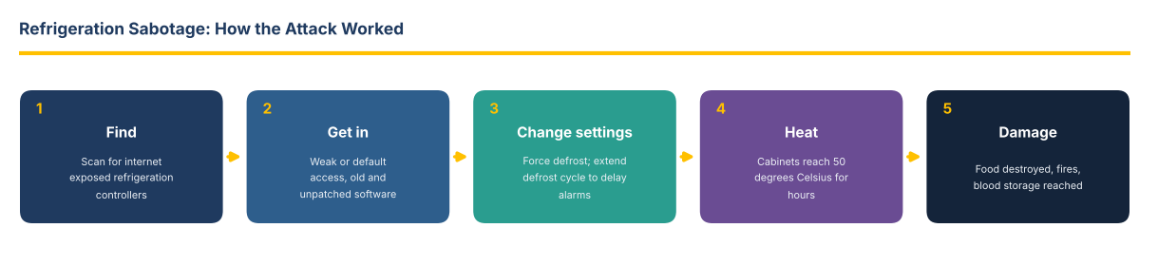
Figure 4. How the refrigeration sabotage worked (after French investigators and public reporting).
Timeline of recent events
| Date | Event | Status |
|---|---|---|
| Nov 2023 | CyberAv3ngers defaces internet exposed Unitronics controllers at water facilities | Public reporting and US government statements |
| Jul 2026 | More than 100 internet exposed water systems attacked in the United States | Private analysts blame Iran; no US attribution |
| 11 to 12 Oct | Refrigeration controllers manipulated at more than 700 French stores | Attributed to Shahid Kaveh by France on 9 Nov |
| 2 Nov | Retailers in at least seven other European countries and three French blood storage sites hit | Not formally attributed |
| 9 Nov | France attributes the first wave; arrest warrants issued | French government report and statement |
| 10 Nov | Iran’s ambassador summoned; EU sanctions sought | Government statements |
| Nov 2026 | FBI and CISA advisory on attacks on industrial refrigeration controllers | Joint advisory |
Hunting guidance
| Signal | Where to look | Why it matters |
|---|---|---|
| Controllers reachable from the internet, including from a maintenance supplier’s addresses | External attack surface scans and firewall rules | The campaign started with scanning for reachable devices |
| Logins to controllers from new addresses or at unusual hours | Controller, gateway and VPN logs | Default or weak credentials were the way in |
| Setpoint, defrost schedule or alarm delay changes outside maintenance windows | Controller change logs and building management systems | Forced defrost and longer alarm delays caused the damage |
| Temperature rises that the alarm system did not report | Independent temperature probes | Alarms were reportedly delayed |
| Scans for industrial equipment from the same addresses | Network and firewall logs | The same infrastructure scanned energy and water equipment |
MITRE ATT&CK techniques
Technique IDs are our own mapping to ATT&CK for ICS from the public reporting on the campaign. They describe the actor’s method, not a published indicator set.
| Tactic | ID | Technique | Observed procedure |
|---|---|---|---|
| Initial Access | T0883 | Internet Accessible Device | Controllers reachable from the internet were found by scanning |
| Initial Access | T0859 | Valid Accounts | Default or weak credentials, per investigators |
| Execution | T0855 | Unauthorized Command Message | Commands sent to controllers to change defrost behaviour |
| Impair Process Control | T0836 | Modify Parameter | Setpoints and defrost schedules changed |
| Inhibit Response Function | T0878 | Alarm Suppression | Reported extension of defrost cycles to delay alarms |
| Impact | T0828 | Loss of Productivity and Revenue | Food spoilage and store disruption |
| Impact | T0879 | Damage to Property | Fires at several stores |
Recommendations
- Take industrial, building and refrigeration controllers off the internet, and put maintenance access behind a gateway with multifactor authentication and logging.
- Remove default credentials and apply controller updates, and plan the replacement of models that have reached the end of support.
- Use independent sensors and alarms for cold storage, safety systems and critical environments, so that a controller change cannot hide a temperature rise.
- For organizations in Europe with energy, water or retail operations, watch government advisories and sanctions developments, and treat Iranian state activity as a live risk to controllers.
- Ask suppliers who remotely maintain your controllers how they secure their access, and whether their systems are exposed.
04. Ransomware and Data Leaks
Fraud Ransomware (new, Python based)
Fraud is Windows ransomware that was first scanned publicly in the second week of November 2026. It renames encrypted files with the .fraud extension and drops a text note called READ_ME_FRAUD.txt. The name has nothing to do with financial fraud and should not be confused with fraud or scam malware. The sample is a Python program bundled into an executable, which the sandbox detects as PyInstaller, and one antivirus engine labels it a generic Python ransomware. The note says every important document is encrypted with AES-256 and the master key is wrapped with RSA-2048, tells victims not to rename or edit encrypted files and asks them to send the victim ID to the operator, who will return an RSA private key. They are told to run the unlocker, or the same program with an –unlock flag, to restore files. The note ends with a section headed system fingerprint, shown as proof of execution, which lists details of the infected machine such as host name, user, operating system, processor, memory, network address, drives and public IP address.
The note gives no way to pay or to make contact. There is no email address, Tor site, messenger identifier, wallet address or ransom amount, and public analysis of another sample reached the same finding. The unlocker being the same program with a flag points the same way: a design in which the decryptor ships inside the encryptor, for testing, is typical of an unfinished or amateur build and not of a criminal operation that expects to be paid. The date in the note is the sandbox’s clock. The ransomware is also not only a locker. The sandbox shows it reading browser profile data, accessing cryptocurrency wallet files, looking up the machine’s public address through a web service, collecting Wi-Fi network information, reading hardware identifiers through WMI and checking for a sandbox through SCSI registry keys. We saw no data theft in the sandbox, so the collection may be preparation for the fingerprint in the note, for a later version or for credential theft that did not run.
The persistence is the unusual part. The program adds a Run key and a file in the Startup folder, and registers a Netsh helper DLL, which makes Windows load the DLL whenever the netsh tool runs. That route gives persistence that survives removal of the obvious entries, and it needs administrator rights. The sample renamed 432 files in the sandbox, set the desktop wallpaper through the registry and ended processes with taskkill, probably to release files for encryption. The sandbox report shows no shadow copy deletion and no log clearing, so recovery from backups and restore points may be possible if they exist and the encryption does not touch them. Nothing is known about victims, delivery or the author.
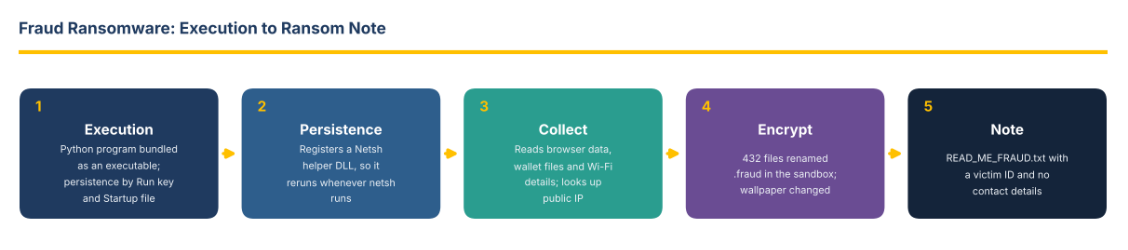
Figure 5. Fraud ransomware flow from execution to the ransom note (assembled from sandbox behaviour signatures and the note).
Observed evidence
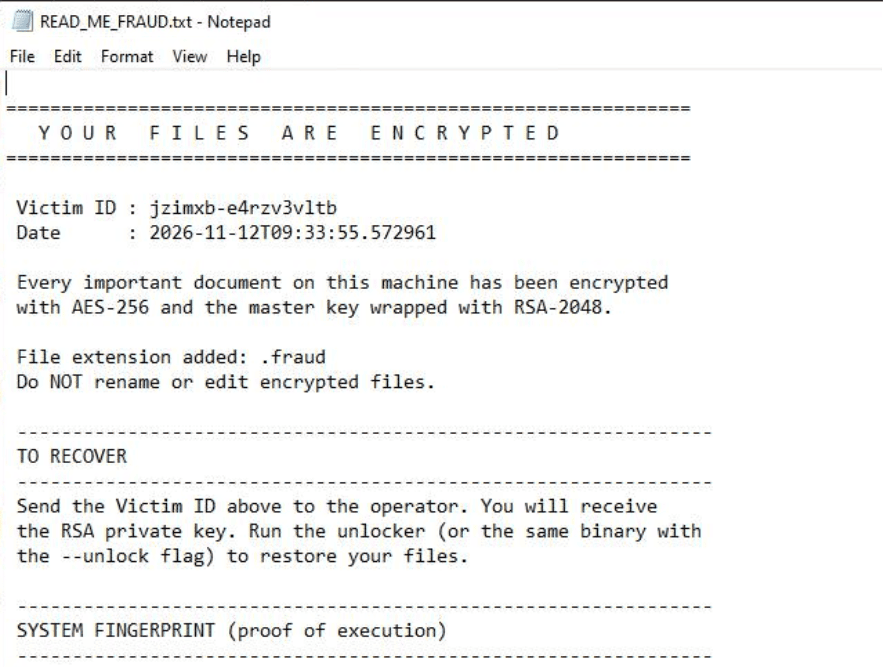
Figure 6. The READ_ME_FRAUD.txt ransom note in the sandbox, cropped before the machine fingerprint section.
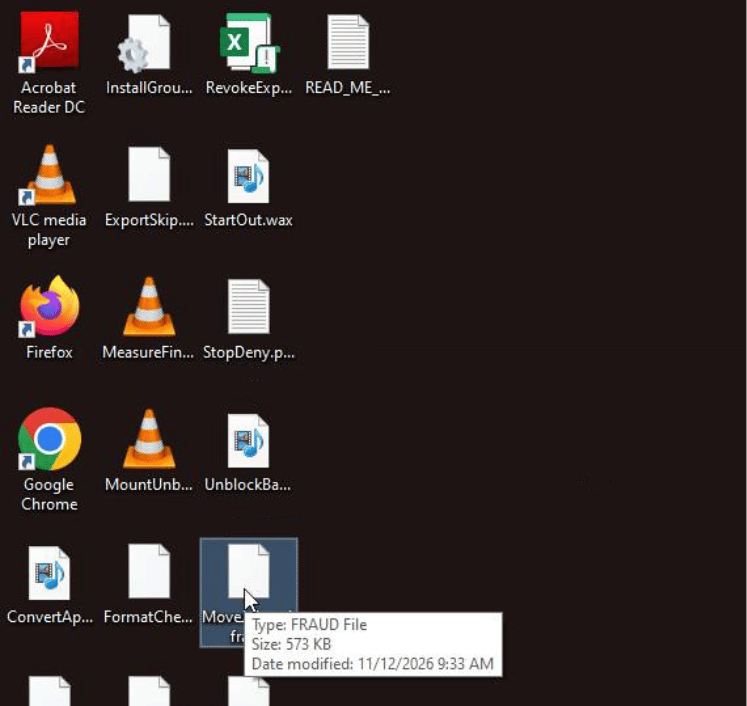
Figure 7. The sandbox desktop after execution: a note file and the FRAUD file type (573 KB in the tooltip).
Behavioural signatures
Sandbox analysis shows the sample renaming 432 files with a new extension, creating a file in the Startup directory, adding a Run key, and registering a Netsh helper DLL for event triggered execution. It executes dropped executables and loads many dropped DLLs, consistent with a bundled Python runtime, and runs command shell one-liners. It reads browser profile data and accesses cryptocurrency wallet files, which are credential theft behaviours. It looks up its external IP address through a web service, queries WMI for hardware identifiers, reads the hostname and domain from the registry, discovers Internet connectivity and Wi-Fi networks, and checks SCSI registry keys. It kills processes with taskkill, sets the wallpaper through the registry and uses WMI.
MITRE ATT&CK techniques
The first group of rows is the sandbox mapping. Rows marked as added are our own, for behaviour the sandbox report shows but its mapping leaves out.
| Tactic | ID | Technique | Observed procedure |
|---|---|---|---|
| Execution | T1059.003 | Command and Scripting Interpreter: Windows Command Shell | Runs cmd.exe one-liners |
| Execution | T1047 | Windows Management Instrumentation | Queries hardware identifiers through WMI |
| Persistence | T1547.001 | Boot or Logon Autostart: Registry Run Keys or Startup Folder | Adds a Run key and a Startup folder file |
| Persistence | T1546.007 | Event Triggered Execution: Netsh Helper DLL | Registers a helper DLL that runs when netsh runs |
| Privilege Escalation | T1547.001 | Boot or Logon Autostart: Registry Run Keys or Startup Folder | Startup persistence |
| Privilege Escalation | T1546.007 | Event Triggered Execution: Netsh Helper DLL | Helper DLL loaded by netsh |
| Defense Evasion | T1112 | Modify Registry | Sets the wallpaper and related values |
| Credential Access | T1555.003 | Credentials from Web Browsers | Reads user and profile data of web browsers |
| Credential Access | T1552.001 | Unsecured Credentials: Credentials In Files | Accesses cryptocurrency wallet and credential files |
| Discovery | T1120 | Peripheral Device Discovery | Enumerates drives and storage |
| Discovery | T1012 | Query Registry | Reads system settings |
| Discovery | T1082 | System Information Discovery | Reads hardware and system details |
| Discovery | T1016.001 | System Network Configuration Discovery: Internet Connection Discovery | Checks Internet access and looks up the public IP |
| Discovery | T1016.002 | System Network Configuration Discovery: Wi-Fi Discovery | Collects Wi-Fi network information |
| Collection | T1005 | Data from Local System | Collects local data |
| Impact | T1491 | Defacement | Replaces the desktop wallpaper |
| Impact (added) | T1486 | Data Encrypted for Impact | Renames and encrypts files with .fraud |
| Discovery (added) | T1497.001 | Virtualization/Sandbox Evasion: System Checks | Checks SCSI registry keys |
Indicators of compromise
| Indicator | Type | Context |
|---|---|---|
| 1b6affb4a22bf5fea029e43cdb0 40b209f854b258 a8de236a4919c323692a21e | SHA256 | Fraud ransomware sample |
| .fraud | File extension | Appended to encrypted files |
| READ_ME_FRAUD.txt | Filename | Ransom note |
| Netsh helper DLL entry | Persistence | A DLL registered under the Netsh helper key; look for new entries |
| jzimxb-e4rzv3vltb | Victim ID | Printed in the note in our capture; per sample, not per victim |
| –unlock | Command line flag | Built in decryptor mode described in the note |
Other ransomware and data leak activity
Queens Public Library, which serves about 2.3 million residents of New York City, was hit by a ransomware attack that encrypted its systems and disrupted public computers, Wi-Fi and checkout. York University in Canada disclosed that a threat actor stole personal information submitted through its online forms, with records reaching back to 2007. DreamHost said a deliberate attack may have exposed credentials for its File Manager and webmail, with email and files on its FTP and SFTP server, but not control panel logins or billing details. A major certificate authority disclosed that a server migration left an internal business system reachable from the internet, so that an unassigned account could read archived customer data, including identity documents for a minority of customers, though certificate issuance was not affected.
Recommendations
- Keep offline or immutable backups and test restoration. Fraud leaves shadow copies alone, but a later version may not.
- Alert on new Netsh helper DLL registrations, new Startup folder files and Run keys, taskkill bursts against many processes and wallpaper changes by unexpected processes.
- Assume browser stored passwords and wallet files on an infected machine are stolen. Reset credentials, revoke sessions and move any funds.
- If ransomware appears with no contact method, preserve the note and a sample encrypted file and do not search for the operator. Involve incident response.
- Audit servers moved or rebuilt this year, since a migration can leave an internal system reachable from the internet.
05. Credential and Account Exposure
VOLTA-AUTODOXER: a stealer that asks language models to rank its victims
Research published on 31 October describes VOLTA, also labelled VOLTA-AUTODOXER, a self deleting Windows information stealer written in C and C++ that adds an unusual last step to the familiar theft of passwords, cookies and wallets. After it has collected what it can, it builds a structured evidence bundle about the victim and sends it to a commercial language model through a model routing service, with an instruction to produce a ranked dossier of what the victim is worth. The researchers describe the model as the operator’s triage analyst: it turns a raw credential log into a prioritized, evidence backed list of monetizable assets, including accounts that could be sold, drained or used for further access. The malware tries a chain of three models and falls back to the next when one refuses the request. The research calls the stealer mature and the model layer optional.
The collection is broad. VOLTA takes saved credentials, cookies and session tokens from browsers, cryptocurrency wallets with an inline wallet password cracker, Wi-Fi profiles and screenshots. It bypasses Chrome’s app bound encryption, and the researchers flag Chrome launched in headless mode by an unexpected parent process as a detection signal. It enriches the profile with live session abuse against a victim’s email and other services. Results go out in stages, with archives sent to a Telegram bot, and the program deletes itself. Its model request leaves the infected host, so it creates network traffic that conventional stealers do not: a call to a model routing service from a machine that has no reason to use one. A harvest log, volta_debug.txt, stays in the user’s profile folder and records what was taken and whether the model call worked, which makes it the best artifact after the fact.
For financial institutions the significance is prioritization. A stealer that ranks victims by value helps an operator find the one employee in a thousand who has access to payments, a corporate single sign on session or a crypto wallet, and to act on that account first. The researchers infer from build time configuration slots that several operator specific builds exist, though sales of VOLTA have not been confirmed, and the way the stealer reaches victims is not described. Cookies and refresh tokens can outlive a password reset, so treating a confirmed infection as a credential reset alone is not enough.
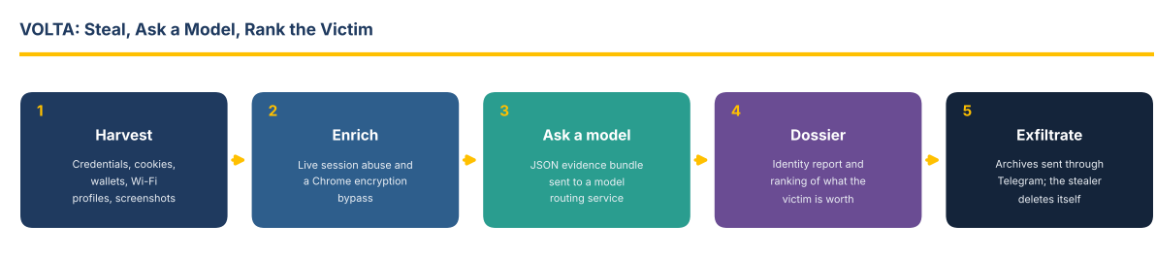
Figure 8. VOLTA from theft to ranked dossier (after the published research).
| Attribute | Detail |
|---|---|
| Type | Windows information stealer with an optional language model victim ranking stage; self deleting |
| Language | C and C++ |
| Collects | Credentials, cookies, session tokens, cryptocurrency wallets, Wi-Fi profiles, screenshots |
| Evasion | Chrome app bound encryption bypass; self deletion |
| Model step | JSON evidence bundle to a model routing service; chain of three models with fallback on refusal; low temperature |
| Exfiltration | Archives sent through a Telegram bot in stages |
| Artifacts | volta_debug.txt in the AppData folder; volta_log.zip, volta_dox.zip, volta_doxnet.zip; Identity_Report.txt and AI_Analysis.txt |
| Distribution | Not described; build time configuration slots suggest several operator builds |
MITRE ATT&CK techniques
Technique IDs are our own mapping from the published research.
| Tactic | ID | Technique | Observed procedure |
|---|---|---|---|
| Credential Access | T1555.003 | Credentials from Web Browsers | Saved passwords and data, including Chrome with an encryption bypass |
| Credential Access | T1539 | Steal Web Session Cookie | Cookies and session tokens |
| Credential Access | T1110.002 | Brute Force: Password Cracking | Inline wallet password cracker |
| Discovery | T1016.002 | System Network Configuration Discovery: Wi-Fi Discovery | Wi-Fi profile collection |
| Collection | T1113 | Screen Capture | Screenshots |
| Collection | T1005 | Data from Local System | Wallets and files |
| Defense Evasion | T1070.004 | Indicator Removal: File Deletion | Self deletion of the executable |
| Exfiltration | T1567 | Exfiltration Over Web Service | Archives sent through Telegram |
| Command and Control | T1102 | Web Service | Model routing service and Telegram used as external services |
Indicators of compromise
| Indicator | Type | Context |
|---|---|---|
| %APPDATA%\volta_debug.txt | File path | Harvest log; survives self deletion; preserve before cleanup |
| volta_log.zip, volta_dox.zip, volta_doxnet.zip | Filenames | Collection and dossier archives |
| Identity_Report.txt, AI_Analysis.txt | Filenames | Dossier files; first line of the report reads TARGET ASSESSMENT, VOLTA AUTODOXER |
| POST to openrouter.ai/api/v1/chat/completions from a non IDE process | Network | Model request from an infected host |
| api.telegram.org sendDocument over 100 KB from the same parent process | Network | Exfiltration of archives |
| Chrome launched with –headless by an unexpected parent | Behaviour | Used to bypass app bound encryption |
Recommendations
- Hunt for volta_debug.txt and the archive names, for headless Chrome started by unexpected parent processes, and for outbound calls to a model routing service or Telegram from machines that have no reason to make them.
- If an infection is confirmed, preserve the harvest log first, then revoke sessions, cookies and OAuth tokens, rotate passwords and keys, and treat wallets as lost. A password reset alone does not end access.
- Prioritize staff who hold payment, treasury, single sign on administrator and crypto roles, since a stealer that ranks victims will find them first.
- Restrict unmanaged tools that call external model services from endpoints, and block the routing service on machines that do not need it, which also reduces data leakage to those services.
Trusted cloud access: Qubole customers
A cloud security firm reported on 9 November that an attacker broke into AWS accounts belonging to multiple customers of Qubole, a data platform, between 14 and 26 October and stole stored secrets and data. The title of the report describes the method as abuse of the platform’s trusted access to those accounts. The detail available to us is limited, and Qubole’s own statement should be read for scope. The pattern is the one seen in other supplier cases this year: a supplier is given a role or key in the customer’s cloud account, and an attacker who takes that access inherits it. Customers should review which suppliers can assume roles in their cloud accounts, check CloudTrail style logs for 14 to 26 October, rotate secrets stored in the accounts the platform can read and restrict the role to what the platform needs.
Recommendations
- List every supplier role, key and integration that can act in your cloud accounts, and remove the ones you do not use. Require external identifiers and narrow permissions on cross account roles.
- Alert on role assumptions by suppliers from new addresses or at unusual times, and on reads of stored secrets.
- After a supplier incident, rotate secrets in the accounts it could reach, not only the credentials it held.
06. Vulnerability Intelligence
Four advisories are covered here, in order of urgency. Two are already exploited and on the CISA catalog, one is a maximum severity flaw in a default setting at the heart of many finance and ERP systems, and one is an update to last issue’s Linux kernel flaw.
| Priority | CVE | Product and severity | Exploitation and fix |
|---|---|---|---|
| 1 Immediate | CVE-2026-20320 | Cisco BroadWorks, XML external entity flaw in the provisioning interface; CVSS 7.5 | Exploited; CISA KEV 10 Nov, due 24 Nov; fixed in RI.2026.07 (Aug); an AI agent campaign used it |
| 2 Immediate | CVE-2026-102895 | GPUStack, authentication bypass through a trusted loopback source; CVSS 9.8 | Exploited; CISA KEV 9 Nov, due 12 Nov; fixed in 2.2.0 (and 2.2.2 for a related flaw) |
| 3 Immediate | CVE-2026-89103 | SAP Gateway, default access control list treats outsiders as internal; CVSS 10.0 | No exploitation reported; fixed in the 10 Nov patch day with a kernel update and a profile setting |
| 4 This week | CVE-2026-98432 | Linux kernel IPv4 TCP use after free; CVSS 9.8 | Fixes shipping; public proof of concept; no confirmed exploitation |
CVE-2026-20320: Cisco BroadWorks XML External Entity Flaw
CVE-2026-20320 is an XML external entity flaw in the Open Client Interface XML parser of Cisco BroadWorks, the call control platform that telecom providers and managed service providers use to run business phone systems. An unauthenticated attacker who sends specially crafted XML to the provisioning service, which listens on port 2208, can read sensitive files from the server with the privileges of a BroadWorks user, and the parser resolves external entities by default. Cisco published the flaw and fixed software on 19 August 2026, in release RI.2026.07 across the application, profile and extended services components. CISA added it to its catalog on 10 November, with a federal deadline of 24 November.
The catalog entry gives few details, but research published at the weekend explains why it was added. Researchers say a Chinese speaking actor used the flaw with the help of a jailbroken language model that ran the intrusion autonomously for more than 14 days against a European telecom provider and 13 organizations that use its data centers and cloud infrastructure, in what they call Operation Snowball. The first step was the flaw, which gave the agent the platform’s system identity key. The agent then chained older flaws in other software on the same hosts to reach root and a second foothold, and set up persistence with common tools. The flaw is a file disclosure bug, not a takeover bug, and its CVSS score of 7.5 is high but not critical. This is an example of a label that understates the use: the file it reads can hold the key to everything else.
| Field | Detail |
|---|---|
| CVE ID | CVE-2026-20320 |
| Affected product | Cisco BroadWorks, Open Client Interface (OCI-P) XML parser |
| Fixed versions | RI.2026.07 and later, covering all components, published 19 August 2026 |
| Severity | CVSS 7.5 (high); information disclosure that enables further attacks |
| Vulnerability type | XML external entity injection (CWE-611), unauthenticated, reading files from the server |
| Exploitation status | Exploited; CISA KEV 10 Nov 2026, federal deadline 24 Nov; an AI agent campaign reported |
| Related flaws | The same CISA update added a media transcoder flaw (CVE-2026-111793) and a command injection flaw in a vendor’s multiple products (CVE-2026-111560) |
Recommendations
- Upgrade BroadWorks to RI.2026.07 or later, including all components, and restrict access to the OCI-P provisioning port to operational systems.
- Treat the platform’s identity keys and any secrets on hosts that were reachable since August as exposed, and rotate them after patching.
- Hunt for the follow on tooling the report describes: remote access frameworks, tunnelling tools and web shells on BroadWorks and neighbouring hosts, and for unusual requests to port 2208.
- Ask your telecom and voice providers whether they run BroadWorks and whether they have patched.
CVE-2026-102895: GPUStack Authentication Bypass
GPUStack is an open source cluster manager for serving AI models and provisioning GPU instances. CVE-2026-102895 lets an unauthenticated attacker become the administrator. In versions before 2.2.0, the authentication code promotes any request whose source is the local machine to the built in administrator when a setting called force_auth_localhost is false, which is the default. In the usual deployment, GPUStack runs behind a reverse proxy on the same host, so every remote request arrives from the local address and is treated as the administrator. A forged X-GPUStack-Real-IP header can do the same. With administrator access an attacker can list and change users, models, workers and configuration, create persistent administrator API keys that work from any address, read worker credentials and cloud provider secrets, and run code on worker hosts through administrator functions.
The fix was committed on 19 May 2026 and shipped in version 2.2.0 on 18 June, a repository advisory followed on 31 July, the CVE was published on 4 November and CISA added it to its catalog on 9 November, with a federal deadline of only three days, 12 November, and a requirement to triage the systems forensically. Attacks have been seen against a server running version 2.1.1, using the bypass to run reverse shells on worker hosts. A related flaw, CVE-2026-102894 (CVSS 9.1), allows account takeover through forged single sign on responses and is fixed in version 2.2.2, which is the version to deploy. Because attackers can create persistent API keys, upgrading is not enough for an instance that was reachable by untrusted networks.
| Field | Detail |
|---|---|
| CVE ID | CVE-2026-102895 (related: CVE-2026-102894) |
| Affected product | GPUStack, open source GPU cluster manager for AI model serving |
| Affected versions | All versions before 2.2.0 (the related SAML flaw: 0.7.1 up to before 2.2.2) |
| Fixed versions | 2.2.0 for the bypass; 2.2.2 for both |
| Severity | CVSS 9.8 critical |
| Vulnerability type | Authentication bypass by spoofing and origin validation error (CWE-287, CWE-290, CWE-346) |
| Exploitation status | Exploited; CISA KEV 9 Nov 2026, deadline 12 Nov; reverse shells on worker hosts reported |
| Attack requirement | Network access to the GPUStack API; default setting |
Recommendations
- Upgrade to 2.2.2 or later. Do not expose the service to untrusted networks, and set force_auth_localhost to true where you cannot upgrade at once.
- Treat any instance that was reachable from the internet as compromised: review users, administrator API keys, workers, models and inference backends created since the exposure, and rotate every secret and cloud credential the cluster held.
- Inventory AI serving infrastructure, including GPU hosts and model gateways run by data science teams and suppliers, since it is often outside normal patching.
CVE-2026-89103: SAP Gateway Default Access Control List
SAP’s November patch day on 10 November fixed four flaws rated CVSS 10.0, all in the base platform: a SAML assertion bypass in the ABAP application server (CVE-2026-120017), memory corruption in the Internet Communication Manager (CVE-2026-76964), a heap overflow in the Web Dispatcher (CVE-2026-89126), and CVE-2026-89103 in the SAP Gateway. The Gateway handles external connections between SAP and other programs, using RFC and BAPI calls. The researchers who found CVE-2026-89103, who named it PROXYGATE, say it is a pre-authentication command execution flaw: an unauthenticated attacker with network access to the Gateway can run operating system commands as the SAP system administrator account, with no credentials and no user interaction.
The cause is a default. The Gateway activates a default access control list that gives high trust to an external caller and treats it as an internal application server. That makes the shipped state vulnerable, and the only question is whether the Gateway is reachable. The fix is not only a patch: it needs a kernel update and the profile parameter gw/acl_mode_proxy set to 1, followed by a review of any permissive proxy rules in the prxyinfo file. A scan of the perimeter cannot show the effective trust decision inside the Gateway. The CVE record describes the flaw as incorrect authorization, while the finders and several analysts describe unauthenticated command execution, and the SAP note number differs between sources (3798345 in the researchers’ write up and 3760274 elsewhere), so use SAP’s own portal. No exploitation or public exploit code has been reported, and the flaw is not on the CISA catalog, which already lists 14 older SAP flaws.
| Field | Detail |
|---|---|
| CVE ID | CVE-2026-89103 (PROXYGATE per its finders) |
| Affected product | SAP Gateway, in the SAP kernel (NetWeaver and S/4HANA based systems) |
| Affected versions | Kernel 7.22, 7.53, 7.54, 7.77, 7.93, 8.04, 9.16, 9.20 and 9.21, and the 7.22 EXT builds, per the CVE record |
| Fixed versions | Patched kernels from the 10 November 2026 SAP Security Patch Day, plus gw/acl_mode_proxy = 1 |
| Severity | CVSS 10.0 critical (scope changed, no privileges, no interaction) |
| Vulnerability type | Incorrect authorization (CWE-863): default access control list trusts an external caller as internal |
| Exploitation status | No exploitation or public exploit reported; not on the CISA catalog as of 12 Nov 2026 |
| Interim measure | Restrict network access to the Gateway ports to known application servers; set gw/acl_mode_proxy = 1; review prxyinfo and secinfo rules |
Recommendations
- Apply the November SAP kernel patches and set gw/acl_mode_proxy to 1, starting with Gateways, Web Dispatchers and ICM services that are reachable from outside the SAP network. Check the SAP note for your release.
- Review prxyinfo and secinfo files for permissive rules, and restrict the Gateway ports with a firewall to the application servers that need them.
- Review SAML 2.0 configurations in ABAP systems for the separate assertion bypass, and treat any SAP system exposed to the internet as a priority.
- Monitor SAP Gateway logs for connections from unexpected addresses and for operating system commands run by the system administrator account.
CVE-2026-98432: Linux Kernel TCP Flaw, Update
Last issue covered CVE-2026-98432, the use after free in the Linux kernel’s IPv4 TCP handshake. Since then the picture has changed in three ways. Fixed kernels have shipped: Red Hat released updates for RHEL 8, 9 and 10 on 1 November and raised its own score to 9.8, AlmaLinux, Rocky Linux and Oracle Linux followed, and Debian, SUSE and Amazon Linux had patched earlier. Ubuntu’s fixes were in the testing repository on 4 and 5 November, and some container and cloud kernels were still pending. Public proof of concept code for the race and a kernel pointer leak was posted on 4 November, and one report mentions suspected scanning on port 443. As of 6 November no exploitation had been confirmed and the flaw was not on the CISA catalog. The Ubuntu security team advises against turning off multipath TCP as a mitigation, since that answers only the one exploit described so far, and recommends installing the updated kernel. No vendor live patch was available as of early November, although a third party reboot free option for Ubuntu 26.04 was reported on 6 November.
Recommendations
- Install the fixed kernel on every Linux host and reboot. Prioritize internet facing servers, load balancers, container hosts and appliances, and check cloud images.
- Where a vendor kernel is not yet available, keep the interim filter that drops TCP packets carrying IP options, and plan the update when it arrives.
- Watch for kernel crashes and unexpected reboots on exposed hosts, and for scanning of listening ports with options set.
Also this week
CISA added four more flaws to its catalog on 9 November: the GPUStack bypass, a FreeSWITCH code injection (CVE-2026-116779), an OpenSSH flaw nicknamed SSHole (CVE-2026-123158) and an IBM Aspera Faspex authorization flaw (CVE-2026-123218). SSHole affects sshd before 10.6p2 on Linux systems that use the musl C library with PAM disabled, which includes Alpine Linux’s default OpenSSH server setup, and attempts from 13 addresses had been recorded by 9 November. A SonicWall SSL VPN flaw (CVE-2026-19868) that lets an attacker with valid credentials for another authentication method bypass SAML and multifactor checks was also added, with a deadline of 20 November. An actively exploited WordPress core flaw (CVE-2026-119977) has an unusual twist: installing the fix opens a short exposure window, so administrators are advised to block access to wp-content/upgrade before updating. A flaw in the APT package manager on Debian and Ubuntu (CVE-2026-109518, CVSS 7.7) can lead to code execution as root. For N-able N-central, see Emerging Threats.
07. Darkweb and Underground Activity
Following the Arkéa money
The first public sign of the Crédit Mutuel Arkéa theft came from the blockchain, not from the bank. An independent investigator tracking suspicious withdrawals flagged more than $106 million leaving an unnamed western European entity on 2 November, raised his estimate to about $133 million two days later and tied it to Arkéa. Blockchain analysis shows that about $63 million of stablecoins was swapped for 27,553 Ether in about four hours through a decentralized exchange, which suggests that the thieves wanted to leave the stablecoin issuers’ freezing powers behind quickly. That is the same laundering logic seen after the Binance theft: convert to Ether, spread across wallets and look for exchanges and brokers with weak checks. For banks, the practical points are to screen incoming transfers from crypto exchanges against published theft addresses, and to expect that funds taken in fiat will be on the chain within hours.
ARTEX in the criminal market
Research this week found that ARTEX is no longer confined to a few operators. A count of 1,608 publicly reachable instances, run by different people for different aims, includes a cluster that collected more than 300 iOS signing certificates and about 190,000 gaming credentials. Signing certificates and gaming accounts are goods that criminal markets already buy, which shows the framework being pointed at whatever sells. The Korean banking campaign of last month, by contrast, left its operator with data and no plan to sell it. The two pictures are consistent: ARTEX lowers the cost of finding and taking data, and the harder part for the criminals is monetizing it.
Ransomware with no contact channel
Fraud ransomware has a note that tells victims to send their victim ID to an operator and gives no address, site or wallet for doing so. A fingerprint of the machine and an unlocker that ships in the same program add to the impression of a build that was meant for testing. The underground produces many such strains. They matter because they are cheap to write with common tools such as Python and PyInstaller, and because some later versions will add a working extortion channel, a leak site or stolen data. The Netsh helper DLL persistence is the feature worth carrying forward into detection.
08. Key Takeaways
- A supplier’s platform is a path to your treasury. Crédit Mutuel Arkéa lost a reported €118 million through a provider’s platform that reached its own accounts. Limit what supplier platforms can pay, require a second approval that does not run through the supplier and rehearse the recall.
- Controllers are targets for states. France attributes the refrigeration sabotage to an Iranian IRGC unit, and a second wave reached other countries and blood storage. Take controllers off the internet, change default credentials and use independent alarms.
- Default settings that trust the network are failures waiting to be reached. SAP Gateway treats outsiders as internal servers, and GPUStack treats local requests as the administrator. Patch, set the safe parameter and restrict the ports.
- A moderate score can hide a decisive flaw. The Cisco BroadWorks file disclosure scored 7.5, yet it gave an AI agent the key to a telecom provider’s platform for two weeks. Rank flaws by what they enable, and act on the CISA catalog.
- Management planes need a plan. N-able pulled N-central offline after 33 flaws were published without notice, and Volt Typhoon used the same product last month. Ask your managed service providers what they run and whether it is patched.
- Stealers now triage their victims. VOLTA asks a model to rank what each victim is worth. Hunt for its artifacts, treat cookies and tokens as stolen, and give extra protection to staff with payment and crypto access.
- Plan for machine speed. An agent can go from a leaked secret to a key vault in five minutes. Revoke secrets automatically and use short lived credentials.
- Keep claims separate from evidence. The Arkéa amount, the second wave’s link to Iran, the 33 N-central flaws, the Fraud note’s fingerprint and the BroadWorks agent story all rest on one source or on unpublished evidence.
Priority actions this week
| Priority | Action | Why now |
|---|---|---|
| Immediate | Upgrade Cisco BroadWorks to RI.2026.07 or later, restrict port 2208, rotate identity keys and hunt for follow on tooling | CVE-2026-20320 is on the CISA catalog and was used in an AI agent campaign |
| Immediate | Upgrade GPUStack to 2.2.2, keep it off untrusted networks, and review users, administrator keys, workers and secrets on any exposed instance | CVE-2026-102895 is exploited, and the CISA deadline was 12 November |
| Immediate | Apply the November SAP kernel patches, set gw/acl_mode_proxy to 1, restrict Gateway ports and review prxyinfo and secinfo | CVE-2026-89103 is a CVSS 10.0 flaw in a default setting |
| Immediate | Ask providers about N-central, apply Hotfix 2, upgrade agents and probes, and keep on premises servers offline until patched | 33 alleged flaws were published with exploits and scanning has started |
| Immediate | Review every supplier platform that can initiate or approve payments, add transfer limits and a second approval that does not run through the supplier, and rehearse a recall | Crédit Mutuel Arkéa lost a reported €118 million through a provider’s platform |
| This week | Take refrigeration, building and industrial controllers off the internet, change default credentials and add independent alarms | France attributes the October sabotage to an Iranian IRGC unit, and a second wave followed |
| This week | Install fixed Linux kernels, including container hosts and cloud images; keep the interim filter where no fix exists | CVE-2026-98432 has a public proof of concept and fixes have shipped |
| This week | Hunt for VOLTA artifacts, headless Chrome from unexpected parents and calls to model routing services; treat sessions on infected hosts as stolen | The stealer ranks victims by value and deletes itself |
| This week | Alert on new Netsh helper DLL registrations, Startup folder files and Run keys, and verify offline backups | Fraud ransomware uses these and leaves shadow copies alone |
Disclaimer
This Report is provided for informational and security-awareness purposes only. The information presented is based on intelligence collected from publicly available sources, underground forums, dark web sources, third-party feeds, and other available data at the time of analysis.
Threat intelligence may be incomplete, outdated, unverified, or subject to change. References to threat actors, organizations, vulnerabilities, indicators, or incidents represent observed or reported information and should not be considered definitive attribution unless explicitly stated and supported by reliable evidence.
The information contained in this report should be independently validated before being used for security, operational, legal, or business decisions. iZOOlogic does not guarantee the accuracy, completeness, or timeliness of the information and shall not be held responsible for any actions or decisions taken solely based on this report.
This report is intended for authorized recipients and should be handled in accordance with applicable organizational security, confidentiality, and information-sharing policies.
