
 HQ/EMEAFind out how we can help your business

In This Issue
01. Threat Landscape
A flaw in PHP itself set the tone for the week. Two critical remote code execution bugs in PHP core, CVE-2026-109618 and CVE-2026-109619, leaked before their fix existed, an exploit tool called PHP2Shell is circulating, and the PHP project moved its emergency patch forward to 14:00 UTC on 21 October. Reports say every PHP version since 5 is affected, but only the supported 8.2 to 8.5 branches will get a fix. When this issue was written no exploitation had been confirmed, and mass scanning was expected within minutes of the release.
Lazarus Group drew attention twice. A report published on 21 October describes Operation FlashHole, in which the group abused a mandatory South Korean banking security program, used GitHub as its command channel and built fake resume sites with AI generated photos. Separately, analysts have firmed up the North Korean link to the $387.5 million Bitget theft and traced a laundering network that is said to have handled more than $1 billion. For financial institutions the nearest items were the eMudhra certificate keys, which affect many Indian banks and fintechs, and the Bitget attribution.
We tracked 9 incidents, listed under Breached Organizations below. Two have no disclosed entry path. One began with stolen credentials, one with a contractor’s file transfer site and one with phishing and a watering hole. Four are claims by ransomware groups that the organizations have not confirmed. Nikkei is the clearest repeat offender for credentials: it disclosed its third incident in a month, this time through stolen logins on a cloud development service that held personal data. The largest incident by records was Burger King Japan, at 11.18 million.
What changed this week
- PHP2Shell. Two critical flaws in PHP core, rated 9.2 by the PHP team, leaked on 20 October with an exploit tool and a published technical analysis whose accuracy is disputed. The fix was scheduled for 14:00 UTC on 21 October and covers only the supported 8.2 to 8.5 branches.
- Operation FlashHole. A security vendor documented Lazarus Group abusing the mandatory banking security software CrossWeb EX in South Korea, with a toolset that includes TouchShift and ClientHub and a post quantum key exchange.
- Hexsomeware, a new Python based ransomware, appeared with a hard coded demo victim ID, a 0.5 BTC demand and no way to contact the operators. It looks more like a test or hobby build than a criminal operation.
- Two exploited or dangerous flaws outside PHP: the SiteGuard Server Edition web application firewall (CVE-2026-106931, exploited, on the CISA catalog since 20 October) and PwnEscape (CVE-2026-99999), a Linux kernel flaw that lets a guest virtual machine attack its host.
- The Indian certificate authority eMudhra revoked eight intermediate certificates after researchers showed their private keys could be recovered almost instantly. Browser makers have blocked them, and there is no evidence of misuse so far.
- Ransomware listings continued, including a US defence training company claimed by DragonForce, a Latin American beauty group claimed by Qilin, and a US tank transport firm claimed by Storm.
Confidence in this assessment
Most of this issue rests on vendor, regulator and company statements and carries high confidence. Where it does not, the text says so. The main open points are:
- PHP: the severity, affected versions and exploit details come from leaks and researchers, not from the PHP advisory, which was due with the release. Some outlets say CVSS 10.0, while the PHP team scored both flaws 9.2. A published technical analysis blames the session upload progress handling, but other analysts say its test code targets an uncommon build and may be partly wrong. Whether any attacks have started was unknown at the time of writing.
- Lazarus Group: the name is an umbrella for several North Korean operations. FlashHole is espionage in South Korea, the Bitget theft is financial, and some tools, including TouchShift, were first documented under a separately tracked cluster. Bitget’s chief executive has softened her early attribution to preliminary indicators.
- Hexsomeware: no victims, operator or delivery method are known, and the demo victim ID suggests a test build.
- eMudhra: reports often say the keys were compromised. The cause was a weak key generation script, not an intrusion, and there is no evidence the keys were used.
- PwnEscape and SiteGuard: severity differs by source (9.3 against 8.8 for PwnEscape, and a local vector on a flaw that is being exploited against servers for SiteGuard), and one vendor lists PwnEscape as actively exploited while others and CISA do not.
How the breaches happened
The 9 incidents fall into five groups, defined by what let the attackers in or, for the claims, by what is known. The week’s pattern is less about clever exploits than about where data and trust were placed.
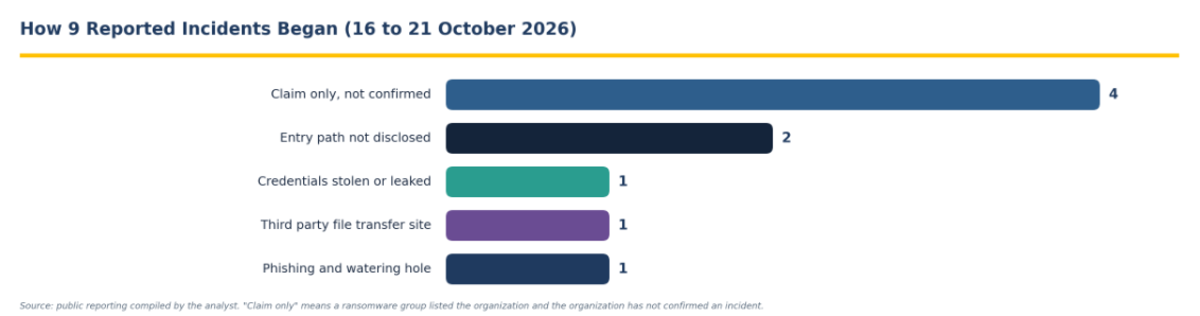
Initial access across 9 incidents first reported or updated between 16 and 21 October 2026.
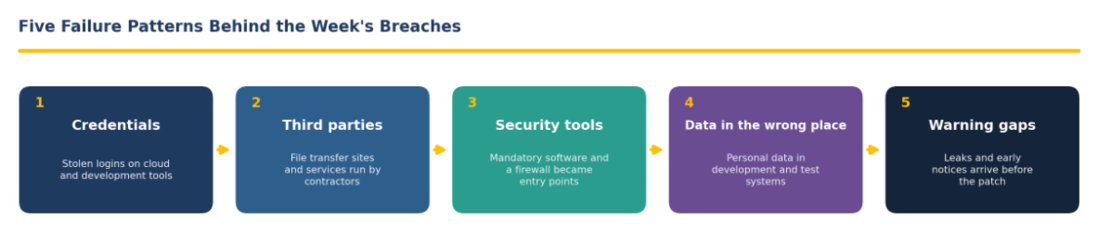
Five failure patterns behind the week’s breaches.
Credentials, again
Nikkei says an unauthorized party used stolen credentials on or about 7 October to enter a cloud service it uses for system development and took about 1.83 million records, of which about 150,000 carried a name, address, email, phone number or date of birth. It revoked the credentials and told the regulator on 11 October. This is the third incident the company has disclosed in about a month. One of the earlier two was a compromised Google Workspace account from July, and its November 2025 breach was a compromised Slack account. The pattern is a company whose accounts are being taken one service at a time.
Contractors and the sites they run
The Educational Testing Service, which runs California’s standardized tests under contract, told the state that an unauthorized party had accessed and copied student data from an SFTP site that ETS operates. The data includes names, student identifiers, dates of birth, addresses, disability and program information and test scores for millions of current and former students. The state agency depends on its contractor’s controls, which it cannot see. Last issue’s Daiwa Securities and Danish register cases told the same story.
Security tools as the way in
Operation FlashHole works by abusing CrossWeb EX, security software that South Korean banking and government sites require users to install. The SiteGuard Server Edition web application firewall, a product bought to stop attacks, has a command injection flaw in a feature that is switched on by default and is being exploited. In both cases the control sits close to the internet, runs with high privileges and is rarely watched as an attack surface.
Personal data in the wrong place
The Nikkei data sat in a development cloud service. Meta, in last issue, had personal data on about 1,500 people in its code repositories against its own policy. Development and test systems are looser than production, are reached with the same stolen logins, and often hold real data copied for convenience. ETS’s data sat on a transfer site. Each time the exposure was larger because the data was somewhere nobody was treating as sensitive.
Warnings that arrive before fixes
PHP’s flaws were known to attackers and researchers before the patch existed. The SiteGuard vendor notified customers with support contracts on 29 September, about two weeks before public disclosure, and now says abuse has been confirmed. Embargoes leak, and early notices give defenders a few hours to find systems, isolate them and prepare, but only if the inventory already exists.
Questions to ask your own team
- Do you know every server that runs PHP, including those a supplier or agency manages, and how quickly you could patch or isolate them?
- Do development and test systems hold real personal data, and do the logins that reach them use multifactor authentication and get reviewed?
- Which contractors run file transfer sites or portals that hold your customers’ data, and how would you learn of a breach there?
Breached organizations
Organizations are named as in public reporting. The list covers incidents first reported or materially updated between 16 and 21 October 2026. Attacker claims are marked as claims, and counts are those reported by the organization unless marked otherwise. Check each name against your own suppliers and their suppliers.
| Organization | Sector, country and date | How it happened | Scale and status |
|---|---|---|---|
| Educational Testing Service (ETS), for the California Department of Education | Education testing contractor, US. Notices 16 to 19 Oct | Unauthorized party accessed and copied data from an ETS operated SFTP site | Millions of current and former public school students: names, student IDs, dates of birth, addresses, disability and program data, test scores. Exact count not stated |
| Burger King Japan | Fast food, Japan. Announced 15 Oct | Unauthorized access to the server that holds member data for its app; how not disclosed | 11.18 million records. Regulator informed; investigation continuing |
| Nikkei | Media, Japan. Regulator told 11 Oct, public 16 Oct | Stolen credentials used on a cloud development service on 7 Oct; credentials revoked | 1.83 million records, about 150,000 with identifying details; the count is of records, not people. Third incident in about a month |
| Catawba County | Local government, US (North Carolina). Filing reported 17 Oct | Cause not stated in the filing | Notice lists Social Security numbers and health related data among the types affected |
| Three South Korean organizations | Software, construction and wired communication equipment, South Korea. Reported 21 Oct | Spear phishing to fake resume and portfolio sites, and a watering hole that abused the CrossWeb security software | Espionage by Lazarus Group (Operation FlashHole). At least three confirmed; the researchers believe more were affected |
| Oak Grove Technologies | Defense training, US. Claim seen 19 Oct | Listed by the DragonForce ransomware group | Claim only: 261 GB. Not confirmed by the company |
| Belcorp | Beauty and personal care, Latin America. Listing 19 Oct | Listed by the Qilin ransomware group | Claim only; details limited. Not confirmed by the company |
| Baltimore Tank Lines | Transport, US. Listing 19 Oct | Listed by the Storm ransomware group | Claim only. Not confirmed by the company |
| POWERsonic Industries | Cable and wire harness manufacturing, US. Listing 19 Oct | Listed by the Aurora ransomware group | Claim only. Not confirmed by the company |
Notes. The four ransomware listings are claims, taken from leak site tracking. Burger King Japan and Catawba County are early statements with little detail on cause. Great Lakes and the other claims listed in last issue are not repeated here.
02. Emerging Threats and Campaigns
eMudhra: weak certificate authority keys, not a break in
On 17 October the major browser makers received a report that the private keys behind eight intermediate certificates issued by the Indian certificate authority eMudhra could be recovered almost instantly. One browser team confirmed it by recovering the keys itself and blocked the certificates the same day. The six intermediates that could issue website certificates were blocked in a leading browser on 17 October, and on two other major platforms on 19 and 20 October. Go programs must be rebuilt with patched libraries to pick up the block. eMudhra says a script error when the certificates were generated in April 2025 was to blame. One key had a value of just 4. It has revoked all eight and stopped issuing under the root that signed them.
Headlines call this a compromise, but nothing was stolen: the keys were weak from the day they were made. The risk is that anyone who recovered them could have issued trusted certificates for any website and intercepted traffic. One browser maker found that none of the six website issuing intermediates had issued a certificate recorded in public transparency logs before the block, and there is no evidence of misuse. It has also removed the root that signed them from its root store and is reviewing whether the authority’s other certificates should stay trusted. For Indian banks and fintechs, eMudhra is a common source of TLS and digital signing certificates, so the question is which certificates in use chain to the affected roots.
| Field | Detail |
|---|---|
| Issuer | eMudhra Limited (India), certificate authority |
| Affected | Eight intermediate CA certificates under its G3 root; six could issue TLS certificates |
| Cause | Key generation script error in April 2025; keys recoverable almost instantly, one with a value of 4 |
| Discovery and response | Reported 17 Oct; blocked in browsers the same day and on other major platforms 19 and 20 Oct; eMudhra revoked all eight |
| Evidence of misuse | None found; none of the six TLS intermediates had issued a logged certificate before the block |
| Still to do | Rebuild Go applications; update trust stores on non-browser clients; replace certificates under the affected chain |
Recommendations
- List every certificate you rely on that was issued by eMudhra, including TLS, code signing, document signing and device certificates, and check whether the chain includes the eight intermediates.
- Replace affected certificates with ones from an unaffected issuer, and rebuild and redeploy Go applications and other software that carries its own trust list.
- Update operating system and appliance trust stores that do not take browser blocks automatically, and watch certificate transparency logs for unexpected issuance for your domains.
- Ask your suppliers whether any of their customer facing or signing certificates use the affected chain.
Development and test systems as a source of personal data
Two incidents in two weeks involved personal data that should not have been where it was. Meta said an outside group used one employee’s stolen credentials to reach GitHub repositories and took source code and personal data on about 1,500 people, mostly employees, which its own policy says should not be stored there. This week Nikkei said stolen credentials opened a cloud service used for system development, and 1.83 million records came out, about 150,000 of them identifying. Neither company has explained how the data got into those systems. The usual reasons are test data copied from production, exports kept for convenience and tokens or files committed by mistake.
| Field | Detail |
|---|---|
| Incidents | Meta (GitHub repositories, disclosed 13 Oct); Nikkei (cloud development service, disclosed 16 Oct) |
| Access | Stolen employee credentials in both cases |
| Data | Meta: source code and personal data on about 1,500 people; Nikkei: 1.83 million records, about 150,000 identifying |
| Common weakness | Production or personal data held in development, test or code storage with weaker controls than production |
Recommendations
- Scan code repositories, development databases and test environments for personal data, and remove or mask it. Use synthetic or masked data for development.
- Require multifactor authentication and conditional access on every cloud and development account, and review which service accounts and tokens can reach data stores.
- Treat development systems as in scope for monitoring and incident response, and alert on bulk reads from them.
03. Threat Actor Activity
Lazarus Group
Lazarus Group is the name most vendors and governments use for North Korean state sponsored hacking. In practice it covers several operations with different goals: cryptocurrency theft, which the FBI attributes to a cluster it calls TraderTraitor and which overlaps with APT38, and long running espionage against South Korea, defence, aerospace and technology, which is usually tied to Operation Dream Job and Cascade Hole. Analysts have noted that the word no longer says much about who did what. Some malware discussed this week, such as TouchShift, was first documented in 2023 under a cluster that another vendor tracks separately from Lazarus, so alias lists should be read with care.
| Attribute | Detail |
|---|---|
| Names | Lazarus Group; APT38 and TraderTraitor for the cryptocurrency theft cluster; Operation Dream Job and Cascade Hole for long running espionage. A cluster called UNC2970 overlaps with Dream Job but is tracked separately by one vendor |
| Assessed origin | North Korea (DPRK), attributed by governments to the Reconnaissance General Bureau |
| Motivation | Espionage and revenue for the state |
| Typical targets | Cryptocurrency exchanges and DeFi; software, construction, defence, aerospace and technology firms; South Korean organizations and users of its mandatory security software |
| Current campaigns | Operation FlashHole (espionage, South Korea); a cluster that uses the COPPERHEDGE backdoor to monetize attacks, including ransomware and a leak site; suspected involvement in the Bitget theft |
| Initial access | Spear phishing with fake job and resume lures, watering holes, abuse of mandatory banking security software, trojanized developer tools |
| Infrastructure | Private GitHub repositories, compromised legitimate websites, Dropbox |
| Notable thefts | Bybit (about $1.5 billion, attributed by the FBI to TraderTraitor); Bitget ($387.5 million, suspected) |
Operation FlashHole
A security vendor’s analysis published on 21 October describes a campaign against South Korea that began in July 2025, shortly after the group ended Operation SyncHole, and was investigated after an incident in January. Attackers abused CrossWeb EX, a program that Korean banks and government sites require users to install to protect browser sessions with public key encryption. The same approach was used against the related Cross EX program in SyncHole and against CrossWeb EX in 2021 to 2023. Researchers could not say exactly how the software was abused, but the legitimate process chain led to a high integrity process and then to malware that runs only in memory.
This time the group was more selective. Targets received spear phishing emails linking to fake resume and portfolio sites hosted on GitHub Pages, tailored to each victim, such as a network appliance developer’s resume and an interior design showcase. The resume photo shows signs of AI generation, and the portfolio is filled with meaningless detail, which suggests the group is using AI to build lures quickly. The sites loaded an external JavaScript file that began the infection. At least three organizations in South Korea’s software, construction and wired communication equipment sectors were hit. The software sector was also a target in SyncHole, which suggests interest in source code and in finding flaws for later attacks.
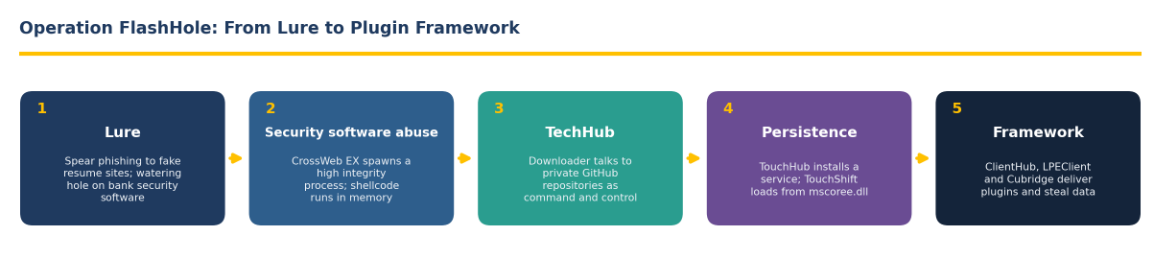
Operation FlashHole from lure to plugin framework (after the vendor analysis).
The malware set is described under Credential and Account Exposure, with indicators. Three features matter for defenders. The group has used private GitHub repositories as a command channel since at least July 2025, using a personal access token, issues and uploaded files. Its newest loader, ClientHub, hides its commands in headers copied from a normal browser and uses a stream cipher, SNOW, that has not been seen in Lazarus malware before. And its profiling tool, LPEClient, now negotiates keys with the ML-KEM-1024 post quantum algorithm, which the researchers note the group adopted faster than many legitimate security products. South Korea has said it will phase out mandatory security software starting in 2026, and the researchers expect attacks on it to stay active until it is gone.
Cryptocurrency theft: Bitget and a laundering network
Bitget’s chief executive said after the 24 September theft that the attack matched North Korean patterns, and she has since described the link as preliminary. Two blockchain analytics firms have since said the thieves are DPRK linked, one calling it highly likely, and one says North Korean thefts have passed $1 billion in 2026. Two forensic firms are still investigating the intrusion, and public reporting has not tied it conclusively to Lazarus Group by name. On 5 October an on chain investigator said he had posed as a paying client and exposed a Chinese network that laundered more than $1 billion for North Korean hackers, including most of the Bybit proceeds. Through that work he traced about $12 million and helped freeze 442,000 USDT. Authorities have not confirmed his claims. The point for financial institutions is that cashing out is the hard part, which is why screening for stolen funds matters.
Recommendations
- If you operate in South Korea or serve Korean customers, check whether CrossWeb EX or similar mandatory banking software is installed on staff machines, keep it updated and monitor for child processes it should not start.
- Hunt for the indicators below, especially mscoree.dll outside System32, a service named like a Windows service with two extra letters and the description Microsoft Service, and files in C:\Windows\System32\RasConv.
- Look for endpoints calling the GitHub API with tokens, creating and updating issues, or contacting Dropbox from processes that have no reason to.
- Brief engineers and recruiters on lures that link to resume or portfolio sites, and treat any request to run code from a candidate as hostile.
- For firms that handle cryptocurrency, screen deposits and withdrawals against published stolen fund addresses, and review the controls on any third party security product with access to signing or approval systems.
04. Ransomware and Data Leaks
Hexsomeware Ransomware (new, low sophistication)
Hexsomeware is Windows ransomware first seen in October 2026 when a sample was submitted to a public scanning service. It renames encrypted files with the .hexsomeware extension, drops a short text note called HEXSOMEWARE_READ_ME.txt and shows a full screen ransom window with a countdown. The window is headed Hacked by Hexsomeware, uses the tagline Your files, our choice, and ends with the line Fsociety, Anonymous, Stay together, which borrows hacktivist and television branding. It demands 0.5 BTC to a single Bitcoin address and says files will be decrypted automatically after three confirmations. It gives no email address or other contact. The window disappears after a restart and does not come back.
Several details point to a test build or an amateur program, not to a criminal operation. The victim ID printed in both notes begins with DEMO and was identical in our capture and in an independent public analysis, so it is hard coded, while the key ID changed between runs. The notes include a Playfair cipher prefix described as a tamper check. Automatic decryption after payment would need a server that checks the blockchain, and the sample offers no sign of one. One antivirus engine identifies it as a Python ransomware agent, and the sample unpacks 17 DLLs, which fits a Python program bundled into an executable. Nothing is known about victims, delivery or the author, and the name is unrelated to the older Hexadecimal (Crypt888) and Hexamethy families.

Hexsomeware flow from execution to the ransom screen (assembled from sandbox behaviour signatures).
Observed evidence
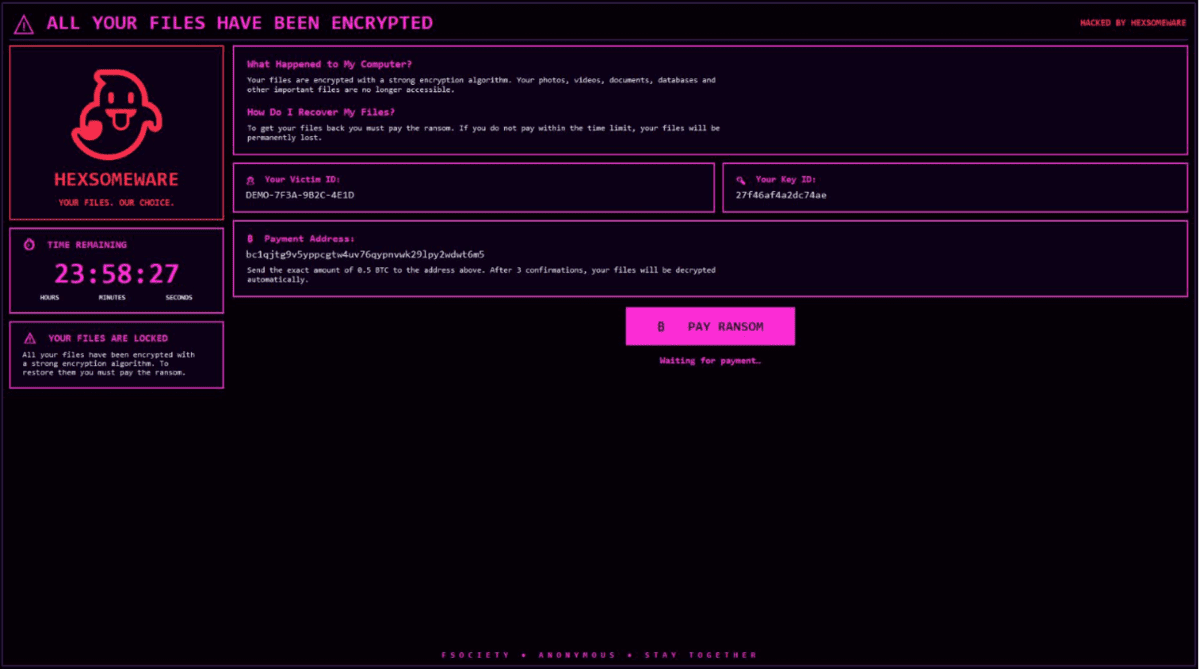
The full screen Hexsomeware ransom window shown in the sandbox, with the demo victim ID and 0.5 BTC demand.
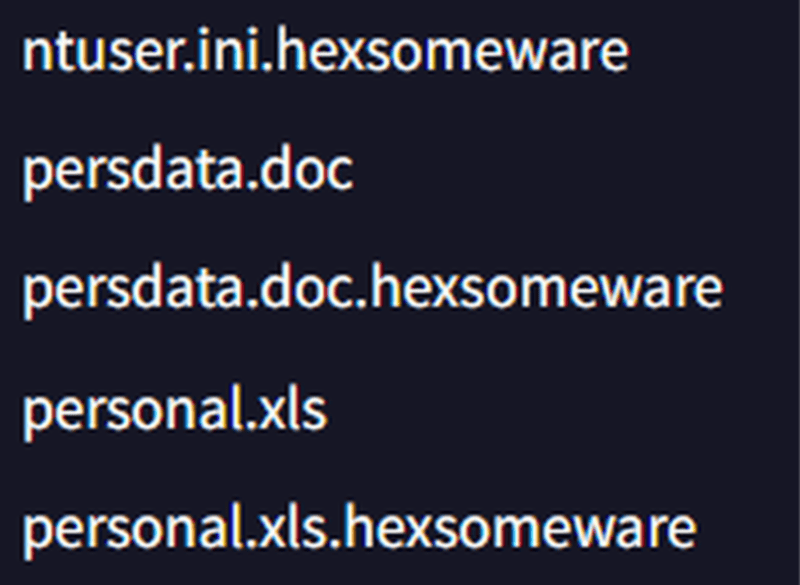
Files after execution. Each document appears twice, once with the .hexsomeware extension and once without, which is not how an encryptor normally behaves; this may reflect how the sandbox lists files, and we could not confirm whether originals survive.
Behavioural signatures
Sandbox analysis shows the sample changing Windows Defender settings (the DisableAntiSpyware value and real time protection), deleting shadow copies and using the Volume Shadow Copy COM API, and killing processes with taskkill. It switches off Registry Editor, Task Manager and the command prompt through registry changes, which is a blunt measure that also locks out the person responding. It discovers network shares and other systems in the same network, uses WMI and creates a Windows service. It renamed 66 files in the sandbox. The sandbox report lists no data theft behaviour, and the notes do not threaten publication.
MITRE ATT&CK techniques
The rows marked as added are our own, for behaviour the sandbox report shows but its technique mapping leaves out.
| Tactic | ID | Technique | Observed procedure |
|---|---|---|---|
| Execution | T1047 | Windows Management Instrumentation | Uses WMI |
| Persistence | T1543.003 | Create or Modify System Process: Windows Service | Creates a Windows service |
| Privilege Escalation | T1543.003 | Create or Modify System Process: Windows Service | Service runs with high privileges |
| Defense Evasion | T1006 | Direct Volume Access | Accesses volumes directly |
| Defense Evasion | T1562.001 | Impair Defenses: Disable or Modify Tools | Changes Windows Defender settings |
| Defense Evasion | T1070.004 | Indicator Removal: File Deletion | Deletes files and shadow copies |
| Defense Evasion | T1112 | Modify Registry | Disables Registry Editor, Task Manager and cmd.exe; changes Defender keys |
| Discovery | T1135 | Network Share Discovery | Looks for network shares |
| Discovery | T1018 | Remote System Discovery | Finds other systems on the network |
| Impact | T1490 | Inhibit System Recovery | Deletes shadow copies |
| Impact (added) | T1486 | Data Encrypted for Impact | Renames and encrypts files with .hexsomeware |
Indicators of compromise
| Indicator | Type | Context |
|---|---|---|
| f5f7de24680f11add804 d980f959c598696641e4b22f3 73c81df14e74b32901e | SHA256 | Hexsomeware sample |
| .hexsomeware | File extension | Appended to encrypted files |
| HEXSOMEWARE_READ_ME.txt | Filename | Text ransom note |
| DEMO-7F3A-9B2C-4E1D | Victim ID | Hard coded in the sample, not unique to a victim |
| 27f46af4a2dc74ae | Key ID | From our capture; a different value (4c0a802860e6c078) appeared in an independent analysis, so it changes per run |
| bc1qjgt9v5yppcgtw4uv76qypnvwk29lpy2wdwt6m5 | Bitcoin address | Payment address in our capture (transcribed; verify before use) |
| EXSOHKWBRKXS | String | Playfair cipher prefix shown as a tamper check in the text note, per an independent analysis |
Other data leaks of note
Burger King Japan said on 15 October that unauthorized access to the server holding member data for its app exposed 11.18 million records, and it is still investigating how. Nikkei and the Educational Testing Service are covered in the breach analysis above. The ransomware groups listing victims this week included DragonForce, Qilin, Storm, Aurora and N0n, mostly against small and mid sized manufacturers, transport and services firms in the United States. Those listings are claims, and the groups often post before negotiations end.
| Organization | Group | Sector and country | Status |
|---|---|---|---|
| Oak Grove Technologies | DragonForce | Defense training, United States | Claim, 261 GB; seen 19 Oct |
| Belcorp | Qilin | Beauty and personal care, Latin America | Claim; seen 19 Oct; details limited |
| Baltimore Tank Lines | Storm | Transport, United States | Claim; seen 19 Oct |
| POWERsonic Industries | Aurora | Cable and wire harness manufacturing, United States | Claim; seen 19 Oct |
Recommendations
- Keep offline or immutable backups and test restoration. Hexsomeware deletes shadow copies and may leave you without Registry Editor, Task Manager or a command prompt, so keep a response toolkit that does not depend on them.
- Alert on changes to Windows Defender settings, shadow copy deletion, registry changes that disable Task Manager, Registry Editor or cmd.exe, and the creation of new services from user writable folders.
- Treat ransomware leak site claims as leads. Check whether the named organization is your supplier, and ask for a statement before acting.
05. Credential and Account Exposure
TouchShift and ClientHub: the Lazarus loader chain
Two of the malware families in Operation FlashHole are worth knowing in detail, because they appear in several Lazarus campaigns and are built to stay in memory. TouchShift is a loader that has been seen since at least 2023. It is installed as a DLL named mscoree.dll, which is loaded by side loading, and it unlocks an encrypted payload by combining its arguments, a hard coded key and the filename of the program that loaded it, so that a copy on its own cannot be decrypted. ClientHub is a newer loader found in the group’s private GitHub repository. Researchers assess with medium to high confidence that it is an advanced version of the group’s earlier CookiePlus malware. It has one version that talks to websites and one that uses the Dropbox API.
In the chain, a downloader called TechHub starts in memory and fetches a second program called TouchHub from the group’s GitHub repository. TouchHub copies a legitimate Windows program to C:\Windows\System32\RasConv\ImeBroker.exe, registers it as a service with a name borrowed from the netsvcs group plus two random letters and the description Microsoft Service, and puts TouchShift beside it as mscoree.dll. It then copies timestamps from monitor.sys to make the files look old. TouchShift loads another TechHub, which in turn installs ClientHub and LPEClient. ClientHub gets its commands and payloads from a command server while LPEClient, which profiles the machine, sends its traffic through ClientHub and receives the final payload, Cubridge. Cubridge is the orchestrator, with plugins for Active Directory queries and file collection and a browser stealing tool.
The credential theft is the part that matters here. The browser tool can be injected into Chrome, Edge and Brave and takes saved passwords, cookies, bookmarks and history. A Cubridge command also retrieves the key that protects Chromium’s stored secrets by reading the browser’s Local State file and calling the Windows data protection function. Another plugin queries Active Directory over LDAP. Collected files are archived with an old ZipCrypto scheme and a hard coded password before upload, and a file cleaner overwrites and deletes evidence. ClientHub uses the SNOW stream cipher for its configuration and imitates browser headers in its requests, and LPEClient uses the post quantum key exchange described under Threat Actor Activity.
| Component | Role | Notes | Where seen |
|---|---|---|---|
| TechHub | Downloader and first stage | Uses GitHub issues and files as command channel; four commands; also known as CLOUDBURST and NickelLoader | Start of the chain |
| TouchHub | Installer | Copies a Windows program to RasCony\ImeBroker.exe, registers a service, drops TouchShift | Persistence |
| TouchShift | Loader | Side loaded as mscoree.dll; AES key derived from arguments, a built in key and the filename | Persistence |
| ClientHub | Loader and relay | HTTP or Dropbox versions; SNOW cipher; browser like headers; loads plugins and LPEClient | Payload delivery |
| LPEClient | Profiler and payload loader | Collects host, antivirus and mitigation details; ML-KEM-1024 key exchange; loads Cubridge | Payload delivery |
| Cubridge | Orchestrator | Plugins, tools and modules; also known as SIDESHOW and LightlessCan | Post compromise |
| Browser stealer | Tool | Injects into Chromium browsers to take passwords, cookies, history and bookmarks | Credential theft |
| ADFinder | Plugin | LDAP queries against Active Directory | Discovery |
MITRE ATT&CK techniques
Technique IDs are our own mapping from the vendor analysis, not taken from it.
| Tactic | ID | Technique | Observed procedure |
|---|---|---|---|
| Initial Access | T1189 | Drive by Compromise | Watering hole that abuses CrossWeb EX |
| Initial Access | T1566.002 | Phishing: Spearphishing Link | Links to fake resume and portfolio sites |
| Execution | T1055 | Process Injection | Shellcode injected into a legitimate Windows program |
| Execution | T1620 | Reflective Code Loading | Payloads and plugins loaded in memory |
| Persistence | T1543.003 | Create or Modify System Process: Windows Service | TouchHub registers a service named like a Windows service |
| Persistence | T1574.002 | Hijack Execution Flow: DLL Side Loading | mscoree.dll loaded by a copied Windows program |
| Defense Evasion | T1070.006 | Indicator Removal: Timestomp | Copies timestamps from monitor.sys; synchronizes file times |
| Defense Evasion | T1027 | Obfuscated Files or Information | Encrypted payloads, key derived from the filename |
| Credential Access | T1555.003 | Credentials from Web Browsers | Browser stealer tool; Chromium Local State key |
| Discovery | T1087.002 | Account Discovery: Domain Account | ADFinder LDAP queries |
| Collection | T1560.002 | Archive Collected Data: Archive via Library | ZipCrypto archives with a hard coded password |
| Command and Control | T1102 | Web Service | Private GitHub repositories, Dropbox API |
| Command and Control | T1573 | Encrypted Channel | RSA, RC6, SNOW and ML-KEM-1024 |
Indicators of compromise
Hashes are MD5 values as published by the researchers, which are weak for blocking. Treat file names, paths and the behaviour as the more reliable signals.
| Indicator | Type | Context |
|---|---|---|
| ec84d6cb2ae7974 767aedac246b50a3e | MD5 | TouchShift (mscoree.dll) |
| a28cba214058fc ae2883d8cffc883abd | MD5 | TouchShift (mscoree.dll) |
| c105d6b16f5445 82772de0159f24c00a | MD5 | TouchShift (mscoree.dll) |
| 2f8475a90a2562 4ed02f1d18d4e6d65d | MD5 | TouchShift (mscoree.dll) |
| 676fabe30a28b5 3925fba98e34b35986 | MD5 | TouchShift (mscoree.dll) |
| b4a7eff35f048f0 6fb0a2d7631f23a7d | MD5 | TouchShift (mscoree.dll) |
| ff07641dc56914 dd90ee0bd7404d7ad7 | MD5 | ClientHub loader (liblzma.dll) |
| C:\Windows\System32\RasConv\mscoree.dll | File path | Side loaded TouchShift |
| C:\Windows\System32\RasConv\ActivationStore.dat | File path | TechHub configuration |
| C:\Program Files\Common Files\System\msadc\msadc.inc | File path | ClientHub configuration |
| C:\ProgramData\Dell\Dell1.tmp and Dell3.tmp | File path | Reported paths of temporary files |
| javadevhouse[.]co[.]kr | Domain | Hosts the malicious script on the resume lure |
| pythonapischool[.]com | Domain | Hosts the malicious script on the design lure |
| cubedesign[.]co[.]kr | Domain | Cubridge command server (compromised site) |
| fp-news[.]co[.]kr | Domain | Cubridge command server (compromised site) |
| k-wbc[.]co[.]kr, rcsh[.]co[.]kr, ksog[.]org | Domain | ClientHub command servers (compromised sites) |
Recommendations
- Alert on mscoree.dll outside System32 or WinSxS, on services running a copied Windows program from RasConv, and on any new service whose name matches an existing netsvcs service plus two letters.
- Monitor for processes that call the GitHub API with personal access tokens, create or edit issues, or contact Dropbox without a business reason, and for unsigned DLLs loaded by legitimate Windows programs.
- Treat browser stored passwords and session cookies on a suspected host as stolen: reset credentials, revoke sessions and rotate any tokens the browser held.
- Review which directory accounts can run LDAP queries from workstations, and alert on bulk LDAP enumeration from endpoints.
- Do not rely on hash blocking. Use the paths, domains and behaviours, and treat compromised legitimate sites on the domain list as suspect only in context.
Nikkei: stolen credentials, a third time
Nikkei said an unauthorized party used stolen credentials to reach a cloud service it uses for system development and took about 1.83 million records, of which about 150,000 had a name, email, address, phone number or date of birth and the rest carried no identifying detail. Nikkei notified Japan’s data protection regulator on 11 October, revoked the credentials and found no evidence of misuse or publication as of 16 October. It also found no sign of wider system compromise. This is the third incident it has disclosed in about a month, and its pattern is account by account: a compromised Google Workspace account from July, a Slack account in November 2025 and now a development cloud service. The company has not said how the logins were stolen.
Recommendations
- Inventory every cloud and software as a service account used by development and operations teams, enforce multifactor authentication, and review sign ins from new locations and devices.
- Rotate credentials after any incident across all services a person or system used, not only the one that was breached, since the same logins appear to be reused or taken together.
- Watch for stolen credentials in infostealer logs and breach data, and reset them before they are used.
06. Vulnerability Intelligence
Three advisories are covered here, in order of urgency. The PHP flaws affect an enormous number of servers and a fix is only hours old. The SiteGuard flaw is already exploited. PwnEscape needs a guest on a host to be dangerous, but it affects most virtualization and cloud hosts.
| Priority | CVE | Product and severity | Exploitation and fix |
|---|---|---|---|
| 1 Immediate | CVE-2026-109618 and CVE-2026-109619 | PHP core, remote code execution; CVSS 9.2 (v4.0) per the PHP team; some reports say 10.0 | Details and exploit tool leaked 20 Oct; emergency release 21 Oct 14:00 UTC for PHP 8.2 to 8.5; exploitation not confirmed at time of writing |
| 2 Immediate | CVE-2026-106931 | SiteGuard Server Edition WAF, command injection; CVSS 8.5 (v4.0) | Exploited; CISA KEV 20 Oct; fixed in Ver 8.00 Update 5 (FreeBSD Ver 7.00 Update 6) |
| 3 This week | CVE-2026-99999 | Linux kernel IPv4 (PwnEscape), VM escape; CVSS 9.3 (CVE record) or 8.8 (one Linux vendor) | Public proof of concept; no confirmed exploitation; kernel fixes shipping |
CVE-2026-109618 and CVE-2026-109619: PHP Core Remote Code Execution
The PHP security team announced on 20 October that it would ship an emergency release on 21 October at 14:00 UTC, after details of two critical flaws leaked ahead of a planned disclosure later in the week. It scored both 9.2 on CVSS v4.0. The CVE numbers and the description as remote code execution come from a security research firm, which says it reproduced CVE-2026-109618 and is holding its own technical details until patches are out. One researcher says PHP’s notice lists the fixed versions as 8.5.12, 8.4.27, 8.3.36 and 8.2.35, and that every older version is end of life, still vulnerable and unpatched, with the flaws reaching back to 2004. Other reports had not confirmed those numbers when this issue was written. A tool called PHP2Shell, whose banner claims it works on every PHP release from 5.4.0, surfaced, and a short exploitation video was posted and removed. The European Union’s CERT advised isolating internet facing PHP applications where patching could not be done at once. One firm that tracks online stores expects attacks within minutes of the release and lists Magento, Shopware and WooCommerce stores among those exposed, and commentators warn that appliances and control panels written in PHP with exposed management pages are also at risk.
What the published technical analysis says
An independent researcher published a technical report on 20 to 21 October that attributes the flaws to a use after free in the session extension’s upload progress handling. The code that tracks the progress of file uploads keeps two cached pointers into live data structures, and the report says those pointers are used after the data has been freed, which can end in a function call that the attacker influences. The report describes a proof of concept as working in a laboratory and ships an exploit framework with it. It says there are two likely paths: one through the upload progress handler, and a second in the multipart request parser, which runs for every multipart form post whether or not upload progress is switched on.
The report is not from the PHP team, which has not confirmed its mechanism, and other analysts have raised doubts. Its test code is written for a LiteSpeed build of PHP, not the more common FPM setup. One tester found that PHP 8.4 keeps the data alive, which contradicts an assumption in the exploit, and another analyst says it looks partly generated from public code commits while still pointing at the right area for one of the flaws. We treat the report as a plausible lead and not a confirmed explanation, and it should not be used to decide that a system is safe.
The report’s stopgap is to set session.upload_progress.enabled to Off in php.ini, in a user ini file or in htaccess, and to reload PHP FPM or the web server, which it says closes one of the two paths. Other analysts say this does not cover the multipart handling and is not a full fix. A community suggestion for sites that do not need file uploads is to block multipart requests at the web server, for example by returning a 403 for that content type. Both are interim measures that can break upload features, and PHP developers have said the only real fix is the patch.
Several facts were open when this issue was written. The PHP notice does not name the CVE numbers, the vulnerable component or whether attackers need a login or a particular configuration. Some reports say the flaws reach PHP 5, 6, 7 and 8. PHP supports only branches 8.2 to 8.5, so older versions are expected to get no fix. One widely repeated claim that PHP runs about seven in ten websites is a social media estimate. A search engine capture taken for this issue lists about 2.2 million internet facing results, led by the United States (585,504), China (188,329), Germany (152,729), Japan (141,574) and Hong Kong (67,834). The query is not recorded, so the number is indicative only, and searches based on version banners also miss servers that hide
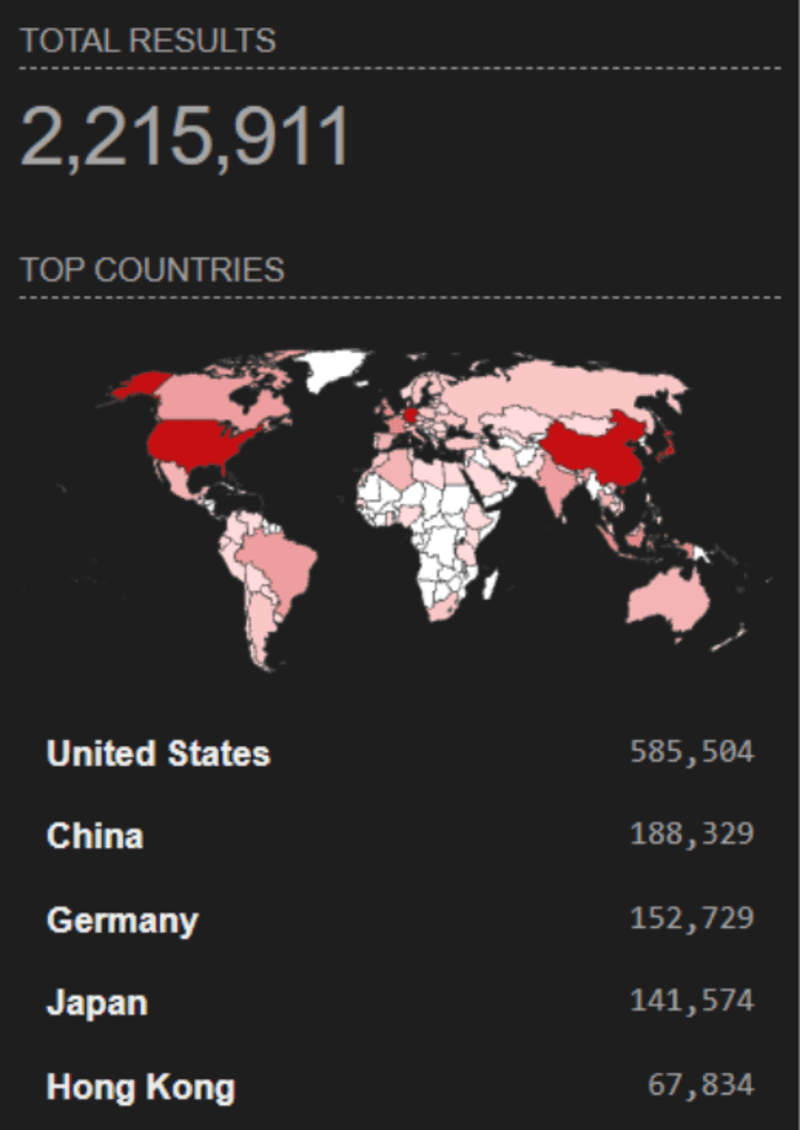
Search engine result counts by country from the capture described above (query not recorded; indicative only).
| Field | Detail |
|---|---|
| CVE IDs | CVE-2026-109618, CVE-2026-109619 |
| Affected product | PHP core (the PHP language runtime itself, not a plugin or framework) |
| Affected versions | Not confirmed in the notice; reports say PHP 5 to 8 with the flaws dating to 2004; fixes planned only for the supported branches |
| Fixed versions | Reported as 8.5.12, 8.4.27, 8.3.36 and 8.2.35, per one researcher citing the PHP notice; check php.net |
| Severity | Critical; CVSS 9.2 (v4.0) from the PHP team; some outlets say 10.0 |
| Vulnerability type | Remote code execution (per researchers); a published analysis describes a use after free in session upload progress handling and a second path in multipart parsing; disputed |
| Exploitation status | No confirmed exploitation as of 21 Oct, midday; exploit tool and a laboratory framework circulating; mass attacks expected |
| Interim measures | session.upload_progress.enabled set to Off (partial); block multipart requests where uploads are not needed (partial); neither replaces the patch |
| Fix | Emergency PHP release scheduled for 14:00 UTC on 21 Oct |
Recommendations
- List every system that runs PHP, including those managed by agencies, hosting providers and software suppliers, and note the PHP version on each. Do this first, before the patch.
- Patch to the fixed release for your branch as soon as it is available, and rebuild container images and base images that include PHP. Check distribution packages, which can lag the upstream release.
- If you cannot patch at once, consider the interim measures: turn off session upload progress, and block multipart requests on sites that do not need uploads. Test them first, and do not treat them as a fix.
- Plan the upgrade or isolation of systems on PHP versions that will get no fix, and ask suppliers who run such versions for a date.
- Until patched, restrict exposure of internet facing PHP applications to what is needed, and watch web logs for unusual multipart requests and for new files in web directories, in case of a web shell.
- Do not rely on a web application firewall alone, and note that one widely used firewall product (SiteGuard) is itself under attack this week.
CVE-2026-106931: SiteGuard Server Edition Command Injection
SiteGuard Server Edition is a host based web application firewall that is widely used in Japan and installs into Apache, Nginx and IIS web servers. The vendor says its statistics function, which is on by default, has an OS command injection flaw that lets an attacker run commands as root on Linux and FreeBSD or as SYSTEM on Windows. The vendor’s alert states that abuse has already been confirmed, and Japan’s JPCERT/CC issued an emergency alert on the same day. The vendor told customers with direct support contracts on 29 September and published its alert on 14 October. CISA added the flaw to its catalog on 20 October. The attacker, the victims and the method have not been published.
The vendor gives an unusual warning: updating or patching may erase traces of an attack, so administrators should first download the diagnostic information from the web management screen. The vendor also offers a file replacement patch for installations that cannot upgrade, including end of life versions. IIS editions 3.10 to 4.00 Update 4 are not affected. The severity is rated CVSS 8.5 under v4.0 and 7.8 under v3, and the vector is described as local with low privileges, yet the flaw is being exploited against servers and JPCERT/CC rates it critical. How the attack gets from the internet to the statistics function has not been explained, so the vector label should not be read as saying remote exploitation is unlikely.
| Field | Detail |
|---|---|
| CVE ID | CVE-2026-106931 |
| Affected product | SiteGuard Server Edition, host based WAF |
| Affected versions | Apache, Nginx and IIS (not FreeBSD): 2.20 and later before 8.00 Update 5. FreeBSD Apache and Nginx: 2.20 and later before 7.00 Update 6. Only when the statistics function is on. IIS 3.10 to 4.00 Update 4 not affected |
| Severity | CVSS 8.5 (v4.0); 7.8 (v3.0); local vector, low privileges; rated critical by JPCERT/CC |
| Vulnerability type | OS command injection (CWE-78) in the statistics function |
| Impact | Commands as root (Linux, FreeBSD) or SYSTEM (Windows) |
| Exploitation status | Exploited; vendor and JPCERT/CC confirmation; CISA KEV 20 Oct 2026 |
| Fix | 8.00 Update 5 (7.00 Update 6 for FreeBSD); file replacement patch for other versions |
Recommendations
- Before changing anything, download the diagnostic information from the web management screen and keep it with your incident record.
- Then upgrade to 8.00 Update 5 (7.00 Update 6 on FreeBSD), or apply the vendor’s file replacement patch where an upgrade is not possible.
- Assume exposure since at least 29 September on servers that ran an affected version with statistics enabled: check for unexpected processes, new accounts, scheduled tasks and outbound connections, and rotate secrets held on those hosts.
- Restrict access to the management interface and review whether a security product with root privileges needs to be reachable from the internet.
CVE-2026-99999: PwnEscape, Linux Kernel Guest to Host Escape
PwnEscape is a flaw in the Linux kernel’s IPv4 networking code, assigned CVE-2026-99999 by the kernel’s CVE team. When a packet with bad checksum metadata enters the stack, the checksum routine can write over a packet header the kernel has already checked and acted on. A guest virtual machine can use this to leak host kernel memory, crash the host and, in the researcher’s lab, run code as root on the host. The code dates back to kernel 2.6.27. A researcher found it during a public sandbox challenge in August 2026 and reported it privately on 4 September. The fix was accepted on 8 October, merged into the mainline kernel on 14 October and announced with the CVE on 15 October. The number looks like a placeholder, but it is a genuine kernel assignment.
The scoring differs: the CVE record gives 9.3 and one Linux vendor gives 8.8 because it assumes the attacker needs some privileges. Public technical detail and a proof of concept exist, and no exploitation had been confirmed in the sources we reviewed. One Linux vendor’s portal says it tracks the flaw as an active exploit case, which conflicts with other sources and with its absence from the CISA catalog, so we treat that as unverified. Hosts that run untrusted guests are exposed whatever the distribution. Shared hosts without virtual machines are exposed only where unprivileged users can create user namespaces. Patched kernels are available for Debian (bookworm 6.1.190-1 and trixie 6.12.113-1), and other distributions were testing or preparing updates at the time. Partial mitigations are to turn off checksum offload for untrusted guests and to disable unprivileged user namespaces.
| Field | Detail |
|---|---|
| CVE ID | CVE-2026-99999 (PwnEscape) |
| Affected product | Linux kernel, IPv4 networking (skb_checksum_help), since 2.6.27 |
| Severity | Critical; CVSS 9.3 (CVE record), 8.8 (one Linux vendor) |
| Vulnerability type | Out of bounds write from unvalidated checksum metadata (CWE-787) |
| Impact | Host memory disclosure, host crash, code execution as root on the host (lab) |
| Who is exposed | Hosts that run untrusted guests; shared hosts where unprivileged users can create user namespaces |
| Exploitation status | Public proof of concept; no confirmed exploitation in sources reviewed; one vendor lists it as exploited, unverified |
| Fix | Mainline commit merged 14 Oct 2026; distribution kernel updates rolling out |
Recommendations
- Update the kernel on hypervisors and container hosts first, particularly multi tenant cloud, hosting, CI runners and any host that runs guests you do not control.
- Where you cannot update yet, disable checksum offload for untrusted guests and disable unprivileged user namespaces, and accept that these are partial.
- Ask cloud and hosting providers what they have done, and if you run your own virtualization, make a list of hosts and guests by trust level.
Also this week
CISA added six vulnerabilities to its catalog on 20 October, including three in Plex Media Server and one in Siemens Software Center along with SiteGuard. A critical command execution flaw in the Collabora component used with Nextcloud, CVE-2026-110447, is being exploited, with the advisory published on 14 October, more than four weeks after the fix. F5 released out of band patches for critical NGINX vulnerabilities, which we have seen at headline level only. Last issue’s Ivanti Connect Secure and Bricksforge flaws were exploited and should still be treated as urgent.
07. Darkweb and Underground Activity
PHP2Shell: an exploit tool ahead of the patch
The most useful underground signal this week is a negative one for defenders: working exploit material for the PHP flaws surfaced before the fix did. A screenshot of PHP2Shell, credited to a research group, leaked with the embargoed advisory, its banner claims it works on every PHP release from 5.4.0, and a short exploitation video was posted and then taken down. An independent researcher then published a technical report with a laboratory exploit framework. Other analysts say its test code targets a less common web server build and may not work as published, and one says it looks partly generated from public code commits, yet it points at the right area for at least one of the flaws. That mix is typical of leaks: partial, unreliable and still useful to attackers who finish the job. Past patterns suggest scanning for exposed PHP servers starts within hours of a release, and public exploit code often appears before the CVE is formally published. Organizations that finished their inventory before the release were in a much better position than those that began afterwards.
A laundering network exposed
On 5 October an on chain investigator published a long thread saying he had spent months posing as a paying client of a Chinese network that launders stolen cryptocurrency. He says the network moved more than $1 billion for Lazarus Group, including almost all of the Bybit proceeds, and that he got access after funding an address with $349,700. He reported tracing about $12 million of stolen funds and helping to freeze 442,000 USDT. Authorities have not confirmed the network’s size or its link to Lazarus, and the investigator’s account of what operators told him cannot be checked. Its value for defenders is the picture of how stolen funds are turned into cash: through brokers, over the counter desks and exchanges with weak identity checks.
Borrowed branding
Hexsomeware borrows its look from hacktivist culture and television: a ransom screen signed Fsociety, Anonymous, Stay together, a demo victim ID and no way to reach the operators. Branding like this costs nothing and proves nothing, and it is a reminder that the underground produces noise as well as threats. The first job with any new name is to find out whether anyone has actually been hit.
08. Key Takeaways
- Inventory PHP now. The flaws are in PHP core, a fix covers only the supported 8.2 to 8.5 branches and exploit material is already circulating. A published analysis points at upload handling and suggests a stopgap setting, but the stopgap is not a fix and the analysis is disputed. Know every server that runs PHP, including those a supplier manages, and be ready to patch or isolate.
- Treat security software as attack surface. FlashHole abuses mandatory banking security software, and a widely used web application firewall is being exploited. Patch the SiteGuard flaw after saving the diagnostic data the vendor asks for.
- Check your certificate chains. eMudhra’s weak keys were fixed by revocation, but certificates under the affected chain need replacing, and Go applications need rebuilding.
- Look at your development systems. Nikkei and Meta lost personal data from places that should not have held it, through stolen logins. Mask data, use multifactor authentication and monitor them like production.
- Know what your contractors run. ETS’s file transfer site exposed California student records. Find the file transfer sites and portals that hold your customers’ data and ask how a breach there would reach you.
- Patch Linux hosts that run guests you do not control. PwnEscape breaks the boundary between guest and host, and partial mitigations exist for those who cannot update at once.
- Keep claims separate from evidence. The Lazarus label, Hexsomeware’s origin, the ransomware leak site listings and the severity scores for PHP and PwnEscape are all contested or unconfirmed.
Priority actions this week
| Priority | Action | Why now |
|---|---|---|
| Immediate | List all PHP systems and patch to the fixed release for your branch as soon as it is out; plan for PHP versions with no fix | CVE-2026-109618 and CVE-2026-109619 are critical, details leaked and an exploit tool is circulating |
| Immediate | Download SiteGuard diagnostic information, then upgrade to 8.00 Update 5 (7.00 Update 6 on FreeBSD) or apply the vendor patch | CVE-2026-106931 is exploited and on the CISA catalog since 20 October |
| Immediate | Find certificates issued under the eight revoked eMudhra intermediates, replace them and rebuild Go applications | Browser blocks are in place and affected certificates will stop working |
| This week | Patch kernels on hypervisors, container hosts and any host that runs untrusted guests; disable checksum offload for untrusted guests where you cannot | CVE-2026-99999 lets a guest attack the host; proof of concept is public |
| This week | Remove personal data from development and test systems, and enforce multifactor authentication on all cloud and developer accounts | Nikkei and Meta both lost data through stolen logins to development systems |
| This week | Review contractor run file transfer sites and portals that hold your customer or student data | ETS exposed millions of records through an SFTP site it operates |
| This week | If you operate in South Korea, hunt for the FlashHole indicators and review the mandatory banking security software on staff devices | Lazarus Group abused CrossWeb EX in a campaign running since July 2025 |
| This week | Verify offline backups and alert on Defender tampering, shadow copy deletion and registry changes that disable Task Manager or cmd.exe | Hexsomeware does all of these, and the same signals catch better ransomware |
Disclaimer
This Report is provided for informational and security-awareness purposes only. The information presented is based on intelligence collected from publicly available sources, underground forums, dark web sources, third-party feeds, and other available data at the time of analysis.
Threat intelligence may be incomplete, outdated, unverified, or subject to change. References to threat actors, organizations, vulnerabilities, indicators, or incidents represent observed or reported information and should not be considered definitive attribution unless explicitly stated and supported by reliable evidence.
The information contained in this report should be independently validated before being used for security, operational, legal, or business decisions. iZOOlogic does not guarantee the accuracy, completeness, or timeliness of the information and shall not be held responsible for any actions or decisions taken solely based on this report.
This report is intended for authorized recipients and should be handled in accordance with applicable organizational security, confidentiality, and information-sharing policies.
