
 HQ/EMEAFind out how we can help your business

In This Issue
01. Threat Landscape
The financial sector’s third party problem was on full display this week. On 19 November the ransomware group n0n published customer data tied to JPMorgan Chase, Visa and Mastercard after a 48 hour countdown. All three say the data came from outside vendors that run marketing and loyalty programs, that no payment data or core systems were involved and that they are working with the vendors. About 16,000 JPMorgan Reserve cardholders, more than 6,000 Visa premium cardholders in Asia-Pacific and Mastercard cardholders in several regions are affected, and none of the vendors has been named. On 24 November FinCEN, the US financial regulator, said an unauthorized party had accessed a limited subset of its systems and moved some Bank Secrecy Act filing deadlines to 30 December. A sixth South Korean savings bank also confirmed a breach.
The second story is a control plane. Broadcom fixed a critical authentication bypass in VMware vCenter on 19 November (CVE-2026-123890) after research showed a suspected China-nexus group, Armory Castle, had used it as a zero day since early September. The group’s tool steals the vCenter directory database and the SAML signing key, so patching alone does not end its access. Five days later Broadcom fixed a second, separate vCenter bypass in the same service (CVE-2026-123903), with public proof of concept code claimed on the day of the patch.
The third is a first. Researchers say autonomous AI agents run through an open source framework found a previously unknown path traversal flaw in MONAI Label, a medical imaging server, went from mapping its interface to writing arbitrary files in about 11 minutes and later got a root shell on a university server, with a suspected Chinese operator behind them. CISA put the flaw in its catalog on 23 November. Add Ruby2Shell, a Ruby interpreter flaw that gives code execution in default Rails applications, and a stealer called Remus whose advertised Gmail zero day turned out to be a fake browser extension, and the week was one of machines doing more of the work.
We tracked 10 incidents, listed under Breached Organizations below. Three came through a compromised third party vendor, three are claims or leaks that the organizations have not confirmed, two used zero days against a control plane or an application, one began with abnormal access to a mobile website and one has no disclosed entry path. The largest by reach is the vendor leak across three global financial brands, with the regulator incident the most sensitive.
What changed this week
- n0n published data tied to JPMorgan Chase, Visa and Mastercard on 19 November. The firms say marketing vendors were the source and that no payment data was exposed. The vendors are not named, and the group also listed several financial services firms in Canada, Mexico and the United States on 24 and 25 November.
- FinCEN disclosed unauthorized access to some systems on 24 November and extended some Bank Secrecy Act filing deadlines to 30 December. It has not said which systems, when the access began or whether data was taken.
- Armory Castle exploited VMware vCenter CVE-2026-123890 as a zero day from early September, after first using a remote support appliance zero day. Broadcom patched it on 19 November, CISA listed it on 20 November, and a second vCenter bypass, CVE-2026-123903, was fixed on 24 November.
- AI agents found and exploited a zero day in MONAI Label (CVE-2026-133968) in about 11 minutes. It was added to the CISA catalog on 23 November, and the fixed version is 0.8.6.
- Ruby2Shell (CVE-2026-132825), a heap overflow in Ruby’s string case conversion, was fixed on 18 November in Ruby 3.3.14, 3.4.13 and 4.0.10. Several widely used self hosted products still ship an affected Ruby, and the finders plan to publish a proof of concept.
- Black Lotus, a new Windows ransomware, encrypts files with the .black_lotus extension, tells victims to contact a Telegram handle or a Simplex link and not to involve law enforcement. The name has nothing to do with the 2023 BlackLotus UEFI bootkit.
- Remus Stealer was advertised as having a Gmail zero day that survives password changes. Researchers found a fake Google Sheets Chrome extension that reads Gmail through the browser session, and no Gmail flaw.
- Korea Investment Savings Bank said on 24 November that the personal information of 86,433 customers was leaked after abnormal external access to its mobile website, the sixth savings bank hit since late September.
- Java4Shell and NGINX2Root, covered last issue, now have public proof of concept code in part, scanning has begun and neither is confirmed exploited.
Confidence in this assessment
Most of this issue rests on vendor, government and company statements and carries high confidence. Where it does not, the text says so. The main open points are:
- n0n leaks: the three firms confirm a vendor leak but not the vendors’ names or the full count. The group is new, and trackers report that it names many organizations at once, so its other listings should be treated as claims. One article says the group used AI agents, which is its own claim.
- FinCEN: the agency has confirmed unauthorized access to a limited subset of systems and nothing else. We do not know whether the filing portal itself was reached or whether data was taken.
- Armory Castle: the attribution to a suspected China-nexus group is at moderate confidence in the research. One update says its tool was seen in July, earlier than the first reported exploitation in September, so the start date is not settled.
- MONAI Label: the AI agent account comes from one research report, and the operator is linked to China with moderate confidence.
- Ruby2Shell: the CVE record scores it 7.4 and the Ruby team calls it critical, so labels disagree. The Ruby team says it knows of proof of concept exploits, and none had been reported used.
- Black Lotus: no victims, leak site or operator are known. The note’s date is the sandbox clock plus seven days.
- Remus: the operators’ claim of access that survives a password reset has not been verified, and the extension, not a Gmail flaw, explains what researchers saw.
How the breaches happened
The 10 incidents fall into five groups by what let the attackers in or, where that is unknown, by what has been disclosed. A compromised vendor is the largest known route, and it is the one that reached the biggest names.
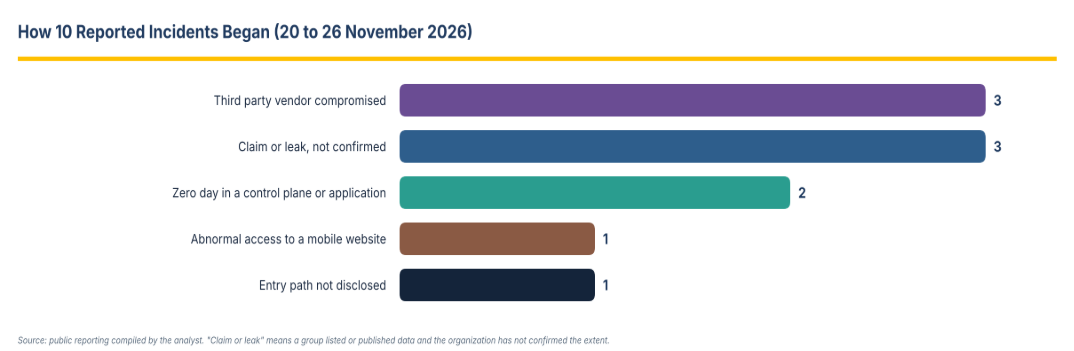
Figure 1. Initial access across 10 incidents first reported or updated between 20 and 26 November 2026.
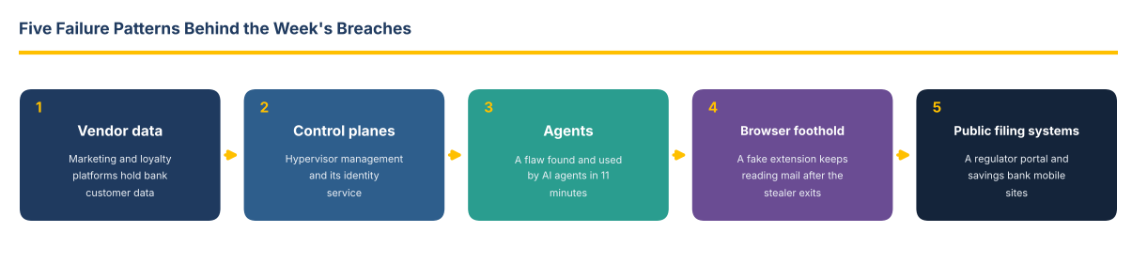
Figure 2. Five failure patterns behind the week’s breaches.
Vendor data
The leaked records are the kind that sit in marketing, loyalty and reservation systems: names, email addresses, phone numbers, dining and travel bookings, and for some JPMorgan customers account identifiers. A bank, a card network and a payments company each handed that data to a supplier that guarded it less well than their own systems. The fallout is mostly phishing, with the better targeted lures that premium cardholders attract, but it also damages trust in a way no patch fixes.
Control planes
vCenter manages the virtual machines that hold most enterprise workloads, and its directory service issues the identities that other systems trust. Armory Castle did not stop at taking the server: its tool copies the directory database and the SAML signing key, which lets it forge administrator sessions later, past a patch and past multifactor authentication. The same service had a second flaw fixed five days after the first. A control plane that was exploited as a zero day for more than two months should be treated as possibly compromised, not only as unpatched.
Agents
In the MONAI Label case the agents mapped an API, found an upload filename parameter that allowed path traversal and wrote arbitrary files within about 11 minutes. The other targets in the campaign, such as an unauthenticated Redis server, took hours of failed attempts, which shows that the agents are not infallible, only persistent and cheap. A person’s one contribution was a proxy into a second university network. Software with weak defaults and no authentication, often used by research teams and data scientists, is the easiest prey.
Browser foothold
Remus shows how a browser extension can outlast the malware that installed it. After the stealer has run and exited, a fake Google Sheets extension keeps reading Gmail through the user’s signed in session. Changing a password does not remove it, and removing the extension is the fix. The same lesson applies to any workforce browser: an unapproved extension is a persistent foothold.
Public filing systems
The FinCEN incident touches the systems that banks use to file suspicious activity reports, and the Korean savings banks were reached through mobile websites. Neither case has a public technical cause yet. Both are a reminder that systems that exist to meet regulatory duties can be the ones with the least resilience, and that an outage of a filing portal can have its own compliance cost.
Questions to ask your own team
- Which suppliers hold your customers’ names, emails, bookings or account identifiers for marketing, loyalty or events, and what do your contracts say about their security, breach notice and data retention?
- Is your vCenter patched for both directory service flaws, and could you tell whether an attacker took the SAML signing key or created an administrator account?
- Which research, data science and imaging servers run in your environment without authentication, who owns them and are they reachable from the internet?
- Which browser extensions can your staff install, and would you notice one reading their mail?
Breached organizations
Organizations are named as in public reporting. The list covers incidents first reported or materially updated between 20 and 26 November 2026. Attacker claims are marked as claims, and counts are those reported by the organization unless marked otherwise. Check each name against your own suppliers and their suppliers.
| Organization | Sector, country and date | How it happened | Scale and status |
|---|---|---|---|
| JPMorgan Chase | Banking, US. Confirmed 19 Nov | Attackers reached marketing data held by outside vendors, per the bank; the n0n group claimed and leaked it | About 16,000 Chase Reserve cardholder email addresses, some with phone numbers and account IDs, and 124 bank employees; the bank says no payment data and no core systems; credit monitoring offered |
| Visa | Payments, global. Confirmed 19 Nov | A vendor in Asia-Pacific, per Visa; the data looks like a marketing platform for dining programs | More than 6,000 premium cardholders, reported in Hong Kong, Japan, Singapore, Australia and South Korea; no card numbers, per Visa |
| Mastercard | Payments, global. Confirmed 19 Nov | Third party providers; leaked by n0n | Cardholder contact details, travel and dining bookings and marketing records, in North America, the Middle East and Africa; exposure said to be contained; network unaffected |
| FinCEN | Financial regulator, US. Disclosed 24 Nov | Unauthorized party accessed a limited subset of systems; entry, start date and data not disclosed | Some systems offline; Bank Secrecy Act filing deadlines extended to 30 Dec |
| Korea Investment Savings Bank | Banking, South Korea. Announced 24 Nov | Abnormal external access to its mobile website | Personal information of 86,433 customers; the bank says account passwords were not leaked; sixth savings bank hit since late Sept |
| Organizations running VMware vCenter | Multiple sectors, global. Research 19 to 20 Nov | Armory Castle exploited a vCenter authentication bypass as a zero day from early Sept, after a remote support appliance zero day | “Multiple incidents” per the research; no victims named; patch 19 Nov; tool steals the directory database and SAML signing key |
| University servers running MONAI Label | Education and research, East Asia. Sept, reported 20 Nov | AI agents run by a suspected China-nexus operator found a path traversal zero day and used it | Root shell on one university server; a second university network reached through a tunnel; about 48 hours of activity |
| WHI Holdings (Works Human Intelligence) | HR software provider. Listed 24 Nov | Listed by the INC Ransom group with sample images and a countdown; entry unknown | Claim only; not confirmed by the company |
| Restaurant Brands International (Burger King) | Food service, global. Published about 25 to 26 Nov | Data published by the Inception ransomware group; entry not disclosed | Claim and leak; extent not confirmed in the sources we reviewed |
| Financial services firms listed by n0n | Payments, wealth and tax advice, Canada, Mexico and the United States. Listed 24 to 25 Nov | Listed on the n0n leak site: PayClip, Atlantis Financial, Generations Wealth, ClearPath Wealth Management, Buyers Advisors and a tax advice firm; entry unknown | Claims only; not confirmed by the firms |
Notes. The vendors behind the JPMorgan, Visa and Mastercard leaks are not named by the firms, and numbers differ across reports, from about 16,000 JPMorgan customers to more than 22,000 across the three brands. The listings of financial services firms are claims from leak site tracking and several belong to a group that lists many victims a day. The Restaurant Brands row is based on a claim that we could not confirm independently.
02. Emerging Threats and Campaigns
n0n and the vendor leaks: JPMorgan, Visa and Mastercard
n0n is a ransomware and extortion group that first appeared in mid September 2026 and has become one of the most active posters on leak sites within weeks. On 16 November it listed Mastercard, Visa and JPMorgan Chase and started a 48 hour countdown. On 19 November, when the deadline passed, it published marketing files. JPMorgan said on the same day that attackers had accessed marketing data held by outside vendors, which may include some customer names and email addresses, and that the incident had nothing to do with a separate service slowdown earlier in the week. The leak covers about 16,000 email addresses of holders of the Chase Reserve card, an invitation only product, some with phone numbers and account IDs, and 124 bank employees. Visa said a vendor in Asia-Pacific was the source, and the data, more than 6,000 premium cardholders, appears to come from a marketing platform for dining programs. Mastercard’s data includes cardholder contact details, travel and dining bookings and marketing records. All three say no card numbers or payment data were exposed and that their own systems were not involved.
The firms have not named the vendors, and one report suggests the JPMorgan data came from a platform that manages loyalty programs. The group’s page had no screenshots of the data when the countdown began, so the claim could not be checked at that stage. The leak that followed matched what the firms then confirmed. For institutions that run similar programs, the sensible reading is that any supplier with premium customers’ contact details and spending behaviour is a target, and that the exposure is a source of convincing phishing and fraud, not of direct financial loss.
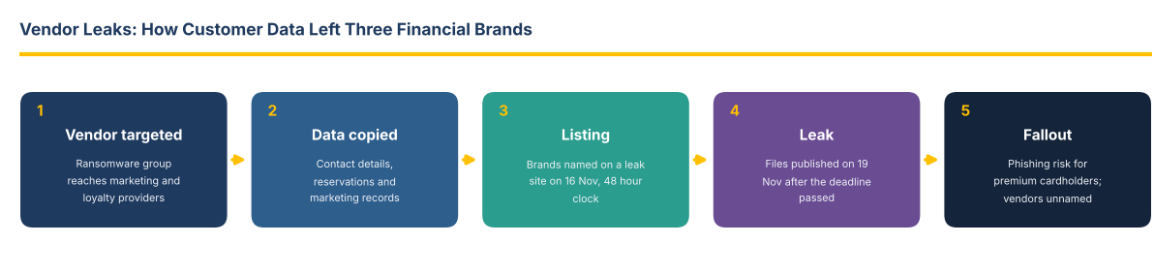
Figure 3. How customer data left three financial brands through their vendors (after the firms’ statements and public reporting).
| Field | Detail |
|---|---|
| Group | n0n, a ransomware and extortion group active since mid September 2026 |
| Dates | Listed 16 Nov; 48 hour countdown; leaked 19 Nov; firms confirmed 19 Nov |
| Source | Outside vendors running marketing, loyalty and dining programs; not named by the firms |
| JPMorgan | About 16,000 Reserve cardholder emails, some with phones and account IDs; 124 employees |
| Visa | More than 6,000 premium cardholders in Asia-Pacific; vendor in the region |
| Mastercard | Cardholder contacts, bookings and marketing records in several regions |
| Firms’ position | No payment data, no card numbers, no core systems; customers to be contacted; credit monitoring offered |
Recommendations
- List every vendor that holds customer contact data for marketing, loyalty, events or dining programs, including those run by your card network or partner banks, and require breach notice terms, security reviews and limits on retention and fields shared.
- Share the minimum: avoid sending account identifiers, phone numbers or spending details to marketing platforms that do not need them, and tokenize where possible.
- Prepare customer messages for a vendor leak, warn premium customers about phishing and watch for fraud calls that use details from the leaked files.
- Treat leak site countdowns as an early warning: check listings daily for your name and your vendors’ names.
FinCEN: a regulator’s systems accessed
FinCEN disclosed on 24 November, in a service alert on its BSA E-Filing website, that an unauthorized party had accessed a limited subset of its systems. It took some systems offline and moved some Bank Secrecy Act filing deadlines to 30 December. The portal is the one banks and other financial institutions use to submit suspicious activity reports and other filings. The agency has not said which systems were reached, when the access began or whether any data was viewed or taken. Until it does, institutions should avoid assuming either that their filings are exposed or that they are not. Filing records are sensitive, because a suspicious activity report names customers and describes the bank’s suspicions, and the rules forbid disclosing their existence.
- Follow the agency’s service alerts for the new deadlines, and keep a record of when you filed and what you submitted, in case of re-filing.
- Review the accounts that your staff use on the portal, enforce multifactor authentication and remove people who no longer file.
- Prepare for questions from regulators and examiners about your filing process during the outage.
Korean savings banks: the sixth victim
Korea Investment Savings Bank announced on 24 November that abnormal external access to its mobile website exposed the personal information of 86,433 customers, the largest breach so far among savings banks. It says sensitive information tied directly to transactions, including account passwords, was not leaked. It brings to six the savings banks hit since the end of September. No public attribution or method has been published for these incidents, and we do not claim a link to the ARTEX campaigns that hit other Korean institutions earlier this autumn. Institutions with mobile sites should check logs for abnormal external access, review rate limits and bot controls, and look for scripted user agents and bursts of requests.
AI agents: a zero day found and used without a person
The MONAI Label case, covered under Vulnerability Intelligence, is the clearest example yet of agents doing the whole job: mapping an application, finding a flaw nobody had reported and using it. A cloud provider’s threat team reports that the agents ran for about 48 hours against university networks in East Asia, failed against some targets and succeeded against others, and left an unprotected control panel that exposed the operator’s prompts and run history. The FBI’s advisory from two weeks ago warned of intrusions that reach privileged access in under three hours. The practical response is the same: find and fix your own exposed and forgotten services first. See also the separate iZOOlogic threat advisory on ARTEX.
- Inventory research, data science and imaging servers, annotation tools and model gateways, since they often ship with authentication off and run as root.
- Run them behind a gateway with authentication, as unprivileged users with write access limited to their data directory.
- Watch for new files written outside expected directories, new Python startup files and unexpected training jobs.
ScreenConnect: exploitation against MSP technicians
Following the SCKit campaign covered last issue, threat actors are now exploiting the patched ScreenConnect flaw CVE-2026-84869 to target MSP servers and technician workstations without warning. Providers that have not applied the vendor’s fix, removed unapproved extensions and invalidated technician sessions should assume exposure. Ask your managed service providers whether they have done so.
03. Threat Actor Activity
Armory Castle (formerly UNC5221)
Armory Castle is the name that current research uses for a suspected China-nexus espionage cluster that was formerly tracked as UNC5221. The cluster is known for exploiting zero days in edge and management appliances, such as remote access and support products, and then moving quietly through the identity and virtualization systems behind them. Earlier research linked it to zero day attacks on VPN appliances and to a backdoor for vCenter. Attribution to China is at moderate confidence in the current research, and the motive is espionage: stealing secrets that help reconnaissance and downstream compromises.
A report published on 19 November describes its most recent chain. In late August the group exploited a zero day in a remote support appliance (CVE-2026-102764) to break in at the edge and steal secrets. From early September, in the course of the same intrusions, it exploited a second zero day, CVE-2026-123890, an authentication bypass in the VMware Directory Service that runs inside vCenter Server and gives an unauthenticated attacker the [email protected] account. The flaw is a session key disclosure over DCE/RPC, and the attacker needs only network access to the vCenter. The exploit tool, a Go utility called BONESAW, connects over port 2012, creates a new single sign on administrator, copies the directory database (the LMDB file) and extracts the SAML signing key of the Security Token Service. With that key the group can forge administrator sessions, known as Golden SAML, that bypass multifactor authentication and do not depend on a password. Other tool names in the research are SAWSNAKE, BEARBONES and LAZYBONES. One update says investigators found BONESAW in use in July, on a server that was already patched for an earlier vCenter bypass (CVE-2026-59309, disclosed on 29 July), so the first use may have been earlier than September.
Broadcom patched the flaw on 19 November with no workaround, and CISA added it to its catalog on 20 November. Fixed builds are vCenter 8.0 U3m, 9.0.2.0200 and 9.1.1.0200, with VMware Cloud Foundation taking the fix through vCenter. vCenter 7.0 had no public patch at the time of the first reports. A second flaw in the same directory service, CVE-2026-123903, was fixed on 24 November in an advisory covering 23 flaws, with public proof of concept code claimed on the same day. The patch does not undo what the group did: the SAML signing certificate is unchanged unless it is rotated, forged assertions made before the patch can still work, the rogue administrator and local accounts remain, and SSH keys added to ESX hosts persist. Recovery means rotating the identity trust that the attacker abused.
| Attribute | Detail |
|---|---|
| Names | Armory Castle (current research name), formerly UNC5221 |
| Assessed origin | China-nexus, suspected; moderate confidence |
| Motivation | Espionage; secrets and access for downstream compromise |
| Typical targets | Organizations running edge and management appliances, and the virtualization and identity systems behind them |
| Initial access | Zero days in edge appliances, including a remote support product (CVE-2026-102764) |
| Current chain | vCenter authentication bypass CVE-2026-123890 from early September; BONESAW; Golden SAML |
| Tooling | BONESAW (Go) with SAWSNAKE, BEARBONES and LAZYBONES artifacts |
| Status | Active; report published 19 Nov 2026; patch 19 Nov; CISA catalog 20 Nov |
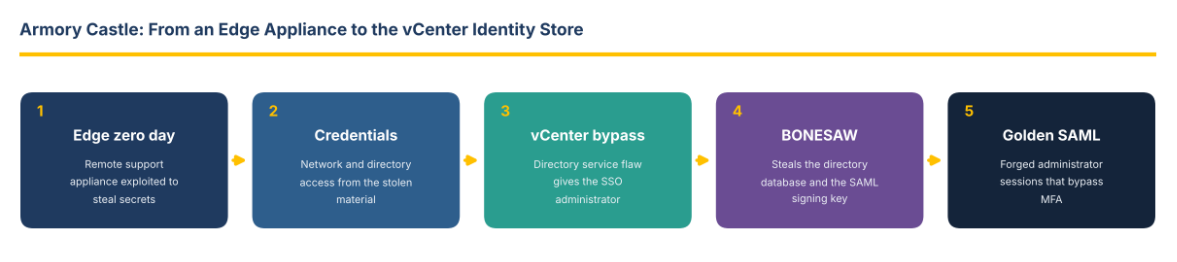
Figure 4. Armory Castle from an edge appliance to forged vCenter sessions (after the published research).
Hunting guidance
| Signal | Where to look | Why it matters |
|---|---|---|
| Connections to port 2012 on a vCenter from addresses other than ESX hosts and approved tools | Network logs and vCenter firewall logs | BONESAW exploits the directory service over this port |
| New single sign on administrators or local accounts created outside change control | vCenter SSO and local account audit | The tool creates a backdoor administrator |
| Reads or copies of the directory database file and the Security Token Service signing material | File access and vmdir logs on the appliance | The group steals the LMDB file and the SAML signing key |
| SAML assertions or administrator sessions with unusual issuance times or sources | vCenter and identity logs | Forged tokens bypass multifactor authentication |
| New SSH authorized keys for root on ESX hosts | Host configuration and SSH logs | Persistence survives a vCenter update |
| Artifacts named BONESAW, SAWSNAKE, BEARBONES or LAZYBONES on appliances | File integrity monitoring on vCenter | Tool names from the research |
MITRE ATT&CK techniques
Technique IDs are our own mapping from the published research.
| Tactic | ID | Technique | Observed procedure |
|---|---|---|---|
| Initial Access | T1190 | Exploit Public Facing Application | Zero days in a remote support appliance and in vCenter |
| Credential Access | T1552 | Unsecured Credentials | Secrets taken from the edge appliance |
| Persistence | T1136 | Create Account | New SSO administrator and local accounts |
| Credential Access | T1606.002 | Forge Web Credentials: SAML Tokens | Golden SAML administrator sessions from the stolen signing key |
| Defense Evasion | T1556 | Modify Authentication Process | Authentication bypass in the directory service |
| Collection | T1005 | Data from Local System | Copy of the directory database |
| Persistence | T1098.004 | Account Manipulation: SSH Authorized Keys | SSH keys on ESX hosts |
| Lateral Movement | T1021.004 | Remote Services: SSH | Pivot from vCenter to ESX hosts |
Recommendations
- Patch vCenter now for both CVE-2026-123890 and CVE-2026-123903 (VMSA-2026-0009 and VMSA-2026-0011), and plan a replacement for vCenter 7.0, which has no public patch. Do not expose vCenter to the internet or to broad internal networks.
- After patching, assume compromise if the vCenter was reachable since early September: rotate the SAML signing certificate and the vSphere SSO and service credentials, remove unknown administrators and local accounts and check ESX hosts for new SSH keys.
- Hunt for BONESAW artifacts and unusual connections to the directory service port, and review identity logs for forged administrator sessions.
- Move management of virtual infrastructure to a separate network, require multifactor authentication for administrators and monitor administrator logins and changes.
- Review remote support and other edge appliances for the zero day and stolen secrets: rotate credentials and tokens held by them.
04. Ransomware and Data Leaks
Black Lotus Ransomware (new, unrelated to the UEFI bootkit)
Black Lotus is Windows ransomware first scanned publicly around 11 and 12 November 2026 and noted by researchers in the following week. It appends the .black_lotus extension, drops a note called how2recovery.txt and replaces the wallpaper with a dark, polished lotus image headed Your files have been encrypted, which tells victims to open the note on the desktop and not to rename files or use third party recovery tools. The sandbox shows Windows registering a BLACK_LOTUS file type for the encrypted files. The name is shared with other things and should not be confused with them: it has no connection with BlackLotus, the 2023 UEFI bootkit that bypassed Secure Boot, which was a firmware threat, or with other uses of the name in industry.
The note is short. It says the network has been encrypted and lists four warnings: do not rename or modify files, because decryption will fail; do not use third party recovery tools, because files will be permanently damaged; do not involve law enforcement or incident response companies, because it will not help and raises the price; and you need the group’s decryptor and cipher key. It gives two ways to make contact, a Telegram handle, @black_lotus_ransom, and a link to a Simplex chat, asks the victim to include a victim ID in the first message, warns that the longer you wait the higher the price and states a date on which the decryptor expires. There is no ransom amount, and no leak site or payment address is shown. The expiry date in our capture is 3 December 2026, exactly seven days after the sandbox run, so it is likely computed at run time and says nothing about a real victim. Telling victims not to call incident responders is a pressure tactic, not a technical claim, and the advice that does the most good is the opposite.
The behaviour is aggressive. The sandbox shows the sample clearing Windows event logs on a large scale, deleting shadow copies and using the Volume Shadow Copy COM API, changing boot configuration data with bcdedit, deleting the backup catalog with wbadmin and renaming 2,419 files, far more than the samples we analysed in recent weeks. It enumerates connected drives, drops files in System32 and in Program Files on a large scale, modifies registry classes and settings under the user hive, changes system policy and uses the Task Scheduler COM API, which suggests persistence. It reads browser profile data and enumerates browser information, which are credential theft behaviours, though we saw no data leaving the sandbox. Nothing is known about delivery, victims or the operator.
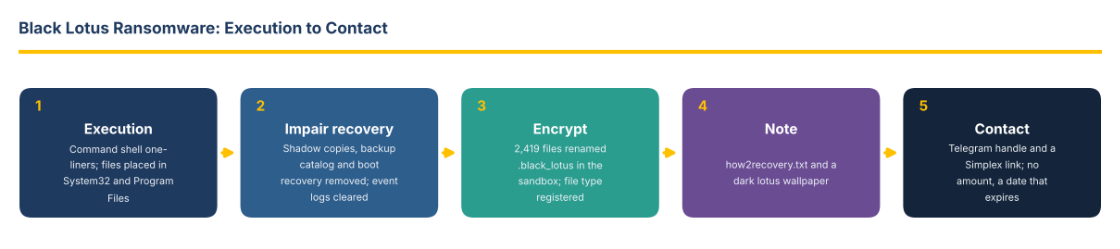
Figure 5. Black Lotus flow from execution to the contact details (assembled from sandbox behaviour signatures and the note).
Observed evidence
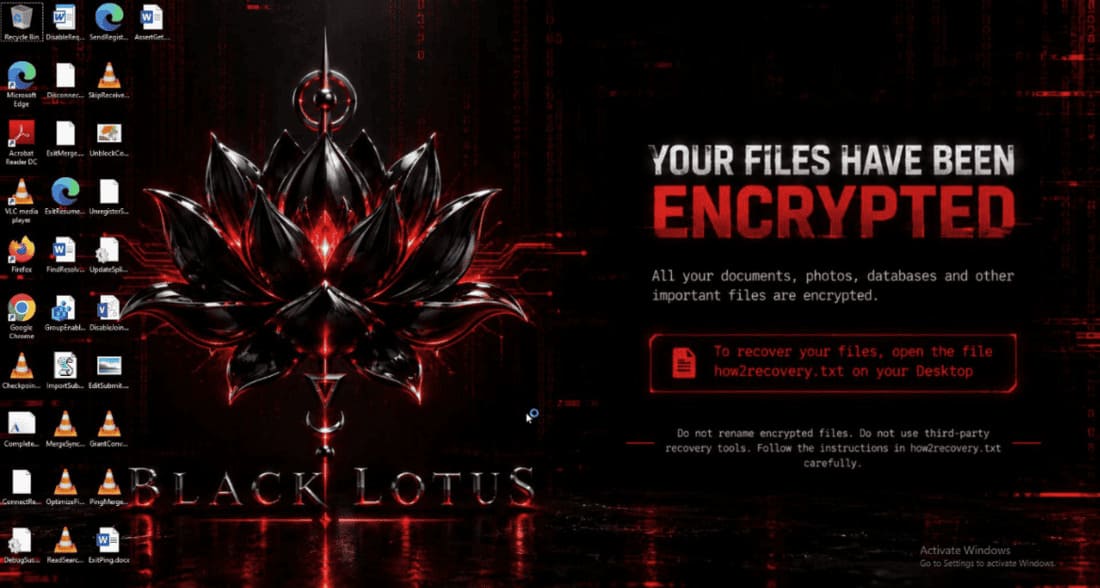
Figure 6. The sandbox desktop after execution, with the Black Lotus wallpaper and the instruction to open how2recovery.txt.
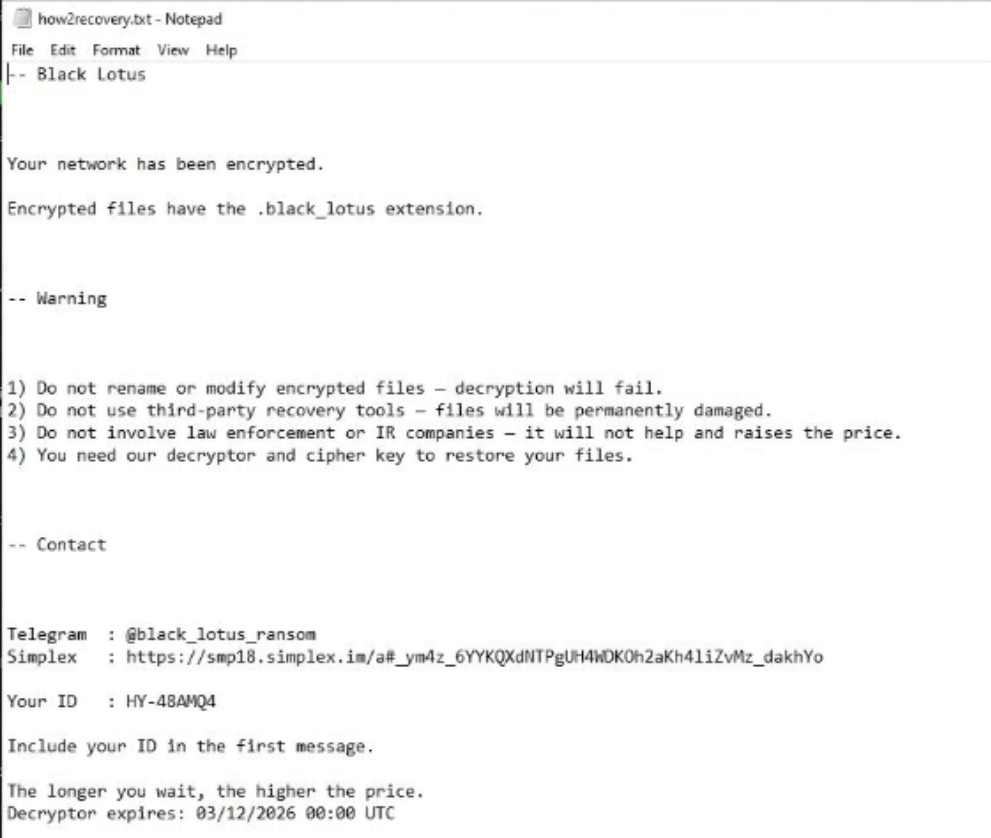
Figure 7. The how2recovery.txt ransom note with the Telegram handle, the Simplex link, the victim ID and the expiry date.
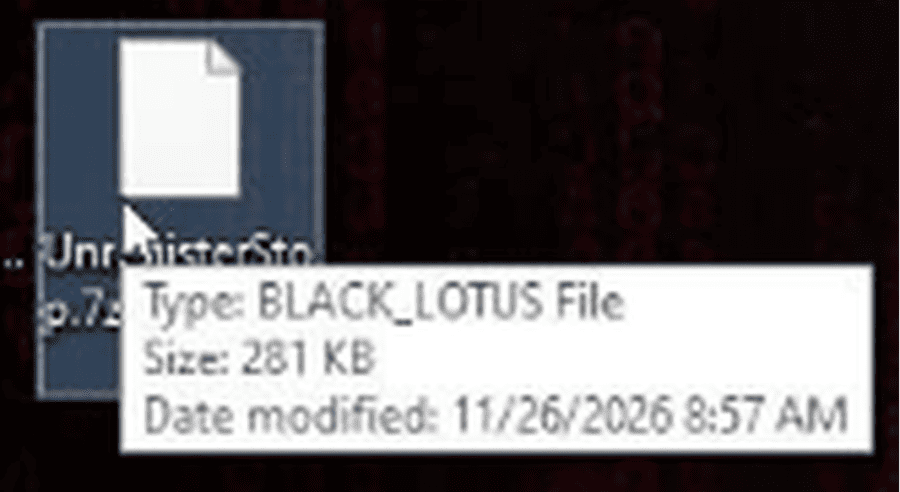
Figure 8. An encrypted file in the sandbox: file type BLACK_LOTUS, 281 KB, modified 26 November 2026.
Behavioural signatures
Sandbox analysis shows the sample clearing Windows event logs, deleting shadow copies, changing boot configuration with bcdedit, deleting the backup catalog with wbadmin and renaming 2,419 files with a new extension. It reads browser profile data, enumerates browser information and connected drives, drops files in the System32 directory and in Program Files, sets the wallpaper through the registry and modifies registry classes and data under the user hive. It executes command shell one-liners, reads the hostname and domain from the registry, checks SCSI registry keys, modifies system policy, uses a Windows hook and the Task Scheduler COM API, and opens its note in Notepad.
MITRE ATT&CK techniques
The first group of rows is the sandbox mapping. Rows marked as added are our own, for behaviour the sandbox report shows but its mapping leaves out.
| Tactic | ID | Technique | Observed procedure |
|---|---|---|---|
| Execution | T1059.003 | Command and Scripting Interpreter: Windows Command Shell | Runs cmd.exe one-liners |
| Execution | T1047 | Windows Management Instrumentation | Uses WMI |
| Defense Evasion | T1006 | Direct Volume Access | Accesses volumes directly |
| Defense Evasion | T1070.001 | Indicator Removal: Clear Windows Event Logs | Clears Windows event logs |
| Defense Evasion | T1070.004 | Indicator Removal: File Deletion | Deletes shadow copies and the backup catalog |
| Defense Evasion | T1112 | Modify Registry | Sets the wallpaper, file type and policy values |
| Credential Access | T1555.003 | Credentials from Web Browsers | Reads user and profile data of web browsers |
| Credential Access | T1552.001 | Unsecured Credentials: Credentials In Files | Sandbox flagged reads of credential material in files |
| Discovery | T1217 | Browser Information Discovery | Enumerates browser information |
| Discovery | T1120 | Peripheral Device Discovery | Enumerates connected drives |
| Discovery | T1012 | Query Registry | Reads system settings |
| Discovery | T1082 | System Information Discovery | Reads hardware and system details |
| Discovery | T1016 | System Network Configuration Discovery | Reads the hostname and domain |
| Collection | T1005 | Data from Local System | Collects local data |
| Impact | T1491 | Defacement | Replaces the desktop wallpaper |
| Impact | T1490 | Inhibit System Recovery | Deletes shadow copies, the backup catalog and boot recovery settings |
| Impact (added) | T1486 | Data Encrypted for Impact | Renames and encrypts files with .black_lotus |
| Persistence (added) | T1053.005 | Scheduled Task/Job: Scheduled Task | Task Scheduler COM API used |
| Discovery (added) | T1497.001 | Virtualization/Sandbox Evasion: System Checks | Checks SCSI registry keys |
Indicators of compromise
| Indicator | Type | Context |
|---|---|---|
| 26157f02cc1b6c7cb636888dd5619dc 01aeec7ae1eab1a6ca9fd9114adcf678d | SHA256 | Black Lotus sample |
| .black_lotus | File extension | Appended to encrypted files |
| how2recovery.txt | Filename | Ransom note |
| @black_lotus_ransom | Telegram handle | Contact in the note |
| smp18[.]simplex[.]im/a#_ym4z _6YYKQXdNTPgUH4WDKOh2aKh4liZvMz_dakhYo | Simplex link | Chat contact in the note (transcribed from the capture; verify) |
| HY-48AMQ4 | Victim ID | Printed in the note for this sample; expected to differ per victim |
| BLACK_LOTUS File | File type | Registered file type for encrypted files |
Other ransomware and extortion activity
The n0n group listed more than 50 organizations in a single day around 16 November, including payments and wealth management firms, and its listings on 24 and 25 November added PayClip, Atlantis Financial, Generations Wealth, ClearPath Wealth Management and others. Trackers and commentators note its credential driven, AI assisted style and claims of nearly 200 victims, which makes its listings a mix of real incidents and claims. The INC Ransom group listed WHI Holdings, an HR software provider, on 24 November with sample images and a countdown to a release of cloud credentials. The Inception group published data attributed to Restaurant Brands International, the owner of Burger King, and two banks named by a group called Storm in November confirmed breaches, one of them a savings bank that told 16,069 people that names and Social Security numbers were affected. These are claims until the organizations confirm.
Recommendations
- Keep offline or immutable backups and test restoration. Black Lotus removes shadow copies, the backup catalog and boot recovery settings, clears event logs and covers every connected drive.
- Alert on wbadmin delete catalog, shadow copy deletion, bcdedit recovery changes, clearing of the Security and System logs (Event IDs 1102 and 104) and new file type registrations in the registry.
- Do not follow a note’s advice to avoid incident response. Involve responders and law enforcement, preserve the note and a sample encrypted file, and treat contact channels such as Telegram and Simplex as evidence, not as a place for staff to go.
- Assume browser stored passwords on an infected machine are stolen. Reset credentials, revoke sessions and review mapped drives.
- Check leak sites and your vendors’ names daily, since several financial firms were listed with little warning this week.
05. Credential and Account Exposure
Remus Stealer: the Gmail “zero day” that was a browser extension
Remus is a Windows information stealer sold to criminals as a service. On 8 November its operators began advertising version 1.3.9 with a feature that lets a buyer open a compromised Gmail inbox from a control dashboard, and claimed that access continued after the victim changed the password or revoked sessions. Research on 9 November recorded those claims, found no demonstration and found no evidence of a previously unknown Gmail flaw, and a self described customer said the access survived a password change. The feature was marketed as an enterprise option at about $1,000 a month. The mail provider’s own statement is that attacks using stolen session tokens on infected devices are not new and that there is no Gmail vulnerability involved.
Analysis published on 24 November explains what the feature is. The stealer delivers, through its dynamic configuration, a Windows DLL that carries a Chrome extension inside a ZIP archive. PowerShell unpacks the archive into the temporary folder, and the module edits Chrome’s profile preference files directly and turns on Developer Mode, because Chrome removed the launch switch that malware used to load extensions and enables unpacked extensions only in Developer Mode. The extension is named to look like Google Sheets. It uses the victim’s existing signed in Gmail session to read new mail about once a minute, including verification codes, and sends it to a collection server. The analysis describes retrieval of messages without attachments, and notes that checking several account slots does not show that all of them were compromised.
Two points matter for defenders. The label is wrong: there is no Gmail zero day, and treating it as a Google flaw would send teams to the wrong place. And the claim that a password reset does not help is partly true for a different reason: the extension stays installed after the stealer has exited, and it works through the browser’s signed in session, so a reset alone does not end it. The fix is to find and remove the extension and the preference changes, revoke sessions and rebuild the browser profile. For financial institutions, a stolen mailbox is the key to password resets, one time codes and the correspondence that fraud depends on, which makes the extension a high value foothold.
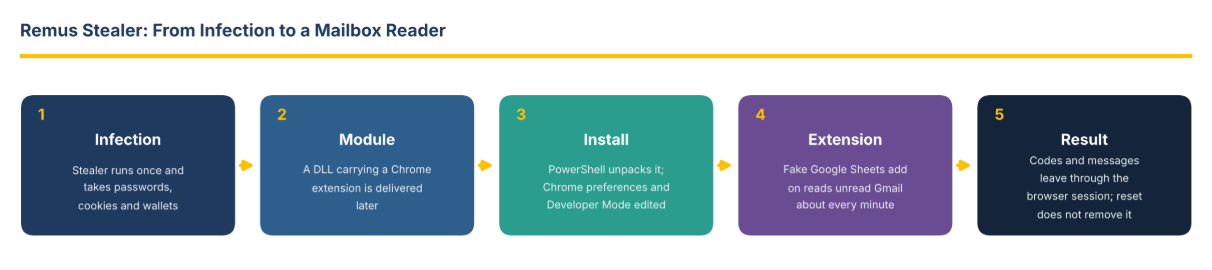
Figure 9. How Remus turns a one time infection into a persistent mailbox reader (after the published research).
| Attribute | Detail |
|---|---|
| Type | Windows information stealer sold as a service; version 1.3.9 advertised from 8 Nov 2026 |
| Claim | Persistent Gmail access that survives password changes; marketed at about $1,000 a month as an enterprise feature |
| Reality | A Chrome extension disguised as Google Sheets that reads Gmail through the existing browser session; no Gmail flaw |
| Delivery of the module | A DLL carrying the extension ZIP, delivered later by dynamic configuration; not embedded in the stealer |
| Install | PowerShell Expand-Archive into the temporary folder; Chrome profile preferences edited and Developer Mode enabled |
| Behaviour | Reads unread mail about once a minute, including verification codes; no attachments retrieved |
| Persistence | The unpacked extension remains after the stealer exits; a password reset does not remove it |
MITRE ATT&CK techniques
Technique IDs are our own mapping from the published research.
| Tactic | ID | Technique | Observed procedure |
|---|---|---|---|
| Execution | T1059.001 | Command and Scripting Interpreter: PowerShell | Expand-Archive unpacks the extension ZIP |
| Persistence | T1176 | Browser Extensions | Malicious unpacked Chrome extension |
| Defense Evasion | T1112 | Modify Registry | Chrome profile preferences edited and Developer Mode enabled |
| Credential Access | T1555.003 | Credentials from Web Browsers | Stealer takes saved credentials and cookies |
| Credential Access | T1539 | Steal Web Session Cookie | Session tokens used to reach Gmail |
| Collection | T1114.002 | Email Collection: Remote Email Collection | Unread Gmail messages and codes read through the session |
| Command and Control | T1071.001 | Application Layer Protocol: Web Protocols | Messages sent to a collection server |
Indicators of compromise
| Indicator | Type | Context |
|---|---|---|
| cfmepkojgnkahbmgablgdahdomjdppgf | Chrome extension ID | Extension disguised as Google Sheets |
| mgggekjcdcdaiagafcbdhcdapifehhmc | Chrome extension ID | Second extension ID from module analysis |
| hxxps://prem1um[.]onl/m | URL | Collection endpoint |
| PowerShell Expand-Archive of a ZIP named with a 32 character extension ID | Behaviour | Unpacking of the extension in the temporary folder |
| Chrome with Developer Mode enabled and an unpacked extension that the user did not install | Configuration | Result of the profile edit |
Recommendations
- Block unmanaged Chrome extensions through policy, restrict Developer Mode and alert on unpacked extensions and on changes to profile preference files.
- Hunt for the extension IDs, the collection endpoint and PowerShell unpacking ZIP files in temporary folders, and for Chrome profiles with Developer Mode switched on.
- If a machine had an infostealer, remove the extension, rebuild the browser profile, revoke all sessions, reset passwords and one time code settings from a clean device and review the mailbox for rules, forwarding and sent items.
- Do not accept claims of a zero day on their face. Ask for the technical evidence and check the simpler explanation first.
- Give staff with access to payments, treasury and administrator roles hardware bound authentication, so that a stolen mailbox cannot reset their access.
Golden SAML: when the signing key is the credential
Armory Castle’s tool steals the key that signs vCenter’s SAML tokens. Whoever holds it can write administrator sessions that no password, reset or multifactor prompt can stop, until the signing certificate is replaced. The same applies to any identity provider or federation service whose signing key can be taken from a server, including directory federation servers and cloud identity bridges. Treat signing keys as the most sensitive credentials you have: protect them in hardware, restrict who can reach the host, alert on exports and rotate them after any suspected compromise.
06. Vulnerability Intelligence
Four advisories are covered here, in order of urgency. Two are on the CISA catalog, one is exploited as a zero day and one was found by AI agents. A fourth, Ruby2Shell, is a critical flaw in a language runtime that sits under many self hosted products. Java4Shell and NGINX2Root, covered last issue, have moved from disclosure to scanning, and are updated at the end.
| Priority | CVE | Product and severity | Exploitation and fix |
|---|---|---|---|
| 1 Immediate | CVE-2026-123890 and CVE-2026-123903 | VMware vCenter directory service, authentication bypass; CVSS 9.8 each | First exploited as a zero day since early Sept, CISA KEV 20 Nov; second has public proof of concept claimed; fixed in 8.0 U3m, 9.0.2.0200, 9.1.1.0200 |
| 2 Immediate | CVE-2026-133968 | MONAI Label, path traversal and arbitrary file write, unauthenticated by default; CVSS 9.8 | Exploited by AI agents; CISA KEV 23 Nov; fixed in 0.8.6 (22 Nov) |
| 3 This week | CVE-2026-132825 (Ruby2Shell) | Ruby string case conversion heap overflow; critical per Ruby, 7.4 in the CVE record | No exploitation reported; fixed in 3.3.14, 3.4.13, 4.0.10; proof of concept expected |
CVE-2026-123890 and CVE-2026-123903: VMware vCenter Directory Service Authentication Bypass
CVE-2026-123890 is an unauthenticated authentication bypass in the VMware Directory Service, vmdir, that runs inside vCenter Server. It is rated CVSS 9.8, is classified as authentication bypass using an alternate path or channel, and gives an attacker the [email protected] account, the most privileged identity in the vSphere single sign on domain. Broadcom disclosed it on 19 November in advisory VMSA-2026-0009, with no workaround. Research the same day showed that a suspected China-nexus group, Armory Castle, had exploited it as a zero day since early September, more than two months before the fix, across multiple incidents. CISA added it to its catalog the next day. The exploit chain, tooling and recovery steps are described under Threat Actor Activity.
CVE-2026-123903 is a different flaw in the same service. Broadcom fixed it on 24 November in advisory VMSA-2026-0011, which covers 23 flaws across ESX, vCenter, Workstation, Fusion, VMware Tools and Avi Load Balancer, including two further 9.8 rated ESX flaws. A malicious actor with network access to vCenter can bypass authentication, and there is no workaround. Several researchers reported it independently, public proof of concept code was reported on 24 November and we have not verified it, and Broadcom does not mention exploitation. Broadcom’s advisories often omit exploitation warnings, so silence is not proof of safety. It is the third vmdir bypass fixed this year, after one in July and the zero day. Patches for the earlier flaw cannot be assumed to cover the new one, so check that both advisories are applied.
| Field | Detail |
|---|---|
| CVE IDs | CVE-2026-123890 (VMSA-2026-0009); CVE-2026-123903 (VMSA-2026-0011) |
| Affected product | VMware vCenter Server directory service (vmdir); the second advisory also covers ESX and other VMware products |
| Fixed versions | vCenter 8.0 U3m, 9.0.2.0200 and 9.1.1.0200 for the first; vCenter 7.0 had no public patch; check VMSA-2026-0011 for the second |
| Severity | CVSS 9.8 for both; no workaround |
| Vulnerability type | Authentication bypass using an alternate path or channel (CWE-288) in vmdir |
| Exploitation status | CVE-2026-123890 exploited since early Sept 2026, CISA KEV 20 Nov; CVE-2026-123903 public proof of concept claimed, no exploitation reported |
| Attack requirement | Network access to vCenter; no credentials |
Recommendations
- Apply VMSA-2026-0009 and VMSA-2026-0011 to every vCenter and ESX host, and plan the replacement or extended support of vCenter 7.0.
- Restrict network access to vCenter to a management network, and never expose it to the internet.
- For any vCenter reachable since early September, rotate the SAML signing certificate and SSO and service credentials, review SSO administrators and local accounts and check ESX hosts for new SSH keys.
- Hunt for BONESAW artifacts and connections to the directory service port, and review identity logs for forged sessions.
CVE-2026-133968: MONAI Label Path Traversal, Found by AI Agents
MONAI Label is an open source server for annotating medical images, used by research teams. CVE-2026-133968 is a path traversal flaw in its datastore upload endpoints, PUT /datastore/image and PUT /datastore/label, which build the destination path from the image identifier or label tag without confining it to the datastore. A caller can therefore write files anywhere the server process can write. Authentication is off by default, so any client that can connect can use it, and the severity is CVSS 9.8. The maintainers released version 0.8.6 on 22 November, which also fixes a similar flaw in session upload. The advisory had appeared on 18 November and the CVE on 20 November, and CISA added it to its catalog on 23 November.
What makes the case notable is how it was found. A cloud provider’s threat team reports that autonomous AI agents run through an open source penetration testing framework called Cairn, operated by a suspected China-nexus actor at moderate confidence, identified the application, mapped its API, found the upload filename parameter and tested it for traversal. They went from mapping to arbitrary file writes in about 11 minutes. On one university server they planted a Python startup file and triggered a training job that ran it, which returned a reverse shell as root. The operator then gave the agents a proxy into a second university network that ran the same software. The activity ran for about 48 hours from 8 September, and other targets, including an unauthenticated Redis server, held out for hours of failed attempts. The framework’s control panel was left unprotected and exposed the operator’s prompts and run history, which is how the activity was reconstructed.
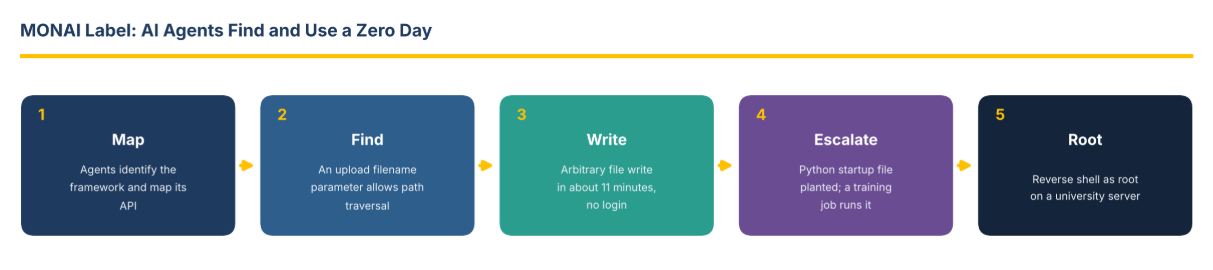
Figure 10. How AI agents found and used the MONAI Label flaw (after the published research).
| Field | Detail |
|---|---|
| CVE ID | CVE-2026-133968 (advisory GHSA-qc22-rmgc-vg94) |
| Affected product | MONAI Label, open source medical image annotation server |
| Affected versions | 0.8.5 and earlier; authentication disabled by default |
| Fixed versions | 0.8.6 (released 22 Nov 2026); requires Python 3.11 or newer |
| Severity | CVSS 9.8 critical |
| Vulnerability type | Path traversal (CWE-22) leading to arbitrary file write |
| Exploitation status | Exploited since Sept 2026 by AI agents; CISA KEV 23 Nov 2026, federal deadline 26 Nov |
| Interim measures | Do not expose the server to untrusted networks; run as an unprivileged user with write access limited to the datastore; review for unexpected files |
Recommendations
- Upgrade MONAI Label to 0.8.6 or later. Keep it off untrusted networks, enable authentication and run it as an unprivileged user.
- If a 0.8.5 or older server was reachable, look for unexpected files, new Python startup files such as sitecustomize.py, unfamiliar training jobs and outbound reverse shells, and treat the host as compromised until cleared.
- Inventory annotation tools, model servers and gateways, Redis and other data science services, and bring them under normal patching and authentication.
CVE-2026-132825: Ruby2Shell, Ruby String Case Conversion Heap Overflow
Ruby2Shell is a one byte heap buffer overflow in how Ruby changes the case of strings in some legacy single byte encodings, such as ISO-8859-1 and Windows-1252. In those encodings a case change can produce a longer result, for example the German letter ß becomes SS, and the affected code checks for one byte of space but writes two, corrupting the adjacent heap. It is reached through functions such as upcase, swapcase, downcase with folding and casecmp?, and the vulnerable code dates to Ruby 2.4.0. UTF-8 strings take a different path and are not affected. Ruby released 4.0.10, 3.4.13 and 3.3.14 on 18 November, fixing this and six other memory safety flaws in the regular expression engine and string handling, so upgrading covers all seven. Ruby 3.2 and older have no fix.
The Ruby team rates the flaw critical and says it knows of proof of concept exploits that give code execution in some scenarios. The finders say it is reachable without authentication in default Rails and classic style Sinatra applications, and plan to publish a proof of concept about a week after disclosure. The CVE record, published by the MITRE assigner, scores it only 7.4 with a local vector and high complexity, so the labels disagree. A low number on a vulnerability list should not hide it from a team that runs public Rails applications. Because the flaw is in the interpreter, updating application gems does not fix it, and several self hosted products that bundle Ruby, including popular code hosting, collaboration and customer support platforms, still shipped an affected Ruby in their latest releases on 19 November. No exploitation had been reported, and it is not on the CISA catalog.
| Field | Detail |
|---|---|
| CVE ID | CVE-2026-132825 (GHSA-34m4-m9fh-gqp5), named Ruby2Shell |
| Affected product | Ruby interpreter, and products that bundle it |
| Affected versions | Ruby 2.4.0 to 3.3.13, 3.4.0 to 3.4.12 and 4.0.0 to 4.0.9 where untrusted strings are case converted in ISO-8859 or Windows-125x encodings |
| Fixed versions | 3.3.14, 3.4.13, 4.0.10; no fix for 3.2 and older |
| Severity | Critical per the Ruby team; CVSS 7.4 in the CVE record |
| Vulnerability type | One byte heap buffer overflow in string case conversion |
| Exploitation status | No exploitation reported as of 19 to 20 Nov 2026; proof of concept exploits known to the maintainers; public release expected |
| Interim measure | None published; a web application firewall rule may block the exploit request until you upgrade |
Recommendations
- Upgrade Ruby to 3.3.14, 3.4.13 or 4.0.10 and restart. Replace Ruby 3.2 and older, which have no fix.
- Find self hosted products that bundle Ruby and ask the suppliers for fixed releases; apply a web application firewall rule as a stopgap where you can.
- Review Rails and Sinatra applications that handle untrusted text in legacy encodings, and expect exploit code to appear within days.
Java4Shell and NGINX2Root: where they stand a week on
Neither flaw is confirmed exploited and neither is on the CISA catalog, but both have moved. For Java4Shell, sensors recorded more than 150 requests shaped like attacks from five addresses and honeypot requests with a Java4Shell reconnaissance user agent, with no successful intrusion reported. The public proof of concept only triggers the memory corruption, while a vulnerability intelligence provider has a full remote code execution exploit for its customers. A security vendor’s release on 24 November that describes the flaw as under active exploitation cites no incident data. For NGINX2Root, a finder’s firm published a proof of concept for the lead flaw, CVE-2026-123007, and two other finders hold working exploits that they have not released. Patch first, and treat the window as short.
Also this week
The ScreenConnect flaw CVE-2026-84869 is being exploited against MSP technicians, as covered under Emerging Threats. A critical flaw in a legacy ASP.NET anti-CSRF library, Idunno.AntiCsrf, is exploited for unauthenticated code execution, and users are urged to stop using it. A cloud management flaw at a travel router and remote KVM maker was used to install malware on some customers’ devices. A Windows local privilege escalation exploit named SignDrop was released publicly without a fix, and a Chrome flaw exploited in the wild was patched. For the Danfoss refrigeration controller flaws and N-central, see earlier issues.
07. Darkweb and Underground Activity
n0n: a leak site that moves at machine pace
n0n runs its leak site with a rhythm that other groups have copied from older gangs and then sped up. It lists many victims at once, it started a 48 hour countdown on three of the best known names in finance on a single Monday, and it published the files when the clock ran out. Trackers recorded it naming 59 organizations on 16 November alone, and it claims nearly 200 victims since September. Its listings on 24 and 25 November added payments, wealth and tax advice firms in Canada, Mexico and the United States. A commentator reported on 25 November that n0n says it used AI agents against the financial industry. That is the group’s own claim and we have not seen evidence for it, but the tempo is consistent with automation. The practical rules are the same: check daily for your name and your suppliers’ names, treat each listing as a claim until verified, and prepare customer messages in advance.
Black Lotus: contact through messaging apps, not Tor
Most ransomware notes send victims to a Tor chat. Black Lotus gives a Telegram handle and a link to a Simplex chat, which is an end to end encrypted messenger that does not need a phone number. Both are easy to open and easy to abandon, and neither leaves the kind of hosted infrastructure that investigators can take down. The note’s instruction to avoid incident response and law enforcement is aimed at the moment of highest pressure. Defenders can record the handle and the link as indicators, but should expect the contact details to change quickly, and should not send staff to message a handle they found in a note.
Remus: marketing a feature that was a browser extension
Remus is sold as a stealer with tiers, and its operators found that a headline feature sells. Advertising persistent Gmail access that survives password changes, as an option at about $1,000 a month, drew attention from researchers who found it was a browser extension and not a mail service flaw. This is how the criminal market now competes: dashboards, enterprise tiers and claims of a zero day that make a stealer look like a product. For buyers, the feature turns a one time infection into months of access to a mailbox. For defenders, the claims are marketing and the detection is concrete: the extension IDs, the collection endpoint and the preference edits.
08. Key Takeaways
- Your vendors hold your customers. JPMorgan, Visa and Mastercard customer data left through marketing and loyalty suppliers that were not named. Map every vendor that holds contact data, limit what you share, require breach notice and prepare phishing warnings for premium customers.
- Treat vCenter as a control plane that may be compromised. A zero day was used for more than two months, the attacker’s tool steals the SAML signing key, and a second bypass followed five days after the first. Patch both advisories, then rotate the signing certificate and credentials and look for rogue administrators and SSH keys.
- Agents now find and use zero days. In MONAI Label they went from mapping an API to arbitrary file writes in about 11 minutes. Inventory research and data science servers that run without authentication, patch them and run them as unprivileged users.
- Do not trust labels. Remus advertised a Gmail zero day and was a browser extension; Ruby2Shell is critical per Ruby and 7.4 in the CVE record; Black Lotus shares a name with an unrelated UEFI bootkit. Ask for the technical evidence and check the simple explanation first.
- Ruby2Shell can sit under products you did not know used Ruby. Upgrade Ruby and ask suppliers of self hosted products for fixed releases, since several still shipped an affected version.
- Regulators’ systems are targets too. FinCEN took some systems offline and moved filing deadlines to 30 December. Keep your own filing records, follow service alerts and prepare for examiner questions.
- Do not follow a ransom note’s advice. Black Lotus tells victims not to involve incident response or law enforcement, and gives no way to verify anything. Keep offline backups, preserve the note and call responders.
- Keep claims separate from evidence. The n0n AI agent claim, the other n0n listings, the WHI and Restaurant Brands listings, the vCenter start date and the second vCenter flaw’s exploitation status all rest on a single source or on a claim.
Priority actions this week
| Priority | Action | Why now |
|---|---|---|
| Immediate | Apply VMSA-2026-0009 and VMSA-2026-0011 to vCenter and ESX; restrict vCenter to a management network; rotate the SAML signing certificate and credentials; hunt for BONESAW and rogue administrators and SSH keys | CVE-2026-123890 was exploited as a zero day since early September and a second bypass has public proof of concept claimed |
| Immediate | Upgrade MONAI Label to 0.8.6, enable authentication and keep the server off untrusted networks; review reachable servers for unexpected files and startup scripts | AI agents exploited CVE-2026-133968 and CISA set a deadline of 26 November |
| Immediate | Review vendors that hold customer contact data for marketing and loyalty programs; set notice terms and limits on fields; warn premium customers about phishing | n0n leaked JPMorgan, Visa and Mastercard customer data through vendors on 19 November |
| This week | Upgrade Ruby to 3.3.14, 3.4.13 or 4.0.10, ask suppliers of self hosted products for fixed releases and add a web application firewall stopgap | Ruby2Shell can give code execution in default Rails applications and a proof of concept is expected |
| This week | Apply Java4Shell and NGINX2Root fixes from last issue and watch for scanning; both have public proof of concept in part | Probes have begun and exploit code is available to some |
| This week | Block unmanaged Chrome extensions and Developer Mode; hunt for the Remus extension IDs and endpoint; rebuild profiles and revoke sessions on infected machines | The Remus extension keeps reading Gmail after the stealer exits |
| This week | Follow FinCEN service alerts, keep records of filings and review portal accounts and multifactor authentication | Some filing deadlines were moved to 30 December after unauthorized access |
| This week | Verify offline backups and alert on wbadmin catalog deletion, shadow copy deletion, bcdedit changes and event log clearing; involve responders if a note says not to | Black Lotus removes every recovery route and clears event logs |
Disclaimer
This Report is provided for informational and security-awareness purposes only. The information presented is based on intelligence collected from publicly available sources, underground forums, dark web sources, third-party feeds, and other available data at the time of analysis.
Threat intelligence may be incomplete, outdated, unverified, or subject to change. References to threat actors, organizations, vulnerabilities, indicators, or incidents represent observed or reported information and should not be considered definitive attribution unless explicitly stated and supported by reliable evidence.
The information contained in this report should be independently validated before being used for security, operational, legal, or business decisions. iZOOlogic does not guarantee the accuracy, completeness, or timeliness of the information and shall not be held responsible for any actions or decisions taken solely based on this report.
This report is intended for authorized recipients and should be handled in accordance with applicable organizational security, confidentiality, and information-sharing policies.
