
 HQ/EMEAFind out how we can help your business

In This Issue
01. Threat Landscape
The week was dominated by the largest cryptocurrency theft on record. On 29 October attackers drained about $6.3 billion from Binance’s hot wallets across ten blockchains, most of it in around 20 minutes. Binance says the cause was a compromised engineer’s workstation that led to a service container and the system that signs withdrawals, and says it has found no evidence that any private key leaked. The FBI attributed the theft on 31 October to North Korea’s TraderTraitor group, the same cluster tied to the Bybit theft, and listed more than 600 addresses. About $3 billion was frozen, Binance resumed withdrawals in phases on 1 November and says it has covered about 95 percent of the affected amount from its insurance fund and treasury.
Two other lines of research bear directly on financial clients. A report on Volt Typhoon’s Silent Train network shows a China state aligned actor using short lived chains of hacked routers to run zero day attacks on SD-WAN controllers, remote management platforms and other control planes. And a report on CyberDakait documents seven families of Android banking trojans aimed at Indian banking customers, with at least 17,960 infected phones and more than 7.6 million intercepted text messages, spread through fake calls and texts from a bank. Around them, the usual supply chain pattern continued: a third party script drained about $2.7 million from Polymarket users, a hardware wallet maker lost customer records and a device authenticity key, and a second wallet maker warned of a suspected hardware implant in devices sold by the reseller at the centre of the Ledger case.
We tracked 13 incidents, listed under Breached Organizations below. Four came through a compromised supplier, script or reseller, and one through an engineer’s endpoint into a signing system. One used AI assisted techniques, one targeted customers by phone and malware, and one used zero days on management platforms. One has no disclosed entry path, and four are claims by ransomware groups or data sellers that the organizations have not confirmed. Binance is the largest by value, at about $6.3 billion.
What changed this week
- Binance. About $6.3 billion was stolen from hot wallets on ten chains on 29 October. The FBI attributed it to TraderTraitor on 31 October. Withdrawals reopened in phases on 1 November, with a net outflow of about $3.6 billion in the first hours. Details are under Emerging Threats.
- Volt Typhoon. Research on 28 October describes Silent Train, a rotating relay of compromised routers and devices, and four zero day campaigns against Versa Director, N-able N-central, Cisco Catalyst SD-WAN and VeloCloud Orchestrator. The network has been disrupted.
- CyberDakait. Seven Android banking trojan families, including GhostBat, targeted customers of 11 Indian banking institutions from July 2025. At least 17,960 phones were infected and about 7.6 million messages intercepted. Details are under Credential and Account Exposure.
- One Decryptor, a new Windows ransomware, demands 0.42 BNB on the BNB Smart Chain within 72 hours, then double. Unlike last week’s Coffin Locker, its payment address is valid and its claims are consistent. The name is the ransom screen’s, not a decryption tool.
- Vulnerabilities. A Linux kernel TCP flaw (CVE-2026-98432) scored 9.8 can be reached by a single network packet and is not yet fixed in some major distributions. A Drupal Commerce flaw (CVE-2026-118539) that lets anyone tamper with store data is exploited. An Android flaw (CVE-2026-58882) lets a text message crash phones, and a public exploit exists.
- Crypto supply chain. A hijacked monitoring service injected a wallet drainer into Polymarket’s site, a hardware wallet maker will destroy 18,835 devices after losing a device authenticity key, and a second wallet maker warned about an implant in devices from the CryptoBilis reseller.
- A blockchain analytics firm disclosed a breach in which attackers used offensive agentic techniques to reach systems and internal tools, exposing customer names, emails and job roles. A malicious extension that impersonated an AI coding assistant was found on an AI code editor’s marketplace, affecting up to 5,000 users.
- Cisco confirmed that an ASA and Firepower VPN flaw (CVE-2026-76418) is exploited to crash firewalls, and PHP2Shell attacks have now compromised servers, including management interfaces of a firewall product and a US government affiliated network.
- Two offers of workforce data appeared on criminal forums: a claimed full database and source code of an Indian employee monitoring platform for $10,000, and a claimed civil servant database for Karimun Regency in Indonesia covering 7,773 active employees. Both are unverified.
Confidence in this assessment
Most of this issue rests on vendor, regulator, law enforcement and company statements and carries high confidence. Where it does not, the text says so. The main open points are:
- Binance: the cause is Binance’s preliminary account of an engineer endpoint, and the company has not published a full root cause. The loss ranges from $5.91 billion to $6.43 billion by source, the chain count from eight to eleven, and the frozen amount from $2.5 billion to $3 billion. The FBI attribution is firm. Other claims, such as targeted social engineering of staff, are not confirmed.
- Volt Typhoon: the link between Silent Train and the actor is the researchers’ assessment. A separate report on a Cisco SD-WAN flaw says only that the infrastructure overlaps with Silent Train.
- CyberDakait: the researchers cluster seven families under one name but say they have not shown that a single operator runs them all. Victim and message counts come from exposed infrastructure and are minimums.
- One Decryptor: no victims, operator or delivery method are known. The sample reads browser data, but the sandbox shows no exfiltration, and the 72 hour deadline is probably computed at run time.
- Linux TCP flaw: severity differs by source (9.8, 8.3, 8.1, 7.0 and 5.9), and the root exploit reported by an AI developer’s researcher exists only in its laboratory and has not been published.
- Android flaw: the CVE record gives no score, although some outlets call it critical, and it describes a denial of service, not code execution.
- Forum sale offers: both are claims by sellers. The employee monitoring listing comes from an account created on 2 November with a single post and does not name the platform, and neither dataset has been confirmed by the organization concerned.
How the breaches happened
The 13 incidents fall into seven groups by what let the attackers in or, for the claims, by what is known. Supply chain compromises are the largest group, and the biggest loss of the year came through the machinery that signs transactions.
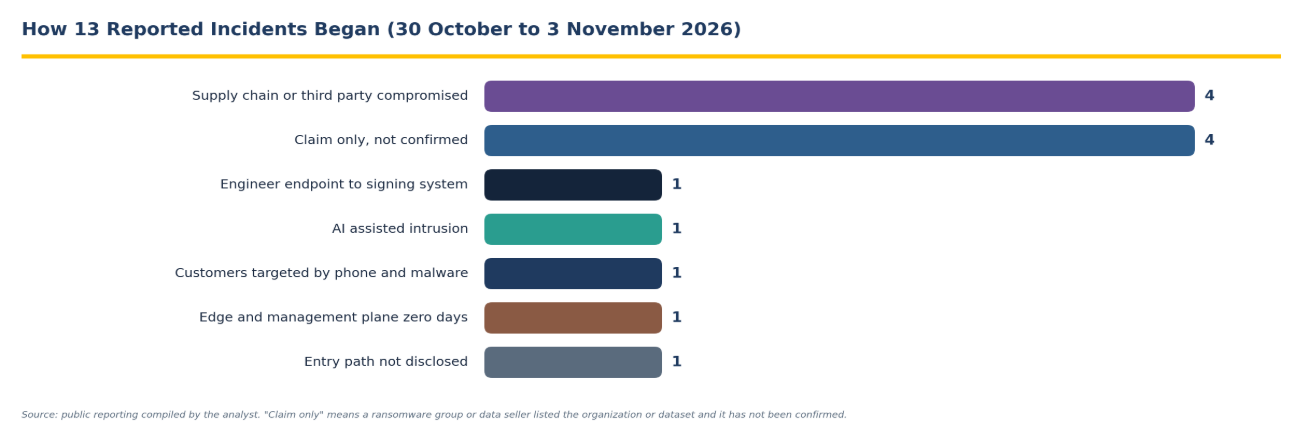
Initial access across 13 incidents first reported or updated between 30 October and 3 November 2026.
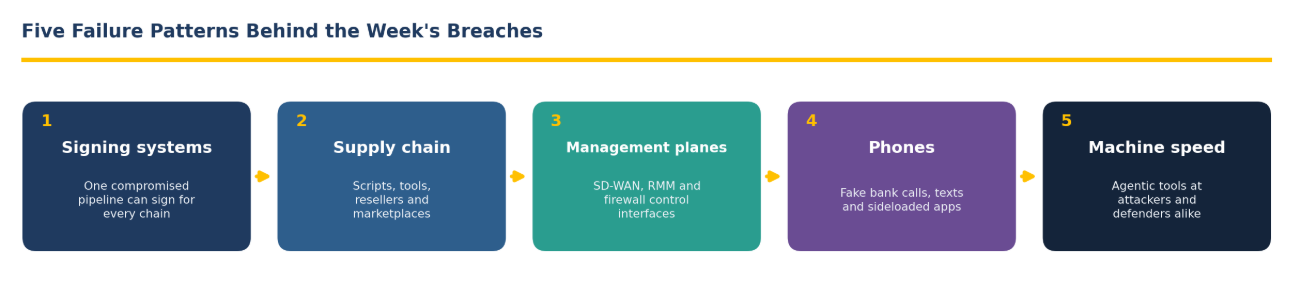
Five failure patterns behind the week’s breaches.
Signing systems
Binance’s loss did not come from a flaw in a blockchain or in a wallet. Binance says an engineer’s workstation led to a service container and from there to the path that submits withdrawals, and that the signing system produced valid signatures for transactions the attacker chose. The attackers had prepared at least 36 hours earlier, funding an operator wallet through Tornado Cash in small amounts. On Ethereum they used 50 pre signed authorizations that handed one hot wallet to a contract only they controlled, and on the other chains they used ordinary signed transfers. The lesson is that whoever can make the signer sign controls the money, whatever happens to the keys.
Supply chain
Polymarket lost about $2.7 million from 33 deposit wallets in under an hour after a third party website monitoring service had its domain records hijacked through its registrar and served a script that drained crypto. The hardware wallet maker Keystone lost customer records and a device authenticity key when an attacker used a flaw in a third party monitoring tool on its website, and will destroy 18,835 devices that carry the old key. Trezor warned of a suspected implant in a device sold by the CryptoBilis reseller, the same reseller named in last month’s Ledger case. A malicious extension reached up to 5,000 users through an AI code editor’s marketplace. In each case the victim relied on a supplier it could not see into.
Management planes
Volt Typhoon’s four zero day campaigns all hit the platforms that manage other systems: an SD-WAN controller, a remote management server and an orchestrator. Compromising one of them can reach every branch, device or customer it controls. Cisco also confirmed this week that an ASA and Firepower VPN flaw is exploited to crash firewalls. A management plane is a single point of control, and it is usually reachable from the internet.
Phones
CyberDakait works by getting a customer to install the malware themselves. Victims receive a text and then a call from someone posing as a bank representative, are sent to a fake page and told to install a protection app, and the app asks for permission to read and send text messages. The operators then read the one time passcodes. The Android SMS flaw is a different problem, but it is a reminder that the phone is the place where passwords, codes and calls meet.
Machine speed
A blockchain analytics firm says attackers used offensive agentic techniques to reach its systems and internal tools, and last week’s ARTEX research described the same approach against banks, Japanese companies and Microsoft 365 tenants. The Binance attackers pre signed their authorizations and ran across ten chains within minutes. Defenders face attacks that are prepared slowly and executed in minutes, and the response has to be prepared in advance too.
Questions to ask your own team
- Who or what can make your payment, withdrawal or settlement systems sign or release funds, how is that path separated from engineers’ workstations and build systems, and what limits stop a burst of transfers?
- Which third party scripts, monitoring services and resellers sit on your payment pages, hardware or supply chain, and how would you learn that one had been taken over?
- Are the management consoles for your SD-WAN, remote management and firewall products reachable from the internet, and could you tell if someone logged in from an unfamiliar address?
- What would your customers see if a caller posing as your bank told them to install an app, and how would you find infected phones in your customer base?
Breached organizations
Organizations are named as in public reporting. The list covers incidents first reported or materially updated between 30 October and 3 November 2026. Attacker claims are marked as claims, and counts are those reported by the organization unless marked otherwise. Check each name against your own suppliers and their suppliers.
| Organization | Sector, country and date | How it happened | Scale and status |
|---|---|---|---|
| Binance | Cryptocurrency exchange, global. Theft 29 Oct; FBI attribution 31 Oct; withdrawals reopened 1 Nov | Engineer workstation compromised, then a service container and the withdrawal signing path, per Binance; Ethereum hot wallet taken over with EIP-7702 authorizations, signed transfers on other chains | About $6.3 billion (range $5.91 billion to $6.43 billion) across ten chains; about $3 billion frozen; about 95 percent covered by Binance; attributed to TraderTraitor |
| Polymarket, through DebugBear | Prediction market, global and a website monitoring service. 31 Oct | Domain records of the third party service hijacked through its registrar; a script that drains crypto was served to one customer’s site | About $2.7 million drained from 33 deposit wallets in under an hour; trading paused; $3.9 million later returned to traders |
| Keystone | Hardware wallet maker, global. Disclosed Oct 28 to 31 | Attacker used a flaw in a third party monitoring tool on its website to escalate privileges | 25,964 customer records, 12,873 checkout records and a device authenticity key; 18,835 devices to be destroyed; shipping suspended |
| Trezor devices sold by CryptoBilis | Hardware wallets, Southeast Asia. Warning in late Oct | Suspected hardware implant in a Trezor Safe 5 sold by the reseller; same reseller as the Ledger case | Credible reports only; buyers since March 2026 advised to move funds to a new wallet with a new seed |
| Cursor extension marketplace | AI code editor marketplace, global. Disclosed 30 Oct to 2 Nov | Two versions of an extension impersonating an AI coding assistant were tampered with to install a persistent SSH backdoor; how the attacker published it is not explained | Up to 5,000 users; keys rotated and marketplace rebuilt |
| A blockchain analytics firm (name withheld) | Blockchain analytics, global. Disclosed 30 to 31 Oct | Attackers used offensive agentic techniques to reach systems and internal tools in early October | Customer names, emails and job role labels; counts not disclosed |
| Revolve | Fashion retail, US. Reported 31 Oct | Attackers accessed multiple company systems; entry not disclosed | Names, contact details, card numbers and expiry dates; 127,200 individuals in Texas and 1,328 in Vermont |
| Customers of 11 Indian banking institutions and two government programs | Banking customers, India. Research 28 Oct, activity since Jul 2025 | Fake bank calls and texts led victims to install trojan apps hosted on GitHub; seven families under the CyberDakai name | At least 17,960 infected phones; about 7.6 million messages intercepted; over $30,500 in cited victim losses |
| Hundreds of organizations in telecom, government, defense, IT services and utilities | Critical infrastructure and IT, mainly US. Research 28 Oct | Silent Train relay network used for zero day attacks on management platforms; Volt Typhoon, per researchers | Hundreds of victims per the research; network disrupted; no named victims |
| A US biopharmaceutical company (name withheld) | Biopharma, US. Claim 2 Nov | Listed on the N0n ransomware leak site | Claim only. Not confirmed by the company |
| layarn.com | Duty free retail, Israel. Claim 31 Oct | Listed on the SafePay ransomware leak site | Claim only. Not confirmed by the company |
| An Indian employee monitoring SaaS platform (name not given) | Workforce software, India. Sale offer seen 2 to 3 Nov | Seller on a criminal forum offers a claimed full production database, source code and activity logs; the platform is said to be decommissioned | Claim only: about 230 GB, 934 company schemas, 15,577 employee profiles, $10,000 asking price; seller account created 2 Nov; unverified |
| Karimun Regency government (Riau Islands, Indonesia) | Local government workforce data, Indonesia. Post 2 Nov | Seller on a criminal forum offers a claimed civil servant database; sample of 100 entries offered as proof | Claim only: 7,773 active employees and 471 near retirement; unverified |
Notes. We withhold the names of the analytics firm and of the biopharmaceutical company because the first is a security supplier and the second appears only as a placeholder in tracking data. The ransomware listings and the two data sale offers are claims. Polymarket’s loss figure was $2.7 million in first reports and the amount returned to traders was $3.9 million, and the difference has not been explained. The Silent Train row reports an actor’s campaign, not a list of victims.
02. Emerging Threats and Campaigns
Binance: a hot wallet signing pipeline turned against its owner
At about 20:05 UTC on 29 October, outflows began from hot wallets that Binance operates across ten blockchains. Within roughly 20 minutes attackers moved about $6.3 billion, which is about four times the Bybit theft of $1.5 billion in 2025 and the largest cryptocurrency theft on record. Estimates differ: the FBI says more than $6 billion, the exchange says about $6.3 billion, one analytics firm says $6.36 billion, and another count says $6.43 billion across 11 chains, of which 82 percent was on Ethereum and Bitcoin. The largest single movement was on Ethereum, where one hot wallet gave up 167,464 ETH and 63 tokens including 1.615 billion USDT. On Bitcoin about 18,270 BTC left, on Tron 612.7 million USDT and 46.4 million TRX left within two minutes, and on the XRP Ledger five wallets sent more than 233 million XRP to a single address. Wallets on Arbitrum, Avalanche, Optimism, Base and Solana were drained as well, and a Binance smart account holding about 823 million USDC was also moved.
The method matters more than the number. On Ethereum the attacker submitted one transaction with 50 EIP-7702 authorizations. EIP-7702 is an Ethereum feature that lets an ordinary account delegate its behaviour to a smart contract. Each authorization was signed by a Binance hot wallet and pointed it at a sweeper contract that takes instructions only from the operator. An authorization works only at the wallet’s current transaction count, which keeps moving on a busy hot wallet, so the attacker sent many versions and one landed. About three and a half minutes later the operator told the hot wallet to send its entire balance to an address it controlled. On the other chains the attacker did not need any feature: the same signing system produced ordinary valid transfers. That is why analysts conclude that the attacker could make Binance’s signing system sign transactions of its choosing, not that any one chain or wallet was broken.
Binance’s preliminary account, in statements by its co-chief executives, is a three step chain: an engineer’s workstation, a privileged service container in its cloud environment and the withdrawal submission path, with no evidence that any private key was leaked. How the workstation was compromised has not been disclosed, and some analysts say social engineering of engineering staff is the likely route, which is unconfirmed. The preparation was visible in hindsight. The operator wallet received small Tornado Cash withdrawals in the days before, a contract was deployed shortly ahead, and signatures were obtained in advance and then used in one burst. Binance says these features match the Bybit and KelpDAO thefts. There is no software vulnerability and no CVE. The attacker’s laundering so far differs from Bybit: large swaps through market makers and lending protocols, mostly into Ether, instead of bridges, according to the research and the FBI.
The aftermath was orderly. Stablecoin issuers and other parties froze about $3 billion, Binance suspended withdrawals, and the FBI named TraderTraitor on 31 October, listed more than 600 addresses and asked decentralized finance protocols to block transactions linked to them. Binance reopened withdrawals in phases at 06:00 UTC on 1 November, restored the first 15 networks within about six and a half hours and recorded about $4.6 billion in withdrawals against $1.0 billion in deposits, a net outflow of about $3.6 billion or 2.1 percent of assets. It says it has covered about 95 percent of the impact using its Secure Asset Fund for Users, part of its futures insurance fund and its treasury, and published proof of reserves. For financial institutions with crypto exposure or custody arrangements, the useful facts are the speed, the breadth across chains and the dependence on one signing path.
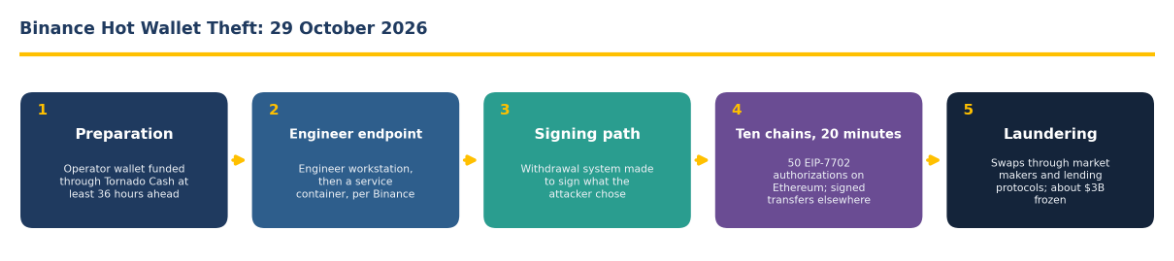
The Binance hot wallet theft (after Binance’s statements, the FBI and on chain analysis).
| Field | Detail |
|---|---|
| Victim | Binance hot wallets on ten chains (eleven in one count) |
| Date | 29 October 2026; first outflows about 20:04 to 20:05 UTC; most funds gone in about 20 minutes |
| Loss | About $6.3 billion per Binance; range $5.91 billion to $6.43 billion by source |
| Cause (preliminary) | Compromised engineer workstation, then a service container, then the withdrawal signing path; no evidence of a leaked private key, per Binance |
| Method | Ethereum: 50 EIP-7702 authorizations signed by a hot wallet and pointed at an attacker contract; other chains: ordinary signed transfers |
| Preparation | Operator wallet funded through Tornado Cash at least 36 hours before; contract deployed shortly ahead |
| Response | About $3 billion frozen; withdrawals suspended 30 Oct and reopened in phases 1 Nov; about 95 percent of the impact covered |
| Attribution | FBI: North Korea, TraderTraitor, on 31 October; more than 600 addresses listed |
| Laundering | Swaps through market makers and lending protocols, mostly into Ether |
Recommendations
- Separate the signing path from engineers’ workstations and build systems. No developer or operations endpoint should be able to reach, or influence, the service that signs withdrawals, and administrator access to it should need hardware bound approval.
- Put an independent policy layer between the requester and the signer: transaction limits, velocity limits, destination allowlists and a second approval that does not depend on the same systems. Refuse to sign delegations or authorizations that your own policy does not expect, including EIP-7702 authorizations for hot wallets.
- Alert on changes to a wallet’s code or delegation, on new type 4 transactions and on bursts of withdrawals across chains, and have a circuit breaker that can pause signing in seconds.
- Keep hot wallet balances small and split across many wallets and signers, so that one compromised path cannot take most of the money.
- Rehearse the freeze playbook: contacts at stablecoin issuers and exchanges, pre drafted law enforcement reports and a customer communications plan. In this case the first hours decided how much was frozen.
- For banks and custodians with exposure to exchanges, review concentration, proof of reserves and withdrawal terms, and watch for scams that use the incident as a lure.
Crypto supply chain: scripts, hardware and marketplaces
Four smaller incidents show the same weakness from different angles. Polymarket briefly suspended trading on 31 October after DebugBear, a third party website monitoring service, said its domain records were compromised through its registrar. A script that drained crypto was then served on the site of one of its customers, and about $2.7 million left 33 deposit wallets in under an hour. DebugBear says it has seen no sign that its own systems were compromised, and Polymarket later returned $3.9 million to affected traders. In June Polymarket disclosed another third party compromise that injected a malicious script into its front end, with reported losses of around $3 million.
Keystone, a hardware wallet maker, said an attacker exploited a flaw in a third party data monitoring tool on its website to escalate privileges. The attacker obtained 25,964 customer records, 12,873 checkout records and a key used to verify the authenticity of its devices. Keystone will stop using the old key, destroy 18,835 devices in inventory that carry it and has suspended shipping. Trezor said it had credible reports of a suspected hardware implant in a Trezor Safe 5 sold by the CryptoBilis reseller, which is the reseller at the centre of the Ledger implant case, and advised anyone who bought one from that reseller since March 2026 to move funds to a new wallet with a new seed. Separately, two versions of an extension that impersonated an AI coding assistant were tampered with on an AI code editor’s marketplace to install a persistent SSH backdoor, reaching up to 5,000 users before the marketplace was rebuilt.
| Incident | Weak point |
|---|---|
| Polymarket and DebugBear | A third party service’s domain records, hijacked through its registrar, used to serve a wallet drainer |
| Keystone | A flaw in a third party monitoring tool on the vendor’s own website, leading to a device authenticity key |
| Trezor and CryptoBilis | A reseller in the distribution chain, suspected of fitting a hardware implant |
| AI code editor marketplace | A tampered extension under another vendor’s name; the publishing route is unexplained |
Recommendations
- Know every third party script and service on pages that handle money or credentials, protect your own domain registrar and DNS accounts with strong authentication and registry locks, and ask suppliers to do the same.
- Use content security policy and subresource integrity on payment and login pages, and alert on script changes.
- Buy hardware and software from the maker or official channels, and treat an unofficial reseller or marketplace listing as untrusted.
- For code editor and browser extensions, restrict installs to an approved list and review what a new version changes before it deploys.
03. Threat Actor Activity
Volt Typhoon
Volt Typhoon is the name one major software vendor uses for a China state sponsored actor that has been active since at least 2021 and is known for pre positioning in the networks of critical infrastructure, communications and IT service providers, mostly in the United States. Western agencies have described its aim as preparing for disruption in a crisis, not collecting intelligence. It relies heavily on living off the land: it uses the tools already on a system and valid accounts, which leaves little malware to find. Other vendors track overlapping activity under names such as Vanguard Panda, Bronze Silhouette, Insidious Taurus and Voltzite, so alias lists should be read with care.
Research published on 28 October describes how it hides. Silent Train is not a standalone network but a series of compromised small office routers, internet of things devices and enterprise equipment that the actor has rotated through since late 2023. Operators connect through chains of these devices, each chain is built for one operation and torn down afterwards, and the actor can build a new chain with different infrastructure in under two minutes, so the number of live nodes at any moment is close to zero. The network follows the 2024 takedown of the KV botnet that the same actor used. The researchers say it has been used for at least four confirmed zero day campaigns against management and control platforms: Versa Director (CVE-2024-39717), N-able N-central (CVE-2025-8875 and CVE-2025-8876), Cisco Catalyst SD-WAN Controller (CVE-2026-20127) and Arista VeloCloud Orchestrator (CVE-2026-16812), plus a likely zero day against Quest KACE. It also exploited known flaws in firewall, VPN and application delivery appliances from several vendors.
The pattern is the point. Every zero day campaign through Silent Train hit a platform that manages other systems, such as SD-WAN controllers, remote monitoring and management servers and orchestrators. Compromising one of them gives reach into every branch, device or customer it manages. The researchers report hundreds of victims in telecommunications, government, defense, managed service providers, utilities and IT firms. A separate report the same day says a threat actor whose infrastructure overlaps with Silent Train used the Cisco SD-WAN flaw to deploy malware that harvests encryption keys, and that the Cisco flaw was exploited from late 2025, before Cisco disclosed it in February 2026. That report describes an overlap in infrastructure, not an attribution, and the link between Silent Train and Volt Typhoon is the researchers’ assessment. For financial clients the exposure is through networks, branch connectivity and the managed service providers that run them.
| Attribute | Detail |
|---|---|
| Names | Volt Typhoon (one vendor’s name); other vendors use Vanguard Panda, Bronze Silhouette, Insidious Taurus and Voltzite for overlapping activity |
| Assessed origin | China, state sponsored, per governments and vendors |
| Motivation | Pre positioning for disruption in a crisis; some espionage |
| Typical targets | Critical infrastructure, communications, defense, managed service providers and IT firms, mainly in the United States and allied countries |
| Initial access | Zero days and known flaws in edge devices and management platforms, delivered through short lived relay chains |
| Infrastructure | Silent Train: rotating chains of compromised routers, IoT devices and enterprise equipment; rebuilt in under two minutes |
| Tradecraft | Living off the land, valid accounts, web shells on management platforms in earlier cases, tunnelling tools |
| Status | Silent Train disrupted after the 28 October research; actor assessed to remain active |
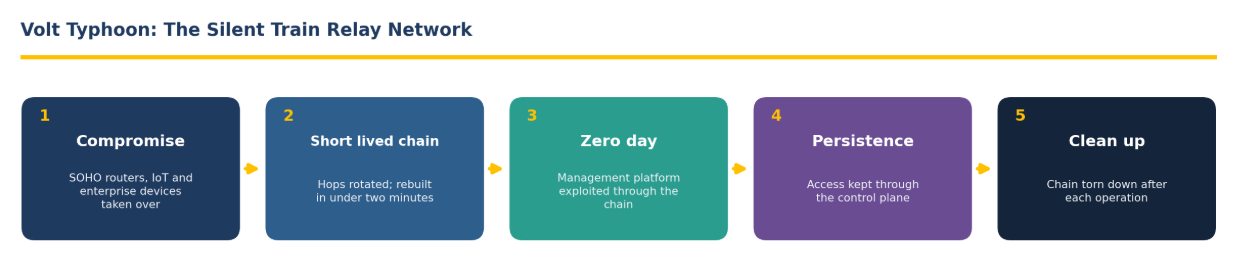
The Silent Train relay network and how Volt Typhoon uses it (after the published research).
Zero days used through Silent Train
| Product | Flaw | Notes |
|---|---|---|
| Versa Director | CVE-2024-39717 | File upload flaw used to deliver the VersaMem web shell, which harvests credentials and reaches downstream customers (2024) |
| N-able N-central | CVE-2025-8875 and CVE-2025-8876 | Remote monitoring and management platform; confirmed zero day campaign |
| Cisco Catalyst SD-WAN Controller | CVE-2026-20127 | Authentication bypass rated 10.0; exploited from late 2025; disclosed February 2026 |
| Arista VeloCloud Orchestrator | CVE-2026-16812 | Operating system command injection; zero day |
| Quest KACE | Patched October 2025 | Likely zero day campaign, per the research |
Hunting guidance
| Signal | Where to look | Why it matters |
|---|---|---|
| Logins to SD-WAN controllers, remote management servers and orchestrators from home router or hosting addresses | Management plane access logs | Silent Train chains end in compromised routers and devices |
| New administrators, API keys or tokens on a management platform | Platform audit logs | Persistence through the control plane |
| Configuration pushes or policy changes outside change windows | Controller change logs | Access to the control plane lets an attacker reach every site |
| Web shells or unexpected files on management servers | Endpoint and file integrity monitoring | Earlier campaigns used web shells such as VersaMem |
| Tunnelling tools such as Chisel or FRP and built in system tools used for discovery | Endpoint telemetry | Living off the land after access |
| Management interfaces reachable from the internet | External attack surface scans | Every campaign started at an exposed management or edge device |
MITRE ATT&CK techniques
Technique IDs are our own mapping from the published research and from earlier public reporting on the actor.
| Tactic | ID | Technique | Observed procedure |
|---|---|---|---|
| Resource Development | T1584.008 | Compromise Infrastructure: Network Devices | Hacked routers, IoT and enterprise devices used as relays |
| Command and Control | T1090.003 | Proxy: Multi hop Proxy | Short lived chains of relays hide the origin |
| Initial Access | T1190 | Exploit Public Facing Application | Zero days and known flaws in management platforms and edge devices |
| Persistence | T1505.003 | Server Software Component: Web Shell | Web shells on management platforms in earlier cases |
| Credential Access | T1552.004 | Unsecured Credentials: Private Keys | Key harvesting malware on SD-WAN, linked by infrastructure overlap |
| Defense Evasion | T1078 | Valid Accounts | Uses valid accounts and system tools to blend in |
| Command and Control | T1572 | Protocol Tunneling | Tunnelling tools for access to internal networks |
Recommendations
- Take management planes off the internet. Restrict SD-WAN controllers, remote management servers and orchestrators to a management network or a small set of addresses, and require multifactor authentication.
- Patch the named products first: Versa Director, N-able N-central, Cisco Catalyst SD-WAN, VeloCloud Orchestrator and Quest KACE, and review the audit logs for the period since late 2025 for access from unexpected addresses.
- Ask managed service providers and network suppliers how they protect these platforms, whether yours is exposed and how they would tell you of a compromise.
- Alert on administrator, API key and policy changes on management platforms, and keep copies of configurations to detect unauthorized change.
- Replace or isolate end of life routers and IoT devices at branches and sites, since they are the raw material for relay networks.
04. Ransomware and Data Leaks
One Decryptor Ransomware (new, BNB payments)
One Decryptor is Windows ransomware first scanned publicly around the end of October 2026. It renames encrypted files with the .ofx extension, drops a note called README_ONECRYPTOR.txt and shows a windowed ransom screen titled One Decryptor 0.2, which is a payment program and not a decryption tool. The name is misleading, and files cannot be recovered by running it without the key. The window shows 0.42 BNB due on the BNB Smart Chain (BEP-20), a 72 hour countdown and a note that the price doubles to 0.84 BNB after the deadline. It gives a payment address and a memo format, ONECRYPTOR-0x2 followed by the machine ID, and asks the victim to email the transaction hash to [email protected] after paying. The note says other assets, such as Bitcoin, Ether, USDT on Tron or any other token, are lost on arrival and do not count.
The note claims every file is encrypted with AES-256 using its own session key wrapped with an RSA-2048 key, that the private half is not on the disk, and that shadow copies, the backup catalog and recovery were disabled. The sandbox supports the last part: it shows shadow copies deleted, the backup catalog deleted with wbadmin, boot configuration changed with bcdedit and Windows event logs cleared. It also shows the sample reading browser profile data, which is a credential theft behaviour, adding a Run key and a file in the Startup folder, and creating a scheduled task. The sandbox report shows no data exfiltration, and the note makes no leak threat.
This sample looks more serious than last week’s Coffin Locker. Its amounts are consistent (0.42 and 0.84 BNB), the claim that the private key is not on the machine matches the design, and the payment address passes the Ethereum address checksum, so it is a valid address that could receive funds. We could not check whether it has received any. Paying in BNB on the BNB Smart Chain is unusual and cheap, with confirmations in seconds. The 72 hour deadline may be computed at run time, as in other builds we have analysed, and the sample is a version 0.2, which suggests an early build. There is no connection to the Binance theft: BNB is simply the exchange’s token, and nothing links the two. Nothing is known about victims, delivery or the operator.
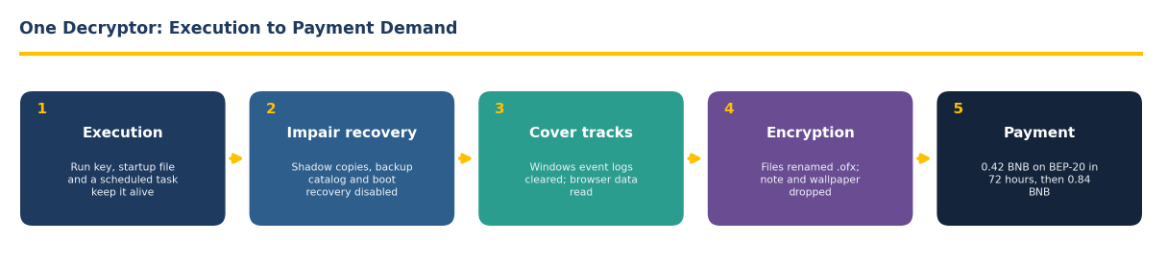
One Decryptor flow from execution to the payment demand (assembled from sandbox behaviour signatures and the note).
Observed evidence
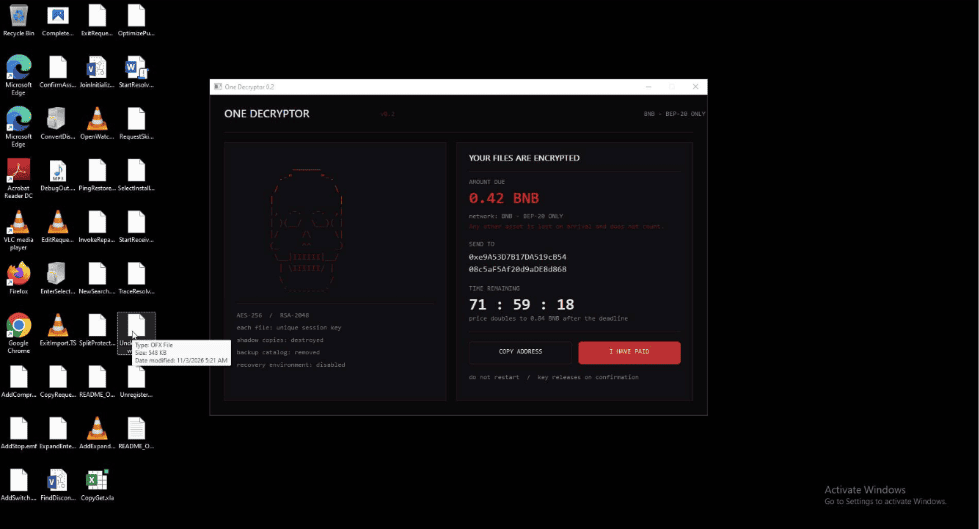
The One Decryptor window on the sandbox desktop, with the 0.42 BNB demand, the 72 hour countdown and the .ofx file type shown in the tooltip.
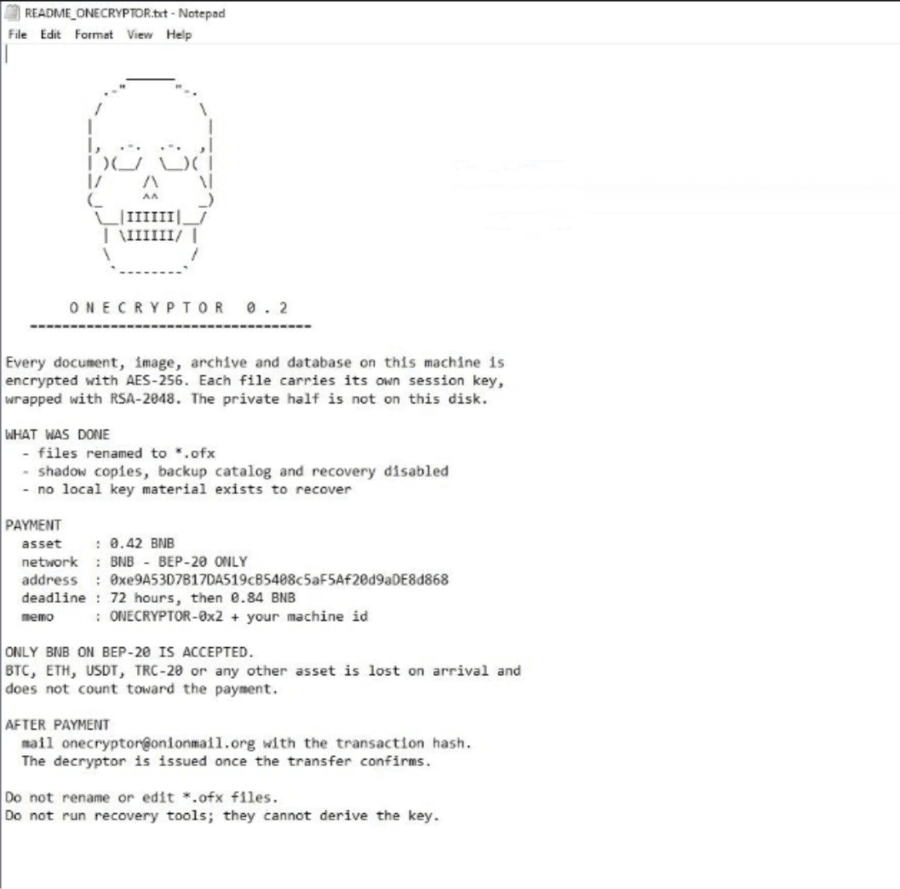
The README_ONECRYPTOR.txt ransom note, with the payment terms and the cipher claims.
Behavioural signatures
Sandbox analysis shows the sample clearing Windows event logs, deleting shadow copies and using the Volume Shadow Copy COM API, changing boot configuration with bcdedit and deleting the backup catalog with wbadmin. It creates a file in the Startup folder, adds a Run key, creates a scheduled task through the Task Scheduler COM API, sets the wallpaper through the registry and drops an executable. It reads browser profile data, which infostealers use to take saved credentials, checks SCSI registry keys, a common sandbox detection step, and reads the hostname and domain from the registry. It opens its note in Notepad when done.
MITRE ATT&CK techniques
The first group of rows is the sandbox mapping. Rows marked as added are our own, for behaviour the sandbox report shows but its mapping leaves out.
| Tactic | ID | Technique | Observed procedure |
|---|---|---|---|
| Execution | T1059 | Command and Scripting Interpreter | Runs commands such as wbadmin and bcdedit |
| Execution | T1047 | Windows Management Instrumentation | Uses WMI |
| Persistence | T1547.001 | Boot or Logon Autostart: Registry Run Keys or Startup Folder | Adds a Run key and a Startup folder file |
| Privilege Escalation | T1547.001 | Boot or Logon Autostart: Registry Run Keys or Startup Folder | Startup persistence |
| Defense Evasion | T1006 | Direct Volume Access | Accesses volumes directly |
| Defense Evasion | T1070.001 | Indicator Removal: Clear Windows Event Logs | Clears Windows event logs |
| Defense Evasion | T1070.004 | Indicator Removal: File Deletion | Deletes shadow copies and the backup catalog |
| Defense Evasion | T1112 | Modify Registry | Sets the wallpaper and related values |
| Credential Access | T1555.003 | Credentials from Web Browsers | Reads user and profile data of web browsers |
| Credential Access | T1552.001 | Unsecured Credentials: Credentials In Files | Sandbox flagged reads of credential material in files |
| Discovery | T1120 | Peripheral Device Discovery | Enumerates drives and storage |
| Discovery | T1012 | Query Registry | Reads system settings |
| Discovery | T1082 | System Information Discovery | Enumerates system information |
| Discovery | T1016 | System Network Configuration Discovery | Reads the hostname and domain |
| Collection | T1005 | Data from Local System | Collects local data |
| Impact | T1491 | Defacement | Replaces the desktop wallpaper |
| Impact | T1490 | Inhibit System Recovery | Deletes shadow copies, the backup catalog and boot recovery settings |
| Impact (added) | T1486 | Data Encrypted for Impact | Renames and encrypts files with .ofx |
| Execution (added) | T1053.005 | Scheduled Task/Job: Scheduled Task | Creates a scheduled task |
Indicators of compromise
| Indicator | Type | Context |
|---|---|---|
| 799d96730e07061547c2a63 48cdc630f1d938e5785a0f8ce d612f362d3950197 | SHA256 | One Decryptor sample |
| .ofx | File extension | Appended to encrypted files |
| README_ONECRYPTOR.txt | Filename | Ransom note |
| [email protected] | Contact for the transaction hash | |
| 0xe9A53D7B17DA519cB54 08c5aF5Af20d9aDE8d868 | BNB Smart Chain address | Payment address (transcribed from the capture; checksum valid; verify before use) |
| ONECRYPTOR-0x2 followed by the machine ID | Payment memo | Required in the payment transaction |
| One Decryptor 0.2 | Window title | Ransom screen program version |
Other ransomware and data leak activity
Ransomware groups listing new victims this week included N0n, SafePay and others, mostly against small and mid sized firms in the United States, the Middle East and Asia. Revolve, a US fashion retailer, told regulators that attackers accessed multiple company systems and took customer names, contact details, payment card numbers and expiry dates, with 127,200 individuals reported in Texas and 1,328 in Vermont. Card issuers should expect fraud that uses the data. The cause of the Revolve intrusion has not been disclosed. All of these ransomware listings are claims. Two offers of workforce data on criminal forums are covered under Darkweb and Underground Activity.
| Organization | Group | Sector and country | Status |
|---|---|---|---|
| A US biopharmaceutical company (name withheld) | N0n | Biopharma, United States | Claim; seen 2 Nov |
| layam.com | SafePay | Duty free retail, Israel | Claim; seen 31 Oct |
Recommendations
- Keep offline or immutable backups and test restoration. One Decryptor deletes shadow copies, the backup catalog and boot recovery settings.
- Alert on wbadmin delete catalog, shadow copy deletion, bcdedit recovery changes, clearing of the Security and System logs (Event IDs 1102 and 104), new Startup folder files and Run keys, and wallpaper changes.
- Assume browser stored passwords on an infected machine are stolen: reset credentials, revoke sessions and disable password saving for staff who handle financial systems.
- If ransomware appears, preserve the note and a sample encrypted file, involve incident response and do not pay on the strength of a note. Payments in BNB or other tokens cannot be recovered once sent.
- Card issuers: monitor for fraud tied to the Revolve exposure and check merchant breach notices against your portfolios.
05. Credential and Account Exposure
CyberDakait and GhostBat: Android banking trojans aimed at Indian customers
Research published on 28 October describes a financially motivated Android malware campaign against customers of Indian banks that has run since July 2025. The researchers group seven trojan families, cyb3rx, appkjl, godz, d-passive, d-shine, GhostBat and tenxen, under the name CyberDakait, and say the cluster has been active in India since January 2025. GhostBat is the best known of them: it is the newer form of GhostGrab, which earlier reports described spreading through fake transport apps. The researchers identified at least 17,960 compromised devices and 7,611,443 intercepted text messages, and found that the operators had impersonated 11 Indian banking institutions and two government programs. The messages included one time passcodes, transaction alerts and account messages. The cited victim losses so far are small, over $30,500, but they are only the losses that were reported.
The attack starts with the customer. The victim receives a text about a card, and then a call from someone posing as a bank representative, often offering a credit card protection plan. The caller sends them to a bank themed web page, sometimes through WhatsApp, with buttons such as Login Now or Activate Protection. The button downloads an Android installation file hosted in a public GitHub repository, which gives the download a reputable address. The first file is a dropper that installs the main trojan and a cryptocurrency miner. The trojan then asks for permission to read and send text messages, shows fake bank screens over the real banking apps to capture credentials and card details, and forwards messages to the operators. One family had an administrative controller app in a GitHub repository, which let the operators track victims and send commands, and exposed Firebase storage revealed another 15,596 compromised devices. After the research was reported, the GitHub accounts and repositories were deactivated.
Two cautions apply. The researchers say they have not shown that one operator runs all seven families, so CyberDakait is a cluster label, not a confirmed actor. And the counts are minimums that come from exposed infrastructure, so the real number of infected phones is probably higher. Evidence in the research suggests the developers wrote and compiled malware on Android phones, which fits a low cost operation with many small variants, so blocking one family will not stop the rest.
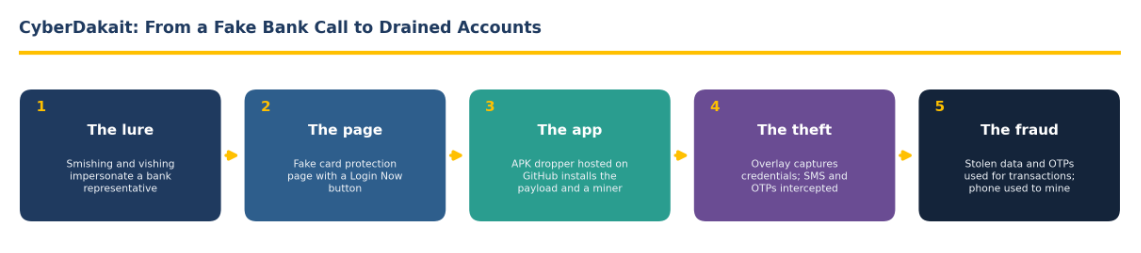
The CyberDakait attack flow from a fake bank call to account fraud (after the published research).
| Family | Notes | Role | Seen |
|---|---|---|---|
| GhostBat (and older GhostGrab) | Banking themed WebViews, SMS interception, Firebase exfiltration, covert mining | Main banking trojan | Fake transport and banking apps |
| cyb3rx | Has an administrative controller app for tracking victims and issuing commands | Remote control and theft | GitHub hosted |
| appkjl, godz, d-passive, d-shine, tenxen | Further families with overlapping behaviour; separate code | Credential and SMS theft | GitHub hosted droppers |
| XMRig based miner | Delivered with the dropper | Cryptojacking | Bundled with the trojans |
MITRE ATT&CK techniques
Technique IDs are our own mapping to Mobile ATT&CK from the published research. Permissions listed show capability, and the research documents actual use.
| Tactic | ID | Technique | Observed procedure |
|---|---|---|---|
| Initial Access | T1660 | Phishing | Smishing and vishing impersonate a bank and lead to a fake page |
| Initial Access | T1476 | Deliver Malicious App via Other Means | APK downloaded from a hosting site, outside an app store |
| Credential Access | T1417.002 | Input Capture: GUI Input Capture | Overlays fake bank screens to capture credentials and card details |
| Collection | T1636.004 | Protected User Data: SMS Messages | Intercepts text messages including one time passcodes |
| Collection | T1582 | SMS Control | Forwards and sends messages |
| Command and Control | T1481 | Web Service | Firebase and GitHub used for exfiltration and delivery |
| Impact | T1496 | Resource Hijacking | XMRig based cryptocurrency miner on the phone |
Recommendations
- Tell customers plainly and often that the bank will never ask them to install an app from a link, a message or a call, and that a request to ‘activate protection’ is a scam. Use the lure wording in your warnings.
- Reduce reliance on text message passcodes for payments and logins. Move to in app approvals or hardware bound credentials that malware on the phone cannot read.
- Detect infected devices on the server side: sideloaded installs, accessibility or overlay permissions, new devices enrolling shortly after a call, one time passcodes requested from unusual contexts and transactions that follow a password reset.
- Add on device protections to your own app that detect overlays, screen sharing and untrusted installers, and refuse sensitive actions when they appear.
- Report malicious repositories and accounts to the hosting platform, take down fake bank pages quickly and work with the national CERT, and share indicators across banks.
06. Vulnerability Intelligence
Three advisories are covered here, in order of urgency. Two are in widely deployed software that attackers can reach without credentials, and one needs only a text message. The Linux flaw is not yet fixed in some major distributions, the Drupal flaw is exploited and the Android flaw has a public exploit.
| Priority | CVE | Product and severity | Exploitation and fix |
|---|---|---|---|
| 1 Immediate | CVE-2026-118539 | Drupal Commerce Core, missing authorization; rated highly critical by Drupal | Exploited; fixed in 3.3.13 and 8.x-2.41; audit orders |
| 2 Immediate | CVE-2026-98432 | Linux kernel IPv4 TCP use after free; CVSS 9.8 from the kernel CVE team, 5.9 to 8.3 elsewhere | Fixed upstream; some distributions have no kernel yet; no exploitation seen; root exploit exists in a laboratory |
| 3 This week | CVE-2026-58882 | Android WAP Push handler, zero click denial of service; no score | Public exploit; Android 14 to 17 fixed; Android 12 and 13 unpatched |
CVE-2026-118539: Drupal Commerce Core Missing Authorization
CVE-2026-118539 is a missing authorization flaw in Commerce Core, the module that adds a shopping cart and checkout to Drupal sites. Drupal’s security team published advisory SA-CONTRIB-2026-254 on 28 October, rated it highly critical (21 out of 25) and said it is being exploited in the wild. The CVE record followed on 30 October. Insufficient authorization on routes and entity fields lets an unauthenticated attacker change commerce data, such as orders. The Drupal advisory has not published the requests or fields involved, and has not said whether the flaw was exploited as a zero day. Affected versions are Commerce Core 3.x before 3.3.13 and the 8.x-2.x line before 2.41, and the module is used on more than 42,000 sites. The flaw was not on the CISA catalog as of 30 October.
The risk is financial and quiet. An attacker who can change an order may alter prices or totals, mark orders as paid, change shipping or refund details, or read order data, without leaving the kind of file or crash that most monitoring looks for. Stores should assume that orders made since the flaw was exploited could have been altered and should compare order records, payment provider records and fulfilment. Because the module sits on the payment path, card data and customer data are also at stake if the flaw reaches them.
| Field | Detail |
|---|---|
| CVE ID | CVE-2026-118539 (Drupal advisory SA-CONTRIB-2026-254) |
| Affected product | Drupal Commerce Core module (3.x and 8.x-2.x lines) |
| Affected versions | Commerce Core 3.0.0 to 3.3.12 and earlier releases up to 8.x-2.40 |
| Fixed versions | 3.3.13 and 8.x-2.41 |
| Severity | Highly critical (21 of 25) per Drupal; critical in other records; no CVSS score from NVD yet |
| Vulnerability type | Missing authorization (CWE-862) leading to unauthorized changes to commerce data |
| Exploitation status | Exploited in the wild per Drupal; not on the CISA catalog as of 30 Oct 2026 |
| Attack requirement | None; no authentication |
Recommendations
- Update Commerce Core to 3.3.13 or 8.x-2.41 on every Drupal store, including those run by agencies and suppliers.
- Audit orders and refunds since 28 October, and earlier if the store was unpatched for longer: compare order records with payment provider and fulfilment records, and look for changed prices, statuses and addresses.
- Review web logs for unusual requests to Commerce routes and API endpoints, and tighten the web application firewall rules for those paths while you patch.
- Check payment and checkout pages for changes, in case the flaw was used to add scripts.
CVE-2026-98432: Linux Kernel IPv4 TCP Use After Free
CVE-2026-98432 is a use after free in the part of the Linux kernel that sets up incoming IPv4 TCP connections. When a client retransmits its first packet, one processor can still be building the reply from the connection’s IP options while another has already closed the new connection and freed the options, so the reply reads memory that is no longer valid. It is triggered by a connection request that carries IPv4 options such as Record Route or Timestamp, sent to any listening IPv4 port, and the code runs inside the kernel before any application sees the packet. The bug dates to Linux 4.4. It was fixed upstream in early October with a short change that delays freeing the options, published as a CVE on 15 October and scored 9.8 by the kernel CVE team on 24 October.
Severity depends on who is asked. The kernel team scores it 9.8, assuming a network attacker needs no privileges. Other scores are lower because the race is hard to win: 8.3 under a newer scoring system, 8.1 from some Linux vendors, 7.0 from a cloud provider and 5.9 from one major Linux vendor, which expects a crash as the likeliest result. A researcher at an AI company reported on 27 October that an unreleased internal model had written a remote root exploit for a multipath TCP listener, a lab result that has not been published. No exploitation in the wild had been reported and the flaw is not on the CISA catalog. Fixed upstream kernels include 6.12.113, 6.6.159, 6.1.190, 5.15.223 and 5.10.272, and kernels 4.4 to 5.4 are end of life with no fix. As of 2 November, Debian had fixed kernels while Ubuntu and Red Hat based releases did not, and AlmaLinux had kernels in testing. One analysis notes that programs written in Go open multipath TCP listeners by default, which would widen the exposed set, but we could not confirm that.
| Field | Detail |
|---|---|
| CVE ID | CVE-2026-98432 |
| Affected product | Linux kernel IPv4 TCP connection setup, since 4.4 |
| Fixed versions | Upstream 6.12.113, 6.6.159, 6.1.190, 5.15.223, 5.10.272 and newer branches; end of life branches have no fix; distribution kernels vary |
| Severity | CVSS 9.8 (kernel CVE team); 8.3, 8.1, 7.0 and 5.9 in other records |
| Vulnerability type | Use after free race (CWE-825), reached by a TCP SYN carrying IPv4 options |
| Exploitation status | No exploitation reported; no public exploit; root exploit reported in a laboratory only; not on the CISA catalog |
| Attack requirement | Network access to a listening IPv4 TCP port; no authentication |
| Interim measure | Drop IPv4 TCP packets that carry options before the TCP stack sees them (for example with a firewall rule); test first |
Recommendations
- Inventory Linux hosts by kernel version and distribution, and apply updated kernels as your distribution releases them. Where none exists yet, apply the interim packet filter and rebuild when the fix arrives.
- Prioritize internet facing servers, load balancers, container hosts and appliances built on Linux, and replace systems on end of life kernels.
- Ask suppliers of appliances and cloud images which kernel they ship and when it will be patched.
- Watch for kernel crashes and unexpected reboots on exposed hosts, which are the most likely sign of attempts.
CVE-2026-58882: Android WAP Push “SMS of Death”
CVE-2026-58882 is an integer overflow and out of bounds read in the part of Android that decodes WAP Push messages, which are a kind of text message that carries a link or settings. A specially crafted message, only a few bytes long and sent to the WAP Push port, makes the phone’s cellular stack fail. The victim does not need to open anything: Android processes the message before it reaches the inbox, so the phone may crash, restart or lose service with no sign of what caused it, and repeated messages can cause a reboot loop and interrupt calls, including emergency calls. A researcher published a proof of concept this week, and a working exploit is available to low skilled attackers. The flaw allows a denial of service and does not give code execution.
The patch situation is uneven. The CVE record lists Android 14 to 17 as affected, and the researcher says Android’s maker fixed those versions in the October 2026 updates, but the flaw was not in the October bulletin and the CVE was published only on 2 November with the November bulletin. Android 12 and 13 phones no longer get fixes and stay exposed, which affects a large number of older devices. The CVE record gives no score and says the flaw is not known to be exploited, although some outlets describe it as critical. That label overstates it: the effect is a crash, not a takeover. For banks and customers the practical risk is disruption of calls and of text message codes, and the use of the flaw to cut off a victim while fraud is under way.
| Field | Detail |
|---|---|
| CVE ID | CVE-2026-58882 (“SMS of Death”) |
| Affected product | Android WapPushOverSms.decodeWapPdu; Android 14 to 17 listed; Android 12 and 13 reported unpatched |
| Fixed versions | November 2026 Android security bulletin; reportedly fixed in October updates for supported versions |
| Severity | No score published; denial of service, no code execution |
| Vulnerability type | Integer overflow leading to out of bounds read (WAP Push header length) |
| Exploitation status | Public proof of concept; no exploitation reported; not on the CISA catalog |
| Attack requirement | Ability to send a text message to the phone number; no user interaction |
| Impact | Phone crash or reboot loop and loss of cellular service, including emergency calls |
Recommendations
- Make sure managed Android devices run a supported version with the latest security update, and replace Android 12 and 13 devices that no longer receive them.
- For staff who depend on phones for approvals or on call duty, keep a second channel and an authenticator that does not depend on text messages.
- Tell customers that a phone that crashes or loses service when a text arrives should be treated as suspect, and that a bank will not ask for codes after an outage.
- Ask mobile carriers whether they filter malformed WAP Push messages.
Also this week
Cisco confirmed on 28 October that an ASA and Firepower Threat Defense VPN flaw, CVE-2026-76418, is being exploited to reload firewalls that run SSL VPN with secondary authentication, and that there is no workaround. PHP2Shell flaws, covered in earlier issues, have now been used to compromise servers, including management interfaces of a firewall product and a US government affiliated network, so patch status and exposure on PHP hosts remain urgent. The Binance theft involved no software vulnerability and has no CVE: the attacker used a feature of Ethereum, EIP-7702 delegation, with signatures that the exchange’s own signing system produced.
07. Darkweb and Underground Activity
Binance: how the stolen funds move
Laundering is the stage that decides whether a theft pays, and the first week of tracing shows a method that differs from Bybit’s. The attacker funded the operation through small withdrawals from Tornado Cash, so the money going in was already mixed. After the theft, the funds were converted, mainly into Ether, through large swaps on decentralized exchanges, through market makers and through lending protocols, instead of through bridges that can be blocked at chokepoints. The FBI listed more than 600 addresses tied to the theft and asked decentralized finance protocols to block transactions linked to North Korean hackers, and about $3 billion was frozen at the stablecoin and token issuers. Analysts expect the attacker to swap Ether for Bitcoin and to cash out through over the counter brokers and exchanges, as it did after Bybit. Last issue’s report on the Chinese laundering network, said to have handled more than $1 billion for North Korean thieves, describes the kind of services involved. For banks and exchanges, the practical step is to screen deposits and counterparties against the published addresses and to treat large, fast swaps as a red flag.
An employee monitoring platform’s database offered for sale
On 2 to 3 November a user called Dams, whose forum account was created on 2 November and has a single post, offered what he calls the only surviving complete copy of an Indian employee monitoring and time tracking platform, headquartered in India with customers worldwide. The post asks $10,000 for an exclusive sale through the forum’s escrow service, with a $2,000 option for a de identified customer list, payment in Bitcoin and delivery by file transfer once escrow is funded. It describes about 230 GB. The package is said to include a MySQL dump with a separate schema for each of 934 companies covering users, logins, timesheets, leave and payments; two MongoDB clusters with about 694 million documents of application activity logs, location tracking and wellness and health logs; 41 GB of activity logs and screenshots from 675 companies; a payment ledger with Stripe and Razorpay exports for 1,168 paying customers; a master list of about 24,000 customer companies; the source code from a GitLab backup with 3,099 repositories; and every released agent binary. The seller says it holds 15,577 verified employee profiles with emails and hashed passwords, and offers a ten user sample by private message, watermarked for each buyer.
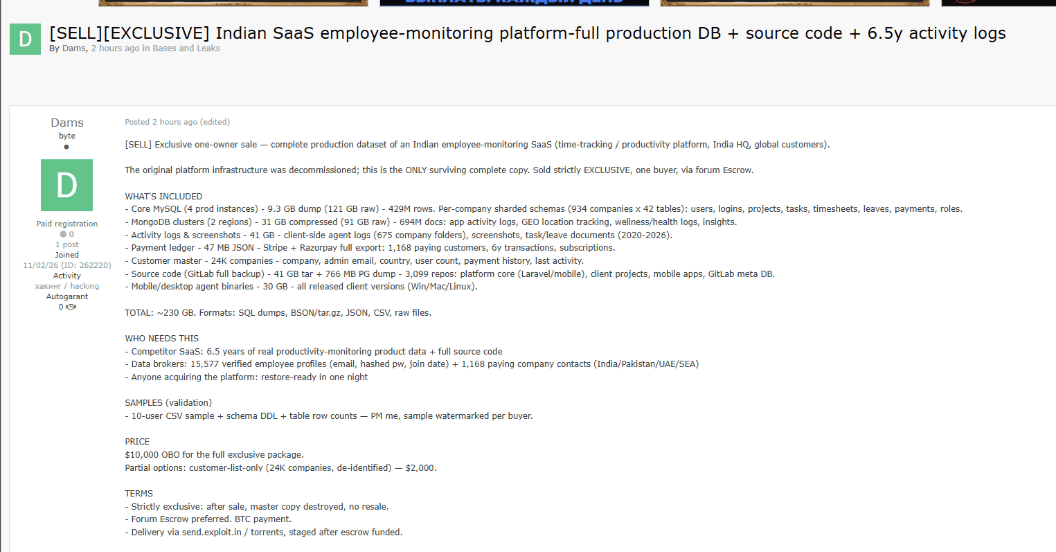
The forum sale post for the claimed employee monitoring platform database (a claim, not verified data).
We cannot verify any of it, and several points call for caution. The account is new, the platform is not named, and the seller says the original infrastructure was decommissioned, which conveniently explains why nobody can check. The price is low for a package of this size, and the language about the only surviving copy and exclusive sale is standard on these forums. If the data is real, the harm is wide. Employee monitoring tools hold screenshots, application and location history and sometimes health related notes about staff at every customer that uses them, and screenshots can contain customer data, credentials and internal documents. The post names data brokers, competitors and acquirers as the likely buyers and lists India, Pakistan, the UAE and Southeast Asia as the customer base. For financial institutions and outsourcers in those markets, the first step is to find out whether any supplier runs such a tool on your staff and to ask for a written statement. A decommissioned platform that still holds copies of customer data is also a retention failure in its own right.
Recommendations
- Ask IT, HR and your outsourcers whether an employee monitoring or productivity tracking platform is used on staff who handle your data, and which supplier provides it.
- If a supplier is confirmed as affected, assume screenshots and activity logs may hold customer data, credentials and internal documents, rotate credentials used on monitored machines and warn staff about phishing that uses real work details.
- Check contracts for how long suppliers keep data after a service ends, and ask for deletion certificates, so that a decommissioned platform does not keep your data.
- Do not contact the seller or download samples. Treat the offer as a lead, record it and wait for a statement from the supplier.
Indonesian local government workforce data
On 2 November a member of a criminal forum, with an account from August 2026 and 39 posts, offered a database titled the Karimun Regency Government Workforce Database. Karimun Regency is a local government in the Riau Islands province of Indonesia. The heading uses WTS, short for want to sell, and our capture shows no price. The post lists the fields as name, civil servant number (NIP), gender, place and date of birth, status, rank and grade, job title and unit, religion, address, phone number and email, for 7,773 active employees and 471 employees approaching retirement, and includes a sample of 100 entries as proof. We show only the headline and the description, because the sample holds personal data of public employees.

The forum post offering the claimed Karimun Regency workforce database, cropped to remove the sample data.
The post is a claim and the regency has not confirmed a breach. The fields listed, a civil servant ID with date of birth, address, phone number and email, are what fraudsters use for identity and loan scams, and civil servants are a favoured group for payroll deduction loans because their income is steady. Lenders in Indonesia and elsewhere should expect applications that use these details. The fields read like an export from a human resources system, which could mean a leak from the regency, a contractor or a connected system, but the post does not say, and we cannot tell whether the data is current.The post is a claim and the regency has not confirmed a breach. The fields listed, a civil servant ID with date of birth, address, phone number and email, are what fraudsters use for identity and loan scams, and civil servants are a favoured group for payroll deduction loans because their income is steady. Lenders in Indonesia and elsewhere should expect applications that use these details. The fields read like an export from a human resources system, which could mean a leak from the regency, a contractor or a connected system, but the post does not say, and we cannot tell whether the data is current.
Recommendations
- Lenders and payment providers: tighten verification for loan and account applications that rely on civil servant IDs and public employee details, and watch for applications that match the listed fields.
- Public bodies and their suppliers: confirm whether the data is genuine, review who has access to workforce exports, and warn staff about phishing that uses their real details.
- Treat the listing as a lead, do not download the sample and share the claim with the relevant national CERT.
Prediction market scam kits
Research this week describes several Russian language teams of fraud affiliates that have adapted their models to prediction markets such as Polymarket and Kalshi. Three of them, AtlasCore, PolyFucked and Magnetic Team, sell websites, administration panels, cryptocurrency payment systems, victim management tools, technical support and promotional guidance, and pay affiliates 60 to 80 percent of the victim deposits. The sites look like real prediction market interfaces and use established fraud mechanics to stop victims from recovering the money. It is a franchise model: the barrier to entry is low, and campaigns scale as soon as a topic is popular. This matters for the Polymarket incident in the register, because users who were already wary of the site may be the target of the next scam that offers to recover their funds.
Commercial mobile spyware for wallets and messaging
A commercial Android spyware service called uCreator is designed for ordinary users of mobile wallets and messaging applications across China and Southeast Asia, including GCash, WeChat, WeCom, QQ, Telegram, WhatsApp, LINE, Zalo, KakaoTalk, Viber and MoMo, and can clone WeChat accounts. Victims install repackaged copies of legitimate apps through sideloading or social engineering. The malware runs the real app in a virtual container and instruments it, instead of drawing a fake overlay as the GodFather banking trojan does, so it is quieter, works beyond the login screen and can be extended to any app for which the vendor writes a module. Together with the CyberDakait trojans in Credential and Account Exposure, it shows that banking fraud on phones is being sold as a service and does not depend on overlays.
08. Key Takeaways
- Protect the signing path. Binance lost about $6.3 billion because attackers could make its withdrawal system sign for them, and Binance says no key leaked. Separate signing from engineers’ workstations, add an independent policy layer with limits and allowlists, alert on delegation changes, and keep a circuit breaker that can stop signing in seconds.
- Know your suppliers’ suppliers. A monitoring service’s hijacked domain records drained Polymarket users, a flaw in a monitoring tool cost a wallet maker its authenticity key, and a reseller was named again in a hardware implant case. Lock registrar accounts, use content security policy on payment pages and buy from the maker.
- Management planes are single points of control. Volt Typhoon used four zero days against SD-WAN controllers and remote management platforms through a relay it can rebuild in two minutes. Take management interfaces off the internet, patch the named products and alert on administrator and policy changes.
- Customers are the target and the phone is the weapon. CyberDakait infected at least 17,960 Indian customers’ phones after a fake bank call. Warn customers in plain words, reduce reliance on text message passcodes and detect sideloaded apps and overlays on the server side.
- Check store orders, not just servers. The exploited Drupal Commerce flaw changes commerce data quietly. Update the module and compare orders, refunds and payments since 28 October.
- Patch Linux kernels and use the interim filter. CVE-2026-98432 is reachable by one packet, some major distributions have no fixed kernel yet, and a root exploit exists in a laboratory. Replace phones on Android 12 and 13, which stay exposed to the SMS flaw.
- Test recovery and watch the signals. One Decryptor deletes shadow copies, the backup catalog and boot recovery settings, clears event logs and reads browser passwords. Payment in BNB or any token cannot be reversed.
- Keep claims separate from evidence. Binance’s root cause is preliminary, the Silent Train link is the researchers’ assessment, CyberDakait is a cluster and not a confirmed single actor, the ransomware listings and the two forum data sale offers are claims until the organizations confirm.
Priority actions this week
| Priority | Action | Why now |
|---|---|---|
| Immediate | Update Drupal Commerce Core to 3.3.13 or 8.x-2.41 and audit orders, refunds and payments since 28 October | CVE-2026-118539 is exploited and changes commerce data without authentication |
| Immediate | Restrict management interfaces for Versa Director, N-able N-central, Cisco Catalyst SD-WAN, VeloCloud Orchestrator and Quest KACE, patch them and review audit logs back to late 2025; patch Cisco ASA and Firepower VPN for CVE-2026-76418 | Volt Typhoon used zero days against these platforms, and the Cisco VPN flaw is exploited |
| Immediate | For exchanges, custodians and payment firms: separate the signing path from engineer endpoints, add transaction limits and allowlists, alert on wallet delegation and authorization changes and rehearse a freeze | Binance lost about $6.3 billion through one compromised signing path in about 20 minutes |
| This week | Update Linux kernels as distributions release them, apply the interim filter that drops TCP packets with IP options where no fix exists, and review PHP hosts for the PHP2Shell flaws | CVE-2026-98432 is reachable by one packet and not yet fixed in some distributions; PHP2Shell is exploited |
| This week | Warn customers about fake bank calls that lead to app installs, plan a move away from text message passcodes and add server side detection of sideloaded apps and overlays | CyberDakait infected at least 17,960 phones and intercepted about 7.6 million messages |
| This week | Update managed Android devices and replace Android 12 and 13 phones; keep a second channel for approvals | CVE-2026-58882 can crash phones with a text and has a public exploit |
| This week | Inventory third party scripts and services on payment and login pages, lock registrar and DNS accounts and enable content security policy and subresource integrity | A hijacked monitoring service drained Polymarket users |
| This week | Ask suppliers and outsourcers whether an employee monitoring tool is used on staff who handle your data, and tighten loan checks that rely on civil servant details | Two workforce data sale offers appeared on criminal forums, both unverified |
| This week | Verify offline backups and alert on wbadmin catalog deletion, shadow copy deletion, event log clearing and new Run keys or Startup files | One Decryptor does all of these |
Disclaimer
This Report is provided for informational and security-awareness purposes only. The information presented is based on intelligence collected from publicly available sources, underground forums, dark web sources, third-party feeds, and other available data at the time of analysis.
Threat intelligence may be incomplete, outdated, unverified, or subject to change. References to threat actors, organizations, vulnerabilities, indicators, or incidents represent observed or reported information and should not be considered definitive attribution unless explicitly stated and supported by reliable evidence.
The information contained in this report should be independently validated before being used for security, operational, legal, or business decisions. iZOOlogic does not guarantee the accuracy, completeness, or timeliness of the information and shall not be held responsible for any actions or decisions taken solely based on this report.
This report is intended for authorized recipients and should be handled in accordance with applicable organizational security, confidentiality, and information-sharing policies.
