
 HQ/EMEAFind out how we can help your business

How a Single Threat Group Allegedly Put 800 million Global Identities on the Telegram Auction Block
The digital underground has a new epicenter. ShinyHunters, the infamous threat actor group, has recently been re-emerged on telegram with a coordinated release of data stolen from some of the world’s largest corporations. This isn’t just a leak; it’s a wholesale auction of global infrastructure.
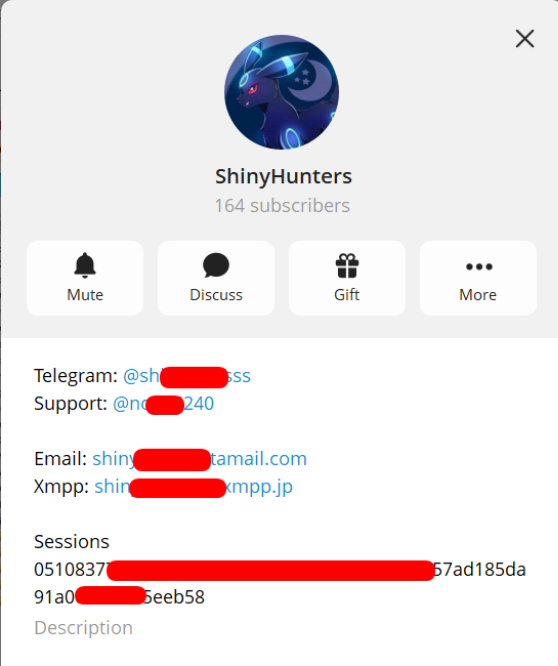
Technical Intelligence: ShinyHunters (May 2026)
Current Activity and High-Value Targets
As of May 6, 2026, the group is aggressively marketing datasets from massive global infrastructure and consumer platforms. Their current “inventory” claims to include:
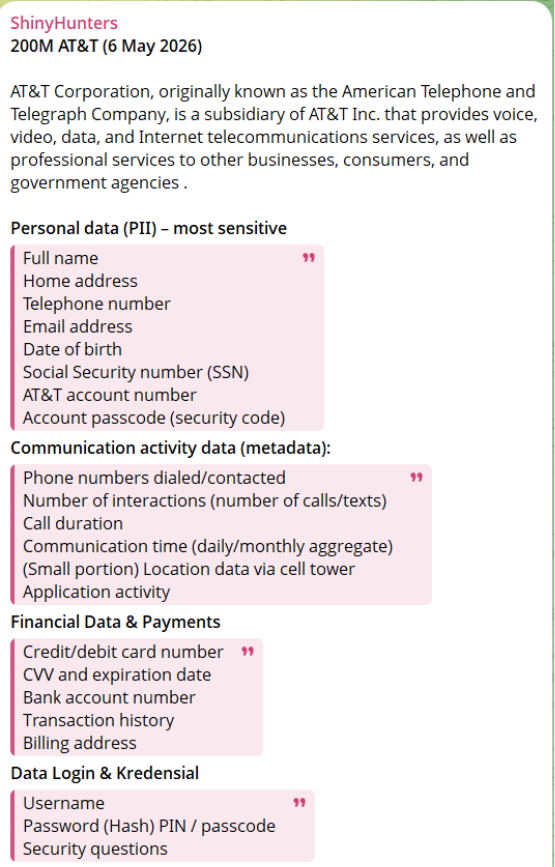
- AT&T (200 million Records): A primary focus, listed for 2.1 BTC. The data includes sensitive PII (SSNs, Account Passcodes), metadata (call logs/durations), and internal business strategy documents.
- Ticketmaster / Live Nation (560 Million Customers): A massive 1.3TB dataset containing full customer details, order history, and partial credit card data. Asking price: $10,000 USD.
- Santander Group: A smaller but highly sensitive dump of 30 million customer records, including 28 million credit card numbers and internal HR lists for Spain, Chile, and Uruguay.
The AT&T Escalation
On May 6, 2026, the group listed a 200 million record database from AT&T. Unlike standard PII leaks, this includes Account Passcodes and Social Security Numbers. For cybersecurity professionals, this represents a “Gold Standard” breach, providing everything an attacker needs for a full-scale identity takeover campaign.
The listing promotes extensive access to personal, financial, and technical data. At this stage, the claim remains unverified.
Monetizing the Infrastructure
The group’s pricing strategy shows a sophisticated understanding of the market. While massive consumer dumps like Ticketmaster are priced for “bulk” buyers at $10,000 USD, the highly sensitive AT&T data is held for a premium of 2.1 BTC (approx. $130,000+ at current rates).
Technical Indicators & Proof of Access
Based on the screenshots and files shared in the associated telegram channel, the group is providing specific technical evidence to validate their claims:
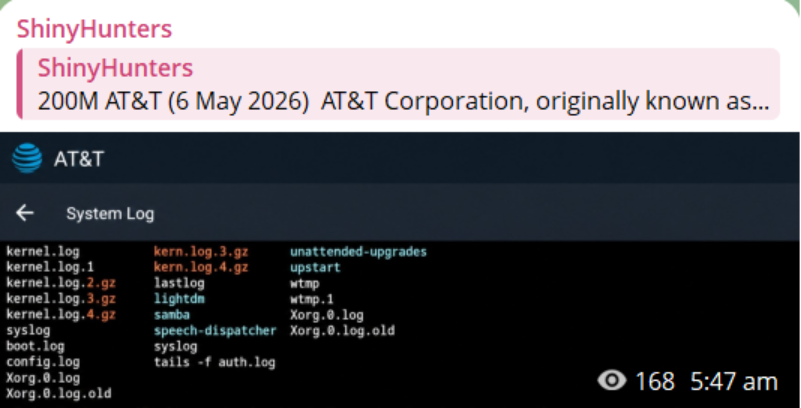
- Infrastructure Logs: They have shared snippets of system logs (e.g., auth.log, syslog, kern.log) ostensibly from compromised environments. Interestingly, the screenshots show a Tails OS environment, suggesting they are using localized, amnesic operating systems to manage the exfiltrated data.
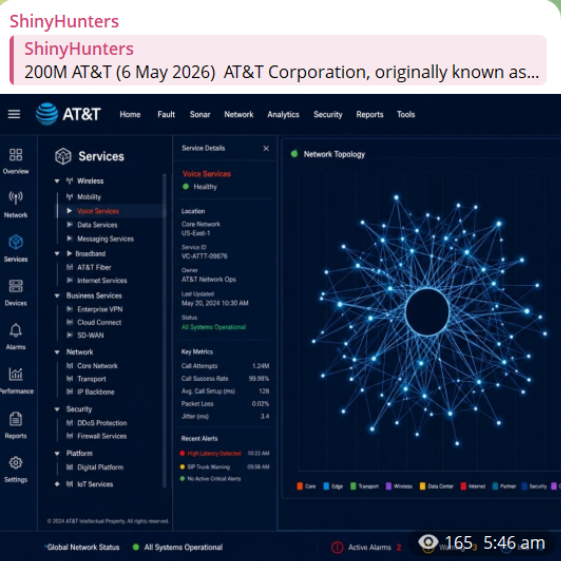
- Network Dashboards: Visual proof includes captures of “Global Network Status” dashboards, showing real-time call success rates and latency metrics, which supports their claims of deep access into telecommunications backends.
- Data Structure: The Ticketmaster dump is organized into complex directories such as ./sales_ord_deluxe_hdr and ./patron_lkup, totaling hundreds of gigabytes in CSV format.
- Assessment of Evidence: Both artifacts are insufficient to validate claims of large-scale data exfiltration or database compromise.
The “Everything” Claim:
In a bold statement on their Telegram channel, the group claimed to possess data from Salesforce, Cisco, Microsoft, Google, and CrowdStrike. While these claims remain largely unverified, the sheer volume of proven data from Ticketmaster and Santander suggests that their reach is currently unchecked.
Ttp Context (Shinyhunters-aligned Behavior)
| TACTICS | TECHNIQUES | ID | DESCRIPTION |
|---|---|---|---|
| Initial Access | Phishing | T1566 | Credential harvesting via social engineering |
| Initial Access | Trusted Relationship | T1199 | Access through third-party systems |
| Initial Access | External Remote Services | T1133 | Use of SaaS or remote access platforms |
| Persistence | Valid Accounts | T1078 | Continued access using compromised credentials |
| Credential Access | Steal Application Access Token | T1528 | Theft of authentication tokens |
| Credential Access | Use of Web Session Cookie | T1539 | Session hijacking |
| Discovery | Account Discovery | T1087 | Enumeration of accounts |
| Collection | Data from Information Repositories | T1213 | Access to centralized systems |
| Exfiltration | Exfiltration Over Web Services | T1567 | Data transfer via web channels |
| Impact | Data Theft and Extortion | T1657 | Monetization through data sale or exposure |
Note: These techniques reflect known behavior associated with ShinyHunters and are not confirmed for this specific incident.
Potential Impact
If validated, exposure of sensitive personal and financial data may lead to identity theft, fraud, and targeted phishing campaigns.
Current impact remains unconfirmed.
Assessment
The claim presents low evidentiary support despite originating from a known threat actor.
The screenshots provided do not demonstrate access to sensitive databases or internal systems. The Linux system log artifact is generic, and the service dashboard image only indicates potential visibility into operational metrics without confirming data access.
Threat level: Low to Moderate (unverified claim with potentially high-impact data exposure)
Conclusion
ShinyHunters are no longer just “Pokemon players” (as they mockingly refer to themselves). They have evolved into a major data broker entity, leveraging modern encrypted tools to bypass traditional forum-based law enforcement monitoring.
The information provided in this article is based on publicly available open-source intelligence (OSINT). It is intended for awareness and defensive cybersecurity purposes only.
