
 HQ/EMEAFind out how we can help your business

Overview
A publicly disclosed zero-day vulnerability affecting Cursor on Windows can allow attacker-controlled code to run when a user opens a malicious Git repository in the AI-assisted code editor.
The issue centers on how Cursor locates the Git executable during project initialization. Public research indicates that Cursor may search inside the opened workspace for git.exe instead of relying only on the trusted system-installed Git binary. If a repository contains a rogue executable with that name in its root directory, Cursor can launch it automatically without a prompt.
This behavior turns a routine developer workflow into a potential code execution path. A victim does not need to open an attachment, enable macros, or manually execute a file. Opening the repository in Cursor on Windows may be enough to trigger the payload.
At the time of this editorial review, public reporting did not identify confirmed widespread in-the-wild exploitation. However, the vulnerability is considered high risk because a proof-of-concept exists, the attack path is straightforward, and no official fix for this specific issue was identified in the public sources we reviewed.
Threat Intelligence Summary
| Field | Classification |
|---|---|
| Threat type | Unpatched zero-day vulnerability |
| Affected software | Cursor on Windows |
| Primary abuse path | Malicious Git repository containing a rogue git.exe |
| Execution trigger | Opening or loading the repository in Cursor |
| Exploitation status | Proof-of-concept publicly available; no confirmed widespread exploitation identified in public reporting reviewed |
| Risk level | High for Windows-based development environments |
| T |
Timeline
| Date | Event |
|---|---|
| December 15, 2025 | Mindgard reports identifying and privately disclosing the issue to Cursor. |
| April 30, 2026 | Researchers report verifying the behavior against Cursor 3.2.16 on Windows. |
| July 10, 2026 | Cursor lists version 3.11 in its public changelog. Public reporting indicates the git.exe issue remained unaddressed after later releases. |
| July 14, 2026 | Mindgard publicly discloses technical details after months of attempted coordination. |
| At time of writing | No official fix or advisory for this specific git.exe workspace execution issue was identified in public sources reviewed. |
Vulnerability Overview
The vulnerability stems from executable search behavior during repository initialization. When Cursor loads a project on Windows, it attempts to locate Git binaries from multiple locations, including the current workspace. A malicious repository can abuse that behavior by placing an attacker-controlled executable named git.exe in the repository root.
When the repository is opened, Cursor may execute the rogue binary as part of normal project loading. The code runs with the privileges of the logged-in user, which means the attacker’s access depends on the permissions and stored secrets available on the developer workstation.
The risk is not tied to prompt injection, model output, or a complex chain of exploitation. The repository itself becomes the delivery vehicle.
Attack Flow
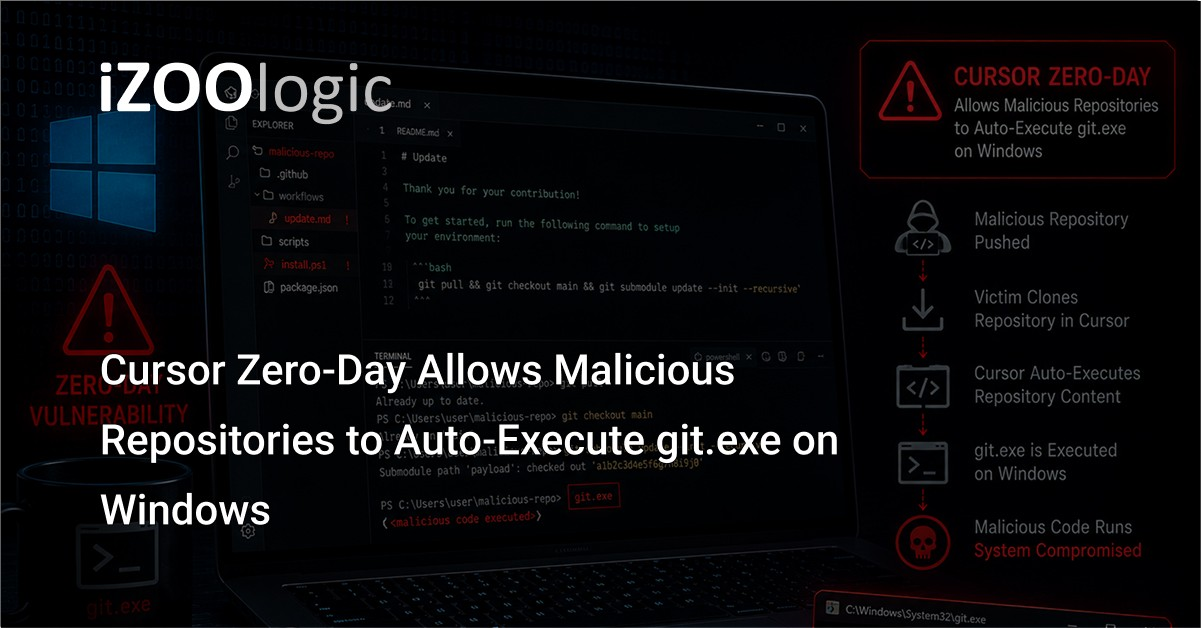
A successful attack can follow this sequence:
- An attacker creates a Git repository or compromises an existing one.
- A malicious executable named git.exe is placed in the repository root.
- The repository is shared through GitHub, GitLab, Bitbucket, a contractor channel, an internal collaboration space, or another code-sharing path.
- A Windows user opens the repository in Cursor.
- Cursor resolves Git from the workspace and launches the rogue git.exe during project initialization.
- The payload runs under the current user context and may launch follow-on activity.
Because developers routinely open repositories from partners, contractors, open-source projects, and internal teams, this technique can blend into normal software development activity.
Why This Matters
This issue is significant because it targets a trusted stage of the software development lifecycle. The malicious content does not need to hide in a dependency, package registry, or build pipeline. Instead, it sits inside a repository and waits for the affected development tool to process the workspace.
Several factors increase the operational risk:
- No phishing attachment is required.
- No document macro or script approval is required.
- No manual file execution by the victim is required.
- Code execution may occur before the developer has reviewed the repository contents.
- A repository can appear legitimate while still carrying a rogue executable.
For organizations using AI-assisted development tools, compromised developer workstations may expose source code, access tokens, SSH keys, cloud credentials, internal repositories, or build-system access.
Potential Impact
Successful exploitation could allow an attacker to:
- Execute arbitrary code on a developer workstation.
- Deploy malware, remote access tooling, or ransomware.
- Steal SSH keys, Git credentials, browser-stored credentials, or GitHub Personal Access Tokens.
- Access locally stored cloud credentials or configuration files.
- Modify source code or prepare malicious commits.
- Establish persistence on the endpoint.
- Use stolen credentials for lateral movement into internal systems.
The highest-risk cases involve developer systems with access to production infrastructure, private repositories, CI/CD systems, cloud accounts, or sensitive customer data.
Affected Platform
| Category | Details |
|---|---|
| Affected platform | Cursor on Windows |
| Observed versions in public reporting | Cursor 3.2.16; public reporting also indicates the issue persisted after later releases |
| Trigger | Opening a repository containing a rogue git.exe in the repository root |
| User interaction required | Opening or loading the repository in Cursor |
| Linux and macOS status | No public evidence reviewed indicates the same Windows executable path behavior affects Linux or macOS |
Indicators of Compromise and Suspicious Behavior
No campaign-specific hashes, domains, or IP addresses have been published for this disclosure because it describes a vulnerability rather than one known malware campaign. Security teams should focus on behavior-based detection.
| Type | Indicator or behavior |
|---|---|
| File | Unexpected git.exe located in a repository root or developer workspace folder |
| Process | cursor.exe spawning git.exe from a project directory rather than the trusted system Git installation path |
| Process | PowerShell, Command Prompt, script interpreters, or unknown child processes appearing immediately after a repository is opened |
| Execution | Unsigned or unfamiliar executables running from cloned repository paths |
| Network | Unexpected outbound connections shortly after opening a repository in Cursor |
Detection Opportunities
Organizations should review endpoint, EDR, and application-control telemetry for:
- Cursor launching executables from user workspace or source-code directories.
- Executables running directly from cloned repository paths.
- Abnormal process trees involving cursor.exe, git.exe, PowerShell, cmd.exe, or scripting interpreters.
- New persistence mechanisms created shortly after repository access.
- Credential access alerts originating from developer workstations.
- New outbound network activity from recently opened project directories.
MITRE ATT&CK Mapping
| Tactic | Technique | ID | Relevance |
|---|---|---|---|
| Initial Access | Supply Chain Compromise | T1195 | A malicious repository is used as the delivery path through a trusted development workflow. |
| Execution | User Execution | T1204 | The user opens the repository, which triggers execution through the affected application. |
| Execution | Command and Scripting Interpreter | T1059 | Follow-on payloads may use PowerShell, cmd.exe, or scripting tools. |
| Defense Evasion | Masquerading | T1036 | A malicious binary is named git.exe to resemble the legitimate Git executable. |
| Persistence | Boot or Logon Autostart Execution | T1547 | Follow-on malware may establish persistence after initial execution. |
| Credential Access | Credentials from Password Stores | T1555 | Attackers may target stored credentials on the developer workstation. |
| Credential Access | Unsecured Credentials | T1552 | Locally stored secrets such as tokens, keys, and config files may be exposed. |
| Collection | Data from Local System | T1005 | Sensitive files and source code may be collected from the endpoint. |
| Lateral Movement | Remote Services | T1021 | Compromised credentials may be used to access other systems. |
Recommendations
Until an official security update is available and deployed, organizations should consider the following defensive measures:
- Avoid opening untrusted or unknown repositories in Cursor on Windows.
- Inspect unfamiliar repositories for unexpected executable files before opening them in Cursor.
- Verify that Git operations resolve to the trusted system-installed Git binary.
- Use Windows Defender Application Control, AppLocker, or equivalent application-control tooling to restrict executable launches from developer workspace directories.
- Monitor developer endpoints with EDR coverage and review suspicious process trees involving Cursor.
- Analyze unfamiliar repositories in isolated virtual machines, Windows Sandbox, or disposable environments.
- Educate developers about malicious repository risks and software supply chain attacks targeting development tools.
- Review access tokens and local secrets on workstations that may have opened suspicious repositories.
Assessment
This vulnerability represents a notable attack surface in modern AI-assisted development environments. By abusing Cursor’s Git executable resolution behavior on Windows, an attacker can convert a repository into an automatic code execution vector.
The technique is concerning because it fits naturally into developer workflows. It does not require a malicious attachment, macro approval, package installation, or direct execution of a suspicious file. The user action is simply opening a repository in the affected application.
Although public reporting reviewed for this article did not identify confirmed widespread exploitation, the issue should be treated as a high-priority risk for Windows-based development environments. The combination of a simple attack path, public proof-of-concept, and lack of an identified official fix increases the defensive urgency.
Organizations should give particular attention to developer workstations with access to sensitive source code, private repositories, CI/CD systems, cloud accounts, or production infrastructure.
The information in this article is based on publicly available open-source intelligence and is intended for cybersecurity awareness and defensive planning.
