
 HQ/EMEAFind out how we can help your business


Executive Summary
During routine threat research, we identified a Mobile application masquerading as a legitimate device cleaning utility while communicating with attacker-controlled infrastructure to remotely modify its behavior after installation.
Static analysis revealed multiple advance capabilities including remote configuration, review-evasion logic, persistent background execution, and encrypted telemetry collection that collectively elevate the application beyond conventional adware.
com.clean.ultra.file (“Ultra Clean”) presents as a junk/file cleaner with an antivirus UI, but its core function is a remotely-operated advertising engine driven by an attacker-controlled command-and-control (C2) server. It exhibits behaviour that raises it above ordinary adware to malware-grade: 1000
- C2 remote control – an HTTPS config server dictates ad frequency, formats, and behavioural switches.
- Google Play review evasion – a server-controlled isAudit flag plus risk-gating knobs let the operator hide the abusive behaviour while the app is under Google review or on “risky” devices (analysts/VPN users).
- Push-driven, out-of-context ad launching – Firebase Cloud Messaging (FCM) pushes carry commands that launch ad-bearing activities without user interaction; further ad launches are triggered by screen-unlock and by any app install/uninstall on the device.
- Encrypted device-fingerprint exfiltration – persistent identifiers are gathered, AES-encrypted with a static embedded key, and uploaded to a second attacker server.
- Process persistence – a specialUse foreground service keeps the process alive so runtime-registered receivers continue firing.
Application Overview
The analysed application is distributed through the Google Play Store under the name Ultra Clean: Cleaner & Manager (com.clean.ultra.file) and is published by Pedhroza Artwork. It is presented as a utility application offering junk file cleanup, antivirus scanning, storage optimization, and photo management capabilities. At the time of analysis, the listing reported more than 1M+ downloads and advertised features including file cleaning, malware scanning, large file identification, and duplicate photo management. The application’s public-facing functionality appears consistent with a legitimate device optimization utility; however, static analysis identified substantially different backend behaviour involving remote command-and-control (C2), review-evasion mechanisms, and encrypted telemetry collection.
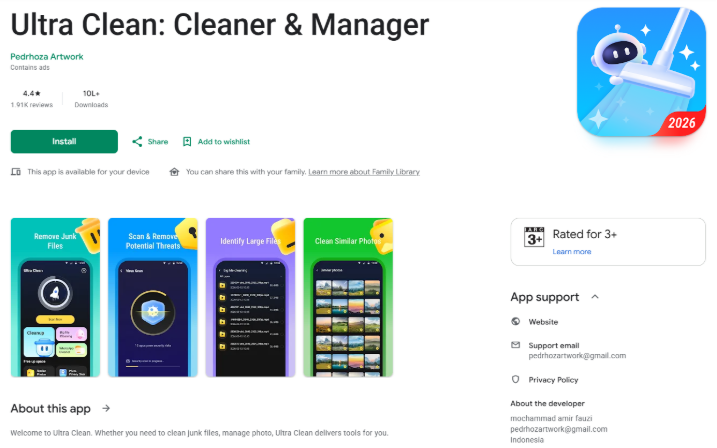
https://play.google.com/store/apps/details?id=com.clean.ultra.file
Key Findings
- Server-Controlled Command-and-Control (C2): The application communicates with attacker-controlled infrastructure to retrieve remote configuration policies and upload encrypted telemetry, enabling operators to dynamically modify application behavior after installation.
- Google Play Review Evasion: A remotely configurable isAudit flag, combined with multiple risk-based controls, allows the application to alter its behavior during Google Play review or when running in suspected analysis environments, indicating deliberate defense-evasion capabilities.
- Remote Tasking via Firebase Cloud Messaging (FCM): The application abuses Firebase Cloud Messaging as a command channel to remotely trigger advertisement activities, notifications, and other operator-defined actions without requiring application updates.
- Persistent Background Operation: A foreground service maintains process persistence, allowing dynamically registered broadcast receivers to continuously monitor device events such as screen unlocks and application installation or removal.
- Event-Driven Advertisement Delivery: Advertisements are triggered by user interactions including device unlock, home screen activity, and package installation or removal, maximizing advertisement impressions through server-controlled timing policies.
- Extensive Device Fingerprinting: The application collects numerous persistent device identifiers—including Android ID, Google Advertising ID (GAID), Firebase identifiers, AppsFlyer identifiers, install referrer, VPN status, and device characteristics—for tracking and profiling purposes.
- Encrypted Telemetry Exfiltration: Collected device information is signed, AES-encrypted using embedded cryptographic material, and transmitted to a dedicated telemetry endpoint hosted on attacker-controlled infrastructure.
- Anti-Analysis and Obfuscation: The application employs PairIP protection, encrypted strings, encrypted assets, VPN detection, and runtime behavioral controls to hinder analysis and complicate detection.
- No Evidence of Traditional Spyware Capabilities: Static analysis did not identify functionality associated with credential theft, SMS interception, contact harvesting, silent application installation, runtime code loading, or file theft.
- Malware-Grade Adware Assessment: The combination of remote command-and-control, review-evasion logic, persistent execution, encrypted telemetry collection, and dynamic advertisement orchestration elevates the application beyond conventional adware, warranting classification as malware-grade, server-controlled Android adware.
Architecture Overview
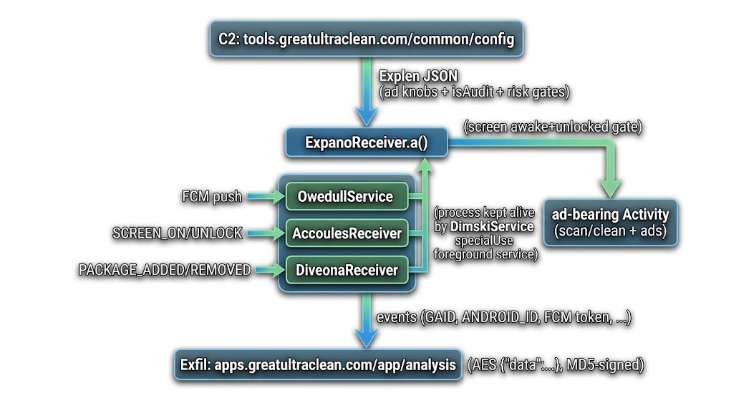
Ultra Clean is built around a remote ad-orchestration loop:
Technical Findings
C2 Infrastructure
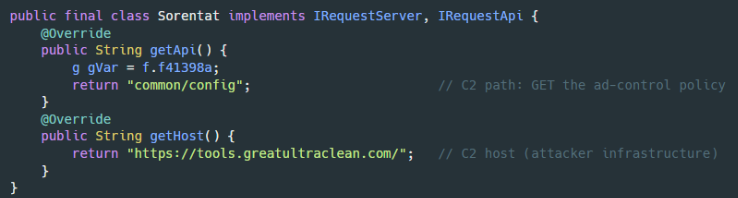
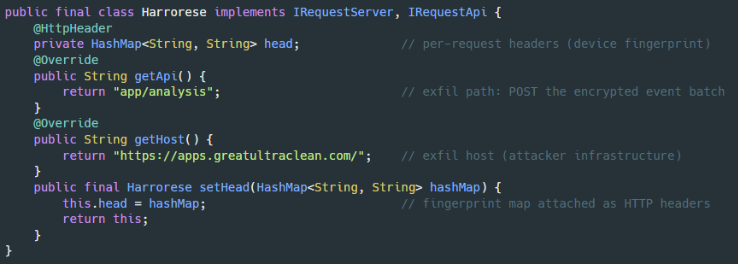
The app talks to two operator-controlled hosts on the same domain: tools.greatultraclean.com/common/config supplies the remote ad-control policy, and apps.greatultraclean.com/app/analysis receives the encrypted telemetry. Because these are IRequestServer/IRequestApi implementations, the host+path are resolved at request time from these constants. The manifest additionally sets usesCleartextTraffic=”true”, so plain HTTP is permitted alongside HTTPS.
Two hardcoded hosts are declared as hjq/EasyHttp request-server classes
Remote-Config Schema & Review Evasion
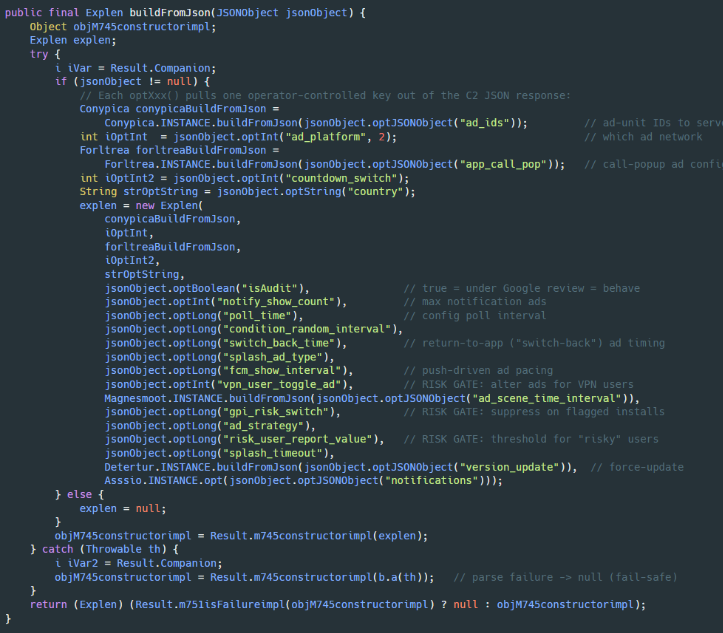
Explen is effectively a remote control panel the operator serves to each device. The security-critical keys are:
- isAudit - a server-set boolean signalling “you are under review / being watched.” The app can then present benign behaviour during Google’s inspection and switch the abusive ad engine back on in the field.
- gpi_risk_switch, risk_user_report_value, vpn_user_toggle_ad - risk gates that change behaviour for flagged installs, “risky” users, or VPN users (a common analyst/sandbox signal).
Deliberately altering behaviour to evade store review is a Google Play Device & Network Abuse / Deceptive Behaviour violation, and is the specific trait that elevates this sample from ordinary adware to malware-grade.
The C2 response is deserialized into Explen. The parser reveals the full control surface:
Trigger Subsystem
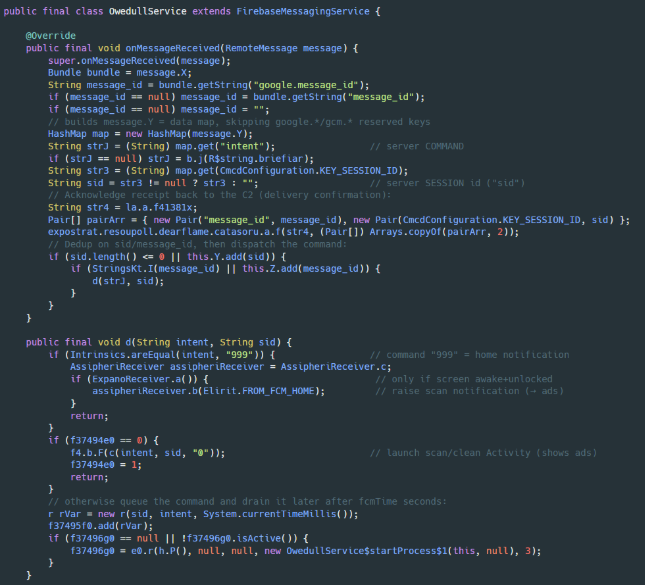
FCM push → ad launch
A silent data-push carries two operator fields, intent (a command) and sid (a session id). The service first reports delivery back to the C2, then d() executes the command: value ”999″ raises a home notification (gated on the screen being unlocked), any other value directly launches the scan/clean Activity, which renders interstitial/app-open ads. Extra commands are queued and drained after the server-set fcm_show_interval. This is a server → device tasking channel (C2) whose payload is ad display – the point where the adware behaviours meet.

Screen-unlock ad trigger
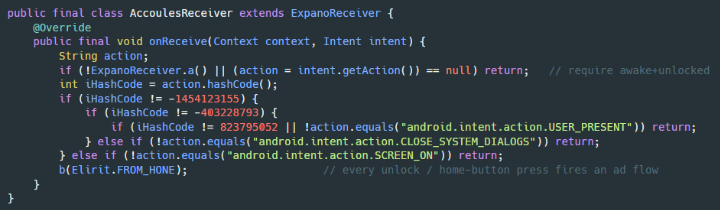
Turning the screen on, unlocking, or pressing home (SCREEN_ON / USER_PRESENT / CLOSE_SYSTEM_DIALOGS) triggers an out-of-context ad, independent of the user opening the app.
App install/uninstall trigger
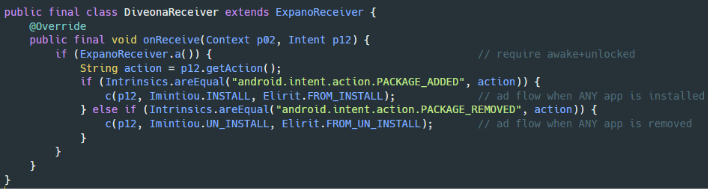
Any package install or removal on the device (observable because the app holds QUERY_ALL_PACKAGES) triggers an ad flow tagged FROM_INSTALL / FROM_UN_INSTALL.
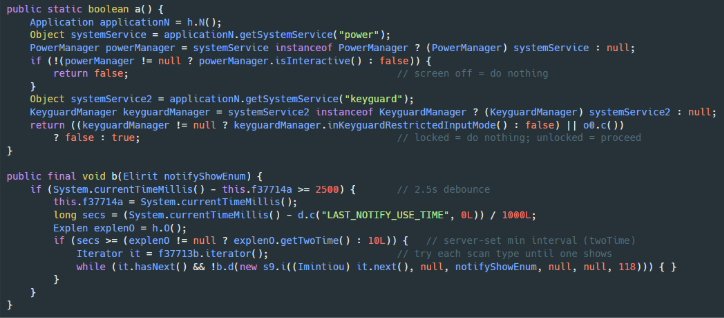
Impression-maximising gate - every trigger is gated on the device being awake AND unlocked:
Ads fire only when the device is awake and unlocked - guaranteeing a real impression – and are throttled by a 2.5-second debounce plus a server-controlled minimum interval (twoTime). This is deliberate ad-monetisation tuning, not incidental behaviour.
Persistence. The trigger receivers AccoulesReceiver / DiveonaReceiver are not declared in the manifest – they are registered at runtime, so the app must stay resident. It does so with a specialUse foreground service: The foreground service keeps the process alive so the dynamically-registered receivers continue catching SCREEN_ON / PACKAGE_ADDED events and the FCM channel stays live – the persistence layer of the ad engine.

Device Fingerprint & Exfiltration
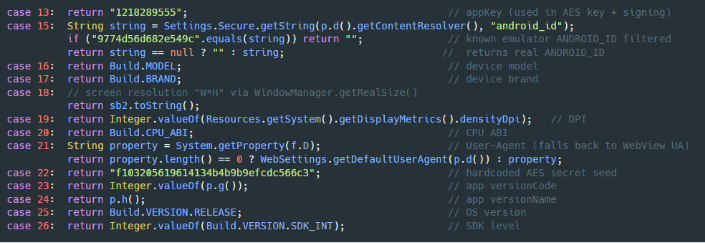
Step 1 – Identifier collection
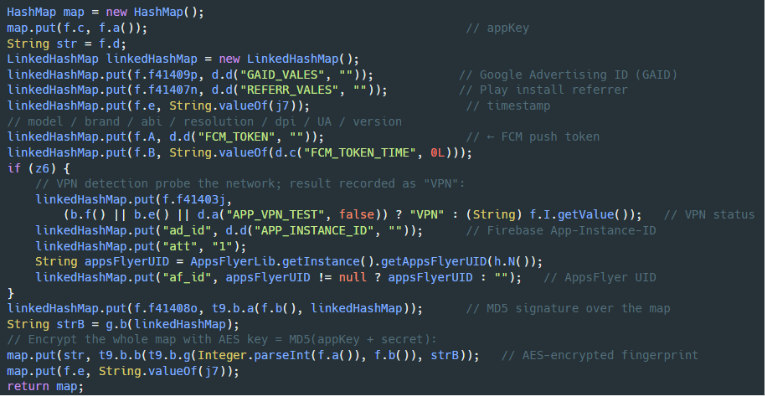
Step 2 – Fingerprint assembly + encryption
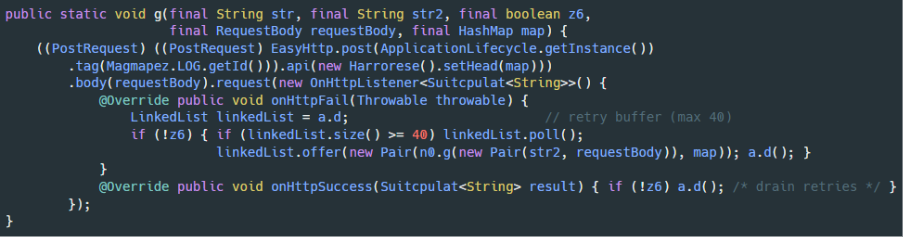
Step 3 – Upload transport + Firebase mirror
The app builds a persistent identifier bundle - ANDROID_ID, GAID, install referrer, FCM token, Firebase App-Instance-ID, AppsFlyer UID, VPN status and full device build data – signs it (MD5), AES-encrypts it into {“data”: …}, and POSTs it to apps.greatultraclean.com/app/analysis. Events accumulate in a LinkedBlockingQueue (batched, capped at 60), and on network failure are retried from a 40-entry LinkedList. The same events are duplicated into Firebase Analytics under Mobi_* names. The filtering of the well-known emulator and the explicit VPN check are anti-analysis/anti-sandbox tells consistent with the review-evasion logic.


Cryptography & Obfuscation
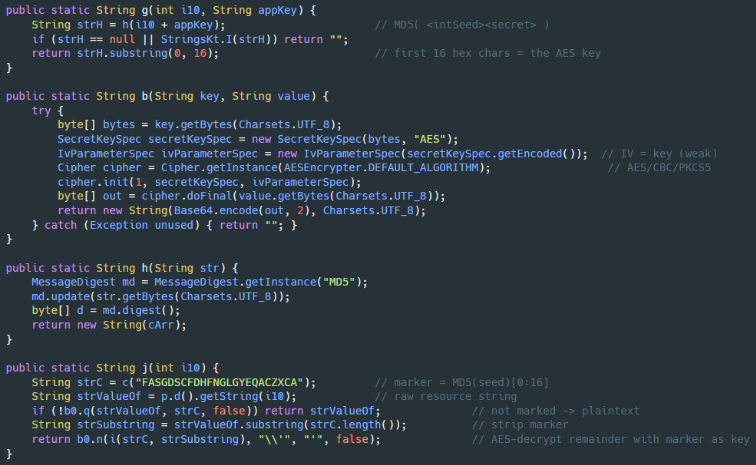
- Payload encryption uses AES-128/CBC/PKCS5 where the IV equals the key and the key derives from values shipped inside the APK (MD5(“1218289555″+”f103205619614134…”)[0:16]). This is cryptographically weak and trivially reversible by anyone holding the APK - its purpose is to defeat casual network inspection, not to protect the user.
String de-obfuscation (j) hides sensitive strings – endpoint paths (common/config, app/analysis), request parameter names, and event names – as AES ciphertext prefixed with a 16-char MD5 marker, decrypted on demand at runtime.
Encrypted assets assets/se_plat.json (ad-platform ID map) and assets/db_des.json use the same scheme.
Packing: the app is wrapped in the PairIP anti-tamper VM (libpglarmor.so, libsigner.so).
Recoverable secrets (for detection / offline decryption): appKey 1218289555, AES seed f103205619614134b4b9b9efcdc566c3, string-decrypt seed FASGDSCFDHFNGLGYEQACZXCA.
MITRE ATT&CK for Mobile Mapping
| ATT&CK Tactic | Technique ID | Technique | Observed Activity |
|---|---|---|---|
| Execution | T1624 | Event Triggered Execution | Broadcast receivers execute malicious logic when screen unlock, package install, package removal, or FCM events occur. |
| Persistence | T1547 | Boot or Logon Autostart Execution (Android service persistence) | A foreground service keeps the process alive, allowing runtime-registered receivers to remain active. |
| Discovery | T1426 | System Information Discovery | Collects Android ID, device model, brand, OS version, SDK level, screen resolution, CPU ABI, and user-agent information. |
| Discovery | T1418 | Software Discovery | Uses QUERY_ALL_PACKAGES and monitors package installation/removal events. |
| Discovery | T1422 | Network Information Discovery | Determines VPN usage and network characteristics before reporting telemetry. |
| Collection | T1517 | Access Notifications / Device Information Collection | Collects persistent identifiers including GAID, Android ID, FCM token, Firebase App Instance ID, AppsFlyer UID, install referrer, and device metadata. |
| Command and Control | T1437 | Application Layer Protocol | Communicates with remote C2 infrastructure over HTTPS for configuration retrieval and telemetry upload. |
| Command and Control | T1521 | Encrypted Channel | Encrypts collected telemetry using AES before transmission to the remote server. |
| Command and Control | T1437 | Application Layer Protocol | Firebase Cloud Messaging (FCM) is abused as a remote tasking mechanism to deliver server-controlled commands. |
| Exfiltration | T1646 | Exfiltration Over C2 Channel | AES-encrypted device fingerprint and telemetry are transmitted to attacker-controlled infrastructure. |
| Defense Evasion | T1633 | Detect Analysis Environment | Server-controlled isAudit, VPN checks, and risk-based logic modify runtime behavior to evade Google Play review and analyst environments. |
| Defense Evasion | T1406 | Obfuscated Files or Information | AES-encrypted strings, encrypted assets, and PairIP protection conceal internal functionality. |
User-Reported Behaviour
Publicly available Google Play reviews reveal multiple user reports describing persistent advertisements, unexpected application behavior, excessive background activity, and difficulty removing the application. While these reports cannot independently confirm malicious functionality, they are consistent with several behaviors identified during static reverse engineering, including persistent background execution, remote advertisement orchestration, and event-triggered advertisement delivery.
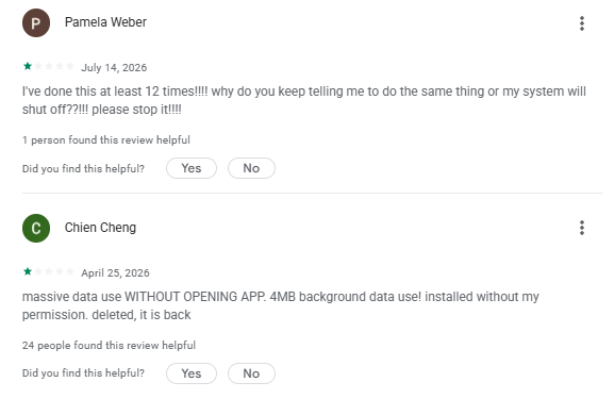
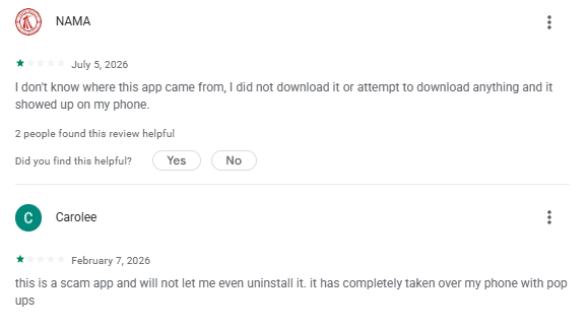
Several user complaints are consistent with the application’s observed architecture, including persistent background execution, continuous network communication, and remotely orchestrated advertisement delivery. However, certain claims such as automatic installation without user interaction or the inability to uninstall the application were not confirmed during static analysis and therefore should be treated as unverified user observations pending dynamic investigation.
Recommendations
Recommendations for Google Play
- Immediately remove the application from Google Play following a full policy review due to evidence of remote-controlled behavior, review-evasion logic, and extensive device fingerprinting.
- Investigate additional applications published by the same developer and identify related applications using shared infrastructure (*.greatultraclean.com), the Explen configuration schema, and the Mobi_* Firebase event taxonomy.
- Identify and suspend related developer accounts using shared code, signing certificates, SDKs, or backend infrastructure.
- Review applications implementing review-evasion logic, including server-controlled flags such as isAudit, VPN detection, and risk-based behavioral gating that modify functionality after publication.
- Enhance automated Play Protect detection for applications that combine Firebase Cloud Messaging with remote configuration to trigger out-of-context activities and dynamically alter runtime behavior.
Recommendations for Users
- Uninstall the application immediately if installed.
- Clear the application’s data before removal to eliminate locally stored configuration and identifiers.
- Monitor for unusual advertising behavior, unexpected notifications, or abnormal battery and network usage after installation.
- Reset the Google Advertising ID after uninstalling the application to reduce persistent advertising-based tracking.
- Review other applications installed from the same developer and remove any that are no longer trusted.
- Download applications only from reputable developers and carefully review requested permissions, privacy policies, and user reviews before installation.
Conclusion
Static reverse engineering of the Ultra Clean Android application (com.clean.ultra.file) identified a server-controlled advertising framework that exceeds the characteristics of conventional mobile adware. Rather than operating as a standalone cleaner application, the sample relies on attacker-controlled infrastructure to remotely configure its behavior, trigger advertising activities, and collect persistent device identifiers for transmission to external servers.
The most significant finding is the presence of a remote configuration mechanism incorporating review-evasion controls. Server-side parameters such as isAudit, together with multiple risk-gating controls, allow the operator to selectively suppress or enable malicious functionality depending on the execution environment. This capability enables the application to present benign behavior during application review while activating aggressive monetization and tracking functionality after deployment, representing a deliberate attempt to evade security analysis and app store detection.
The application further maintains continuous communication with attacker-controlled infrastructure through HTTPS and Firebase Cloud Messaging (FCM), enabling remote tasking, advertisement orchestration, telemetry collection, and behavioral updates without requiring application updates. Device identifiers-including Android ID, Google Advertising ID (GAID), Firebase identifiers, AppsFlyer identifiers, VPN status, and extensive device metadata-are collected, encrypted using embedded cryptographic material, and transmitted to the operator’s infrastructure.
Although this assessment did not identify capabilities associated with traditional banking malware or spyware-such as credential theft, SMS interception, contact harvesting, runtime code execution, or silent application installation-the combination of remote command-and-control, review-evasion logic, persistent background execution, extensive device fingerprinting, and encrypted telemetry exfiltration substantially increases the application’s operational risk beyond that of ordinary ad-supported software.
Based on the observed functionality, the application should be classified as malware-grade, server-controlled adware that poses a significant privacy and security risk to affected users. The identified infrastructure, configuration schema, and behavioral indicators provide high-confidence detection opportunities for defenders and should be considered for immediate threat hunting, IOC deployment, and coordinated reporting to Google Play to prevent further distribution.
