
 HQ/EMEAFind out how we can help your business

Executive Summary
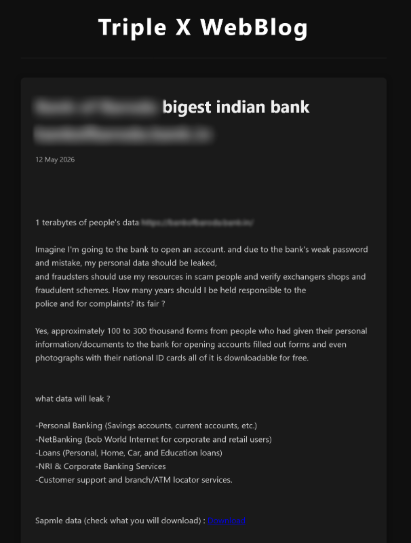
On 12 May 2026, Triple X WebBlog published a post claiming to possess approximately 1 TB of data belonging to a major Indian public sector bank, comprising 100,000 to 300,000 customer records. The publication includes sample files and a download link to the dataset.
Incident Details
Victim: One of India’s Largest Public Sector Banks
Industry: Banking and Financial Services
Country: India
Threat Actor: Triple X
Incident Type: Data Breach / Data Leak
Publication Date: 12 May 2026
Claimed Dataset: ~1 TB
Claimed Records: 100,000 to 300,000
About the Victim
The victim is one of India’s largest public sector banks, offering retail, corporate, treasury, international, and digital banking services.
About Triple X
Triple X operates a public leak platform known as Triple X WebBlog. Public intelligence on the actor remains limited. No public malware family, infrastructure analysis, or attribution has been documented.
Threat Actor Modus Operandi
Observed workflow:
- Obtain unauthorized access.
- Collect sensitive customer information.
- Publish sample files.
- Release the dataset through a public download link.
- Publicize the breach.
Attack Analysis
The publication contains sample documents and a download link but no ransom note, negotiation portal, payment instructions, or evidence of file encryption. No technical intrusion details have been released.
Data Exposure
Reported data includes customer onboarding forms, KYC documents, identity cards, customer photographs, banking application forms, and other personally identifiable information.
TTP Context
| Tactic | Technique ID | ATT&CK ID | Description |
|---|---|---|---|
| Initial Access | Exploit Public-Facing Application | T1190 | Potential exploitation of an internet-facing application. |
| Initial Access | Valid Accounts | T1078 | Use of compromised credentials. |
| Collection | Data from Information Repositories | T1213 | Collection of customer information. |
| Collection | Data from Local System | T1005 | Collection of files from compromised systems. |
| Collection | Data from Network Shared Drive | T1039 | Collection from shared storage. |
| Collection | Archive Collected Data | T1560 | Archive data before exfiltration. |
| Exfiltration | Exfiltration Over C2 Channel | T1041 | Transfer of stolen data. |
| Exfiltration | Exfiltration to Cloud Storage | T1567 | Upload of stolen data to cloud services. |
Assessment: The techniques above provide investigative context and are not confirmed through forensic evidence.
Potential Impact
If authentic, exposed customer information increases the risk of identity theft, phishing, account takeover, financial fraud, document forgery, regulatory scrutiny, and reputational damage.
Defensive Recommendations
Review authentication logs, monitor DLP alerts, audit access to customer repositories, search for exposed organizational data, enforce MFA, monitor underground forums, and increase phishing monitoring.
Threat Assessment
High Confidence
- Triple X has publicly published a leak page claiming responsibility for the incident, providing strong evidence that the group is associating itself with the compromise.
- The leak page suggests the incident has progressed to the extortion or public disclosure stage.
Medium Confidence
- The reported dataset size and record count should be treated with caution, as threat actors may exaggerate stolen data volumes.
- Although leaked data supports claims of unauthorized access, the scope and authenticity of the records remain unverified.
Low Confidence
- The initial access vector remains unknown, with no evidence confirming how the threat actor gained access.
- There is no reliable information regarding malware usage, persistence mechanisms, encryption activity, or attacker infrastructure.
- It is unclear whether the incident involved ransomware deployment or was limited to data theft and extortion.
