
 HQ/EMEAFind out how we can help your business

1. Executive Summary
FalkonC2 is not malware alone. Rather, it is an exploit framework built on a polymorphic build engine known as MorphMorph2 which creates unique obfuscated samples upon request. FalkonC2 comprises several modular attack pieces that come together to form two operational versions for sale as Malware-as-a-Service products branded as ROTEMELLI1 (consumer endpoints) and ROTEMELLI2 (enterprises with EDR bypass).
Previous reports have detailed the operation and advertised capabilities of FalkonC2. In contrast, this report digs deeper into the details of what each of nine source files related to the core framework modules does, as well as how the build engine generates evasions.
1.1 Key Findings
1.1.1 The Build Engine
MorphMorph2 is a WebSocket server listening on port 5664 that takes compilation requests from buyers and delivers obfuscated binaries. The wide character strings are encrypted using substitution character cipher. ANSI strings, in turn, are encrypted using XOR cipher with a unique 41-character SHA1 key generated on-the-fly during compilation of the binary. Signature detection across samples is impossible.
1.1.2 The Components
Four source-verified modules provide unique functionalities for attacks:
- RAHR retrieves local network configuration information by querying the Windows registry and exfiltrates it to C2 without using WMI and launching any child process.
- RSCR checks cloud screenshot directories, starts Win+PrintScreen operation if they do not exist, and exfiltrates captured screenshots and deletes them from disk immediately after transmission.
- RSHE launches a hidden cmd.exe using pipes as stdin and stdout and runs an injected command. It sends a beacon with a predefined acknowledgment to C2. RSHE does not receive any command output.
- The BSOD Decoy module displays a fake Windows crash screen, locks all mouse and keyboard inputs for 60 to 96 seconds and starts a real system reboot by NtRaiseHardError after the timer expires.
The fifth template module rshr.h is included in each ROTEMELLI malware sample but its functionality is not implemented in the analyzed source code.
1.1.3 What the BSOD Decoy Is Actually Covering
This is the element which modifies the threat picture the most. Post Titles on underground forums characterize the BSOD Decoy as “blue screen of death decoy for rmm-hvnc agent“. The 60 to 96 seconds lockout time window is not intended to protect RAHR, RSCR, and RSHE operating in series. It is intended to protect an operator using a hidden desktop via Hidden Virtual Network Computing (HVNC) interactive session, with legitimate RMM software enabling ongoing control of the machine. Threat intelligence reports reveal ScreenConnect, Datto and SimpleHelp are the RMM software of choice. The BSOD Decoy hides the user while the operator is conducting his operations out of sight. This is an important development beyond the simple evasion overlay.
1.1.4 Infrastructure
- 30 hardcoded C2 domains of the form api.deldome[n].[tld] with .today and .com top level domains (Refer the IoCs subsection in Section 8 before blocking them)
- Three user-agent strings for Adobe Acrobat Updater used in each module, unchanged across all compilations
- Build server running at C:\Users\Administrator\Desktop\DisAssembly\ using JetBrains CLion 2026.1.2, clang-cl and Ninja
- B13 compilation database including all SHA1 keys of all samples
1.1.5 MaaS Model and Active Deployment
ROTEMELLI operates as a subscription service with buyer verification and a clear restriction against VirusTotal sample uploads. The ROTEMELLI_2 enterprise version is delivered as a zip file consisting of msnight.dll and a decoy binary MicrosoftTeams-LANDriver.exe. Infections have been observed across the US, Australia, Netherlands and Poland successfully bypassing Microsoft Defender for Endpoint.
1.2 Evidence Standards
All the claims made in this advisory are based on one of three levels of evidence:
- Findings that are based on verified sources come directly from the analysis of source files and are also verified by the code.
- Findings that are corroborated show up in both the source and in external threat intelligence reporting.
- Findings that are reported only are found exclusively in external reports and are not verified by any sources. In case of discrepancies between the two, this advisory sides with the code.
2. Threat Actor Profiling
2.1 The Developer
The primary attribution anchor for FalkonC2 is embedded in the source itself. Every analyzed component carries the IDE-generated header “Created by sysapollinaris on 5/2/2026.” This is the developer’s JetBrains CLion username, hardcoded into the project at creation. Forum posts releasing the same source code are attributed to the handle Apollinaris, and the BSOD Decoy release is explicitly signed “Dev by Apollinaris.” sysapollinaris and Apollinaris are the same person. No forum correlation is required to establish this; we infer this directly from the source files.
The commercial operation ran under a separate sales handle on a Russian-language cybercrime forum, self-described as “Falkon Support.”
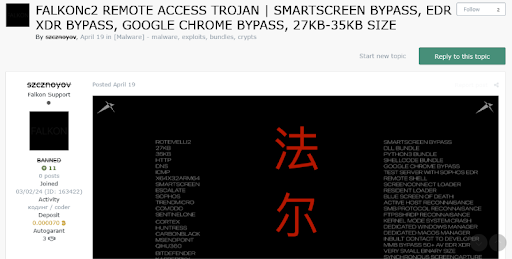
FalkonC2 advertisement on an underground forum
That account was subsequently banned. Apollinaris then registered a new account on the same platform and began releasing components publicly. The developer returning to the same forum under a new identity after the commercial account was banned, can be a behavioural indicator that the developer and the sales operator might be the same individual.
2.2 Timeline

Timeline of Posting & Advertisement for FalkonC2
The timeline traces the actor’s documented activity from initial forum registration through to the public source code releases. Two phases are visible. The first is a commercial operation running from mid-2024 through April 2026 under a dedicated sales identity, ending abruptly with an account ban. The second begins two months later when the developer re-emerges under a new identity on the same platform and begins releasing components publicly. The overlap between the May 2026 source file timestamps and the active commercial period confirms that development and sales were running in parallel, not sequentially.
2.3 Developer Profile
Forum discussions reveal deliberate architectural choices. The primary design goals were size and speed. The base binary without the morpher was engineered to 17KB. MorphMorph2 brings compiled samples to approximately 37KB. The SmartScreen bypass adds further overhead reaching approximately 70KB. WinHTTP was chosen over libcurl to eliminate third-party dependencies. LLVM and clang were chosen over GCC and MinGW for custom runtime optimizations. The developer confirms experience with MASM64, MASM32, NASM and ARM64 assembly but argues modern compiler optimizations achieve equivalent results without the complexity. The analyzed source is entirely C++.
A successor version has already been written, described as weighing 9KB and more capable than the released version. As stated by the TA, it will not be released publicly.
2.4 The GOP Rootkit
The BSOD Decoy source release is labelled “BEFORE GOP.” The post announces a GOP Rootkit as a follow-on project.
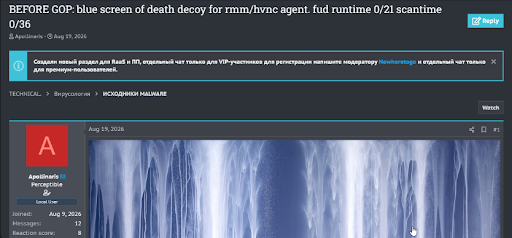
FalkonC2 BSOD module released on an underground forum
The user-mode NtRaiseHardError trigger in the current BSOD Decoy was always a temporary mechanism. GOP is the planned kernel-mode successor. External reporting describing a kernel-mode BSOD capability likely reflects GOP rather than the user-mode implementation confirmed in the analysed source.
2.5 Geographic Indicators
The commercial listing explicitly prohibits use against systems in CIS countries and Japan. The MorphMorph2 source independently hardcodes LCID 1041, the Japanese locale, as the default execution exclusion. These two indicators corroborate each other without relying on the same source. CIS and Japan protection appearing in both the marketing terms and the compiled binary is consistent with a Russian-speaking actor maintaining standard operational boundaries. The consistent “Slava!” sign-off across posts reinforces this. No stronger geographic attribution is warranted from the available evidence.
2.6 Unverified Capabilities
The commercial listing advertises capabilities which are not present in the analysed source files released till now:
- DNS and ICMP communication
- MM4/MM7/MM8 encryption
- macOS manager
- GPS tracker and Active Directory detector.
These either exist in unanalyzed components, represent the version currently in development or are marketing claims. The source does not confirm them and this advisory does not assert them. FalkonC2 is an actively maintained project. The analyzed source represents a prior generation, not the current one.
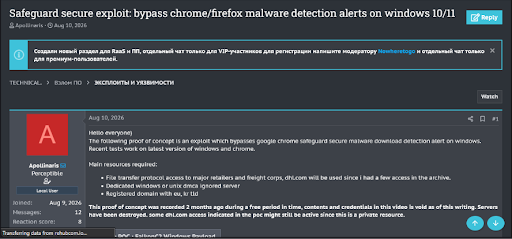
Sale of an alleged Chrome download bypass on an underground forum
The Chrome download alert bypass advertised in the original post, as a zero-day is corroborated by a proof of concept posted by Apollinaris on August 10, 2026, two days before the first source code releases.
3. Architecture Overview
3.1 The MorphMorph2 Foundation
The unique selling point of FalkonC2 is not one specific feature but rather the entire engine that drives all its components. MorphMorph2, which is the polymorphic compilation engine for the framework, creates a unique binary for each customer on each separate request. Unlike conventional malware that shares one binary among all victims and thus gets easier to detect with signatures as time goes, MorphMorph2 compiles functionally identical malware with different obfuscation, encryption keys and code each time.
3.2 System Architecture
There are three layers to the framework, each clearly defined.
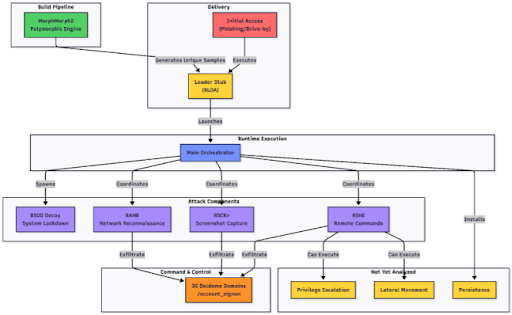
Architecture diagram for the released files and known capabilities
- Build Layer (MorphMorph2) is a WebSocket server running on port 5664 that accepts compiled requests and outputs polymorphic binaries. The buyers supply payload, icon, required privilege, exclusion paths and geofencing rules. Everything else is handled by the engine itself – strings get encrypted, decrypt functions are injected, CMake is configured, and the process is compiled using clang-cl and ninja. Each sample is recorded into a B13.DB SQLite database that uses SHA1 hash as primary key.
- Component Layer (RAHR, RSCR, RSHE, BSOD Decoy) has each attack module saved as a C++ header file in template directories, tree for EXE output and treedll for DLL output. All four modules share the same pattern of C2 communications, and each of their API calls gets dynamically resolved using GetProcAddress and does not appear in import table.
- Execution Layer is what the victim sees. BSOD Decoy runs first, it hides the desktop, blocks any user input and shows the fake Windows crash screen while the operator conducts operations behind this screen through HVNC session that runs on hidden desktop. Then, 60 to 96 seconds later, it forces a hard error through NtRaiseHardError and the system restarts.
3.3 The Obfuscation Pipeline
Two techniques for string encryption work at compile-time and it is very easy to get confused about both but necessary to keep them distinct.
- Wide-character strings are encrypted using the CustomDecrypt() function, which performs a character substitution cipher during run-time to substitute between two fixed, reverse order alphabets.
- ANSI strings are encrypted using the xorDecrypt() function, which performs an XOR between each byte and the SHA1 key per sample, hardcoded into the function itself before compiling. Each sample has its own unique decryption key.
- Mirror byte encoding is a completely different technique, used by RAHR when exfiltrating the network data by performing three different bit-wise operations followed by converting them into hex. Mirror byte encoding is a transit obfuscation technique working at an altogether different phase of process.
3.4 C2 Communication
Each part logs in at /account_signon on one of 30 hardcoded deldome domains, which is chosen randomly for each connection through CryptGenRandom. The static user-agent strings for each part make them good markers for detection because they do not vary for each compilation:
- RAHR: Adobe Acrobat Updater/25.001.20937 WinHTTP/10.0
- RSCR: Adobe Acrobat Updater/25.001.20312 WinHTTP/10.0
- RSHE: Adobe Acrobat Updater/25.001.20709 WinHTTP/10.0
Each request is made with an x-status-for header, which contains the key for each sample, using SHA1 with the mirror byte encoding along with the secondary runtime data. The key is added during compilation through the substitution of the string MOPHER-DAPI. From there, once the defender gains access to the key in one beacon, all other beacons compiled from the same source become known by header.
4. Component Analysis
RAHR, RSCR, RSHE and BSOD Decoy are the four source-verified components that make up every Rotemelli sample, each of them purpose-built for a discrete function, each sharing the same C2 communication pattern and none of them appearing in the import table.
4.1 RAHR: Network Reconnaissance
RAHR, as named internally by the Local IPv4 Interface Capture Utility, is the network reconnaissance tool. The tool runs at an early stage of the attack chain to get an overall picture of the network topology of the victim prior to making any lateral movement decisions.
4.1.1 What It Does
RAHR exploits one registry key only:
HKEY_LOCAL_MACHINE\SYSTEM\CurrentControlSet\Services\Tcpip\Parameters\Interfaces. This key includes all configuration information of the network adapter for each network interface on the machine, identified by its GUID. For each interface, RAHR requests the following:
- EnableDHCP: if DHCP is enabled
- DhcpIpAddress/IPAddress: present IP address assignment with fallback to static
- DhcpSubnetMask/SubnetMask: present network mask assignment with fallback to static
- DhcpDefaultGateway/DefaultGateway: present gateway address assignment with fallback to static
- DhcpServer: DHCP server IP
- DhcpNameServer/NameServer: present name server addresses, either DHCP assigned or static
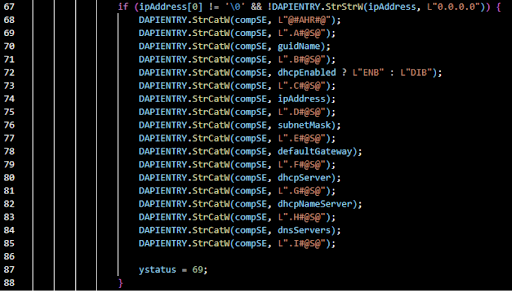
RAHR Delimiter Structure
Network interfaces with no IP address or 0.0.0.0 assigned are skipped. The valid network interfaces are organized using internal delimiters (records separated by “@#AHR#@”; fields separated by “.A#@S@” through “.I#@S@”) and then provided to the obfuscation process. The use of these delimiter strings can be considered as an artifact for detection.
4.1.2 Exfiltration
Prior to sending out the network traffic, the structured network data undergoes mirror byte encoding: the byte is mixed up by nibble, bit-pair and individual bit swaps and turned into a two-character hexadecimal representation. The encoded data gets prefixed with AP7: and put into a 1MB buffer and uploaded to a random deldome domain at /account_signon. The POST includes the RAHR specific user-agent Adobe Acrobat Updater/25.001.20937 WinHTTP/10.0 and the obfuscated x-status-for identifier.
There is one thing worth mentioning: RegEnumKeyW – the function responsible for the iteration of adapter GUIDs – is directly imported, unlike every other API in the framework which is dynamically resolved using the DAPIENTRY structure. It is not a part of API hiding mechanism. RegEnumKeyW will appear in the import tables of all RAHR containing malware samples.
4.2 RSCR: Screenshot Exfiltration
RSCR – the Screenshot Capture Utility Over HTTPS – is the espionage component. It allows the operator to get visual proof of what was displayed on the victim machine screen during the infection and to upload it before the victim even realizes that anything happened.
4.2.1 What It Does
The RSCR checks for the following items in succession:
- %USERPROFILE%\OneDrive\Pictures\Screenshots
- %USERPROFILE%\Pictures\Screenshots
These are the directories that Windows 11 fills automatically when a user uses the combination Win + PrintScreen. If any of these exist, the RSCR uses one of them. If both directories do not exist, the module sends the Win + PrintScreen keystrokes using SendInput function which creates this directory and stores a screenshot to it before returning.
If there is a valid directory, RSCR enumerates its files, sends the keystrokes, waits for 1000 milliseconds, and re-enumerates the directory. All the files created between these enumerations are the new screenshots taken by the system. Then for each of these files:
- Reads the file into the preallocated buffer
- All files that are less than 125 bytes are discarded as not valid captures
- Deletess the original file immediately after reading
- The file contents are prepended with AP6: and then sent to C2.
Screenshots will not remain locally after they have been sent out. No residual evidence will remain if memory forensics are not conducted.
4.3 RSHE: Command Execution
RSHE – Remote Shell Utility Over HTTPS – is the module responsible for commands execution. There is one misconception concerning RSHE that should be clarified. RSHE does not return command output to the C2 server. It only executes the command and acknowledges it.

RSHE SOKOL beacon
4.3.1 What It Does
RSHE allocates 2 pipes 64 KB each for stdin and for stdout/stderr and spawns the C:\Windows\SysWOW64\cmd.exe using CREATE_NO_WINDOW flag. The utilization of SysWOW64 folder means that the compilation target is 32-bit version. RSHE waits for 3 seconds for shell creation, sends command to the stdin pipe and waits 2 more seconds for completion of command execution. Then all pipes are closed and all remaining commands running are dropped.
RSHE does not send any output from the command execution back to C2. RSHE uses obs() mirror byte encoding to encode the fixed string “SOKOL”. Then, it adds “AP3:” prefix to the result and sends the whole thing into 1 MB buffer at random deldome domain. SOKOL acts as a beacon of execution acknowledgement, sending nothing but confirmation that the command was executed.
4.4 BSOD Decoy: Evasion and Operator Cover
The BSOD Decoy is a module which recontextualizes everything in the framework. It is a mock-up of Windows crash screen on its surface, but it is also an operator concealment tool: the way to keep the physical user blind and paralyzed while a threat actor operates interactively on the same machine behind a hidden desktop.
4.4.1 What It Does
The module is a Qt application that opens a fullscreen window replicating a Windows 11 BSOD with,
- #0178d4 background
- 🙁 in 180px Segoe UI Light
- CRITICAL_PROCESS_DIED stop code
- Windows logo mimicking the QR code area
- A percentage counter incrementing toward completion
Before the window appears, three things happen in sequence:
- Every other window including the taskbar is hidden
- BlockInput(TRUE) locks all keyboard and mouse input
- A low-level keyboard hook via SetWindowsHookEx(WH_KEYBOARD_LL) suppresses the Windows keys, both Ctrl keys and the Applications menu key
The hook does not intercept Alt and Ctrl+Alt+Del is handled by Winlogon before any user-mode hook can see it, so that specific escape route is not blocked. In practice the combination is enough to trap a typical user for the full lockout window.
4.4.2 The Timer Mechanism
Every 12 seconds, QTimer fires a signal. Each time a random integer from 1 to 5 is added to a counter initialized with 0 value. Module stops being in the lockout state when counter reaches 100.
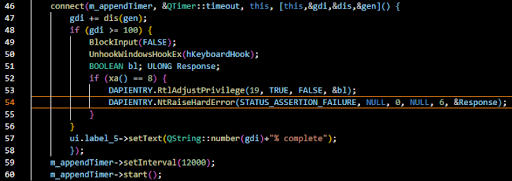
BSOD Timer and Hard Error Trigger
This means that it takes 5 to 8 timer ticks until the end, thus lockout phase lasts for 60 to 96 seconds. User sees the percentage counter which directly corresponds to this counter.
4.4.3 The Hard Error Trigger
When the counter reaches 100, the module uninstalls the keyboard hook, restores input with BlockInput(FALSE) and triggers a hard error:
- RtlAdjustPrivilege(19) to acquire SE_SHUTDOWN_NAME
- NtRaiseHardError(STATUS_ASSERTION_FAILURE, …, 6, …) with response option 6 (OptionShutdown)
That makes a real Blue Screen of Death and causes a forced reboot. Reboot flushes the memory and gets rid of any runtime evidence of execution of the malware during the lockout.
4.5 MorphMorph2: Polymorphic Build Engine
MorphMorph2 is the compilation engine that powers FalkonC2. The operators use it in their infrastructure to create custom-made samples on the fly. Each instance of ROTEMELLI malware compiled for buyers was produced by that engine, customized according to the buyer’s requirements and compiled within 15 seconds.
4.5.1 Build Server
MorphMorph2 works as a uWS WebSocket server on port 5664 from a computer at C:\Users\Administrator\Desktop\DisAssembly\. The server is set up with 1GB maximum payload, 60-second idle time-out and 16MB backpressure threshold. There is a SQLite database called B13.DB with a table UserCmp which records all compilations by SHA1 key and saves a cc field which is used for marking special variants like ROTEMELLI_2.
Professional development environment is worth mentioning: JetBrains CLion 2026.1.2, clang-cl compiler from Visual Studio LLVM compiler and Ninja build system. It’s a maintained organized development environment, not something hacked together on the go.
4.5.2 Compilation Protocol
Buyer makes requests via WebSocket in this form:
COMPILE:[PAYLOAD]:[ICON]:[PE]:[ACCESSRIGHTS]:[EXCLUDE]:[MORPH]:[COUNTRY]:[SHA1_KEY]
Or for DLL output:
COMPILEDLL:[PAYLOAD]:[ICON]:[PE]:[ACCESSRIGHTS]:[EXCLUDE]:[MORPH]:[COUNTRY]:[SHA1_KEY]
SHA1_KEY must be exactly 41 symbols. Other fields should consist of no less than 2 symbols. Server checks SHA1_KEY against B13.DB first. If there is no known SHA1_KEY then CCA_QAK response will be sent. That’s how buyers are authenticated: access to the build server is controlled via database.
Every parameter defines the output:
- PAYLOAD: Base64-encoded shellcode or secondary payload embedded into compiled executable
- ICON: Base64-encoded icon embedded into PE resources
- ACCESSRIGHTS: “LOCU” uses asInvoker rights, everything else requiresAdministrator
- EXCLUDE: Checks for a file, which if it is present, causes the binary to exit instantly
- MORPH/COUNTRY: LCID values embedded along with default 1041 value (Japanese language locale)
4.5.3 String Encryption Pipeline
GetStringsFromFile() is called by the engine for each template header, which searches for 3 different string patterns, i.e. L”… ” wide-character strings, comma-prefixed ANSI strings, and strings located within function calls. Lines containing /*IGNORE-MORPH*/ are ignored.
There are two encryption algorithms used depending on the string type. The SHA1_KEY serves as a compilation-time C2 identifier and an encryption key.
- L”… ” wide-character strings are encrypted using CustomEncrypt() and are replaced with calls to CustomDecrypt(). This routine encrypts characters using a simple character substitution between two different reversed alphabets.
- ANSI strings are encrypted using SHA1_KEY with xor algorithm and replaced with xorDecrypt() calls.
- Both decryption routines are injected to the compiled source code at the place-holder location before the compilation phase starts.
- Additionally, the SHA1_KEY is placed into capi32.h to replace MOPHER-DAPI place-holder, making SHA1_KEY aim1 – x-status-for header of every C2 beacon generated from that sample.
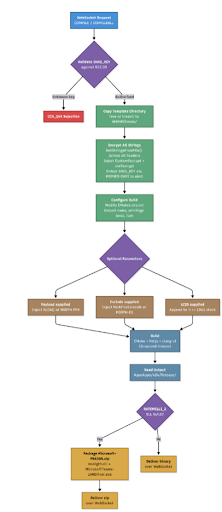
String encryption pipeline flowchart diagram
The process is now carried out in the following manner:
- Verify the validity of SHA1_KEY against B13.DB, deny CCA_QAK if it fails the test
- Copy the correct template tree to the timestamped working directory (HHMMSSmmm)
- Invoke GetStringsFromFile() in all headers to encrypt strings and add decrypt functions
- Edit CMakeLists.txt for output file name, privilege and icon resource
- If payload was provided, insert the call for RLOA() into mml.h after the /MORPH-PPA/ tag.
- If exclusion path was provided, insert the PathFileExistsW early-exit into mml.h after the /MORPH-CO/ tag.
- In case geofencing was required, append the provided LCID to the already present ii == 1041 check.
- Run CMake and Ninja with a timeout of 15 seconds and extract the compiled binary from AppoAppo/x64/Release/.
- When building the ROTEMELLI_2 DLLs, make an archive consisting of msnight.dll and MicrosoftTeams-LANDriver.exe and name it Microsoft-PRA389.zip
5. Component Assembly and Attack Chain
The four components described above in Section 4 do not work separately. They are being combined into a single executable binary through the tool called MorphMorph2, which then runs on top of the mml.h loader. Any ROTEMELLI sample received by victims comes from this combination. The components are just the parts of the weapon and mml.h is what turns them into one.
5.1 The ROTEMELLI Variants
There are two different named variants of FalkonC2 created from the same components.
- ROTEMELLI1 targets consumer endpoints. It is built as EXE, operates under user privilege and prioritizes quick data collection over persistence. The attack window is very limited by design – execute, exfiltrate, reboot.
- ROTEMELLI2 targets corporate environments. The program builds itself as a DLL and is packaged in Microsoft-PRA389.zip alongside MicrosoftTeams-LANDriver.exe as the decoy loader. It is then marked in the B13.DB compilation database as ROTEMELLI_2 to enable specific packaging. The DLL build name is msnight.
5.2 The Attack Chain
Here is the order of actions performed on the victim’s computer according to the source code.
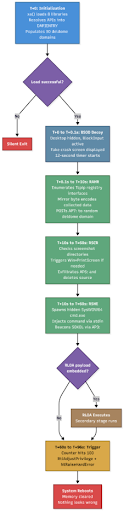
Attack chain pipeline flowchart diagram
5.2.1. T+0: Initialization
The program starts, and the initialization function xa() starts to run. This function loads eight Windows libraries (User32, Winhttp, Kernel32, Advapi32, Shlwapi, Ole32, ntdll and Netapi32) and resolves every required API by GetProcAddress into the DAPIENTRY structure. 30 deldome C2 servers domains are written to the d1[] array. If any library cannot be loaded, function xa() finishes work prematurely and the malware quits without running other modules.
5.2.2. T+0 to T+0.1s: BSOD Decoy Launch
BSOD Decoy starts working and gains control of the user experience until the end of attack. The desktop and taskbar are hidden, BlockInput prevents any actions, and the fake crash screen fills the screen. 12 seconds timer starts working. From this moment, the real user can do nothing.
5.2.3. T+0.1s to ~T+10s: Network Reconnaissance
RAHR works when the user is staring at the fake crash screen. RAHR gathers information about every network interface in Tcpip registry branch, formats data using its own delimiters, mirrors byte encoding and sends this information to a randomly selected deldome server using AP7: prefix. Now the operator has all information about network configuration of the victim’s computer.
5.2.4. T+10s to T+60s: Screenshot Exfiltration and Command Execution
Then comes RSCR. It scans the screenshot folders, performs Win+PrintScreen if needed, waits for the filesystem, exfiltrates the newly generated screenshot, having the AP6: prefix, and deletes the original file. As a result, the attacker gets an image of what was displayed on the victim’s screen.
RSHE works parallel to it or right after it gets a signal from the orchestrator module mml.h, spawns a hidden cmd.exe process, injects the command through stdin and sends the acknowledgment message to the C2 server having AP3: prefix. If there is any secondary payload embedded in the code at compile time using the RLOA() injection function, it runs here too.
5.2.5. T+60s to T+96s: The Window Closes
The counter for the BSOD Decoy gets closer to 100%. The user has seen a credible BSOD message screen counting to 100%. The operator has 60 to 96 seconds of time without any observations. With the last tick of the timer, it stops the hooking of the keyboard, allows the input, acquires SE_SHUTDOWN_NAME privileges using RtlAdjustPrivilege and calls NtRaiseHardError. The system gets a real crash and reboots.
And this reboot is not accidental. It cleans all memory and runtime artifacts and resets the user’s perception. From the user’s point of view, the computer got a crash and then recovered itself.
5.3 Customization at Compile Time
Every element of the attack chain presented above is customizable at compile time by the buyer. This is exactly what MaaS provides – not a mere malware but a weapon adjusted specifically to the target.
- The PAYLOAD parameter allows for payload injection where the binary code includes additional shellcode/malware that works with the main component using RLOA()
- The ACCESSRIGHTS parameter controls whether the binary elevates privileges or works silently at user-level
- The EXCLUDE parameter injects a PathFileExistsW function call into the binary to exit if a particular file exists. This allows the binary to evade sandboxing
- The MORPH/COUNTRY parameters allow for geofencing by injecting the LCID check. The binary will run only in specified countries. By default, the hardcoded value for locale is 1041 (Japanese), indicating the region that is to be protected from infection
- The ICON parameter allows for injecting an icon in the PE resources to spoof legitimate software
5.4 The ROTEMELLI_2 Delivery Chain
The customer demands a COMPILEDLL build with the msnight output name. The B13.DB database marks the demand as ROTEMELLI_2. After the compilation process, the engine compresses msnight.dll and MicrosoftTeams-LANDriver.exe into a Microsoft-PRA389.zip package delivered to the customer over WebSocket protocol.
6. ROTEMELLI Variants and Deployment
6.1 Delivery Vectors
The delivery methods of the malware cannot be traced back directly from the source code. Instead, the code indicates what artifacts are generated by the framework.
- ROTEMELLI1 compiles as a standalone EXE file with an icon and output file name specified by the buyer. The framework supplies an operator with a compiled malicious binary in the disguise of any application chosen by the operator. The mass delivery is consistent with the consumer version of the malware, but the specific method is not known.
- ROTEMELLI2 is somewhat more specific. The build engine packs every enterprise build into Microsoft-PRA389.zip file with MicrosoftTeams-LANDriver.exe and msnight.dll. The Teams name is not accidental. The zip file that pretends to be a part of Microsoft Teams in an enterprise environment can be a convincing lure for precisely such environments. External threat intelligence sources report the framework’s RMM loader abusing ScreenConnect, Datto and SimpleHelp for execution of the malware. This requires either social engineering of the user to execute the file or deployment through already existing access.
6.2 The RMM and HVNC Layer
The most important operational detail of ROTEMELLI2 is not in the malware itself, but in what it covers. The external threat intelligence reports show FalkonC2 operators use legitimate RMM tooling, namely ScreenConnect, Datto and SimpleHelp, which are renamed and executed via built-in function dubbed an RMM Loader. That provides persistent and interactive access to the machine, which will survive the BSOD reboot procedure.
6.3 Financial Software Targeting
Both malware variants are set up to prioritize financial software environments. Threat intelligence reports show that FalkonC2 stubs perform audit of endpoint for presence of Intuit QuickBooks and Sage50 Accounting installations and prioritize those environments for fast and automated exfiltration. Capi32.h includes NetShareEnum and Service Control Manager APIs (OpenSCManagerA, OpenServiceA, QueryServiceStatus) used in software inventory and service enumeration procedures, though the code to detect specific financial software environments is not present in analyzed source files and possibly implemented in rshr.h or additional modules.
Such targeting is not random. QuickBooks and Sage50 contain bank account credentials, payroll and vendor payment information and provide direct access to business financial accounts. Just a single screenshot during the login to one of these applications can yield immediately actionable credentials.
6.4 Geographic Targeting and Geofencing
As per external threat intelligence reporting, active infections have been confirmed in the United States, Australia, the Netherlands, and Poland. Geofencing capabilities are provided in MorphMorph2 through the ability to inject the LCID of the target geography at compile time to restrict execution. The hardcoded LCID check in the source code for MorphMorph2 is set at 1041, which is the LCID for Japanese. This could indicate a build environment or a geographic region that the operator does not want to target with infections.
6.5 The MaaS Operation
ROTEMELLI is being distributed as an operational product instead of just a tool. Subscription pricing is in place, as well as user verification prior to access.
The anti-VirusTotal clause in the terms of service is also of great operational importance, since it retains detection evasion capabilities for all customers because no one customer burns the framework signatures by uploading to an analysis platform such as VirusTotal. The clause is enforced, indicating that the operator monitors for compliance.
7. C2 Infrastructure and Communications
7.1 The Deldome Network
All four components of ROTEMELLI share the same C2 infrastructure: 30 hardcoded domains following a naming convention within two TLDs. The full list of domains, confirmed by reviewing the source code can be found in Section 8.
Numbering gaps are not sequential, as there is grouping in ranges of 1 to 9, 21 to 26, 81 to 86 and 92 to 100, with significant gaps. It cannot be determined whether the gaps arise out of deletions, phase registration or tiering from the given data. What is obvious is that all 30 are given equal importance in the selection process: connections randomly select from the total list of 30 using CryptGenRandom.
7.2 The Communication Protocol
All parts utilize the same protocol no matter what data they transmit.
- Behavior: HTTPS POST to /account_signon on port 443
- Method: POST
- Encryption: Standard TLS. The malware does not verify the chain of certificates, which means that any certificate can be used to sinkhole the domain.
- User-Agent: Specific to component, fixed for all compilation instances:
- RAHR: Adobe Acrobat Updater/25.001.20937 WinHTTP/10.0
- RSCR: Adobe Acrobat Updater/25.001.20312 WinHTTP/10.0
- RSHE: Adobe Acrobat Updater/25.001.20709 WinHTTP/10.0
All these strings remain constant; not randomized, not rotated and not varied in any way per compilation. Same in every ROTEMELLI sample ever seen. Making them highly trustworthy detection signatures for network monitoring – anything else which utilizes these strings must be investigated.
7.3 The x-status-for Header
Every request carries an x-status-for header with no legitimate purpose in standard HTTP traffic. Its presence alone is worth alerting on.

x-status-for Header Construction
The value combines aim1, the per-sample SHA1 key embedded at compile time by replacing the MOPHER-DAPI placeholder in capi32.h, with aim2, a secondary runtime value not assigned in any analyzed source and likely populated in mml.h.
Out of these, aim1 is the operationally significant half. Consistent across every beacon from the same compiled sample regardless of domain or timing, recovering it from a single capture lets a defender identify every other beacon from that sample across sessions. It is the most reliable correlation handle in the framework and a priority extraction target during incident response.
7.4 Data Routing
The sole /account_signon endpoint is responsible for handling all three kinds of data via a prefix-based routing mechanism. The first four bytes of the POST body identify the originator of the beacon and give instructions to the C2 backend regarding handling the following data:
- AP7: network reconnaissance data from RAHR, mirror-byte-encoded, padded to 1 MB
- AP6: raw screenshot file data from RSCR, file bytes written straight after the prefix
- AP3: the fixed SOKOL beacon data from RSHE, mirror-byte-encoded, padded to 1 MB
Both RAHR and RSHE pad their POSTs with 0xFFFFF bytes irrespective of data size. This consistent size prevents detection based on payload length and ensures that a network monitor is unable to differentiate between a small RSHE beacon and a large RAHR exfiltration based on the latter’s size.
The Content-Type header follows the component not the data:
- RAHR: text/html
- RSCR: image/png regardless of actual screenshot format
- RSHE: text/html
All these Content-Type values incorrectly describe the POST body payload. This is a deliberate and useful inconsistency – a 1 MB POST request with Content-Type text/html sent to a brand-new domain by a process without any need for networking is not expected network traffic.
7.5 Redundancy and Takedown Resistance
The 30-domain structure supposes that some of the domains will be taken down; since domains are selected at random, no single one carries so much traffic as to stand out and blocking several of them reduces connectivity in proportion but does not stop the malware. There is no domain generation algorithm either. If all 30 domains are taken down at the same time, the malware samples will go dormant and will not be able to recover on their own. That is the only real limitation of the architecture and therefore it is worthwhile to aim at a coordinated simultaneous takedown of all 30 domains.
8. Detection, Hunting and Mitigations
FalkonC2 is specifically engineered to defeat signature-based detection. Every compiled sample is unique, and the import table is empty. That framing is accurate, but it creates a misleading impression that the framework is undetectable, while it’s not. The behaviour is consistent across every sample, the C2 infrastructure is fully enumerated, and several components leave artifacts that are difficult to hide regardless of how the binary changes.
8.1 Network Detection
The network layer is where the highest-confidence, lowest-effort detections live. The deldome infrastructure is fully known, the user-agent strings are static, and the x-status-for header has no legitimate use anywhere.
- Block the domain list. All 30 deldome domains are confirmed from source and listed in Section 7. A simultaneous DNS and firewall block across all 30 is the single highest-leverage defensive action available. Deployed samples cut off from all 30 domains go dormant.
- Alert on the user-agent strings. These three strings are hardcoded per component and do not vary across compilations:
- Adobe Acrobat Updater/25.001.20937 WinHTTP/10.0 (RAHR)
- Adobe Acrobat Updater/25.001.20312 WinHTTP/10.0 (RSCR)
- Adobe Acrobat Updater/25.001.20709 WinHTTP/10.0 (RSHE)
Any process other than a legitimate Adobe Acrobat installation producing these exact strings is worth immediate investigation. These are exact-match, high-confidence signatures that hold across every Rotemelli sample ever compiled.
- Alert on x-status-for. This header has no legitimate purpose in standard HTTP traffic. Any outbound request carrying x-status-for with a hex-encoded value should be treated as a potential indicator.
- Flag the endpoint and POST size combination. Outbound HTTPS POST requests of approximately 1MB to /account_signon on newly registered or low-reputation domains, carrying Content-Type: text/html or Content-Type: image/png, are not normal application traffic. The Content-Type mismatch is particularly useful: RAHR sends a 1MB binary payload with text/html and RSCR sends raw screenshot data with image/png applied statically regardless of actual file format.
8.2 Endpoint Detection
Each component produces a distinct set of API calls and behavioral artifacts. These hold across every compiled variant.
8.2.1 RAHR
The registry access pattern is the primary signal. Sequential enumeration of HKEY_LOCAL_MACHINE\SYSTEM\CurrentControlSet\Services\Tcpip\Parameters\Interfaces followed by queries to EnableDHCP, DhcpIpAddress, DhcpSubnetMask, DhcpServer and DhcpNameServer from a non-system process is anomalous. Legitimate applications query specific interfaces they need, not the entire adapter tree systematically.
Callback to the previous note: RegEnumKeyW appears as a direct import in RAHR-containing samples rather than being resolved dynamically like every other API in the framework. It will show in the import table of any binary containing RAHR, which is a minor but useful static analysis signal.
Alert on:
- RegOpenKeyExW + RegEnumKeyW on the Tcpip\Parameters\Interfaces path from a non-system process
- 0xFFFFF byte heap allocation immediately followed by WinHttp calls from a process with no expected network functionality
8.2.2 RSCR
The file deletion pattern is the strongest signal. A process that reads a file from %USERPROFILE%\OneDrive\Pictures\Screenshots or %USERPROFILE%\Pictures\Screenshots and then immediately deletes it is not behaving like any legitimate screenshot application. File integrity monitoring on both paths will catch this.
Alert on:
- SendInput with VK_LWIN + VK_SNAPSHOT from a non-user-initiated process
- File read immediately followed by DeleteFile on the same path within either screenshot directory
- VirtualAlloc allocating 10MB from a process with no expected large file I/O
- FindFirstFileW / FindNextFileW enumeration of screenshot directories from unexpected processes
8.2.3 RSHE
The pipe-and-process creation sequence is the tell.
Alert on:
- cmd.exe spawned from C:\Windows\SysWOW64 by a non-terminal, non-shell parent process with CREATE_NO_WINDOW
- Two 64KB pipes created immediately before a cmd.exe launch from an unexpected parent
- WinHttp calls from a process that just created a cmd.exe subprocess
8.2.4 BSOD Decoy
The input locking and keyboard hook combination is unusual outside of accessibility software and is essentially never seen alongside window-hiding behavior.
Alert on:
- BlockInput(TRUE) called from a non-system process
- SetWindowsHookEx with WH_KEYBOARD_LL installed globally from an unexpected process
- GetTopWindow followed by a ShowWindow(SW_HIDE) loop across all desktop windows
- RtlAdjustPrivilege(19) followed by NtRaiseHardError from a user-mode process
- A fullscreen window with title “bsoda”, background color #0178d4 and a disabled context menu
8.3 Behavioral Detection
Some of the strongest signals are behavioral patterns that span multiple components or are visible without API-level visibility.
- A system that reboots 60 to 96 seconds after an apparent crash with no memory dump phase and no event log entries consistent with genuine hardware failure should be treated as a potential BSOD Decoy execution
- A progress indicator that increments on a precise 12-second interval during a crash screen is not how real Windows error recovery works
- Screenshot files that appear in OneDrive or Pictures screenshot directories and then disappear within seconds without any user interaction are a reliable RSCR indicator
- Renamed or unsigned instances of ScreenConnect, Datto or SimpleHelp appearing on endpoints without an approved deployment record are consistent with the RMM loader capability documented in external reporting. Allowlist approved RMM installations by hash and alert on deviations.
8.4 Hunting Guidance
For teams running proactive threat hunts, the following queries are worth building against your telemetry.
- Hunt for the user-agent strings in proxy or firewall logs, filtered to source processes. Legitimate Adobe Acrobat update traffic originates from the Adobe Acrobat application itself. The same string originating from svchost, explorer, a document viewer or any unnamed process is a high-fidelity hit.
- Hunt for processes that call both RegEnumKeyW on the Tcpip\Parameters\Interfaces path and WinHttpSendRequest within the same execution context. This cross-API correlation is specific to RAHR and produces very low false positive rates.
- Hunt for cmd.exe instances with no parent terminal and no visible console window that were created alongside two anonymous pipe handles. Filter to cases where the parent process has no established network functionality. This catches RSHE execution independent of which binary delivered it.
- Hunt for WebSocket connections to port 5664 in your environment. This is the MorphMorph2 build server port. Any internal or outbound WebSocket traffic on this port warrants immediate investigation.
8.5 Mitigation Priorities
For security leaders making prioritization decisions, the following actions are ordered by impact-to-effort ratio.
- Block all 30 deldome domains at DNS and firewall simultaneously. This is fast, low-cost and immediately disrupts any deployed samples in your environment.
- Enable SSL inspection on outbound traffic. Without it, the AP-prefixed POST bodies and x-status-for header values are invisible. With it, every Rotemelli beacon becomes readable and alertable.
- Audit RMM tooling in your environment. Approved tools should be allowlisted by hash. Unnamed, unsigned or renamed instances of ScreenConnect, Datto or SimpleHelp on endpoints that have no approved deployment record are a serious finding regardless of whether FalkonC2 is the vector.
- Implement file integrity monitoring on screenshot directories. Both %USERPROFILE%\OneDrive\Pictures\Screenshots and %USERPROFILE%\Pictures\Screenshots should alert on unexpected file deletion. The cost of this monitoring is low, and it catches RSCR activity that leaves no other on-disk trace.
- Ensure forensic telemetry ships off host in real time. The BSOD Decoy’s hard error trigger is designed to clear local memory and reboot the system before a responder can act. If your EDR telemetry only lives locally, a BSOD Decoy execution may erase the evidence of what ran during the lockout window. Off-host SIEM ingestion ensures the record survives the reboot.
8.6 MITRE ATT&CK Mapping
| Technique | ID | Component |
|---|---|---|
| Query Registry | T1012 | RAHR |
| System Network Configuration Discovery | T1016 | RAHR |
| Screen Capture | T1113 | RSCR |
| Windows Command Shell | T1059.003 | RSHE |
| Remote Access Software | T1219 | BSOD Decoy / RMM Loader |
| System Shutdown/Reboot | T1529 | BSOD Decoy |
| Disable or Modify Tools | T1562.001 | BSOD Decoy |
| Obfuscated Files or Information | T1027 | MorphMorph2 |
| Deobfuscate/Decode Files or Information | T1140 | MorphMorph2 |
| Execution Guardrails: Environmental Keying | T1480.001 | MorphMorph2 (geofencing) |
| Application Layer Protocol: Web Protocols | T1071.001 | All components |
| Encrypted Channel | T1573 | All components |
| Exfiltration Over C2 Channel | T1041 | RAHR, RSCR |
| Masquerading | T1036 | BSOD Decoy, RSHE, delivery |
| Dynamic Resolution | T1568 | All components (domain randomization) |
8.7 IOCs
8.7.1 Domains (block all simultaneously)
A note on the domain list: The 30 deldome domains below are hardcoded in the analyzed source files and should be blocked as a precaution. However, no public WHOIS records, DNS resolution or threat intelligence feed attribution has been found for any of these domains at time of writing. The commercial listing advertised weekly domain rotation for ROTEMELLI1 and 72-hour rotation for ROTEMELLI2, which suggests the actual operational infrastructure used in live campaigns may differ from the hardcoded list in the analyzed source. These domains are included here as indicators derived from source code analysis, not from confirmed live C2 observation. Monitor threat intelligence feeds for operational domain updates as the framework evolves.
api.deldome1.today, api.deldome2.com, api.deldome3.today, api.deldome4.today, api.deldome5.com, api.deldome6.today, api.deldome7.today, api.deldome8.com, api.deldome9.today, api.deldome21.today, api.deldome22.today, api.deldome23.com, api.deldome24.today, api.deldome25.today, api.deldome26.com, api.deldome81.today, api.deldome82.today, api.deldome83.today, api.deldome84.com, api.deldome85.today, api.deldome86.today, api.deldome92.today, api.deldome93.com, api.deldome94.today, api.deldome95.today, api.deldome96.com, api.deldome97.today, api.deldome98.today, api.deldome99.com, api.deldome100.today
8.7.2 Network signatures
- User-Agent: Adobe Acrobat Updater/25.001.20937 WinHTTP/10.0
- User-Agent: Adobe Acrobat Updater/25.001.20312 WinHTTP/10.0
- User-Agent: Adobe Acrobat Updater/25.001.20709 WinHTTP/10.0
- HTTP header: x-status-for (hex-encoded value)
- URI: /account_signon
- POST body prefix: AP7:, AP6:, AP3:
8.7.3 File indicators
- Microsoft-PRA389.zip
- msnight.dll
- MicrosoftTeams-LANDriver.exe
- B13.DB (SQLite, build server artifact)
- Window title: bsoda
8.7.4 Registry
- HKLM\SYSTEM\CurrentControlSet\Services\Tcpip\Parameters\Interfaces (enumerated by non-system process)
Build server
- Path: C:\Users\Administrator\Desktop\DisAssembly\
- Port: 5664 (WebSocket)
Disclaimer: This advisory consolidates original source code analysis and open-source threat intelligence on FalkonC2 and its ROTEMELLI variants. Technical findings are derived directly from nine source files released by the developer across multiple underground forums between August 12 and August 19, 2026. Operational and attribution findings draw on continuous monitoring of underground forum activity and public threat intelligence reporting. The analysed source represents a prior generation of the framework. Development is ongoing, new capabilities are in active development and the threat landscape around this actor continues to evolve. Treat this advisory as a point-in-time snapshot and monitor for updates as additional source files and operational intelligence become available.
