
 HQ/EMEAFind out how we can help your business

Banking & Financial Services Sector
Threat actors, campaigns, exposures and exploitation activity
Contents
- Executive summary
- Key findings
- Intelligence methodology
- Global threat landscape
- Finance threat matrix
- Cross-industry context
- Industry-specific threat actors
- Featured case study: Operation IronShadow
- Campaigns, incidents and data exposure
- Additional notable sector incidents
- Malware and tooling
- Banking fraud and payment system threats
- Attack vectors and techniques
- Vulnerabilities and exploitation activity
- MITRE ATT&CK mapping
- Emerging threats and trends
- 6–12 month outlook
- Business impact
- Global regulatory and resilience considerations
- Detection priorities
- Actionable defensive recommendations
- 24-hour / 7-day / 30-day action plan
- Conclusion
- Analytic confidence and caveats
- Appendix A: Operation IronShadow (Aotera) indicators
Executive summary
The global banking and financial services sector remained a high-value target throughout the reporting window. The combined view of iZOOlogic collection, threat telemetry and independent analysis shows three overlapping pressures: financially motivated ransomware and extortion, theft and brokerage of customer or employee data, and disruptive activity against public-facing financial infrastructure. The activity spans North America, Europe, Asia-Pacific, the Middle East, Latin America and Africa, with the most severe risk concentrated around institutions and technology providers that hold payment, identity or transaction data.
Ransomware and extortion remained a high-impact threat throughout 2026. Open leak-site tracking recorded 34 finance-sector claims in January and 59 in August; the same series captured 6 finance/banking entries during the first two days of September. A separate finance-sector dataset recorded 78 victims in Q1 and 114 in Q2, a 46.2% increase. Global all-sector tracking reached 964 claimed victims in August. These are public claims, not confirmed-breach counts.
Banking-specific exposure extends beyond ransomware. In H1 2026, banking accounted for 5,251 of 23,645 identified data-leak risk events (22.2%). Banking also represented 44.74% of 45,321 phishing, counterfeit and brand-abuse risk events. The pattern points to persistent customer-facing identity abuse, credential harvesting and impersonation risk alongside direct intrusion activity.
The sector is increasingly exposed through internet-facing access systems, identity infrastructure, payment applications, third parties and trusted tools. Exploitation, stolen credentials and social engineering can converge into the same end state: privileged access to payment, customer, treasury and transaction data.
Threat activity is geographically distributed. The Q2 2026 finance dataset recorded victims across 31 countries; the United States accounted for 54% of observed finance ransomware victims, while the remaining exposure was dispersed across multiple markets. Concentration therefore exists without geographic confinement.
For defenders, treat ransomware, identity compromise, data theft and third-party exposure as one connected financial-risk problem. Prioritise exposed remote-access and application infrastructure, phishing-resistant authentication, privileged-access controls, rapid credential/session revocation, supplier monitoring and high-fidelity egress detection.
Key findings
Five intelligence judgments define the current financial-services threat environment. These judgments are intended to guide prioritisation rather than simply catalogue incidents.
- Internet-facing infrastructure remains a primary entry point. VPN gateways, security appliances and business applications continue to provide externally reachable paths into sensitive environments.
- Identity is becoming the bridge between social engineering and privileged access. Credential theft, help-desk manipulation, session abuse and weak authentication controls can convert human interaction into durable access.
- Third-party compromise creates systemic exposure. Shared providers, managed services and connected platforms can allow one compromise to affect multiple financial institutions or business functions.
- Data exposure creates a long-tail fraud problem. Credentials, session material, identity documents and payment-related records may remain exploitable after the original incident has been contained.
- Payment-system manipulation deserves first-class treatment. The financial objective can be fraudulent transaction execution rather than disruption alone, making transaction integrity and privileged payment access central security concerns.
Intelligence methodology
This report presents iZOOlogic’s assessment of cyber threat activity affecting the global banking and financial-services sector during the reporting period. The assessment combines iZOOlogic research, observed threat activity, incident monitoring, vulnerability intelligence, ransomware and data-leak telemetry, and analyst assessment.
Reporting period: 1 January 2026 – 2 September 2026. Intelligence cutoff: 2 September 2026. September activity is treated as a partial observation period.
Sector scope. The report covers banking, credit unions, investment and securities firms, asset management, lending and consumer finance, microfinance, payment providers, fintech organisations and other entities whose compromise can directly affect financial transactions, customer funds, financial information or payment infrastructure.
Global threat landscape
The 2026 global threat picture is best understood as a layered risk environment. Public ransomware and extortion tracking provides broad visibility into claimed victim activity, while sector classification and technical intelligence are used to identify finance-specific trends. Across January–September 2026, ransomware is only one component of the financial threat surface: banking and broader finance also face data leakage, phishing/counterfeit activity, identity compromise, public-facing application abuse and third-party concentration.
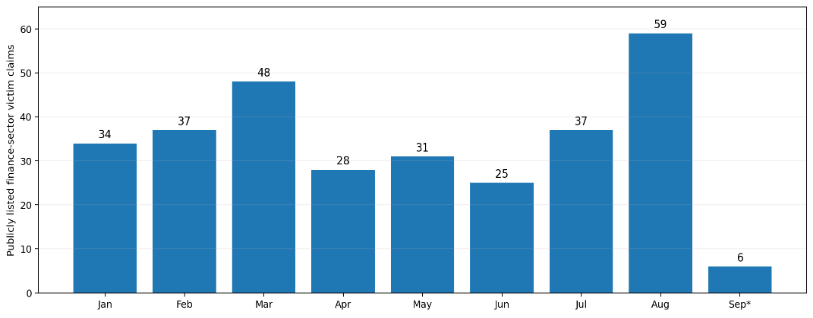
Finance-sector ransomware claims by month – Jan–Sep 2026.
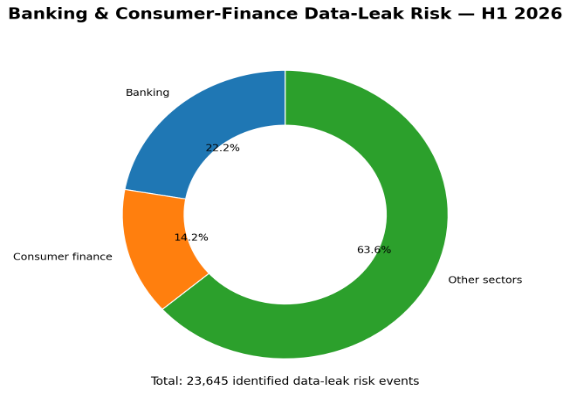
Banking and consumer-finance external data-leak risk events – H1 2026.
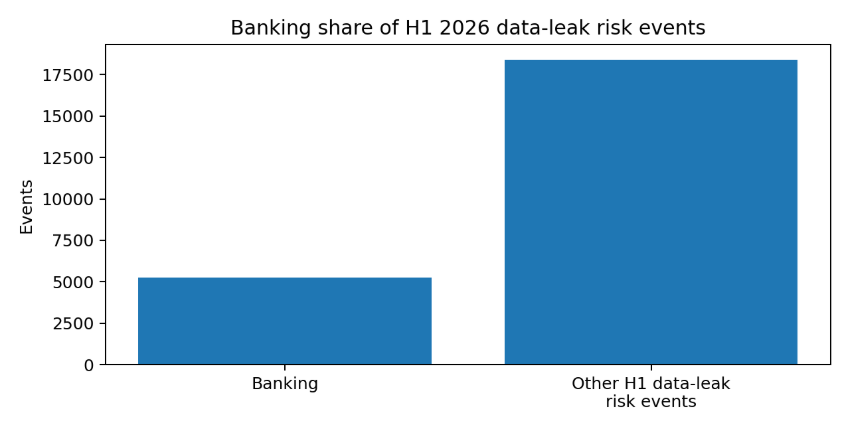
Banking accounted for 5,251 of 23,645 H1 2026 external data-leak risk events in the referenced finance dataset. Source – Dataset of Surface Web and Dark Web.
Finance ransomware activity is geographically broad. In the Q2 2026 finance-sector dataset, the United States accounted for 54% of observed victims; six additional markets each recorded an elevated 3% share, and the remaining 28% was distributed across other countries. The signal is concentration without confinement: attackers can scale the same access, extortion and credential techniques across mature and emerging financial ecosystems.
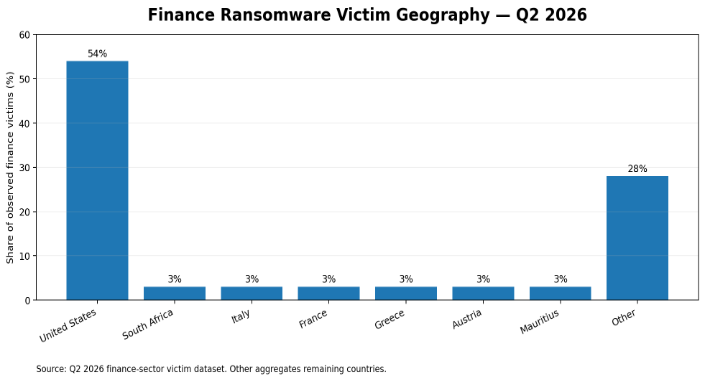
Finance ransomware victim geography – Q2 2026. “Other” aggregates the remaining markets.
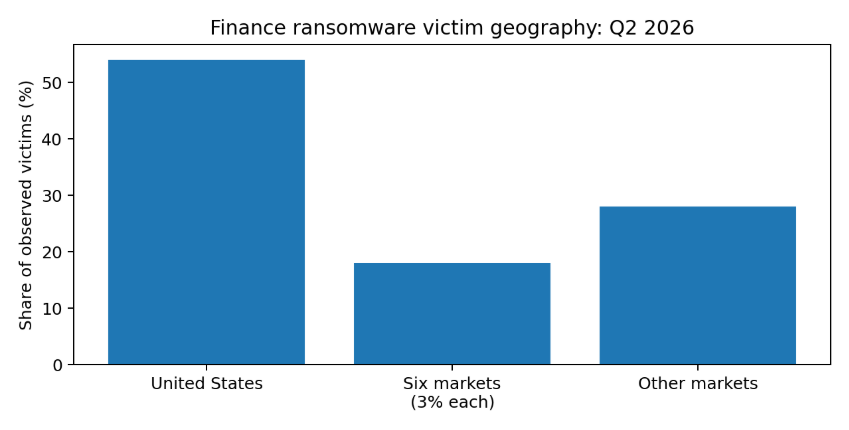
Q2 finance ransomware victim geography: United States 54%, six markets at 3% each, and other markets 28%.
Tempo. Finance-sector ransomware claims were uneven during the reporting period and increased from 34 claims in January to 59 in August. September is partial through 2 September and is not comparable with complete monthly totals.
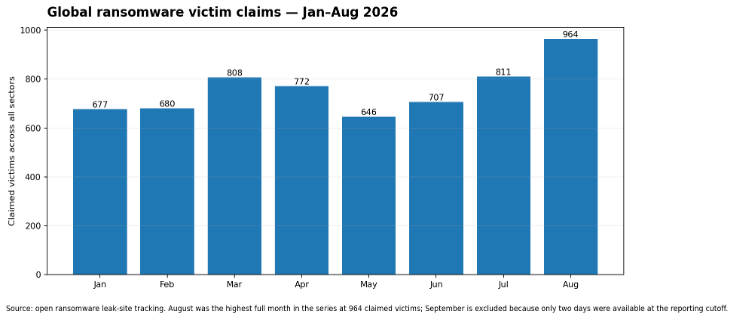
Global ransomware victim claims – Jan–Aug 2026. Full-month global figures are shown because September was not yet a complete observation period at the reporting cutoff.
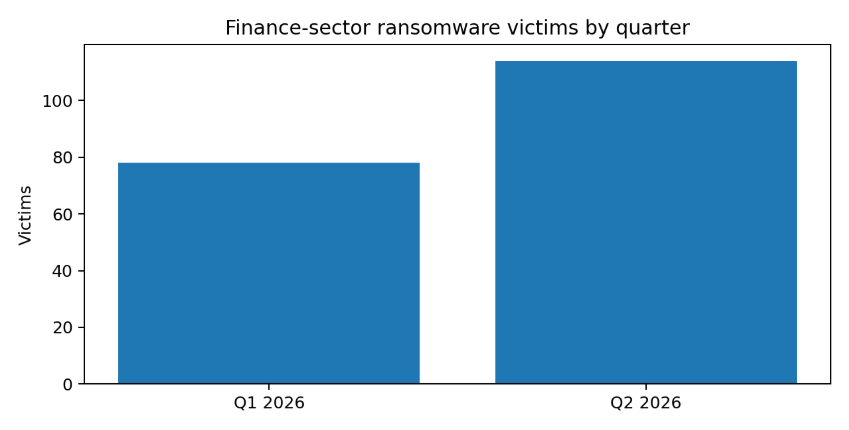
Q1 versus Q2 finance-sector ransomware victims in the referenced dataset: 78 versus 114.
Finance threat matrix
The table below ranks major threat categories by expected likelihood, business impact and current direction of travel. Priority reflects financial-sector consequence, not raw incident volume.
| Threat category | Likelihood | Impact | Trend | Primary exposure |
|---|---|---|---|---|
| Internet-facing exploitation | High | Critical | ↑ | Remote access, security gateways, payment-facing applications |
| Identity / credential compromise | High | Critical | ↑ | Privileged identities, remote access, help desk, sessions |
| Third-party compromise | High | Critical | ↑ | MSPs, SaaS, payment providers, shared platforms |
| Payment-system manipulation | Medium-High | Critical | ↑ | Payment applications, APIs, privileged transaction access |
| Ransomware / extortion | High | High | ↑ | Endpoints, servers, virtualization, shared infrastructure |
| Data brokerage / credential resale | High | High | ↑ | Customer, employee and payment-related records |
| AI-assisted social engineering | High | High | ↑ | Executive impersonation, support channels, payment requests |
| Web exploitation / defacement | Medium | Medium-High | → | Public websites, upload functionality, exposed services |
| Strategic espionage | Medium | High | → | Financial intelligence, customer/transaction data, suppliers |
Regional exposure
The observed activity is geographically distributed, but the dominant attack objective differs by market. The following regional view is an analytical synthesis of the activity profiled in this edition and is intended for prioritization, not as a measure of total regional incident volume.
| Region | Dominant observed themes | Financial-sector concern |
|---|---|---|
| North America | Ransomware, identity compromise, supplier exposure | Customer data, privileged access and third-party concentration |
| Europe | Ransomware, edge exploitation, data exposure | Operational resilience, regulated data and internet-facing infrastructure |
| South Asia | Phishing, identity abuse, ransomware, hacktivism | Customer identity, digital banking and public-facing services |
| Southeast Asia | Ransomware, data leakage, credential abuse | Banking, securities and connected service providers |
| Latin America | Payment fraud, credential compromise, RAT activity | Transaction integrity and payment-system access |
| Middle East & Africa | Data theft, ransomware, finance-data brokerage | Sensitive customer data, lending and payment infrastructure |
Cross-industry context
Finance is not the largest sector by raw ransomware volume, but it remains a high-value target because a compromise can combine monetary theft, sensitive identity data, payment disruption and regulatory consequences. In Q2 2026, financial services represented 6% of publicly listed ransomware victims in one global sector benchmark. Finance should therefore be prioritised by consequence and asset criticality, not victim count alone.
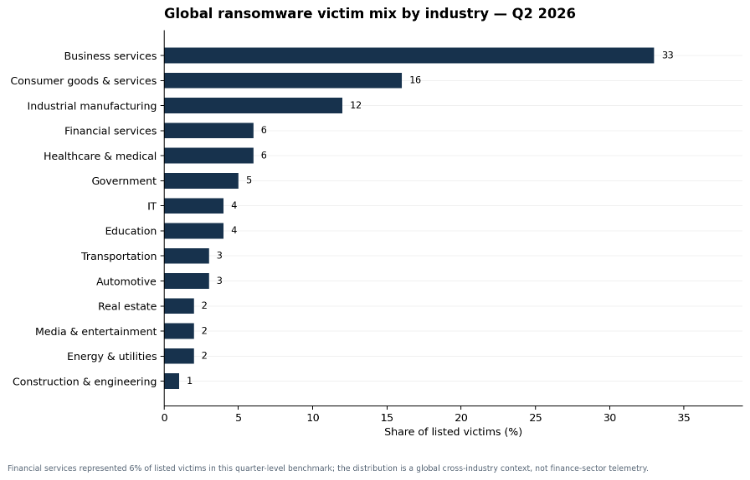
Global ransomware victim mix by industry – Q2 2026 benchmark. Financial services represented 6% of listed victims.
Volume is not the same as severity. Financial institutions remain attractive because disruption affects payment rails, liquidity, trading, customer access and trust simultaneously. Ransomware actors therefore gain leverage from both the value of the data they steal and the low tolerance for prolonged service interruption, while identity and payment-data theft can create downstream losses after systems are restored.
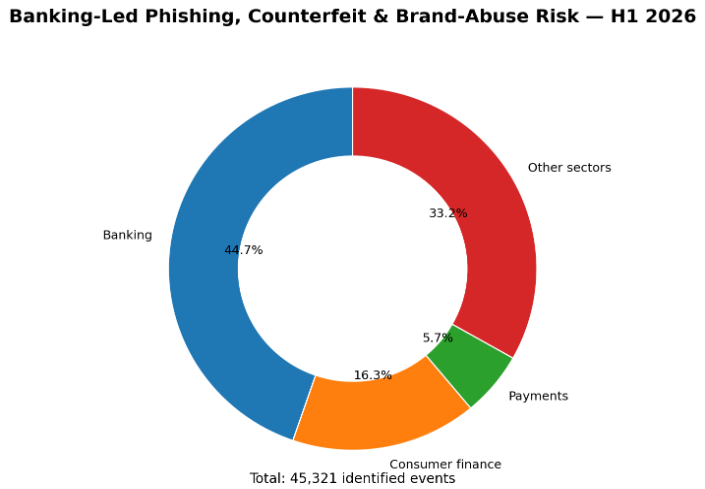
Banking-Led Phishing, Counterfelt & Brand-Abuse Risk – H1 2026
Impact is better measured through operational and downstream loss than through a historical breach-cost average. For finance, the immediate concerns are payment and customer-service interruption, exposure of regulated data, fraud enabled by stolen credentials or session material, and contagion through shared providers.
Why finance is targeted out of proportion to its victim count
Financial institutions combine three qualities that attackers value: direct proximity to money and payment rails, dense stores of monetisable personal and account data, and low tolerance for downtime that raises the pressure to pay. That combination means finance-sector incidents convert to profit and leverage more reliably than incidents in higher-volume sectors, which is why the sector attracts both the most capable ransomware operators and the most persistent state-nexus financial-theft actors.
Industry-specific threat actors
The actors below are most relevant to the observed activity during the reporting period. They span financially motivated ransomware and eCrime, state-nexus financial theft or espionage, and hacktivist activity.
| Actor | Class | Focus | Relevance this period |
|---|---|---|---|
| Qilin (Agenda) | RaaS, financially motivated | Global; finance a priority vertical | Most active RaaS operation of H1 2026. Rust-based, double extortion. An affiliate exploited Check Point VPN (CVE-2026-50751). Directly observed here against a French investment house. |
| INC Ransom | RaaS, financially motivated | Global; cross-sector | Emerged as the dominant exploiter of the SonicWall SMA 1000 chain from early August 2026. Observed here disclosing a Malaysian securities firm with leaked identity documents. |
| Scattered Spider (UNC3944, Octo Tempest, Muddled Libra) | eCrime, financially motivated | US and UK; finance, insurance | Help-desk vishing and identity takeover into Entra ID, then Citrix or VPN pivot and VMware ESXi encryption. Re-focused on financial services despite claims of retirement. |
| Lazarus Group / APT38 | DPRK state-nexus, financial theft | Global banks, SWIFT, crypto | Long-running DPRK cluster behind bank and interbank-transfer heists (APT38) and large cryptocurrency thefts. Persistent strategic threat to banks and exchanges. |
| UNC1069 (CryptoCore, MASAN) | DPRK state-nexus, financial theft | Crypto, DeFi, fintech, VC | Social engineering via compromised Telegram accounts, fake Zoom or Teams calls and AI-generated deepfake video, ClickFix delivery. New tooling SILENCELIFT, DEEPBREATH, CHROMEPUSH. Overlaps Lazarus and Bluenoroff. |
| BREEZE COMET (formerly UNC5669) | Financially motivated | Brazil; financial services, payments, fintech | Targets banking software, payment APIs and privileged financial access; associated with fraudulent transaction activity. |
| Silver Fox (Void Arachne) | China-nexus, dual espionage and financial | APAC and South Asia incl. India | Tax-authority-themed phishing delivering ValleyRAT, Gh0st RAT / HoldingHands and the ABCDoor backdoor via DLL side-loading and SEO poisoning. Finance staff are a stated target; India is in scope. |
| Mustang Panda | China-nexus, espionage | Global; government and finance-adjacent | Prolific Chinese espionage actor using PlugX and USB-borne implants. Relevant to finance mainly through supply-chain and strategic espionage exposure. |
| APT-C-36 (Blind Eagle) | Espionage and financial | Latin America; finance and government | Commodity RAT operator (AsyncRAT, Remcos, njRAT) using phishing lures against Latin American financial and government targets. Relevant to institutions with LatAm operations. |
Featured regional case study: Operation IronShadow
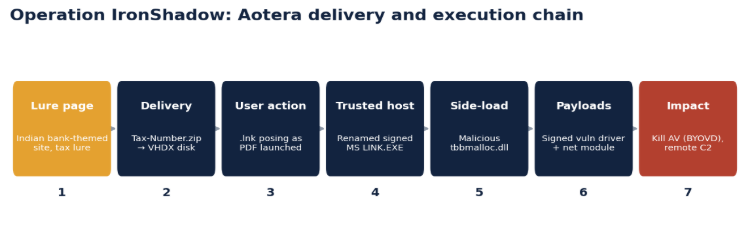
This regional case study is retained because it demonstrates a reusable finance-targeting pattern: social engineering can lead to trusted-binary abuse, DLL side-loading, BYOVD defence evasion and fileless execution. It is an illustrative regional example, not a basis for global attribution.
Overview
Operation IronShadow centers on Aotera, a heavily padded loader delivered through a banking-themed document lure. The chain uses a VHDX container, a disguised shortcut, a renamed signed binary that side-loads a malicious library, and a signed vulnerable driver that disables security tooling before remote control is established.
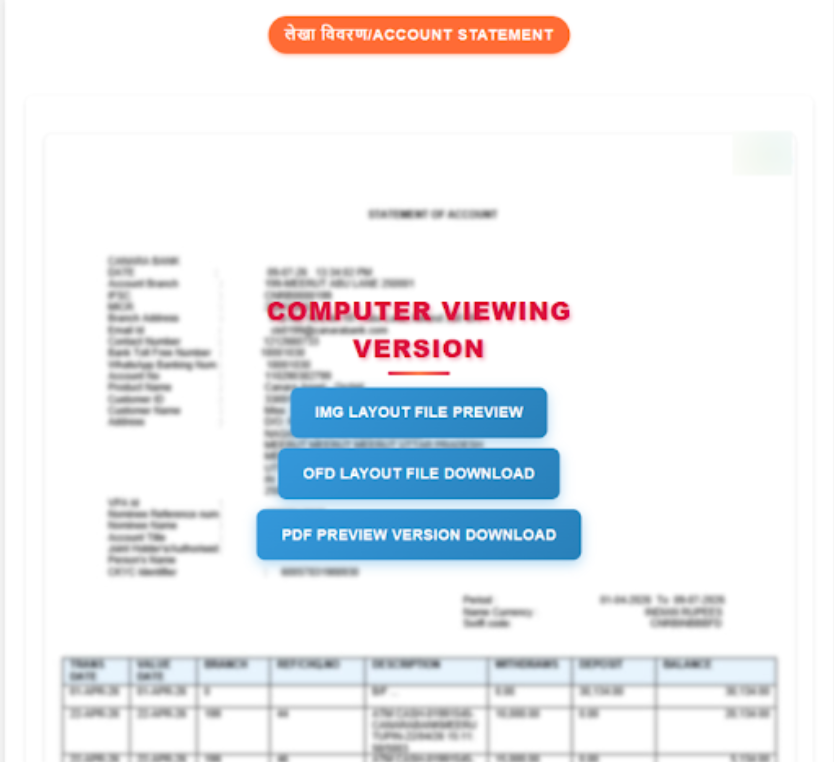
Screenshot of the banking-themed account-statement lure used in the regional case study.
Banking-themed lure and document-download page associated with the regional Operation IronShadow case.
How the trusted-binary abuse works
Detection lesson: a valid signature on the execution host does not make every dependent library trustworthy. Validate library identity and location, monitor renamed signed utilities, and alert execution from user-writable directories.
Concealment and recovered components
- Concealment. Aotera uses misleading exports and encrypted embedded components, while the delivered payloads support security-tool termination and remote control. Behaviour-based detection is therefore more reliable than signature-only controls.
- BYOVD. A signed vulnerable driver is used to terminate protected security processes, making defence evasion durable rather than momentary.
- Fileless execution. Additional attacker-supplied code can be executed from registry-backed storage and inside trusted Windows processes.
- Analytic value. Banks should monitor the full execution chain rather than rely on publisher’s reputation alone.
Attribution. The activity is assessed with moderate to high confidence as associated with Silver Fox based on tradecraft overlap including signed-binary sideloading, BYOVD defence evasion, finance-themed social engineering and multi-stage payload delivery. The assessment is regional and should not be generalized to all 2026 finance-sector activity.
Technical indicators from the case are retained in Appendix A for controlled defensive use. Validate file, network and behaviour-based detections against known-good software before blocking.
Campaigns, incidents and data exposure
Ransomware and data-leak activity
Ransomware and extortion claims remained distributed across established and newer operations. The internal collection is retained as direct evidence, while the global analysis relies on broader open leak-site telemetry. All claims are treated as claims unless independently corroborated.
| Group | Victim | Segment | Geography | Date | Assessment |
|---|---|---|---|---|---|
| Qilin | Philippe Hottinguer Finance | Investment / finance | France | 19 Aug 2026 | Published on Qilin leak site, ~4,200 views. Consistent with Qilin’s H1 2026 dominance and its affiliate use of Check Point VPN access. |
| INC Ransom | CIMB Securities | Securities / bank | Malaysia | 31 Aug 2026 | Disclosure listing quoting 5B revenue; leaked Malaysian national identity card shown. Aligns with INC Ransom’s Aug 2026 SonicWall SMA campaign. |
| Unattributed (green leak portal) | Cozad Asset Management | Asset management | United States | 22 Aug 2026 | 13 GB advertised as password-free download. Claimed employee PII (passport, driver licence, SSN), financials, contracts and legal files. |
| Unattributed (green leak portal) | Gale Credit Union | Credit union | United States (IL | 31 Aug 2026 | Threat to upload 50 GB. Claimed employee and client PII, credit-card data, contracts. Pending publication at capture. |
| CoinbaseCartel | PT Bank Perekonomian Rakyat Bintan | Rural bank (BPR) | Indonesia | active | Listed active; stated revenue ~5M. |
| CoinbaseCartel | LifeBank Microfinance Foundation | Microfinance | Philippines | active | Listed active; stated revenue ~5M. |
| CoinbaseCartel | Longhorn Investments | Finance / lending | United States | active | Listed active; stated revenue ~5M. |
| Unattributed (“LEAKS” portal) | Finodaya Capital | NBFC | India (Indore) | published | RBI-regulated NBFC; leak page ~10,500 views. High relevance to Indian finance clients. |
| Unattributed (“LEAKS” portal) | ASHA Microfinance Bank (ASA Nigeria) | Microfinance bank | Nigeria | published | CBN-licensed subsidiary of ASA International; leak page ~50,500 views. |
| Unattributed (blue “NEW” card) | BOK Financial | Financial services | United States (OK) | 28 Aug 2026 | Claimed 46 GB following failed negotiation. Claimed and unverified; not independently corroborated. |
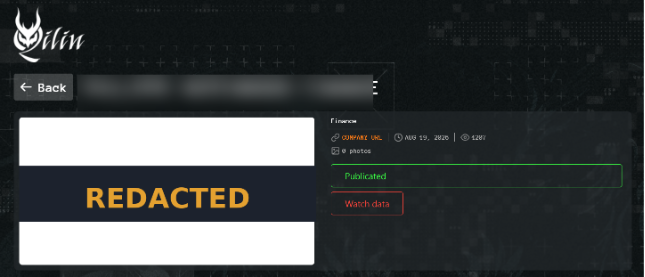
Redacted Qilin leak-site listing of a finance-sector victim. Victim name and logo removed; group branding, sector tag and publication status retained.
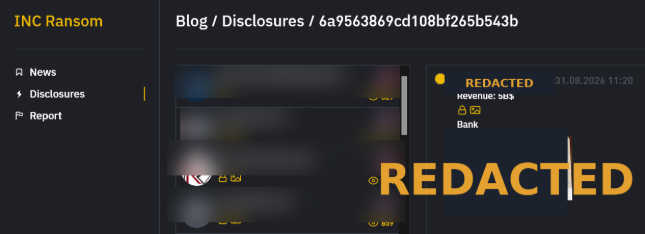
Redacted INC Ransom disclosure of a securities firm. Company name and the exposed national identity document have been removed.
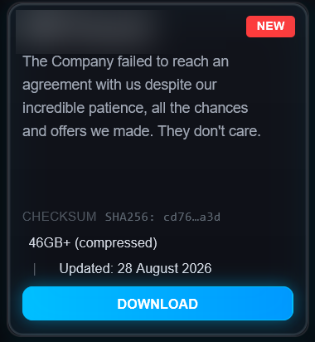
Redacted extortion card following a failed negotiation. Claimed 46 GB; victim name removed. Treated as claimed and unverified.
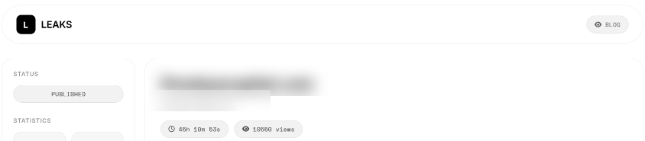
Redacted header of an unbranded leak portal listing a regulated non-banking financial company. Victim name and logo removed.
Two victims are directly regulated financial institutions in high-relevance jurisdictions: Finodaya Capital, a Reserve Bank of India regulated NBFC, and ASHA Microfinance Bank, a Central Bank of Nigeria licensed institution. Publication of these leaks carries regulatory notification, data-protection and reputational consequences for the institutions and raises supply-chain exposure for any counterparties. Client teams with exposure to Indian NBFCs should treat the Finodaya listing as a priority monitoring item.
Attribution caveat. The green terminal-styled leak portal and the blue leak card are not self-identified with a known group in the captured evidence. They are reported here by their observable characteristics rather than being attributed to a named operation. The BOK Financial claim in particular rests solely on the actor’s post and should be carried as unverified until corroborated.
Dark-web database sales and brokerage
Seven forum threads across two Tor marketplaces offered finance-sector data for sale or free release. Seller credibility is the decisive analytic variable here: reputation scores and account age ranged from throwaway accounts with a reputation of zero to established vendors with hundreds of reputation points. Higher-reputation listings warrant more weight, though all volume and record-count figures remain unverified seller claims.
| Listing | Segment and geography | Claimed size | Date | Assessment |
|---|---|---|---|---|
| PT Brantas Abipraya | Indonesia (state construction; financial audits) | 236 GB | ~May 2026 | Seller “MVP” tier. Disclosed access method: exposed NAS with default credentials, unpatched file-sharing protocol for lateral movement, no MFA on admin panels with password reuse, and no detection of two days of bulk exfiltration. High tradecraft-disclosure value. |
| Commercial bank (Thailand, unnamed) | Thailand (commercial bank) | 5.1 GB / 17.5M records | 26 Aug 2026 | Seller reputation 0, three-month-old account. Claimed 158k employee records, 106 admin accounts with bcrypt hashes, 68k plaintext passwords, LINE session tokens and payment-gateway data. Severe if genuine; seller credibility low. |
| Fast Credit Finance | Nigeria (lending platform) | 870 GB | 25 Apr 2026 | Established seller, reputation 22, account since 2023. Framed as a large loan and financial-information leak. Moderate credibility. |
| Digit RE Group | France (real estate; banking docs) | 73 GB / 140k files | 24 Jun 2026 | High-reputation vendor (517, MVP). Claimed identity cards, passports, contracts, invoices and banking documents, with ~1,000 samples provided. Higher credibility. |
| Nawaqis | Saudi Arabia (B2B procurement / payments) | 28 GB | 27 Aug 2026 | High-reputation vendor (120, top tier). Claimed to have wiped the source databases after exfiltration. Detailed invoice, payment-request and gateway-transaction data described. |

Access-method disclosure carried in a forum sale thread (company identity cropped out). The seller volunteers the exact conditions that enabled the breach.
Credential and payment-data exposure. The Thai commercial-bank and Nawaqis listings are the most significant from a downstream-risk perspective, because they advertise plaintext passwords, session tokens and payment-gateway records. If genuine, these enable credential-stuffing, session hijacking and payment fraud well beyond the originally breached institution. Even treating the claims as unverified, the categories of data described justify defensive assumptions of credential reuse across the affected regions.
Website defacements and hacktivism
Nine defacements struck finance-sector web properties. The activity is low in technical sophistication but high in signalling value, and it disproportionately affected cooperative banks and smaller finance providers. Two clusters stand out: a coordinated same-day pair of Indian cooperative-bank defacements by a self-described Pakistani hacktivist crew, and a pair of European defacements that share an identical vulnerable upload path, pointing to opportunistic mass exploitation of a common web component rather than deliberate finance-sector targeting.
| Target | Geography | Defacer / team | Date | Server | Note |
|---|---|---|---|---|---|
| Bavla Nagarik Sahakari Bank | India (Gujarat) | ZylonxWolf / Wolf Intelligence PK | 09 Aug 2026 | Nginx | Cooperative bank; hacktivist message. |
| Contai Co-Operative Bank | India (West Bengal) | ZylonxWolf / Wolf Intelligence PK | 09 Aug 2026 | Nginx | Same crew, same day as Bavla; coordinated pair. |
| viprafinance.in | India | Miyomar / AuroraGroup | 20 Aug 2026 | Apache | Root index.php defaced. |
| activedirectory.tgkfinance.in | India | overthrash1337 / Team Hazardous PK | 29 Aug 2026 | unknown | Defaced an “activedirectory” subdomain, indicating an internet-exposed identity-adjacent service. Elevated concern. |
| sbptechbank.pl | Poland | middle | 18 Jul 2026 | Apache | Defacement written to an uploads path (images/baforms/uploads/). Suggests arbitrary file upload. |
| bankingleadshunter.de | Germany | Antonkill | 18 Jul 2026 | Apache | Identical uploads path pattern to the Polish target; same-day. Indicates mass exploitation of a shared vulnerable component. |
| finance.mhs2.go.th | Thailand | EbRaHiM-VaKeR | 25 Aug 2026 | Cloudflare | Government finance web property. |
| newcorporatebank.com | Luxembourg | chinafans / Hack_0xTeam | 01 Sep 2026 | LiteSpeed | Telegram-promoted crew. |
| aifinancehub.co.uk | United Kingdom | 0xfay / Cyber Alpha Wolf | 10 Aug 2026 | LiteSpeed | Fintech web property. |
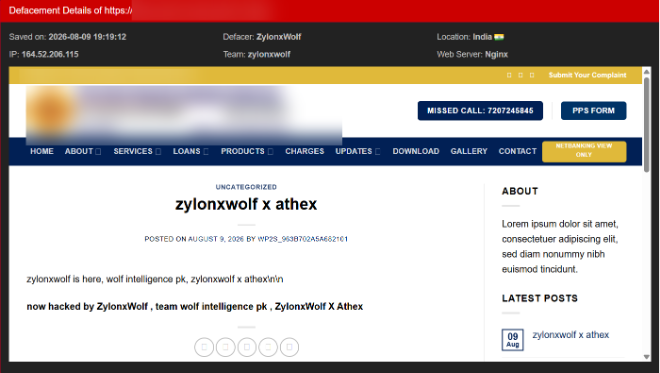
Redacted defacement record for an Indian cooperative bank. Victim name, logo and URL removed; defacer handle, team, hosting and timestamp retained as evidence.
- Regional hacktivism. Five of the nine targets are Indian. The Bavla and Contai cooperative-bank defacements were carried out by the same crew on the same day, consistent with a themed campaign rather than isolated opportunism. cooperative banks typically run lean security programmes and are attractive, low-effort targets for signalling operations.
- Identity-service exposure. The tgkfinance.in target was an “activedirectory” subdomain. Even if the defacement itself was superficial, an internet-exposed identity-adjacent service is a material finding and warrants a check for equivalent exposures in client estates.
- Shared-component exploitation. The Polish and German targets were both defaced by writing a text file into an identical images/baforms/uploads path on the same day by different handles. This is the signature of a widely scanned, mass-exploited file-upload weakness in a shared web component, not targeted intent.
Additional notable sector incidents
Beyond the artefacts collected directly by the iZOOlogic Research Team, the following finance-sector incidents from the reporting window are included to provide additional sector context. They are included to place the collected activity in context and to reinforce the period’s dominant themes: vendor and supply-chain concentration, exploitation of internet-facing software, and the exposure of highly sensitive customer financial data. Figures are as reported and may be revised as investigations conclude.
| Incident | Nature | Reported scale | Timing | Note |
|---|---|---|---|---|
| MSP compromise cascade (Qilin) | MSP compromise cascading into 32 South Korean financial institutions | 1M+ files, 2 TB+ | H1 2026 | Single MSP breach reused privileged access to reach 32 institutions without breaching each. Defining supply-chain event of the period. |
| Financial-services vendor compromise | Vendor to US banks and credit unions; SonicWall exploitation | Up to 1.35M customers, 74+ institutions | Disclosed Mar 2026 | SSNs, taxpayer IDs and financial account details exposed across dozens of institutions via one vendor. Flagged at elevated risk before the breach. |
| Fintech lender breach | Blockchain-focused fintech lender | ~967,200 accounts | 2026 | Confirmed breach affecting close to a million accounts at a fintech lender. |
| US financial institution breach | US financial services | 182,793 individuals | Mar to Apr 2026 | Personal information of ~183k individuals potentially compromised. |
| US financial-services breach | US financial services | ~47,876 individuals | Mar 2026 | Breach disclosed to a state regulator; data types not fully specified. |
| Fintech/brokerage offboarding exposure | US fintech / brokerage | Millions of brokerage customers | Disclosed 2026 | Offboarding failure let a departed employee pull brokerage reports; portfolio and account data suited to targeted social engineering of investors. |
- Supply-chain concentration is a recurring root cause. Two large 2026 cases involved a single compromised provider cascading into dozens of financial institutions, while another vendor incident exposed data across more than 70 institutions. Third-party security therefore remains a first-order finance-sector risk.
- Vulnerability exploitation is one of the leading technical causes. Exploitation of vulnerabilities, frequently in vendor-managed infrastructure, has become a leading initial-access vector, consistent with the appliance and application vulnerabilities profiled in this report.
- Non-obvious insiders and process gaps. The Block case shows that offboarding and access-review failures remain a live risk, distinct from external intrusion, and one that regulated institutions are expected to control.
Malware and tooling
The tooling observed or associated with this period’s activity clusters into three groups: ransomware payloads deployed for extortion, post-exploitation implants dropped on compromised edge appliances, and remote access trojans delivered through social engineering. A recurring theme is the abuse of legitimate software, from open-source proxies and file-sync utilities to signed binaries used for side-loading, which lets adversaries blend into normal administrative activity and evade controls that focus only on known-bad files.
| Family / tool | Type | Function | Associated actor |
|---|---|---|---|
| Aotera (loader) + BYOVD driver + net module | Loader, kernel driver, RAT | Trusted-binary side-loading; signed vulnerable driver kills security tools; registry-stored fileless payloads and remote control. | Silver Fox (assessed) |
| Qilin (Agenda) ransomware | Ransomware | Rust-based (formerly Go); strong hybrid encryption, log and backup removal, double extortion. | Qilin RaaS affiliates |
| INC / INC Ransom payload | Ransomware | Data theft plus encryption; leak-site extortion. Operationalised the SonicWall SMA chain. | INC Ransom |
| TRAILBLAZE / BRUSHFIRE / SPAWN | Dropper, passive backdoor, ecosystem | In-memory dropper, TLS-intercepting backdoor and modular implant set deployed after Ivanti exploitation. | UNC5221 |
| KNUCKLEBALL / ORANGETAIL / Suo5 | Loader, webshell, proxy | Custom loader plus Behinder-style webshell and open-source tunnelling proxy on compromised SonicWall SMA. | UTA0533 |
| ValleyRAT | Remote access trojan | Delivered via DLL side-loading and SEO poisoning; anti-analysis; modular plugins. | Silver Fox |
| Gh0st RAT / HoldingHands, ABCDoor | RAT and backdoor | Deployed alongside ValleyRAT for persistence and collection. | Silver Fox |
| SILENCELIFT / DEEPBREATH / CHROMEPUSH | Recon and data-capture tooling | Host and browser data capture on Windows and macOS in crypto-sector intrusions. | UNC1069 |
| Rclone (abused) | Legitimate tool abuse | Observed for bulk data exfiltration after VPN auth-bypass access. | Qilin affiliate |
- Living-off-the-land and legitimate-tool abuse. Scattered Spider’s use of native VMware ESXi utilities and the Qilin affiliate’s use of Rclone show that the highest-impact actions in these intrusions often involve no custom malware at all. Detection must extend to anomalous use of legitimate administrative tooling.
- Edge-appliance implants. The Ivanti and SonicWall intrusions deployed in-memory droppers, TLS-intercepting backdoors, webshells and log-tampering tools directly on the appliance, below the visibility of most endpoint controls. Appliance integrity monitoring and vendor compromise-assessment tooling are required to detect them.
Banking fraud and payment-system threats
Financial-sector cyber risk extends beyond ransomware and data theft. Attackers can target payment infrastructure, authentication mechanisms, transaction workflows, customer devices, payment cards, financial messaging and the operational processes used to move and receive money. The resulting loss can occur without traditional ransomware: a compromised identity or payment component may provide sufficient access to initiate fraudulent transactions, redirect funds or enable downstream criminal monetisation.
The sections below treat cyber compromise and payment fraud as one connected threat lifecycle. Some mechanisms are primarily technical, while others depend on social engineering, insider access, customer compromise or criminal cash-out networks.
Threat priority and analytical coverage
The following prioritisation is an iZOOlogic analytical model based on potential financial impact, attacker leverage and the degree to which a compromise can move from access to transaction execution. It is not an incident-frequency statistic.
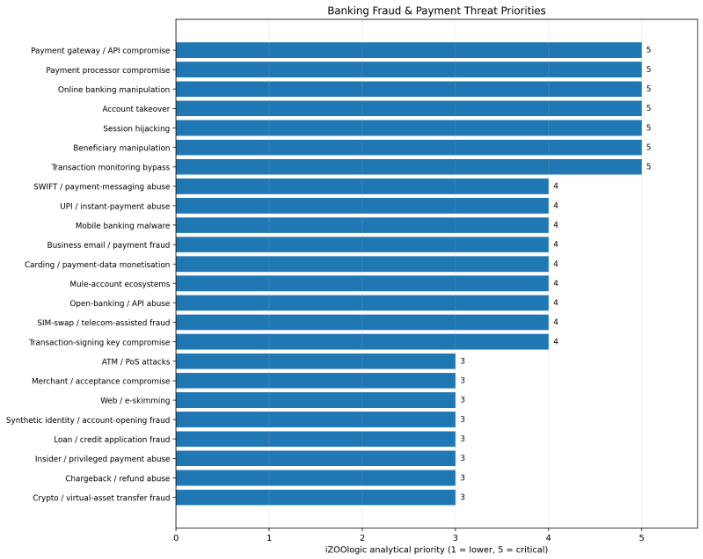
Banking fraud and payment threat priorities. Scores represent analytical priority, not observed event volume.
Payment infrastructure and transaction systems
Payment gateway compromise
Payment gateways connect merchants, banks, processors and transaction systems and can become high-value targets when administrative interfaces, API credentials, signing keys or integration secrets are exposed. Compromise can enable transaction manipulation, credential theft, abuse of payment routing or access to payment-related customer data.
Payment processor compromise
A compromised processor, payment aggregator or shared service provider can expose multiple financial institutions or merchants through trusted integrations. This creates concentration risk because one intrusion can provide access to transaction data, authentication flows or operational interfaces shared across many customers.
Online banking manipulation
Attackers with privileged access to online-banking components may attempt to alter transaction workflows, authentication settings, limits, beneficiary records or other controls. Malicious actions performed through legitimate administrative accounts can resemble authorised operations and therefore require strong change monitoring.
Beneficiary manipulation
Attackers may create, replace or modify payment beneficiaries before initiating transfers. Changes should be treated as high-risk events, particularly when followed by new-device access, unusual authentication, high-value transfers or rapid transaction velocity.
Transaction monitoring bypass
Fraudsters and intruders may seek to remain below transaction thresholds, exploit gaps between fraud and security monitoring, or change transaction parameters to avoid existing controls. Monitoring should correlate authentication, device, beneficiary, transaction velocity, geolocation and behavioural signals.
Payment API and open-banking abuse
Public APIs and open-banking integrations can become high-value attack surfaces when authentication, consent, token handling, rate limits or partner access are weak. Use scoped permissions, strong client authentication, transaction-level controls and rapid token revocation.
Transaction-signing key compromise
Compromise of cryptographic keys, certificates, signing tokens or other transaction-authorisation material can undermine otherwise strong access controls. Protect keys in hardened environments, restrict signing privileges, monitor key use and require controlled rotation after suspected compromise.
Identity, session and social-engineering abuse
Account takeover
Stolen credentials, phishing, malware, password reuse, help-desk manipulation and credential stuffing can convert an exposed identity into access to customer accounts, privileged banking applications or payment administration.
Session hijacking
Stolen session cookies, tokens or other authentication material can allow attackers to act after successful authentication without possessing the original password. Session revocation, device binding, risk-based reauthentication and monitoring for anomalous session changes reduce exposure.
Business email and payment-instruction fraud
Business email compromise, supplier impersonation and executive impersonation can cause employees to initiate or approve fraudulent payments even when core banking controls remain uncompromised. High-value or unusual payment instructions should require independent verification through a trusted channel.
AI-assisted impersonation and deepfake fraud
Voice cloning, synthetic video and generated correspondence can make fraudulent payment or credential requests more convincing. Controls should focus on independent verification and transaction authority rather than relying solely on users to identify synthetic content.
SIM-swap and telecommunications-assisted fraud
Compromise of mobile-number control can weaken SMS-based authentication, enable account-recovery abuse and assist account takeover. High-risk account changes should use stronger identity proofing and authentication factors that do not depend solely on possession of a phone number.
Credential and token resale
Credentials, session tokens, cookies, API keys and authentication material can be sold or reused long after the original breach. Exposure monitoring should distinguish between a credential being listed and evidence that it remains valid, then prioritise containment based on privilege and reuse potential.
Payment rails, cards and physical financial infrastructure
SWIFT and payment-messaging attacks
Payment-messaging environments remain attractive because privileged access can enable manipulation of payment instructions, message workflows or supporting credentials. Protection should include strict segregation of payment roles, transaction controls, privileged-access monitoring, message integrity and independent verification of unusual payment activity.
Carding and payment-data monetisation
Stolen card numbers, security codes, expiry data and related customer information can be monetised through card-not-present fraud, underground marketplaces and automated card-testing activity. A card appearing in an underground dataset does not by itself establish that the issuing bank was breached; source attribution and compromise path should be assessed separately.
ATM and point-of-sale attacks
ATM and PoS environments can be targeted through malware, logical attacks, skimming, black-box techniques, remote administration abuse or compromise of supporting systems. Logical ATM attacks can manipulate dispensing functions, while PoS compromise can expose payment credentials and enable downstream fraud.
Mobile banking malware
Malicious mobile applications, fake banking applications, remote-access tools, overlay attacks, SMS interception and device compromise can capture credentials, OTPs or transaction context. Financial institutions should correlate mobile-risk signals with transaction anomalies and rapidly revoke compromised sessions or devices.
UPI and instant-payment abuse
Real-time payment systems create a low-latency fraud environment in which stolen credentials, social engineering, malicious applications, QR-code manipulation, remote access and account takeover can be converted into rapid transfers. Controls should emphasise transaction limits, velocity checks, beneficiary risk, device and behavioural signals, rapid customer reporting and recovery workflows.
QR-code and authorised-push-payment manipulation
Fraudsters can replace legitimate QR codes, redirect users to attacker-controlled destinations or use urgent prompts to induce authorised push payments. Banks should treat QR and recipient changes, first-time payment relationships and unusual transaction context as risk events.
Merchant and payment-acceptance compromise
Compromise of merchant portals, checkout systems, payment plugins or payment-acceptance infrastructure can expose customer data and redirect or manipulate payment flows. Financial institutions should monitor third-party payment components and investigate unexpected changes to checkout, routing or settlement configurations.
Web and e-skimming
Compromise of payment pages, checkout scripts or customer-facing web applications can allow attackers to capture payment information before it reaches the intended processor. Monitor script and content changes, third-party dependencies, integrity controls and unusual outbound requests from payment pages.
Financial-crime infrastructure and downstream monetisation
Mule-account ecosystems
Compromised or recruited accounts can act as collection points for stolen funds, allowing criminal operators to separate the initial fraud event from final cash-out. Mule detection should combine KYC signals, account age, transaction velocity, device relationships, beneficiary networks and unusual inbound/outbound flow patterns.
Synthetic identity and account-opening fraud
Fraudsters may combine real and fabricated identity elements to create accounts that can later be used for payments, credit applications or laundering. Financial institutions should correlate identity proofing, device reputation, document integrity and behavioural signals rather than evaluating each identity element independently.
Loan and credit-application fraud
Compromised identities, synthetic identities, stolen documents and manipulated application information can be used to obtain credit or redirect disbursements. Controls should validate identity, device, income and account relationships and monitor post-origination changes for fraud indicators.
Insider and privileged payment abuse
Employees, contractors or administrators with legitimate payment authority can abuse access intentionally or after account compromise. Strong segregation of duties, just-in-time privileges, session recording and independent approval are required for sensitive payment functions.
Chargeback and refund abuse
Attackers may exploit refund, reversal or chargeback workflows to generate fraudulent credits or manipulate legitimate transactions. Monitoring should correlate refunds with the original transaction, account history, device signals and employee actions.
Cross-border and correspondent-payment fraud
Cross-border payment chains introduce additional intermediaries, jurisdictions and settlement steps that can be exploited for beneficiary substitution, payment diversion or rapid movement of funds. High-risk corridors and unusual correspondent behaviour should receive enhanced monitoring.
Crypto and virtual-asset transfer fraud
Compromised banking or payment accounts can be used to purchase, convert or transfer value into virtual assets that may be difficult to recover. Controls should combine transaction risk, beneficiary screening, device and account signals, and rapid escalation for suspicious conversion activity.
How cyber compromise becomes financial loss
The common pattern across these threats is a progression from access to authority and then to monetisation. Attackers may begin with credentials, an exposed gateway, a mobile device, a payment processor, a trusted vendor or social engineering. The critical defensive boundary is reached when that access can influence a beneficiary, payment instruction, transaction workflow, session, payment credential or transaction-signing function.
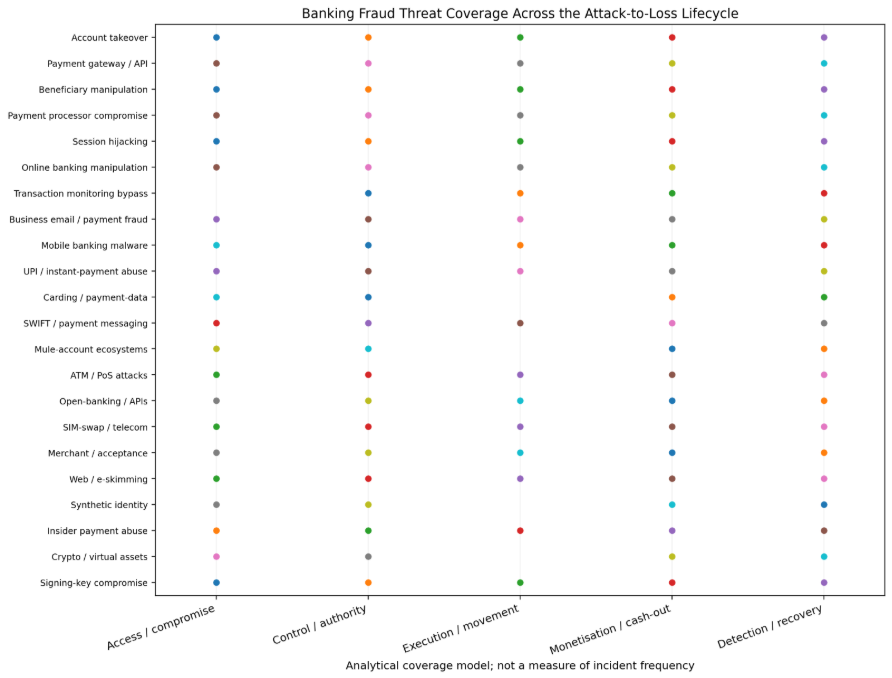
Banking fraud threat coverage across the attack-to-loss lifecycle. The model describes control coverage, not incident frequency.
| Threat category | Primary financial objective | Primary control objective |
|---|---|---|
| Credential / session compromise | Account takeover, payment access | Phishing-resistant MFA, session revocation, behavioural monitoring |
| Payment infrastructure compromise | Transaction manipulation, payment diversion | Least privilege, integrity monitoring, strong change control |
| Beneficiary / instruction fraud | Redirection of legitimate payments | Independent verification and dual approval |
| Card / mobile compromise | Card-not-present fraud, unauthorised mobile transactions | Device intelligence, token protection, transaction analytics |
| Mule / cash-out ecosystem | Rapid movement and laundering of stolen funds | Network analytics, KYC correlation, rapid recovery |
| Third-party compromise | Multi-institution exposure | Supplier access governance, segmentation, concentration monitoring |
Detection and response priorities
- Correlate identity, endpoint, network, payment and fraud telemetry. A suspicious login should be capable of increasing scrutiny of subsequent payment actions.
- Monitor privileged changes to beneficiaries, payment limits, transaction rules, API configurations, signing material and settlement instructions.
- Use independent approval and out-of-band verification for high-value, unusual or first-time payment relationships.
- Revoke credentials, sessions, tokens and device trust rapidly after suspected account or application compromise.
- Preserve immutable logs for authentication, payment administration, beneficiary changes, payment configuration and transaction execution.
- Coordinate cyber, fraud, financial-crime and incident-response teams so a cyber indicator can trigger transaction-level containment where appropriate.
- Triage customer-device, mobile-malware and SIM-swap indicators together with abnormal transaction activity to reduce the gap between account compromise and financial loss.
Attack vectors and techniques
Across the observed activity, initial access concentrated on a small number of repeatable vectors. These are ordered below by how frequently they appear in this edition’s evidence and in the corroborating reporting on the named actors.
1. Exploitation of internet-facing appliances and applications
One of the leading initial-access vectors for the ransomware and data-theft activity is exploitation of internet-facing gateways and enterprise applications. SonicWall SMA, Check Point VPN, Ivanti Connect Secure and the Oracle E-Business Suite Payments module all appear as active-exploitation targets this period, and external benchmarks identify exploited vulnerabilities as the single most common root cause of financial-sector ransomware. These appliances are attractive because they are exposed by design, aggregate credentials and session tokens, and sit at the boundary of the internal network.
2. Identity-based social engineering
For actors that do not lead with a vulnerability, the primary vector is social engineering aimed at identity. Scattered Spider uses help-desk vishing and impersonation to trigger self-service password resets and defeat MFA, while UNC1069 uses compromised Telegram accounts, spoofed video meetings and AI-generated deepfakes to build rapport before delivering malware. Both routes end in the same place: valid credentials and session tokens that let the adversary operate as a legitimate user.
3. Credential exposure and reuse
The forum listings make credential exposure a first-class vector in its own right. Plaintext passwords, bcrypt hashes and session tokens advertised in the Thai commercial-bank and Nawaqis dumps feed directly into credential-stuffing and session-hijacking against the originating institution and, through reuse, against unrelated services. The Brantas Abipraya disclosure explicitly cites reused administrative passwords as an enabling condition.
4. Weak or absent multi-factor authentication
Missing MFA on administrative and remote-access surfaces recurs throughout the evidence, from the Brantas Abipraya admin panels to the identity-takeover tradecraft of Scattered Spider. Where MFA exists but is not phishing-resistant, help-desk and self-service-reset abuse remains effective.
5. Vulnerable web components
The defacement cluster shows opportunistic exploitation of vulnerable public web components, including an arbitrary file-upload weakness exploited across two European finance-sector sites on the same day. The same class of weakness that permits a defacement permits webshell deployment and host compromise.
6. Tax-lure and finance-themed phishing
Silver Fox’s tax-authority-themed phishing, which explicitly targets finance staff and has run against Indian organisations, rounds out the vector set. Finance-themed lures exploit the routine, deadline-driven nature of financial correspondence to lower recipient suspicion.
Vulnerabilities and exploitation activity
Five vulnerabilities profiled in this edition were assessed as actively exploited and relevant to technologies commonly deployed in financial environments. Four are internet-facing remote-access or gateway appliances, and the fifth is a payment-processing module. The clustering is not incidental: remote-access appliances and payment systems are precisely the assets that give an adversary either the credentials to reach the money or a direct path to payment data.
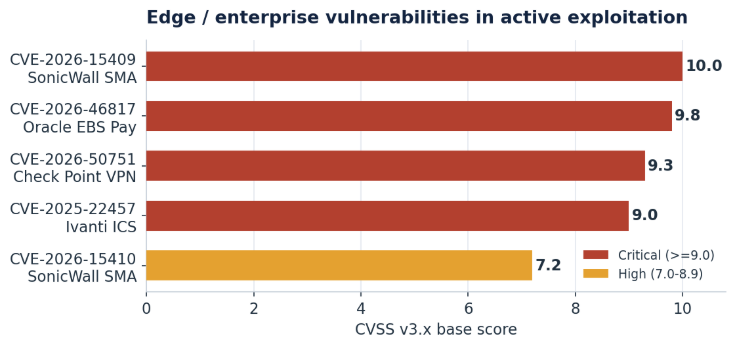
Named vulnerabilities in active exploitation, by CVSS base score.
| CVE | Affected product | CVSS | Nature | Exploitation status |
|---|---|---|---|---|
| CVE-2026-15409 | SonicWall SMA 1000 | 10.0 (Critical) | Unauthenticated SSRF via Work Place interface; chained to reach internal admin service. | Zero-day from 22 Jun 2026 (UTA0533); INC Ransom dominant exploiter from Aug 2026. Listed in a recognised exploited-vulnerability catalogue. |
| CVE-2026-15410 | SonicWall SMA 1000 | 7.2 (High) | Authenticated command injection in the management console; RCE as root when chained with the SSRF. | Chained with CVE-2026-15409 for unauthenticated device takeover. Credential, session and TOTP-seed theft observed. Listed in a recognised exploited-vulnerability catalogue. |
| CVE-2026-50751 | Check Point Remote Access / Mobile Access VPN | 9.3 (Critical) | Authentication bypass via deprecated IKEv1; VPN session without valid password. | Exploited from 07 May 2026; a Qilin ransomware affiliate confirmed post-compromise. Rclone exfiltration, Tox comms. |
| CVE-2025-22457 | Ivanti Connect Secure / Pulse | 9.0 (Critical) | Buffer overflow enabling unauthenticated RCE on ICS 22.7R2.5 and earlier. | Observed in active exploitation during the 2026 reporting period; TRAILBLAZE, BRUSHFIRE and SPAWN deployed. Ongoing exposure where unpatched. |
| CVE-2026-46817 | Oracle E-Business Suite (Payments) | 9.8 (Critical) | Unauthenticated takeover of the Oracle Payments File Transmission component over HTTP. | In-the-wild exploitation from 27 Jun 2026; linked to initial-access brokerage and payroll data theft. Listed in a recognised exploited-vulnerability catalogue. Directly relevant to payment operations. |
Prioritisation. P1: internet-facing SonicWall SMA 1000, Check Point Remote Access VPN using IKEv1, and Ivanti Connect Secure; remediate, perform compromise assessment and rotate affected credentials/sessions as appropriate. P1: internet-reachable Oracle E-Business Suite Payments; patch or isolate and validate payment-application integrity. P2: internal or non-exposed instances; prioritise by asset criticality and compensating controls.
MITRE ATT&CK mapping
The techniques below consolidate the behaviours observed or associated with this period’s activity. The mapping is intended to drive detection-engineering and control-validation priorities rather than to serve as a complete adversary emulation plan.
| Tactic | Technique | Where seen in this edition |
|---|---|---|
| Initial Access | T1190 Exploit Public-Facing Application |
SonicWall SMA, Check Point VPN, Ivanti ICS and Oracle EBS exploitation. |
| Initial Access | T1133 External Remote Services | VPN and remote-access appliance abuse for entry. |
| Initial Access | T1566 Phishing | Silver Fox tax-lure phishing; finance- themed lures. |
| Initial Access | T1078 Valid Accounts | Reused and stolen credentials; VPN auth bypass yielding valid sessions. |
| Execution | T1204 User Execution | ClickFix and malicious-archive execution in social-engineering chains. |
| Persistence | T1505.003 Web Shell | ORANGETAIL and Behinder-style shells on compromised SMA appliances. |
| Persistence | T1543 Create or Modify System Process |
Startup-file modification on edge appliances to survive reboot. |
| Priv. Escalation | T1068 Exploitation for Privilege Escalation |
SonicWall SMA local privilege escalation to root (CVE-2026-15410). |
| Defense Evasion |
T1562.002 Disable Windows Event Logging / Logging |
SPAWNSLOTH-style log tampering; syslog suppression on appliances. |
| Defense Evasion |
T1218 System Binary Proxy Execution |
DLL side-loading into rundll32 by Silver Fox / ValleyRAT. |
| Credential Access |
T1555 Credentials from Password Stores |
Harvest of credentials, session tokens and TOTP seeds from appliances. |
| Credential Access |
T1110 Brute Force / credential stuffing |
Enabled by advertised plaintext and hashed credential dumps. |
| Discovery | T1046 Network Service Discovery | SSRF-driven internal service probing from edge appliances. |
| Lateral Movement |
T1021 Remote Services | Citrix, VPN and administrative-tool pivoting into internal systems. |
| Collection / Exfil | T1567 / T1048 Exfiltration Over Web / Alt Protocol |
Bulk exfiltration via Rclone and file- sharing services. |
| Impact | T1486 Data Encrypted for Impact | Qilin and INC Ransom encryption of victim environments. |
| Impact | T1657 Financial Theft | DPRK-nexus fund and cryptocurrency theft; extortion. |
| Impact | T1491.002 External Defacement | Hacktivist defacement of finance-sector web properties. |
| Defense Evasion |
T1574.002 Hijack Execution Flow: DLL Side-Loading |
Aotera side-loaded into a renamed signed Microsoft linker. |
| Defense Evasion |
T1553.005 Subvert Trust Controls: Mark-of-the-Web Bypass |
VHDX delivery strips the downloaded- file mark (Aotera). |
| Defense Evasion |
T1014 Rootkit / BYOVD | Signed vulnerable driver terminates protected security processes (Aotera). |
| Priv. Escalation | T1548.002 Bypass User Account Control |
Bundled UACMe with 32 bypass techniques (Aotera). |
| Priv. Escalation | T1055.012 Process Hollowing | Attacker code run inside a hollowed signed Windows process (Aotera). |
| Persistence | T1112 Modify Registry | C2 override and fileless payload stored under HKCU\Console (Aotera). |
Emerging threats and trends
1. Finance ransomware accelerated during 2026
Finance-sector ransomware claims increased from 34 in January to 59 in August in the monthly open-tracking series. A separate sector dataset recorded 114 finance victims in Q2 versus 78 in Q1, a 46.2% increase. Global all-sector claims also reached a 2026 high of 964 in August.
2. Banking faces a broader external-risk surface
H1 2026 financial-sector data-leak risk events totalled 23,645, with banking accounting for 5,251 events (22.2%). Banking also represented 44.74% of 45,321 identified phishing and counterfeit-risk events. Identity abuse and data circulation therefore remain major banking risks alongside ransomware.
3. Third-party access remains a systemic multiplier
Shared service providers, managed platforms and connected applications can turn one compromised identity or supplier into a multi-institution event. Financial entities should assess privileged vendor paths, trust relationships and concentration risk as part of operational resilience.
4. AI-assisted social engineering is increasing identity risk
Convincing impersonation, fake meetings, help-desk manipulation and socially engineered authentication resets raise the value of phishing-resistant authentication and independent verification. Controls should not depend on users reliably spotting synthetic media.
5. Non-bank finance remains attractive to extortion actors
Asset management, advisory, consumer finance, payments and other non-bank financial entities hold highly monetisable identity and transaction data and often rely on shared digital infrastructure. Their exposure can create both direct loss and downstream counterparty risk.
6–12 month outlook
Identity-centric intrusion will remain a high-probability path. Attackers are likely to continue combining social engineering, credential abuse and session theft to reach privileged environments without depending on custom malware.
Payment manipulation will become a more visible financial-security problem. Where attackers can reach transaction infrastructure, the incentive to monetise access directly can exceed the incentive to deploy disruptive malware.
Third-party concentration will amplify incident scale. A compromised provider, integration or privileged service account can create simultaneous exposure across multiple financial institutions.
Internet-facing edge devices will remain high-value targets. Gateways and remote-access systems concentrate access, credentials and network trust at the perimeter and can provide attackers with high-leverage initial access.
AI will primarily increase the effectiveness and scale of existing fraud techniques. Deepfake, voice-cloning and AI-generated content should be treated as accelerants of impersonation and social engineering rather than isolated threat categories.
Non-bank financial entities will remain attractive targets. Lenders, asset managers, payment firms, fintechs and service providers hold valuable identity, transaction and financial data while often relying on shared digital infrastructure.
Business impact
The 2026 activity translates into five material business risks: operational disruption, regulated-data exposure, fraud and account takeover, third-party contagion, and erosion of customer trust.
Operational disruption
Ransomware against finance targets systems that must stay available: core banking, payments, trading and customer-facing services. The operational impact can therefore propagate quickly across customers, counterparties and payment dependencies. The sector also remains exposed to hypervisor and infrastructure-level attacks that can interrupt many services simultaneously.
Data protection and regulatory exposure
Multiple artefacts involve regulated institutions and sensitive personal data, including government identity documents. Publication can trigger breach-notification, evidence-preservation and customer-communication obligations under the applicable regime. Global financial organisations should maintain jurisdiction-specific playbooks covering notification thresholds, legal holds, third-party coordination and regulator engagement.
Financial fraud and downstream loss
The credential and payment-data exposures, plaintext passwords, session tokens and payment-gateway records, enable credential-stuffing, account takeover and payment fraud that can extend to customers and counterparties long after the initial breach. DPRK-nexus activity adds direct theft of funds and cryptocurrency as an endpoint.
Third-party and concentration risk
Because so much finance-sector data now sits with shared service providers and platforms, a single provider breach can expose many institutions at once. This concentration converts an individually manageable vendor incident into a systemic event, and it is visible in both the external case studies and the procurement-platform listings in this edition.
Reputational and trust impact
The sector runs on trust. A defaced public website, a leak-site listing or a customer-data sale each erodes confidence disproportionately to the technical severity of the underlying event, and the reputational tail often outlasts the operational recovery.
Impact summary
| Threat condition | Potential business impact | Primary control objective |
|---|---|---|
| Ransomware / extortion | Service interruption, recovery cost, customer disruption | Rapid isolation and resilient recovery |
| Identity compromise | Account takeover, privileged access, fraudulent actions | Phishing-resistant authentication and identity monitoring |
| Data exposure | Privacy impact, fraud, customer impersonation | Data minimisation, DLP and exposure monitoring |
| Third-party compromise | Multi-institution operational or data impact | Concentration mapping and supplier controls |
| Payment-system compromise | Direct financial loss and transaction manipulation | Transaction integrity and independent approval |
| Defacement / DDoS | Customer-facing disruption and trust erosion | Edge protection, integrity monitoring and resilience |
For a typical finance-sector victim in this landscape, the expected loss is a compound of ransom or extortion pressure, multi-week operational recovery, regulatory penalties and notification cost, downstream fraud liability, and lasting reputational damage. The economics strongly favour prevention and rapid detection over response, which is the basis for the prioritisation in the next section.
Global regulatory and resilience considerations
The incidents in this edition may carry regulatory, contractual and operational consequences in the jurisdictions represented. Finance-sector clients should treat notification readiness as part of their control posture rather than an afterthought handled during a crisis. The guidance is general and organisational, not legal advice.
Cross-jurisdictional requirements
- Finance-sector organisations should pre-stage incident-notification, evidence preservation, customer communication and regulator-engagement workflows for every jurisdiction in which they operate. The exact deadline and reporting threshold varies, but the operational requirement is consistent: retain trustworthy logs, establish decision ownership, map affected third parties and determine scope quickly.
- Data-protection requirements. Customer, employee and transaction data can create privacy, breach-notification and remediation duties that differ by jurisdiction. Maintain data inventories, lawful-processing records, retention controls and a tested breach-assessment workflow.
- Operational-resilience expectations. Financial regulators increasingly expect demonstrable resilience for critical services, privileged access, outsourced technology and recovery capabilities. Map critical business services and validate recovery against scenarios involving ransomware, identity compromise and third-party disruption.
Operational resilience across regions
The global financial sector operates under different privacy, cyber-incident, operational-resilience and financial-conduct regimes. Despite different legal mechanisms, the common control expectation is demonstrable governance over critical services, third-party dependencies, privileged access, incident response and customer-impact management.
Regulatory readiness matrix
| Trigger | Readiness objective | Security action |
|---|---|---|
| Customer PII exposure | Determine applicable notification threshold and scope | Preserve evidence; identify affected records and jurisdictions |
| Third-party incident | Assess downstream institutional exposure | Validate shared access, data flows and provider communications |
| Ransomware / extortion | Activate incident and resilience procedures | Contain, preserve evidence and validate recovery |
| Payment compromise | Prioritise transaction containment | Review privileged payment access and suspicious transactions |
| Identity compromise | Revoke attacker-controlled access | Reset credentials, invalidate sessions and review authentication events |
| Critical service disruption | Assess operational-resilience impact | Activate continuity procedures and test alternate service paths |
Detection priorities
The following detection priorities translate the observed attack paths into monitoring requirements for SOC, IAM, network, endpoint, cloud and fraud teams.
| Domain | Priority detections | Key telemetry |
|---|---|---|
| Identity | MFA reset anomalies; new privileged sessions; impossible travel; token/session anomalies | IAM / Entra / IdP |
| Edge infrastructure | Unexpected administrative changes; anomalous authentication; outbound connections; suspicious processes | VPN / gateway / appliance telemetry |
| Endpoint | VHD/VHDX mounting; unusual LNK execution; signed binary + unusual DLL; security process termination | EDR / Windows telemetry |
| Virtualisation | Unexpected esxcli or vim-cmd activity; management-plane access outside change windows | ESXi / hypervisor logs |
| Payment systems | New beneficiaries; privileged configuration changes; unusual transaction workflow; service-account activity | Payment / fraud / application logs |
| Data movement | Bulk outbound transfer; Rclone or sync utility use; unusual archive creation | Proxy / firewall / DLP / EDR |
| Third parties | Unexpected vendor sessions; access outside approved windows; new privileged paths | PAM / VPN / IAM / vendor logs |
Actionable defensive recommendations
Recommendations are grouped by urgency and mapped to the vectors and chains above. Priority-one actions directly close the doors the observed extortion actors are using and should be executed on an emergency-change basis.
Priority 1: close exposed attack paths (0 to 14 days)
- Emergency-patch and compromise-assess internet-facing appliances. Apply fixed builds for SonicWall SMA 1000 (CVE-2026-15409 and CVE-2026-15410), Check Point Remote Access VPN (CVE-2026-50751), and Ivanti Connect Secure (CVE-2025-22457). Patching alone is insufficient: follow each vendor advisory to hunt for compromise and, where indicators exist, re-image or redeploy the appliance.
- Rotate credentials, sessions and MFA seeds on affected appliances. Reset administrator and user passwords, invalidate active sessions and reset TOTP tokens, because exploitation may predate the patch and harvested seeds enable re-entry.
- Eliminate the deprecated IKEv1 path. On Check Point gateways, move Remote Access authentication to IKEv2 only, make machine-certificate authentication mandatory and remove legacy-client support.
- Patch or isolate internet-facing Oracle E-Business Suite. Apply the Oracle fix for CVE-2026-46817 to the Payments module and restrict EBS web interfaces to internal networks pending validation.
- Inventory internet-exposed identity and admin surfaces. Identify and remove from public exposure any identity-adjacent services (the observed activedirectory subdomain is a cautionary example) and any legacy web components with file-upload functionality.
Priority 2: break the identity and credential chain (2 to 8 weeks)
- Enforce phishing-resistant MFA. Require FIDO2 or equivalent for all administrative, remote-access and privileged cloud accounts, closing the self-service-reset and help-desk abuse that Scattered Spider relies on.
- Harden the help desk. Introduce out-of-band identity verification for password and MFA resets, especially for executives and privileged staff, with callback and manager approval for high-risk changes.
- Assume credential exposure and reuse. Force resets where reuse against the exposed regional datasets is plausible, deploy credential-stuffing and impossible-travel detection, and monitor for the advertised finance-sector dumps.
- Retire plaintext and weak credential storage. Audit for plaintext password stores and weak hashing of the kind advertised in the forum dumps, and remediate to modern salted hashing.
Priority 3: detect lateral movement, payment abuse and exfiltration (ongoing)
- Protect payment administration with separate privileged identities and independent transaction approval; investigate changes to beneficiaries, payment rules or transaction-signing configuration outside approved workflows.
- Correlate cyber telemetry with fraud telemetry. A suspicious login, session change or privileged access event should be capable of triggering transaction-level review where appropriate.
- Monitor legitimate-tool abuse. Alert on anomalous use of Rclone and other sync utilities, and on native VMware ESXi tooling (esxcli, vim-cmd) used outside change windows, the technique Scattered Spider uses at the hypervisor layer.
- Instrument egress. Baseline and alert on bulk outbound data transfers; the Brantas Abipraya disclosure cites two days of undetected exfiltration as an enabling condition.
- Protect and isolate virtualisation infrastructure. Segment ESXi management, enforce MFA and lockdown mode, and monitor hypervisor activity, which most endpoint controls do not see.
- Preserve appliance and identity logs off-box. Ship VPN, appliance and identity-provider logs to tamper-resistant storage so on-device log suppression does not blind investigation.
- Hunt for trusted-binary side-loading (Aotera). Alert on Microsoft-signed binaries loading unsigned or non-standard libraries from user-writable folders, on renamed signed utilities, on VHDX mounting followed by shortcut execution, and on writes to HKCU Console values such as IpDate. Block the signed vulnerable driver by hash and deploy the Appendix A detection rule.
- Treat BYOVD as a first-class risk. Maintain and enforce a vulnerable-driver blocklist, monitor for handles opened to driver device objects that are not legitimately installed, and investigate security services that restart and immediately die.
Priority 4: resilience, monitoring and governance (continuous)
- Extend monitoring to the criminal ecosystem. Continue iZOOlogic dark and deep web monitoring for leak-site listings, forum sales and defacements naming the organisation, its brands and its key third parties, so exposure is detected at disclosure rather than after fraud.
- Manage third-party concentration. Map critical service providers and shared platforms, require security assurances and breach-notification clauses, and rehearse a provider-compromise scenario given the sector’s concentration risk.
- Counter AI-enabled social engineering. Brief finance and executive staff on deepfake meeting and Telegram-impersonation tradecraft, and require out-of-band verification for any payment or credential action requested over chat or video.
- Validate detections against this edition. Use the MITRE ATT&CK mapping to confirm coverage of the observed techniques, and exercise the two attack chains in tabletop or purple-team form.
- Prepare regulatory response in advance. Pre-stage notification, evidence-preservation and customer-communication workflows for each jurisdiction and sector regulator in the organisation’s operating footprint. Assign decision owners and exercise the process before an extortion event.
- Triage defacements as potential footholds. Investigate any defacement of an owned finance-sector property for webshells and deeper compromise rather than simply restoring the page.
24-hour / 7-day / 30-day action plan
Use this sequence as a practical implementation bridge from intelligence to operational action.
| Timeframe | Required action |
|---|---|
| Within 24 hours |
Identify exposure to the five actively exploited vulnerabilities; review privileged remote access; validate backup/recovery availability; review high-risk payment administration access. |
| Within 7 days |
Complete compromise assessment for exposed appliances; revoke/reset affected credentials and sessions; review third-party privileged paths; enable phishing-resistant MFA for highest-risk accounts; hunt for Aotera/BYOVD behaviours. |
| Within 30 days |
Complete attack-surface inventory; implement transaction-level monitoring for high-risk payment activity; strengthen help-desk verification; baseline egress; segment virtualisation management; exercise a combined cyber-fraud and third-party incident scenario. |
Conclusion
The 2026 financial-services threat landscape demonstrates increasing convergence between identity compromise, internet-facing exploitation, third-party exposure, data monetisation and direct financial abuse. Ransomware remains a major consequence, but the broader risk is an attacker converting a single compromised identity, appliance, supplier or application into sustained access to financial data or transaction authority.
Financial institutions should therefore protect identity, infrastructure, data and payment integrity as one interconnected attack surface. The strongest defensive posture combines accelerated remediation of actively exploited exposure, phishing-resistant authentication, transaction-level controls, third-party resilience, high-fidelity behavioural monitoring and tested recovery. The goal is not simply to prevent encryption or data loss; it is to prevent an attacker from converting access into financial control.
Analytic confidence and caveats
- Ransomware and leak-site victim counts represent observed or claimed activity and should not be treated as confirmed breach counts unless independently validated.
- Underground-market record counts, dataset sizes and seller claims may be inflated or fabricated. Seller reputation can influence analytic weighting but does not establish authenticity.
- Attribution is probabilistic. Infrastructure, tooling and tradecraft overlaps support assessment but do not by themselves constitute definitive identity.
- Geographic concentration should not be interpreted as evidence that other regions are low risk; coverage and disclosure practices vary materially by market.
- CVSS indicates technical severity and does not by itself determine business risk. Exposure, exploitability, asset criticality and evidence of active exploitation should drive prioritisation.
- Forecasts represent analytical judgments from the reporting window and may change as adversary behaviour, technology and regulatory conditions evolve.
- This report is intended to support defensive decision-making and is not legal advice or confirmation of an incident where the underlying event remains unverified.
Appendix A: Operation IronShadow (Aotera) indicators
The indicators below correspond to the featured case study. Command-server and delivery infrastructure are kept in separate rows because they perform different roles, and the two labelling traps noted in the case study are not reproduced as blockable indicators. Validate hash and behavioural detections against known-good Microsoft software to limit false positives.
| Type | Indicator | Role / note |
|---|---|---|
| Command server | 103.97.131.179:8888 | TCP. First-choice C2. |
| Command server | 103.97.131.179:6666 | TCP. Second-choice C2, same host. |
| Command server | 103.97.128.141:7777 | TCP. Third-choice C2, only after 200 failed attempts. |
| Lure / delivery domain | pxoisevhx[.]live | Hosts Indian banking-themed lure page. Not a C2. |
| Lure / delivery domain | qzixudex[.]win | Hosts Indian banking-themed lure page. Not a C2. |
| Lure / delivery domain | kaiwxnyes[.]live | Hosts Indian banking-themed lure page. Not a C2. |
| SHA-256 (VHDX) | fa9d17e6d8c850f7601c21d506f04 6e6ebe3fd0d521856d17aeaa421782 d50aa4d | Tax-Number.vhdx delivery disk. |
| SHA-256 (LNK) | e69e8436d6121f3a379c65cdd2bb 44342ae4650ae703ce8c59259923 51179290 | Tax-Number.pdf.lnk shortcut. |
| SHA-256 (host EXE) | e388eb34fe4d280633609f6acec12 a3e73c288f6b69ce402c3d24c0d0f 5524f3 | Renamed signed Microsoft linker. |
| SHA-256 (loader) | 78ee7f326c80ab538c46bebf3aaa6 f49fd70df14b6221b16b28d40b96f9 cc4879 | tbmalloc.dll, Aotera loader as delivered. |
| SHA-256 (network mod.) | 46d08dc5be33055470e913cd57ad 9117ca3438d310802ae1dd4656c6 d522f97a | Decrypted network / remote-control module. |
| SHA-256 (driver) | 87e8d39db624f37d3e77aedf487a2 dfd197f1a4730ea74f4e7a4341de ae2ff | Decrypted signed vulnerable kernel driver. |
| Registry hunt | HKCU\\Console value lpDate |
Attacker-controlled C2 override. Survives executable replacement; not a file on disk. |
| Device object | \\\\.\\DCROVDRV_U | Handle opened where the command driver is not legitimately installed indicates deliberate BYOVD placement. |
Detection rule
The following rule identifies the Aotera loader by its true internal module name, its embedded decryption key and its side-loaded filename, combined with the oversized-file characteristic used to defeat scanning and upload limits.
rule Aotera_Loader_Strict {
meta:
author = “iZOOlogic Research Team”
malware_family = “Aotera”
confidence = “High”
strings:
$internal_name = “k1dilr8q.dll” ascii
$embedded_key = “coUYCHbTxi4onSs2rG42QGjh3KffwM4dq1ot1HtkFvJOd/YMUoEz5b3+OiTOgpEG” ascii
$tbbmalloc = “tbbmalloc” ascii
condition:
uint16(0) == 0x5A4D and filesize > 400MB
and $internal_name and $embedded_key and $tbbmalloc
}
About iZOOlogic
iZOOlogic is a cybersecurity and threat intelligence organization focused on helping businesses identify, understand and respond to evolving cyber threats through threat intelligence, adversary tracking, dark and deep web monitoring, vulnerability analysis, malware research and security assessments. Its Threat Research team monitors threat actors, ransomware operations, data-leak activity, underground marketplaces, phishing campaigns, malware and actively exploited vulnerabilities across industries and regions, transforming this intelligence into actionable assessments that help organizations understand attacker behavior, exposure and potential business impact.
