
 HQ/EMEAFind out how we can help your business


Executive Summary
MedusaLocker ransomware is a financially motivated ransomware-as-a-service double-extortion operation first observed in September 2019. The organization is formally characterized by the CISA, the FBI, the Department of the Treasury, and the Financial Crimes Enforcement Network in joint advisory AA22-181A dated 30 June 2022. MedusaLocker is described as a ransomware that operates under an affiliate business model, where affiliates earn 55 to 60 percent of the profits and the remaining 40 percent goes to the software developer. Infection occurs mostly through insecure Remote Desktop Protocol configurations and email phishing.
The advisory notes that the MedusaLocker leak site and builder infrastructure were still active up until August 2026 according to the last date of an indicator batch collected. A hands-on analysis of a recent encryptor build publicly known as Bavacai shows a working three-tier key hierarchy using RSA-2048 and ChaCha20, database/backup services kill lists, file unlocking with Restart Manager API, and process id spoofing for explorer.exe along with amateur implementation mistakes that silently bypass several commands in the sample designed to prevent recovery.
Publicly reported similar looking encryptor builds Bavacai, Bagajai, Baradai, and BabyLockerKZ show similarities in infrastructure, registry artifacts, and contact identifiers and, therefore, with moderate to high confidence, can be part of the same builder and leak site backend. This assessment along with the details of the evidence are presented in Section 4.
Naming Note: MedusaLocker Is Not Medusa
MedusaLocker should not be confused with the separate ransomware operation known as Medusa. The two share a similar name only. MedusaLocker was first observed in September 2019 and is the subject of CISA advisory AA22-181A (30 June 2022). Medusa was first observed in June 2021, operates its own distinct leak site, and is the subject of a separate CISA, FBI, and MS-ISAC advisory, AA25-071A (12 March 2025, updated August 2026), which documents an affiliate tracked as Storm-1175 exploiting internet facing services including Fortra GoAnywhere MFT. No government or media source reviewed for this advisory treats MedusaLocker and Medusa as the same operation, shared codebase, or shared personnel. All indicators, samples, and analysis in this advisory pertain to MedusaLocker only.
| Differentiating Points | MedusaLocker (subject of this advisory) | Medusa (separate, unrelated operation) |
|---|---|---|
| First observed | September 2019 | June 2021 |
| Government advisory | CISA/FBI/Treasury/FinCEN, AA22- 181A (30 Jun 2022) | CISA/FBI/MS-ISAC, AA25-071A (12 Mar 2025) |
| Primary initial access | RDP compromise; phishing and malicious attachments | Exploitation of internet facing services; purchased initial access |
| Encrypted file extension pattern | Builder generated, varies per build (see Section 4) | .MEDUSA |
| Notable affiliate | Not named in the government advisory | Storm-1175 (per Microsoft Threat Intelligence attribution) |
Key Assessments
- Motivation: Financially motivated double extortion, combining file encryption with a threat to publish exfiltrated data on a Tor hosted leak site. No evidence of ideological or state directed targeting was identified in reviewed sources.
- Sophistication: Assessed as MODERATE. The core cryptographic design, an RSA-2048 wrapped, per file ChaCha20 or AES key hierarchy, is sound and unrecoverable without the operator’s master private key. Operational tradecraft, including parent process ID spoofing and a WoW64 sysnative process hop used to break simple parent-child detection chains, shows working knowledge of Windows internals. This is offset by consistently amateurish implementation, including debug symbol paths left in compiled binaries, typoed configuration keys that silently disable intended recovery inhibition commands, and no anti-debug, anti-VM, or string obfuscation beyond a single, trivially reversed ChaCha20 layer over the embedded configuration resource.
- Business model: Ransomware as a service with an affiliate split of 55 to 60 percent to the affiliate, per the 2022 government advisory. A shared builder and leak site backend appears to service multiple affiliate driven, differently branded encryptor outputs, detailed in Section 4.
- Targeting: Broad and largely opportunistic by sector and geography rather than sector selective. Direct analyst review of the group’s active leak site (Section 5) shows manufacturing, retail and consumer goods, education, legal and professional services, and technology as the most represented sectors among identifiable victims, with North America and Europe most represented by region.
- Infrastructure: Tor hosted data leak and file server infrastructure, with contact channels historically including email, qTox, and more recently SimpleX chat. Analysis of one active leak site instance shows a shared backend serving victim entries under multiple differently branded builds, discussed in Section 4.
- Tooling overlap: The core encryptor design, registry persistence pattern, and contact-channel conventions recur across multiple publicly named builds, consistent with a shared, actively maintained builder rather than independent development by unrelated actors.
Threat Actor Profile and Builder Attribution
MedusaLocker has operated continuously since 2019, publishing ransom notes with communication instructions in every folder containing an encrypted file and directing victims to pay a specified Bitcoin wallet address, per CISA advisory AA22-181A. Independent public ransomware tracking aggregators, reviewed for this advisory without attribution to any single named vendor, corroborate sustained posting activity on the group’s leak site through the most recent indicator batch reviewed, dated August 2026.
A cluster of publicly documented encryptor builds, discussed elsewhere under the individual names Bavacai, Bagajai, Baradai, and BabyLockerKZ, has repeatedly been linked back to MedusaLocker’s core infrastructure through several independent technical pivots. These are summarized below with an explicit confidence rating for each.
| Evidence pivot | Builds linked | Assessment |
|---|---|---|
| Identical qTox contact identifier observed across two independently analyzed samples | Two builds share one qTox ID | High confidence: shared operator or affiliate infrastructure |
| Identical Tor leak site and file server backend observed across two independently analyzed builds | Two builds resolve to the same onion service | High confidence: shared leak site backend, not independent infrastructure |
| Identical registry key path and RSA key wrap format (HKLM or HKCU\SOFTWARE\PAIDMEMES) across builds | Confirmed in at least two builds | High confidence: shared builder or shared source code lineage |
| Leak site victim record URL slug observed to coincide with a build’s file extension name in at least one case | One build reviewed directly | Unconfirmed hypothesis, treated as provisional. It has not been validated across a large enough sample to rule out coincidence and is not relied upon elsewhere in this advisory. |
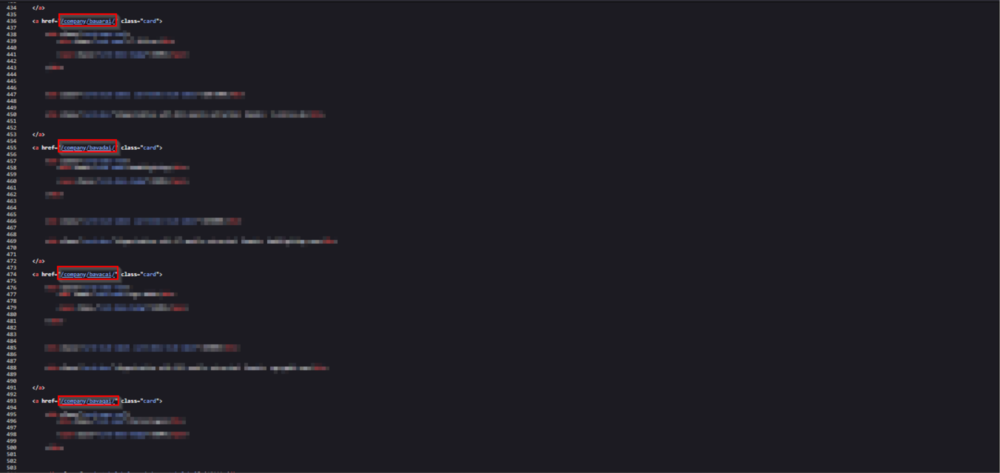
Raw HTML source of the leak site, showing sequential /company/ URL slugs (bauarai, bavadai, bavacai, bavaqai) as literal href attributes on adjacent victim card elements.
Direct inspection of the leak site’s page source confirms that each victim entry is addressed by a short, algorithmically generated slug embedded directly in the HTML as its /company/ URL path, with bavacai sitting immediately adjacent to bavadai, bavaqai, and bauarai in the raw markup. This is consistent with the slug-to-victim mapping observed earlier in Section 4 and reinforces that these strings function as internal record identifiers on the leak site’s backend rather than as descriptive or self-chosen victim names. It does not, on its own, establish why a subset of these slugs also appears elsewhere in public reporting as standalone ransomware or build names; that connection remains the unconfirmed hypothesis noted above, and this source code excerpt is presented only as supporting context for how the slugs are generated and structured, not as confirmation of the hypothesis itself.
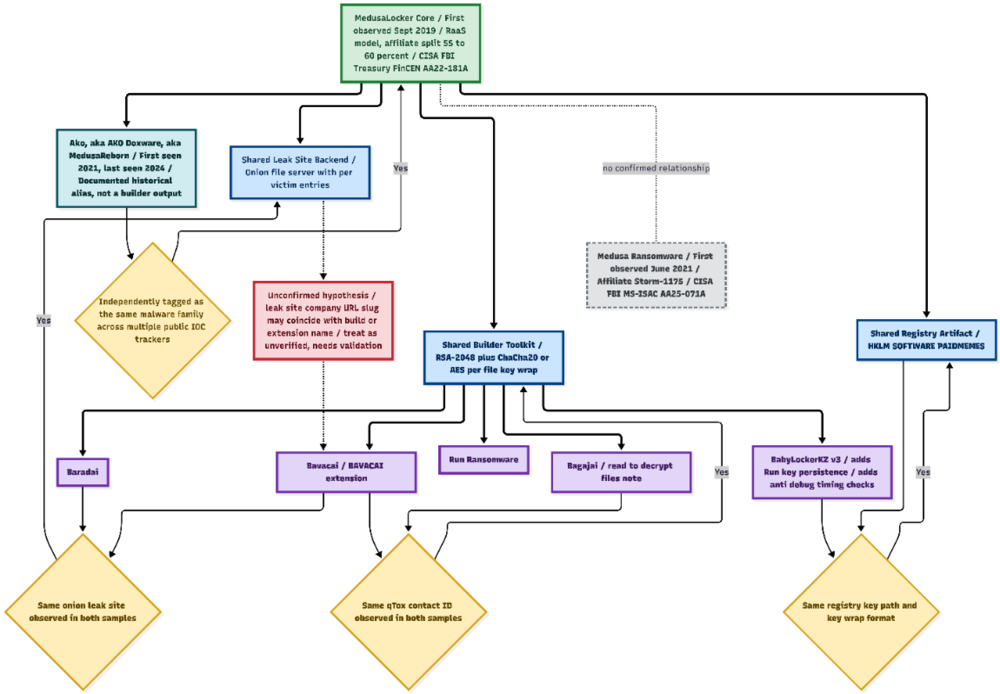
MedusaLocker core operation, shared builder and leak site infrastructure, and publicly named build outputs.
The practical implication of this cluster of evidence is that vendor and researcher writeups naming Bavacai, Bagajai, Baradai, or BabyLockerKZ as distinct ransomware families should be read with caution. This advisory’s working assessment is that these represent individual builder outputs or affiliate deployments of the same underlying MedusaLocker toolkit rather than separately developed malware families, though it stops short of asserting this for every publicly circulated name given the limits of available sample coverage.
Activity Timeline
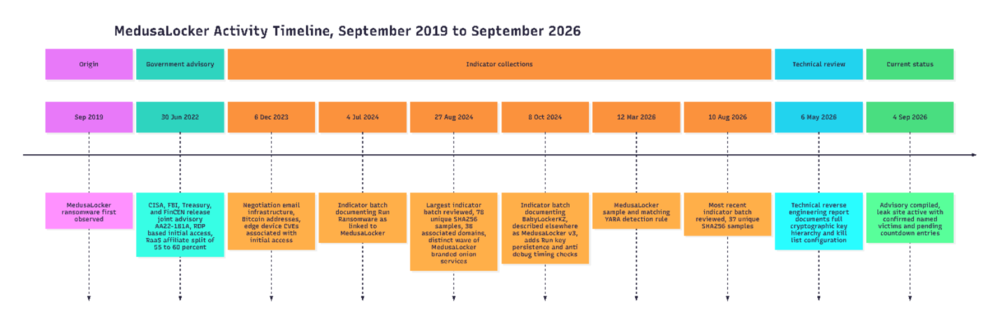
MedusaLocker activity timeline, September 2019 to September 2026, color coded by evidence type.
The timeline separates the first observation and advisory milestone events from the seven indicator batches and one direct technical review considered for this advisory. There are two aspects worth mentioning. First, the roughly three-year gap between the 2022 government advisory and the vast majority of the indicator samples considered in this advisory does not constitute a gap in the review process of this advisory but rather an ongoing process for the group; MedusaLocker is known to be continuously active during this timeframe elsewhere. Second, the frequency of release of distinct builds with distinct branding increases starting with the second half of 2024 when Run Ransomware and BabyLockerKZ are released within four months from each other. This is in accordance with the shared builder assessment provided in Section 4, where it can be argued that this is indicative of a single builder and leak site to produce numerous samples rather than four different ransomware families created in quick succession.
The two most recent entries show that the group was operational at the time of writing this advisory. The 6 May 2026 technical review is the deepest source considered in this advisory and serves as the basis for cryptographic and tradecraft analysis presented in Sections 4 and 6. The 4 September 2026 entry gives us the most up-to-date insight into the operations of the group, as it is a direct technical view of its leak site rather than an information collected from the third party and shows the presence of entries with a countdown timer waiting to be named next to the ones that are already disclosed.
Targeted Sectors, Regions, and Victimology
The sector and regional distributions below are derived directly from review of 36 identifiable, named victim entries observed on the group’s active data leak site, rather than from a third party’s reported victim count. Two additional entries corresponding to a personal or non-organizational record were excluded from this count. Several regional attributions were inferred from domain naming or descriptive context where no explicit country was stated and should be treated as provisional; these are grouped separately as unconfirmed.
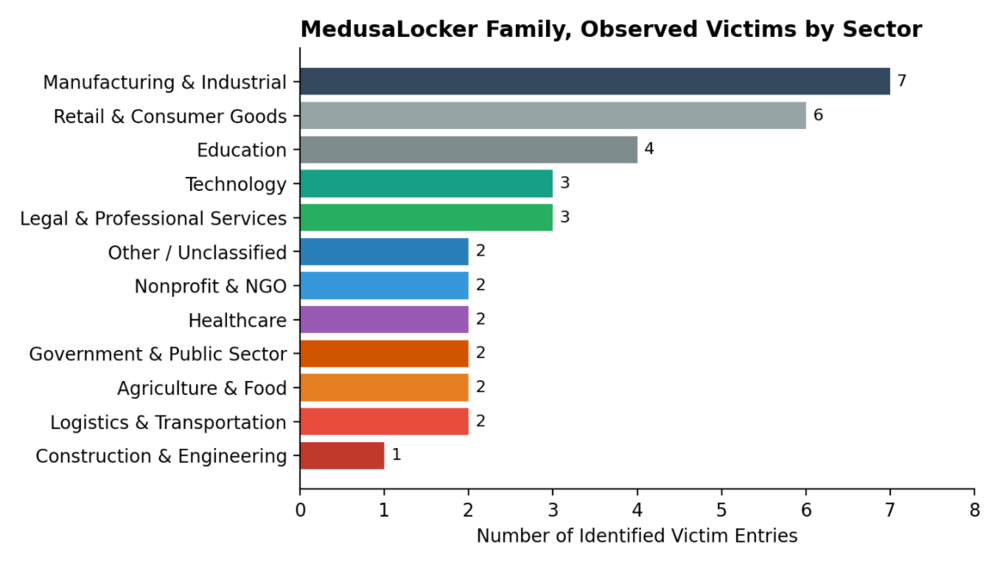
MedusaLocker family, observed victims by sector, derived from direct leak site review.
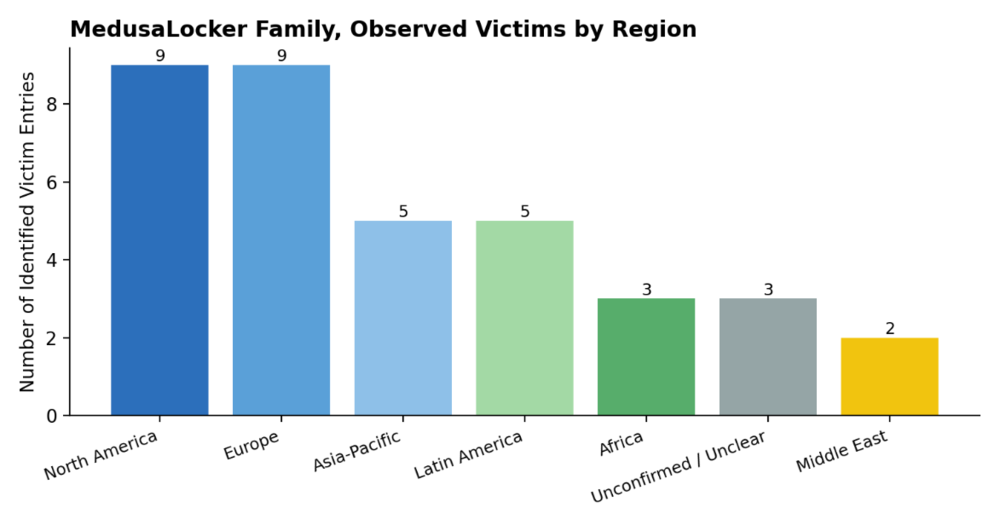
MedusaLocker family, observed victims by region, derived from direct leak site review.
Manufacturing and industrial organizations, along with retail and consumer goods companies, account for the largest identifiable share of victims, followed by education and legal or professional services. North America and Europe are the most represented regions, with a smaller but consistent presence across Asia-Pacific, Latin America, and Africa. Ransom demands observed on victim entries ranged from 5,000 to 300,000 US dollars, with most demands clustered between 15,000 and 75,000 dollars, consistent with an opportunistic, small to mid-sized enterprise targeting model rather than a campaign focused on a small number of high value targets.
TTPs and MITRE ATT&CK Mapping
Mappings below are drawn from a firsthand technical review of a MedusaLocker builder derived sample together with the 2022 government advisory. Confidence reflects the strength of corroboration across the sources reviewed, not the severity of the technique.
| Tactic | Technique (ID) | Evidence / Rationale | Confidence |
|---|---|---|---|
| Initial Access | Exploit Public-Facing Application (T1190) | Historical indicators associate MedusaLocker campaigns with exploitation of Fortinet SSL-VPN (CVE-2018-13379, CVE-2022-42475), Windows Print Spooler (CVE-2022-21999), and ManageEngine (CVE-2022-47966). | Medium |
| Initial Access | External Remote Services (T1133) | Government advisory documents RDP configuration compromise as the predominant initial access vector. | High |
| Initial Access | Phishing (T1566) | Government advisory documents email spam and malicious attachments as a secondary initial access vector. | Medium |
| Defense Evasion | Access Token Manipulation: Parent PID Spoofing (T1134.004) | Direct technical review confirms the sample spawns a self-relaunched child process for network drive encryption with explorer.exe declared as the parent process via UpdateProcThreadAttribute. | High |
| Defense Evasion | Hide Artifacts: Hidden Window (T1564.003) | Direct technical review confirms the sample hides its console window post-initialization by default configuration. | High |
| Defense Evasion | Encrypted/Encoded Files: Encrypted Resources (T1027.013) | Direct technical review confirms the sample’s configuration, including all contact and ransom note data, is stored ChaCha20 encrypted inside a PE resource, keyed by plaintext strings stored two entries away in the same data section. | High |
| Defense Evasion | Command and Scripting Interpreter: Windows Command Shell (T1059.003) | Direct technical review confirms all recovery inhibition and process termination commands are shell spawned via cmd.exe, wrapped in a WoW64 to sysnative process hop intended to break simple parent-child detection rules. | High |
| Impact | Data Encrypted for Impact (T1486) | Direct technical review confirms a three-tier RSA-2048 plus ChaCha20 key hierarchy with per file rekeying and a configurable intermittent encryption scheme. | High |
| Impact | Inhibit System Recovery (T1490) | Direct technical review confirms shell invocation of vssadmin, wbadmin, wmic shadowcopy, and bcdedit boot status policy commands; two of seven observed commands in the reviewed sample contained typos that silently prevented execution. | High, with a documented partial implementation failure in the specific sample reviewed |
| Impact | Service Stop (T1489) / Process Discovery via kill list (T1057) | Direct technical review confirms a curated, shell invoked kill list targeting Microsoft SQL Server, SSRS, SSIS, SSMS, and PostgreSQL processes and services; several list entries contained syntax errors that prevented the intended process or service from being stopped. | High, with documented implementation errors |
| Discovery | System Information Discovery (T1082) / System Network Configuration Discovery (T1016) | Direct technical review confirms the sample collects hostname, domain, CPU model, RAM, physical disk count, and external IP address (via a single outbound request to a public IP lookup service) to construct a per victim identifier. | High |
| Impact | Data Destruction, partial (T1485) | Direct technical review confirms the sample empties the Recycle Bin on every encrypted drive at the end of its run. | High |
Encryption Design and Notable Tradecraft
Key Hierarchy
The reviewed builder derived sample implements a standard three tier ransomware key hierarchy. An operator held master RSA-2048 keypair, whose public half is embedded in the sample’s encrypted configuration, is used to wrap a freshly generated, per victim RSA-2048 keypair at first execution. That victim keypair persisted to the registry and is in turn used to wrap a freshly generated, per file symmetric key and nonce for every individual file encrypted. The wrapped victim private key and the wrapped per file key are both appended to the end of every encrypted file, meaning recovery is possible only with the operator’s master private key, regardless of which registry or file artifacts a victim retains.
Intermittent Encryption
The reviewed sample supports a configurable intermittent, or partial, encryption scheme intended to reduce encryption time on very large files, controlled by two configuration constants defining a maximum buffer size and an inner chunk size. In the specific build reviewed, these constants combined such that files above approximately 1.2 gigabytes are left with a substantial unencrypted tail, and the configured intermittent skip behavior did not meaningfully activate for typical office and database file sizes, which were instead fully encrypted.
Recovery Inhibition and Process Termination
The reviewed sample shell invokes volume shadow copy deletion, Windows Backup catalog deletion, and boot status policy modification commands, alongside a curated list of service stop and process termination commands targeting Microsoft SQL Server, SQL Server Reporting and Integration Services, SQL Server Management Studio, and PostgreSQL. Notably, several of these commands in the specific sample reviewed contained typographical errors, for example a malformed switch that silently prevented termination of the PostgreSQL process, and a misspelled backup subcommand that silently prevented deletion of the system state backup. This is treated as evidence of amateur implementation rather than a deliberate evasion technique.
Defense Evasion
Two evasion techniques of note were confirmed by direct review. First, when running with administrative privileges, the sample self relaunches a copy of itself to handle network drive encryption in a separate process, using UpdateProcThreadAttribute with the PROC_THREAD_ATTRIBUTE_PARENT_PROCESS attribute to declare explorer.exe as that child process’s parent, which can defeat simple process lineage-based detection logic. Second, every shell invoked recovery inhibition command is wrapped in a WoW64 to sysnative process hop, spawning a 32-bit cmd.exe which in turn spawns a native 64-bit cmd.exe via the sysnative path alias, breaking detection rules that expect the malware’s own process to be the direct parent of vssadmin or taskkill. No anti-debug, anti-VM, sandbox detection, API hashing, or meaningful string obfuscation was identified; the sample’s only obfuscation is a single ChaCha20 layer over its own embedded configuration resource, and the key and nonce used for that layer are themselves stored as plaintext strings elsewhere in the same binary.
Indicators of Compromise
The indicators below are for detection and blocking purposes only.
Indicators are organized by ingestion or collection date, most recent first, rather than by indicator type. This reflects operational priority: the freshest batches are the most likely to still correspond to live infrastructure or currently circulating samples, while the December 2023 batches at the end of this section are retained for retrospective hunting value rather than as an expectation that the same infrastructure remains active today. The full corpus spans seven collection dates and contains.
- 134 unique SHA256 file hashes
- 92 unique MD5 file hashes
- 83 unique SHA1 file hashes
- 98 unique negotiation and support email addresses
- 19 unique Bitcoin addresses
- 18 unique domains.
Representative subsets are shown per batch below; full deduplicated lists are available on request.
10 August 2026, Most Recent (MedusaLocker)
37 unique file samples (correlated across SHA256, MD5, and SHA1 where the source data linked them). No domains, emails, or CVEs in this batch.
| SHA256 | MD5 | SHA1 |
|---|---|---|
| 02257ae951ff87599c 7526b9f154e58612fd1f1ac678c c0eded6b0344e54d7d9 | c18faf673c6ea25d491ad7a3c 6480c109 | e3299c6bfebbc527a5fc0176da7cb6 b7ca3239ed |
| 21169e5a0b4a1d0b7bac5b33 5139c7de57b33229fd26a38 3e0948938a76d5863 | 702f732f25e128d0419c40d9 5cf5de79 | 5dfaa76ef4b04a72af1dbcf2f397030 59c53b0d1 |
| 21bae361cfc5384fb4d1fa26 f235627abaeb9ce4738587cd 1720e137e22fa77 | aff823ee30ddcaab967d3428 2eedb192 | 2bef55047878e706df04b01df3514c 296a09bd58 |
| 5185e3d6e9d888053f1b 4f6dd9070adc57fddd988638b60 bc777dc9bb289df | 5dc49cefd36bcf8e85bee064 2c3f15a9 | 5fee0af0edeac29d960a89d7aade8 1e4c97fa8 |
| 5aec156c17b263dc3330b2 f0714572fee5e3092f26fcf3b6b bab17d4dbf1d3aa | c5b7ad23c374722a0b1ea6e 4d118d18 | 0fd7cae53470299b4cfaf60c25654 c62b7ef55 |
| 680d52786ffa6f6fcaaf9f55 51cd224a847869a5edaed71916 22fd291b2f68 | fa8dcdf9718e5b9ad888d8b8 1a5f1d2e1 | 486dbc740754ef49aaf92e4c754d17 3ec9b8cb0 |
| 690b3aacb438e50788ca6 018d18caa7bd1d18121e71649e7 d2e36067919ca0d6 | fd97ea4b8cfbe711cdeff06d6 e8c502f | 4dec5c08c21d06255cab4b527b36a 4a3c834028d |
| 9245ade3702aa814af9449e f1f455b10f6968fe536c791fc3f 133a29bf295b01 | e108770f35c958d528e1db9e 00c91747 | f550287f1bca7c8525225bc3f3bfc7f 3ecc67bdce |
| a42df8053e42a3f98ce47aa 8a0d130c0aa939d3dd9a85850 11ddd665a8463fe0 | 4d56b55b133743418061a05 b4c09cb74 | a5833eec48932d697f0cdc1780e401 0667513f0cd |
| bb9dc320beebc64c20ab49 2162dd9214b36455faa038985 51fea2e19c85cf518 | a05e23d383f6c7a3cdf243bf 4bded992 | 559b1f00e8600537eafaa76a2ab1ab 689b136d72 |
| 0c9ab72d252930a81293227 31682073415f3502451ff87b5 83fba358d8d84ad9 | – | – |
| 0e8a7e1488d7e2ab614d36c 7be3decfc66f3a8c0d1d997d6 fc4bd23dbc3e9db4 | – | – |
| 156d3ec934d09e4b938db205 c03392cdac85c9fe9d61818 46615cb29fdc79268 | – | – |
| 1e22f31fbe22cb34d093f183dac 757e81d1972c92c3c1863 97f0067e4b288200 | – | – |
| 34f27db838b73f28aaa85bcf9 78d361b4ff14096fad2c38b78 acb50034702808 | – | – |
| 3dcb2d87765159534b187b9a 2fe8fff6412b184304aa8c154 ab093a934e02a11 | – | – |
| 45c2ca5a78f9533cf91d3d3 3af05824546ff24d9edca8a4f4 ee059d8504f7f4 | – | – |
| 59f8e945b39c5ce5c13f59fe1 8caec2e2f352d42837a46935 f8746708337658c | – | – |
| 6060b686d2bfc038023b23cec bfd9069f8878cdcd0ffc519e 9057e657aeaeb9a | – | – |
| 60693c229131a42ffcefc7b03 c8926878e2852032cba3254d 2b79c618a35f65c | – | – |
| 66d296674c4cba7a3a3803ea 8a3816654689b27ee04b11f3 58582ca7e07b7ccc | – | – |
| 677be95825346cae080c802 e8fde5d0285cbc0246d219f87 b2747187d488a405 | – | – |
| 68d92f3e92a41614297a82eec 91dbf693664798e221eb9ec 60a248b7682efed3 | – | – |
| 6bc35d7eccbb2472d90ff48876 fdaa501e45a90891fc18a26 14111288745fc90 | – | – |
| 6deaa2058e37a070579b11739 ddab9d3410937854ca6499 9beda90cde5184127 | – | – |
| 71daf6018eb1f9ab10d92170a d42fd64846897c063398a31 c5ee026f3c37859a | – | – |
| 7504810d12072e2516a87cdc 321b94554ac93e1c71d4549 8dd89bd47904723bd | – | – |
| 7cf8f4739977be63d7af5d12 28234d85c29b9bba0cb732bc 99e04b1da01759d8 | – | – |
| 7db73ba4fe7185b9335ad3 359e4676932dae08059d7b894f 86681425c46ef372 | – | – |
| 83083e80e79a5624a805cf aa7daafb8917974c45d48d9340 4acd70810e5179f8 | – | – |
| ac51546006f6829a41f1b7a 3916cf7707a9f080fbb7169c85 6000482bc8f3661 | – | – |
| af517d61090454df4a7bb3a8 04001d399d1cf75c99556be2 5acfb5756e07c789 | – | – |
| b36076e014dd3ab2b7917a0 a9d1c3e1669e33cde68e1611 0d25f13de7c9dfb9a | – | – |
| c59b82a4ba01b2cb6075b957 1c17ab584d0e1af0a93cac4 cd6de3043c3ffb23a | – | – |
| f07d0c11104d21833466d6fb9 2b2c1745f459bdd94421f97b 27c8530e49244aa | – | – |
| f08af553a6cfc18c4200099b64 66962ee2498cc561febdea4 5cc033a3fac4264 | – | – |
| ffe98374173d7c2084a1a6953 b308c13a8b9493294af831c 23542b0d88654036 | – | – |
6 May 2026 (Direct Technical Review, Non-Batch Sourced)
Artifacts below come from the firsthand technical review of a builder derived sample rather than from a dated OTX style indicator batch and are placed here by the review’s own date.
| Location | Description |
|---|---|
| HKLM\SOFTWARE\PAIDMEMES\PUBLIC | Victim RSA public key blob, base64 encoded |
| HKLM\SOFTWARE\PAIDMEMES\PRIVATE | Victim RSA private key blob, wrapped with the operator master public key |
| Run key persistence value (variant dependent) | Observed added in at least one later build iteration, not present in all reviewed samples |
- Ransom note filenames vary by build; one reviewed sample used WHATS_HAPPEND.txt (note the misspelling), written to the root of every encrypted drive and every directory the encryptor entered. A separate, differently formatted note, HOW_TO_RECOVER_DATA.html, has also been publicly documented for this family.
- Encrypted file extension is builder generated and varies per build; treat any newly appended, non-standard file extension applied network-wide alongside a matching ransom note as a strong indicator.
- PDB debug path artifacts have been observed in at least one compiled sample, indicating an internal, non-obfuscated development build process.
Sample SHA256 referenced in this technical review: 86b4d075d5bd0c49cbb21fd43935789b6612a2165273cc158dd0607b68941d04 (corresponding MD5: 7ae9c8b779ce3114199f4fd6335f681d).
12 March 2026 (MedusaLocker)
Single sample, notable for a matching YARA detection rule.
| SHA256 | MD5 | SHA1 |
|---|---|---|
| f1c361bb3b649918bc5b3ad3fc5cbd1bbd7c 585fbe2557410e267d161d3bb998 | – | – |
| Type | Value | Context |
|---|---|---|
| YARA rule ID | 0edce2b2b6ed1e5a78ab6ad28512d7574f9c08b a | Detects this MedusaLocker sample |
8 October 2024 (BabyLockerKZ, Linked)
| SHA256 | MD5 | SHA1 |
|---|---|---|
| 1e9246e6a35731143368ea a0ade4f3cf576d6b22e6090152 f6e94f1fa3070651 | a98675c091691c27369457 8843d4a780 | 9079acbbd2466fd79488b8 405bb8f770a7b2ae52 |
| 2eddfe711c32ef1668e14a 10d00452c83c29e394e17c41f49 1550a1583c1bcac | f32af20bbe82c33dffa9ac 6a50ecb278 | 52a08d0fb6cc37c2d4804 198c1db6c2e7e8c6fc6 |
| 33a8024395c56fab4564b9 baef1645e505e00b0b36bff6ad 3aedb666022599a | 56b6d9b9fbcb471d5447fd fd362f0a71 | 28c1fefc10b890cef70a3f 0fc40ba121ee44c475 |
| 364f1b7466d8e4c9f55294ec f1f874c763bcf980c59b0250c 613ac366def6aca | 73fc61bbec7230ef268be9 5246dbfa67 | d700c6548240a75fc8a0b72 ac4ad2cca1b6d4fe5 |
| 48046fb0e566f5a2d184f84 b76d6cadc458762556daed0e4a 3a1200afebfb54 | afddf1db7b4dd2928105e3a d2e3e7054 | bba5a0c24a06abc2edc79bd 1432b74f217a9da25 |
| 5d5d639fdfbf632bb7d9f1bb2 8731217d09d36078ab5e594b af2a5a41267a5d2 | aa0dec3adef08a4dbd65518 3de9d2843 | 30e74bcafb2edee17e10f76 5dbc3724ae2b467f1 |
| 63eb3d2886d9cb880c9b0d54b 94f3e149b3b5b6215a33a0ef 63588a09dcd4499 | 022a903fe51bf05830c679503 233d7b6 | ca42b7fa4f292fb2fbe29f30b b1c84fb8d357a3c |
| 759b96f4406578cc0836a3a 2bf11c8bc553effac72f8d28b9 4aec78b66be906 | 2aed9553069de3ea13ceb7f b8d62302 | 474dbdedcb966747360ada8 3ed83b391ef3eb53 |
| 8edbb1944d94ff91ee917c3 1590b6d1d5690a52fc153e44355 ee9749aa0f4625 | db82819a97d3951c9ed9890 93b97b62 | b9d5d4e7d3a8560728479ed 1011a2df70a06e3 |
| 9f066975f1e02b29c7c63528 0f405c59704ce4f4e06b04e9ac8a 7eac22acd3c7 | 8cbcb7dc9d6d5847bb8391cb 1e0d4986 | e834573675941729abacdf4b 7e1abe1eaf3b94e2 |
| c0c726a23111c220d02ffd01 a85f9788249e42baece03f83b6059 170453b801 | 2dc0dad1939edfdf997525ba c94cdc21 | e3e398a3eed8ffc0266dbe37 c396909eee150cf4 |
| d00f7cf6af68ba832b9d364f2 8411346cfe66fd3b1f5bcac31876 6add29ff7f0 | f2465e305c6ffe9853928c912 7f53485 | fdb01ab55c0ec4da517bb6374 b0e99174d3f95cc |
| dc4840a0992b218cbedd5a7ac5 c711cb98f1f9e78a8ffdea37c69 4061dfd34c6 | 51afb877c52cc888f5581996ff bcc2 | e2030f46b171a6fbd1d9509f318 9b21b6e80425 |
| 012657c4548d9c98223caa4cc7a a52fc083d6983d4fde16aca327 1412e7fe3fe | – | – |
| 1f2df15442593b159e45d16a27e4 d43d3a9062da212a588ba4c04 8f214a0b7be | – | – |
| 270c3354b3ee2940b499e365eaba 143fba9d458f434dc38e663d c0f08e96121e | – | – |
| 6ae3a58a78be9c606009c657de4e3 90538b21ad951e62b6f4d311 38e1a75732c | – | – |
| 8bc455e5de35290f8a9437635794 7bd72aaf6f4d452c25a8ef44e03 7ef76b9f | – | – |
| b8c994e3ed7cc9080916119 ddc315533c129479f508676 d7544b82b2e24745f | – | – |
27 August 2024 (MedusaLocker, Largest Batch Reviewed)
94 unique file samples, 18 domain and 4 URLs.
| SHA256 | MD5 | SHA1 |
|---|---|---|
| 09f0a04346eaa20e41a 9116e3444e2f77248b78fa4e62 43e022f5bdd5a7ad210 | 5e1a53a0178c9be598e dff8c5170b91c | cf917f0d5bd02e5fd1d1 a9c3cc3763717542e07 |
| 0a758a922bdaacc08a4a 62881eeb0f17075058ecf7329cbc10 a9bfe1fba0814 | e03fa1e0dd3d0fb6960e7 6219ddf86c | c92fd297256aa8d70607e3 3188b91442208aaeb3 |
| 104ffe0cc10413b8c3dd 04fdc921f07c3cc55efba9a63ccd ccf45e4012151c5f | 6701070c21d3c6487c3e 6291f2f0f1c9 | 7219f91bd5fb94128159 d18956e1bd9132bf10e0 |
| 1934b4641ca540ac4fd3 9c37e6f8b6878ddf111b5c8eb2de2 6c842cb6bd7b9b8 | 42bc883e7a31b011d268 7eba178c2525 | f7b0369169dff3f10e97 4b9a10ec15f7a81dec54 |
| 26af222204fca27c0fda bf9eefbfdb638a8a9322b297119f8 5cce3c708090f0 | 646698572afbbf24f50e c5681feb2db7 | 70530bc23bad38e6aee6 6cbb2c2f58a96a18fb79 |
| 2a0047fe9748f2a45196 dbf75e4f1a951d249daad380cbc9e ab8ff66fb35814 | bdc0920c0aa76ce2b09e eb18d76fdc63 | 4910858e175eb8b22f58 21e555e6aa6a0f143c2 |
| 2e9fceb9d4378a4e67250 f0cb633a020be6eb1c57237272a5 0cb4db36997db7 | 9691c8164fa6fbfbbf44d 92dcfc2a023 | d36db5874f39688324518 088059273a4f2e9d33f |
| 33628f3ac96127ce96b52 7740202cf3d132908ee0480c4c4101 7caaff76d92b1 | 17c6e23f6787dfe4ae982 130db5a8447 | c61a3753c45cfb44effff 158ee2b67adf3c90bf |
| 3e19d1653c08206c55e1f8 35bd890b067b652b99a7b38bad4d7 8ad7490c6a0f8 | 49b53d3c715ec879efeb51 d386b9d923 | 78daa8b99d2fa422926465 f36e13f31587b9e142 |
| 3e22df5e41df76a46ab360 be05fe0ee5c336c84fd55db7763fe 4e214dca194b4 | 28ec152fadc5119c31f1fc 984735b324 | 48e24f5c2c7572ed29a0e5 8b02e596f0638bc1f6 |
| 4210633410fd1b0f344725 56943b26a9f3f12fc3ceb79860ef9 3d037b52723f9 | 70f87b7d3aedcd50c9e1c7 9054e026bd | 4da108a96280fb2c4d3077 bef17937e9b2dad848 |
| 48c924b6743943biefd996f 12ae10a5a6d035528c04a4671d16 87a76fadce573 | 715ddf490dbaf7d67780e44 448e21ca1 | 00f09f4ca9fc814019bbeb5 57439abb49b17b49 |
| 4ae110bb89ddcc45bb2c4e 980794195ee5eb85b526199caede f7334f0f57cc4 | 82143033173cbeee7f559 00df8ab8c5 | e03aedb8b9770f899a29f1 939636db43825e95cf |
| 4d4df87cf8d8551d836f67b fde4337863bac3ff6b5cb3246750 54ea023b12ab6 | 84b88ac81e4872ff3bf15c7 2f43d101 | 0823d067541de16325e5454 a91b57262365a0705 |
| 50a334ff766b053dee01ee1e 410eebc5a24144517c59f9317ec 47be9b70f6c48 | 3030943c7e5f2c7b710c416 f7d979c25 | 9f5a9707ba0fcd5b695be13 1dedfde3b2d359d9 |
| 634d84758d8d922bbfb0ad3 c904c38fc7989f11503877acf02ad 5dad3775df7a | adf82786199fd5014675f8b 5450cce16 | 5fff4c7c46e9d43682b3f90 5b67e01a666ca042d |
| 657c0cce98d6e73e53b4001e eea51ed91fdcf3d47a18712b6ba 9c66d59677980 | 8cd11f34d817a99e4972641 caf07951e | db5e29c0729486ba383342 6093652451c5fca9b5 |
| 6a87226ed5cca8e072507d 6c24289c57757dd96177f329a00b0 0e40427a1d473 | f627c30429d967082cdcf6 34aa735410 | 7ab128659ad586761ea680 0d59a1ccf1547a039 |
| 6a973119a7c1cb0151cd94 b34d24e963260a000da3e3a8df4b9 6e2430ffa409e | c89dd8098bb565ffbca2b 015fa3a862e | c7163968518d5a7d86c5f ce07d05141c646ef6f6 |
| 736de79e0a2d08156bae6 08b2a3e63336829d59d38d619076 42149a566ebd270 | 47386ee20a6a94830ee4f a38b419a6f7 | ee4575cf9818636781677 d632363ddc65652deab |
| 746c79b5b6030091c3 7251939690eee31d023de530354 4b46032bf89580806e5 | d82b27fdcc3a63f2ab0 c46c5a3caef0a | f968e5c2314e198f4c0c 2a4596d13ee1b6482330 |
| 7593b85e66e49f39feb31 41b0d390ed9c660a227042686 485131f4956e1f69ff | 120e36c2428a4bfe9f37b 977f698fa39 | 1bbda98348f0d8d58c6afc cd50a76321d02919f9 |
| 79357c9248aea61fa25f0 641f2eeb13bb259da645ab2e8d d696b702ed4fa976b | 161d8e8477bb7ae272b38 c58432e8400 | 4537e90314d053f31c9ec 507acdbc2567a081234 |
| 79e009e12ba6d60665faf 5bdd523d80f0fe6be28694914 cf0fa64929b4052e67 | aa82e62207615d2f227ce 9a0e488b912 | d9390b6c1478970a9e7b8 a3fe854a42efdc582f6 |
| 8597f458f1dcc5ecdf 209d9c98b1f72c2fce248623 6aae73adbe26fb6f9c671 | 858ffbe870a7454c4 a59f889d8d49169 | fc31989737dcf21b7 3bc0956220852dfab2cb549 |
| 8724e513ca2b4ce055b b846220e57c2ab622f296bf7a 768393a701319d3eac70 | d9fa435d704caebc544 08e03227f0044 | 0f36dff01beaf57d68b 12fa0234853638c1c6f0 |
| 8846c8be509a4b274d6 d1465cc14d44cfb0a51917d3a 00ce00fa0b35a4284 | 21ea77788aa2649614c 9ec739f1dd1b8 | 2da8d08d67ad3945ebf 7a589acdd76dcc4a3510b |
| 8b9bdc5cf5534d377a62 01d1803a5aa0915b93c9df52 4307118fd61f361bdba2 | 9353a3fa46ce13ea133c fab51c8cbd7a | f3e66237577a690ee90 7deac9ffbf6074a85e7a5 |
| 8b9c7d2554fe315199f ae656448dc193accbec162d4af ff204ce2346507a8a | 4fdabe571b66ceec3448 939bfb3ffcd1 | 763499b37aacd317e7d2 f512872f9ed719aacae1 |
| 912018ab3c6b16b39ee84 f17745ff0c80a33cee241013ec3 5d0281e40c0658d9 | bb8bdb3e8c92e97e2f636 26bc3b254c4 | 70df765f554ed73922004 22c18776b8992c09231 |
| 9144a60ac86d4c91f7553 768d9bef848acd3bd9fe3e599b7 ea20248a3115669 | a57f84e3848ab36fd59c9 4d32284a41e | 4d5992de4601c4306885 c71b0ba197184bb69221 |
| 940bddbc6ef19b21f2022 d61bf4d006969da11f9e0beb a98586e554dfcc741 | 2316091f02153ac20df7 68513aae1a4 | 6b7b1017b9313ab87fc c4ea08a427c1499b89dc |
| 96632f716df30af567d a00d3624e245d162d0a05ac4 b4e7cbadf63f04ca8d3da | a03b57cc0103316e974 bbb0f159f78f6 | 9138f9184f3d0fde885 3490aa2155edf1567f0b |
| 9814f9d8a8b129d745 d74d3069da69aaf4187146 327cb615108e9ed1b5d3c58e | 4536297338323c0078 3fdceabf8d36bf | 7ad1bf03b480ebd2b8 5b2bc5be4b9140b0ce6d4d |
| a533f9ae8f26997eeb 35ddac6d1d955924f6eea1794 b8a227457e95cf524d44 | b64ced51ca13ef75fa 0347d3a638555a | 6a1a46a0de15e81a81 57fd3d3e9e1cb498791e3f |
| a8b84ab6489fde1fab9 87df27508abd7d4b30d06ab854 bfda37a277e89a2558 | 4293f5b9957dc9e6124 7e6e1149e4c0f | c87cd85d434e358b85f 94cad098aa1f653d9cdbf |
| aae247b1fe640f2c96cb fa508d18475f3e4c8b29fa117a 31d17ba0c4e5caa48 | 99a1f6e096dc79b1bc1 adbefaa0cd9c5 | 0bcf20885b0d64a876e 7b46497b22689cb93d33 |
| abe330ec7e157293afee 2d96489165d3aa0ed9a59252ecf 4f3acfa3205ca9d15 | 7ecc2ed7db7bbb6dc794 f29feb477c8c | 855b8aeb4160641ecea5 710174086ee74d3e42c1 |
| b1e97cd1ae60622ae83c 56c9d15895a24405f949e4bb337 e86159bcdd93e138e | 38b1cdb61aff9b5096cc 971cbb3159e0 | 78bcffb9ee6a7d29e18f 66c0138aa3fd3a9225fa |
| bae48fe24d140f4c1c11 8edbfaee4ab6446c173a0d0b84958 5a88db3f38f01b8 | 312e41aa5901f6e00811 de343627d418 | 0c1ce8017cfcc24927ff f1b00606e8c83c4ebfa7 |
| bcf49e8f493c9eff83d 9bc891e91dc91777f02b4f176e44b2 0f9a2d651f20fc3 | 2979ed84c4ca3deb292 4bd1f26bf88bd | 8f01f9112904389e0b5 3a25506ef69f99cc0fa1b |
| cdfbe62ef515546f172 8189260d0bdf77167063b6dbb771db 6ed8b61145a2bc | b79475c4783efdd8122 6946cb5669a79 | d612165251d5f1dcfb1 f1a762c88d956f49ce344 |
| d0c1662ce239e4d2880 48c0e3324ec52962f6ddda77da0cb7 af9c1d9c2f1e2eb | 6a58b52b184715583cda 792b56a0a1ed | 3477a173e2c1005a81d0 42802ab0f22cc12a4d55 |
| d33b09ddee82c5c439cb 0c66e5c1dee9ad5259e912a3979b3 1c66622fb9d47ea | ad182ac22ee9e8075a324 fcee2038108 | 212e3254099967712c669 0be11ae9d65a8966ffa |
| d9770865ea739a8f1702a2 651538f4f4de2d9288d188d8ace2 c79936f9c2688 | ddfad055be70acdfea36acf 28d418b3 | b82787dc098eefa8bf917f6 cfb294ac3f8349f0 |
| e0221e692fa3476cb2d862c 1aee07f3e87d83411ef9a534fd8d 20efbaee0394 | 57ee7ef00e09c4048d78406 b3dca5b7 | 81467ca16e87dfacd9c965f 105fb5b30548f1ded |
| e2c2a80cb4ecc511f30d72b 3487cb9023b40a25f6bbe07a92f4 7230fb76544f4 | 412568f078ec521bdba6ae1 4b9f36823 | 3e5a80fe286834f6d5f0aaf 014a420ec40ebad7 |
| e70a261143213e70ffa10643 e17b5890443bd2b159527cd2c408d ea989a17cfc | 30e71d452761fbe75d9c8648b 61249c3 | a35dd292647db3cb7bf604497 32fc5f12162f39e |
| ed139beb506a17843c6f4b631a fdf5a41ec93121da66d142b4123 33e628b9db8 | 47d222dd2ac5741433451c8aca ac75bd | 02a0ea73ccc55c0236aa1b4ab5 90f1787e3586e |
| ef1318ede7ab1a8e851f0e05 2630615daa5ad45002536b2957634 66d234b4e74 | 908e3b6aab0126ef4efcdc8c 4805abd7 | 2a9ac8a2a940e537a12ab177 20b5d93815849ce |
| f064dfde1338a45c76c9bbe9 d7c8b358884c32c21510df14ab9b 72df9ead1ba | f07dc09a859321bca78c1d7d a99ad181 | 6d51174ce888641bc27d5ee 968b19b472e014212 |
| f3ba88ec065136ff706b14b 73ad3b0c5ed14c8e3d22ebcda6ced 5fec3dc37c3e | 4edd2632a12e06568ed69e 49a8595a5 | 54b024d15c2f8ff241383e 9603b2eb7e43ead07e |
| f47e3555461472f23a b4766e4d5b6f6d260e335a6abc31 b860e569a720a5446 | 597de376b1f80c06d5 01415dd973dcec | 629c9649ced38df8151 24221b80c9d9c59a85e74 |
| facc02c8d7a9927e3e12 76f8122a2656136af1b8817511e d350b678b46407098 | 59e3542c4d5293a1a12b 2bb6cb357d92 | f31322bc47eec5f5c7da 0e46f23fb868c982daa1 |
| fb07649497b39eee0a935 98ff66f14a1f7625f2b6d4c30d 8bb5c48de848cd4f2 | 217b5b689dca5aa002640 1bffc8d3079 | 86d92fc3ba2b3536893b 8e753da9cbae70063a50 |
| fd24ff7e838fea83607 9c4554254768abdce32c4f4614 8c609a5a676c9e71103 | 4984d9af56c39a161b6 27e019ed2604d | eef59fd5b714844bfd4 4270d909b1441cd537b |
| – | 08278e867322735de9 e75f59b539426e | – |
| – | – | 15177fbb65d707b308ba c50f612b795494314001 |
| 1658a064cb5a5681eee 7ea82f92a2b7a14f70268dd a3fc7aad8a610434711a8f | – | – |
| – | 168447d837fc71d eeee9f6c15e22d4f4 | – |
| – | 1a395bd10b20c116 b11c2db5ee44c225 | – |
| 3581f1c9ee74f83d3d4 76aa5a947a040d9f2613a8362321 80c195f678b64dee6 | – | – |
| – | 3618b68d7db4614ec8 d33b5052cc0e85 | – |
| 5292be813828a591871 11aofd3c989fcfe0b7c893061340c0 0e246443a1e31db | – | – |
| 52b9a7b44154bbb9d81a 581a7de4902b1c661559ea87803 d9cb85339805bd6ca | – | – |
| 53e80ddb515bc2edfdf a94b9e21f2b10c6d13cfa03b16bf 8a80bc052b690b2d0 | – | – |
| 61c26b20a2b291252c cf1b2ae4319542df526e820f96a d4667478ab101b6ee1f | – | – |
| – | 7405efcdd3e931cd e430317df1c00131 | – |
| 761330a5e5b16f27fef 971e1f41d309ee9f5f158dd09e 81b2b31cda6dafa59f0 | – | – |
| – | – | 78f36b7e0041a74b97 9e449cbfaf50434055b1590 |
| – | 7b9dbd1a611dc4d37 8607e5f50b23654 | – |
| 7bca36f037557b0f84 412a666ef76dee8bfec1bc7754 112b95f34634b8b72fed | – | – |
| – | – | 80ad29680cb8cecf58 d870ee675b155fc616097f |
| – | 83371c800dde36a5ff9 fb404d43ee777 | – |
| 83a17f3fda45b00e34934dd d0d5ed72c479170cb39097938f 07a5dc6e92068c3 | – | – |
| – | – | 931601f016ccb022a1fa65 8a073819b22db03a5c |
| – | 94e797f17313dc5d704d 2d026a842e3d | – |
| 94f420e16a4eb515407 6895cd8c5f677db4273d37d44b81 e1d04b26e851b69fe | – | – |
| 9555810647200a6eda7 5dfe1527c1d8720e929b19a6086e 536fb4fce4d9db485 | – | – |
| a780972312e2644f2955 5ec9275053eebce37befe038eaba eb783443209bc921 | – | – |
| aa4cd5e9ff8ef8e4a726 01c03154231631a5179167400a5 478ca4282188b1163 | – | – |
| abbaff145b18d26db84 d52669d1279e928d51f1f571f686 cb100d7893cb69295 | – | – |
| – | acb0fde71fa3d57261e8 eac9c3da88ab | – |
| add2850732c42683ee92 ba555bbff88bf54aeee7c51e2 4f15a898f2d5aff66b | – | – |
| – | b09cd13c7a9ce8c94e1 5303f140bdd9f | – |
| b136a1d9125f4a74e114db0 30877ddb72476c6aeb0ea514 1a4bce5e37cec0839 | – | – |
| bdadf73a531421f832714078c 438267a76fd5085596c86f2fa 4b7341cb336da1 | – | – |
| cdc509cd5807b2fadafc162 8a9cd4cfc93f0120d60c1b04 46327bf65de68b9d9 | – | – |
| – | d02e837ecc8d57f66 d6911b7286c9e71 | – |
| d579b1853c528e54464c 2607e55951ee01b0ab75bc016c14de 1c38068328a81 | – | – |
| – | d8550fb34f7ccc47b02 c51b138b11dd | – |
| db0b5c434ddc7c97505a8be2 4431e9fbe484c2113df4ddf06 1aee91c35eab8b6 | – | – |
| e5d819fd969d6bc913698c44 beb5c8f763a6d6f07b7cdb35 14c4b61a68a1d747 | – | – |
| – | f2596d857cbc976d6f1 264f006719c6a | – |
Domains Services, 27 August 2024 Batch
The source indicator export tags clearnet domains under a single generic ‘domain’ field.
| Domain |
|---|
| areyouaredo.com |
| cock.li |
| decorous.cyou |
| etobylovjanvare.ru |
| glorymolly.com |
| la2deluxe.net |
| medusa-stealer.cc |
| mmhlcpa.com |
| nogiledeneli.ru |
| pervogoaprela.ru |
| petrochina.co.id |
| ransom.data |
| rayabco.com |
| sydneywestcancer.org |
| trabzonspor.org.tr |
| tutanoa.com |
| wearehungry.info |
| wholeness.business |
URLs, 27 August 2024 Batch
| URL |
|---|
| http://46.148.235.114/cmd.php |
| http://95.213.145.101 |
| http://95.213.145.101/64ME_bul |
| https://medusa-stealer.cc |
4 July 2024 (Run Ransomware, Linked)
Single sample.
| SHA256 | MD5 | SHA1 |
|---|---|---|
| cdc509cd5807b2fadafc 1628a9cd4cfc93f0120d60c1b0 446327bf65de68b9d9 | 83371c800dde36a5ff9 fb404d43ee777 | 931601f016ccb022a1 fa658a073819b22db03a5c |
6 December 2023, Batch A (MedusaLocker)
27 unique file samples, 19 Bitcoin addresses, 6 CVEs, and 54 emails.
| SHA256 | MD5 | SHA1 |
|---|---|---|
| 104ffe0cc10413b8c3dd 04fdc921f07c3cc55efba9a63ccdc cf45e4012151c5f | 6701070c21d3c6487c3e 629 1f2f0f1c9 | 7219f91bd5fb94128159 d18956e1bd 9132bf10e0 |
| 4ae110bb89ddcc45bb2 c4e980794195ee5eb85b5261799c aedef7334f0f57cc4 | 82143033173cbeee7f5 59002 fb8ab8c5 | e03aedb8b9770f899a 29f1939636db 43825e95cf |
| 4d4df87cf8d8551d83 6f67fbde4337863bac3ff6b5cb32467 5054ea023b12ab6 | 84b88ac81e4872ff3b 15c72f 431d101 | 0823d067541de16325 e5454a91b57 262365a0705 |
| 50a334ff766b053dee0 1ee1410eebc5a24144517c59f931 7ec47be9b70f6c48 | 3030943c7e5f2c7b71 0c416f 7d979c25 | 9f5a9707ba0fcd5b69 5be131dedfdfe 3b2d359d |
| 657c0cce98d6e73e53b 4001eeea51ed91fdcf3d47a18712b 6ba9c66d59677980 | 8cd11f34d817a99e497 2641c af07951e | db5e29c0729486ba383 3426093652 451c5fca9b5 |
| 746c79b5b6030091c372 51939690eeee31d023de5303544b 46032bf89580806e5 | d82b27dcc3a63f2ab0c4 6c5 a3caef0a | f968e5c2314e198f4c0 c2a4596d13e e1b6482330 |
| 7593b85e664f39feb3 141b0d390ed9c660a22704268648 5131f4956e1f69ff | 120e36c2428a4bfe9f 37b977f 698fa39 | 1bbda98348f0d8d58c 6afccd50a763 21d02919f9 |
| 8597f458f1dcc5ecdf 209d9c98b1f72c2fce2486236aae73 adbe26fb6f9c671 | 858ffbe870a7454c4a 59f889d 8d49169 | fc31989737dcf21b73 bc0956220852 dfab2cb549 |
| 8b9bdc5cf5534d377a 6201d1803a5aa0915b93c9df524307 118fd61f361bdba2 | 9353a3fa46ce13ea13 3cfab5 1c8cbd7a | f3e66237577a690ee 907deac9ffbf60 74a85e7a5 |
| 9814f9d8a8b129d745 d74d3069da69aaf4187146327cb615 108e9ed1b5d3c58e | 4536297338323c0078 3fdcea bf8d36bf | 7ad1bf03b480ebd2b8 5b2bc5be4b9 140b0ce6d4d |
| a8b84ab6489fde1fab 987df27508abd7d4b30d06ab854bf da37a277e89a2558 | 4293f5b9957dc9e612 47e6e1 149e4c0f | c87cd85d434e358b85 f94cad098aa1 f653d9cdbf |
| aae247b1fe640f2c96 cbfa508d18475f3e4c8b29fa117a31 d17ba0c4e5caa48 | 99a1f6e096dc79b1bc 1adbef aa0cd9c5 | 0bcf20885b0d64a876 e7b46497b22 689cb93d33 |
| abe330ec7e157293afe e2d96489165d3aa0ed9a59252ecf4 f3acfa3205ca9d15 | 7ecc2ed7db7bbb6dc79 4f29f eb477c8c | 855b8aeb4160641ecea 5710174086 ee74d3e42c1 |
| b1e97cd1ae60622ae83 c56c9d15895a24405f949e4bb337 e86159bcdd93e138e | 38b1cdb61aff9b5096c c971c bb3159e0 | 78bcffb9ee6a7d29e18 f66c0138aa3fd 3a9225fa |
| bae48fe24d140f4c118 edbfaee4b6446c173a0d0b8495 85a88db3f38f01b8 | 312e41aa5901f6e0081 1de34 3627d418 | 0c1ce8017cfcc24927 fff1b00606e8c 83c4ebfa7 |
| d33b09ddee82c5c439 cb066e5c1dee9ad5259e912a3979 b31c66622fb9d47ea | ad182ac22ee98075a3 24fce e2038108 | 212e3254099967712c 6690be11ae9 d65a8966ffa |
| e2c2a80cb4ecc511f3 0d72b3487cb9023b40a25f6bbe 07a92f47230fb76544f4 | 412568f078ec521bdb a6ae14b9f36823 | 3e5a80fe286834f6d5 f0aaf014a420ec40ebad7d |
| ed139beb506a17843c 6f4b631afdf5a41ec93121da66d 142b412333e628b9db8 | 47d222dd2ac5741433 451c8acaac75bd | 02a0ea73ccc55c0236 aa1b4ab590f11787e3586e |
| fd24ff7e838fea83607 9c4554254768abdce32c4f461 48c609a5a676c9e71103 | 4984d9af56c39a161b6 27e019ed2604d | eef59fd5b71487448bf d44270d909b1441cd537b |
| – | 08278e867322735de9e 75f59b539426e | – |
| – | 217b5b689dca5aa002 6401bffc8d3079 | – |
| – | 30e71d452761fbe75d 9c8648b61249c3 | – |
| – | 7405efcdd3e931cde 430317df1c00131 | – |
| – | 7b9dbd1a611dc4d37 8607e5f50b23654 | – |
| – | acb0fde71fa3d5726 1e8eac9c3da88ab | – |
| – | d02e837ecc8d57f66 d6911b7286c9e71 | – |
| – | d8550fb34f73ccc47 b02c51b138b11dd | – |
CVEs, Batch A
| CVE | Description | Status |
|---|---|---|
| CVE-2018-13379 | Fortinet FortiOS SSL-VPN path traversal / credential disclosure. | Patched; verify no legacy unpatched instances remain |
| CVE-2022-21999 | Windows Print Spooler privilege escalation. | Patched; verify |
| CVE-2022-2294 | Chrome WebRTC heap buffer overflow. | Patched; verify |
| CVE-2022-2295 | Chrome V8 type confusion. | Patched; verify |
| CVE-2022-42475 | Fortinet FortiOS SSL-VPN heap based buffer overflow (actively exploited). | Patched; verify |
| CVE-2022-47966 | ManageEngine multiple products SAML based remote code execution. | Patched; verify |
Bitcoin Addresses, Batch A
| Bitcoin Address |
|---|
| 12xd6KrWVTgHEJHKPEFXwMVWuFK4k1FCUF |
| 14cATAzWd7CQf35n8Ea5pKJPfhM6jEhak |
| 14oH2h12LvQ7BYBufcry5vfKoCq2hTPoev |
| 184ZCaoxkvimVZaj8jZFujC7EwR3BKWvf |
| 18wRbb94CjyTGkUp32ZM7krCYCB9MXUq42 |
| 1ABrXRfP6yHePpi7jmDZkS4Mfpm1ZiatH5 |
| 1AereQUH8yjNPs9Wzeg1Le47dsqC8NNaNM |
| 1DRxUFhJjGUdojCzMWSLmwx7Qxn79XbJq |
| 1DeNHM2etQHp5AszTsUiS4WDHWkGc5UxHf |
| 1DyMbw6R9PbJqfUSDcK5729xQ57yJrE8BC |
| 1Edcufenw1BB4ni9UadJpQh9LVx9JGtKpP |
| 1HEDP3c3zPwiqUaYuWZ8GBfdAQQSa6SMgw |
| 1HZHhdJ6VdwBLCFhdu7kDVZN9pb3BWeUED |
| 1HdgQM9bjX7u7vWJnfrY4MWGBQJi5mVWV |
| 1PopeZ4LNLanisswLndAJB1QntTF8hpLsD |
| 1PormUgPR72yv2FRKSVY27U4ekWMKobWjg |
| bc1q9jg45a039tn83jk2vhdpranty2y8tnpnrk9k5q |
| bc1qy34v0zv6wu0cugea5xjlxagsfwgunwkzc0xcjj |
| bc1qz3lmcw4k58n79wpzm550r5pkzxc2h8rwmmu6xm |
Emails, Batch A
6 December 2023, Batch B, Oldest Batch Reviewed (MedusaLocker)
3 unique file samples, 3 domains, 16 Bitcoin addresses, and 76 emails.
| SHA256 | MD5 | SHA1 |
|---|---|---|
| facc02c8d7a9927e3e1 276f8122a2656136af1b8817511ed 350b678b46407098 | 59e3542c4d5293a1a12 b2bb6cb357d92 | f31322bc47eec5f5c7d a0e46f23fb868c982daa1 |
| – | 94e797f17313dc5d704 d2d026a842e3d | – |
| – | b09cd13c7a9ce8c94 e15303f140bdd9f | – |
Domains and Hostnames, Batch B
| Type | Value | Context |
|---|---|---|
| Domain | decorous.cyou | Ransom negotiation / associated infrastructure |
| Domain | ransom.data | Ransom negotiation / associated infrastructure |
| Domain | wholeness.business | Ransom negotiation / associated infrastructure |
Bitcoin Addresses, Batch B
| Bitcoin Address |
|---|
| 12xd6KrWVTgHEJHKPEFXwMVWuFK4k1FCUF |
| 14cATAzWd7CQf35n8Ea5pKJPfhM6jEhak |
| 14oH2h12LvQ7BYBufcry5vfKoCq2hTPoev |
| 184ZCaoxkvimVZaj8jZFujC7EwR3BKWvf |
| 18wRbb94CjyTGkUp32ZM7krCYCB9MXUq42 |
| 1ABrXRfP6yHePpi7jmDZkS4Mfpm1ZiatH5 |
| 1AereQUH8yjNPs9Wzeg1Le47dsqC8NNaNM |
| 1DRxUFhJjGUdojCzMWSLmwx7Qxn79XbJq |
| 1DeNHM2etQHp5AszTsUiS4WDHWkGc5UxHf |
| 1DyMbw6R9PbJqfUSDcK5729xQ57yJrE8BC |
| 1Edcufenw1BB4ni9UadJpQh9LVx9JGtKpP |
| 1HEDP3c3zPwiqUaYuWZ8GBfdAQQSa6SMgw |
| 1HZHhdJ6VdwBLCFhdu7kDVZN9pb3BWeUED |
| 1HdgQM9bjX7u7vWJnfrY4MWGBQJi5mVWV |
| 1PopeZ4LNLanisswLndAJB1QntTF8hpLsD |
| 1PormUgPR72yv2FRKSVY27U4ekWMKobWjg |
Emails, Batch B
Priority read: defenders standing up detections from this advisory should prioritize the 10 August 2026 and 6 May 2026 entries first, since these are the most likely to reflect still-relevant hashes and tradecraft. The 27 August 2024 and 8 October 2024 batches remain useful for network infrastructure hunting. The two December 2023 batches are retained for retrospective and historical hunting value only.
Host and File System Artifacts
- Ransom note filenames vary by build; one reviewed sample used WHATS_HAPPEND.txt (note the misspelling), written to the root of every encrypted drive and every directory the encryptor entered. Another note, HOW_TO_RECOVER_DATA.html can be found here.
- Encrypted file extension is generated by builder and varies per build; treat any newly appended, non-standard file extension applied network-wide alongside a matching ransom note as a strong indicator.
- PDB debug path artifacts have been observed in at least one compiled sample, indicating an internal, non-obfuscated development build process.
Detection and Hunting Recommendations
- Hunt for parent process ID anomalies: alert on processes whose recorded parent is explorer.exe but whose creation was not initiated interactively by the logged-on user, particularly for processes that immediately begin high volume file write activity.
- Hunt for the WoW64 to sysnative shell chain: alert on a 32-bit cmd.exe spawning a native 64-bit cmd.exe via the sysnative path alias, especially when the resulting command line includes vssadmin, wbadmin, wmic shadowcopy, or bcdedit.
- Monitor for Restart Manager abuse: alert on RmStartSession and RmShutdown API usage by non-administrative or non-backup-related processes immediately preceding bulk file modification.
- Monitor for mass file renaming to a new, non-standard extension: across a short time, window and multiple directories, particularly on file shares and mapped network drives.
- Monitor RDP exposure: flag any internet facing host accepting RDP connections without network level authentication or multi factor authentication enforced, consistent with the group’s predominant initial access vector.
- Monitor for the specific service and process kill list pattern: repeated net stop and taskkill invocations against Microsoft SQL Server, SSRS, SSIS, SSMS, and PostgreSQL service and process names in immediate sequence.
- Treat unresolved leak site countdown entries as early warning signal: where threat intelligence tooling supports leak site monitoring, alert on new entries appearing under the group’s known onion infrastructure even before a victim name is disclosed.
Mitigation and Preventive Controls
Immediate Priority Actions
- Disable direct internet exposure of RDP: and require VPN plus multi factor authentication for any remote administrative access, given RDP compromise is the group’s predominant documented initial access vector.
- Patch historically associated edge device and application CVEs: listed in the IOC section, if still present in the environment, including Fortinet FortiOS SSL-VPN and ManageEngine products.
- Maintain offline or immutable, tested backups: isolated from the production domain, given the group’s consistent use of shadow copy deletion and backup catalog deletion commands.
General Controls
- Enforce least privilege and network segmentation: particularly around backup infrastructure and database servers, which are directly targeted by the group’s kill lists.
- Enable and monitor tamper protection on endpoint security tooling.
- Apply application allowlisting or strict change control for remote management software.
- Update incident response and negotiation playbooks: to account for double extortion pressure and direct any unsolicited contact from the group to law enforcement rather than engaging directly.
Scope Notes
- This advisory is based on open source and government sourced intelligence, a firsthand technical review of one builder derived sample, and direct review of one active leak site instance. No direct incident response telemetry was reviewed.
- The relationship between MedusaLocker and the publicly named builds Bavacai, Bagajai, Baradai, and BabyLockerKZ is assessed with the confidence levels stated in Section 4 and should not be treated as definitively confirmed for every publicly circulated name.
- The hypothesis that a victim’s leak site URL slug coincides with that victim’s build specific file extension name is explicitly flagged as unconfirmed and provisional and is not relied upon elsewhere in this advisory’s conclusions.
- Sector and regional victim classifications in Section 5 were performed directly by the analyst from firsthand leak site review and should be treated as a best effort categorization rather than a confirmed, exhaustive census.
NOTE:
This advisory consolidates open source and government sourced intelligence on the MedusaLocker ransomware operation, a ransomware as a service group first documented by U.S. federal authorities in 2022 and continuously active since. Analysis draws on a firsthand technical review of a builder derived encryptor sample, direct examination of the group’s active data leak site, a corpus of indicators spanning December 2023 through August 2026, and cross-referenced government advisories. Particular attention is given to a cluster of publicly reported, similarly named encryptor builds (including builds referred to elsewhere as Bavacai, Bagajai, Baradai, and BabyLockerKZ) which this advisory assesses, with stated confidence levels, as outputs of a single shared MedusaLocker derived builder and leak site backend rather than as independent ransomware families. This advisory also explicitly distinguishes MedusaLocker from the separate and unrelated ransomware operation known as Medusa, addressed in Section 3.
