
 HQ/EMEAFind out how we can help your business


Table of Contents
1. Threat Landscape
This week the landscape was shaped by the active exploitation of identity and access infrastructure, continued state aligned espionage against South Asia, and financially motivated crypto ransomware. A maximum severity authentication bypass in Cisco Identity Services Engine (CVE-2026-76460) entered active exploitation and the CISA Known Exploited Vulnerabilities catalogue. The Pakistan nexus actor Transparent Tribe (APT36) ran Operation RapidRust, introducing a new Rust based backdoor, RUSTYSHADE. RIED, a variant of the Makop ransomware family, continued email negotiated double extortion against Windows environments. Underground monitoring also surfaced an unverified surface web claim by an actor using the name Terminal 404 against a Malaysian government domain.
The common thread is pressure on identity, recovery and supply chain trust: attackers are bypassing authentication, destroying backups, and reaching air gapped systems through removable media. The defensive priority is to patch exposed access infrastructure, protect and test backups, and harden identity controls.
2. Emerging Threats and Campaigns
The most significant emerging campaign this period is Operation RapidRust, attributed to Transparent Tribe (APT36) and observed between August to September 2026. The campaign marks a shift of the group toolset toward the Rust language and introduces four previously undocumented tools: the RUSTYSHADE backdoor, the RUSTYMOVE removable media propagation utility, and the PSNATCH and BASHNATCH file stealers for Windows and Linux. These are detailed under Threat Actor Activity and Malware and RATs below.
- Identity infrastructure under fire. Active exploitation of Cisco ISE (CVE-2026-76460) continues a pattern of adversaries targeting authentication and access control appliances as a route into wider environments.
- Air gap bridging. RUSTYMOVE revives USB based propagation to reach isolated networks, a technique of particular concern for segmented operational and defence environments.
- Living off trusted platforms. RUSTYSHADE uses private GitHub repositories for command and control and Backblaze for payload hosting, blending malicious traffic with legitimate cloud services.
3. Threat Actor Activity
Transparent Tribe (APT36)
Transparent Tribe, tracked as APT36 and also known as Mythic Leopard, ProjectM and Earth Karkaddan, is a Pakistan nexus espionage group active since around 2013. It has historically targeted Indian government, military, defence and diplomatic entities, along with education and, more recently, Linux (BOSS) and Android platforms. The group has maintained a high operational tempo through 2026.
| Attribute | Detail |
|---|---|
| Aliases | APT36, Transparent Tribe, Mythic Leopard, ProjectM, Earth Karkaddan |
| Assessed origin | Pakistan nexus |
| Motivation | Espionage and intelligence collection |
| Targeted sectors | Government, defence and military, diplomatic, education |
| Targeted regions | India and Afghanistan (this campaign) |
| Current campaign | Operation RapidRust (observed August 2026) |
| New tooling | RUSTYSHADE, RUSTYMOVE, PSNATCH, BASHNATCH |
In Operation RapidRust the group registered typosquatted domains impersonating Indian news outlets to stage PowerShell scripts and payloads, and hosted archives on the Backblaze cloud storage service. Post compromise activity included reconnaissance, network mapping, scheduled task persistence, lateral movement attempts and anti forensics. The campaign follows earlier 2026 activity, including the PATCHCORD backdoor reported against Afghan telecom and South Asian critical infrastructure, and the GITSHELLPAD implant seen in the Gopher Strike campaign, with which RUSTYSHADE shares functional overlap.
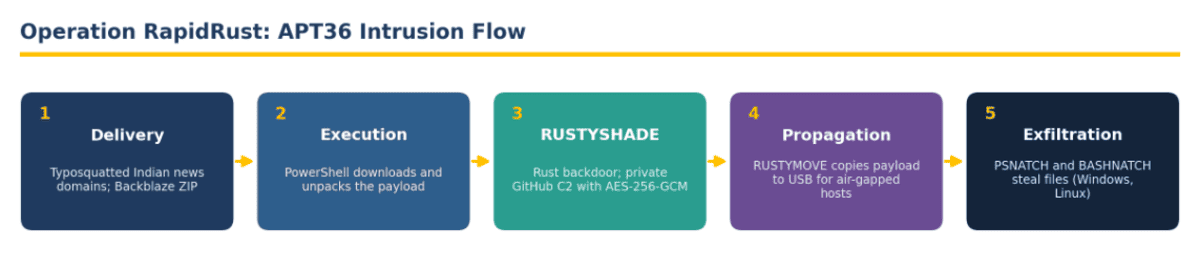
Operation RapidRust intrusion flow.
Recommendations
- Block and hunt for the RapidRust indicators, including Backblaze hosted archive retrieval by PowerShell and anomalous GitHub API traffic from servers and endpoints.
- Disable or tightly control removable media use on sensitive and segmented networks to counter RUSTYMOVE propagation.
- Alert on typosquatted news domains and on scheduled tasks and autorun entries created outside change control.
4. Ransomware and Data Leaks
RIED Ransomware (Makop family)
RIED is a Windows crypto ransomware variant assessed to belong to the Makop family, a strain first documented in early 2020. On execution it encrypts files and appends an extension in the pattern .[victim ID].[email].RIED (for example, .[E174…][[email protected]].RIED), drops a ransom note named +README-WARNING+.txt, and changes the desktop wallpaper to a message reading that files were encrypted and directing the victim to make contact for decryption. Negotiation is conducted over email ([email protected] and [email protected]) rather than a Tor portal, which is consistent with Makop tradecraft. The family attribution rests on the note format, the extension and email naming pattern, and the behavioural signatures below.
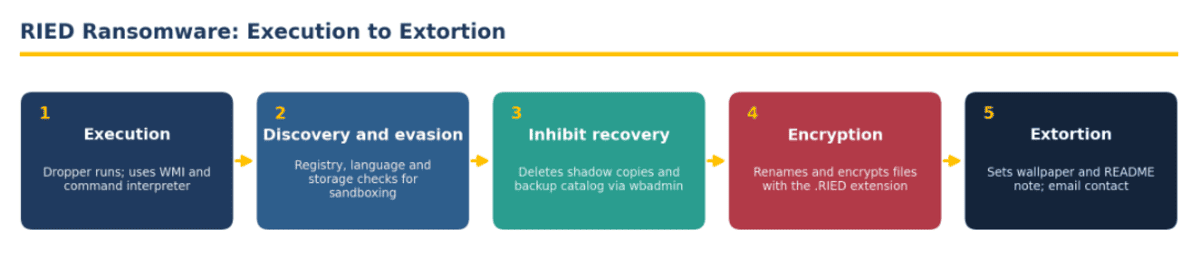
RIED ransomware flow from execution to extortion.
Observed evidence
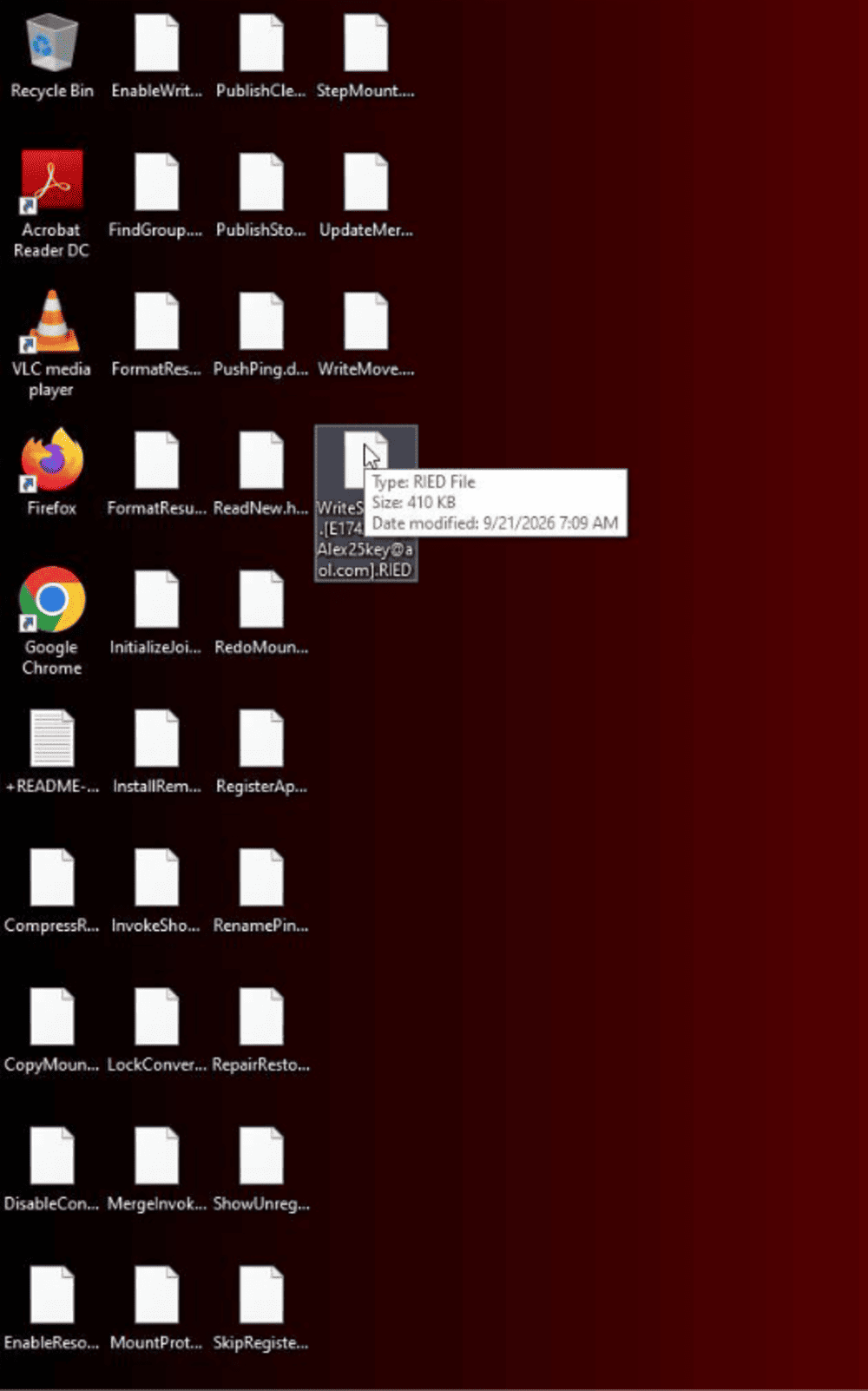
An encrypted file showing the .RIED extension and the operator email.
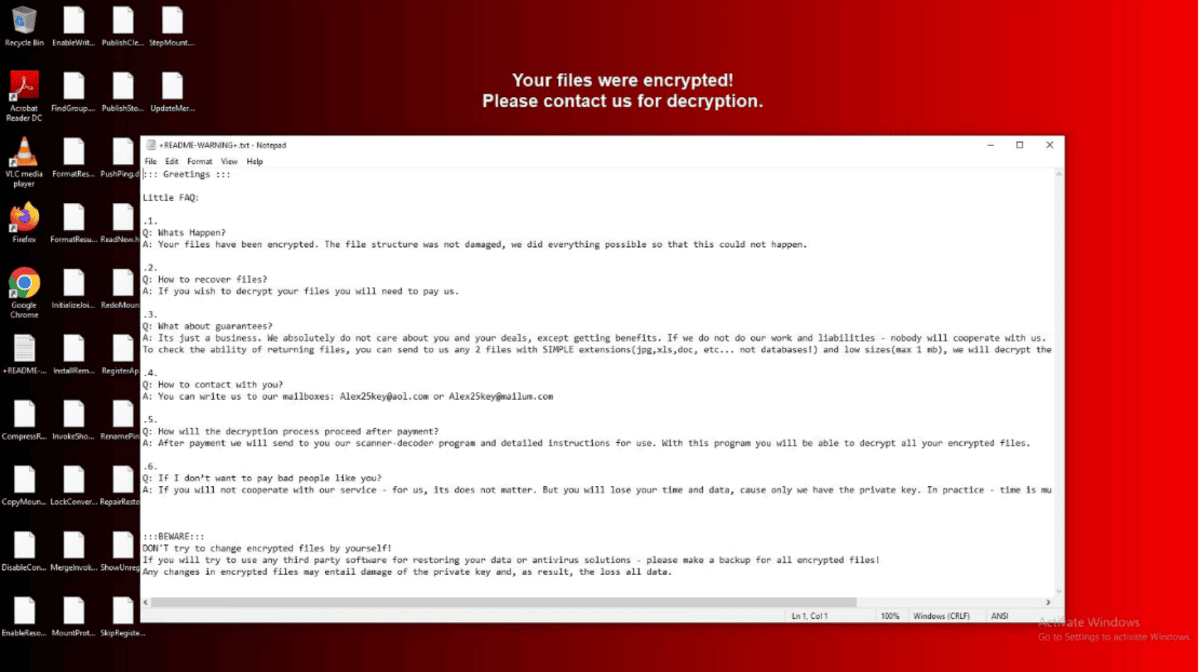
The +README-WARNING+.txt ransom note over the RIED wallpaper.
Behavioural signatures
Sandbox analysis records the following behaviours. RIED deletes shadow copies and the backup catalog (using wbadmin.exe and the Volume Shadow Copy service COM API) to inhibit recovery, renames thousands of files with the added extension, harvests credentials from the Windows Credential Manager and web browsers, and sets the desktop wallpaper through the registry. It performs extensive sandbox and environment discovery (SCSI and processor registry keys, system language and storage enumeration), drops components into the System32 and Program Files directories, contacts a third party web service commonly abused for command and control, and uses the Task Scheduler COM API for persistence.
MITRE ATT&CK techniques
| Tactic | ID | Technique | Observed procedure |
|---|---|---|---|
| Execution | T1059 | Command and Scripting Interpreter | Executes commands via the interpreter and WMI |
| Persistence | T1053.005 | Scheduled Task/Job: Scheduled Task | Task Scheduler COM API for persistence |
| Defense Evasion | T1070.004 | Indicator Removal: File Deletion | Deletes the backup catalog with wbadmin.exe |
| Credential Access | T1555 | Credentials from Password Stores | Reads browser stores and Windows Credential Manager |
| Discovery | T1082 | System Information Discovery | Registry, language and storage enumeration (anti sandbox) |
| Command and Control | T1102 | Web Service | Abuses a third party web service for C2 |
| Impact | T1490 | Inhibit System Recovery | Deletes shadow copies and the backup catalog |
| Impact | T1486 | Data Encrypted for Impact | Encrypts and renames files with the .RIED extension |
Indicators of compromise
| Indicator | Type | Context |
|---|---|---|
| bee78f1ea8788e5a813 b11ac89abe72833ec6e1df677d 200df92a37a6c4912ab | SHA256 | Ransomware file |
| [<victim-ID>]-[<email>].RIED | File extension | Appended to encrypted files |
| +README-WARNING+.txt | Filename | Ransom note |
| [email protected] | Operator negotiation contact | |
| [email protected] | Operator negotiation contact | |
| wbadmin.exe (backup catalog deletion) | Behaviour | Inhibit system recovery |
Recommendations
- Maintain offline or immutable backups and test restoration, since RIED deletes shadow copies and the backup catalog.
- Alert on wbadmin.exe and vssadmin backup and shadow copy deletion, and on Task Scheduler persistence created outside change control.
- Restrict execution from user writable directories and monitor for mass file rename activity indicative of encryption.
- Do not pay; preserve the note and a sample encrypted file, and engage incident response and the relevant national CERT.
5. Malware and RATs
RUSTYSHADE
RUSTYSHADE is a new 64 bit Windows backdoor written in Rust and introduced in Operation RapidRust (see Threat Actor Activity). Its defining feature is the abuse of attacker controlled private GitHub repositories for command and control over the GitHub REST API, with communications encrypted using AES-256-GCM and authenticated by a hardcoded GitHub personal access token. The operator creates a separate repository per victim and tracks exfiltrated files locally in %APPDATA%\SmartUploader\uploaded_files.json to support incremental theft. RUSTYSHADE shares functional overlap with the earlier Golang implant GITSHELLPAD, but adds encrypted C2, new commands and the shift to Rust.
| Attribute | Detail |
|---|---|
| Type | Backdoor / remote access trojan (Rust, 64 bit Windows) |
| Operator | Transparent Tribe (APT36) |
| C2 channel | Private GitHub repositories via the GitHub REST API |
| Encryption | AES-256-GCM for C2 traffic |
| Capabilities | Screenshots, webcam capture, file operations, background command execution, directory listing |
| Delivery | PowerShell retrieval of a Backblaze hosted ZIP; USB propagation via RUSTYMOVE |
| Companion tools | RUSTYMOVE (USB spread), PSNATCH and BASHNATCH (file stealers) |
Deployment observed in the field used a PowerShell command to download and stage the payload from a Backblaze URL. The companion utility RUSTYMOVE watches for removable media every two seconds and copies a ZIP containing RUSTYSHADE plus a shortcut disguised as a PDF to the drive root, enabling spread to air gapped hosts.
MITRE ATT&CK techniques
| Tactic | ID | Technique | Observed procedure |
|---|---|---|---|
| Execution | T1059.001 | Command and Scripting Interpreter: PowerShell | PowerShell downloads and stages the payload |
| Command and Control | T1102.002 | Web Service: Bidirectional Communication | Private GitHub repositories for C2 (AES-256-GCM) |
| Command and Control | T1105 | Ingress Tool Transfer | Retrieves payloads from Backblaze hosted archives |
| Collection | T1113 | Screen Capture | Captures screenshots on command |
| Lateral Movement | T1091 | Replication Through Removable Media | RUSTYMOVE copies the payload to USB devices |
| Exfiltration | T1567 | Exfiltration Over Web Service | PSNATCH and BASHNATCH exfiltrate stolen files |
Recommendations
- Monitor for GitHub REST API traffic from hosts with no development role, and for hardcoded token use against private repositories.
- Alert on PowerShell downloads from cloud storage such as Backblaze, and restrict outbound access to only required services.
- Enforce removable media controls and application allow listing on segmented and air gapped networks.
6. Vulnerability Intelligence
CVE-2026-76460: Cisco ISE Authentication Bypass
CVE-2026-76460 is a critical authentication bypass in an API of Cisco Identity Services Engine (ISE) and the Cisco ISE Passive Identity Connector (ISE-PIC). It carries the maximum CVSS 3.1 base score of 10.0. The flaw stems from insufficient authentication control on an API endpoint: an unauthenticated, remote attacker can send a crafted request to bypass the web based management interface, and Cisco warns that successful exploitation can lead to command execution with root privileges. That level of access allows an attacker to control the appliance and to hide or remove evidence of compromise.
| Field | Detail |
|---|---|
| CVE ID | CVE-2026-76460 |
| Affected product | Cisco ISE and Cisco ISE-PIC (regardless of configuration) |
| Severity | Critical (CVSS 3.1 base score 10.0) |
| Vulnerability type | Authentication bypass (insufficient authentication control on an API) |
| Impact | Unauthenticated access; possible root command execution |
| Exploitation status | Active exploitation confirmed by Cisco |
| CISA KEV | Added 16 September 2026 (federal remediation due 19 September 2026) |
| Advisory | cisco-sa-ISE-ABP-VNSW7Tn5 |
Cisco ISE 3.0 has reached end of software maintenance and must be migrated to a supported, fixed release. In distributed deployments every node must be patched, since updating only the primary node does not protect the environment. Cisco advises reviewing access.log on each node for suspicious usernames as an indicator of attempted exploitation.
Recommendations
- Upgrade all Cisco ISE and ISE-PIC nodes to a fixed release immediately, treating internet exposed instances as the top priority.
- Review access.log on every node for anomalous usernames, and cross check network and firewall logs held off the device, since an attacker may delete local logs.
- Where exploitation is suspected, re image the affected nodes and restore configuration from a trusted backup.
- Assess third party and managed service exposure, as providers may operate affected ISE instances on your behalf.
7. Dark Web and Underground Activity
Terminal 404 versus aim.gov.my
On 20 September 2026 an actor using the name Terminal 404 published a post claiming to have exploited the Malaysian government domain aim.gov.my, stating that all of its subdomains were compromised and signing off “Hacked by Terminal 404”. The post was observed on a surface web channel and includes screenshots of an automated host checking tool run against regional SAFIS subdomains. The claim is reproduced here as reported and is not independently verified at the time of writing.
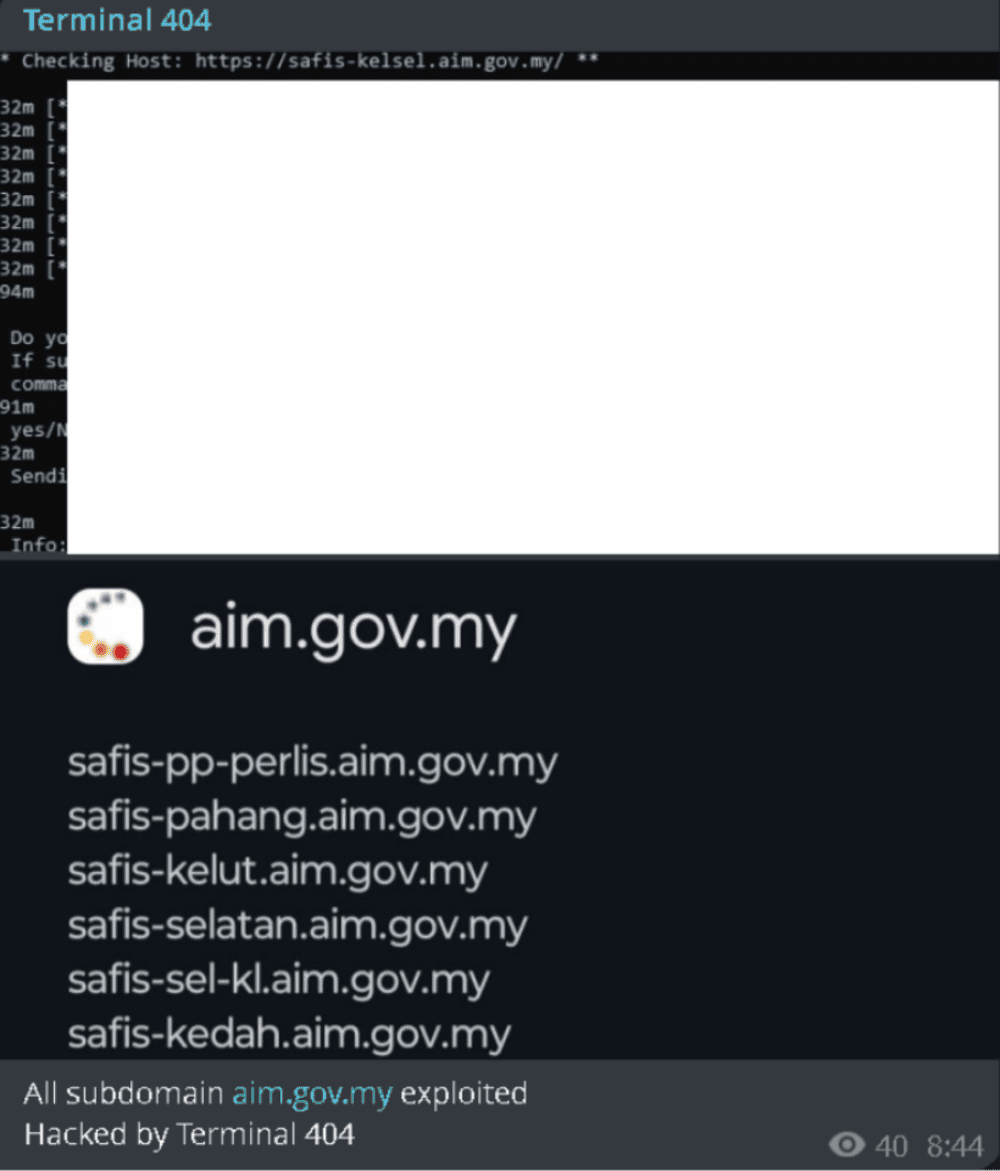
The Terminal 404 post claiming exploitation of aim.gov.my subdomains (source: surface web).
Claimed incident
| Field | Detail |
|---|---|
| Victim domain | aim.gov.my (Malaysian government) |
| Claimed impact | Exploitation of all subdomains; regional SAFIS hosts named |
| Threat actor | Terminal 404 |
| Date observed | 20 September 2026 |
| Source | Surface web channel |
| Verification | Unverified actor claim |
Subdomains named in the post include: safis-kelsel, safis-pp-perlis, safis-pahang, safis-kelut, safis-selatan, safis-sel-kl and safis-kedah, all under aim.gov.my.
Actor profile (as tracked)
| Field | Detail |
|---|---|
| Actor | Terminal 404 |
| First and last presence | 20 September 2026 (both) |
| Total publications | 2 |
| Other publication | babacal.ma.gov.br (Brazil government) |
| Assessed TTPs | Reconnaissance, Collection |
| Affected surface | Government (assessed critical) |
| Threat score | 34/100 (baseline monitored exposure) |
| Tracked country | Brazil |
Analytic note
Two points warrant caution. First, the tracked country for this actor is recorded as Brazil, which derives from its other publication (babacal.ma.gov.br); the aim.gov.my target is a Malaysian government domain, so the country field should not be read as applying to this claim. Second, despite being described as a recurring actor, Terminal 404 shows only two publications, both on the same day, and a low baseline threat score, which is consistent with a newly observed rather than established actor. As with similar cases, actors may recycle old or outdated data, and national authorities have previously found referenced servers inactive. This entry is provided for situational awareness and monitoring and should not be treated as a confirmed breach without corroborating evidence such as validated samples or an official disclosure.
8. Key Takeaways
- Patch Cisco ISE now. CVE-2026-76460 is a CVSS 10.0 authentication bypass under active exploitation; every node must be updated and reviewed for the documented log indicators.
- Protect and test recovery. RIED destroys shadow copies and the backup catalog, so offline or immutable, tested backups are the decisive control against Makop family ransomware.
- Harden against APT36. Operation RapidRust brings a Rust backdoor with GitHub based C2 and USB propagation; restrict removable media, monitor cloud service abuse, and watch for typosquatted domains.
- Watch identity and cloud abuse. Both RUSTYSHADE and the wider week show adversaries hiding in trusted platforms (GitHub, Backblaze) and targeting access infrastructure; monitor for anomalous use of these services.
- Treat underground claims as leads, not facts. The Terminal 404 claim against a government domain is unverified; corroborate before acting or reporting.
