
 HQ/EMEAFind out how we can help your business

In This Issue
01 Threat Landscape
The week’s breach reporting centred on financial and government identity data. Four South Korean banks confirmed breaches between 30 September and 2 October, and press reports put as many as seven lenders in the same wave. On 5 October Denmark disclosed that attackers had used a private company’s lookup rights to pull records on 8.8 million people from its national population register. On 6 October the FBI and US Secret Service warned that FortiBleed, a credential campaign against Fortinet firewalls and VPN gateways, is still active and is feeding ransomware.
We tracked 20 incidents, listed under Breached Organizations below. Seven have no disclosed entry path. Five are the South Korean lenders, reached through exposed services by a method not yet confirmed. Four involved a software flaw that was exploited or left unpatched. Three came from misused trusted access or social engineering, and one was an exposure rather than an intrusion. Bitget remains the largest loss by value at about $387.5 million. Denmark’s register is the largest new incident by number of people, and Texas regulator data put the 2025 Oracle Health breach at nearly 20 million.
What changed this week
- The FBI narrowed the entry path for its jobs portal breach. On 5 October its cyber chief said a contractor failed to install a patch on a platform managed by a third party, and the contractor was removed. That is hard to reconcile with the attackers’ claim of an undocumented zero day.
- FortiBleed is still active. The FBI and Secret Service say victims are being locked out of Fortinet firewalls and that access has been passed to ransomware affiliates, including affiliates of INC/Lynx and Payload. One threat intelligence vendor counts more than 86,000 compromised devices in 194 countries.
- A Russian state linked cluster resumed its hotel wireless campaign. Vendor reporting attributes CaptiveCrunch to Storm-2945, a sub cluster of Midnight Blizzard (APT29). It restarted on 29 September with new redirect domains and a Rust version of its CornFlake implant. The attribution is a vendor assessment, not a government finding.
- A new ransomware strain, Calipso, was documented on 5 October. It encrypts files with the .calipso extension, removes recovery options, clears event logs and negotiates only through the Session messenger. Its note makes no data theft claim.
- XWorm is still being delivered through several chains, including a new loader, 2CLoader, that also delivers two stealers. XWorm is sold to many operators, so no single actor is behind it.
- Vulnerabilities: GitLab CVE-2026-85706 (CVSS 10.0) is exploited and on the CISA catalog. GitLab AI Gateway CVE-2026-90970 (CVSS 9.9) and Chrome WebGL CVE-2026-103628 (CVSS 9.6) are critical with no confirmed exploitation. Google released Chrome 155 on 6 October with 247 fixes. CISA added Citrix NetScaler CVE-2026-88779 to its catalog on 4 October, with a federal deadline of 7 October.
- Law enforcement had a better week. Jordanian authorities detained a long standing ShinyHunters member on 3 October, and a 16 year old accused of leading KillSec ransomware was arrested after an international operation took down its infrastructure.
Confidence in this assessment
Most of this issue rests on vendor and government statements and carries high confidence. Where it does not, the text says so. The main open points are:
- South Korean banks: the breaches are confirmed. Whether AI tools were used is an expert opinion in the press and is not confirmed.
- FBI portal: the FBI says a contractor missed a patch. Which flaw it was has not been confirmed, and the contractor is named only in press reports citing unnamed sources.
- CaptiveCrunch: the link to Midnight Blizzard is a vendor assessment of a sub cluster, and the tooling and victims differ from that group’s usual pattern.
- Calipso: no victims, operator or data theft have been identified, so any family or actor label is premature.
- FortiBleed: the 86,644 figure counts devices confirmed compromised. Another report cites more than 400,000 devices targeted, which is a different measure.
- DIVD: the account of an AI agent carrying out the intrusion comes from DIVD itself, and the software vendor has not yet verified the second flaw.
How the breaches happened
The 20 incidents fall into five groups, defined by the failure that let each one begin. Several share the same weak point: something the business owned or trusted and did not treat as exposed.
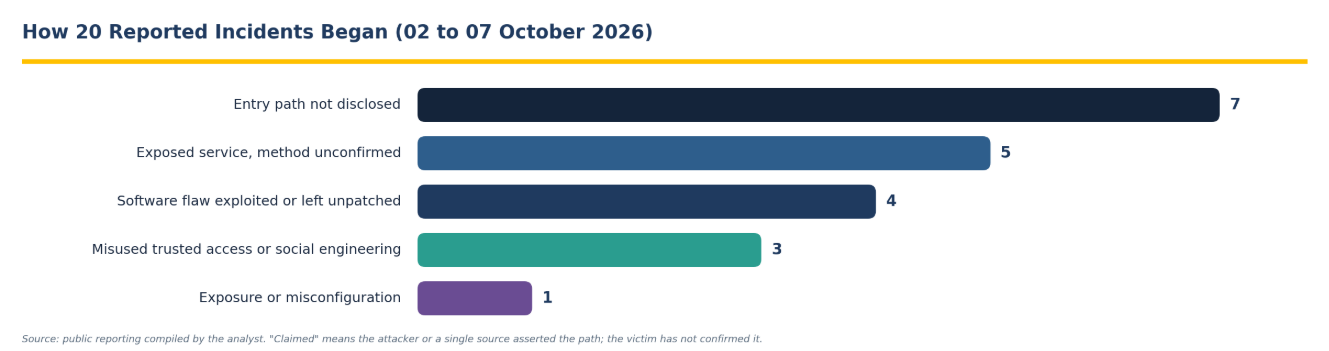
Initial access across 20 incidents first reported or updated between 02 and 07 October 2026.
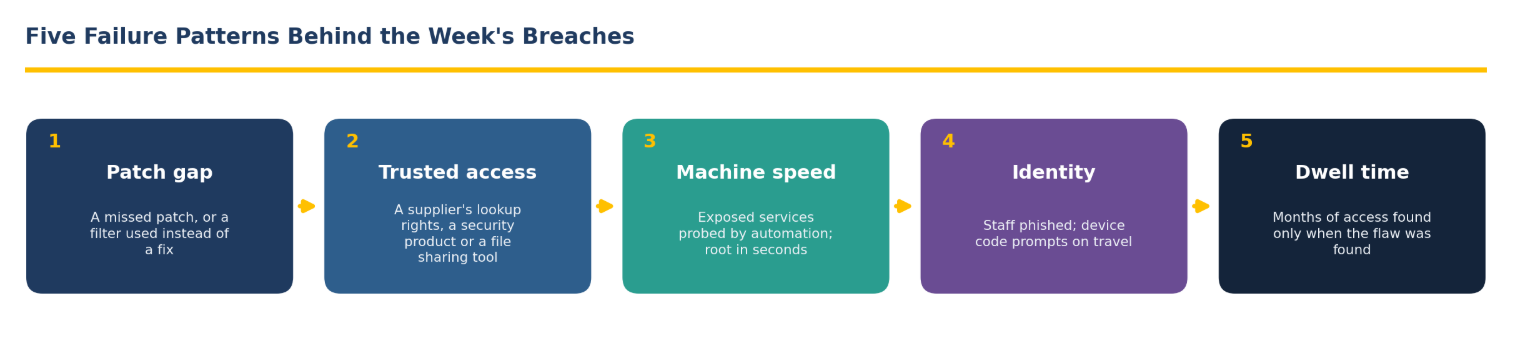
Five failure patterns behind the week’s breaches.
A missed patch, or a filter in place of one
The FBI jobs portal breach is the clearest case. The attackers said they used a new zero day. On 5 October the bureau’s cyber chief said its review found that a contractor had not installed a patch issued for a platform managed by a third party. Press reports citing unnamed sources identify the platform as PeopleSoft. That fits what we saw last week: organizations that blocked the PeopleSoft management path with a firewall rule were bypassed when one character of the path was encoded, writing %50 in place of P. GitLab CVE-2026-85706 works the same way. Encoding the letter c in the word commits (%63ommits) makes GitLab’s front proxy miss the route while the application still serves it. In both cases the filter and the application decode the same path differently.
Trusted access that was misused
Denmark’s Central Person Register was breached through a private company’s lawful right to search it. Attackers ran automated lookups for about ten days in September and obtained names, addresses and identity numbers for about 8.8 million people, roughly 80 percent of the register. An administrator noticed the spike on 2 October. How the company’s access was taken over has not been disclosed. ASOS confirmed on 7 October that attackers compromised a third party communication platform and sent rogue notifications to its users, and a group calling itself Xuanye Group claimed the attack on a new Telegram channel. Bitget reports that a flaw in an unnamed third party security product gave attackers high level internal credentials. The Defense Manpower Data Center left unencrypted personnel records exposed through a file sharing flaw for nearly nine months, and has not named the product.
Exposed services probed at machine speed
Four South Korean banks confirmed breaches within about four days. At Shinhan Bank the attackers reached a service used by loan recruiters, and Korean press reports the same attacker address in incidents at up to seven lenders. Press reports citing experts say AI agents probably probed for vulnerabilities. That is unconfirmed. FortiBleed shows the same speed on a larger scale, with automated credential attacks against exposed firewall and VPN administration. The Dutch Institute for Vulnerability Disclosure says an autonomous AI agent chained two Zammad zero days and reached root in seconds on 21 September. At Bitget, about $361 million left in roughly 70 minutes on 24 September, after two small test transfers fell below the exchange’s risk threshold. Detection and containment measured in hours cannot keep up with steps measured in seconds or minutes.
Staff and identities
Clover Health told the SEC that social engineering compromised three non managerial employee accounts. The intrusion that affected Clover and AngMar Management Services happened in July and became public in October. The Midnight Blizzard sub cluster does not need a password at all. It persuades a traveller to enter a device code on a genuine Microsoft sign in page, which authorizes the attacker’s session.
Months of undetected access
The Defense Manpower Data Center found the intrusion only when it found the flaw, so the access had not triggered an alert. The Danish register’s ten days of automated lookups were caught by a person noticing a spike, not by a control. Advantest began notifying people on 7 October of a ransomware attack in February in which personal, medical and financial data was stolen. Responders report Citrix NetScaler compromises dating to early September, before the vendor advisory on 27 September. Where records sit unencrypted in a shared system, a long dwell time turns directly into mass exposure.
Questions to ask your own team
- Which suppliers and partners can query your identity data, who monitors their volume, and how would you know if one of their accounts were taken over?
- Where a firewall or proxy rule is the only mitigation, has anyone tested an encoded or mixed case version of the path? Are patches on supplier managed platforms verified, or assumed?
- Are firewall, VPN and other management interfaces reachable from the internet, and are the accounts on them protected by multifactor authentication?
- Could you detect and contain probing, privilege changes and bulk data reads within minutes, including on partner and broker facing services?
Breached organizations
Organizations are named as in public reporting. The list covers incidents first reported or materially updated between 02 and 07 October 2026. Attacker claims are marked as claims, and counts of people affected are those reported by the organization unless marked otherwise. Check each name against your own suppliers and their suppliers.
| Organization | Sector, country and date | How it happened | Scale and status | Central Person Register (CPR) | Government population register, Denmark. Detected 2 Oct, disclosed 5 Oct | Attackers misused a private company’s legitimate lookup access; automated lookups for about 10 days in September. How the company was compromised is not disclosed | About 8.8 million people (about 80 percent of the register): names, addresses, CPR numbers. Company access cut; police investigating; no suspect named |
|---|---|---|---|
| Shinhan Bank | Banking, South Korea. Disclosed 30 Sep to 2 Oct | Unauthorized external access to a service tied to its loan recruiter network; method not confirmed; AI tools suspected by press | About 25,000 customers: names, phone numbers, annual income, borrowing limits. Regulator on site |
| KB Kookmin Bank | Banking, South Korea. About 2 Oct | Unauthorized external intrusion; method not confirmed | 119 customers |
| Hana Bank | Banking, South Korea. About 2 Oct | Unauthorized external intrusion; method not confirmed | 89 customers |
| BNK Busan Bank | Banking, South Korea. By 2 Oct | Unauthorized external intrusion; method not confirmed | 11 customers |
| Yegaram Savings Bank and Hyundai Capital | Savings and consumer finance, South Korea. By 4 Oct | Reported as part of the same wave from a shared attacker address; single source | One source reports about 40,000 people at Yegaram. Low confidence |
| FBI (FBIjobs.gov portal) | US government. Claimed 22 Sep, FBI statement 5 Oct | FBI says a contractor failed to install a patch on a third party managed platform; press sources identify PeopleSoft. Attackers claim a zero day | Staff and applicant data claimed, including medical files. Contractor removed. Scope unconfirmed |
| Defense Manpower Data Center | US defense personnel records. Letters 24 Sep, wide coverage to 5 Oct | Flaw in a file sharing system exposed a server of unencrypted records; access from October 2025 to 16 July 2026. Product and actor not named | 2.76 million living and 294,000 deceased individuals. No misuse indicated |
| Bitget | Cryptocurrency exchange, global. Detected 24 Sep, withdrawals resuming to 2 Oct | Vulnerability in an unnamed third party security product gave high level internal credentials; fraudulent withdrawals followed | About $387.5 million. Lazarus Group suspected, not confirmed. Full incident report still pending |
| Dutch Institute for Vulnerability Disclosure (DIVD) | Security research non profit, Netherlands. Attack 21 Sep, analysis published to 3 Oct | Two Zammad zero days chained by what DIVD describes as an autonomous AI agent; root access in seconds | Volunteer data taken; segmentation limited the spread. Vendor has not yet verified the second flaw |
| ASOS | Online retail, UK. Confirmed 7 Oct | Attackers compromised a third party communication platform and sent rogue notifications to users. A group calling itself Xuanye Group claimed it on Telegram. A possible link to a data platform flaw is speculation | Names and contact details may be exposed. ASOS says payment card data and passwords were not affected |
| Advantest | Semiconductor test equipment, Japan. Notified 7 Oct | February 2026 ransomware attack; entry not disclosed; no group has claimed it | Names, dates of birth, SSNs, passport and licence numbers, medical and financial data. Over 500 California residents; total not disclosed |
| Oracle Health | Healthcare technology, US. Regulator figures 2 Oct | 2025 breach of the company’s healthcare unit, after 22 January; entry not covered in the reporting reviewed | Nearly 20 million people (about 3 million in Texas): SSNs, addresses, medical information |
| Clover Health | Health insurance, US. Intrusion July, public 5 Oct | Social engineering of three non managerial employee accounts, per an SEC filing | Unauthorized access to servers; patient data confirmed affected |
| AngMar Management Services | Healthcare management, US. Intrusion July, public 5 Oct | Intrusion followed by ransomware and data theft (double extortion); entry not disclosed | About 700 GB reported stolen. With Clover Health, about 250,000 records reported in total |
| ATB-Market | Grocery retail, Ukraine. 5 Oct | Cyberattack with online services down and a ransom demand shown on the company website; entry not disclosed | A $400,000 demand and a threat to leak data; single feed source |
| Genesis Credit Management | Financial services, US. 3 Oct | Listed on a ransomware leak site; entry path unknown | Claim by the Qilin group only. Unconfirmed |
| Fakturownia | Invoicing platform, Poland. Reported by 4 Oct | Attackers stole a large part of the master database; method not disclosed | Invoices, payment details and API keys. Platform serves over 500,000 businesses |
| Hotel guest platform (name not published) | Hospitality software, one country. Reported 4 Oct | Publicly exposed database of documents; single source | Over 32 million records with passport data, including over 600,000 UK passport holders |
| Oil tanker (operator not named) | Maritime, US bound. Confirmed 2 Oct | Propulsion system compromised; method and actor not disclosed | Confirmed by US authorities. Manual backup controls exist |
Notes: The Yegaram and Hyundai Capital entry and the hotel platform rest on single sources, and the Genesis Credit Management entry is an attacker claim. The Oracle Health figure comes from regulator data reported by the press and relates to a 2025 incident. Counts for the South Korean wave vary by source. The confirmed bank figures above total about 25,200 people. One aggregator reports about 66,000 people and 2,200 corporate records across seven institutions, which we have not adopted.
02 Emerging Threats and Campaigns
South Korean lender breach wave
Between 30 September and 2 October, Shinhan Bank, KB Kookmin Bank, Hana Bank and BNK Busan Bank each disclosed that an unauthorized external party had accessed customer data. Woori Bank and NongHyup Bank said they blocked intrusion attempts. At Shinhan the exposed data included names, phone numbers, annual income and borrowing limits for about 25,000 customers, taken from a service used by loan recruiters. Korean press reports the same attacker address in incidents at up to seven financial firms, which points to one operator working through a list of targets. On 2 October South Korea’s Financial Services Commission ordered all banks, card issuers and savings institutions to inspect their externally exposed IT systems, and the Financial Supervisory Service began an emergency inspection at Shinhan. The president is reported to have ordered an investigation on 4 October.
| Field | Detail |
|---|---|
| Victims | Shinhan Bank (about 25,000), KB Kookmin Bank (119), Hana Bank (89), BNK Busan Bank (11); Yegaram Savings Bank and Hyundai Capital reported by one source |
| Dates | Disclosures 30 September to 2 October 2026; regulator order 2 October |
| Entry | Unauthorized external access to externally exposed services; Shinhan service tied to a loan recruiter network; method not confirmed |
| Data exposed | Names, phone numbers, annual income and borrowing limits at Shinhan; smaller sets elsewhere |
| AI link | Press reports citing experts say AI agents probably probed for flaws; unconfirmed |
| Attribution | None. Reported shared attacker address across several firms |
The AI link is an expert opinion in the press, not a finding by the banks or investigators. One report names a specific open source tool, but it comes from a weak source and we have not repeated it. The shared attacker address is also reported second hand. It points to common infrastructure, not an identified actor. Income and borrowing limit data are well suited to targeted lending fraud, so the risk to customers continues after the breach is closed. For lenders the lesson is where the attackers got in: services built for brokers, recruiters and partners, exposed to the internet.
Recommendations
- Inventory every internet facing service used by brokers, agents, recruiters and other partners, and apply the same authentication, rate limiting and monitoring as for customer channels.
- Alert on automated enumeration and bulk reads from partner services, and test whether anomalous volume would page a person within minutes.
- Brief fraud teams on the data types exposed, and watch for lending, income and borrowing limit themed scams against affected customers.
- Share indicators with sector bodies, since the same infrastructure was reported against several institutions.
AI agent breach of DIVD through Zammad zero days
On 21 September 2026 the Dutch Institute for Vulnerability Disclosure was breached through its Zammad helpdesk system. DIVD describes the attack as agentic: an AI agent chose its own next steps, hijacked a session, ran code as the Zammad service account and reached root within seconds, then read other services and exfiltrated data. DIVD noticed the next day because the activity was loud, and network segmentation stopped the agent going further. DIVD identified two previously unknown flaws, CVE-2026-102489 and CVE-2026-102490, published them on 30 September, and a detection analysis followed on 3 October. Zammad versions 6.3.0 to 6.5.4 are affected for the full chain, and DIVD advises upgrading to version 7 or taking the system offline.
The agentic account rests on DIVD’s own statements and the traces it recovered. The software vendor had not published an advisory by 1 October and said it could not verify CVE-2026-102490 without technical detail. We treat the AI description as credible but unconfirmed, and the flaws as real until the vendor says otherwise. Segment helpdesk systems from identity, file and database services, and alert on rapid privilege changes from a single account.
Citrix NetScaler: update since last issue
Last week’s issue covered Citrix NetScaler CVE-2026-88771 and CVE-2026-88772 as zero days. Since then, incident responders report dozens of compromises dating to early September, and CISA advises organizations to assume compromise, preserve forensic evidence and then patch. On 4 October CISA added CVE-2026-88779, a memory buffer flaw that can cause denial of service, to its catalog with a federal deadline of 7 October. Any appliance patched only after 27 September should be treated as possibly compromised, because patching does not remove web shells or stolen credentials left by earlier access.
03 Threat Actor Activity
Midnight Blizzard (APT29, Cozy Bear)
Midnight Blizzard is a Russian state sponsored espionage group attributed by the United States and United Kingdom governments to the Foreign Intelligence Service (SVR). It has operated since at least 2008 and is linked to the SolarWinds supply chain compromise of 2020 and to the 2024 compromise of a major software vendor’s corporate email. Its objective is long running intelligence collection against governments, diplomatic bodies, non governmental organizations and IT service providers, and it has favoured stolen identities, OAuth abuse and cloud access over noisy malware.
| Attribute | Detail |
|---|---|
| Aliases | APT29, Cozy Bear, The Dukes, NOBELIUM, UNC2452, YTTRIUM, Dark Halo, StellarParticle |
| Assessed origin | Russia |
| Assessed sponsor | Foreign Intelligence Service (SVR), attributed by US and UK governments |
| Motivation | Intelligence collection in support of Russian foreign policy |
| Historic targets | Governments, diplomatic entities, non governmental organizations, IT service providers, think tanks |
| Current campaign | CaptiveCrunch, run by the Storm-2945 sub cluster; observed since May 2026 and resumed 29 September 2026 |
| Observed victims | Travelling employees across financial services, professional services, legal, health care, energy and retail |
| Tooling | CornFlake (Go remote access trojan, new Rust variant), ChocoShell (PowerShell stealer), FruitStone (operator panel), ClickFix lures, device code phishing |
CaptiveCrunch resumes
Vendor reporting updated on 5 October 2026 says Storm-2945 resumed the CaptiveCrunch campaign on 29 September. The cluster manipulates DNS and HTTP traffic on guest networks served by captive portals, the sign in pages shown on hotel and conference wireless. When a device runs its automatic connectivity check, the user is redirected to fake browser or operating system updates, to ClickFix pages that tell the user to paste commands, or to a genuine Microsoft sign in page where the user is asked to enter an attacker supplied device code, which authorizes the attacker’s session. Equipment and management systems are common across affected sites, and responders now suggest that several hospitality managed service providers are involved, which would explain how quickly the cluster redeployed. The link to Midnight Blizzard is a vendor assessment of a sub cluster, based on overlaps in device code phishing, email theft through Microsoft Graph and victims, and no government has attributed the campaign. The fit is imperfect: it targets travelling staff of any sector rather than diplomats and relies on broad ClickFix lures and AI assisted code, so a headline that says simply APT29 may overstate what is known. Cozy Bear and Midnight Blizzard are different vendors’ names for overlapping clusters, and how the captive portals were first compromised is still unexplained.
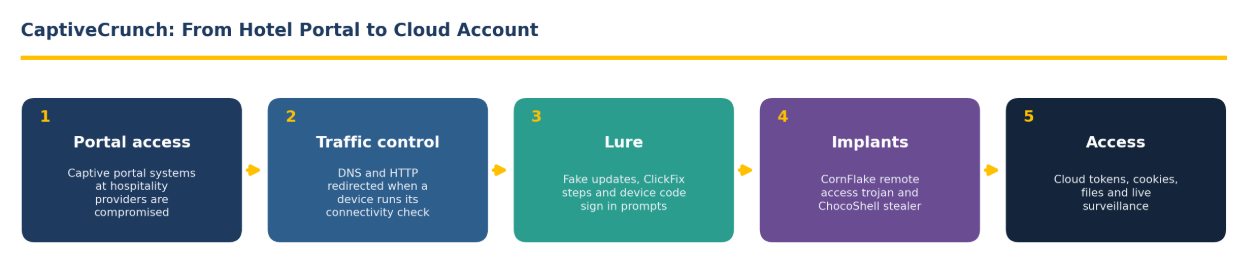
CaptiveCrunch attack flow from hospitality portal to cloud account (after vendor reporting).
Two implants stand out. CornFlake is a Go remote access trojan that copies itself to the user profile as svchost32.exe, registers a service called Cloud Sync Service, and restores its own persistence if removed. It provides keylogging, clipboard capture, screenshots, microphone and webcam capture, browser credential theft, file collection, USB monitoring and a remote shell, with encrypted command and control. ChocoShell is a PowerShell stealer that runs in memory, disables AMSI, bypasses User Account Control and steals browser cookies, saved passwords, Microsoft 365 single sign on tokens and stored wireless passwords. The resumed activity adds a Rust variant of CornFlake whose characteristics are consistent with AI enabled development, and the original ChocoShell script carries developer comments that suggest AI assisted authorship.
| Indicator | Type | Context |
|---|---|---|
| cdn-gstat[.]com | Domain | CaptiveCrunch redirect, first seen 30 September 2026 |
| sslcdnhost[.]com | Domain | CaptiveCrunch redirect, first seen 30 September 2026 |
| network-privacy[.]com | Domain | CaptiveCrunch redirect, first seen 1 October 2026 |
| 154.29.75[.]245 | IPv4 | CaptiveCrunch infrastructure, first seen 29 September 2026 |
| 149.3.170[.]186 | IPv4 | Device code phishing infrastructure, first seen 1 October 2026 |
| 213.145.86[.]112 | IPv4 | ChocoShell command and control |
| /t/pixel.gif?m= | URI path | ChocoShell beacon disguised as a tracking pixel |
| %APPDATA%\svchost32\svchost32.exe | File path | CornFlake copy; service named svchost32, display name Cloud Sync Service |
| 918fa52ae45ed60ba7cc8bdc99c3cbe9ab92e0375ec31fc05d0d4513be11c593 | SHA256 | CornFlake |
| be99857449d2856dd5a84e21c8a3d5e0e01456adb44062ddec5a6b4970d8d42c | SHA256 | ChocoShell |
Recommendations
- Block the OAuth device code flow with conditional access wherever it is not required, and require phishing resistant multifactor authentication for staff who travel.
- Tell travelling staff to treat hotel, conference and airport wireless as untrusted, prefer cellular or eSIM connections or managed travel routers, and never install software or enter a device code offered through a captive portal.
- Hunt for the svchost32 service, the Cloud Sync Service display name, the listed domains and addresses, and file creation within two minutes of a connectivity check.
- Review sign ins using device code authentication, revoke refresh tokens for suspected victims and review recent OAuth application consents.
- Teach staff to treat any instruction to paste a command into Windows Terminal or the Run box as hostile, whatever page it appears on.
04 Ransomware and Data Leaks
Calipso Ransomware (new, family unresolved)
Calipso is a 64 bit Windows ransomware first publicly described on 5 October 2026 after a sample was submitted to a public scanning service. It encrypts files and appends the .calipso extension, drops a text note named recovery.txt, and replaces the desktop wallpaper with a message reading that all data is locked and that recovery.txt must be opened. The wallpaper also tells the victim not to rename or delete the note and not to contact law enforcement.
The note is unusual in what it leaves out. It gives no email address, no Tor site, no payment amount and no cryptocurrency wallet. Contact is through the Session messenger only, using a Session ID and a Case ID that the victim must paste into the first message. The operators offer to decrypt one small file as proof, say that only they hold the private key, and warn that antivirus or third party recovery tools may damage the key. An offer expiry is printed in the note. It makes no claim that data was stolen and refers to no leak site. No victims, operator or delivery method have been identified, and the sandbox shows no exfiltration. The note’s wording closely follows older REvil era and Sugar ransomware notes. That is template reuse: Calipso’s Session only contact and lack of a leak site do not fit REvil’s practice. Antivirus engines disagree on a family name, and one heuristic label from the Chaos family should not be read as attribution. The name is also shared with an unrelated 2016 Crysis variant, so check searches carefully.
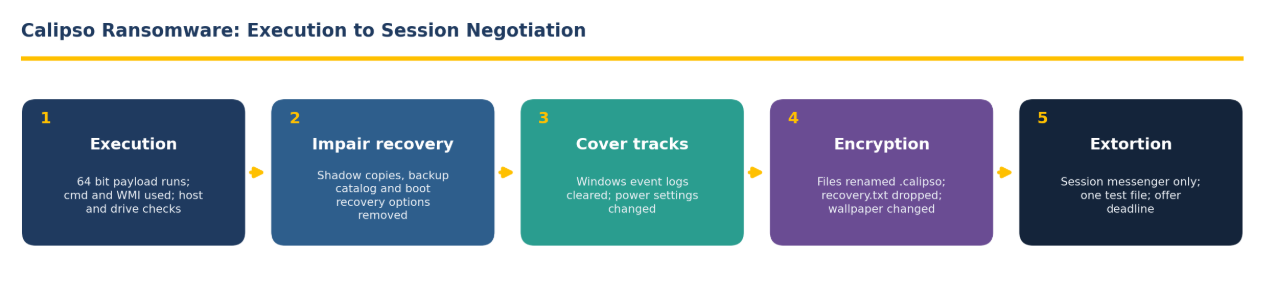
Calipso ransomware flow from execution to Session negotiation (assembled from sandbox behaviour signatures).
Observed evidence
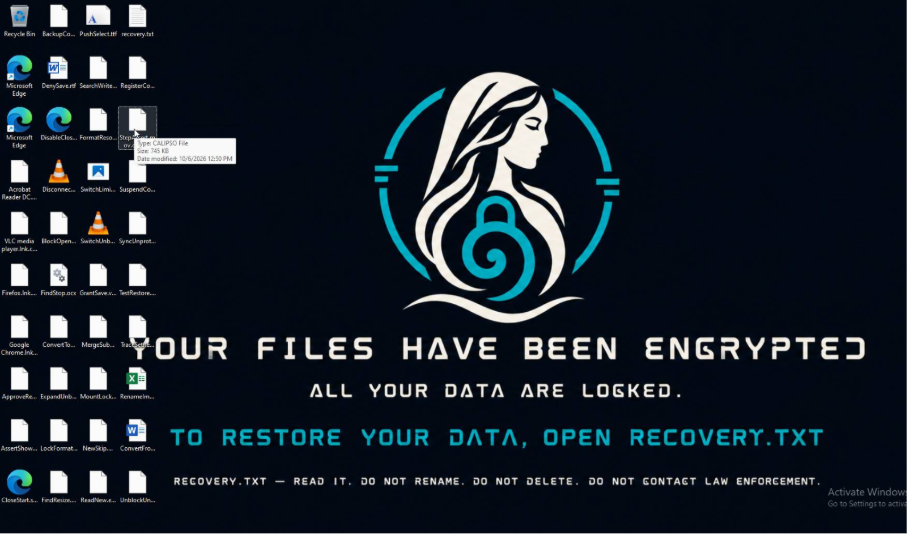
Sandbox desktop after execution: .calipso file type (745 KB encrypted file in the tooltip), recovery.txt and the replacement wallpaper.
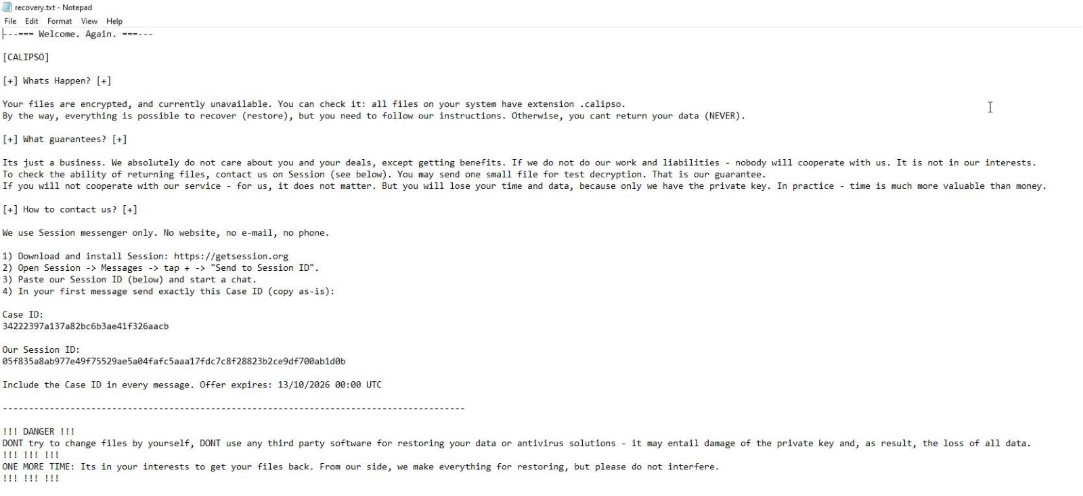
The recovery.txt ransom note opened in Notepad on the sandbox desktop.
Behavioural signatures
Sandbox analysis records the following behaviours. Calipso deletes shadow copies and uses the Volume Shadow Copy service COM API, modifies boot configuration data using bcdedit, deletes the backup catalog using wbadmin.exe and clears Windows event logs. It changes power settings with powercfg, modifies registry classes, the Control Panel and system policy, sets the wallpaper through the registry and uses the Task Scheduler COM API. It drops files in the System32 and Program Files directories and writes desktop.ini files. For discovery it enumerates connected drives, checks processor and SCSI registry keys, which sandboxes often read to detect analysis, reads the hostname and domain, the system time and browser information, and executes command shell one liners. It also reads browser profile data and accesses the Windows Credential Manager, which indicates credential collection capability.
MITRE ATT&CK techniques
| Tactic | ID | Technique | Observed procedure |
|---|---|---|---|
| Execution | T1059.003 | Command and Scripting Interpreter: Windows Command Shell | Executes command shell one liners |
| Execution | T1047 | Windows Management Instrumentation | Uses WMI during execution and recovery removal |
| Persistence | T1653 | Power Settings | Changes power settings with powercfg to keep the host awake |
| Defense Evasion | T1006 | Direct Volume Access | Accesses volumes directly |
| Defense Evasion | T1070.001 | Indicator Removal: Clear Windows Event Logs | Clears Windows event logs |
| Defense Evasion | T1070.004 | Indicator Removal: File Deletion | Deletes files including the backup catalog |
| Defense Evasion | T1112 | Modify Registry | Changes registry classes, wallpaper and system policy |
| Credential Access | T1555.003 | Credentials from Password Stores: Credentials from Web Browsers | Reads user and profile data of web browsers |
| Credential Access | T1555.004 | Credentials from Password Stores: Windows Credential Manager | Suspicious access to credential history |
| Credential Access | T1552.001 | Unsecured Credentials: Credentials In Files | Sandbox flagged reads of credential material in files |
| Discovery | T1217 | Browser Information Discovery | Enumerates browser information |
| Discovery | T1120 | Peripheral Device Discovery | Enumerates connected drives |
| Discovery | T1012 | Query Registry | Reads processor, SCSI and system information |
| Discovery | T1082 | System Information Discovery | Enumerates system information |
| Discovery | T1016 | System Network Configuration Discovery | Reads hostname and domain from the registry |
| Discovery | T1124 | System Time Discovery | Gathers the system time |
| Collection | T1005 | Data from Local System | Collects local data |
| Impact | T1491 | Defacement | Replaces the desktop wallpaper with the ransom message |
| Impact | T1490 | Inhibit System Recovery | Deletes shadow copies, the backup catalog and boot recovery settings |
| Impact | T1486 | Data Encrypted for Impact | Encrypts files and appends .calipso (shown in the capture; not in the sandbox mapping) |
Indicators of compromise
| Indicator | Type | Context |
|---|---|---|
| 9f77af05e8b3112eb13777853c7397442d8467549c3bce01f2639305f98e96ed | SHA256 | Calipso ransomware sample |
| .calipso | File extension | Appended to encrypted files |
| recovery.txt | Filename | Ransom note |
| 05f835a8ab977e49f75529ae5a04fafc5aaa17fdc7c8f28823b2ce9df700ab1d0b | Session ID | Operator contact in the note |
| 34222397a137a82bc6b3ae41f326aacb | Case ID | Identical in two independent analyses, so not unique to a victim in this build |
| getsession.org | Domain | Legitimate messenger download referenced by the note |
| Offer expires: 13/10/2026 00:00 UTC | Note text | Run date plus seven days; an earlier analysis shows 12/10/2026 |
Leak site and extortion activity of note
The Qilin group listed Genesis Credit Management, a US financial services firm, on its leak site on 3 October. This is the group’s claim only, the firm has not confirmed it, and no data sample has been validated. A Ukrainian grocery chain, ATB-Market, confirmed a cyberattack on 5 October after a $400,000 ransom demand appeared on its website and attackers threatened to leak data. In the US, AngMar Management Services reported a ransomware attack with data theft to health regulators, which is the double extortion pattern that Calipso does not claim. Separately, researchers describe Warlock ransomware attacks that used compromised SharePoint servers for initial access, which links this section to the SharePoint exploitation covered in last week’s issue. The FBI and Secret Service also say FortiBleed access is being passed to INC/Lynx and Payload ransomware affiliates; see Credential and Account Exposure.
Recommendations
- Maintain offline or immutable backups and test restoration, since Calipso removes shadow copies, the backup catalog and boot recovery settings.
- Alert on shadow copy deletion, wbadmin catalog deletion, bcdedit recovery changes, powercfg changes, clearing of the Security and System logs (Event IDs 1102 and 104) and mass file renaming.
- Monitor servers and endpoints for the Session messenger being installed or contacting the Session network, since it is the only contact route in the note, and treat unmanaged installs as suspicious.
- Do not pay; preserve the note, the wallpaper and a sample encrypted file, submit the sample to a ransomware identification service, and engage incident response and the relevant national CERT.
- If an encrypted host is found, check the window before the offer expiry for related access, and hunt for credential theft from browsers and the Windows Credential Manager on the same host.
05 Credential & Account Exposure
FortiBleed: Fortinet credential campaign still active
FortiBleed is a global credential compromise campaign against internet facing Fortinet FortiGate firewalls and SSL VPN gateways, first reported in June 2026. It is not a single new vulnerability. Attackers use automated credential attacks against exposed administration and VPN access, take over accounts and, in some cases, delete accounts or change passwords so that legitimate administrators are locked out. On 6 October the FBI and US Secret Service published a joint advisory, titled FortiBleed Operations Continue Targeting Exposed Systems Leading to Reports of Lockouts. It says initial access brokers are passing the access to ransomware affiliates, including affiliates of INC/Lynx and Payload.
One threat intelligence vendor has verified more than 86,000 compromised devices (86,644) across 194 countries, and counted at least 12 confirmed ransomware attacks stemming from FortiBleed by July. A separate report puts the number of devices targeted above 400,000, which is a different measure from devices confirmed compromised. Because the access is credential based, patching does not remove it. Accounts and passwords the attackers created or changed stay in place until someone finds them.
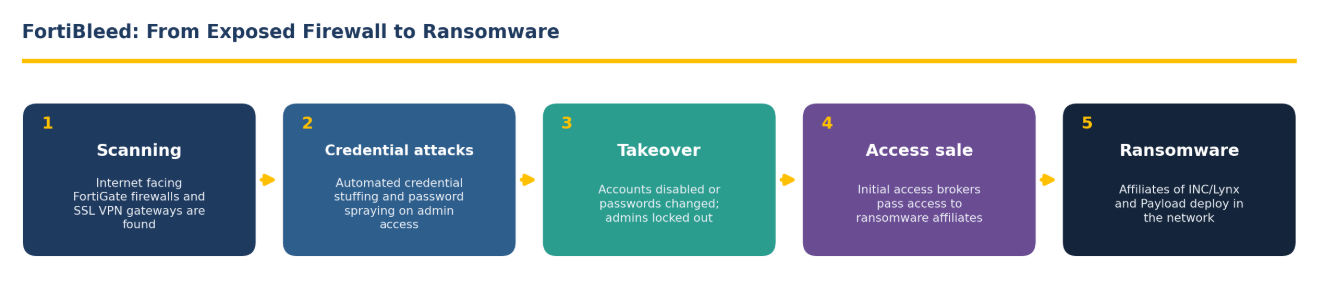
FortiBleed attack flow from exposed firewall to ransomware (after the joint advisory and vendor reporting).
| Field | Detail |
|---|---|
| Campaign | FortiBleed (first reported June 2026) |
| Targets | Internet facing FortiGate firewalls and FortiOS SSL VPN gateways |
| Method | Credential compromise through automated attacks on exposed administration and VPN access; not a single new flaw |
| Scale | 86,644 devices confirmed compromised in 194 countries (one vendor); more than 400,000 reported as targeted (another report) |
| Impact | Administrator lockouts through deleted accounts or changed passwords; access sold to ransomware affiliates |
| Ransomware link | Affiliates of INC/Lynx and Payload; at least 12 confirmed attacks by July |
| Advisory | FBI and US Secret Service joint advisory, 6 October 2026 |
Indicators of compromise
| Indicator | Type | Context |
|---|---|---|
| 85.11.187[.]8 | IPv4 | Associated with FortiBleed password cracking activity |
| 193.8.187[.]2 | IPv4 | Related infrastructure linked to the attack chain |
| 193.8.187[.]42 | IPv4 | Related infrastructure linked to the attack chain |
These addresses are as reproduced by a news outlet from the advisory. The advisory also lists account names found on compromised devices. Confirm both against the advisory before blocking.
Recommendations
- Remove internet administration of firewalls and VPN gateways, or restrict it to named addresses.
- Reset all administrator and VPN credentials, including accounts you did not create, and enable multifactor authentication on both.
- Review firewall and VPN users, recent configuration changes and logs for unexpected accounts, logins from the listed addresses and signs of lateral movement.
- Keep out of band access to the management plane, so a lockout does not also cut your ability to respond.
- Treat any confirmed FortiBleed access as a ransomware precursor, and do not pay if ransomware follows.
Misused account access: Denmark’s population register
On 5 October Denmark’s digitalisation ministry disclosed that unauthorized parties had obtained names, addresses and CPR identity numbers for about 8.8 million people, living, deceased and moved abroad. That is about 80 percent of the register’s roughly 11 million records. The attackers used the lawful search access of a private Danish company, running automated lookups for about ten days in September. A register administrator noticed unusual activity on the evening of Friday 2 October, the data protection authority was notified on 4 October, the company’s access was cut and police are investigating. People with name and address protection were not included.
The ministry has not said how the company’s access was compromised or who is responsible. The CPR number is used for tax, healthcare and banking, so the exposure is an identity risk for financial institutions even though the reported data is limited to names, addresses and numbers.
| Attribute | Detail |
|---|---|
| Victim | Central Person Register (CPR), Denmark |
| Detected and disclosed | Detected 2 October 2026; regulator notified 4 October; disclosed 5 October |
| Access | Misuse of a private company’s lawful lookup rights; automated lookups over about 10 days in September |
| Scale | About 8.8 million people (about 80 percent of the register) |
| Data | Names, addresses and CPR numbers; protected addresses not included |
| Response | Company access blocked; regulator notified; police investigation and security review under way |
| Attribution | None. Authorities say it is not possible to say who is behind it |
Recommendations
- Do not treat knowledge of a name, address and national identity number as proof of identity. Add stronger checks for account changes, new credit applications and recovery requests.
- Watch for account opening and account takeover attempts that use correct Danish personal details, and for scams that quote them.
- Review which suppliers and customers can run bulk lookups against your own records, and alert on volume, timing and source.
- Protect accounts with lookup rights with multifactor authentication and address restrictions, and monitor them for sudden automated use.
XWorm and 2CLoader: credential stealing malware
XWorm is a modular remote access trojan written for .NET that has been sold as malware as a service since 2022. Reporting describes more than 50 plugins, which cover remote control, keylogging, clipboard and credential theft, DDoS and the delivery of ransomware, and encrypted command and control traffic. Because it is sold to many buyers, XWorm appears in unrelated campaigns, and the delivery chain tells defenders more than the payload does. Earlier this year it was seen in Excel phishing that exploited CVE-2018-0802 and ended in process hollowing into Msbuild.exe, in fake bank receipts delivered as .pdf.js files against Latin American businesses, and in ClickFix fake verification pages aimed at the hospitality sector.
The new item this week is 2CLoader, a loader identified in August 2026 and reported on 1 October. It delivers the Vidar and Remus information stealers and, in some samples, XWorm. The loader keeps its configuration and encrypted payload in a resource, decrypts it with layered XOR and AES-256-GCM, calls the Windows kernel through indirect system calls, checks for virtual machines, debuggers and user activity, and can run a payload as in memory .NET, as a manually loaded PE file or through process hollowing. It uses HTTP for command and control and supports persistence through the registry, the Startup folder and scheduled tasks. The way 2CLoader reaches victims has not been reported. One vendor profile ties XWorm to a single named cybercrime group. That does not fit malware sold to many buyers, so we have not carried it. The infrastructure indicators below come from feed samples and a loader report, and dynamic DNS and cloud storage are also used legitimately, so validate them before blocking.
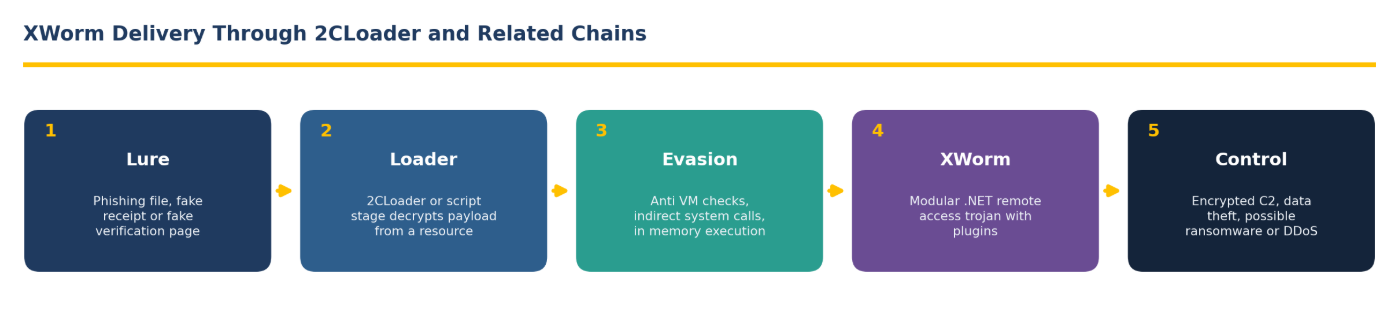
XWorm delivery through 2CLoader and related chains (assembled from vendor reporting across 2026).
| Attribute | Detail |
|---|---|
| Type | Remote access trojan (.NET, modular, malware as a service) |
| Operator | Not attributed; sold to many buyers |
| Delivery | Phishing attachments, fake receipts, ClickFix pages and the 2CLoader loader |
| Execution | In memory .NET, manual PE loading and process hollowing (Msbuild.exe in earlier chains) |
| Persistence | Registry run keys, Startup folder and scheduled tasks |
| Capabilities | Remote control, keylogging, credential theft, plugins, DDoS and ransomware delivery |
| C2 | Encrypted channel; recent infrastructure uses dynamic DNS names and cloud storage hosted files named as images |
MITRE ATT&CK techniques
Technique IDs are our own mapping from reported behaviour across several campaigns, not from a single source.
| Tactic | ID | Technique | Observed procedure |
|---|---|---|---|
| Initial Access | T1566.001 | Phishing: Spearphishing Attachment | Excel and script file lures |
| Execution | T1204.002 | User Execution: Malicious File | Victim opens the lure file |
| Execution | T1059.001 | Command and Scripting Interpreter: PowerShell | PowerShell stages and loads .NET modules |
| Execution | T1218.005 | System Binary Proxy Execution: Mshta | HTA stage in earlier Excel chains |
| Defense Evasion | T1055.012 | Process Injection: Process Hollowing | Msbuild.exe or a suspended process hollowed to host XWorm |
| Defense Evasion | T1620 | Reflective Code Loading | .NET payload run directly in memory |
| Defense Evasion | T1027 | Obfuscated Files or Information | Layered XOR and AES-256-GCM, payload held in a PE resource |
| Defense Evasion | T1497 | Virtualization and Sandbox Evasion | Anti VM, anti debugging and user activity checks in 2CLoader |
| Persistence | T1547.001 | Boot or Logon Autostart: Registry Run Keys and Startup Folder | Registry, Startup folder and scheduled task persistence |
| Collection | T1056.001 | Input Capture: Keylogging | XWorm keylogger plugin |
| Credential Access | T1555.003 | Credentials from Web Browsers | Stealers delivered alongside XWorm |
| Command and Control | T1071.001 | Application Layer Protocol: Web Protocols | HTTP beacon to /api/beacon in 2CLoader |
Indicators of compromise
| Indicator | Type | Context |
|---|---|---|
| 62[.]60[.]226[.]185 | IPv4 | 2CLoader infrastructure; an XWorm feed also lists t0907.exe on this address |
| /api/beacon | URI path | 2CLoader HTTP POST beacon |
| nothinglikefaith[.]duckdns[.]org | Domain | XWorm infrastructure reported 2 October 2026 |
| loveyoufaith[.]duckdns[.]org | Domain | XWorm infrastructure reported 2 October 2026 |
| infogruposyc[.]duckdns[.]org | Domain | XWorm infrastructure reported 2 October 2026 |
| d15f8b15696bf2118bf81cf9656f28a6bc6992731956f2e070ce0f033fdd2ef3 | SHA256 | XWorm sample listed 4 October 2026 |
| 4d403644d7520429283d7e1e4477971fe0b5a418d5e1341f9f12f8f1e84480ee | SHA256 | XWorm sample listed 30 September 2026 |
Recommendations
- Block or sandbox script, shortcut and double extension attachments such as .pdf.js, and warn staff about unexpected receipts and verification pages that ask them to paste commands.
- Alert on Msbuild.exe or other signed binaries started without a build context, on hollowed processes, and on unsigned code that reads from its own resources and starts .NET in memory.
- Treat any infostealer detection as a possible XWorm precursor and reset browser saved passwords, session cookies and tokens for the affected user.
- Monitor for new Startup folder entries, run keys and scheduled tasks that launch from user writable folders, and for HTTP POST beacons to unfamiliar domains on a fixed path.
- Patch Office against CVE-2018-0802 and block the legacy Equation Editor component where it is not needed.
06 Vulnerability Intelligence
Three flaws are covered here, ranked by urgency. One is exploited and on the CISA catalog, one affects a niche but privileged component, and one affects nearly every desktop. CVE-2026-85706 was disclosed on 10 September and stays in this issue because it is still the most urgent of the three.
| Priority | CVE | Product and severity | Exploitation and fix |
|---|---|---|---|
| 1 Immediate | CVE-2026-85706 | GitLab CE and EE, CVSS 10.0, unauthenticated file read | Exploited; CISA KEV 11 September; fixed 19.1.8, 19.2.6, 19.3.2 |
| 2 Immediate | CVE-2026-103628 | Chrome WebGL, CVSS 9.6, code execution from a web page | No exploitation reported; fixed in 154.0.8037.97 and covered by Chrome 155 |
| 3 This week | CVE-2026-90970 | GitLab AI Gateway (self hosted), CVSS 9.9, command execution | No exploitation reported; fixed 19.2.4, 19.3.2, 19.4.1 |
CVE-2026-90970: GitLab AI Gateway Command Execution
CVE-2026-90970 is a critical template injection flaw in the self hosted GitLab AI Gateway, the service that connects a GitLab instance to its AI features. An authenticated user with access to the Duo Agent Platform can submit a crafted flow configuration that escapes the sandbox around prompt templates and runs arbitrary commands on the gateway host. GitLab rated it 9.9 with a changed scope, which means the effect can extend beyond the gateway itself. It was disclosed on 2 October 2026. GitLab says it contacted customers who run their own gateways before publishing, and that GitLab hosted customers are already protected. One aggregator reports exploitation and a proof of concept, but the vendor advisory, the CISA record and other sources say there is none, so we treat that as unverified.
| Field | Detail |
|---|---|
| CVE ID | CVE-2026-90970 |
| Affected product | GitLab AI Gateway, self hosted deployments |
| Affected versions | 18.1.6 or later before 19.2.4; 19.3 before 19.3.2; 19.4 before 19.4.1 |
| Fixed versions | 19.2.4, 19.3.2, 19.4.1 |
| Severity | Critical (CVSS 3.1 base score 9.9) |
| Vulnerability type | Improper neutralization in a template engine (CWE-1336); requires an authenticated user |
| Exploitation status | No exploitation confirmed as of 5 October 2026; the CVE record lists exploitation as none |
| Workaround | None published; upgrade |
Recommendations
- Upgrade every self hosted AI Gateway to 19.2.4, 19.3.2 or 19.4.1, including Helm deployments, where the new image tag must be set.
- Until upgraded, restrict Duo Agent Platform access to named users, and review who can create or edit flow configurations.
- Review gateway hosts for unexpected child processes, outbound connections and reads of tokens or model credentials, and rotate any that the gateway holds if compromise is suspected.
CVE-2026-85706: GitLab Commits API Path Traversal
CVE-2026-85706 is a maximum severity path traversal in the GitLab repository commits API that lets an unauthenticated attacker read arbitrary files readable by the GitLab service. The upload helper behind POST /api/v4/projects/:id/repository/commits processes a file path parameter before authentication and does not confine it to the repository. Encoding one character of the route, for example %63ommits, makes the front proxy miss the route while the application still decodes and serves it. The attacker needs at least one public project on the instance. Readable files include application logs, database.yml and gitlab-secrets.json, which can lead to authenticated access and full compromise of the instance.
GitLab fixed the flaw on 10 September 2026 in a release that addressed 18 vulnerabilities. Scanning began within a day, CISA added it to the Known Exploited Vulnerabilities catalog on 11 September with a federal deadline of 14 September, and several public proof of concept exploits now exist. The same release fixed CVE-2026-87719, an authenticated insecure deserialization flaw rated 9.9, and CVE-2026-88765, a buffer overflow rated 8.5. One source describes CVE-2026-85706 as exploitable only by authenticated attackers. That is wrong: the vendor and every technical write up call it unauthenticated. It is also the second case this month, after PeopleSoft, where one encoded character separates what a proxy blocks from what an application serves, so where a firewall rule is the mitigation, assume it can be bypassed until it is tested against encoded paths. Because the flaw has been exploitable since mid September, patching alone does not show an instance was not read.
| Field | Detail |
|---|---|
| CVE ID | CVE-2026-85706 |
| Affected product | GitLab Community Edition and Enterprise Edition, self managed |
| Affected versions | 18.7 to 19.1.7; 19.2.0 to 19.2.5; 19.3.0 to 19.3.1 |
| Fixed versions | 19.1.8, 19.2.6, 19.3.2 and later (released 10 September 2026) |
| Severity | Critical (CVSS 3.1 base score 10.0) |
| Vulnerability type | Path traversal (CWE-22) with missing authentication enforcement (CWE-306) |
| Exploitation status | Exploited; CISA KEV 11 September 2026; public proof of concept code available |
| Impact | Disclosure of secrets, credentials and configuration; path to full instance compromise |
Recommendations
- Upgrade GitLab to 19.1.8, 19.2.6, 19.3.2 or later without waiting for a maintenance window.
- Treat gitlab-secrets.json, database credentials, runner tokens and any secrets stored in CI variables as exposed if the instance was reachable and unpatched, and rotate them.
- Search web and proxy logs for requests to the commits endpoint that contain %63ommits or other encoded route characters, and for unusual reads of configuration files.
- Remove public projects that are not needed, since the attack depends on at least one, and keep management and API access off the public internet where possible.
CVE-2026-103628: Chrome WebGL Out of Bounds Write
CVE-2026-103628 is a critical out of bounds write in the WebGL component of Google Chrome. A remote attacker can use a crafted HTML page to run code, and the CVE record states that this code runs outside the browser sandbox. It was fixed in Chrome 154.0.8037.97 for Linux and 154.0.8037.97 and 154.0.8037.98 for Windows and macOS, released on 1 October 2026, and Microsoft Edge followed with 154.0.4258.53. NVD scores the flaw 9.6, with user interaction required, which in practice means visiting a hostile or compromised web page. No exploitation has been reported and the flaw is not on the CISA catalog. Google has held back technical detail until most users update, so the exploit chain is unknown, and the sandbox escape label some outlets use is not established.
Chrome 155 now supersedes that build. Google released it on 6 October 2026 (155.0.8059.39 on Linux, 155.0.8059.39 and .40 on Windows and macOS) with 247 security fixes, including 53 high severity flaws and four critical use after free flaws in the Chromecast, Browser, Navigation and Track components (CVE-2026-106382, CVE-2026-106197, CVE-2026-106358 and CVE-2026-106347). Google reports no exploitation of any of them, and two of the critical flaws were found by a researcher using AI assistance. Edge follows Chrome, so check for the matching Edge update. Packaged Chromium also lags: at least one Linux distribution had not shipped the 154 fix in early October, which matters for containers and headless browser services.
| Field | Detail |
|---|---|
| CVE ID | CVE-2026-103628 |
| Affected product | Google Chrome and Chromium based browsers before the fix |
| Affected versions | All Chrome desktop builds before 154.0.8037.97 |
| Fixed versions | Chrome 154.0.8037.97 (Linux), 154.0.8037.97 or .98 (Windows, macOS); Edge 154.0.4258.53. Chrome 155.0.8059.39 or later is current |
| Severity | Critical (Chromium rating); CVSS 3.1 base score 9.6 |
| Vulnerability type | Out of bounds write, CWE-787, in WebGL |
| Exploitation status | No exploitation reported; not on the CISA KEV catalog |
| Attack requirement | User opens a crafted web page |
Recommendations
- Confirm managed Chrome and Edge fleets report Chrome 155.0.8059.39 or later (and the matching Edge build), and force a browser restart, since the update does not apply until relaunch.
- Inventory Chromium inside Electron applications, headless rendering services, PDF generators and container images, and rebuild them from the fixed upstream or vendor package.
- For high risk users, consider enabling enhanced protection or disabling hardware accelerated WebGL on unpatched devices until updated.
- Track exploitation reporting: a fixed critical browser bug with restricted detail is a common candidate for rapid reverse engineering.
07 Darkweb and Underground Activity
ShinyHunters under law enforcement pressure
Dutch police announced arrests of suspects linked to ShinyHunters on 29 September, and on 3 October Jordanian authorities detained another long standing member, who is reported to be cooperating with US investigators. The FBI breach took place after the first arrest, and the group told several journalists that it did not plan to extort the bureau or publish the stolen data, although samples were given to reporters. The group presents the operation as retaliation for an FBI advisory in May 2026, which is its own claim and has not been verified. On 5 October the FBI said its review found that a contractor failed to install a patch for a third party managed platform, which is hard to reconcile with the group’s claim of an undocumented zero day. Press reports citing unnamed sources name the platform as PeopleSoft and the contractor, and the FBI has not itself named either.
KillSec infrastructure seized
An international operation led by Europol seized the leak site of the KillSec ransomware group, took control of five core servers and secured at least 110 terabytes of stolen data. Europol linked the group to roughly 1,000 suspected attacks. A 16 year old accused of leading the group was arrested on 2 October, and US prosecutors have indicted the same person for attacking at least 500 organizations. The two counts differ, and both are allegations at this stage.
Arrests do not remove capability. The techniques used against PeopleSoft and GitLab are public, the group kept operating after its first member was arrested, and its stated motive for the FBI breach is unverified. Seizing a leak site also raises the question of who now holds the stolen victim data. The gap between roughly 1,000 attacks and at least 500 organizations is a reminder that attack counts and victim counts measure different things. Leak site activity continues: Qilin’s listing of a US financial services firm on 3 October shows the sector is still a target.
Access brokers and Telegram claims
FortiBleed shows how the underground supply chain works. The FBI and Secret Service say initial access brokers are selling access obtained through compromised Fortinet devices to ransomware affiliates, including affiliates of INC/Lynx and Payload. In a smaller case, a group calling itself Xuanye Group claimed the ASOS compromise on a newly created Telegram channel. ASOS has confirmed unauthorized access to a third party platform, but the claim itself is unverified.
08 Key Takeaways
- Look at how, not just who. Seven of 20 incidents have no disclosed entry path, five are lenders reached through exposed services, and four began with an exploited or unpatched flaw. Check your suppliers against the Breached Organizations list.
- Credentials are the quiet way in. FortiBleed locks administrators out of Fortinet firewalls and hands access to ransomware affiliates. Take management interfaces off the internet, reset credentials and enforce multifactor authentication.
- Supplier access is attack surface. Denmark’s register lost 8.8 million records through one company’s legitimate lookup rights, and ASOS was reached through a third party platform. Know who can query your data and watch their volume.
- Partner and broker services are being probed quickly. Four South Korean banks confirmed breaches in about four days. Inventory these services and watch for automated enumeration.
- Verify patches, especially on supplier platforms. The FBI says a contractor missed one, and a single encoded character beat PeopleSoft and GitLab filters. Patch GitLab CVE-2026-85706 and Citrix CVE-2026-88779 now.
- Protect travellers. The Midnight Blizzard sub cluster resumed on 29 September. Block device code sign in where it is not needed, and tell staff never to act on prompts from hotel wireless.
- Test recovery, and keep browsers current. Calipso removes shadow copies, the backup catalog and boot recovery settings and clears logs. Move Chrome to version 155 and Edge to its matching update.
- Keep claims separate from evidence. The AI role in the Korean bank breaches, the AI agent account at DIVD, the Midnight Blizzard attribution and Calipso’s lineage are unconfirmed.
Priority actions this week
| Priority | Action | Why now |
|---|---|---|
| Immediate | Patch GitLab CE and EE to 19.1.8, 19.2.6 or 19.3.2 or later, and rotate secrets held on the server | CVE-2026-85706 is on the CISA KEV catalog with public exploit code |
| Immediate | Update Chrome to 155.0.8059.39 or later and Edge to its matching update, and check browsers embedded in Linux containers | Chrome 155 fixes 247 flaws, including four critical use after free bugs, and covers CVE-2026-103628 |
| Immediate | Patch Citrix NetScaler for CVE-2026-88779 and treat appliances patched after 27 September as possibly compromised | Added to CISA KEV on 4 October, federal deadline 7 October |
| Immediate | Remove or restrict internet administration of FortiGate firewalls and VPNs, reset admin and VPN credentials and enable multifactor authentication | FBI and Secret Service say FortiBleed lockouts and ransomware are ongoing |
| This week | Inspect internet facing customer, partner and broker services, and review which suppliers hold lookup access to identity data and who watches their volume | Four South Korean banks and the Danish register were breached through exposed services or misused partner access |
| This week | Upgrade self hosted GitLab AI Gateway to 19.2.4, 19.3.2 or 19.4.1 | CVE-2026-90970 allows command execution by any user with Duo Agent Platform access |
| This week | Block device code sign in unless required, and brief travelling staff to refuse captive portal prompts | The Midnight Blizzard sub cluster resumed on 29 September |
| This week | Verify offline backups and alert on shadow copy, backup catalog, boot setting and event log tampering | Calipso removes all four before it encrypts |
Disclaimer
This Report is provided for informational and security-awareness purposes only. The information presented is based on intelligence collected from publicly available sources, underground forums, dark web sources, third-party feeds, and other available data at the time of analysis.
Threat intelligence may be incomplete, outdated, unverified, or subject to change. References to threat actors, organizations, vulnerabilities, indicators, or incidents represent observed or reported information and should not be considered definitive attribution unless explicitly stated and supported by reliable evidence.
The information contained in this report should be independently validated before being used for security, operational, legal, or business decisions. iZOOlogic does not guarantee the accuracy, completeness, or timeliness of the information and shall not be held responsible for any actions or decisions taken solely based on this report.
This report is intended for authorized recipients and should be handled in accordance with applicable organizational security, confidentiality, and information-sharing policies.
