
 HQ/EMEAFind out how we can help your business


Executive Summary
eMudhra Limited is an Indian digital trust and cybersecurity company that provides digital identity, electronic signature, and Public Key Infrastructure (PKI) services. In India, these capabilities support digital signing, authentication, and trust services within the country’s regulated digital-signature ecosystem. Separately, eMudhra operates the emSign certificate authority infrastructure, including global SSL/TLS and code-signing services. The distinction is important: the incident described in this report concerns weaknesses in eMudhra’s global certificate authority infrastructure and does not, by itself, establish a compromise of India’s broader digital-signature infrastructure.
On 17 October 2026, an independent security researcher demonstrated that the private keys associated with eight intermediate Certificate Authority (CA) certificates operated by eMudhra under its emSign Global TLS and code-signing infrastructure were cryptographically weak and recoverable from their corresponding public certificates. Generated during a key ceremony on 30 April 2025, the affected P-384 keys contained small integer values rather than properly randomized cryptographic values. All eight intermediates chained to a publicly trusted root, and each was also cross-signed under a widely trusted legacy root, extending the potential exposure across certificate-validation environments.
Following disclosure, major browser and operating-system vendors introduced blocking measures, and eMudhra revoked all eight intermediates on 18 October 2026. Root-program distrust and software updates have substantially reduced exposure in the mainstream browser ecosystem. However, residual risk remains in non-browser environments—including API clients, backend services, containers, CI/CD pipelines, and embedded devices—that rely on outdated trust stores or do not adequately enforce certificate revocation. Certificate Transparency monitoring identified no certificates chaining to the six affected TLS intermediates in public logs before blocking began, and no malicious exploitation had been confirmed as of 23 October 2026. These findings do not conclusively exclude misuse against clients that lack equivalent monitoring or validation controls.
The incident has also triggered wider business and regulatory consequences. According to the information covered in this report, eMudhra has announced a voluntary withdrawal from the global SSL/TLS certificate business, Indian authorities have initiated a review, and approximately 30,000 additional certificates are expected to require reissuance following the affected root’s removal from trust stores. The reported regulatory position distinguishes these developments from eMudhra’s separately regulated Indian digital-signature and eSign services, which have been stated to be unaffected.
This report examines the technical root cause, all eight affected intermediate CAs and their recovered key values, the response by browser and root-program operators, residual exposure outside the browser ecosystem, and the remediation required to restore trust. It also assesses the broader implications for digital trust, certificate lifecycle governance, and organizations dependent on publicly trusted certificate infrastructure.
Key Takeaways
- Eight keys, trivially recoverable. Eight eMudhra intermediate CA certificates from an April 30, 2025 key generation ceremony used P-384 private keys that were small integers rather than properly randomized 384 bit values, recoverable from the public certificate in under a second.
- Six TLS CAs, two code signing CAs. The TLS keys would let anyone issue a certificate that trusting clients would accept for any domain; the code signing keys could in principle let software be signed in a way that appears to come from a verified publisher on systems that skip revocation checks.
- Browsers are covered. The major browser and operating system vendors blocked the compromised certificates between 17 and 20 October 2026, one vendor has removed the affected root entirely from its trust store, and another’s removal is expected to reach all devices by around 27 October 2026.
- Non-browser clients are the remaining gap. API clients, containers, build pipelines and embedded devices that skip revocation and Certificate Transparency checks remain exposed until their own trust stores are updated.
- No confirmed abuse, but a long exposure window. As of 23 October 2026 no malicious use has been confirmed, but the keys were technically recoverable for approximately 17 months before disclosure.
At a Glance
| Attribute | Details |
|---|---|
| Related CVEs | No CVE covers the CA incident itself, since the flaw sits in eMudhra’s key ceremony rather than a software product. Downstream fixes are tracked separately, including one covering certificate verification code and a second covering a browser blocklist update. |
| Severity | Not formally scored for the CA incident itself; the browser blocklist fix has been rated high impact by the affected vendor, with a government vulnerability database entry scoring it 5.4 on the CVSS v3.1 scale. |
| Affected products | Eight eMudhra intermediate CAs (six TLS, two code signing) and their cross signed copies under a legacy partner root; any client that trusts eMudhra’s affected root hierarchy without revocation or Certificate Transparency checks. |
| Affected versions | G3B and G3C intermediates generated on 30 April 2025; client side trust stores and toolchains released before the 17 to 20 October 2026 updates. |
| Fixed in | Current releases of all major browsers; updated trust store components; current releases of major language runtimes and their certificate bundle packages; updated Linux distribution CA certificate packages. |
| Exploitation status | No confirmed malicious use as of 23 October 2026; the keys have been recovered independently by multiple researchers and are now public. |
| Patch availability | Available for browsers and most trust stores and runtimes; a small number of niche platforms remained pending at time of writing. |
| Discovered by | An independent security researcher, reported 17 October 2026. |
Overview of the Compromise
The eMudhra CA key compromise is the exposure of private keys for eight eMudhra intermediate CA certificates, reported on 17 October 2026. Each key was a P-384 value far below the range a secure implementation would use, so anyone holding the public certificate could recover the private key in under a second and, in principle, sign certificates that clients trusting eMudhra’s affected hierarchy would accept.
Affected Certificates and Infrastructure
Eight intermediates from the 30 April 2025 key ceremony are affected: six TLS issuing CAs covering Domain Validation, Organization Validation and Extended Validation, each in two regional variants, plus two code signing CAs. All eight were also cross signed under a legacy partner root for broader compatibility, so each compromised key appears in two separate certificates.
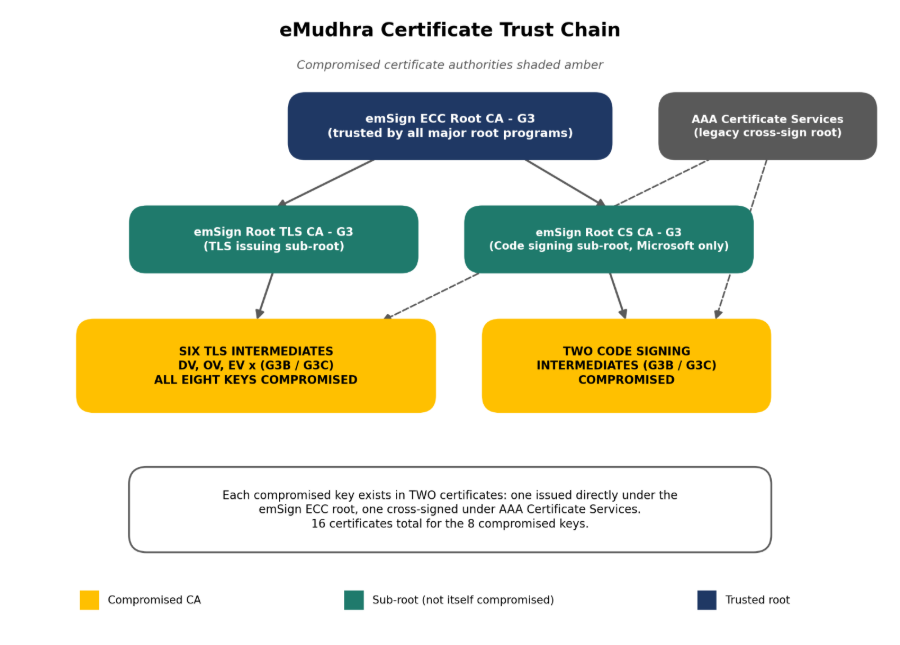
Severity of the Weak Keys
Every affected private key was a small integer, providing on the order of eight bits of effective strength instead of the 384 random bits a key of this type should carry. Recovering any of the eight requires testing a trivial number of candidate values against the public key, a task an ordinary computer finishes in milliseconds. The certificates themselves look structurally normal; only testing the private key against the public key reveals the flaw.
| Intermediate CA | Entity | Purpose | Recovered private key |
|---|---|---|---|
| EM DV TLS CA, G3B | eMudhra BV (Netherlands) | TLS, Domain Validated | 156 |
| EM DV TLS CA, G3C | eMudhra Inc (United States) | TLS, Domain Validated | 230 |
| EM OV TLS CA, G3B | eMudhra BV (Netherlands) | TLS, Organization Validated | 155 |
| EM OV TLS CA, G3C | eMudhra Inc (United States) | TLS, Organization Validated | 4 |
| EM EV TLS CA, G3B | eMudhra BV (Netherlands) | TLS, Extended Validation | 115 |
| EM EV TLS CA, G3C | eMudhra Inc (United States) | TLS, Extended Validation | 56 |
| EM OV CS CA, G3B | eMudhra BV (Netherlands) | Code signing | 66 |
| EM OV CS CA, G3C | eMudhra Inc (United States) | Code signing | 237 |
Root Cause
eMudhra’s preliminary account attributes the flaw to an approved deviation in its key generation ceremony script, intended to test key wrapping and unwrapping on the hardware security module, which instead caused a second, weaker key pair to be generated. Because the resulting key pairs carried similar internal labels, the weaker pair was used by mistake for the certificate signing requests actually submitted. eMudhra has said it will re-verify every key ceremony it has performed.
An earlier warning sign appears to have been misdiagnosed. In June 2025, an incident report recorded invalid certificate revocation list signatures from the same six TLS intermediates, later traced to as early as 23 May 2025. At the time, eMudhra attributed this to a manual process referencing the wrong key configuration, published corrected revocation lists, and the matter was closed. eMudhra’s 2026 account ties the earlier failure to the same underlying key mismatch, which only became clear once the weak keys themselves surfaced.
Discovery and Disclosure
An independent security researcher found the weakness on 17 October 2026 while examining public certificate data and reported it the same day to the major browser and operating system root programs and to eMudhra. As proof, the researcher signed an identical test message with each of the eight private keys, which anyone could verify independently against the published certificates. A separate individual, credited with cryptography engineering work at one of the responding root programs, subsequently published a public tracking resource for affected software and patch status.
Exposure Timeline
The weak keys existed from the ceremony on 30 April 2025 until blocking began on 17 October 2026, an exposure window of roughly 17 months. Anyone who inspected the certificates during that period could, in principle, have recovered the keys, and no technical record can confirm or rule out whether anyone did so outside the certificates that are publicly logged.
| Date | Event |
|---|---|
| 30 Apr 2025 | Key ceremony generates the eight intermediates with weak P-384 keys. |
| 14 May 2025 | The intermediates are cross signed under a legacy partner root. |
| 23 May 2025 | Earliest archived evidence of invalid revocation list signatures from the six TLS intermediates. |
| 17 Oct 2026 | Disclosure and the first blocking actions begin. |
| 18 to 20 Oct 2026 | eMudhra revokes all eight intermediates; the remaining major platforms ship blocks; one root program removes the affected root from its trust store entirely. |
| 27 Oct 2026 (expected) | A further root program’s removal of the affected root is expected to reach all devices. |
Potential Impact
Anyone holding an intermediate CA private key can sign new certificates that chain to a publicly trusted root. With the six TLS keys, an attacker in an active network interception position could issue a valid looking certificate for any domain and intercept or modify HTTPS traffic from clients that still trust the chain and do not check revocation. The two code signing keys could, in principle, let software be signed in a way that appears to come from a verified publisher on systems that skip revocation checks.
Exploitation Status
As of 23 October 2026, no malicious use has been confirmed. Certificate Transparency monitoring shows no certificate chaining to the affected TLS intermediates was logged before blocking began, which rules out undetected attacks against clients that enforce that logging. Clients that skip these checks have no equivalent evidence either way, so past misuse against them cannot be fully ruled out. Since disclosure, multiple parties have recovered the keys independently and the values are now public; they should be treated as known to any capable party.
Browser and Platform Protection
Yes. The major browsers blocked the six TLS intermediates within hours of disclosure using remote blocklist mechanisms that did not require a restart, with platform level protections following over the next two to three days. These browsers also enforce Certificate Transparency, and log operators have worked to prevent new certificates chaining through the compromised CAs from entering accepted logs. Configurations that do not receive remote blocklist updates automatically, for example under certain enterprise policies, required a separate point release to gain the same protection.
Residual Risk: Non-Browser Systems
Non-browser TLS clients carry most of the remaining risk: API clients, backend services, containers, CI/CD pipelines and embedded or IoT devices often trust a bundled CA store, skip revocation checks and ignore Certificate Transparency. Independent researcher testing found that several common command line and scripting language clients on Linux and macOS accepted a forged certificate issued under one of the compromised intermediates after the browser block was already in place. High value paths include installer scripts fetched over HTTPS, build systems holding deployment or signing credentials, and server to server API calls that carry sensitive data.
Code Signing Exposure
Potentially. Two of the eight intermediates are code signing CAs issued under a root trusted by one major platform vendor for that purpose. A holder of those keys could, in principle, sign executables that would appear to come from a verified publisher on systems that skip revocation checks. eMudhra states only one of the eight intermediates was ever used in a production issuing role, and that it was a TLS CA, not a code signing CA, implying the two code signing CAs were never used. As of 23 October 2026, no detailed advisory has confirmed whether platform level blocking explicitly covers code signing validation paths in addition to TLS, and code signing certificates are not subject to Certificate Transparency, so no independent public record can confirm what, if anything, the two CAs signed.
Vulnerability Tracking and CVEs
No CVE covers the CA incident itself, since the flaw sits in eMudhra’s key ceremony rather than in a software product. Downstream software fixes carry their own tracking identifiers: one public vulnerability record (CVE-2026-111943) tracks the certificate verification code change in a major language runtime, and a second (CVE-2026-113470) tracks a browser’s blocklist update, which the affected vendor has rated high impact and which a government vulnerability database scores at 5.4 on the CVSS v3.1 scale.
Root Program Response
Root programs moved beyond blocking the eight intermediates to distrust the root above them. One major root program has already removed the affected root entirely from its trust store, to protect applications that read that trust store but do not receive remote blocklist updates. Another root program operator has committed to removing the same root from its own root store, with the change expected to reach all devices by around 27 October 2026, and is reviewing eMudhra’s remaining, currently unaffected root. eMudhra revoked all eight intermediates on 18 October 2026 and has stopped issuing under the affected root.
Patch and Remediation Status
Most major operating systems, language runtimes and package managers have shipped updated trust stores and certificate verification code within days of disclosure. A small number of niche platforms remained pending at time of writing. Applications built with an affected language toolchain gain the fix only after being rebuilt against a patched release; existing compiled binaries keep their old behavior until recompiled and redeployed.
Testing for Exposure
Community published verification endpoints allow a certificate check against the compromised chain: a certificate error from the client being tested means it has rejected the compromised intermediates, while a successful connection means it still trusts them and needs an update. iZOOlogic recommends running this kind of test against the actual code path a service uses in production, not only a browser or a generic command line tool, since different clients on the same machine can use different certificate verification logic.
Guidance for Certificate Holders
Any service presenting a certificate that chains to the affected root should be replaced with a certificate from a hierarchy still trusted by major clients, since the upcoming root removal will otherwise cause that service to start failing certificate validation. eMudhra has stated that approximately 30,000 certificates require migration to its separate, unaffected root hierarchy, with the large majority originally issued through automated certificate management, which should simplify reissuance.
Handling Devices That Cannot Be Updated
Devices with a frozen or vendor controlled trust store need the compromised intermediates blocked manually where possible. Removing only the top level affected root is not sufficient on every platform, since the legacy cross sign chains the same keys to a separate, widely trusted root, and some platforms trust the TLS and code signing sub roots directly. Where manual distrust is not possible, segment the device, restrict its outbound TLS connections to known destinations, and enable revocation checking wherever the platform supports it as a partial mitigation.
Mitigation and Recommendations
- Update every trust store: apply operating system certificate bundle updates and update language level trust bundles; rebuild container images from patched base images rather than patching running containers in place.
- Rebuild affected language runtime binaries: recompile and redeploy services built with an affected toolchain, since existing binaries keep their old trust behavior until rebuilt.
- Test the real certificate validation path: check API clients, CI/CD runners, proxies and appliances against the compromised chain directly, and treat any successful connection as an open finding, not only a browser level pass.
- Inventory certificates chaining to the affected root: identify internal and external services on that chain and replace them ahead of the upcoming root removal.
- Hunt for misuse since the April 2025 ceremony date: review TLS inspection, proxy and endpoint logs for certificates or signed binaries chaining to the eight intermediates, with particular attention to code signing activity.
- Contain devices that cannot be updated: distrust the eight intermediates where possible, segment affected devices, and restrict their outbound connections.
- Enable revocation checking wherever it is optional and currently disabled, as an additional layer while trust store updates complete.
- Do not resolve certificate errors that appear after patching by disabling certificate verification; treat such errors as confirmation that a migration is still outstanding.
How iZOOlogic Can Help
iZOOlogic’s Global Security Operations Centre supports clients through this type of public key infrastructure incident in several ways:
- Attack surface and certificate monitoring: continuous discovery of a client’s internet facing domains, subdomains and IP addresses, with monitoring of the TLS certificates they present, so that any asset still chaining to the affected eMudhra root or one of the eight revoked intermediates can be flagged and prioritized for replacement ahead of the upcoming root removal.
- Cyber threat intelligence and advisory tracking: ongoing monitoring of this incident and its related vulnerability records as remediation and root program decisions evolve, with follow on advisories issued to clients as the picture develops, including the business, regulatory and market dimensions covered in this report.
- Brand and fraud monitoring: monitoring for fraudulent use of forged or look alike certificates against a client’s branded domains and customer facing infrastructure, which would be the most likely vector for any real world abuse of this specific weakness.
- Dark and deep web monitoring: monitoring underground and closed sources for discussion, sale or practical use of the compromised eMudhra key material or associated tooling against a client’s sector or brand specifically.
- Incident response support: where iZOOlogic identifies a forged certificate, a malicious domain, or other artifact tied to this incident and targeting a client’s brand, GSOC can support takedown, coordinate disclosure to the relevant root program, and assist with the client’s own internal response.
