
 HQ/EMEAFind out how we can help your business

In This Issue
01. Threat Landscape
Agents set the tone this week. Research published over the past fortnight shows an open source agentic penetration testing framework, ARTEX, in use across three operations: a campaign against seven South Korean financial institutions in late September and early October, attacks aimed at about 80 Japanese companies, and a China state aligned actor’s abuse of a cloud backup application to try to reach more than 2,250 Microsoft 365 tenants. In the last case the actor reached privileged access in under three hours in several tenants, with sign in attempts running at up to 2,900 a minute. The tool’s developer has closed the project, but copies are out, and the common thread is speed: scanning, password spraying and escalation done faster than most teams can respond.
Closer to financial clients, GMO Internet Group’s Onamae.com Desktop Cloud, a hosted Windows desktop service used by foreign exchange traders, was breached and shut down on 21 October, and attackers demanded about ¥8 billion. Customers reported unauthorized trades, the attackers threatened to keep manipulating accounts at more than 70 securities and FX firms, and trading logins saved in customer tools may have been taken. A Brazilian skimming group planted a card stealer in a shared analytics script that an e-commerce platform loads on every checkout. And the Australian Signals Directorate cut an Amadey operator off from about 180,000 infected computers.
We tracked 10 incidents, listed under Breached Organizations below. Two are linked by research to AI assisted intrusion, two began with a compromised supplier platform or script, and three have no disclosed entry path. Three are claims by ransomware groups that the organizations have not confirmed. The largest by records is Sony So-net, at about 2.58 million.
What changed this week
- ARTEX. Research tied the South Korean bank intrusions to ARTEX, an open source agentic penetration testing framework developed in China and run alongside commercial and open weight AI models. A Japanese security firm found it on six servers aimed at about 80 Japanese companies. Details are under Emerging Threats and Threat Actor Activity.
- Storm-0940, a China state aligned actor, used ARTEX against Microsoft 365 customers by abusing the credentials of ConnectWise Cloud Backup, a multi tenant application that already had access to them. ConnectWise disabled seven application identities and suspended three services.
- GMO Internet’s Onamae.com Desktop Cloud, used by FX traders, was breached. The service was shut down on 21 October, ¥8 billion was demanded, data was published on 27 October and no ransomware has been confirmed. The platform will not restart.
- Coffin Locker, a new Windows ransomware, claims strong encryption and per file keys, but its note gives 75 BTC in one place and 0.075 BTC in another, and the payment address on its lock screen does not look valid. It reads more like a test build than a criminal operation.
- Amadey. The Australian Signals Directorate said on 27 October that it had entered an operator’s backend and cut it off from about 180,000 infected computers. Researchers count 53 separate Amadey botnets, so the takedown removes one controller, not the loader.
- Vulnerabilities. Node.js and the Brotli library (CVE-2026-111497, called Node2Shell) and Adobe Commerce and Magento (CVE-2026-48356, called PolyShell) were added to the CISA catalog on 27 October. PHP disclosed a third, still unpatched flaw (CVE-2026-115560) two days after its emergency release, and the fixed PHP2Shell flaws drew millions of attack attempts.
- A Brazilian skimming group compromised the shared analytics script of the e-commerce platform Convertr and took card numbers, CVV codes and CPF tax IDs from the checkouts of dozens of brands from 24 October.
- Sony So-net told customers on 27 October that about 2.58 million customer records were exposed after unauthorized access on 19 October. The University of New Mexico Health System diverted ambulances for two hours on 26 October during a ransomware attack.
Confidence in this assessment
Most of this issue rests on vendor, regulator and company statements and carries high confidence. Where it does not, the text says so. The main open points are:
- ARTEX: it is a tool, not an actor. The Korean and Japanese intrusions are attributed only to unidentified, likely Chinese speaking operators, and the research that names the actor in the cloud attack says it did not identify that actor as responsible for the earlier ones. Counts differ by source: about 65,000 to 100,000 records in Korea, and 20 to 80 companies in Japan.
- Storm-0940: the attribution to a China state aligned actor is a vendor assessment. The research refers to four application IDs but lists three.
- GMO Internet: the company has not said how attackers got in. A claim of read and write access over RDP comes from the attackers, and the company says it has not established a link to ARTEX.
- Coffin Locker: no victims, operator or delivery method are known. The 7 day deadline equals the run date plus seven days, so it is computed at runtime, and the demand in the note and the lock screen disagree by a factor of 1,000.
- Amadey: the takedown figures come from the agency’s own statements, and it has not named the operator or said which of the many botnets it removed.
- Node2Shell and PolyShell: the severity differs by source (9.2 against 8.1 for Node2Shell), and PolyShell’s score says user interaction is required, although the flaw is an unauthenticated file upload.
How the breaches happened
The 10 incidents fall into four groups by what let the attackers in or, for the claims, by what is known. The week’s pattern is speed, shared platforms and stolen secrets.
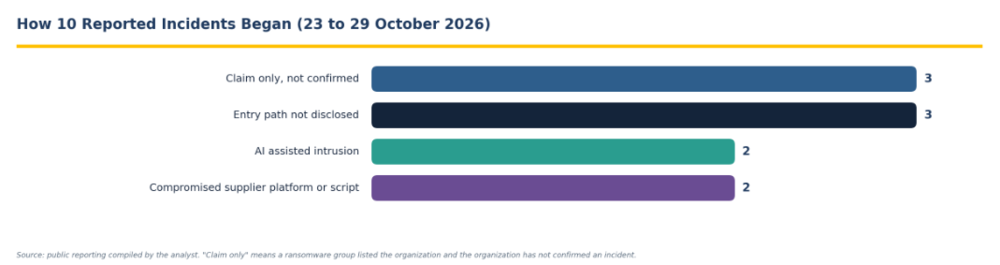
Initial access across 10 incidents first reported or updated between 23 and 29 October 2026.
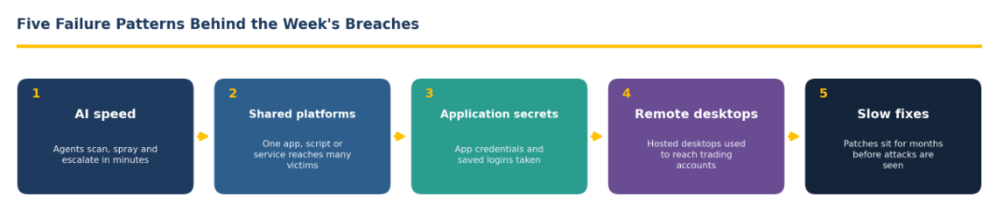
Five failure patterns behind the week’s breaches.
AI speed
ARTEX lets one operator run many agents at once. Seven South Korean banks and lenders were breached in about a week, and the cloud attack on Microsoft 365 tenants reached 2,900 sign in attempts a minute and privileged access in under three hours. The operator behind the Korean campaign left an open directory on its server with its AI session histories, and the logs show it had no plan for the data: at one point it asked an AI assistant to suggest Telegram groups for selling Korean data. The tools are cheap and tireless, and the attacker’s skill matters less than the target’s exposure.
Shared platforms
One set of application secrets for ConnectWise Cloud Backup opened a path into more than 2,250 customer tenants. One analytics script on one e-commerce platform ran on the checkout pages of dozens of brands. One hosted desktop service held the machines of thousands of traders, with 26,739 servers potentially affected. Each customer inherited a supplier’s weakness without having any control over it.
Application secrets and saved logins
The ConnectWise attack never needed a user to sign in: the actor used the backup application’s own credentials, which already held access to customer tenants. At GMO, logins that traders had saved inside trading tools on the hosted desktops may have been taken and used for unauthorized trades. Amadey, covered under Credential and Account Exposure, steals saved browser, email, wallet and session data from home and office machines. A saved secret is a credential that works without a prompt.
Remote desktops
The hosted desktop is attractive because it sits one step from money. Attackers who posted an image claiming read and write access over RDP chose a service that keeps trading software running around the clock, so a breach reaches the accounts behind it and not just the servers. Any remote desktop that holds credentials or sessions for financial systems needs the controls of the systems it reaches.
Slow fixes
Adobe fixed the PolyShell upload flaw in Adobe Commerce and Magento on 14 July, research had made it public in March, scanning began within days and one group injected code into 471 stores in an hour, yet CISA only listed it as exploited on 27 October. The Brotli flaw behind Node2Shell was fixed in the upstream library on 27 February with no release and no advisory, and stayed publicly readable for eight months until the patched versions appeared last week. Convertr was running an outdated analytics server. Defenders who wait for a vendor warning are working from a calendar the attackers do not follow.
Questions to ask your own team
- Which suppliers hold application credentials or consents in your cloud tenant, and would you see one signing in from an address you do not know?
- Do you test your own internet facing logins for password spraying and credential stuffing before someone else does, and how fast would you notice 2,900 attempts a minute?
- Which third party scripts load on your checkout, login and payment pages, and who is told when one of them changes?
- If a hosted desktop or remote service for traders or staff were shut down tomorrow, what would you lose, and where are the logins saved on it?
Breached organizations
Organizations are named as in public reporting. The list covers incidents first reported or materially updated between 23 and 29 October 2026. Attacker claims are marked as claims, and counts are those reported by the organization unless marked otherwise. Check each name against your own suppliers and their suppliers.
| Organization | Sector, country and date | How it happened | Scale and status |
|---|---|---|---|
| GMO Internet Group (Onamae.com Desktop Cloud) | Hosted desktops for traders, Japan. Confirmed 20 Oct, shut 21 Oct, data published 27 Oct | Unauthorized access; malicious programs in some customer server environments; attackers claim RDP read and write access; entry not disclosed | 26,739 servers potentially affected; trading logins may be taken; unauthorized trades reported; ¥8 billion demand refused; no ransomware confirmed; platform will not restart |
| ConnectWise Cloud Backup and downstream | Backup and IT software, global. Credentials used | Application credentials of a multi tenant backup app abused to sign | Sign in attempts at more than 2,250 tenants; privileged access in under three hours in |
| Microsoft 365 tenants | from 15 Oct, attribution 21 Oct | to customer tenants; attributed to Storm-0940 using ARTEX | some; seven application identities disabled, three services suspended; access does not prove data was taken |
| Seven South Korean banks and lenders | Banking and lending, South Korea. Late Sep to early Oct; research 7 Oct | Exposed systems attacked with ARTEX run alongside AI models; one report cites credential stuffing | About 65,000 to 100,000 records (income, loan, ID); operator unidentified, likely Chinese speaking; core banking not targeted |
| Japanese companies (about 80 targeted) | Insurance, finance, logistics, retail, education, Japan. Research 19 to 20 Oct | Six attack servers running ARTEX aimed at about 20 and then about 80 firms | Eight companies disclosed leaks in Sept and Oct; counts differ by source; operators unknown |
| Convertr | E-commerce platform, Brazil. 24 to 27 Oct | Shared analytics script modified to skim checkouts; likely an outdated analytics server with a command execution flaw | Card number, expiry, CVV, name and CPF tax ID from checkouts of dozens of brands; removed 27 Oct; merchants and payment providers being notified |
| Sony So-net | Internet service provider, Japan. Access 19 Oct, detected 23 Oct, disclosed 27 Oct | Unauthorized access; method under investigation | About 2.58 million customer records; email passwords reset |
| University of New Mexico Health System | Healthcare, US. 26 Oct | Ransomware attack; entry not disclosed | Ambulances diverted 12:30 to 14:30; appointments cancelled 26 Oct; critical systems back 27 Oct |
| Coast 2 Coast | Retail and e-commerce services (per a tracker), US. Claim seen 27 to 28 Oct | Listed by the Play ransomware group | Claim only. Not confirmed by the company |
| APPL Holding | Holding company, Germany. Claim 26 Oct | Listed by the Qilin ransomware group | Claim only. Not confirmed by the company |
| A UAE retail and facility services | Services, United Arab Emirates. Claim 27 Oct | Listed by the N0n ransomware group, which claims payroll, | Claim only. Not confirmed by the company |
| A UAE retail and facility services group (name withheld) | Services, United Arab Emirates. Claim 27 Oct | Listed by the N0n ransomware group, which claims payroll, employee and identity document archives | Claim only. Not confirmed by the company |
Notes. The three ransomware listings are claims taken from leak site tracking, and we withhold the name of the UAE group because the listing gives only a description. The ConnectWise row counts one incident with many downstream targets, and sign in attempts do not prove access or data theft. Counts for the Korean and Japanese incidents differ between reports and are given as ranges.
02. Emerging Threats and Campaigns
ARTEX: an agentic AI penetration testing framework in attackers’ hands
ARTEX is an open source agentic penetration testing framework, written in Go and developed in China, which was posted to GitHub in July 2026. It coordinates a team of AI agents that scan a target, choose exploits, run tools and write up findings with little human input, and it can use commercial or open weight language models as its brain. After research linked it to the South Korean bank breaches, its developer made the repository private on 8 October and said the project would be closed source with no further updates. Copies and forks remain, and the research says it is highly likely that more actors will adopt ARTEX and similar tools.
In South Korea, research traced attacks on seven banks and lenders between late September and early October to an unidentified, likely Chinese speaking operator. The operator ran ARTEX with a Chinese language model as its main backend and added other models and an AI coding assistant for extra sessions. It left an open directory on its server that exposed session histories, ARTEX configuration files, memory files and a Chinese language instruction file telling the AI what to test. A server page was titled, in Chinese, as an autonomous penetration testing console. Investigators also found a network of residential and proxy addresses used to reach external model services. About 65,000 to 100,000 records were exposed, including income, loan and national ID data, and the agents did not go after core banking systems. One report says credential stuffing was the entry method, and the regulator’s order of 2 October to inspect exposed systems, covered in earlier issues, followed. The operator’s infrastructure also held tools for cryptocurrency theft, Linux exploitation and mobile testing, and was being assembled as early as August.
In Japan, a security firm examining the infrastructure behind attacks on about 20 companies found ARTEX running on that server, and then on five more, six in total between 18 September and 18 October. The servers were aimed mostly at insurance, finance, logistics, e-commerce, retail and education firms, and the configurations and targets were similar, so one operator may run them. Eight companies had disclosed leaks in September and October, and media reports put the number targeted at about 80. Analysts note that an agent that reads Japanese systems and prompts may also lower the language barrier that used to protect Japanese organizations. The operators are not identified, and a separate Japanese investigation found AI assisted attacks against Japanese services as well. The ConnectWise campaign, attributed to Storm-0940, is covered under Threat Actor Activity.
For defenders, the shift is speed and tirelessness, not new techniques. ARTEX uses known flaws, weak passwords and exposed portals, but it tests all of them at once, around the clock, and adapts when one path fails. Systems that survived because they were obscure, or because no human had time to try, are now tested immediately. See also the separate iZOOlogic threat advisory on ARTEX, which covers the infrastructure behind the South Korea banking breaches and the Japan intrusion campaign.
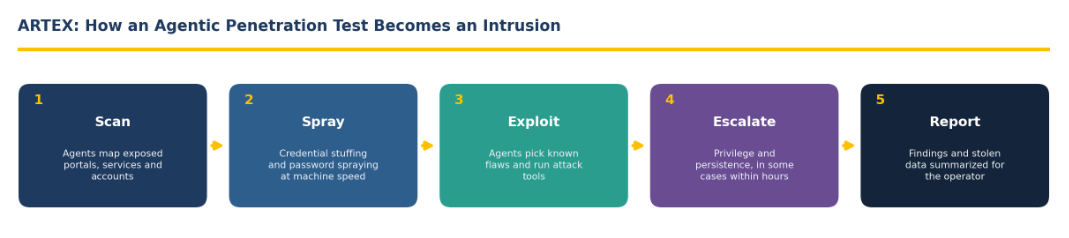
How an agentic penetration test becomes an intrusion (assembled from public research on the Korean and cloud campaigns).
| Field | Detail |
|---|---|
| Tool | ARTEX, open-source agentic AI penetration testing framework (Go), built in China; posted to GitHub in July 2026 |
| Status | Repository made private on 8 October and declared closed source; forks and copies circulate |
| Backends seen | A Chinese language model as the main backend; other models and an AI coding assistant for extra sessions |
| Observed use | Seven South Korean banks and lenders (late Sep to early Oct); about 80 Japanese companies (Sep to Oct); Microsoft 365 tenants through ConnectWise Cloud Backup (Oct) |
| Operators | Unidentified, likely Chinese speaking, for Korea and Japan; Storm-0940 for the ConnectWise campaign. ARTEX is not specific to one actor |
| Typical steps | Reconnaissance, credential stuffing and password spraying, exploitation, privilege escalation, data collection, summary report |
| Artifacts | Chinese language console title; Python request user agents in logs; residential proxy traffic to external model services |
Recommendations
- Test your own exposure the way an agent would. Inventory internet facing portals, partner and broker services and login pages, and run authorized testing against them before an attacker does.
- Defend logins against spraying and stuffing: require multifactor authentication, throttle and block automated sign ins, check passwords against breach lists, and alert on many accounts being tried from one address in a short time.
- Detect machine speed: alert on sign in rates and error counts that no person could produce, on scripted user agents such as Python request libraries, and on bursts of directory and API reads from one session.
- Shorten the time from alert to action. Agents move from access to privilege in hours, so containment steps such as disabling an application identity or isolating a host need to be pre approved.
- Ask suppliers and agencies whether they test their externally exposed systems and how fast they patch.
GMO Internet: a hosted desktop service for traders
On 20 October GMO Internet Group confirmed malicious programs in some customer server environments of Onamae.com Desktop Cloud, a service that rents hosted Windows desktops and is widely used by foreign exchange traders to keep automated trading running. It shut all plans down at 4 a.m. Japan time on 21 October, the day it received an email demanding about ¥8 billion, and contacted the police the next day. It identified 26,739 servers as potentially affected. Customers reported unauthorized transactions on their trading accounts, and GMO says trading account logins saved in trading tools on the compromised servers may have been taken and misused. The attackers threatened to keep manipulating accounts at more than 70 securities and FX firms in Japan and abroad, publish data, and launch ransomware at noon on 27 October.
GMO said it would not pay. It asked customers to back up their data, disconnect and shut down their PCs, and began collecting devices to look for malware. The deadline passed with no ransomware found, and on 27 October the attackers published material that appears to relate to the company and its customers. GMO has said the platform will not restart. It offers free migration to an independent cloud platform for six months, a ¥5,000 goodwill payment to every customer and compensation for verified unauthorized trading losses. It has not said how the attackers got in. The attackers posted an image claiming read and write access to drives over RDP, which is unverified, and GMO says it has not established any link to ARTEX. The lesson is that a hosted desktop holds the keys to financial accounts: saved logins, live sessions and trading tools sit on a machine the customer does not run.
| Field | Detail |
|---|---|
| Service | Onamae.com Desktop Cloud, hosted Windows desktops used by FX traders (all plans) |
| Dates | 22 Oct; deadline 27 Oct at noon; data published 27 Oct |
| Scale | 26,739 servers potentially affected; accounts at more than 70 securities and FX firms threatened |
| Impact | Unauthorized trades reported; saved trading logins may be taken; customer and company data published |
| Demand | About ¥8 billion (about $50 million); refused |
| Response | Platform will not restart; migration offered; ¥5,000 goodwill payment; compensation for verified trading losses |
| Entry | Not disclosed; RDP access claimed by the attackers |
Recommendations
- For brokers and FX firms: treat any hosted or third party desktop that holds client trading logins as part of your attack surface. Watch for logins and orders from new addresses or at unusual speed, and reset affected clients’ credentials and sessions.
- Do not let tools save broker passwords on shared or hosted machines. Use per session tokens with limits, and restrict API keys to trading functions and known addresses.
- Prepare customer messages and compensation rules before an incident, and know who can pause trading access quickly across venues.
Convertr: a card skimmer in a shared analytics script
A Brazilian Magecart group, active since 2024, modified the shared analytics script that the Brazilian e-commerce platform Convertr loads on every merchant checkout. The change was found on 24 October. From then, the checkout pages of dozens of fashion brands sent card number, expiry date, CVV, cardholder name and the Brazilian CPF tax ID to a server controlled by the group. On 26 October the attackers refined the skimmer to match the exact field names of Convertr’s payment interface. The analytics tool was a self hosted copy of an open source product, and the entry is likely an unauthenticated command execution flaw in an outdated version. Convertr removed the skimmer and upgraded the software on 27 October and is notifying merchants and payment providers. Browsers can cache the script for up to 24 hours, so exposure lasted past the cleanup. Anyone who paid by card on a checkout page of that platform since 24 October should ask their bank to block the card, and issuers should expect card fraud with matching tax ID details.
Recommendations
- Inventory every script that runs on payment and login pages, including analytics and tag managers, and remove the ones you do not need. Use a content security policy, subresource integrity and script change monitoring on those pages.
- Keep self hosted analytics and tag servers patched, and treat them as part of the payment environment.
- Issuers and acquirers: watch for card fraud that traces to Brazilian checkouts since 24 October, and use the CPF data exposure in fraud scoring.
03. Threat Actor Activity
Storm-0940
Storm-0940 is the name one major software vendor uses for a China state aligned actor that has been active since at least 2021. It is known for getting in with valid credentials: password spraying and brute force attacks, and the abuse of network edge applications. It works closely with a network of compromised small office and home routers, called CovertNetwork-1658 or Quad7, that submit a very small number of sign in attempts to many accounts, in about 80 percent of cases only one attempt per account per day, which keeps lockouts and alerts down. Credentials from that network have been passed to the actor within the same day. Its targets include government, technology, telecommunications, defence and financial services organizations, with a focus on the United States, the United Kingdom and Australia.
What is new is speed. Research published on 21 October attributes the ConnectWise Cloud Backup supply chain compromise to Storm-0940 and says the actor ran it with ARTEX. Between 10 and 14 October infrastructure at 144.172.64[.]99 ran an automated cross tenant password spray against 327 Microsoft 365 and Exchange Online accounts at eight organizations, producing more than 151,000 failed sign ins and no successful ones that were observed. On 15 October the actor began using ConnectWise Cloud Backup application credentials to sign in to customer tenants as the application itself, which needs no interactive login and no multifactor prompt. It attempted sign ins at more than 2,250 tenants at up to 2,900 a minute, and in multiple tenants reached privileged access in under three hours. Follow on activity through Microsoft Graph included reconnaissance, application credential changes, group and role changes, attempts to widen privileges and, in some environments, reading secrets in Azure Key Vault.
ConnectWise disabled seven application identities, revoked certificates and suspended three services, and a successful sign in does not prove that data was read or taken. Backup and restore workflows may be affected until services return. The campaign shows how a supplier’s application credentials can be turned into access to every customer that granted the application permissions. We also note a point of labelling: ARTEX was used by unidentified operators against Korean banks and Japanese companies, and the research that names Storm-0940 does not say that it was behind those attacks. Treat ARTEX activity as a tool signature, not an actor signature.
| Attribute | Detail |
|---|---|
| Names | Storm-0940 (one vendor’s name); CovertNetwork-1658, Quad7 and ORB07 for the router network it relies on |
| Assessed origin | China; state aligned, per the research that attributes the ConnectWise campaign |
| Motivation | Espionage and access to cloud and identity systems |
| Typical targets | Government, technology, telecommunications, defence and financial services; United States, United Kingdom, Australia |
| Initial access | Password spraying and brute force through compromised routers; edge application flaws; abuse of application credentials |
| Current campaign | ConnectWise Cloud Backup compromise (from 15 Oct): ARTEX driven sign ins at more than 2,250 Microsoft 365 tenants |
| Tooling | ARTEX; Python and curl clients; Microsoft Graph for reconnaissance and role changes |
| Status | Attributed 21 Oct; ConnectWise services suspended and being restored in phases |
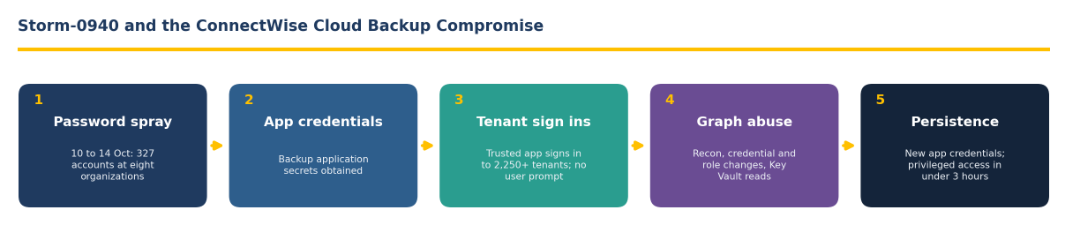
Storm-0940 and the ConnectWise Cloud Backup compromise (after the published research).
Timeline of recent events
| Date | Event | Status |
|---|---|---|
| Sep 2026 | ARTEX activity linked to Storm-0940 begins, per the research | Reported in research |
| 10 to 14 Oct | Automated password spray from 144.172.64[.]99 against 327 accounts at eight organizations | Confirmed in research; no successful sign in seen |
| 15 Oct | ConnectWise Cloud Backup application credentials used to sign in to customer tenants without user prompts | Confirmed by the vendor and independent observers |
| 16 Oct | ConnectWise posts an advisory with indicators that match the spray infrastructure | Confirmed |
| 21 Oct | Storm-0940 and ARTEX named in research; more than 2,250 tenants attempted | Attribution is a vendor assessment |
| Late Oct | ConnectWise restores suspended services in phases | Reported |
Hunting guidance
| Signal | Where to look | Why it matters |
|---|---|---|
| Added key or password credentials on an application or service principal | Entra audit log events such as Add key credentials to application, Add password credentials to application and Update application | Persistence that survives a password reset |
| Sign ins by a backup or integration application from an address that is not the vendor’s | Service principal sign in logs | The campaign used the app’s own credentials |
| New privileged role assignments or group changes by an application | Audit logs and Graph activity logs | AI accelerated follow on activity changed roles and groups |
| Reads of Key Vault secrets by a new identity | Key Vault and Azure activity logs | The actor read secrets in some environments |
| Many accounts each tried once from one address | Sign in logs | Low and slow router spraying, and the fast ARTEX variant |
| Scripted user agents such as python-requests, python-urllib and curl on cloud sign ins | Sign in and Graph logs | Listed user agents from the campaign |
Indicators of compromise
| Indicator | Type | Context |
|---|---|---|
| 144.172.64[.]99 | IPv4 | Cross tenant password spray, 10 to 14 Oct |
| 144.172.64[.]128 | IPv4 | Application sign ins and Graph activity |
| 144.172.64[.]60 | IPv4 | Listed by the vendor and the research |
| 194.165.16[.]21 | IPv4 | Possible link through a reused user agent |
| 506e08f9-6e9a-4da4-942b-a099a03644ae | Application ID | ConnectWise Cloud Backup |
| 24205314-2b89-4e07-a2a4-579e898a5640 | Application ID | ConnectWise application for Microsoft Teams |
| python-urllib/3.12, python-requests/2.31 and 2.34.2, curl/7.88.1, azure-toolkit/1.0 | User agents | Enumeration, spraying and escalation tooling |
The research refers to four application IDs but lists three, so check the vendor’s advisory for updates. Addresses and user agents change quickly, so use them with the behaviours above.
MITRE ATT&CK techniques
Technique IDs are our own mapping from the published research on the campaign and the actor.
| Tactic | ID | Technique | Observed procedure |
|---|---|---|---|
| Initial Access | T1110.003 | Brute Force: Password Spraying | Automated cross tenant spray of 327 accounts |
| Initial Access | T1195.002 | Supply Chain Compromise: Compromise Software Supply Chain | Abuse of ConnectWise Cloud Backup application credentials |
| Initial Access | T1078.004 | Valid Accounts: Cloud Accounts | Application identity signs in to customer tenants |
| Discovery | T1087.004 | Account Discovery: Cloud Account | Reconnaissance through Microsoft Graph |
| Persistence | T1098.001 | Account Manipulation: Additional Cloud Credentials | Application credential changes |
| Privilege Escalation | T1098.003 | Account Manipulation: Additional Cloud Roles | Group and privileged role changes |
| Credential Access | T1555.006 | Credentials from Password Stores: Cloud Secrets Management Stores | Reads of Azure Key Vault secrets in some environments |
| Command and Control | T1090.002 | Proxy: External Proxy | Router botnet and proxy infrastructure |
Recommendations
- Audit every third party application that has consent or credentials in your Microsoft 365 and Entra tenant, remove the ones you do not use, and restrict the permissions of the rest. Review applications from backup, migration and management suppliers first.
- Alert on changes to application credentials and roles, and on application sign ins from addresses outside the supplier’s published ranges. Use workload identity protection and conditional access for service principals where available.
- Block legacy authentication, require phishing resistant multifactor authentication for people, and monitor for password spraying: many accounts tried once from one address.
- Check the audit logs for the dates 10 to 21 October for application credential changes and Key Vault reads by unfamiliar identities, and rotate secrets if you find any.
- Ask backup and integration suppliers how they protect the secrets of multi tenant applications, how they would tell you of a compromise, and what they can disable at once.
04. Ransomware and Data Leaks
Coffin Locker Ransomware (new, likely a test build)
Coffin Locker is Windows ransomware that was first scanned publicly around 19 October 2026. It appends the .coffin extension, drops a note called how_to_recover.coffin.txt in every folder, replaces the wallpaper with a pixel font lock screen headed Your files have been sealed, and keeps itself alive with a Run key and a scheduled task named CoffinLocker. The executable is called Coffin.exe. The lock screen demands 0.075 BTC to a Bitcoin address and gives a contact email on an anonymous mail service. The note asks the victim to send the transaction ID and the machine name to that address.
Its note makes large claims. Each file is said to be sealed with its own key, using AES-256-GCM for content and ChaCha20-Poly1305 for headers, with X25519 session keys and an RSA-4096 master key. Files are said to start with the bytes of a ZIP archive, which would make them look like ordinary archives. The note says the original file sectors were overwritten with random data, and that volume shadow copies, the Windows backup catalog, restore points and the Recycle Bin were destroyed, so previous versions cannot save you. The sandbox confirms deletion of shadow copies and of the backup catalog with wbadmin, and renamed 247 files, but it cannot tell us whether the encryption claims are true.
Several details point to an unfinished or test build, not a working criminal tool. The note states the ransom as 75 BTC in one place, about $4,900 in its own text, while the lock screen says 0.075 BTC, a factor of 1,000, and the dollar figure only matches the smaller amount. The deadline of seven days is exactly the run date plus seven, so it is computed when the program runs and does not reflect any victim timeline. The payment address shown on the lock screen begins with bc1q and then spells the word COFFIN, and as we transcribed it contains characters that a valid Bitcoin address of that type cannot contain, such as I, O and the digit 1, so it probably cannot receive payment. The note also says a file named coffin_keys\master_rsa_private.pem is the only key that can unlock your files and tells the victim to back it up before touching anything. A genuine extortion operation would not leave its private key on the victim’s machine, which suggests a design error, a staged key, or a build that was never meant to extort. We cannot say whether keeping that folder allows recovery, and a victim should preserve it unmodified before any cleanup.
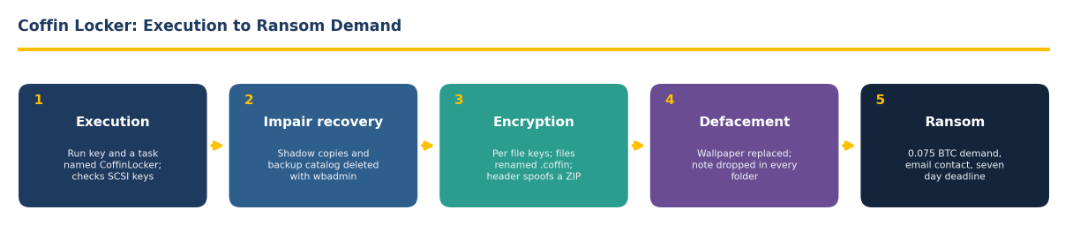
Coffin Locker flow from execution to the ransom demand (assembled from sandbox behaviour signatures and the note).
Observed evidence
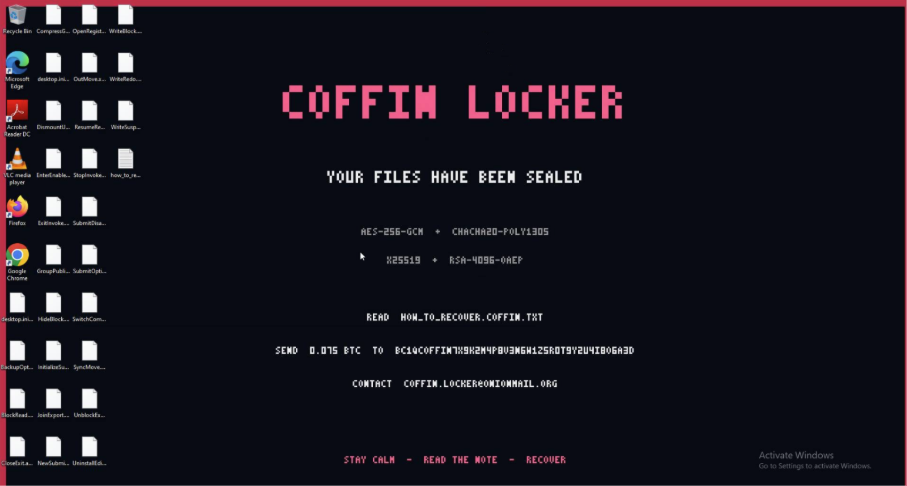
The Coffin Locker lock screen in the sandbox, showing the cipher claims, the 0.075 BTC demand and the contact email.
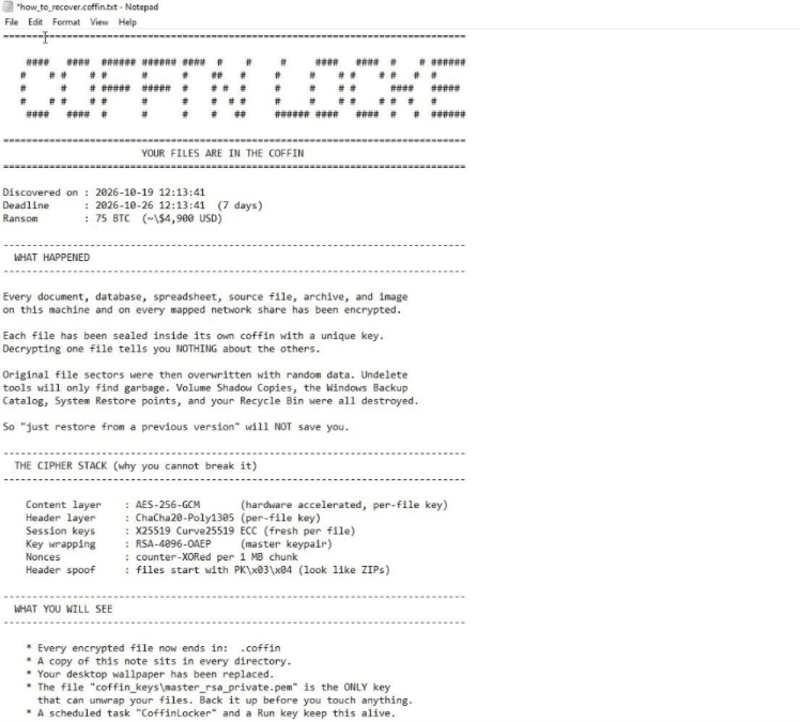
The how_to_recover.coffin.txt ransom note, with the deadline, the 75 BTC figure and the cipher stack claims.
Behavioural signatures
Sandbox analysis shows the sample deleting shadow copies and using the Volume Shadow Copy COM API, deleting the backup catalog with wbadmin, and renaming 247 files with a new extension. It adds a Run key, creates a scheduled task through the Task Scheduler COM API, drops desktop.ini files, sets the wallpaper through the registry and modifies Control Panel settings. It reads the hostname and domain from the registry, checks SCSI registry keys, a common sandbox detection step, discovers its environment with net.exe and loads a large number of dropped DLLs, which is consistent with a program bundled from a scripting language. The sandbox report shows no data theft behaviour, and the note makes no leak threat.
MITRE ATT&CK techniques
The first group of rows is the sandbox mapping. Rows marked as added are our own, for behaviour the sandbox report shows but the mapping leaves out.
| Tactic | ID | Technique | Observed procedure |
|---|---|---|---|
| Execution | T1059 | Command and Scripting Interpreter | Runs commands such as net.exe and wbadmin |
| Execution | T1053.005 | Scheduled Task/Job: Scheduled Task | Task named CoffinLocker |
| Execution | T1047 | Windows Management Instrumentation | Uses WMI |
| Persistence | T1547.001 | Boot or Logon Autostart: Registry Run Keys | Adds a Run key |
| Persistence | T1053.005 | Scheduled Task/Job: Scheduled Task | Scheduled task for persistence |
| Privilege Escalation | T1547.001 | Boot or Logon Autostart: Registry Run Keys | Run key persistence |
| Defense Evasion | T1006 | Direct Volume Access | Accesses volumes directly |
| Defense Evasion | T1070.004 | Indicator Removal: File Deletion | Deletes shadow copies and the backup catalog |
| Defense Evasion | T1112 | Modify Registry | Sets the wallpaper and Control Panel values |
| Impact | T1491 | Defacement | Replaces the desktop wallpaper |
| Impact | T1490 | Inhibit System Recovery | Deletes shadow copies and the backup catalog |
| Impact (added) | T1486 | Data Encrypted for Impact | Renames and encrypts files with .coffin |
| Discovery (added) | T1497.001 | Virtualization/Sandbox Evasion: System Checks | Checks SCSI registry keys |
| Discovery (added) | T1016 | System Network Configuration Discovery | Reads the hostname and domain |
Indicators of compromise
| Indicator | Type | Context |
|---|---|---|
| 034436d3b6715c98fecba 11565a30e2c74945ff183ed a4821c3e59c860cad7ac | SHA256 | Coffin Locker sample |
| Coffin.exe | Filename | Executable name seen in public sandbox reports |
| .coffin | File extension | Appended to encrypted files |
| how_to_recover.coffin.txt | Filename | Ransom note in every folder |
| coffin_keys\master_rsa_private.pem | File path | Local key file named in the note; preserve it unmodified |
| CoffinLocker | Scheduled task | Persistence task named in the note |
| [email protected] | Contact address on the lock screen and in the note | |
| bc1qcoffin7x9k2m4p 8v3n6w12sr0t9y2u4i806a3d | Bitcoin address | As transcribed from the lock screen; probably invalid; verify before use |
Other ransomware and data leak activity
The University of New Mexico Health System detected a ransomware attack on 26 October, diverted ambulances for two hours, cancelled appointments that day and had critical systems back by early on 27 October. It operates the state’s only level 1 trauma center, so even a brief outage had a patient safety effect. Sony So-net said about 2.58 million customer records were exposed after unauthorized access on 19 October that was detected on 23 October, and reset passwords for affected email services. The intrusion method is under investigation. Ransomware groups listing new victims this week included Play, Qilin, N0n, Direwolf and Booba Project, mostly against small and mid sized firms. Those listings are claims.
| Organization | Group | Sector and country | Status |
|---|---|---|---|
| Coast 2 Coast | Play | Retail and e-commerce services, United States | Claim; seen 27 to 28 Oct |
| APPL Holding | Qilin | Holding company, Germany | Claim; seen 26 Oct |
| Services group (name withheld) | N0n | Retail and facility services, United Arab Emirates | Claim; seen 27 Oct; payroll and identity archives claimed |
Recommendations
- Keep offline or immutable backups and test restoration. Coffin Locker deletes shadow copies and the Windows backup catalog, so recovery from local Windows backups cannot be assumed.
- Alert on wbadmin delete catalog and vssadmin or Volume Shadow Copy deletions, new Run keys and scheduled tasks created from user writable folders, and wallpaper changes by unexpected processes.
- If an unknown ransomware appears, preserve the note, a sample encrypted file and any key folder such as coffin_keys before cleaning, and involve incident response. Do not pay on the strength of a note that contradicts itself.
- For hospitals and other safety critical services, rehearse downtime procedures, including diverting patients, so a short outage does not become a safety event.
05. Credential and Account Exposure
Amadey: the loader that steals logins, and a takedown
Amadey is a commodity Windows loader and information stealer that has been sold on criminal forums since 2018, for around $500. A buyer gets a build and a web panel written in PHP and SQL, and infected computers check in with the buyer’s own command server and carry out its orders. Its main job is to install more malware, especially stealers such as StealC and RedLine, remote access tools such as Remcos, and at times ransomware. The most common ways it reached computers were fake software updates, cracked software installers and other malware loaders. In one case the Australian Signals Directorate described, it was hidden in an illegitimate copy of a photo editing program.
On 27 October the Australian Signals Directorate said its operators had entered the backend of one criminal’s Amadey operation, found that it controlled about 180,000 computers worldwide, including some in Australia, and disconnected the controller from every victim. The agency said that without the move those machines would have had their data stolen and sold or used for fraud and identity theft. In a separate case it was tipped off to the sale of 5 terabytes of data stolen from a business that did not know it had been hacked. The operation is a precedent for offensive action by an intelligence agency against criminal infrastructure, but it has limits. Researchers have counted 53 separate Amadey botnets that share no infrastructure, so 52 others keep running, the operator still holds what was taken before the cut, and the code is for sale.
The credential theft matters most to defenders. Amadey beacons by HTTP POST to a path ending in .php on up to three hard coded servers, and its strings and configuration are hidden with a layered cipher and decoded only in memory. Its credential stealing plugin, usually a DLL launched through rundll32, takes saved passwords from browsers, email clients and FTP and SSH tools, and file based items such as cryptocurrency wallets, messaging sessions and desktop documents. Other plugins capture the clipboard, which lets it swap wallet addresses, and take screenshots, and the loader can also act as a proxy. In 2026 researchers linked one Amadey campaign to more than 50 payloads across at least 13 malware families delivered through fake installers, and operators have also used public code hosting sites and compromised self hosted code servers to serve payloads, which makes the downloads look like normal developer traffic.
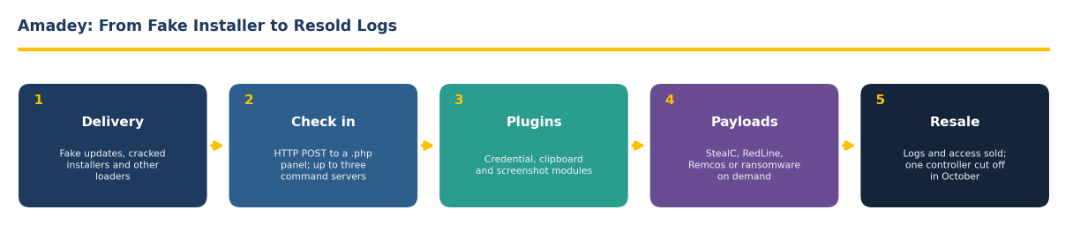
Amadey from fake installer to resold logs (after public research and the agency’s statements)
| Attribute | Detail |
|---|---|
| Type | Windows loader, information stealer and botnet client; sold as malware as a service |
| First seen | 2018; still active, with new samples seen through October 2026 |
| Delivery | Fake software updates, cracked installers, other loaders, phishing attachments, public code hosting sites |
| Command and control | HTTP POST to .php panel paths on up to three hard coded servers |
| Plugins | Credential stealer (cred and cred64 DLLs), clipboard hijacker (clip and clip64 DLLs), screenshot capture |
| Payloads | StealC, RedLine, Remcos and other RATs, proxy malware and ransomware, depending on the buyer |
| Data taken | Browser, email, FTP and SSH credentials; wallets; messaging sessions; documents; screenshots |
| Disruption | One operator cut off from about 180,000 computers by an intelligence agency (announced 27 Oct 2026); 53 botnets counted by researchers |
MITRE ATT&CK techniques
Technique IDs are our own mapping from public analysis of Amadey, and describe the family in general, not one sample.
| Tactic | ID | Technique | Observed procedure |
|---|---|---|---|
| Initial Access | T1189 | Drive by Compromise | Fake updates and malicious ads |
| Execution | T1204.002 | User Execution: Malicious File | Cracked installers and fake updates |
| Execution | T1218.011 | System Binary Proxy Execution: Rundll32 | Plugins such as the credential stealer launched through rundll32 |
| Credential Access | T1555.003 | Credentials from Web Browsers | Browser credential plugin |
| Credential Access | T1056.001 | Input Capture: Keylogging | Clipboard capture and swapping |
| Collection | T1113 | Screen Capture | Screenshot plugin |
| Command and Control | T1071.001 | Application Layer Protocol: Web Protocols | HTTP POST to .php panel paths |
| Command and Control | T1105 | Ingress Tool Transfer | Downloads further payloads and plugins |
| Exfiltration | T1041 | Exfiltration Over C2 Channel | Stolen data sent to the panel |
Recommendations
- Block software installs from unofficial sources and cracked software, and restrict who can run installers. Most Amadey infections start with a user running something they should not.
- Alert on rundll32 loading DLLs from user writable folders, on HTTP POSTs to .php paths on unfamiliar servers and on processes that read browser profile data and then make outbound connections.
- Assume saved browser passwords, wallets and session cookies on an infected machine are stolen. Reset credentials, revoke sessions and rotate tokens from a clean device, and disable password saving in browsers for staff who handle financial systems.
- Do not treat a takedown as the end. The infected computers still need cleaning, and the credentials already taken can be used for months.
- Feed infostealer log monitoring into your credential reset process, so exposed staff and customer logins are found before they are used.
Application identities: the credential no one resets
The ConnectWise Cloud Backup compromise is a lesson in a different kind of credential. A multi tenant application that a customer approves keeps its own secrets and signs in as itself, with no password prompt, no multifactor step and often no sign in alert, and those secrets do not expire when a staff member changes a password. Storm-0940 took the application’s credentials and used them to attempt sign ins at more than 2,250 tenants, then added its own credentials and changed roles in the ones it reached. A password reset would not have removed that access. Review every application consent, service principal and integration key in your cloud tenants, and treat them as privileged accounts with owners, expiry dates, logging and limits.
Recommendations
- Keep a register of applications and service principals with consent in your tenant, who owns each, what it can do and when its secrets expire.
- Alert on new credentials added to an application, on role changes by an application and on application sign ins from unexpected addresses, and rotate application secrets after any supplier incident.
- Prefer certificates or managed identities with short lifetimes over long lived secrets, and restrict application permissions to what the supplier actually needs.
06. Vulnerability Intelligence
Three advisories are covered here, in order of urgency. The Brotli flaw reaches far beyond one runtime and is already attacked. The Magento flaw has been exploited for months and only now reached the CISA catalog. The PHP flaw follows last issue’s emergency fixes and has no patch.
| Priority | CVE | Product and severity | Exploitation and fix |
|---|---|---|---|
| 1 Immediate | CVE-2026-111497 | Brotli decoder (Node.js and others), out of bounds write; CVSS 9.2 (v4.0) from the library’s assigner, 8.1 (v3) elsewhere | Exploited; CISA KEV 27 Oct, due 10 Nov; Node.js 26.12.1, 24.22.1, 22.23.4; Brotli 1.2.1, 1.1.1, 1.0.10 |
| 2 Immediate | CVE-2026-48356 | Adobe Commerce and Magento, unrestricted file upload (PolyShell); CVSS 9.3 | Exploited since March; CISA KEV 27 Oct, due 10 Nov; fixed in APSB26-73 (14 Jul) |
| 3 This week | CVE-2026-115560 | PHP session upload progress, code execution in unusual configurations; no score | Unpatched; no exploitation reported; set session.upload_progress.enabled to 0 |
CVE-2026-111497: Brotli Decoder Out of Bounds Write (Node2Shell)
CVE-2026-111497 is an out of bounds write in the Brotli decoder, the library that decompresses Brotli compressed data. The Node.js project published an advisory and fixes on 21 October for the 26.x, 24.x and 22.x lines. A Brotli stream can signal a switch between block types, and when the signal is invalid the vulnerable decoder treated it as a need for more input instead of a format error, so it kept appending bytes to an eight byte internal buffer and wrote past its end. An attacker who can supply Brotli data that an application decompresses can corrupt memory, which can lead to a crash, disclosure of process memory or code execution, with no authentication. Applications are exposed when they decompress untrusted Brotli data, including responses received through the built in fetch function and request bodies parsed by Express 5.
The flaw reaches well beyond Node.js. It is in the upstream Brotli library, versions 1.0.3 to 1.2.0, which is used by many runtimes and products, and fixed versions are 1.2.1, 1.1.1 and 1.0.10. The upstream fix was committed on 27 February 2026 with no release and no advisory, and stayed publicly readable for eight months before the patched versions were issued last week. Public proofs of concept exist on code hosting sites, one security firm showed code execution against an official Node.js 24.22.0 image, and sensors recorded exploitation attempts on 26 October. CISA added the flaw to its catalog on 27 October with a deadline of 10 November. The library’s assigner scores it 9.2 under CVSS v4.0, while the Node.js project rates it high and some vendors score it 8.1 under v3. Node.js versions 25.x, 23.x and 20.x and older are end of life and get no fix. Some application delivery products bundle the library and are affected, while a Brotli module for the NGINX web server uses only the compression side and is not directly affected.
| Field | Detail |
|---|---|
| CVE ID | CVE-2026-111497 (names include Node2Shell, Brotli2Shell and HTTP2Shell) |
| Affected product | Brotli decoder 1.0.3 to 1.2.0; Node.js 26.x, 24.x and 22.x (bundled); other products that bundle the library |
| Fixed versions | Brotli 1.2.1, 1.1.1, 1.0.10; Node.js 26.12.1, 24.22.1, 22.23.4. No fix for end of life Node.js lines |
| Severity | CVSS 9.2 (v4.0) from the assigner; high per Node.js; 8.1 (v3) in some vendor records |
| Vulnerability type | Out of bounds write (CWE-787) and unchecked return value (CWE-252) |
| Exploitation status | Exploited; CISA KEV 27 Oct 2026, due 10 Nov; public proofs of concept |
| Attack requirement | Application decompresses attacker supplied Brotli data; no authentication |
| Interim measures | Reject or inspect Brotli encoded request bodies and responses from untrusted sources; web application firewall signatures where available |
Recommendations
- Find every use of Brotli: Node.js applications and base images, services that call external APIs with fetch, Express 5 request parsing, and any product or library that bundles the decoder. Software bills of materials help here.
- Update Node.js to 26.12.1, 24.22.1 or 22.23.4 and Brotli to 1.2.1, 1.1.1 or 1.0.10, rebuild container images, and retire end of life Node.js versions.
- Until patched, do not decompress Brotli data from untrusted parties, and consider blocking or inspecting Content-Encoding: br on externally reachable services.
- Hunt for crashes and unusual child processes from Node.js services since 21 October, and review web logs for Brotli encoded requests from unfamiliar sources.
CVE-2026-48356: Adobe Commerce and Magento File Upload (PolyShell)
CVE-2026-48356, named PolyShell, is an unrestricted file upload flaw in Adobe Commerce, Adobe Commerce B2B, Magento Open Source and an events connector. The public analysis describes an unauthenticated request to the guest cart interface that uploads a file which passes the image check but keeps a script extension, so the web server runs it. The file is written under the media directory, which gives the attacker code execution on the store. Adobe fixed it in security bulletin APSB26-73 on 14 July 2026 for versions 2.4.4 to 2.4.9 and the related B2B and connector releases. Public research described the flaw in March, probing began on 16 March, automated mass scanning on 19 March, and one group reportedly injected webshells into 471 stores in an hour. CISA added it to its catalog on 27 October with a deadline of 10 November, more than three months after the patch and seven months after the first attacks.
The scoring is misleading. The vector is CVSS 9.3 with user interaction required and a description of code execution in the context of the current user, yet the flaw is described as an unauthenticated server side upload that needs no interaction. A reader who relied on the label could rate it lower than it deserves. Stores that were unpatched at any time since March may already hold a webshell, and for payment pages the risk includes a card skimmer being added to checkout scripts.
| Field | Detail |
|---|---|
| CVE ID | CVE-2026-48356 (PolyShell) |
| Affected product | Adobe Commerce 2.4.4 to 2.4.9, Commerce B2B 1.3.3 to 1.5.3, Magento Open Source 2.4.6 to 2.4.9 and the I/O Events connector before 1.21.0 |
| Fixed versions | Releases with APSB26-73 (14 July 2026), such as 2.4.8-2026-jul and later |
| Severity | Critical; CVSS 9.3 (v3.1); vector shows user interaction required, which does not match the described exploitation |
| Vulnerability type | Unrestricted upload of file with dangerous type (CWE-434) |
| Exploitation status | Exploited since March 2026; CISA KEV 27 Oct 2026, due 10 Nov |
| Impact | Webshell and code execution on the store; possible skimmer injection on checkout pages |
Recommendations
- Apply APSB26-73 or later to every Adobe Commerce and Magento Open Source store, including those run by agencies and suppliers.
- Check the media and custom options upload folders for script files, review web logs for guest cart requests that upload files, and compare checkout scripts against known good copies for skimmers.
- If a store was unpatched at any time since March, treat it as possibly compromised: rotate admin, database and payment credentials and review payment page scripts.
CVE-2026-115560: PHP Session Upload Progress Code Execution
Two days after its emergency release for the PHP2Shell flaws, the PHP project disclosed CVE-2026-115560 on 23 October, a code execution path in the session upload progress feature that depends on an unusual combination of session settings, in particular a changed session serialize handler. It says the issue is unlikely in practice, will handle it in the regular release cycle and will publish a full advisory with the next release. It has not published affected versions or a score. Applications on fully patched PHP releases can still be affected, and there is no permanent fix yet. The project’s interim advice is to set session.upload_progress.enabled to 0, which it had already recommended for CVE-2026-109619, and keep it off. No exploitation of the new flaw has been reported.
Last issue’s flaws moved on. The fixed releases are PHP 8.5.12, 8.4.27, 8.3.36 and 8.2.35, and one analysis says the patches were rebuilt on 22 October with changelog entries dated that day but unchanged version numbers, so confirm that your build is current. Exploit attempts against the PHP2Shell flaws reached into the millions, with the first attempts seen on 17 October, four days before the release, from anonymized addresses against honeypots, and observed attacks used multipart requests that fit CVE-2026-109618. Researchers report no confirmed compromises, but the activity shows scanning at scale, and a public exploit framework now includes probes for the new flaw as well.
| Field | Detail |
|---|---|
| CVE ID | CVE-2026-115560; related to CVE-2026-109618 and CVE-2026-109619 (fixed 21 Oct) |
| Affected product | PHP, session upload progress feature with a non default session serialize handler; versions not published |
| Severity | No score published; PHP calls it an unlikely code execution vector |
| Exploitation status | No exploitation reported as of 26 Oct; attempts against the earlier flaws reached millions |
| Fix | Not released; full advisory promised with the next regular release |
| Interim measure | session.upload_progress.enabled set to 0 and PHP reloaded; test first, since it disables upload progress bars |
Recommendations
- Set session.upload_progress.enabled to 0 on PHP servers that do not need it, and reload PHP FPM or the web server so the change takes effect.
- Confirm that PHP builds are the current 8.5.12, 8.4.27, 8.3.36 or 8.2.35 releases, and ask suppliers and hosts to confirm theirs.
- Review changes to session.serialize_handler at runtime in your applications, and watch for unusual multipart requests to upload endpoints.
Also this week
The ConnectWise Cloud Backup compromise was an abuse of application credentials rather than a software flaw, so it appears under Threat Actor Activity. CISA’s catalog additions on 27 October included the Brotli and Magento flaws described above. We saw no other newly exploited flaws of comparable weight in the sources reviewed this week.
07. Darkweb and Underground Activity
ARTEX in the underground
The ARTEX story is partly an underground one. The operator behind the South Korean campaign left an open directory with its own AI session histories, and those show someone with access to a large amount of financial data and no plan for it: the operator asked an AI assistant to suggest Telegram groups where Korean data could be sold. That is a sign of how cheap access has become. A tool that finds and takes data at machine speed can produce more data than its operator knows how to sell, and the surplus ends up in channels where it is cheap, public or free. Researchers also found tooling for cryptocurrency theft, Linux exploitation and mobile testing on the same infrastructure. The developer closed the project after the Korean case, but forks and copies are available, and Chinese language instruction files, proxy lists and forks of the tool are the items to watch for in the underground.
Extortion that outruns the incident
The GMO Internet case shows extortion built to outrun the investigation. The attackers emailed their demand on the day the service was shut down, set a deadline for noon on 27 October and threatened three things at once: continued unauthorized trading, publication of customer data and ransomware on customers’ own PCs. The company refused to pay, the deadline passed without ransomware, and the attackers published material anyway. Pressure through threats to the customer base, not just the company, is a pattern worth preparing for: it pushes the victim to act on rumour, and it makes customers part of the incident. Prepare messages, compensation rules and device checks in advance.
A loader’s market, a takedown and a price
Amadey sells for about $500 and has been for sale since 2018, which is why researchers count 53 separate botnets. The Australian Signals Directorate action took one controller offline and cut it off from 180,000 computers, and the agency also learned of the sale of 5 terabytes of stolen business data. A takedown of one buyer’s panel does not change the supply, but it does remove one operator’s data stream and makes the sellers’ customers aware that their panels can be reached. Sellers may now stress operational security, and any logs already taken from the 180,000 machines are likely to stay on sale.
08. Key Takeaways
- Plan for machine speed. ARTEX turns known flaws, weak passwords and exposed portals into an intrusion in hours, and was used against banks, Japanese companies and Microsoft 365 tenants. Test your own exposure, throttle automated logins and pre approve containment steps.
- Application credentials are credentials. Storm-0940 used a backup application’s own secrets to reach more than 2,250 tenants, and a password reset would not have removed it. Keep a register of applications with consent, watch for new credentials and role changes, and rotate secrets after a supplier incident.
- Hosted desktops that hold trading logins are part of the trading environment. GMO’s Desktop Cloud breach led to unauthorized trades and a ¥8 billion demand. Watch for orders from new addresses, restrict API keys, and prepare compensation and customer messages in advance.
- Control the scripts on payment pages. One shared analytics script took card data and CPF tax IDs from dozens of brands. Use content security policies and script change monitoring, and patch self hosted analytics servers.
- Take Brotli and Magento seriously now. Both reached the CISA catalog on 27 October, one after eight months of silence from the upstream project and one more than three months after the vendor’s fix. Update Node.js, Brotli and Adobe Commerce and check stores for webshells.
- Set the PHP stopgap and confirm builds. The PHP project’s new, unpatched flaw has a one line mitigation, and last issue’s fixes were rebuilt without changing version numbers.
- A takedown is not a cleanup. Amadey lost one controller, but 52 other botnets and the stolen data remain. Reset credentials on any machine that ran cracked or fake software.
- Keep claims separate from evidence. Coffin Locker’s cipher claims and its contradictory demand, the ransomware listings, the RDP access claimed at GMO and the attribution of any ARTEX use to one actor are unconfirmed.
Priority actions this week
| Priority | Action | Why now |
|---|---|---|
| Immediate | Update Node.js to 26.12.1, 24.22.1 or 22.23.4 and Brotli to 1.2.1, 1.1.1 or 1.0.10; rebuild images; retire end of life Node.js | CVE-2026-111497 is exploited and on the CISA catalog, due 10 November |
| Immediate | Apply APSB26-73 to Adobe Commerce and Magento stores and check media folders and checkout scripts for webshells and skimmers | CVE-2026-48356 has been exploited since March and was listed on 27 October |
| Immediate | Review Microsoft 365 and Entra application consents and credentials; alert on new application credentials, role changes and odd sign in sources; check logs for 10 to 21 October | Storm-0940 used a supplier application to attempt access at more than 2,250 tenants |
| This week | Set session.upload_progress.enabled to 0 on PHP servers and confirm builds are 8.5.12, 8.4.27, 8.3.36 or 8.2.35 | CVE-2026-115560 has no patch; the earlier PHP flaws are being attacked |
| This week | Throttle and monitor logins for spraying and stuffing, require multifactor authentication and alert on scripted user agents and bursts of attempts | ARTEX drives sign ins at up to 2,900 a minute |
| This week | For brokers and FX firms, review hosted desktops and saved trading logins, watch for orders from new addresses and prepare customer notices | GMO’s Desktop Cloud breach led to unauthorized trades |
| This week | Inventory scripts on payment and login pages, enable content security policy and subresource integrity, and patch self hosted analytics | A shared analytics script skimmed card data from dozens of brands |
| This week | Verify offline backups and alert on wbadmin catalog deletion, shadow copy deletion and new Run keys or tasks; block cracked installers | Coffin Locker and Amadey both rely on these behaviours |
Disclaimer
This Report is provided for informational and security-awareness purposes only. The information presented is based on intelligence collected from publicly available sources, underground forums, dark web sources, third-party feeds, and other available data at the time of analysis.
Threat intelligence may be incomplete, outdated, unverified, or subject to change. References to threat actors, organizations, vulnerabilities, indicators, or incidents represent observed or reported information and should not be considered definitive attribution unless explicitly stated and supported by reliable evidence.
The information contained in this report should be independently validated before being used for security, operational, legal, or business decisions. iZOOlogic does not guarantee the accuracy, completeness, or timeliness of the information and shall not be held responsible for any actions or decisions taken solely based on this report.
This report is intended for authorized recipients and should be handled in accordance with applicable organizational security, confidentiality, and information-sharing policies.
