
 HQ/EMEAFind out how we can help your business

| Field | Value |
|---|---|
| CVE ID | CVE-2026-117298 |
| Vendor | Guangzhou Qibo Network Technology Co., Ltd. (Qibosoft) |
| Product | Qibo CMS X1 (QiboCMS X1) |
| Affected version | Qibo CMS X1.0 (tested build). Successful reproduction confirmed on Gitee source snapshot at commit ff5719d0. Other releases and builds have not been independently assessed. |
| Fixed version | No vendor-confirmed fixed version is identified in the materials reviewed for this report. |
| Vulnerability type | PHP code injection through evaluation of request-derived template content (CWE-95); missing authentication for sensitive functionality (CWE-306). |
| Attack vector | Network |
| Privileges required | None |
| User interaction | None |
| CVSS 4.0 | 9.3 (Critical) – CVSS:4.0/AV:N/AC:L/AT:N/PR:N/UI:N/VC:H/VI:H/VA:H/SC:N/SI:N/SA:N |
| Affected component | application/index/controller/LabelShow.php, function ajax_get |
1. Executive Summary
CVE-2026-117298 is an unauthenticated remote code execution (RCE) vulnerability in Qibo CMS X1 affecting the public index/label_show/ajax_get endpoint. The handler removes ? markers from request parameter names and assigns their values to dynamically named PHP variables; an attacker-supplied view_tpl? parameter can therefore populate $view_tpl. When non-empty, this request-controlled template content is executed through eval(). iZOOlogic reproduced operating-system command execution as the web-server account (www-data) on a stock Qibo CMS X1.0 build at Gitee commit ff5719d0, with command output returned in the HTTP response. MITRE assigned CVE-2026-117298 on 04 November 2026. The tested source snapshot is confirmed; other releases have not been independently assessed, and the materials reviewed do not identify a vendor-confirmed fix.
2. Technical Analysis
2.1 Root Cause
In ajax_get(), request parameters whose names contain the ? marker are processed by removing that marker and assigning the associated value to a PHP variable whose name is derived from the request parameter. The assignment uses PHP variable-variable syntax ($$key), allowing the request to influence the variable name. For example, a request field named view_tpl? is normalized to view_tpl and can populate the $view_tpl variable:
// application/index/controller/LabelShow.php
if (strstr($key,’?’)) {
$parameter[$key] = $value;
$key = str_replace(‘?’,”,$key);
$this->request->get([$key=>$value]);
$$key=$value;
}
After parameter processing, the handler checks whether $view_tpl is empty. If it is empty, the function returns the not_tpl error response. If the request has populated $view_tpl with a non-empty value, execution proceeds to the alternate branch, where the application initializes output buffering and evaluates the template content as PHP:
if(empty($view_tpl)){
//die(‘tpl not exists !’);
return $this->err_js(‘not_tpl’);
}
}else{
@ob_end_clean();ob_start();
eval(‘?>’.$view_tpl);
The handler skips values containing a single-quote character at the checks identified in the source (lines 114–116). This restriction does not prevent the demonstrated issue because the supplied template can be constructed without single quotes. The underlying security problem is that request-controlled content reaches eval(), not merely that a particular character is accepted.
2.2 Data Flow Analysis
The request is retrieved through get_post() (line 107) and processed by ajax_get() in application/index/controller/LabelShow.php. During parameter processing, a key containing ? is normalized with str_replace() and the associated value is assigned to a dynamically named PHP variable at the variable-variable assignment (reported at line 121). In the demonstrated request, this allows the view_tpl? field to populate $view_tpl. The handler then retrieves tag data through Label::get_tag_data_cfg() in application/index/model/Label.php (line 102). After checking that the selected dataset is non-empty, the function reaches the template execution branch and calls eval() on $view_tpl (reported at line 174). The report identifies no effective allowlist or validation that prevents request-derived PHP template content from reaching this execution sink.
2.3 Preconditions
- Network access to the web server is required. No account, authenticated session, or token is required.
- The tagname and pagename values must match the ^([-\w]+)$ pattern (source lines 96–100). In the documented test request, they are set to the same value, and that value must not identify a tag already stored in the database.
- The selected dataset must be non-empty so that the execution branch is reached. In testing, the user table was selected as the data source; it contained the administrator account created during installation.
2.4 CVSS 4.0 Scoring Rationale
The network attack vector (AV:N), low attack complexity (AC:L), no additional attack requirements (AT:N), no privileges required (PR:N), and no user interaction (UI:N) reflect the demonstrated unauthenticated attack path. High confidentiality, integrity, and availability impacts (VC:H/VI:H/VA:H) reflect operating-system command execution under the web-server account. No subsequent-system impact was demonstrated (SC:N/SI:N/SA:N). The 9.3 score is iZOOlogic’s assessment, not an NVD-assigned rating.
3. Impact
- Confirmed Remote Command Execution: Successful exploitation enables arbitrary operating-system command execution under the web-server account (www-data). The command output is returned to the attacker in the HTTP response.
- Not Tested: Reading files outside the web root, database credential extraction, lateral movement, and persistence were not tested. These outcomes are not claimed as confirmed findings in this report.
- Affected Deployment Scope: Deployments containing the vulnerable implementation and exposing index/label_show/ajax_get are potentially vulnerable when the documented preconditions are satisfied. Successful reproduction is confirmed only for the Qibo CMS X1.0 source snapshot at Gitee commit ff5719d0; other releases and builds have not been independently assessed.
3.1 Research Scope and Limitations
The assessment was conducted in a controlled, isolated Docker environment using the Qibo CMS X1.0 source snapshot at commit ff5719d0. The investigation confirms unauthenticated command execution within the privileges of the web-server process. Other product releases, deployment configurations, and software versions were not independently evaluated. The investigation did not assess whether the issue is being exploited in the wild or whether any internet-facing installations have been compromised. Potential post-exploitation activities listed in Section 3 were not validated.
4. Reproduction
4.1 Test Environment
- Docker test stack: PHP 7.4.33 running on an Apache 2.4.54 PHP-Apache image, with MySQL 5.7.
- Stock Qibo CMS X1.0 build from the Gitee repository at commit ff5719d0.
- Installation completed using the default installer options and a local database.
4.2 Reproduction Steps
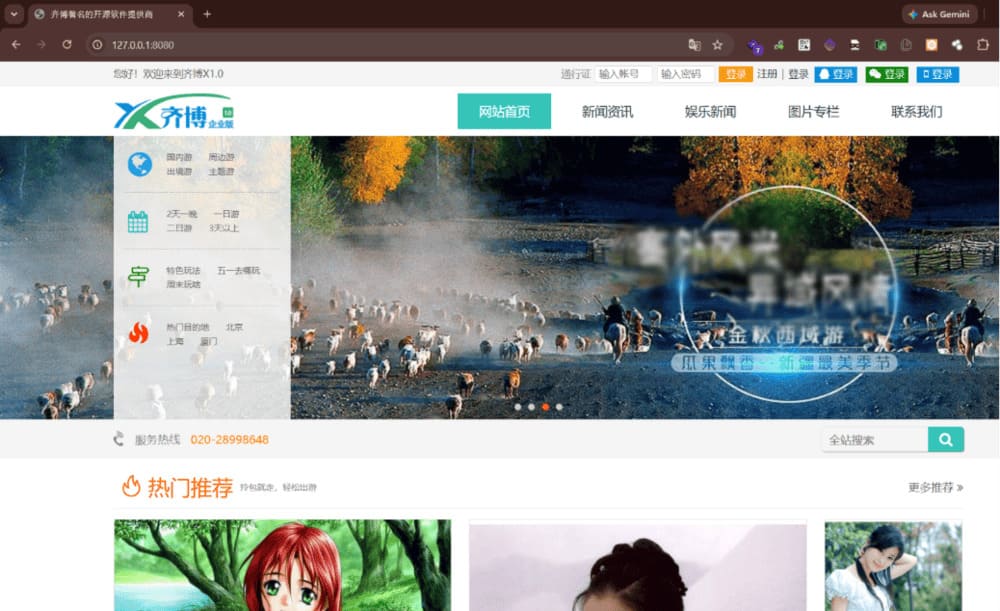
- Start the Docker stack and complete the Qibo CMS X1 installation using the default installer options.
- Send an unauthenticated HTTP POST request to /index.php?s=index/label_show/ajax_get. Set the tagname and pagename query parameters to the same value. The value must match ^([-\w]+)$ and must not correspond to a tag already stored in the database.
- Include the form fields union=class, class=app\common\model\User@labelGet, rows=1, and page=1, together with a request field named view_tpl? containing PHP template content that invokes an operating-system command. The complete executable payload is intentionally withheld from this public report.
- Inspect the data member of the JSON response. In the documented whoami test, the returned command output identifies the executing account as www-data.

The screenshot records HTTP 200 and www-data output from whoami; the complete payload is withheld from this public report under coordinated disclosure.
5. Remediation
- Remove the variable-variable assignment in LabelShow.php (reported at line 121), and audit other locations in application/index/controller and application/common/model where request-controlled keys are used to create PHP variables.
- Do not evaluate template text supplied through an HTTP request. Select templates from trusted, server-side files using a strict allowlist.
- Replace eval(‘?>’.$view_tpl) (reported at line 174) with a safe template-rendering mechanism that uses trusted stored templates only. Disable the functionality for unauthenticated callers until a secure implementation is available.
- Require authentication and authorization for label routes that accept template or class parameters. Restrict callable classes and methods to an explicit allowlist.
- Audit other controllers and models for request-derived variable-variable assignments and evaluation of request-derived strings.
- Release a patched version, publish a security advisory, and notify operators of affected installations.
6. Interim Workarounds for Operators
- At the web server, reverse proxy, or Web Application Firewall (WAF), block requests to index.php when the s query parameter begins with index/label_show, unless the functionality is required for business operations.
- Restrict administrative and management interfaces to trusted networks and authorized source addresses.
- Review access logs for POST requests to index/label_show/ajax_get, particularly requests containing a parameter named view_tpl? or other unexpected template-related parameters.
- Investigate suspicious requests alongside web-server process activity, unexpected child processes, abnormal outbound connections, and unexplained command execution originating from the web-server account.
- Monitor Qibosoft security announcements for a vendor-verified fix and apply the patch once available. These workarounds are temporary risk-reduction measures and do not replace a security patch.
7. Disclosure Timeline
| Date | Event |
|---|---|
| 14 October 2026 | Vulnerability identified during testing of a local, isolated installation. |
| 15 October 2026 | Vulnerability report submitted to Qibosoft ([email protected]) and the Chinese national CERT channel. |
| 04 November 2026 | CVE-2026-117298 assigned by MITRE. |
Disclosure status: The report records submission to Qibosoft and the Chinese national CERT channel on 15 October 2026, followed by MITRE assignment of CVE-2026-117298 on 04 November 2026. The materials reviewed do not document vendor acknowledgement, a vendor-confirmed patch, or an assessment of in-the-wild exploitation.
8. Credit
iZOOlogic Threat Research Team
9. References
- Qibo CMS X1 source-code repository: https://gitee.com/qibosoft/x1_of_cms
- Tested source revision: Gitee commit ff5719d0; affected component: application/index/controller/LabelShow.php, function ajax_get.
- Qibosoft official product website: https://x1.php168.com/
- MITRE CVE Program record: https://www.cve.org/CVERecord?id=CVE-2026-117298 (assigned 04 November 2026).
