
 HQ/EMEAFind out how we can help your business


1. Executive Summary
A critical memory-corruption vulnerability, tracked as CVE-2026-114938 and publicly named “Java4Shell,” has been disclosed in the Base64 decoder of OpenJDK, the runtime that underpins the large majority of enterprise Java deployments. The defect is a heap-based buffer overflow (CWE-122) in the hardware-accelerated decode routine used by the HotSpot just-in-time compiler. An unauthenticated, remote attacker who can cause an affected application to decode attacker-supplied Base64 data can write beyond the end of a heap buffer, disclose adjacent memory in the manner of Heartbleed, and, through controlled heap manipulation, achieve remote code execution.
The flaw is rated 8.1 (High) under CVSS v3.1 by the runtime maintainers and 9.2 (Critical) under CVSS v4.0 by the disclosing research team. It affects OpenJDK 17.0.6 and later, and all releases on the 21, 25 and 27 lines, across every distribution built from OpenJDK. Exploitation additionally requires the host to run on an x86-64 processor with AVX-512 VBMI support; standard Java 8 and 11, and all ARM64 hosts, are not affected.
Practical impact depends on the environment. Where attacker-controlled input reaches the vulnerable decoder, denial of service is the more readily achievable outcome: the out-of-bounds write corrupts adjacent heap memory and the runtime typically crashes later during garbage collection. Reliable remote code execution is possible but requires additional, bespoke exploitation work for each targeted application and runtime; there is no single universal exploit. The headline critical rating reflects the worst-case code-execution outcome rather than the effort an attacker must expend for it.
Fixed builds were released on 17 November 2026. At the time of writing, no in-the-wild exploitation has been confirmed and the vulnerability is not listed in the CISA Known Exploited Vulnerabilities catalogue. However, the root cause and general exploitation technique are public, a working proof-of-concept has been claimed, and details are reported to have leaked ahead of the coordinated patch. The window to weaponisation should therefore be assumed to be short. Immediate patching of all internet-facing and internal Java services is strongly recommended.
2. Vulnerability at a Glance
| Attribute | Detail |
|---|---|
| CVE identifier | CVE-2026-114938 |
| Common name | Java4Shell |
| Vulnerability class | Heap-based buffer overflow / out-of-bounds write (CWE-122) |
| Affected component | HotSpot JIT compiler, x86-64 Base64 decode intrinsic (java.util.Base64) |
| CVSS v3.1 | 8.1 High (AV:N / AC:H / PR:N / UI:N), per runtime maintainers |
| CVSS v4.0 | 9.2 Critical, per disclosing research |
| Impact | Denial of service (JVM crash) is readily achievable; heap disclosure and unauthenticated remote code execution are possible with bespoke, per-application exploitation |
| Authentication | None required for the pre-authentication attack paths |
| Hardware condition | x86-64 CPU with AVX-512 VBMI (Intel Ice Lake+ Xeon; AMD Zen 4+). ARM64 not affected |
| Exploitation status | No confirmed in-the-wild activity; not in CISA KEV as of 17 Nov 2026; PoC claimed |
| Patch availability | Fixed builds released 17 November 2026 |
3. Disclosure Timeline
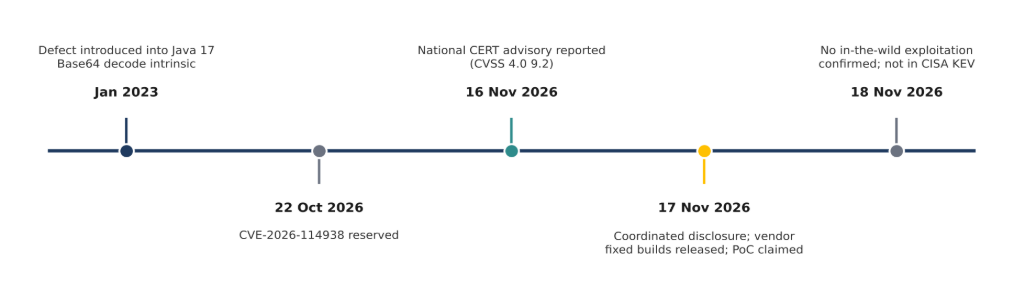
Figure 1. Key milestones for CVE-2026-114938.
Analysis indicates the vulnerable code has been present in Java 17 builds since early 2023 and in every subsequent major line. A related data-loss defect in the same decode routine was corrected in early 2024, but the memory-safety flaw now tracked as Java4Shell was not identified at that time, leaving the exposure in place until the November 2026 coordinated disclosure.
4. Technical Analysis
OpenJDK accelerates Base64 decoding on supported x86-64 processors by substituting a hand-written AVX-512 assembly routine for the standard Java loop once a method has been executed often enough for the C2 compiler to optimise it. These native replacements, known as intrinsics, let the runtime use specialised CPU instructions, but they must respect the bounds of the Java arrays they are given. The decoder first calculates the output space it needs and allocates a destination array, then decodes into it; the allocation itself is correct, and the fault lies further down the call chain in the native routine.
The routine converts each complete 64-byte input block into 48 output bytes. When fewer than 64 input bytes remain, a separate handler decodes the final fragment, and this is where the length calculation fails. For a one-character fragment the handler divides the remaining length by four, discards the remainder and multiplies by three, which yields zero. A padding branch then decrements that value for the trailing padding character, with no check that the result stays non-negative, so the fragment output length becomes minus one.
The negative length is then used to build the write mask. The routine starts from a 64-bit value with every bit set and uses a bit-extract instruction to keep only the requested number of low bits. That instruction reads its bit count from the low byte of the length operand; for minus one that byte is 255, which exceeds the 64-bit width, so the instruction leaves all 64 bits set. The masked vector store therefore writes a full 64 bytes rather than the small number the fragment should have produced.

Figure 2. Sequence of the corruption. The out-of-bounds write occurs in native code before Java rejects the input.
A concrete trigger illustrates the effect. A value of 128 “A” characters followed by a single padding character passes the initial length check and causes a 98-byte destination array to be allocated. The routine decodes the first 128 characters into 96 bytes, then mishandles the trailing fragment and performs a 64-byte masked store beginning at offset 96. Of those 64 bytes, two fall inside the array and 62 are written past its end, into neighbouring heap memory. On newer OpenJDK 17 and later builds an equivalent trigger of 64 “A” characters plus padding reaches the same fault through a smaller allocation; the length threshold to enter the fast path differs between builds.
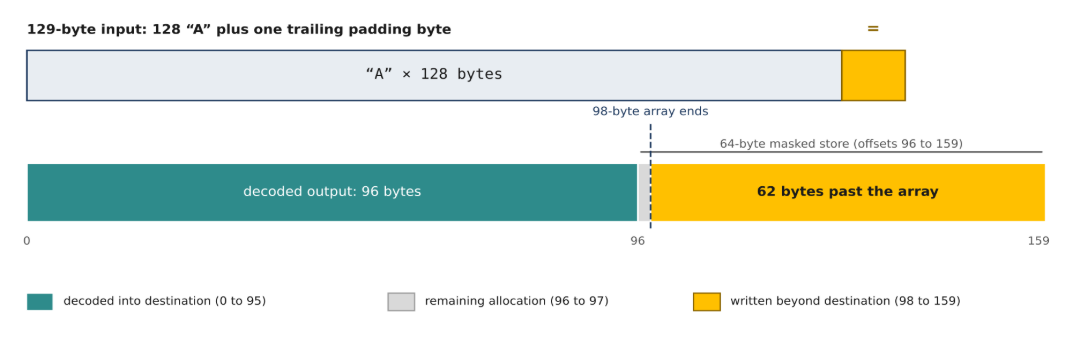
Figure 3. Memory layout of the overrun for the 128-character trigger. 62 of the 64 stored bytes land outside the destination array.
The bytes written are not freely chosen by the attacker. The handler fills unused input positions with a fixed filler before decoding, so most of the excess output is a constrained, repeating byte pattern rather than arbitrary attacker data. Only the position at which the write lands is influenced by the attacker, through the surrounding heap layout. This constraint makes a simple, direct overwrite of attacker-chosen values impossible and is the main reason reliable code execution requires substantial, target-specific exploitation effort.
The decoder subsequently rejects the malformed value and throws an exception, but by then the native routine has already written outside the array, so catching the exception does not undo the damage. A write into unused heap space may pass unnoticed, while a write into an adjacent object header can corrupt data the runtime consults later. In standalone testing this corrupted a neighbouring array header and the runtime crashed during a later garbage collection, which is why the visible symptom often appears far from the decoder call and is most commonly a crash rather than controlled execution.
Decoder scope: in the tested builds the vulnerable fast path is reached through the basic and URL-safe decoders (the decoders returned by the standard and URL-safe factory methods). The MIME decoder follows a different path and does not reach the vulnerable routine. This distinction matters when assessing token and message handling: Base64-encoded credentials, bearer tokens or SAML messages expose an application only if the malformed value is passed to the basic or URL-safe decoder. Code that implements its own decoding, or that normalises or rejects the value before calling the standard decoder, may not be reachable.
Although early reporting described this as a Java 17 problem, the defect is present in the 17, 21, 25 and 27 release lines, and exposure assessments should cover all of them rather than Java 17 alone.
5. Affected Products and Versions
Because the defect resides in upstream OpenJDK, every runtime distribution built from affected OpenJDK sources should be treated as vulnerable until patched. The condition is met only where the runtime is 17.0.6 or later (or any 21, 25 or 27 release before the fixed builds) and the host CPU provides AVX-512 VBMI.
| Release line | Affected | First fixed build |
|---|---|---|
| Java 17 | 17.0.6 up to and including 17.0.21.0.3 | 17.0.21.1 (17.0.21.1+4) |
| Java 21 | All releases before the fixed build | 21.0.13.1 (21.0.13.1+4) |
| Java 25 | All releases before the fixed build | 25.0.5.1 (25.0.5.1+4) |
| Java 27 | All releases before the fixed build | 27.0.1.1 (27.0.1.1+4) |
| Java 8 / 11 (standard) | Not affected | Not applicable |
Standard Java 8 and 11 do not contain the vulnerable intrinsic. One Java SE 8 performance-oriented build (identified as 8u511b33-perf) is listed as affected, as are certain GraalVM-for-JDK 17 and 21 builds, so fleets running performance packs or GraalVM should be checked explicitly rather than assumed safe on the basis of the major version alone.
Distributions built from OpenJDK that are in scope when the version and hardware conditions are met include:
- Oracle Java SE and Oracle OpenJDK
- Eclipse Temurin (Adoptium)
- Amazon Corretto: fixed build 17.0.21.1.2 and matching lines
- Azul Zulu: fixed in the November update for the 17, 21, 25 and 27 lines
- Microsoft Build of OpenJDK
- BellSoft Liberica
- SAP SapMachine
- Red Hat OpenJDK and distribution packages (fixes rolling out on vendor schedules)
- Oracle GraalVM for JDK (17 and 21)
Several distributions were still releasing fixed builds at the time of writing, so each runtime should be confirmed against its own vendor advisory before an asset is marked remediated.
6. Impacted Applications and Exposure Conditions
An application is exposed only where three conditions hold together: it runs an affected Java runtime, on an x86-64 host with AVX-512 VBMI support, and it passes attacker-controlled data to the vulnerable basic or URL-safe decoder (commonly via authentication tokens, JSON Web Tokens, SAML messages, file uploads or API payloads). Where any one condition is absent the service is not exploitable through this flaw, which supports risk-based prioritisation of patching. Research demonstrated working remote code execution against the following widely deployed applications in their default configurations:
| Pre-authentication RCE demonstrated | Post-authentication RCE demonstrated |
|---|---|
| Keycloak Atlassian Jira Atlassian Confluence JFrog Artifactory Jenkins PingFederate |
Apache Kafka Broker Apache Solr Elasticsearch Gerrit Spinnaker |
The lists are not exhaustive. Remote code execution was also demonstrated in sample applications built on common frameworks including Apache Struts and Spring Boot, and a client-side variant was reported in which a Java process that opens a TLS connection to a malicious server can be compromised even when it exposes no service of its own. Financial-sector estates, which rely heavily on Java for core banking, identity, integration and middleware, should assume broad applicability and prioritise internet-facing identity, collaboration and build systems.
7. Exploitation Status
No exploitation has been reported as of 17 November 2026, and the vulnerability is not listed in the CISA Known Exploited Vulnerabilities catalogue. A functional but application-specific proof-of-concept has been publicly claimed, and there is no general, indexed exploit at the time of writing.
The most immediate practical impact is denial of service. Where attacker-controlled data reaches the vulnerable decoder, the out-of-bounds write corrupts adjacent heap memory and the runtime commonly crashes during a later garbage collection, so a remotely triggerable crash of an exposed Java service is the realistic baseline outcome. Heap disclosure and unauthenticated remote code execution are also possible and have been demonstrated, but they require bespoke work for each target: there is no universal payload, and the constrained content of the overwrite raises the effort considerably.
The root cause, trigger input and general technique are now public, and the details are reported to have leaked ahead of the patch. Opportunistic attempts against exposed, unpatched services should therefore be expected in the near term, while reliable code execution against any specific application will take longer to develop. Exposed, internet-facing Java services should be treated as at immediate risk of disruption and patched without waiting for confirmation of active exploitation.
8. Detection and Threat Hunting
Exposure determination requires both a vulnerable runtime and a qualifying processor. The following steps support scoping and hunting:
- Confirm the CPU condition. The vulnerable path runs only on x86-64 processors with AVX-512 VBMI support. On Linux, check for the VBMI flag; an empty result indicates the processor does not support it and the host is not affected:
grep -om1 -E ‘avx512[_]?vbmi’ /proc/cpuinfo - Inventory the runtime, not the dependencies. The flaw is in the JVM itself, so scanning build manifests such as pom.xml or build.gradle will not surface it. Enumerate the actual runtime version of every JVM across servers, containers and bundled application images.
- Verify the running process and its flags. A patch or mitigation takes effect only when the JVM restarts, and the effective runtime may be one bundled with the application rather than the Java on the shell path. Where available, inspect the live process directly:
jcmd <PID> VM.version
jcmd <PID> VM.flags -all - Confirm the control is active. Where a workaround flag has been applied, confirm the process reports UseBASE64Intrinsics as false, or UseAVX set to 2, depending on the option chosen.
- Hunt for trigger patterns. Where request logging permits, review inbound traffic to Java services for anomalous Base64 fields ending in padding, repeated long runs of a single character, and clusters of requests to the same endpoint consistent with heap-grooming attempts or repeated crash-and-retry behaviour.
- Monitor for instability. Unsuccessful attempts frequently crash the JVM with a segmentation fault during garbage collection; a rise in unexplained JVM crashes on exposed, AVX-512-capable Java hosts warrants investigation.
9. Mitigation and Remediation
Primary action: patch. Upgrade every affected Java runtime to the fixed build issued for its line on 17 November 2026, following the relevant vendor advisory, and restart each JVM so the fix is loaded. Include runtimes bundled with applications and container images: after updating a container base image, rebuild and redeploy the application image, then restart the process. Prioritise internet-facing identity, collaboration and build systems, then internal services.
Where patching must be deferred, either of the following JVM start-up flags removes the exposure by disabling the vulnerable code path; both require a JVM restart and neither replaces the patch:
- -XX:-UseBASE64Intrinsics: disables the hardware-accelerated Base64 intrinsic. This is the narrower workaround and is preferred, as it leaves other runtime operations unchanged.
- -XX:UseAVX=2: limits the runtime to AVX2 and disables the AVX-512 path. Apply only on x86-64 hosts; a native ARM64 runtime does not recognise this flag and will fail to start if it is added to shared start-up settings. This option affects other operations that use AVX-512, so assess the performance impact on the workload before applying it broadly.
Request-body buffering at a reverse proxy is not a reliable mitigation. Some exploitation profiles depend on streamed request bodies, but others operate from a single complete request, and upgraded WebSocket connections bypass body buffering entirely. Buffering may raise the bar for specific cases but should not be treated as a substitute for patching or the JVM flags above.
10. Recommendations
- Treat CVE-2026-114938 as a critical, time-sensitive patching priority across all Java estates, scoped to runtimes on AVX-512-capable x86-64 hosts.
- Build an accurate inventory of JVM runtime versions spanning virtual machines, containers and application-bundled JDKs; do not rely on dependency scanning.
- Patch and restart internet-facing Java identity, collaboration and build systems first, applying a start-up flag as an interim control where a maintenance window cannot be secured immediately.
- Confirm remediation against the running process and the specific vendor advisory for each distribution, as fixed builds and identifiers vary by vendor.
- Rotate secrets that may have been exposed on any host where compromise is suspected, given the heap-disclosure capability (private keys, tokens, credentials).
- Monitor the CISA KEV catalogue and intelligence feeds for a change in exploitation status and adjust urgency accordingly.
