
 HQ/EMEAFind out how we can help your business


1. Executive Summary
NGINX2Root is the name given to five memory-safety vulnerabilities in nginx, the web server and reverse proxy that sits in front of a large share of internet-facing services, disclosed on 18 November 2026. Each of the five allows an unauthenticated remote attacker to run commands on the server with the privileges of an nginx worker process, and each is reached through a different configuration: HTTP/2, HTTP/2 or HTTP/3 with proxying to a backend, request-time DNS resolution combined with subrequests, and the mail proxy.
The most significant of the five is CVE-2026-123007, an integer overflow in HTTP/2 flow control that leads to an out-of-bounds heap write. It requires nothing more than HTTP/2 being enabled, a very common setting, and the flawed code has been present in every official release from 1.9.5 in 2015 through 1.31.8. Working remote code execution has been demonstrated over the public internet against servers on the three major cloud platforms, and the attack traffic leaves little trace in standard access logs.
The name refers to a full chain rather than to the nginx flaws alone. Code execution through any of the five nginx bugs runs as the unprivileged worker; root access was achieved by chaining it with a separate, still unpatched flaw in the Linux kernel SCTP subsystem, which also allowed escape from a container to the underlying host. The nginx flaws are fixed in nginx 1.30.7 and 1.31.9 and in updated NGINX Plus builds; the kernel flaw has no fix at the time of writing.
No exploitation has been reported and none of the flaws is listed in the CISA Known Exploited Vulnerabilities catalogue. Given the reach of nginx, the age of the vulnerable code and the level of public technical detail, all internet-facing nginx deployments with HTTP/2 enabled should be patched as a priority, with HTTP/2 disabled as an interim measure where an update cannot be applied immediately.
2. Vulnerabilities at a Glance
| CVE | Flaw type | Configuration required | First affected |
|---|---|---|---|
| CVE-2026-123007 | Integer overflow leading to heap out-of-bounds write (HTTP/2 flow control) | HTTP/2 enabled | 1.9.5 |
| CVE-2026-123633 | Use-after-free (HTTP/2 connection draining) | HTTP/2 with requests proxied to a backend | 1.19.7 |
| CVE-2026-121810 | Use-after-free (HTTP/3 connection draining) | HTTP/3 (QUIC) with requests proxied to a backend | 1.25.0 |
| CVE-2026-123634 | Use-after-free (DNS resolver) | Resolver, a request-derived proxy_pass destination and a subrequest such as mirror or SSI | 1.13.4 |
| CVE-2026-113425 | Use-after-free (mail proxy authentication) | Mail proxy using proxy on and auth_http | 0.5.15 |
The vendor scores each of the five at 8.1 (High) under CVSS v3.1 and 9.2 (Critical) under CVSS v4.0, reflecting the shared worst case of unauthenticated code execution. The nginx project itself rates CVE-2026-123633 as medium because its triggering conditions are narrow. All five are fixed in nginx 1.30.7 (stable) and 1.31.9 (mainline). The companion kernel flaw affects Linux from v4.15 onward and has not yet been fixed.
3. Disclosure Timeline
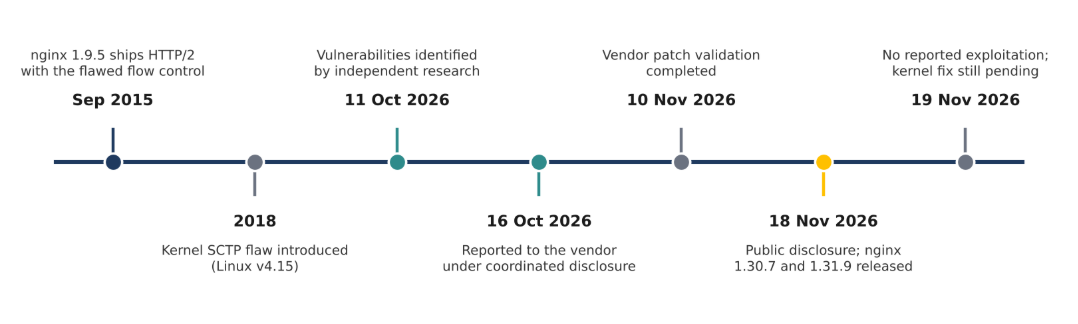
Figure 1. Key milestones for NGINX2Root.
The vulnerabilities were found by independent research during October 2026 and reported to the vendor under coordinated disclosure, with several research teams reporting overlapping findings independently. Fixed open-source releases and NGINX Plus builds were published on 18 November 2026. Research reports that most of the issues were found by automated, AI-assisted code analysis, and the nginx security advisory list records a sharp rise in reported memory-safety flaws during 2026 compared with previous years, a trend that is likely to continue.
4. Technical Analysis
The five nginx flaws are independent of one another; an attacker needs only one, matched to the target configuration. CVE-2026-123007 is an arithmetic error that leads to an out-of-bounds write, while the other four are use-after-free conditions in which nginx frees memory belonging to a connection or request and then continues to use it.
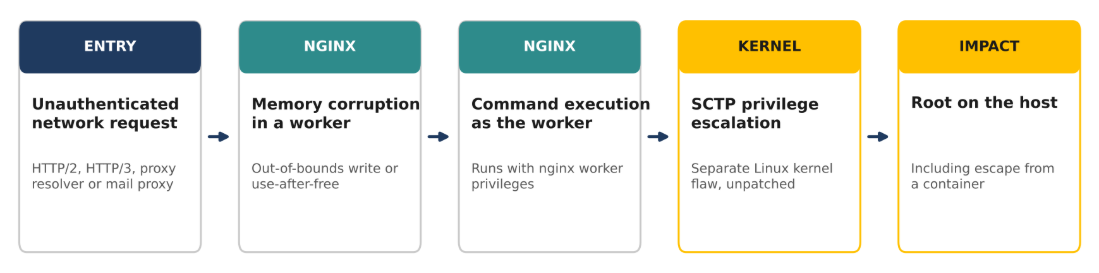
Figure 2. The NGINX2Root chain. Any one nginx flaw gives worker-level execution; root requires the separate kernel flaw.
CVE-2026-123007, HTTP/2 flow control. HTTP/2 uses send windows to limit how much response data a server may send before the client grants more credit through WINDOW_UPDATE frames. nginx deducts credit when it queues response data and returns that credit if the stream is cancelled before the data is sent. If a client raises the window while data is still queued and then cancels the stream, the same credit is effectively added back twice, and the cleanup path never checks the result against the protocol maximum. Once the connection window exceeds its limit, a later bounds check underflows and stops rejecting further increments, allowing the window to be pushed to an arbitrary value.
That oversized window is later interpreted as a small negative number and converted into a very large copy length when nginx assembles TLS output. Combined with the way the system memory-copy routine processes large copies, the result is a controlled out-of-bounds write just before the TLS output buffer together with disclosure of memory addresses in the response. Research used these two primitives to defeat address randomisation and redirect a cleanup function, achieving command execution as the worker. The attack uses only HTTP/2 control frames over a single TLS connection, so the triggering traffic does not appear as requests in standard access logs.
CVE-2026-123633 and CVE-2026-121810, connection draining. When a worker runs low on connection slots, nginx closes idle connections to reclaim them. In HTTP/2, a connection that is part way through receiving a header frame can wrongly remain on the list of idle connections after a request has started on it; in HTTP/3, the parent QUIC connection can be put back on that list while a new stream is still being created. In both cases, when the request then opens a connection to its backend, the slot allocation can close the client connection and free the request while its proxy code is still running, leaving nginx working on freed memory. Exploitation requires the attacker to exhaust connection slots and to receive a connection from nginx, which narrows practical exposure.
CVE-2026-123634, DNS resolver. Where proxy_pass uses a variable and nginx resolves the backend name at request time, a request and its own subrequest (for example a mirror copy of the traffic) can wait on the same DNS answer. If the lookup fails and the client has reset the connection, terminating the main request frees the subrequest’s resolver context while the resolver is still iterating over it. Exploitation also requires the server’s resolver to reach a DNS server under the attacker’s control.
CVE-2026-113425, mail proxy. When nginx proxies IMAP, POP3 or SMTP and checks logins against an HTTP authentication service, a client that resets its connection at the right moment causes nginx to free the session while the connection to the authentication service still refers to it. No valid credentials are required.
Linux kernel SCTP flaw. The escalation from worker to root relies on a use-after-free in the kernel SCTP send path, present since Linux v4.15. On many distributions the SCTP module is installed by default and loaded automatically when a program first opens an SCTP socket, so an attacker running code as the worker can reach it unless module loading is restricted. Because containers share the host kernel, the same flaw gave root on the host from inside a container. Detail on this flaw is being withheld until a kernel fix is released.
5. Affected Products and Versions
| Product | Affected | Fixed |
|---|---|---|
| nginx Open Source (mainline) | 1.31.0 to 1.31.8 | 1.31.9 |
| nginx Open Source (stable) | Releases before 1.30.7 (from 1.9.5 for CVE-2026-123007) | 1.30.7 |
| NGINX Plus 37.1.0 to 37.2.0.1 | Affected | 37.3.0.1 |
| NGINX Plus 37.0.0 to 37.0.7.1 | Affected | 37.0.8.1 |
| NGINX Plus R34 to R36 | Affected | No fix listed by the vendor |
| Kubernetes ingress-nginx | Builds compiling an affected nginx, including v1.15.1 | No upstream fix; project retired in March 2026 |
Version strings alone do not establish exposure. Linux distributions commonly backport security fixes without changing the version reported by nginx, so a server showing an older version such as 1.18.0, 1.22.1 or 1.24.0 may or may not be patched, and must be checked against the full distribution package version and that distribution’s advisory. At disclosure, major distributions including Ubuntu and Debian had not yet shipped fixed packages.
Products that embed nginx, including load balancers, ingress controllers, appliances and container base images, inherit the flaws and depend on their own vendors for fixed builds. Deployments running NGINX Plus R34 to R36 or the retired Kubernetes ingress-nginx controller have no vendor fix and should be moved to a supported, patched release or protected with the interim measures in Section 9.
Internet-wide scan data from 10 November 2026 identified around 56.7 million hosts presenting as nginx, of which roughly 12 million disclosed a version; nearly 99 percent of those fell within the range affected by CVE-2026-123007. These figures overstate true exposure, since exploitation also requires HTTP/2 to be enabled and some hosts carry backported fixes, but they indicate the scale of the remediation task.
6. Exposure Conditions
Each flaw is reachable only in a particular configuration, which allows remediation to be prioritised. The table shows the condition for each and whether disabling HTTP/2 blocks it.
| CVE | Server is in scope when | Blocked by disabling HTTP/2 |
|---|---|---|
| CVE-2026-123007 | HTTP/2 is enabled and reachable | Yes |
| CVE-2026-123633 | HTTP/2 is enabled and requests are proxied to a backend | Yes |
| CVE-2026-121810 | HTTP/3 (QUIC) is enabled and requests are proxied to a backend | No |
| CVE-2026-123634 | A resolver is configured, proxy_pass uses a variable, and a subrequest such as mirror or SSI resolves the same name | No |
| CVE-2026-113425 | nginx is used as a mail proxy with proxy on and auth_http | No |
CVE-2026-123007 is the priority for almost every organisation, as HTTP/2 is enabled by default in many configurations and needs no backend or special feature. Reverse proxies and API gateways that also use HTTP/3 or request-time DNS resolution, and any deployment acting as a mail proxy, carry additional exposure that disabling HTTP/2 does not remove. Financial-sector estates should give particular attention to internet-facing reverse proxies in front of online banking, payment and API services, and to container platforms where the kernel flaw would allow a compromise to spread beyond a single workload.
7. Exploitation Status
No exploitation has been reported as of 19 November 2026, and none of the five CVEs is listed in the CISA Known Exploited Vulnerabilities catalogue. Working exploits have been demonstrated privately for all five flaws and for the kernel escalation, but no public exploit code has been released; the published technical analysis deliberately omits the final steps.
That restraint is unlikely to hold attackers back for long. The root cause of CVE-2026-123007 is described in detail, the fix is visible in the published source, and the target population is very large, so independent development of working exploits should be expected within a short time. Exploit development is demanding, and failed attempts are likely to crash worker processes, which nginx restarts automatically; repeated worker crashes on an exposed server may therefore be the first visible sign of attempts. Because the attack traffic is not logged as requests, successful exploitation may leave little evidence, and internet-facing servers with HTTP/2 enabled should be patched without waiting for reports of active exploitation.
8. Detection and Threat Hunting
A server is exposed to CVE-2026-123007 when it runs an unpatched build containing the HTTP/2 module with HTTP/2 enabled and reachable. The following checks establish each condition and support hunting for attempts:
- Check the version and package. Releases from 1.9.5 to 1.31.8 contain the vulnerable code. For distribution packages, compare the full package version with the distribution advisory, as backported fixes do not change the nginx version:
nginx -v - Confirm the HTTP/2 module is present. A binary built without the module is not affected by CVE-2026-123007:
nginx -V 2>&1 | grep -o — ‘–with-http_v2_module’ - Confirm whether HTTP/2 is enabled. Any output such as listen 443 ssl http2 or http2 on means HTTP/2 is enabled in the configuration on disk:
sudo nginx -T 2>&1 | grep -nE ‘listen.*http2|http2[[:space:]]+on’ - Test external reachability. Run from outside the network, replacing HOST; a result of ALPN protocol: h2 means HTTP/2 is offered to the internet. Where a CDN or proxy sits in front, also test nginx directly:
openssl s_client -connect HOST:443 -servername HOST -alpn h2 </dev/null 2>&1 | grep ALPN - Look for command execution by workers. An nginx worker has no reason to start other programs, so any shell or binary launched by the worker account is the strongest indicator of compromise. Where auditd is in use, record executions by the worker account, replacing NGINX_UID with its numeric user ID:
sudo auditctl -a always,exit -F arch=b64 -S execve,execveat -F euid=NGINX_UID -k nginx_worker_exec - Review worker crashes. Failed attempts commonly crash worker processes. Look for abnormal worker exits and segmentation faults in the error log and for core dumps, and correlate them with the other signals:
sudo grep -Ei ‘worker process.*exited|signal 11|segfault’ /var/log/nginx/error.log - Inspect long-lived HTTP/2 connections. The tested attack holds one TLS connection open for several minutes while sending a high volume of control frames, so received bytes climb quickly while little is sent back and few requests are logged, alongside many short connections from the same source. Comparing connection byte counts with logged request sizes for the same client helps separate this from legitimate large uploads.
- Check exposure to the kernel flaw. Establish whether the SCTP module is loaded or loadable on hosts running nginx, including container hosts:
lsmod | grep -w sctp
9. Mitigation and Remediation
Primary action: update nginx. Upgrade to nginx 1.31.9 (mainline) or 1.30.7 (stable), or NGINX Plus 37.3.0.1 or 37.0.8.1, or to a distribution package confirmed to include the fixes. Restart nginx or complete a binary upgrade after installing; a configuration reload does not replace the running executable. Rebuild and redeploy container images that bundle nginx, and confirm that appliance and ingress vendors have shipped fixed builds.
Where an update cannot be applied immediately, the following configuration changes block the known attack paths. They are temporary and do not replace the update:
- Disable HTTP/2 (CVE-2026-123007 and CVE-2026-123633). On nginx 1.25.1 and later, set http2 off in each affected server block and remove the http2 parameter from listen directives; on earlier versions, remove http2 from the listen directive. Services that require HTTP/2, such as native gRPC, will stop working, so test before applying.
- Disable HTTP/3 (CVE-2026-121810). Remove listen directives containing quic, set http3 off, clear any Alt-Svc header that advertises HTTP/3, and block UDP on the affected port.
- Remove request-time DNS resolution (CVE-2026-123634). Point proxy_pass at a fixed upstream group rather than a variable. Turning off mirror alone is not sufficient, as other subrequest features such as SSI may reach the same flaw.
- Restrict the mail proxy (CVE-2026-113425). Bind mail listeners to a loopback address where external access is not needed, or allow only trusted source addresses at the firewall.
- Block the SCTP kernel module on hosts that do not use SCTP, until a kernel fix is available, by adding a modprobe rule. This prevents automatic loading but does not unload a module already loaded or disable SCTP built into the kernel:
echo ‘install sctp /bin/false’ | sudo tee /etc/modprobe.d/disable-sctp.conf
After a configuration change, reload nginx and confirm the change has taken effect, for example by repeating the external HTTP/2 test. Existing connections remain with the previous workers until they close, so restart the service if old workers persist after the reload.
10. Recommendations
- Treat NGINX2Root as a critical patching priority, starting with internet-facing nginx deployments that have HTTP/2 enabled.
- Inventory every nginx instance, including those embedded in load balancers, ingress controllers, appliances and container images, and verify patch status by package or vendor build rather than by version string.
- Where patching is delayed, disable HTTP/2 on exposed listeners and apply the configuration-specific measures for HTTP/3, request-time DNS resolution and the mail proxy.
- Migrate deployments on NGINX Plus R34 to R36 and the retired Kubernetes ingress-nginx controller to supported, patched releases.
- Block the SCTP kernel module on nginx hosts and container platforms that do not need it, and apply the kernel fix when released.
- Monitor for program execution by nginx workers and for repeated worker crashes on exposed servers, and investigate any occurrence.
- Track the CISA KEV catalogue, distribution advisories and vendor bulletins for changes in exploitation status and for fixed packages.
