
 HQ/EMEAFind out how we can help your business

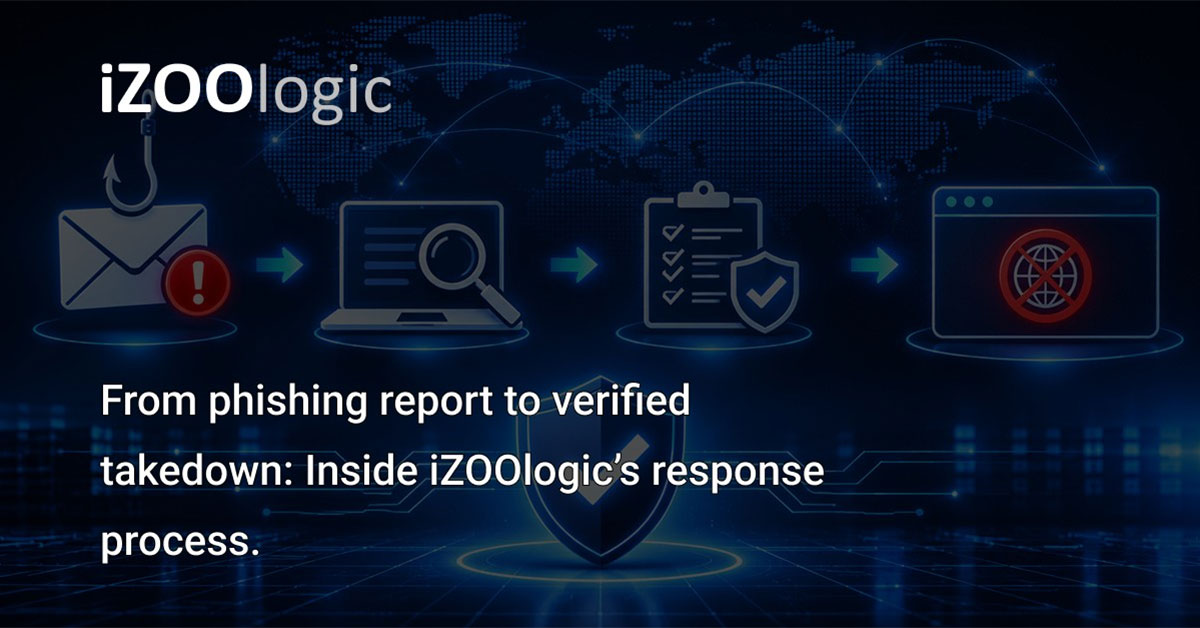
When a phishing website appears to be connected to your business, customers may be at risk before your team has established what happened. The business needs to understand what is being assessed, what action is being taken, and whether the reported threat has been removed.
At iZOOlogic, our role is to assess the reported content, manage the supported response, and explain the outcome. Each stage serves a purpose: establishing the facts, pursuing appropriate action, and giving the client a clear account of the result.
A successful response depends on judgment throughout the matter. It also depends on being precise about what the evidence establishes.
Understanding the reported threat
A suspicious website needs assessment. We consider what the content represents, how it relates to the affected organization, and what potential harm it presents. This helps establish whether a takedown request is supported and what action is appropriate.
A copied name or logo can be relevant, but its presence alone does not explain the full situation. The context matters. The business needs an assessment that connects the reported content to the concern, rather than an assumption based on appearance.
Preserving relevant evidence supports that assessment. Online content can change, and an accurate record helps maintain a clear understanding of what was reported and why action was considered necessary.
For the client, this work provides a reasoned basis for the response. It helps avoid unsupported allegations while keeping attention on content that presents an actionable concern.
Supporting a responsible request
A takedown request needs relevant evidence and appropriate authority. We assess the matter within the agreed service scope and the basis on which we are authorized to act.
The company responsible for the affected service must be able to understand the concern and consider the requested action. Our role includes managing that coordination and addressing relevant questions as the matter progresses.
Where a client clarification is necessary, the request should explain what information is needed and why it matters. Existing information and authorization should be used where they already address the requirement.
This gives the business a clearer understanding of its involvement. It also helps keep the requested action proportionate to the evidence and the reported threat.
Managing the response
The response continues after a report has been submitted. The receiving company may review the evidence, request clarification, take action, or explain why it does not support the requested remedy.
We assess these developments in the context of the reported matter. A reply may resolve an issue, introduce a relevant requirement, or leave the outcome uncertain. The next action should reflect what that response establishes.
Clients need meaningful progress information. Our updates distinguish the action taken, any material external decision, the supported next step, and any necessary client input. They should make the current position understandable without requiring the client to interpret technical correspondence.
Timing can depend on the circumstances of the case and the company reviewing the request. A clear explanation of that position helps the business make decisions while the outcome remains pending.
Establishing what changed
Submitting a report establishes that a request was made. An acknowledgment establishes that it was received. Neither, by itself, confirms removal.
The outcome must correspond to the reported content and the scope of the action. Removing a particular page does not establish that every related website or account has been removed. Restricting access and removing content are also different results.
Verification can draw on relevant action records, evidence of what happened to the reported target, and an explicit company confirmation where one is available. The conclusion must stay within what those records support.
A page that cannot be reached on one occasion is not automatically evidence of a takedown. Equally, the absence of a written company reply does not erase a supported removal outcome. The assessment needs to consider the available evidence together.
These distinctions matter to the business. They explain what has changed, what remains uncertain, and whether further action is justified. They also keep a limited result from becoming an unsupported claim that an entire threat has been eliminated. For a worked example, read Inside a phishing takedown: An iZOOlogic case study.
Considering the remaining risk
A verified takedown addresses the reported target. Related or replacement content may still require attention, depending on the evidence and the agreed service scope.
Where ongoing monitoring forms part of the service, later findings can support further assessment and response. A new finding must still be understood on its own evidence.
Removal also has limits. It does not reverse information a victim has already disclosed or establish that every consequence has been resolved. The affected organization may need to address customer protection or other response measures alongside the takedown.
Clear reporting helps the business understand those limits and decide what remains necessary.
What the business should expect
A managed takedown service should give the business a supported assessment, ownership of the response, and a clear explanation of the result. The client should understand the meaningful action taken and any remaining dependency or uncertainty.
This is the value we aim to deliver through iZOOlogic’s response process. We connect the reported concern to appropriate action and communicate the outcome at the level the evidence supports.
If phishing or website impersonation is affecting your organization, speak with iZOOlogic about an appropriate response for your business.
Related research:
https://izoologic.com/industry-news-update/how-reverse-engineering-markov-chains-exposed-a-china-based-phishing-empire-targeting-24-indian-banks/
