
 HQ/EMEAFind out how we can help your business

1.Executive Summary: What happened in the Optimizely hack?
On 16 November 2026, the threat actor (TA) injected malicious JavaScript code into Optimizely web pages, which affected more than 170 organizations, including BBC, CNN, and HSBC. The injected scripts affected every visitor who visited an affected site between 13 November and 16 November. The payload swaps crypto addresses, steals credit card numbers from checkout forms and even tries to chain this with the Coruna and DarkSword exploits, which target iOS users.
Financially, its impact is low due to the quick clean-up by Optimizely, the injected code has been removed, and the collected funds have been transferred by the threat actors.
2.Who was behind the Optimizely supply chain attack, and how did it spread?
The threat actor is financially motivated. Multiple cryptocurrency wallets have been spotted, covering currencies such as BTC, LTC, ETH, TRON, TON, SOL, and DOGE.Some .icu domains are registered on Hong Kong-based IPs.
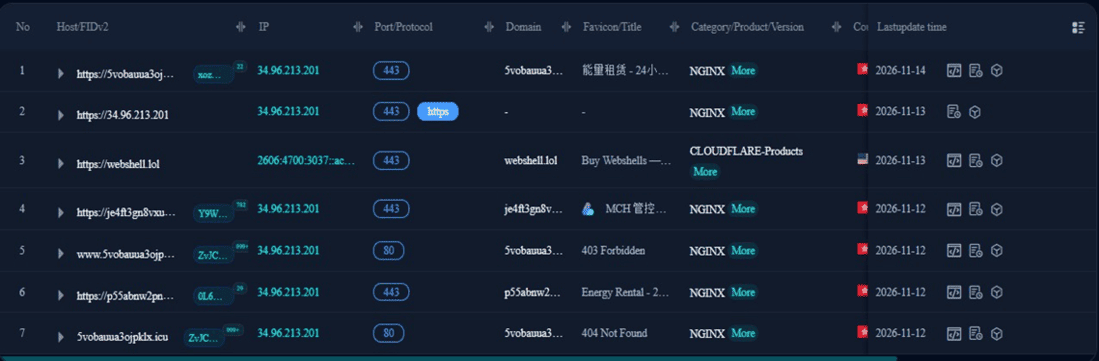
Infrastructure stage: From late October to mid-November, .icu domains were registered.
Injection stage: On 16 November, the attacker started to inject code into multiple Optimizely partners (BBC, Zoom). The same afternoon, cryptocurrency started to flow into the attacker’s wallets. By the evening, the TA’s wallets had received $7,040.
Clean-up stage: On 17 November, the threat actor emptied their crypto wallets and Optimizely started to clean up infected projects.
The iOS hosts were registered from 28 October, one served an exploit entry on 12 November, the TRON wallet has been active since March, and the ETH wallet received funds on 12
November, before the payload domain existed. Coruna and DarkSword also surfaced in March 2026.
How did attackers inject malicious code into Optimizely snippets?
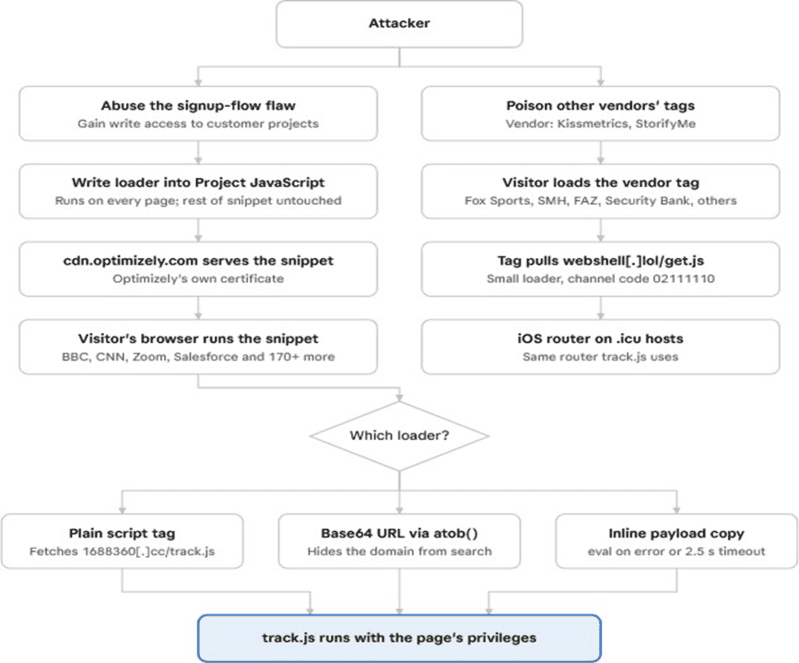
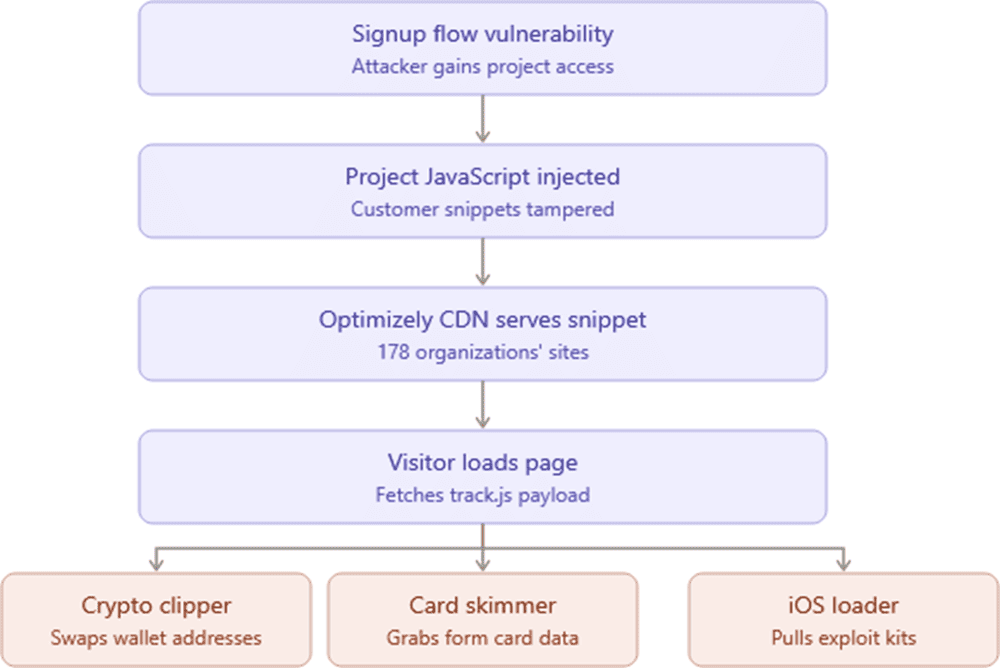
The TA abused the sign-up flow of the Optimizely website. An undisclosed vulnerability in the sign-up flow enabled write access across the entire project. The project directory www folder contains the loader as well. The attacker appended a few lines, and the rest of the code snippets are untouched.
The TA tampered with the Optimizely CDN, the file is served at /js/<client-project-id>.js. Every visitor is affected once the snippet is loaded in their browser.
Multiple variants of the injector were found plain, Base64-encoded via atob, and inline payload. If the plain injector is blocked by CSP, it will attempt to re-infect with the encoded versions. The embedded copy runs via eval.
Since the payload has write access to the entire project, it can read form-fields and non-HttpOnly cookies. The payload runs with the page’s privileges, as if it were part of the same codebase.
Multiple vendors were infected via the inline payload and the get.js variant, which is hosted on webshell[.]lol and, as first observed, carries no clipper or skimming functionality. The .icu domains are configured for iOS exploit chaining to deliver the Coruna and DarkSword exploit kits.
What does the malicious Optimizely script do in a visitor’s browser?
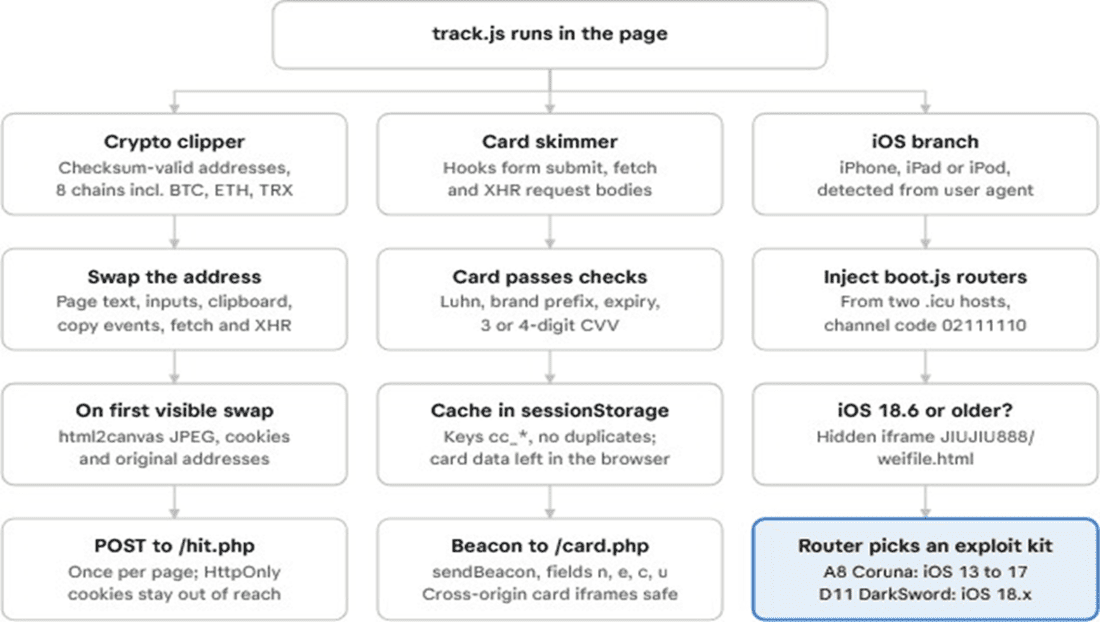
The injector is a single file named track.js,crypto swapping, card skimming, and cookie and screenshot capturing are the primary features of the script.
For address swapping, the script uses regular expressions to find candidate wallet addresses for ETH, BTC, LTC, TRX, TON, SOL, BCH and DOGE, then real checksum checks (base58check, bech32, cashaddr, TON CRC16) confirm them. Only valid addresses are swapped, so the victim’s wallet accepts the replacement without an error.
The script rewrites page text, input and text area values, link and image attributes, copy events, and the URLs and bodies of fetch and XHR requests, and collects evidence: it loads html2canvas from 1688360[.]cc, renders the visible page to a JPEG, and gathers the page URL.
It POSTs the data to /hit.php. The bundle is sent as text/plain, once per page load and only after a swap, so a visitor who never sees a wallet address sends nothing.
For card skimming, it first hooks fetch and XHR request bodies (FormData) and listens for form submits. It detects Luhn-valid numbers, brand prefixes, expiry dates and CVV data.
It stores these details in sessionStorage (cc_), and the card data is sent to the endpoint 1688360[.]cc/card.php with the parameters n, e, c and u, which stand for number, expiry, CVV and page URL.
To detect iOS devices, the user agent is checked for products such as iPhone and iPad. It loads the router via boot.js, two scripts were detected on .icu domains with the data channel code 02111110.
The router collects device telemetry and decodes its API and C2 hosts with XOR, a hidden iframe loads an HTML file and retries the exploit. The router picks an exploit based on the iOS version: for versions 13 to 17 it delivers Coruna, and for version 18 and higher it delivers DarkSword. DarkSword has been patched as of iOS 26.3.
3.How does the Optimizely malware (track.js) work?
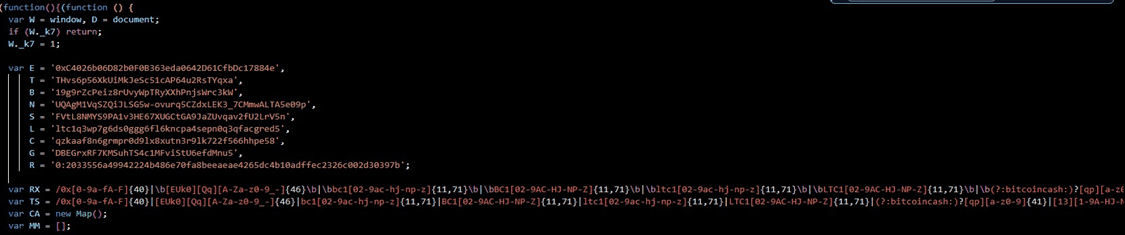
Hard-coded crypto address which later used for swap address, regex parsers used to check current valid crypto wallet address of victim.
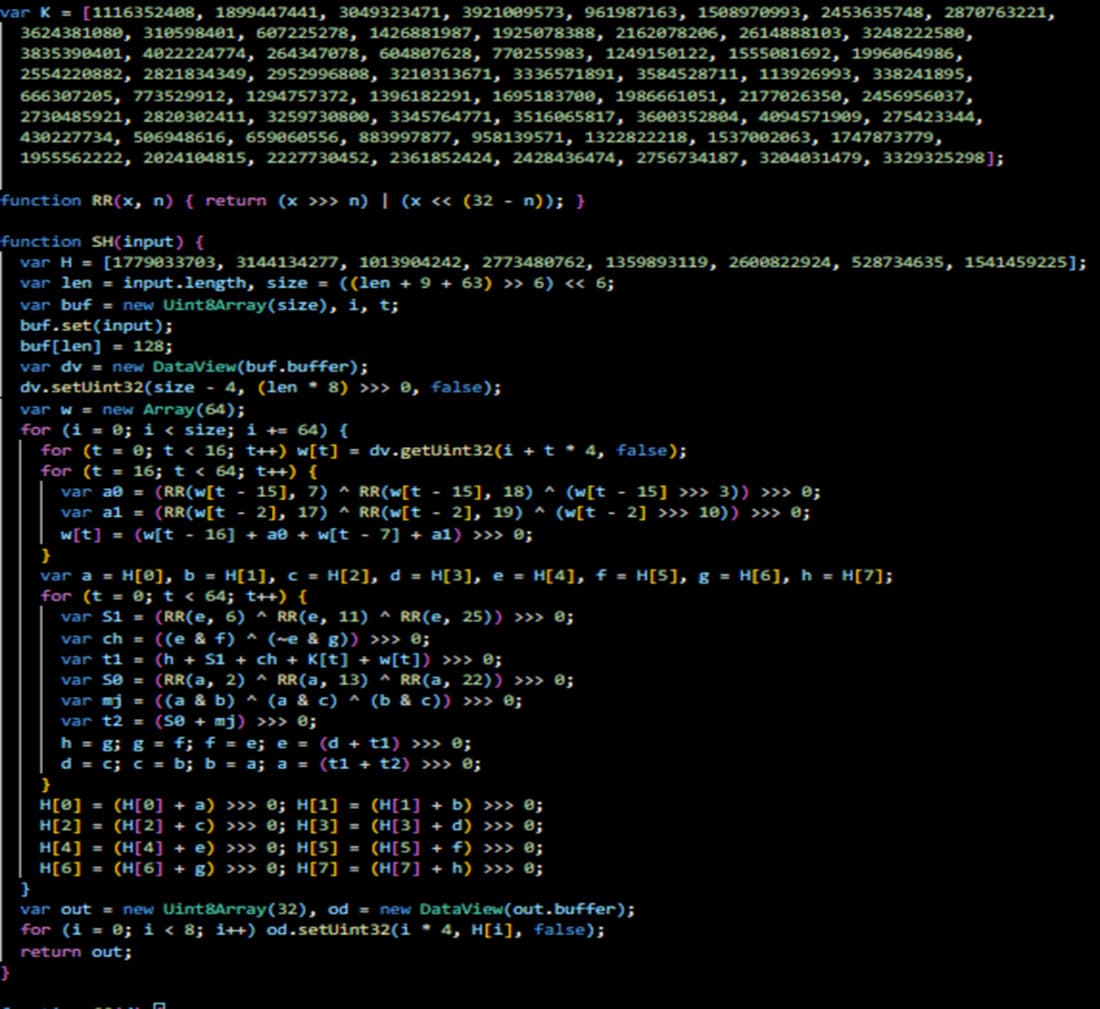
K and H are the standard SHA-256 round constants and initial hash values, so SH() is a from-scratch SHA-256. Its only use is CS() the double-SHA-256 checksum that every Base58Check address.
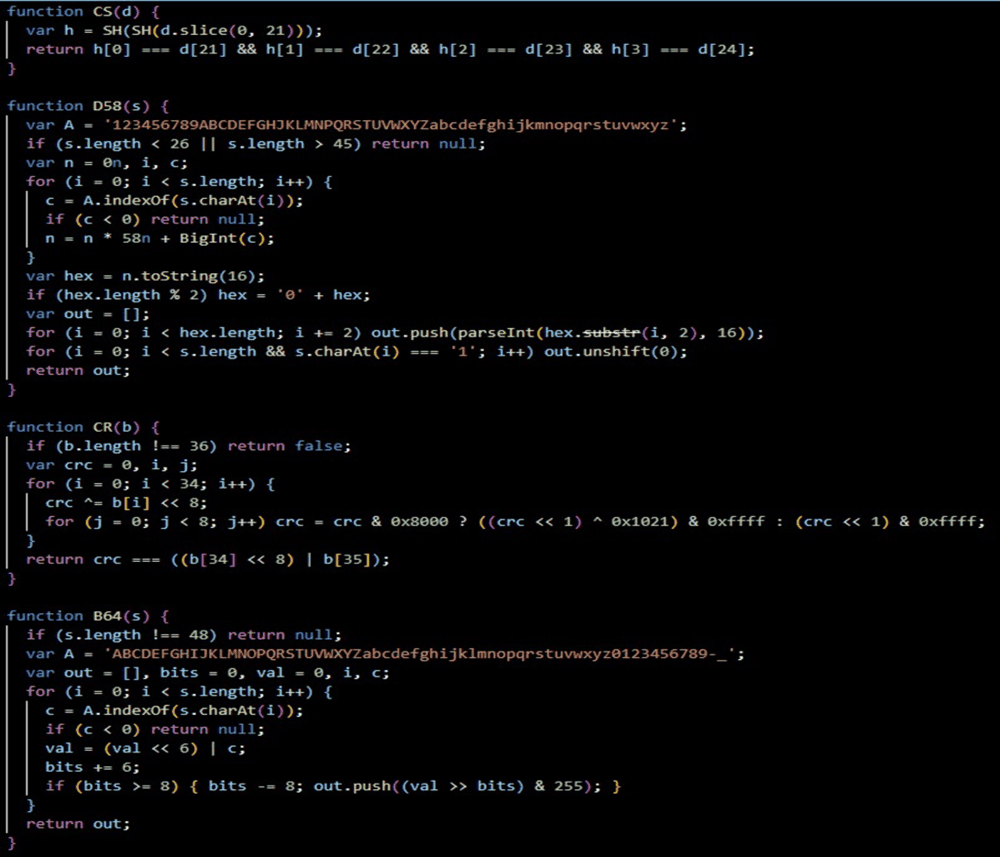
D58() decodes Base58 with BigInt, B64() decodes TON’s URL-safe Base64, CR() is TON’s CRC16-XMODEM (polynomial 0x1021), BP() is the Bech32/Bech32m polymod (it accepts both constants 1 and 0x2bc830a3, so SegWit and Taproot addresses both pass), and BA() is the BCH CashAddr polymod.
the attacker only swaps strings that are genuinely valid addresses. That keeps false positives (order IDs, hashes, API keys) untouched, so the page does not visibly break and the theft is harder to notice.
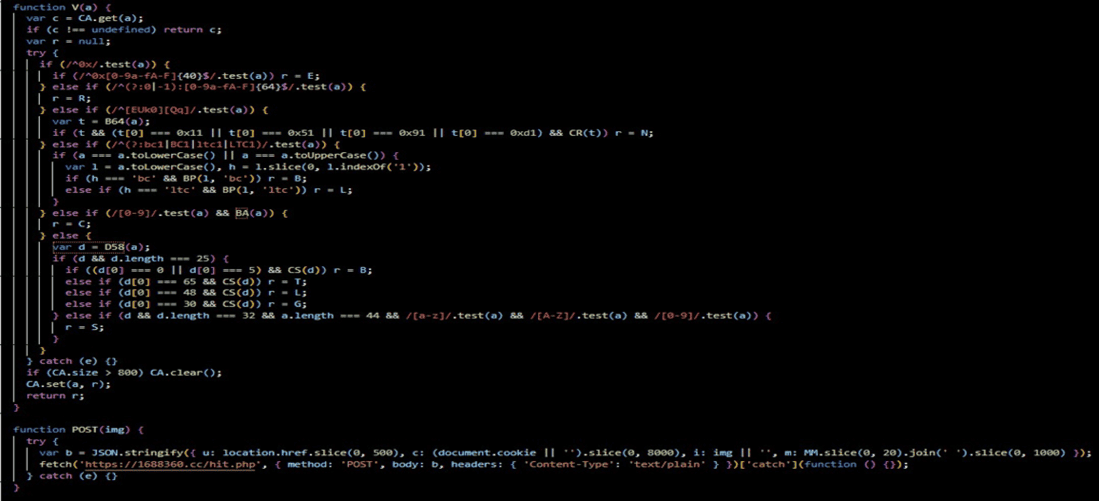
Part of previous code snippet, Legacy version bytes map chains (line 191–195): 0x00/0x05→BTC, 65→TRON, 48→LTC, 30→DOGE. Results are memorized in Map, variable called CA in the code.
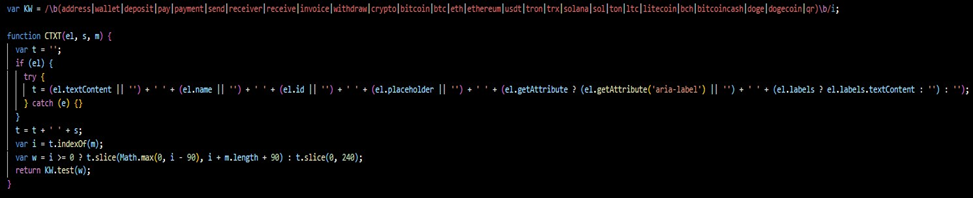
KW is a keyword regex (wallet|deposit|pay|btc|eth|usdt|…). CTXT pulls text from the element plus ±90 chars around the match and only confirms a swap when a payment keyword is in range — so random base58-looking strings outside payment contexts are left alone, reducing breakage and detection.
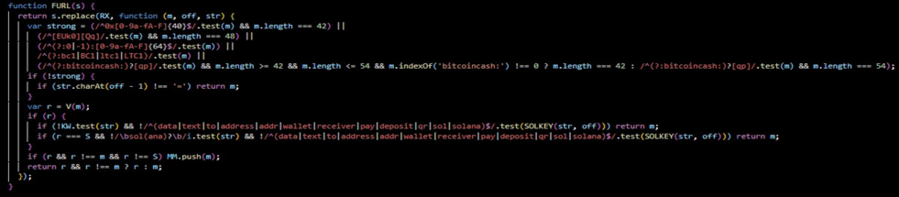
FURL(s) for URLs/attributes , with stricter gating: it requires either a “strong” format match or that the match sit right after = in a query string, and that a crypto keyword be present
nearby (KW, SOLKEY). MM accumulates the original addresses it replaced, later exfiltrated as proof/loot list.
FURL() swaps an address inside a URL only if the URL contains a payment keyword or the address sits in a parameter named to, address, addr, wallet, receiver, pay, deposit, qr, data, text, sol or solana. That targets QR-code generator links and payment deep links without breaking unrelated URLs

Function F is the core text-replacement function. Any valid address it finds is replaced, whatever surrounds it.
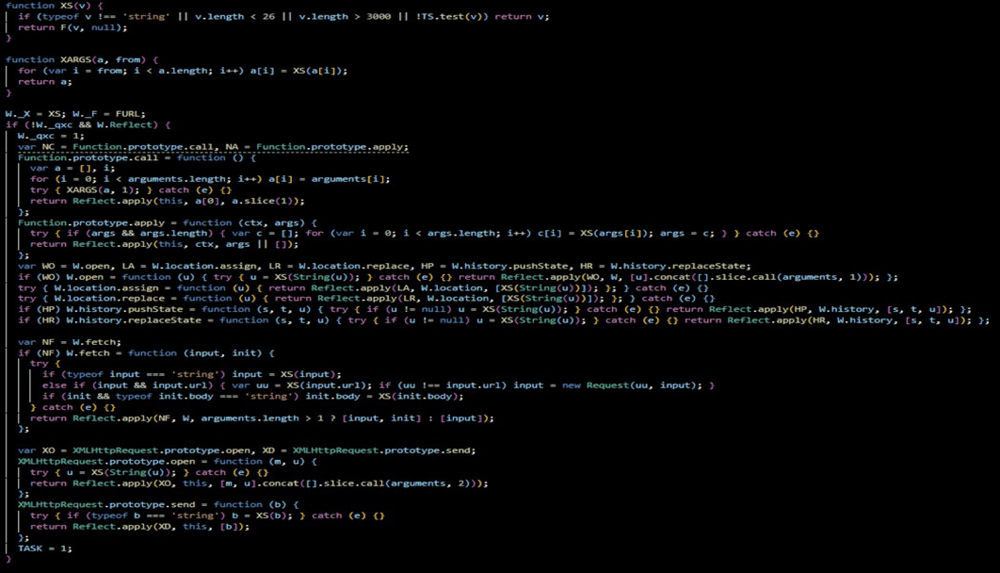
Every .call() and .apply() on the page now passes its string arguments (26 to 3,000 characters long and matching TS) through XS(), which swaps addresses. Wallet libraries, react handlers or payment SDKs that pass an address through any function call receive the attacker’s address instead.
The same XS() wrapper is placed on window.open, location.assign, location.replace, history.pushState, history.replaceState, fetch (URL, Request object and string body) and XMLHttpRequest.open/send. An address is rewritten even when it never touches the visible page, for example in an API call that creates a withdrawal.
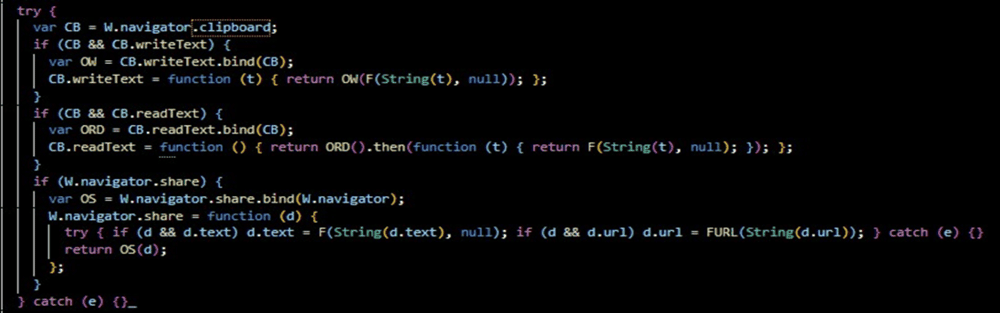
Separate code-block which handles clipboard API and web share, so “copy address” buttons and the mobile share sheet hand out the attacker’s address.
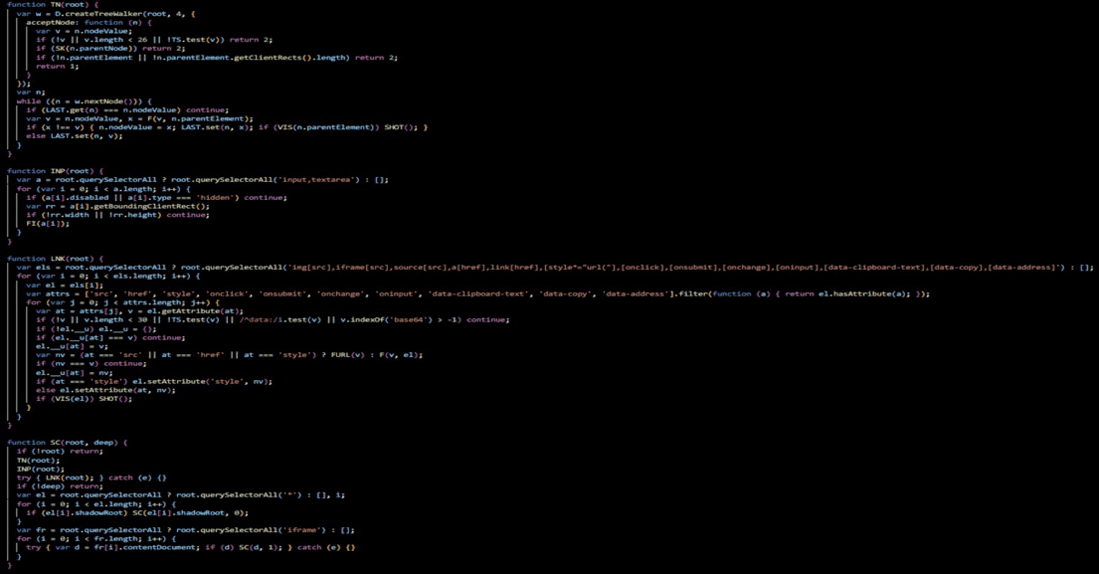
TreeWalker (filter 4 = text nodes) finds nodes ≥26 chars matching TS, skips SCRIPT/STYLE/CODE/PRE/… via SK, skips invisible nodes, then rewrites nodeValue and caches the result in a WeakMap LAST to avoid rework
LNK scans img/iframe/source[src], a/link[href], inline style=”url(…)”, event-handler attributes (onclick, onsubmit, …), and copy-helpers such as data-clipboard-text, data-copy, data-address.
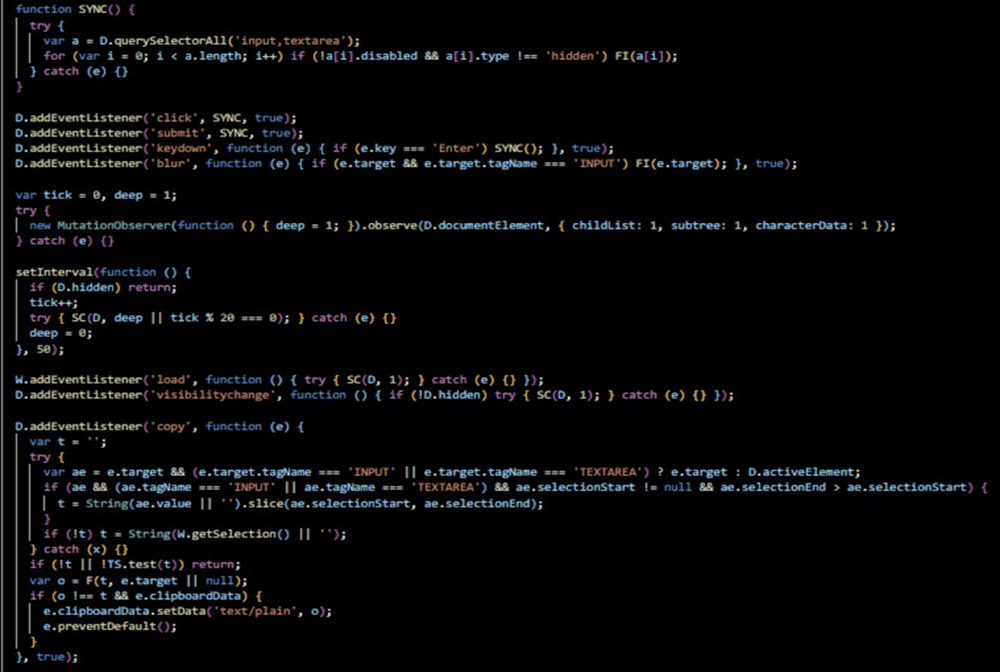
MutationObserver reports a change, and at least once a second. It descends into shadow DOM and same origin iframes, so web components and embedded widgets are covered. The loop pauses while the tab is hidden and re-runs on load and when the tab becomes visible again
Capture-phase listeners on click, submit, enter key and blur re-run SYNC() on every input, so the last rewrite happens just before a form is sent.
When a user selects text and presses CTRL-C, the handler takes the selection, swaps any address, writes the swapped text into the clipboard and cancels the browser’s default copy. The page still shows the correct address, but the clipboard holds the attacker’s.
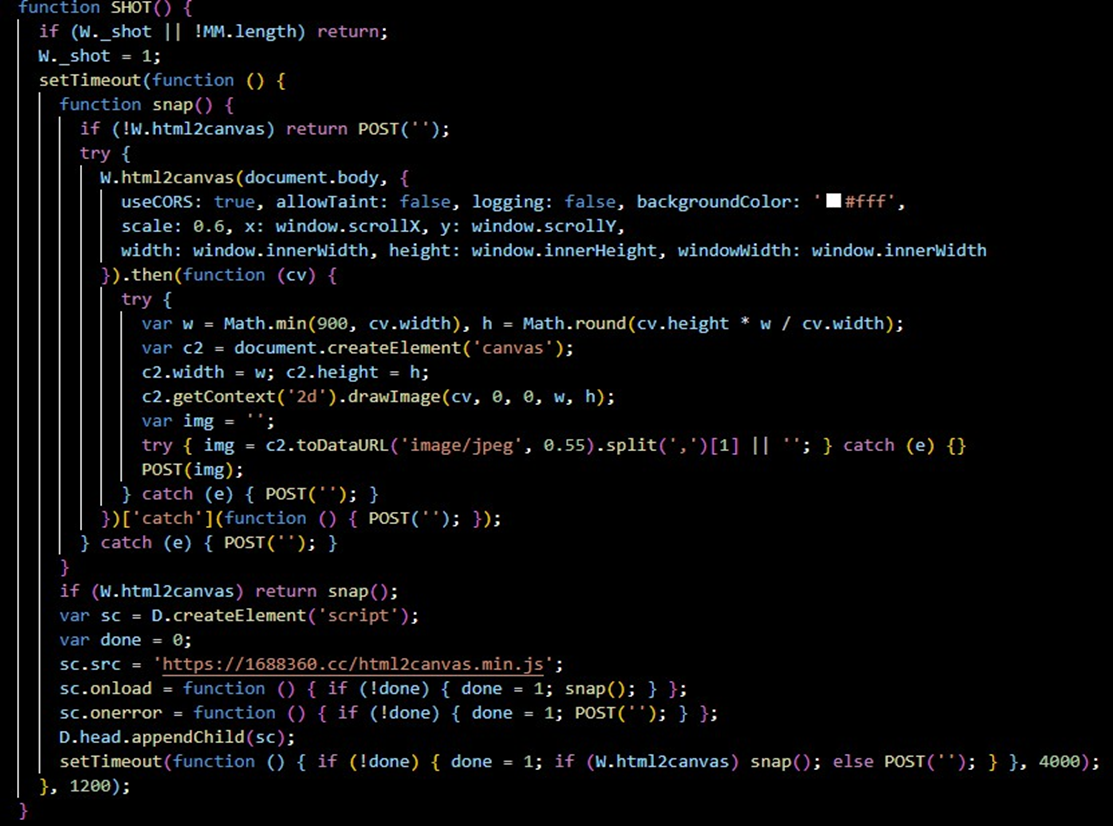
SHOT() runs once per page (window._shot) and only if MM is non-empty, that is, after a payment-context swap on a visible element. It waits 1.2 seconds, loads html2canvas.min.js from the attacker host (with a 4-second timeout), renders only the visible viewport at 0.6 scale, shrinks it to at most 900 px wide and encodes a JPEG at quality 0.55. If anything fails, it still posts the cookies and addresses without the image.
POST(img) function is the exfil channel to 1688360.cc/hit.php. It bundles four things: the URL, up to 8000 chars of document.cookie, the screenshot, and MM which is wrapper of m, m is address which replace victim crypto wallet address to attacker’s wallet address. (Figure of POST function included in Figure 8.)
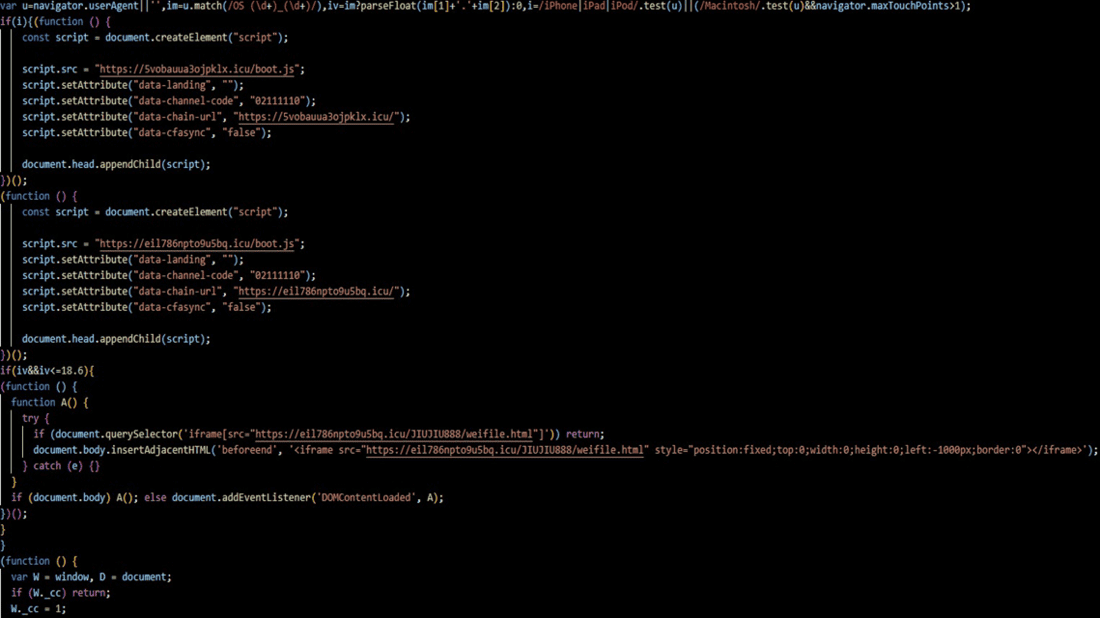
It parses the iOS version and detects iPhone/iPad — including iPadOS masquerading as “Macintosh” via the maxTouchPoints>1 parameter. Two identical loaders are added, one per
.icu host, for redundancy. data-chain-url tells the router where to fetch the exploit chain, and data-cfasync=”false” stops Cloudflare’s Rocket Loader from deferring the script on Cloudflare-fronted sites. On iOS 18.6 or older it also inserts a 0×0 iframe positioned off-screen at left: -1000px that loads /JIUJIU888/weifile.html.
For credit-card skimming, it has multiple functions to acquire card data, BR () function identifies the card brand from its first digits. It covers Visa (4), Amex (34/37), Mastercard (51–55 plus the newer 2221–2720 range), Discover (6011, 65, 644–649), JCB (35), UnionPay (62),
Troy (9792), Mir (2200–2204), Maestro (several prefixes) and Diners (300–305, 36, 38).
Mir’s 220x is tested after Mastercard, but the Mastercard pattern needs a third digit of 2–9, so Mir cards still get through. The Mastercard pattern is slightly too broad; an unknown prefix returns an empty string, which later counts as “not a card”. The brand name itself is never sent anywhere; it only serves as a filter.
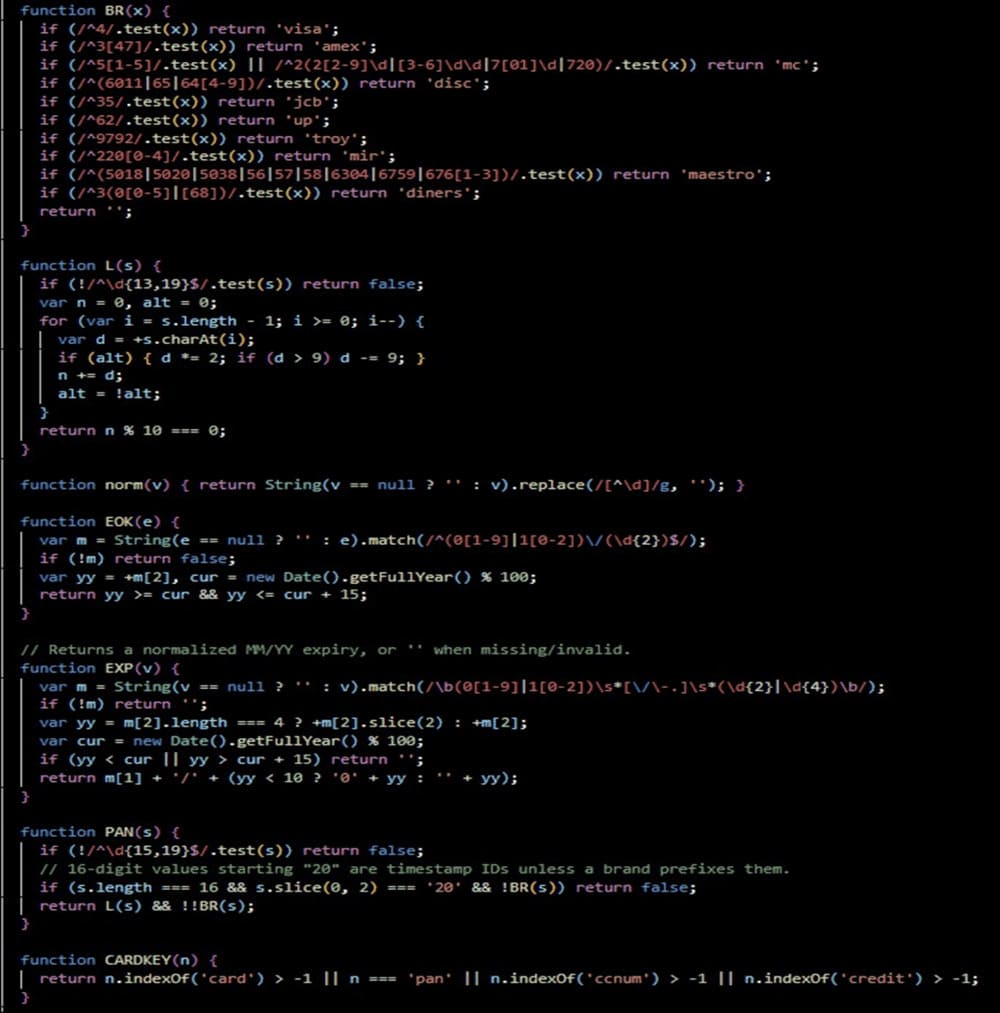
L(s) is the standard Luhn check digit algorithm, starting from the right, every second digit is doubled, and 9 is subtracted if the result is over 9. A real card number’s digits always add up to a multiple of 10. This removes most random 16-digit strings such as order IDs and phone numbers.
PAN(s) combines the checks above card number is real or fake, function L would accept 13 digits, but PAN() doesn’t, the number must pass Luhn and match a known brand.
EXP(v) finds an expiry date anywhere in a value and normalizes it to MM/YY.The pattern isn’t anchored to the start of the string, so text like “Expires 12/2028” also works. Four-digit years are cut into two digits. The year must fall between this year and 15 years ahead. EOK() is a final check for all conditions that are met before sending data to endpoint. CVV(v) strips non-digits and returns the value only if it is 3 or 4 digits.
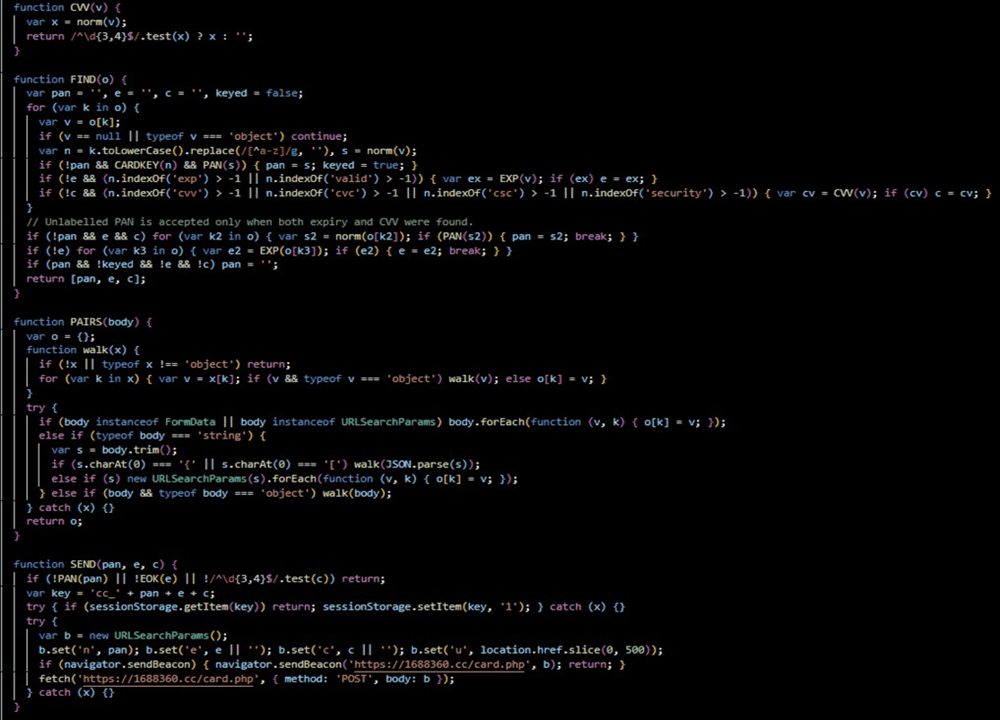
CARDKEY(n) decides whether a field name looks like a card-number field. Names are lowercased and reduced to letters first, so card_number, cardNumber and card-number all become cardnumber.
FIND(o) is the decision maker. It takes the flattened {name: value} object and returns [number, expiry, cvv], look for a card-number field by name and value, an expiry field by name (exp, valid as in “valid thru”), and a CVV field by name (cvv, cvc, csc, security)
PAIRS(body) turns whatever the page is sending into one flat {name: value} object. form data and URL parameters directly strings as JSON if they start with { or [, otherwise as a=1&b=2 form encoding plain objects through walk().
SEND() function checks for a valid number, a strict MM/YY expiry and a 3–4-digit CVV are all required. A number alone is never sent, which keeps the attacker’s data clean.
Deduplication: each card is sent once per browser tab.
The marker key is literally cc_ + number + expiry + CVV, so the full card sits in readable form in sessionStorage until the tab closes. If storage is blocked, the error is caught and the card is sent anyway, just without deduplication. SendBeacon method queues the request in the browser, it goes out when the checkout submit moves the user to another page.
4.Indicators of compromise (IOCs):
| Category | Indicator (defanged) | Type | Context |
|---|---|---|---|
| Domain | 1688360[.]cc | Domain | Payload and exfiltration host (track.js, hit.php, card.php). Registered 16 Nov 05:23 UTC, client Hold since 17 Nov 00:37 NXDOMAIN now. |
| Domain | webshell[.]lol | Domain | Injector / iOS-router loader host (get.js). First seen 17 Sep returns HTTP 403 now. |
| Domain | 5vobauua3ojpklx[.]icu | Domain | iOS boot router (boot.js, /A8/, /D11/, /api/). Registered 9 Nov 17:52 UTC resolves to 34.96.213.201. |
| Domain | eil786npto9u5bq[.]icu | Domain | iOS router and JIUJIU888 exploit stage,hard-coded in track.js. Registered 16 Nov 16:38 UTC was 34.87.36.58. |
| Domain | p55abnw2pnsz0bo[.]icu | Domain | iOS stage, same batch as 5vobauua3ojpklx. TXT ppck-ver=eaf775e3f 8fa03179b5761fa5cca1ecb. |
| Domain | 1y69gy2mdzaltz1[.]icu | Domain | iOS stage, same batch as eil786npto9u5bq (16 Nov 16:38 UTC). |
| Domain | gm38duxoihbmy5o[.]icu | Domain | iOS stage, same batch as eil786npto9u5bq (16 Nov 16:38 UTC). |
| Domain | l7bcsnwc7nzr3uo[.]icu | Domain | Telemetry endpoint /api/iptj. Registered 28 Oct behind Cloudflare. |
| Domain | je4ft3gn8vxudum[.]icu | Domain | c2Base decoded from boot.js, no completed traffic observed. |
| Domain | ios-hack[.]icu | Domain | Visitor IP sync endpoint /api/ip-sync/sync. |
| Domain | q1ls1ho9x7wsxlu[.]icu | Domain | Registered 16 Nov 23:44 UTC, after publication of owner unknown. |
| URL | hxxps://1688360[.]cc/track.js | URL | Main payload: crypto clipper, card skimmer, exfil, iOS loader. |
| URL | hxxps://1688360[.]cc/hit.php | URL | Clipper exfil: POST text/plain JSON {u, c, i, m} = page URL, cookies, JPEG, original addresses. |
| URL | hxxps://1688360 [.]cc/card.php | URL | Card exfil via navigator.sendBeacon fields n, e, c, u. |
| URL | hxxps://1688360[.]cc/html2canvas.min.j s | URL | Screenshot library loaded from attacker host. |
| URL | hxxps://1688360 [.]cc/px.gif | URL | Error telemetry in the inline-fallback loader. |
| URL | hxxps://webshell [.]lol/get.js | URL | iOS-router loader, seen with ?sm= and ?paid= channel code 02111110. |
| URL | hxxps://5vobauua3 ojpklx[.]icu/boot.js | URL | iOS router script injected by track.js. |
| URL | hxxps://eil786npto 9u5bq[.]icu/boot.js | URL | Second iOS router script injected by track.js. |
| URL | hxxps://eil786npto9u 5bq[.]icu/JIUJIU888 /weifile.html |
URL | Hidden 0x0 iframe injected for iOS 18.6 and older. |
| URL | hxxps://eil786npto9u5 bq[.]icu/JIUJIU888 /index.js |
URL | Coruna-associated stage. |
| URL | hxxps://eil786npto9u5 bq[.]icu/A8/a.html | URL | Coruna-associated entry (iOS 13 to 17) also on 5vobauua3ojpklx[.]icu. |
| URL | hxxps://eil786npto9u5bq[.]icu/ A8/34ef64 4ff217a50bead de64dc8e23a7d.js | URL | Packed exploit dispatcher. |
| URL | hxxps://5vobauua3ojpklx[.]icu/D11/b.ht ml | URL | DarkSword-labeled entry (iOS 18.x). |
| URL | hxxps://eil786npto9u5bq[.]icu/D12/b.ht ml | URL | Exploit the entry stage. |
| URL | hxxps://eil786npto9 u5bq[.]icu/chain_log | URL | Exploit-chain logging endpoint. |
| URL | hxxps://5vobauua3ojpklx[.]icu/api/track | /api/gs_state | /api/pe_ok |
URL | Router telemetry and delivery gating endpoints. |
| IP / host | 136.113.106.136 | IPv4 | Hosted 1688360[.]cc. Google Cloud us-central1, AS396982. |
| IP / host | 34.96.213.201 | IPv4 | Hosts 5vobauua3ojpklx[.]icu and p55abnw2pnsz0bo[.]icu. Google Cloud, Hong Kong. |
| IP / host | 34.87.36.58 | IPv4 | Hosted eil786npto9u5bq, 1y69gy2mdzaltz1, gm38duxoihbmy5o (.icu). Google Cloud, Singapore. |
| IP / host | 5e:7a:7f:b3:d7:22:ba:c 7:f5:04:5a:b2:5c:0 d:8a:73 | SSH ed25519 fingerprint |
Host key on 136.113.106.136 (Shodan, 5 Nov). Pivot for sibling servers. |
| IP / host | Certificate transparency: crt.sh CN=webshell.lol | CT pivot | hxxps://crt.sh/?CN=webshell. lol&match= = : certificate history, sibling hostnames, issuance times. |
| File hash | f7b84b9a94f749f8ced3f 0112d0a66894e8bbc3b4aa5592 021d1b8976a9bad40 | SHA-256 | track.js, final build (29,882 bytes), live from 16 Nov 17:56 UTC. Confirmed against our recovered sample. |
| File hash | 617df364120adc47fb 4f55dcc0c69a9b6c9e108a92c60 bc2b64a266254ab02f3 | SHA-256 | track.js, early build (16:07 UTC scan). |
| File hash | 450794992ffe035dce46 2ef669c6ac46e1a9e87b7b0af3e 8f9040f9436cd896f | SHA-256 | track.js, early build (16:17 UTC scan). |
| File hash | c2a34c579e4c2e880275 2c93b3a9cca0230610f3e4dd668 8f4272459c7c7c162 | SHA-256 | Inline fallback payload (24,392 bytes) embedded in BBC and HSBC UAE snippets. |
| File hash | 123f813b18cf5a3b513 beabd52a110e19f1c7834f2aa9 b972633b2214c57e737 | SHA-256 | webshell[.]lol/get.js. |
| File hash | 8d69f32fff37208e52dc573 111e8db99f031f4913845a24f b2e14755747ac860 | SHA-256 | 5vobauua3ojpklx[.]icu/boot.js. |
| File hash | e410b6509f33defce16ad7896 cbe2fb3cc689f2cc53d87c 87d75efba6b57e290 | SHA-256 | eil786npto9u5bq[.]icu/boot.js |
| File hash | 2f69879f1c5bdfe9c075ef6 7ddb6405afe992aff89dcf428635 67f83237d3ba6 | SHA-256 | eil786npto9u5bq[.]icu/boot.js, earlier sample (Amirul Cyber). |
| File hash | f286c965982bee4225c4ed da261ce8685a55721dd997ddedf1 06666101118c07 | SHA-256 | /JIUJIU888/weifile.html. |
| File hash | 435987c1d7f4da3d4a6d3175 538d32751d1a6d55a38dcc 9d39c24399a8eaa6fa | SHA-256 | /JIUJIU888/index.js. |
| File hash | 792deb03483ce9b212df 6f46319a78ea6fc39bfc5b2719 c7e8b87d084524437d | SHA-256 | /D11/b.html (DarkSword-labeled). |
| File hash | 9039ebbdd6abe36ad8ac 48097dae6813d4a49315e140 3c9ae7ebab539601cde6 | SHA-256 | /A8/a.html (Coruna-associated). |
| File hash | 7175872c4fff6eba2bb98 f5a86093f80178baac85b0973a 344a4720aab806b92 | SHA-256 | /A8/34ef644ff217a50beadd e64dc8e23a7d.js(packed dispatcher). |
| File hash | c154f3b644cd51f2446483c 7ffd2ae4f178c4b0cb54846c fb5b83215367349cf | SHA-256 | Poisoned Kissmetrics loader (213 bytes). |
| File hash | 0408c5e199664c7841c4dfd b6e5065ca394f11247e5ed992ce2 8ecaafc936455 | SHA-256 | Poisoned StorifyMe component (793 bytes). |
| File hash | 0f2f2a27d19112e5800 541daecc91eb6c77e49f9b43ed23c890 b876631978533 | SHA-256 | Poisoned minute-ly loader (561 bytes). |
| File hash | a87a2eaea9cfb74aae7283 d15fbdb499b5a8ebc3fab4c453df7 d62e503996240 | SHA-256 | Poisoned Optimizely snippet, GitLab. |
| File hash | 9cab90c80b9a668cbf3b a2489671e7870885273ceb7c0e56 ae478fceb14ffc34 | SHA-256 | Poisoned Optimizely snippet, Zoom. |
| File hash | 305d0b00a7bafae 9f240dbaf5bfdbb19648e38e 509e8992112fcb7866c2e37dc | SHA-256 | Poisoned Optimizely snippet, BBC (inline fallback). |
| File hash | 295f2ff6b934e7be 8c07d501b0561a9a7da29e0fa775b 742613a6edb0d0b6069 | SHA-256 | Poisoned Optimizely snippet, HSBC UAE (inline fallback). |
| Crypto wallet | 19g9rZcPeiz8rUvyWpTRyXXhPnjsWrc3k W | BTC | 0.0853 BTC received swept 17 Nov 05:39 UTC. Hard coded in track.js. |
| Crypto wallet | ltc1q3wp7g6ds0ggg6f l6kncpa4sepn0q3q facgred5 | LTC | 17.02 LTC received swept 17 Nov 04:11 UTC. |
| Crypto wallet | 0xC4026b06D82b0F0B363eda0642D61C fbDc17884e |
ETH / EVM | 0.0745 ETH received swept 17 Nov 05:23 UTC USDC forwarded to a HitBTC deposit. |
| Crypto wallet | THvs6p56XkUiMkJeS c51cAP64u2RsTYqx a | TRON | About 662.9 USDT and 184 TRX have been active since 18 March. |
| Crypto wallet | UQAgM1VqSZQiJLSG5w-ov urq5CZdxLEK 3_7CMmwALTA5e09p | TON | No transactions were observed. |
| Crypto wallet | 0:2033556a49942224b486e70fa8beeaea e4265dc4b10adffec2326c002d30397b | TON (raw) | Same TON wallet, raw form. |
| Crypto wallet | FVtL8NMYS9PA1v 3HE67XUGCtGA9JaZU vqav2fU2LrV5n |
Solana | No transactions were observed. |
| Crypto wallet | qzkaaf8n6grmpr0d9 lx8xutn3r9lk722f566 hhpe58 | BCH | No transactions were observed. |
| Crypto wallet | DBEGrxRF7KMSuhT S4c1MFviStU6efdMn u5 | DOGE | No transactions observed. |
| File name | track.js | JavaScript | Main payload from 1688360[.]cc. |
| File name | get.js | JavaScript | Loader from webshell[.]lol. |
| File name | scan.js | JavaScript | Not in public reporting recovered name, not yet analyzed. |
| File name | boot.js | JavaScript | iOS router from .icu hosts. |
| File name | html2canvas.min.js | JavaScript | Legitimate library is suspicious only when served by a non-site host. |
| Category | Indicator (defanged) | Type | Context |
|---|---|---|---|
| File name | hit.php / card.php / px.gif | Server endpoints | Exfiltration and telemetry endpoints on 1688360[.]cc. |
| File name | weifile.html / index.js / a.html / b.html | HTML / JS | iOS exploit stages under /JIUJIU888/, /A8/, /D11/, /D12/, /C10/. |
| Browser marker | window._k7 | JS global | Clipper run-once guard. |
| Browser marker | window._cc | JS global | Card skimmer run-once guard. |
| Browser marker | window._qxc / window._shot | JS globals | Runtime hooks installed / screenshot already sent. |
| Browser marker | window._X / window._F / window.TASK | JS globals | Exposed swap helpers and leaked global (our code analysis). |
| Browser marker | Non-native Function.prototype.call / apply | Runtime hook | call/apply replaced to rewrite string arguments strongest single sign of the payload. |
| Browser marker | sessionStorage keys starting cc_ | Storage key | Key holds card number + expiry + CVV in plain text. Treat as cardholder data. |
| Browser marker | data-channel-code=”02111110″ | Script attribute | On boot.js tags from track.js and get.js. |
| Browser marker | data-chain-url / data-cfasync=”false” / data-landing | Script attributes | On injected boot.js tags (our code analysis). |
| Browser marker | ds_vk, ds_ keys, DAILI_CFG, chainFrame, data-daili-gate=”v1″ | Router markers | iOS router and entry stages. |
| Browser marker | globalThis.obChTK / let MM= | Code string | Coruna dispatcher module map. |
| Browser marker | d7K9mP2x | XOR key | Decodes API and C2 hosts in the router. |
| Browser marker | cache-control: max-age=15 | HTTP header | Payload server header enabling fast payload swaps. |
| Browser marker | Idle chatter | Header string | Header value observed on attacker-served responses during our analysis. |
| Actor-linked | dmitryyosifovich[@]tutamail[.]com | Linked to the operator in our analysis, attribution is not independently verified. | |
| Actor-linked | 3 recovered strings (two 32-char, one 13-char) | Credentials / keys |
Withheld from public version share with vetted defenders only. |
| Poisoned legit resource | cdn.optimizely[.]com/public/462104113 6/s/bbcx_prod.js | Vendor URL | bbc.com |
| Poisoned legit resource | cdn.optimizely[.]com/public/125375509/ s/landingprod.js | Vendor URL | edition.cnn.com |
| Poisoned legit resource | cdn.optimizely[.]com/js/6395285578973 184.js | Vendor URL | zoom.com |
| Poisoned legit resource | cdn.optimizely[.]com/js/5113954737848 320.js | Vendor URL | about.gitlab.com |
| Poisoned legit resource | cdn.optimizely[.]com/js/22444972181.js | Vendor URL | salesforce.com |
| Poisoned legit resource | cdn.optimizely[.]com/js/5728063363743 744.js | Vendor URL | foxnews.com |
| Poisoned legit resource | cdn.optimizely[.]com/js/25010540072.js | Vendor URL | mutualofomaha.com |
| Poisoned legit resource | cdn.optimizely[.]com/js/4894383279964 160.js | Vendor URL | hootsuite.com, talkwalker.com |
| Poisoned legit resource | cdn.optimizely[.]com/js/752092193.js | Vendor URL | smartsheet.com (re-infected after clean-up) |
| Poisoned legit resource | cdn.optimizely[.]com/js/22914960707.js | Vendor URL | virginmediao2.co.uk |
| Poisoned legit resource | cdn.optimizely[.]com/js/23755770403.js | Vendor URL | stamps.com |
| Poisoned legit resource | cdn.optimizely[.]com/js/26508490611.js | Vendor URL | tricentis.com |
| Poisoned legit resource | cdn.optimizely[.]com/js/20350660683.js | Vendor URL | hsbc.ae |
| Poisoned legit resource | cdn.optimizely[.]com/js/20371380974.js | Vendor URL | insurance.hsbc.com.sg |
| Poisoned legit resource | i.kissmetrics[.]com/i.js, i.kissmetrics[.]io/i.js | Vendor URL | securitybank.com, buzzstream.com, chicagoitsupport.com (from 13 Nov) |
| Poisoned legit resource | cdn.storifyme[.]com | cdn.storifyme[.]xyz /static/web-components/storifyme-elem ents.min.js |
Vendor URL | smh.com.au, unibas.ch (from 13 Nov) |
| Poisoned legit resource | apv-static.minute-ly[.]com/resources/v2 /loader.js |
Vendor URL | foxsports.com (from 13 Nov) |
5.MITRE ATT&CK Framework:
| Tactic | ID | Technique | Evidence in campaign and analysis |
|---|---|---|---|
| Resource Development | T1583.001 | Acquire Infrastructure: Domains | Registered numeric payload domain 1688360[.]cc (16 Nov 05:23 UTC), injector domain webshell[.]lol (seen from 17 Sep) and random .icu iOS routers in same-second batches (9 Nov 17:52 and 16 Nov 16:38 UTC). |
| Resource Development | T1583.003 | Acquire Infrastructure: Virtual Private Server | – |
| Resource Development | T1588.004 | Obtain Capabilities: Digital Certificates | – |
| Resource Development | T1588.005 | Obtain Capabilities: Exploits | – |
| Resource Development | T1608.001 | Stage Capabilities: Upload Malware | – |
| Resource Development | T1608.004 | Stage Capabilities: Drive-by Target | – |
| Resource Development | T1585.002 | Establish Accounts: Email Accounts | – |
| Initial Access | T1190 | Exploit Public-Facing Application | Optimizely states the attacker exploited a vulnerability in its account signup flow, gaining write access to Project JavaScript across unrelated customer projects (vendor-side access). |
| Initial Access | T1195.002 | Supply Chain Compromise: Compromise Software Supply Chain | – |
| Initial Access | T1189 | Drive-by Compromise | – |
| Initial Access | T1456 (Mobile) |
Drive-By Compromise | – |
| Execution | T1059.007 | Command and Scripting Interpreter: JavaScript | All stages are browser JavaScript. Inline-fallback loader runs an embedded 24,392-byte payload via eval() when the remote fetch errors or exceeds 2.5 s. |
| Execution | T1203 | Exploitation for Client Execution | – |
| Defense Evasion | T1027 | Obfuscated Files or Information | Loader variant hides the payload URL in base64 so searches for “1688360” miss it another variant embeds the full payload as base64. |
| Defense Evasion | T1140 | Deobfuscate/Decode Files or Information | – |
| Defense Evasion | T1036.005 | Masquerading: Match Legitimate Resource Name or Location | – |
| Defense Evasion | T1480 | Execution Guardrails | – |
| Defense Evasion | T1008 | Fallback Channels | – |
| Credential Access | T1539 | Steal Web Session Cookie | POST to /hit.php includes document.cookie (up to 8,000 characters). HttpOnly cookies are out of reach. |
| Credential Access | T1056.003 | Input Capture: Web Portal Capture | – |
| Discovery | T1082 | System Information Discovery | track.js parses navigator.userAgent and iOS version (e.g. “OS 18_6” to 18.6) boot.js router collects device and landing-page telemetry (ds_vk visitor keys). |
| Collection | T1185 | Browser Session Hijacking | Man-in-the-browser hooks on Function.prototype.call/apply, fetch, XMLHttpRequest.open/send, window.open, location.assign/replace and history.pushState/replaceState rewrite wallet addresses in transit. |
| Collection | T1115 | Clipboard Data | – |
| Collection | T1113 | Screen Capture | – |
| Command and Control | T1071.001 | Application Layer Protocol: Web Protocols | All C2 and staging over HTTPS: 1688360[.]cc, webshell[.]lol and .icu hosts (/api/track, /api/iptj, /chain_log). |
| Command and Control | T1105 | Ingress Tool Transfer | – |
| Exfiltration | T1041 | Exfiltration Over C2 Channel | Wallet data, cookies and screenshots POSTed as text/plain JSON {u, c, i, m} to /hit.php card data sent to /card.php (n, e, c, u) on the same host. |
| Exfiltration | T1020 | Automated Exfiltration | – |
| Impact | T1565.003 | Data Manipulation: Runtime Data Manipulation | Clipper replaces checksum-valid addresses on 8 chains (BTC, ETH/EVM, LTC, TRX, TON, SOL, BCH, DOGE) in page text, inputs, attributes, URLs and requests with hard-coded attacker wallets. |
| Impact | T1657 | Financial Theft | – |
6.How can you protect your website from an Optimizely-style supply chain attack?
CSP with a host allowlist, not strict-dynamic. An explicit script-src list would have blocked track.js a tight connect-src would have blocked card and cookie exfil. strict-dynamic trusts anything a trusted script adds, so it let the payload in. Drop unsafe-eval to stop the inline fallback.
Keep third-party tags off payment pages. Use the payment provider’s hosted fields in a cross-origin iframe this skimmer cannot read inside one.
Set HttpOnly on session cookies. The payload could only steal cookies readable from JavaScript.
Monitor what third-party scripts serve. SRI does not fit a snippet that changes with every experiment, so watch for content changes and new outbound hosts instead.
Treat the tag manager as production code. Restrict who can publish Project JavaScript, require review, and alert on changes.
7.What does the Optimizely hack teach us about third-party risk?
The campaign shows how little an attacker needs to reach millions of people: no breach of BBC, CNN or Zoom, only write access to one vendor’s script field. For about 16 hours, a single loader in Optimizely’s Project JavaScript turned at least 178 trusted websites into a delivery network for a crypto clipper, a card skimmer and iPhone exploit kits. The operator prepared infrastructure weeks in advance, shipped 26 payload builds in one day, and built in fallbacks so that blocking one domain was not enough. The on-chain take was modest at about $7,040, but the card, cookie and iOS exposure is unmeasured and likely larger. Our analysis of the recovered track.js confirms that wallet addresses were swapped regardless of page context, and that stolen card data was left behind in victims’ browsers. The lesson is that third-party JavaScript runs with first-party trust, so it needs first-party controls: a strict CSP, payment fields isolated in hosted iframes, monitoring of what vendors actually serve, and change control on tag managers. Until those are standard practices, the next campaign like this is a question of when, not if.
8.How did iZOOlogic research this report? (Sources and confidence)
| Area | Source | Used for |
|---|---|---|
| Cryptocurrency | mempool.space, blockchair, solscan, bitscan | Transactions details, Wallet addresses |
| Code | Acquire sample script | For static code analysis |
| Infrastructure | OSINT search engines, VT | To link the campaign’s network IOCs campaign |
| Techniques | attack.mitre.org | Definitions behind Section 5 |
Observed facts are conclusions from static analysis of the sample and from reading the chain of events, such as wallet addresses, which are stated as fact.
Disclaimer: This report presents original research by iZOOlogic Threat Intelligence into the Optimizely Supply Chain Incident. The campaign was analyzed based on evidence present during the campaign; coverage draws on analysis of the recovered payload and on-chain tracing of the decoded wallets.
