
 HQ/EMEAFind out how we can help your business

Overview
IDScan.net has disclosed a data security incident involving customer information stored in its cloud platform. In its September 4 notice, the company said an unauthorized third party may have accessed and/or copied that information.
Separately, KrebsOnSecurity reported that Nexus advertised more than 153 million driver’s license records. IDScan.net has not confirmed that figure, and the full dataset’s authenticity, uniqueness, and origin remain unresolved.
Threat Intelligence Summary
| Field | Details |
|---|---|
| Company Disclosure | IDScan.net said an unauthorized third party may have accessed and/or copied customer information stored in its cloud platform. |
| Reported Service | Nexus was advertised on the Exploit cybercrime forum. The operator’s identity was not established. |
| Marketplace Claim | Nexus advertised more than 153 million driver’s license records plus other identity documents. The categories may overlap and do not establish a unique affected population. |
| Reported Corroboration | KrebsOnSecurity reported matching records for nine consenting individuals to occasions when their IDs were scanned. |
| Unresolved | The complete dataset, advertised totals, unique affected population, origin of every record, operator identity, and claims of continuing access remain unverified. |
| Confidence | High confidence that IDScan.net published the incident notice and that KrebsOnSecurity reported the Nexus observations; limited confidence in the marketplace’s advertised totals, dataset-wide provenance, unique affected population, operator identity, and claims of continuing access. |
Reported Marketplace Claims
The Nexus operator was not identified in the reviewed public sources. The following statements are marketplace claims, not attributed to or independently confirmed threat-actor findings.
- Nexus advertised more than 153 million US and Canadian driver’s license records and additional identity-document categories. The categories may overlap and do not establish a unique affected population.
- The operator claimed continuing access to a major identity-verification company and more than one year of data exfiltration. The reviewed sources do not independently establish continuing access, compromise duration, or the origin of the complete dataset.
- KrebsOnSecurity reported that Nexus offered records reportedly associated with senior US government officials. This limited example does not validate the marketplace’s broader claims.
- The operator did not provide a verified initial-access method or independently confirmed compromise date.
Reported Findings and Evidence Limits
Public reporting described Nexus as a searchable service where redacted records could be previewed and full access purchased. A blank search reportedly returned about 11.5 million pages with roughly 15 entries per page, and the displayed driver’s license counter rose by nearly 400,000 within 24 hours. These observations do not establish unique individuals, support combining document categories into a victim total, or prove continuing exfiltration.
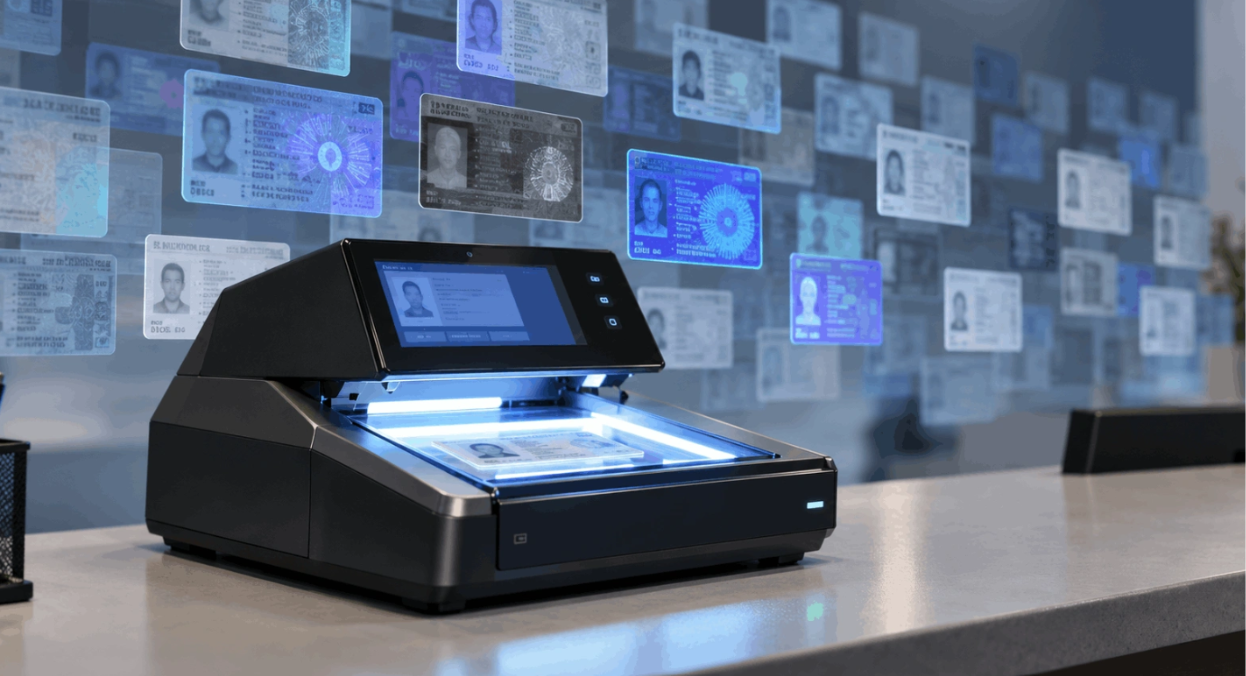
KrebsOnSecurity reported that nine consenting individuals matched displayed-record timestamps to occasions when they had presented identification. It also reported that some Nexus image sets contained front-and-back captures in visible, infrared, and ultraviolet formats resembling capabilities described in IDScan.net’s documentation. These limited matches and reported similarities support a possible connection to IDScan.net for some records but do not establish that every named customer or location was affected or that every Nexus record originated from the company.
IDScan.net said it became aware of the matter on or around September 1. Its September 4 notice states that an unauthorized third party may have accessed and/or copied customer information from accounts on its cloud platform, potentially including full names and driver’s license or other government-issued identification numbers. The company said it secured its systems, engaged third-party specialists, reviewed its security policies and procedures, cooperated with federal law enforcement, notified potentially affected individuals, and offered free credit-monitoring and identity-protection services. It did not disclose an affected customer count.
Multiple proposed class-action lawsuits were filed in the US District Court for the Eastern District of Louisiana after the incident became public. The complaints contain civil allegations that remain subject to litigation; they are not established findings and do not independently establish Nexus’s advertised record count or the complete scope of the incident. Separately, Reuters reported that the FBI was looking into the incident.
Methodology and Evidence Scope
This advisory reviewed IDScan.net’s September 4 data-security notice; reporting by KrebsOnSecurity, Reuters, TechCrunch, The Record, and SafeState; and publicly described civil complaints. FTC and NIST publications were reviewed separately to support the protective guidance. The assessment of distinguished company disclosures, reporter observations, marketplace claims, civil allegations, and unresolved information. It did not include IDScan.net’s internal forensic records, the complete Nexus dataset, provider-controlled logs, or nonpublic law enforcement findings.
Reported Entities and Evidence Limits
Nexus is the reported marketplace service, Exploit is the forum where it was advertised, and IDScan.net is the company that disclosed the cloud data incident. These are contextual entities, not validated technical indicators of compromise. The reviewed sources provide no malicious domains, IP addresses, or file hashes suitable for detection or blocking. IDScan.net should not be treated as a malicious destination.
MITRE ATT&CK
The reviewed public sources do not provide enough verified attacker behavior for a reliable incident-specific MITRE ATT&CK mapping. No technique is assigned in this advisory.
Potential Impact
If the operator’s claims are accurate, authentic document images, photographs, and government identification numbers could facilitate identity fraud, fraudulent credit applications, synthetic-identity schemes, tailored phishing, social engineering, and misuse of account-recovery or onboarding processes. The records could also increase privacy and personal-safety risks for people who need to protect their identity or address, including survivors of domestic violence and participants in address-confidentiality programs. Organizations that accept static document images could face attempts to reuse genuine scans with other obtained personal data. The reviewed sources do not establish exposure of passwords, authentication tokens, or cloud credentials; credential stuffing, direct account takeover, and cloud-service compromise are therefore not confirmed incident impacts.
Recommendations/Mitigations
For End Users
- Follow notifications and guidance from IDScan.net or any organization that collected the identity document, without assuming that the document was included in the incident.
Individuals who receive notification of potential exposure, or who are concerned about identity misuse, may consider the following precautions:
- United States: Consider placing a free credit freeze proactively with Equifax, Experian, and TransUnion; confirmed exposure is not required. A fraud alert is another option for people who are or suspect they may be affected by identity theft. Follow current FTC guidance.
- Canada: Review credit reports from both Equifax and TransUnion for unfamiliar accounts or inquiries. If fraud is suspected, contact both bureaus about placing a fraud alert, notify affected financial institutions, and use the National Fraud Reporting System. A security freeze may also be available in some provinces or territories. Follow current federal, provincial, or territorial guidance.
- Monitor financial accounts and new account notifications for unfamiliar activity, particularly if you have received notice that your information may have been affected.
- Remain cautious of messages that reference license details or request additional identity information; verify such requests through official channels.
- As general account protection measures, use unique passwords and enable MFA or passkeys on important accounts. The reviewed reporting does not establish that passwords, authentication tokens, or account credentials were exposed; these measures are recommended as best practices for general security.
- Report suspected identity misuse to the relevant financial institution, government identity authority, and consumer protection or law-enforcement agency.
For Organizations/Defenders
- Inventory identity verification of vendors, document-scanning workflows, stored data, retention periods, data residency, and cloud dependencies.
- Confirm whether raw document images are retained after verification and require a documented deletion schedule that reflects legal and operational needs. When applying deletion policies, preserve records and artifacts subject to incident-response, legal-hold, regulatory, or investigative requirements.
- Review contractual breach-notification timelines, indemnification terms, audit rights, sub processors, and evidence of current independent security assessments.
- Validate encryption for document images at rest and in transit, role-based access controls, privileged-access monitoring, and alerting for bulk retrieval or export.
- Coordinate with relevant providers to determine whether organizational accounts or submitted documents fall within the incident scope and request the evidence supporting that determination where contractually and legally available.
- Preserve and review authentication, API, administrative, storage-access, and bulk-export telemetry that the organization controls. Request relevant provider-controlled logs, audit records, and incident evidence from the service provider where contractually and legally available.
- Where evidence, provider guidance, or an organization’s own investigation indicates potential credential exposure, rotate affected passwords and API keys, revoke affected tokens, and invalidate active sessions. The reviewed reporting does not establish exposure of passwords, authentication tokens, or API keys.
- For identity proofing, validate both the identity evidence and its connection to the applicant, consistent with NIST SP 800-63A-4. Use live capture, presentation-attack detection, and controls against injected or forged media as complementary safeguards within a risk-based process; no single control guarantees authenticity. This recommendation does not imply that the incident established a compliance violation.
- Monitor for phishing, identity-based account recovery attempts, fraudulent onboarding, and potential reuse of genuine document images where organizational exposure is confirmed, suspected, or under investigation.
- Engage legal, privacy, procurement, communications, and incident-response teams to assess notification and regulatory obligations without assuming the marketplace’s full claims are accurate.
Timeline
| Date | Event |
|---|---|
| August 31, 2026 | A source alerted KrebsOnSecurity to a Nexus advertisement posted by a new user on the Exploit cybercrime forum. |
| September 1, 2026 | KrebsOnSecurity published its investigation into Nexus. Separately, IDScan.net later stated in its September 4 notice that it became aware of the matter on or around September 1. |
| September 1, 2026 | KrebsOnSecurity reported that Nexus became unavailable and that its login page displayed “This service is no longer available.” |
| September 2, 2026 | Reuters reported that the FBI said it was looking into the incident and could not comment further because of the ongoing investigation. Caesars Entertainment separately stated that it was not an active IDScan.net client, had not used VeriScan since February 2025, and expected no impact from the incident. |
| September 4, 2026 | IDScan.net published a notice stating that an unauthorized third party may have accessed and/or copied customer information held in its cloud platform. The company identified potentially affected data as full names and government-issued identification numbers and said it had secured its systems. |
| September 10, 2026 | TechCrunch reported that IDScan.net’s September 4 notice said an unauthorized third party may have accessed and/or copied customer information that could include driver’s license or other government-issued identification numbers. The company did not disclose an affected person count. |
Sources
- IDScan.net, Notification of Data Security Incident, September 4, 2026. Company disclosure stating that an unauthorized third party may have accessed and/or copied customer information stored on the company’s cloud platform. The notice does not confirm Nexus’s advertised record totals, the number of affected individuals, the origin of all records, or claims of continuing access.
- KrebsOnSecurity, FBI Probes Service Selling 153M+ Drivers Licenses, September 1, 2026. Primary reporting on Nexus, including observations of the service and checks involving nine consenting individuals. The reporting does not validate the complete dataset, every advertised record, the unique affected population, or the origin of all records.
- Reuters, FBI probes report of data breach exposing millions of drivers’ licenses in US, Canada, September 2, 2026. Reporting that the FBI said it was looking into the incident. Reuters stated that it could not establish the source of the data.
- TechCrunch, ID verification giant IDScan confirms data breach with more than 150 million drivers’ licenses stolen, September 10, 2026. Secondary reporting on IDScan.net’s September 4 notice and the broader allegations. The article does not independently establish the complete scope of the incident.
- The Record, IDScan data breach notice follows claims of 153 million drivers’ licenses for sale, September 10, 2026. Secondary reporting distinguishes the company notice from the marketplace’s advertised claims.
- SafeState, IDScan Faces Lawsuits Over Alleged 153 Million ID Data Breach, September 7, 2026. Summary of publicly reported civil complaints. Allegations in those complaints remain subject to litigation and should not be treated as established findings.
- Federal Trade Commission, Credit Freezes and Fraud Alerts, Accessed for this advisory. Consumer guidance regarding credit freezes, fraud alerts, and identity-theft precautions.
- National Institute of Standards and Technology, SP 800-63A-4: Digital Identity Guidelines: Identity Proofing and Enrollment, Accessed for this advisory. Identity-proofing and verification guidance. Inclusion does not imply that the incident established a compliance violation.
The information provided in this article is based on publicly available open-source intelligence (OSINT). It is intended for awareness and defensive cybersecurity purposes only.
