
 HQ/EMEAFind out how we can help your business


In This Issue
01 Threat Landscape
This week the landscape was shaped by a large cryptocurrency exchange theft with preliminary North Korean attribution, renewed mass exploitation of Oracle PeopleSoft, a commodity remote access trojan hiding inside a signed Windows process, and a newly documented ransomware variant. Bitget confirmed that approximately $387.5 million was moved to attacker controlled addresses on 24 September, and its chief executive has pointed to the Lazarus Group, although attribution is not confirmed. Incident response and threat intelligence teams reported that UNC6240 (ShinyHunters) has resumed mass exploitation of CVE-2026-35273 by bypassing web application firewall rules with a single encoded character. AsyncRAT continued to be delivered through a fake invoice lure that ends with the payload running inside charmap.exe. Altair, a Windows ransomware variant that appends the .ALTAIR19 extension, was documented with contact infrastructure shared with MedusaLocker family variants. Two further flaws demanded emergency patching: the Citrix NetScaler zero days CVE-2026-88771 and CVE-2026-88772, exploited before a fix existed, and Microsoft SharePoint CVE-2026-65660, which moved from a moderate spoofing label to confirmed exploitation in about six weeks.
The common thread is misplaced trust in components that defenders assume are safe: a third party security product that yielded privileged internal credentials, a firewall rule that was believed to have contained an exposed service, an advisory label that understated a SharePoint flaw, a signed Windows binary used as a host for malware, and system backups that ransomware removes before it encrypts. The defensive priority is to patch rather than filter, verify third party tooling and privileged credential paths, and protect and test recovery. Attribution and data theft claims this week, for the Lazarus Group and for Altair, remain unconfirmed and are labelled as such.
02 Emerging Threats and Campaigns
The most significant emerging incident this period is the Bitget hot wallet theft. Bitget detected unauthorized transfers on 24 September 2026 and has since said that approximately $387.5 million in assets reached attacker controlled addresses, revised upward from an initial estimate of $351.6 million after Zcash and TRON transfers were added. The exchange states that its cold wallets and customer private keys were not affected and that its User Protection Fund, reported at more than $464 million, covers the loss. Incident details follow, and the attribution assessment is under Threat Actor Activity.
- Third party security tooling as an entry point. Bitget reports that the attacker exploited a vulnerability in a third party security product to obtain high level internal credentials, continuing a pattern of adversaries targeting the tools that guard privileged access.
- Controls that did not fire. The first two transfers were below the risk control threshold, and later transfers used legitimate credentials disguised as routine administrative operations, according to Bitget’s chief executive.
- Mitigations that were not patches. UNC6240 bypassed firewall rules protecting Oracle PeopleSoft by URL encoding one character, which is detailed under Vulnerability Intelligence.
Bitget Hot Wallet Incident
On 24 September 2026 Bitget identified unauthorized transfers from its hot and warm wallets. According to the account given by chief executive Gracy Chen on 28 September, the attacker used a vulnerability in a third party security product to obtain high level internal credentials, sent fraudulent withdrawal commands to the wallet system, and then deleted traces of those commands. The transfers spanned multiple networks including Ethereum, XRP Ledger, Zcash, TRON, BNB Smart Chain, Avalanche, Base, Arbitrum and Optimism, and the largest single movement reported was approximately 103 million XRP.
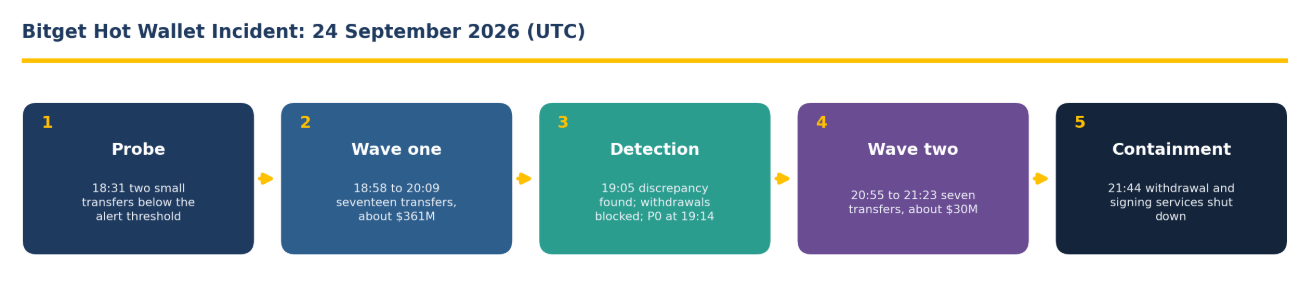
Bitget incident timeline, 24 September 2026 (UTC, as reported by Bitget).
| Field | Detail |
|---|---|
| Victim | Bitget (centralized cryptocurrency exchange) |
| Date detected | 24 September 2026 (first transfers at about 18:31 UTC) |
| Confirmed loss | Approximately $387.5 million (revised from $351.6 million) |
| Wallets affected | Hot and warm wallets; cold wallets and customer private keys reported unaffected |
| Reported access path | Vulnerability in a third party security product (product not named), leading to high level internal credentials |
| Attribution | Suspected Lazarus Group; not confirmed (see Threat Actor Activity) |
| Investigators | Two independent forensic firms |
| Recovery | Bounty of 5% of funds frozen and 5% of funds recovered; some funds frozen with industry partners |
| Service status | BTC withdrawals resumed 28 September; ETH 29 September; USDT 30 September; other assets, fiat and P2P scheduled 2 October |
Bitget’s monitoring identified a significant discrepancy at 19:05 UTC, seven minutes after the first large transfer, blocked user withdrawals, and declared its highest level emergency response at 19:14 UTC. The wallet team began moving funds into cold storage at about 20:40 UTC, and a second wave of seven transfers followed between 20:55 and 21:23 UTC. Withdrawal and signing services were shut down at about 21:44 UTC, and Bitget reports that it identified the root cause within several hours. The wave estimates given by Bitget (about $361 million and about $30 million) are approximate and do not sum exactly to the confirmed $387.5 million total. Detection is also described differently across statements, as 18:31 UTC in the first notice and 19:05 UTC in the later account.
Recommendations
- Review every third party security product with administrative reach into payment, wallet or core banking systems, and treat vulnerability disclosures for those products as emergency patches.
- Enforce withdrawal or payment policy in a service that is independent of the credentials able to submit instructions, including independent verification of large or unusual transfers.
- Tune risk thresholds for probing behaviour, and alert on small test transactions, rapid sequences of transfers across assets and new destination addresses.
- Write administrative commands to an immutable log held off the system so that deleted command traces can be reconstructed.
- Screen counterparties against attacker addresses published by the victim exchange, and report matching flows to the exchange and to law enforcement.
03 Threat Actor Activity
Lazarus Group (TraderTraitor)
The Lazarus Group is a North Korean state aligned threat actor umbrella, assessed to be sponsored by the Reconnaissance General Bureau. It is also tracked as APT38, and its cryptocurrency focused cluster is tracked as TraderTraitor, also known as Jade Sleet and UNC4899. The group has been sanctioned by the United States Treasury since April 2022 and has been linked to the largest thefts in cryptocurrency history, including a $1.5 billion theft from a cryptocurrency exchange in February 2025, which the FBI attributed to TraderTraitor. Public reporting states that North Korea linked actors stole $2.02 billion in 2025 and that a $292 million exploit of a decentralized finance protocol in April 2026 was attributed to the same group.
| Attribute | Detail |
|---|---|
| Aliases | Lazarus Group, APT38; TraderTraitor sub cluster (Jade Sleet, UNC4899) |
| Assessed origin | North Korea (DPRK) |
| Assessed sponsor | Reconnaissance General Bureau |
| Motivation | Financial gain and revenue generation for the state |
| Targeted sectors | Cryptocurrency exchanges, DeFi platforms, custodians, Web3 and AI companies |
| Typical access methods | Fake recruiter social engineering; trojanized developer tools and packages on npm and PyPI |
| Current activity | Suspected in the Bitget theft of 24 September 2026; attribution unconfirmed |
| Sanctions | US Treasury OFAC designation since April 2022 |
TraderTraitor operations typically begin with unsolicited job offers or technical assessments sent to engineers and compliance staff, delivering malware through trojanized repositories and packages, and then use that foothold to reach signing or administrative systems. Proceeds are laundered across chains and bridges, often through decentralized exchanges. A February 2026 report described a Lazarus linked campaign that planted malicious npm and PyPI packages through fake cryptocurrency job offers.
Bitget attribution assessment
Attribution of the Bitget theft to the Lazarus Group is preliminary. The evidence made public to date is summarised below.
| Evidence | Source | Status |
|---|---|---|
| IP addresses resembling VPN infrastructure previously associated with a North Korean group | Bitget chief executive | Stated; no technical data published |
| Stolen XRP traced through cross chain transfers to funds from a July 2026 exchange theft that was reported as attributed to TraderTraitor | Independent on chain analyst; the other exchange’s own review | Third party finding; not confirmed by Bitget |
| Scale, asset mix and speed consistent with earlier North Korean thefts | Media analysis | Pattern only; not attributive |
| Bitget declined to name an actor and does not believe the incident was an inside job | Bitget | Official position: unattributed |
| Reported access path was exploitation of a third party security product to obtain credentials | Bitget | Differs from the recruiter and developer compromise documented for the February 2025 exchange theft; not conclusive |
Analytic note
Three points warrant caution. First, the Lazarus label is an umbrella designation, and the evidence available relates to VPN resemblance and overlapping laundering infrastructure rather than to malware, tooling or forensic artifacts, none of which have been published. Second, the access method Bitget describes, exploitation of a third party security product, does not match the developer targeted social engineering most associated with TraderTraitor, so tradecraft neither supports nor rules out attribution. Third, reports that North Korean thefts have passed one billion dollars in 2026 depend on counting Bitget as North Korean. Until Bitget publishes its security report or a government agency issues an attribution, this entry should be described as a suspected North Korea linked theft rather than an attributed Lazarus operation.
Recommendations
- Brief engineers, compliance staff and administrators on fake recruiter and technical assessment lures, and block execution of untrusted repositories and packages on machines with administrative or signing access.
- Screen inbound and outbound flows against sanctioned and published attacker addresses, and monitor for rapid multi asset movement through bridges and decentralized exchanges.
- Separate developer workstations from production signing and administrative systems, and require hardware backed approval for privileged actions.
- Track Bitget’s forthcoming security report and the forensic findings for indicators, and update detections once tooling is disclosed.
04 Ransomware and Data Leaks
Altair Ransomware (MedusaLocker family, assessed)
Altair is a Windows file encrypting ransomware that appends a variant specific extension, .ALTAIR followed by a number (.ALTAIR19 in the analysed sample), and drops an HTML ransom note named RANSOM_NOTE.html. The note states that the victim’s company network has been penetrated, claims that highly confidential and personal data was copied to a private server, and threatens to release or sell that data if payment is not made. It offers to decrypt two or three non important files for free, warns against renaming or modifying encrypted files and against third party recovery software, and directs victims to two email contacts ([email protected] and [email protected]) and a Tor chat address. A threat intelligence vendor reports that the note sets a 72 hour deadline for contact before the price rises; that line is not visible in the note capture supplied for this report.
The contact domains salamati.vip and amniyat.xyz also appear, with a recovery1 mailbox, in notes for variants that public reporting describes as part of the MedusaLocker family, including BARADAI and Jackpot. On that basis Altair is assessed as a MedusaLocker family variant with moderate confidence. The assessment rests on the note format and shared contact infrastructure and has not been confirmed by code comparison.
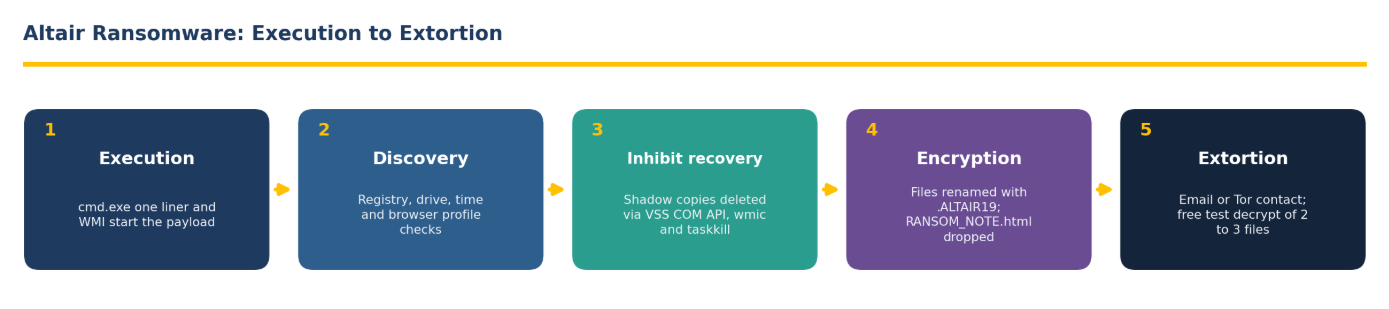
Altair ransomware flow from execution to extortion (assembled from sandbox behaviour signatures and vendor reporting).
Observed evidence
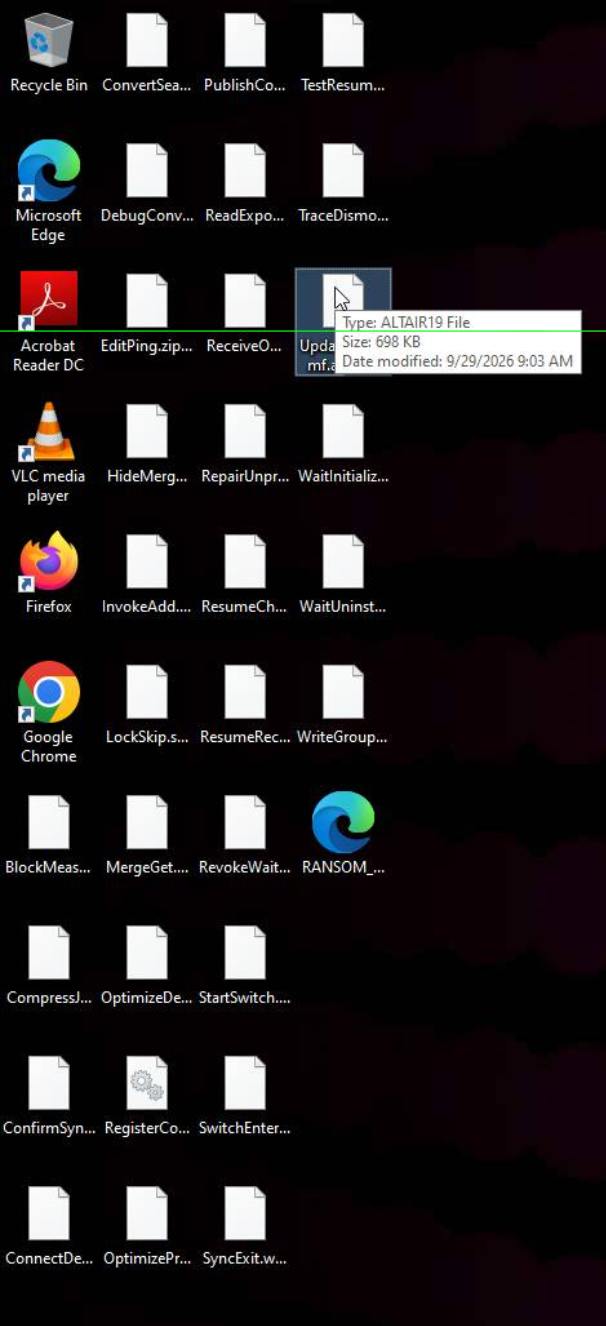
Sandbox desktop after execution, with files carrying the ALTAIR19 file type (a 698 KB encrypted file is shown in the tooltip).
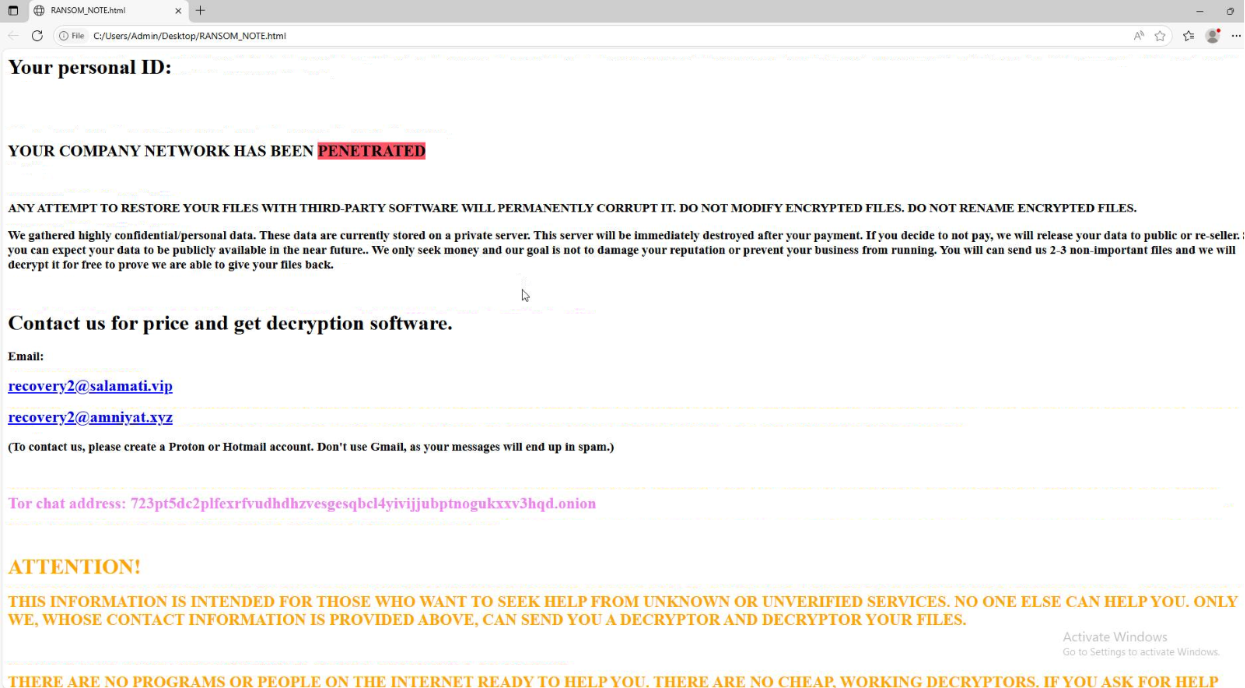
The RANSOM_NOTE.html ransom note opened in a browser on the sandbox desktop.
Behavioural signatures
Sandbox analysis of the sample records the following behaviours. Altair deletes shadow copies, uses the Volume Shadow Copy service COM API and interacts with shadow copies to inhibit recovery; vendor reporting lists the commands Delete Shadows /all /quiet and wmic shadowcopy delete /nointeractive. It kills processes with taskkill (seven instances recorded), executes a cmd.exe one liner, runs net.exe and uses WMI. It enumerates connected drives and physical storage devices, reads the hostname and domain, system time, processor and system information from the registry, and gathers browser information. It also reads user and profile data of web browsers, which indicates credential collection capability. It drops files in the Program Files directory and modifies registry classes.
MITRE ATT&CK techniques
| Tactic | ID | Technique | Observed procedure |
|---|---|---|---|
| Execution | T1059.003 | Command and Scripting Interpreter: Windows Command Shell | Executes a cmd.exe one liner |
| Execution | T1047 | Windows Management Instrumentation | Uses WMI for host information and command execution |
| Defense Evasion | T1006 | Direct Volume Access | Accesses volumes directly |
| Defense Evasion | T1070.004 | Indicator Removal: File Deletion | File deletion recorded by the sandbox |
| Credential Access | T1555.003 | Credentials from Password Stores: Credentials from Web Browsers | Reads user and profile data of web browsers |
| Credential Access | T1552.001 | Unsecured Credentials: Credentials In Files | Sandbox flagged reads of credential material in files |
| Discovery | T1217 | Browser Information Discovery | Enumerates browser information |
| Discovery | T1120 | Peripheral Device Discovery | Enumerates connected drives and physical storage |
| Discovery | T1012 | Query Registry | Reads processor and system information (sandbox check) |
| Discovery | T1082 | System Information Discovery | Enumerates system information |
| Discovery | T1016 | System Network Configuration Discovery | Reads hostname and domain from the registry |
| Discovery | T1124 | System Time Discovery | Gathers the system time |
| Collection | T1005 | Data from Local System | Collects local data |
| Impact | T1490 | Inhibit System Recovery | Deletes shadow copies through the VSS COM API and command line |
| Impact | T1486 | Data Encrypted for Impact | Encrypts files and appends .ALTAIR19 (shown in the capture and vendor reporting; not in the sandbox mapping) |
Indicators of compromise
| Indicator | Type | Context |
|---|---|---|
| fadf86583145544f49d12923ec28bddfdc97633c03d7a466493f1b219137efc7 | SHA256 | Altair ransomware sample |
| .ALTAIR19 | File extension | Appended to encrypted files (numeric suffix varies by variant) |
| RANSOM_NOTE.html | Filename | Ransom note |
| [email protected] | Operator negotiation contact | |
| [email protected] | Operator negotiation contact | |
| salamati.vip and amniyat.xyz | Domain | Contact domains shared with related variants (recovery1 mailboxes) |
| 723pt5dc2plfexrfvudhdhzvesgesqbcl4yivijjubptnogukxxv3hqd.onion | Tor address | Negotiation chat, transcribed from the capture; verify before use |
| Delete Shadows /all /quiet | Command | Shadow copy deletion (reported by a threat intelligence vendor) |
| wmic shadowcopy delete /nointeractive | Command | Shadow copy deletion (reported by a threat intelligence vendor) |
Leak site activity of note
The Storm ransomware group, first recorded on leak sites in August 2026, listed at least two US regional financial institutions on 27 and 29 September, alongside manufacturing and aerospace suppliers. These listings are the group’s own claims. The institutions had not publicly confirmed the incidents at the time of writing, and no data samples have been independently validated.
Analytic note
Several points warrant caution. First, the family assessment above is moderate confidence and rests on the note and infrastructure overlap, not on code. Second, the data theft claim in the note is unverified: the sandbox mapping shows local data collection and access to credential files but no exfiltration technique, so double extortion should be treated as claimed rather than demonstrated. Third, the sandbox tags browser data reading as spyware and stealer behaviour, but that describes a capability seen during detonation and does not show a separate infostealer component. Fourth, the capture comes from an analysis sandbox, so the 29 September 2026 file date, the Admin user and the empty Your personal ID field are artifacts of the environment and not evidence of when a victim was affected. Fifth, initial access, victim sector and geography are not established by the material reviewed, and no victim has been publicly linked to Altair.
Recommendations
- Maintain offline or immutable backups and test restoration, since Altair removes shadow copies through several methods.
- Alert on vssadmin, wmic and PowerShell shadow copy deletion, on wbadmin catalog deletion, and on mass file renaming that adds a numbered extension.
- Block the operator domains salamati.vip and amniyat.xyz at mail and DNS controls, and hunt for the .ALTAIR extension and RANSOM_NOTE.html on file servers.
- Review phishing controls and internet exposed remote access services, since MedusaLocker family intrusions are commonly reported to begin with phishing or compromised network access and Altair initial access is not established.
- Do not pay; preserve the note and a sample encrypted file, and engage incident response and the relevant national CERT.
05 Malware and RATs
AsyncRAT
AsyncRAT is an open source remote access trojan written for .NET, first released in 2019 and still publicly available, which is why it appears in campaigns run by many unrelated operators. It provides keylogging, screen capture, remote command execution and a modular design that lets operators add capabilities. A threat intelligence vendor documented a five stage AsyncRAT chain, reported on 14 September 2026, that hides the payload in a Microsoft signed Windows process. It begins with a batch file named Right-click to open Invoice Details.bat, which starts PowerShell with a hidden window and no profile, decodes a payload using Base64, junk characters and XOR, and stages a renamed AutoIt interpreter, an AutoIt loader script and an extensionless encrypted file in a randomly named Temp folder. A batch file placed in the Startup folder restarts the chain at each sign in without administrator rights or a registry run key. The loader decrypts its payload in memory, starts the 32 bit Character Map program (charmap.exe) hidden, allocates memory in it, copies in the payload and starts a new thread, leaving no matching file on disk.
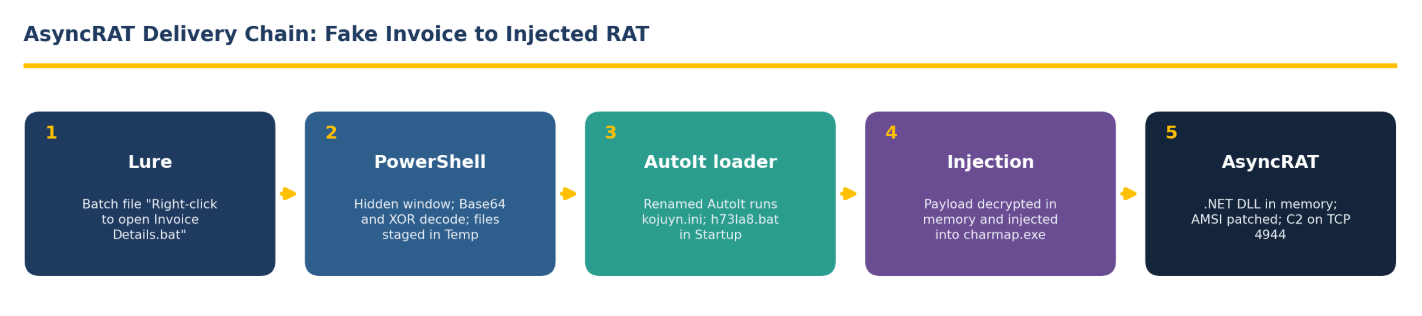
AsyncRAT delivery chain from fake invoice lure to injected payload (after vendor analysis).
| Attribute | Detail |
|---|---|
| Type | Remote access trojan (.NET, open source) |
| Operator | Not attributed; used by many unrelated actors |
| Delivery | Fake invoice batch file, hidden PowerShell and an AutoIt loader |
| Execution host | charmap.exe (Windows Character Map), injected in memory |
| Persistence | Batch file in the user Startup folder |
| Evasion | In memory decryption, AMSI patched inside the infected process, signed host process |
| Capabilities | Screen capture (observed in this analysis); keylogging, remote command execution and plugins (general AsyncRAT features) |
| C2 endpoint | 158[.]51[.]122[.]136 on TCP 4944 |
The final decrypted DLL, Veukuzmw.dll, provides the familiar AsyncRAT features, and the analysis observed screen capture code that grabs the primary display and prepares it for transfer to the operator. AMSI, the Windows script scanning interface, is patched inside the infected process, which reduces visibility of later script and assembly activity. Character Map rarely needs to be launched hidden by an AutoIt process or to make outbound connections, so those relationships are stronger detection signals than the signed file alone. No threat actor has been publicly linked to this chain, and no public reporting reviewed for this issue ties AsyncRAT activity to the Lazarus Group or to the other threats covered here.
MITRE ATT&CK techniques
Technique identifiers below are mapped by the analyst from the reported behaviour and are not taken from the source report.
| Tactic | ID | Technique | Observed procedure |
|---|---|---|---|
| Execution | T1204.002 | User Execution: Malicious File | Victim opens the fake invoice batch file |
| Execution | T1059.001 | Command and Scripting Interpreter: PowerShell | Hidden PowerShell decodes and stages components |
| Execution | T1059.010 | Command and Scripting Interpreter: AutoHotKey and AutoIT | Renamed AutoIt interpreter runs the loader script |
| Persistence | T1547.001 | Boot or Logon Autostart Execution: Startup Folder | h73la8.bat in the Startup folder |
| Defense Evasion | T1027 | Obfuscated Files or Information | Base64, junk characters, XOR and an encrypted payload file |
| Defense Evasion | T1055 | Process Injection | Payload injected into hidden charmap.exe |
| Defense Evasion | T1562.001 | Impair Defenses: Disable or Modify Tools | AMSI patched inside the infected process |
| Collection | T1113 | Screen Capture | Captures the primary display |
Indicators of compromise
File hash values are omitted because the values reproduced in the source article were truncated and could not be confirmed.
| Indicator | Type | Context |
|---|---|---|
| Right-click to open Invoice Details.bat | Filename | Initial batch file lure |
| kojuyn.ini | Filename | AutoIt loader script |
| ogftogcyiblzjccmcbnw.exe | Filename | Renamed legitimate AutoIt interpreter |
| nloemfbihmhm | Filename | Extensionless encrypted payload |
| h73la8.bat | Filename | Startup folder persistence |
| Veukuzmw.dll | Filename | Final AsyncRAT DLL |
| 158[.]51[.]122[.]136:4944 | IP and port | AsyncRAT command and control |
Recommendations
- Block or quarantine batch, script and shortcut attachments from email and downloads, and warn staff about unexpected invoice files.
- Alert on hidden PowerShell that writes to Temp and Startup, on AutoIt binaries launched from Temp, and on charmap.exe that starts hidden, receives injected threads or makes network connections.
- Monitor for AMSI tampering and remote thread creation into signed system utilities, and do not treat a valid signature as proof that a process is benign.
- Block the reported command and control endpoint and hunt endpoints for the listed filenames.
06 Vulnerability Intelligence
CVE-2026-35273: Oracle PeopleSoft PeopleTools Remote Code Execution
CVE-2026-35273 is a critical unauthenticated remote code execution vulnerability in the Environment Management component of Oracle PeopleSoft PeopleTools. It carries a CVSS score of 9.8 and is reported to affect PeopleTools versions 8.61 and 8.62. Attackers reach the vulnerable Environment Management Hub (PSEMHUB) servlet with a serialized Java object. UNC6240, tracked publicly as ShinyHunters, first exploited the flaw as a zero day between 27 May and 9 June 2026, mainly against universities, before Oracle issued an emergency Security Alert on 10 June 2026.
| Field | Detail |
|---|---|
| CVE ID | CVE-2026-35273 |
| Affected product | Oracle PeopleSoft PeopleTools (8.61 and 8.62 reported) |
| Severity | Critical (CVSS 9.8) |
| Vulnerability type | Unauthenticated remote code execution (Java deserialization in the PSEMHUB hub servlet) |
| Impact | Remote code execution, web shells, credential theft and data theft |
| Exploitation status | Active exploitation confirmed by incident response and threat intelligence teams (zero day 27 May to 9 June; renewed wave September) |
| Threat actor | UNC6240 (ShinyHunters) |
| Fix | Oracle Security Alert for CVE-2026-35273 (10 June 2026); web application firewall rules are not a substitute |
On 25 September 2026 incident response and threat intelligence teams reported renewed mass exploitation. UNC6240 modified its requests to bypass firewall rules that blocked /PSEMHUB/ by URL encoding one character, requesting /%50SEMHUB/ instead. Many firewall and proxy rules match the literal path before decoding, while the PeopleSoft server decodes the request and routes it to the vulnerable servlet, so organizations that mitigated with a firewall rule instead of patching remained exposed. Web shells were deployed on dozens of systems worldwide across higher education, technology, IT services, healthcare, agriculture, transportation and government.
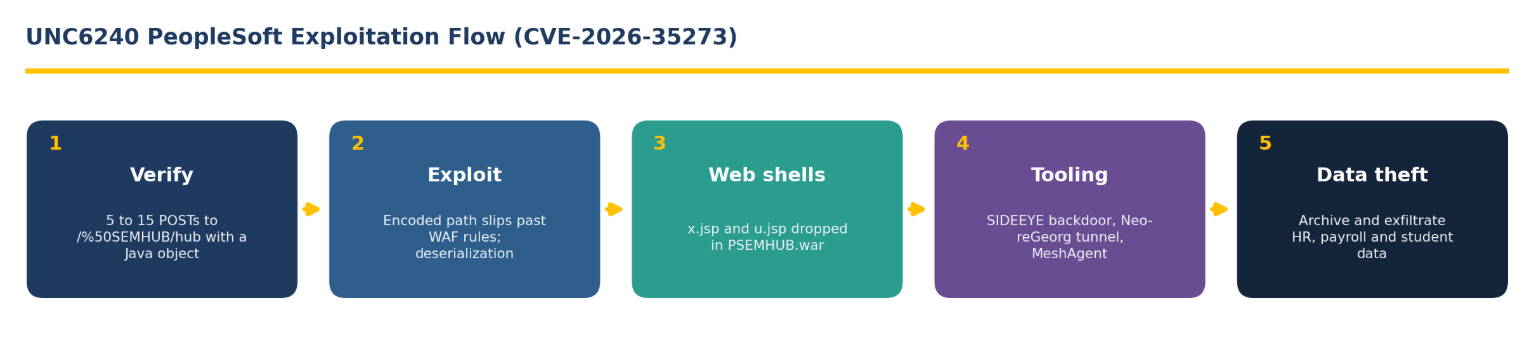
UNC6240 exploitation flow against Oracle PeopleSoft (after vendor reporting).
Targeted servers typically receive five to 15 POST requests to /%50SEMHUB/hub that quietly confirm exploitability. UNC6240 then deploys two web shells, x.jsp for command execution and u.jsp for chunked file upload, uploads a trojanized installer masquerading as a media player (Ple64.exe) that loads the SIDEEYE backdoor in memory, stages the Neo-reGeorg tunneling toolkit, and on Linux installs the MeshAgent remote management tool. A quarter of observed commands ran as root or SYSTEM. A fileless variant returns command output in the HTTP response with no file written, so detections built only on JSP file creation will miss it. The responders note that the actor has a well established pattern of data theft extortion and advise affected organizations to prepare for extortion communications.
ShinyHunters also claimed on 22 September to have compromised FBI infrastructure through a PeopleSoft server. The FBI acknowledged the claim but has not confirmed the theft of 2 TB to 3 TB of data, and the group told a news outlet that the FBI incident involved a different zero day from CVE-2026-35273. That claim is unverified and is not part of the incident response reporting.
Indicators of compromise
| Indicator | Type | Context |
|---|---|---|
| 5[.]199[.]162[.]157 | IPv4 | Attack controller, scanner and callback receiver |
| 104[.]219[.]234[.]138 | IPv4 | Exfiltration staging and remote management host |
| 162[.]219[.]30[.]165 | IPv4 | SIDEEYE command and control (TCP 3333 and 3334) |
| winmanage-me[.]network | Domain | MeshCentral infrastructure |
| /%50SEMHUB/ | URI pattern | Percent encoded firewall bypass path; other variants likely |
| 48b4a0827da7bbfce9fb52464f8a659dea7a035189c52c506c0bfb4b1c3fe494 | SHA256 | x.jsp primary execution web shell (hash varies) |
| 2bee941fb40519d0d1ec52bd79a8f63fc65aac6455c8f2d6b668e3360dfdb5d7 | SHA256 | u.jsp chunked upload web shell |
| 3ba215692665513abfffd4e815c5c45f2d41e5dcc4283a2a3b740930c5c417c3 | SHA256 | Ple64.exe trojanized installer delivering SIDEEYE |
| tunnel.jsp and tunnel.jspx | Filename | Neo-reGeorg tunnel (hash varies by key) |
Recommendations
- Apply the Oracle Security Alert for CVE-2026-35273 to every PeopleSoft instance; firewall rules and path blocking are not a substitute for patching.
- Disable the Environment Management Hub in multi server configurations or remove the PSEMHUB application in single server ones, and enforce blocking on the normalized path, including percent encoded and mixed case variants.
- Search WebLogic access logs for /PSEMHUB/ and encoded variants, POST requests to /hub from external sources and requests to unexpected .jsp or .jspx files, and inspect PSEMHUB.war on every node for x.jsp, u.jsp, tunnel.jsp, tunnel.jspx and Ple64.exe.
- Alert on cmd.exe or /bin/sh spawned by the WebLogic Java process and on unexpected MeshCentral agents.
- Where a web shell is found, treat the host as compromised, preserve evidence, rotate credentials readable by the PeopleSoft service account and prepare for extortion.
CVE-2026-88771 and CVE-2026-88772: Citrix NetScaler Remote Code Execution
CVE-2026-88771 and CVE-2026-88772 are critical remote code execution vulnerabilities in Citrix NetScaler ADC and NetScaler Gateway, exploited as zero days before a fix existed. Citrix published security bulletin CTX697096 on 27 September 2026, confirmed that exploitation had been observed on unmitigated deployments, and fixed six further NetScaler vulnerabilities (CVE-2026-88773 to CVE-2026-88778) in the same release. CISA added both flaws to the Known Exploited Vulnerabilities catalogue on 27 September and reports exploitation globally, with a reported federal remediation date of 30 September 2026. The disclosure followed a private pre notification from the Dutch NCSC that led suppliers to tell administrators to take appliances offline, and a public warning from an exposure management vendor on 26 September.
| Field | Detail |
|---|---|
| CVE IDs | CVE-2026-88771, CVE-2026-88772 |
| Affected product | Citrix NetScaler ADC and NetScaler Gateway (customer managed appliances) |
| Severity | Critical (CVSS 4.0 base score 9.5 for both) |
| CVE-2026-88771 | Improper input validation; unauthenticated attacker runs arbitrary commands; affects the default configuration |
| CVE-2026-88772 | Memory overflow leading to remote code execution or denial of service when DTLS is enabled (the default on VPN virtual servers) |
| Exploitation status | Exploited as zero days; confirmed by Citrix; on the CISA KEV catalogue (27 September 2026) |
| Reported post exploitation | Web shells planted on compromised appliances |
| Workaround | None published; upgrade is the only fix |
| Advisory | Citrix CTX697096 |
A security research firm has published a technical analysis and public proof of concept for CVE-2026-88771, which traces the flaw to a maintenance script that passes text taken from NetScaler logs into a shell context without validation. Ordinary pre authentication requests such as a login attempt can seed the log with a crafted value, and because most NetScaler processes run as root the injected command also runs as root. The trigger is not instant because the script runs on a schedule. With a public proof of concept now available, opportunistic exploitation should be expected to rise. Appliances already patched for the earlier exploited flaw CVE-2026-19490 (KEV, 9 September 2026) remain vulnerable to these two flaws unless they run one of the fixed builds below.
| Product | Affected | Fixed version |
|---|---|---|
| NetScaler ADC and Gateway 14.1 | Before 14.1-73.37 | 14.1-73.37 and later |
| NetScaler ADC and Gateway 13.1 | Before 13.1-64.23 | 13.1-64.23 and later (use 13.1-64.24 if show ns variable returns any variables, to avoid a reported reboot loop) |
| NetScaler ADC 14.1-FIPS | Before 14.1-73.37 FIPS | 14.1-73.37 FIPS and later |
| NetScaler ADC 13.1-FIPS and 13.1-NDcPP | Before 13.1-37.279 | 13.1-37.279 and later |
Analytic note
Three points warrant caution. First, no reliable public attribution exists. One researcher suggested a well resourced, nation state aligned actor because the activity looked like espionage rather than opportunistic crime, but that is an opinion and not a finding, and earlier ransomware and state campaigns against NetScaler should not be used to attribute this one. Second, the scale of exploitation is undetermined, and reports that attacks ran for weeks come from a single researcher citing European government sources. Third, Citrix published no indicators of compromise; its IOC scan in NetScaler Console does not cover every technique, so a clean result is not proof that an appliance was not compromised, and patching does not remove web shells or stolen credentials left by earlier access.
Recommendations
- Before upgrading, preserve evidence from each exposed appliance (logs, a snapshot, a support bundle and a core dump), because an update can remove it.
- Check for compromise using the IOC scan in NetScaler Console (14.1-73.36 or later with telemetry enabled) or by requesting indicators from Citrix Support, and treat internet exposed Gateway, VPN and AAA virtual servers as the first priority.
- Upgrade every NetScaler ADC and Gateway to the fixed build for its branch, and enable Enhanced ISN Generation for CVE-2026-88778, which the upgrade alone does not fix.
- Rotate passwords, secrets and certificates stored on or used through the appliance, forward NetScaler logs to the SIEM, and keep management interfaces off the public internet.
- Disabling DTLS removes the precondition for CVE-2026-88772 but does not address CVE-2026-88771 and is not a substitute for upgrading.
CVE-2026-65660: Microsoft SharePoint Server Code Injection
CVE-2026-65660 is a code injection vulnerability in on premises Microsoft SharePoint Server 2016, 2019 and Subscription Edition. Microsoft fixed it in its 11 August 2026 security updates, and on 25 September 2026 updated its advisory to state that it had reliable evidence of observed attacks. CISA added the flaw to the Known Exploited Vulnerabilities catalogue the same day with a federal remediation date of 28 September 2026, and the Canadian Cyber Centre had issued a warning a day earlier. The flaw sits in how SharePoint checks server side controls against its SafeControls list. On its own it lets an authenticated attacker with low privileges run arbitrary code on the server, and it can reach unauthenticated remote code execution when chained with a separate authentication or anonymous access weakness.
| Field | Detail |
|---|---|
| CVE ID | CVE-2026-65660 |
| Affected product | Microsoft SharePoint Server 2016, 2019 and Subscription Edition (on premises) |
| Severity | High (CVSS 8.8 per NVD; Microsoft initially rated it 6.5) |
| Vulnerability type | Code injection through SafeControls list handling; authenticated, low privilege |
| Impact | Arbitrary code execution on the server; pre authentication remote code execution when chained |
| Exploitation status | Exploited; CISA KEV catalogue (25 September 2026); public technical details and proof of concept code available |
| Fixed builds | Subscription Edition 16.0.19725.20522; 2019 16.0.10417.20198; 2016 16.0.5565.1001 |
| Updates | KB5002893 (Subscription Edition); KB5002894 and KB5002896 (2019); KB5002905 and KB5002906 (2016) |
| Attribution | None public |
Analytic note
The initial classification is a useful lesson in misleading labels. Microsoft first listed the flaw as a spoofing vulnerability with a moderate score of 6.5, and it was later retitled as remote code execution once a researcher published a detailed write up. NVD scored it 8.8. Teams that triaged on the advisory label may have deferred a patch that is now known to be exploited, about six weeks after release and a couple of days after technical details became public. Two further points warrant caution. Reported exploitation attempts began on 24 September, and the first public observation came from a single security vendor honeypot, which documents attempted exploitation rather than a broad campaign or confirmed compromise. No vendor or agency has attributed the activity to a named actor. The chain that produces unauthenticated execution depends on a second weakness, so exposure depends on how anonymous access is configured on the server.
Recommendations
- Confirm the August 2026 SharePoint updates are installed on every SharePoint Server 2016, 2019 and Subscription Edition farm, and verify the build numbers listed above rather than relying on a patch status report.
- Because exploitation began before the federal remediation date, investigate servers for prior compromise, including unexpected web shells, new files under the SharePoint web directories and unusual w3wp.exe child processes.
- Restrict internet exposure of SharePoint and review anonymous access settings, which affect whether a chained pre authentication attack is possible.
- Rotate SharePoint machine keys and service account credentials where compromise is suspected, since SharePoint intrusions have tended to persist after the original flaw is patched.
- Re review advisories that were rated moderate or labelled as spoofing on internet facing collaboration servers when public exploit details appear.
07 Darkweb and Underground Activity
ShinyHunters versus the Clop Leak Site
ShinyHunters, the group tracked by researchers as UNC6240 and responsible for the PeopleSoft campaign above, turned on a rival this period. From 18 September 2026 it breached and defaced the Tor data leak site operated by the Clop ransomware group, first uploading a taunting text file and then replacing the site with a full page defacement reading Domain Seized by ShinyHunters. ShinyHunters claims it took source code, Grav CMS plugins, server logs and the private keys of Clop’s onion service, and threatened to extort Clop. Clop has since moved its leak site to a new onion address and confirmed that its Grav installation had not been fully updated, while disputing that valuable operational or financial data was on the server.
Claimed incident
| Field | Detail |
|---|---|
| Target | Clop ransomware group leak site (Tor) |
| Actor | ShinyHunters (UNC6240) |
| Date | From 18 September 2026 |
| Confirmed | Uploaded file and defacement, verified by a security news outlet on Clop infrastructure |
| Claimed | Theft of source code, plugins, /var/log files and onion service private keys |
| Entry point | Grav CMS flaw; described as an unauthenticated file upload by ShinyHunters and as a path traversal by that outlet |
| Clop response | New onion address announced; disputes the value of the stolen data |
| Verification | Data theft claims unverified |
Analytic note
Two points warrant caution. First, only the defacement and the uploaded file have been independently confirmed; the stolen logs and onion keys are claims by an extortion group with an interest in publicity, and Clop disputes their value. Second, the entry point is described differently by the two parties, as a file upload and as a path traversal, so it should not be reported as a single confirmed vulnerability. The feud matters to defenders because leak site infrastructure, victim lists and negotiation channels may be exposed or unstable, and stolen victim data could be republished by a second party. Clop has been removed from the ShinyHunters leak site, which commonly happens when negotiations are taking place, but that inference is unconfirmed.
08 Key Takeaways
- Treat the Bitget attribution as suspected. The theft is confirmed at about $387.5 million, but the link to the Lazarus Group rests on VPN resemblance and on chain overlap. Review third party security products with privileged reach and add independent verification of large transfers.
- Patch PeopleSoft, do not filter it. UNC6240 bypassed firewall rules with one encoded character; apply the Oracle fix for CVE-2026-35273, disable the Environment Management Hub and hunt every node for web shells.
- Patch the edge and collaboration tier now. Citrix NetScaler CVE-2026-88771 and CVE-2026-88772 were exploited as zero days with a public proof of concept now available, and SharePoint CVE-2026-65660 was exploited after being labelled a moderate spoofing flaw; preserve evidence, check for compromise, then upgrade.
- Protect and test recovery. Altair deletes shadow copies and encrypts with a numbered extension, so offline or immutable, tested backups are the decisive control, and its data theft claim should be treated as unverified until exfiltration is found.
- Do not trust a valid signature. AsyncRAT runs inside charmap.exe; alert on signed utilities that start hidden, accept injected threads or make network connections.
- Separate claims from evidence. Lazarus attribution, Altair’s data theft and ShinyHunters’ claims against Clop and the FBI are assertions until corroborated.
Disclaimer
This Report is provided for informational and security-awareness purposes only. The information presented is based on intelligence collected from publicly available sources, underground forums, dark web sources, third-party feeds, and other available data at the time of analysis.
Threat intelligence may be incomplete, outdated, unverified, or subject to change. References to threat actors, organizations, vulnerabilities, indicators, or incidents represent observed or reported information and should not be considered definitive attribution unless explicitly stated and supported by reliable evidence.
The information contained in this report should be independently validated before being used for security, operational, legal, or business decisions. iZOOlogic does not guarantee the accuracy, completeness, or timeliness of the information and shall not be held responsible for any actions or decisions taken solely based on this report.
This report is intended for authorized recipients and should be handled in accordance with applicable organizational security, confidentiality, and information-sharing policies.
