
 HQ/EMEAFind out how we can help your business

Overview
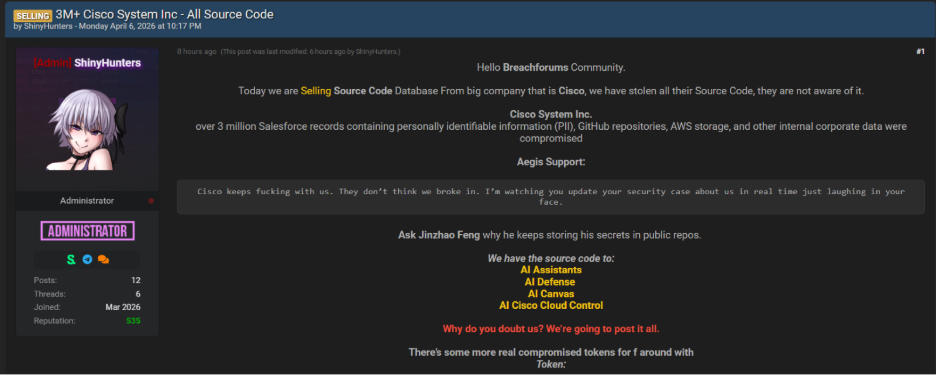
Threat actor ShinyHunters claims to have compromised Cisco Systems and is allegedly offering access to internal data and source code on underground channels. The activity was observed across dark web forums and the actor’s Telegram channel.
Post Metadata
- Source: Threat actor posts on underground forums and Telegram
- Observed: April 2026
- Proof provided: Sample tokens, screenshots, and data claims (unverified)
- Independent validation: None at the time of writing
- Assessment: Unverified claim
- Confidence: Low
Breach Claim Details
The threat actor claims access to multiple internal environments and datasets, including:
- Over 3 million Salesforce records containing Personal Identifiable Information (PII)
- Internal GitHub repositories
- AWS storage resources
- Additional corporate data assets
- Source code associated with multiple Cisco platforms, including:
- Cisco IOS
- Cisco IOS-XE
- Cisco ASA Software
- Cisco NX-OS
- Cisco IOS-XR
- CatOS
- Cisco FTD
- Cisco Viptela
- Cisco Meraki (MS/MX/MR)
- Cisco ACI
- Cisco UCM
- Cisco IOS-FG and related components

The actor also claims possession of source code linked to:
- AI Assistants
- AI Defense
- AI Canvas
- Cisco Cloud Control
In addition, the actor shared alleged authentication of artifacts, including token strings, hashed values, base64-encoded data, and references to internal Splunk queries.
Unc Cluster References
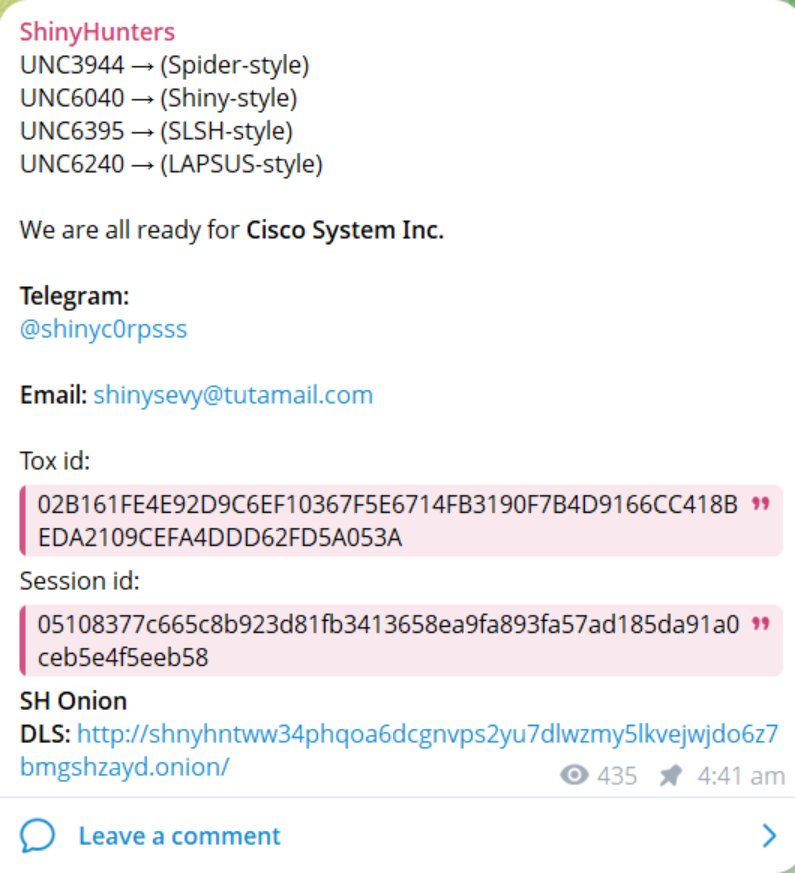
Posts from the actor’s Telegram channel reference multiple UNC clusters:
- UNC3944 (Spider-style operations)
- UNC6040 (ShinyHunters-linked activity)
- UNC6395 (SLSH-style patterns)
- UNC6240 (LAPSUS-style behavior)
These references suggest overlapping or alignment with previously tracked intrusion sets, though no direct attribution is confirmed.
Osint Context
ShinyHunters has previously been linked to high-profile data breaches involving large enterprises and cloud-based platforms. Past activity often includes data exfiltration, credential exposure, and sale of access to underground forums.
At the time of writing, Cisco Systems has not issued a public statement confirming the alleged breach.
Previous Cisco-related Incidents
This is not the first time Cisco Systems has been linked to incidents involving social engineering or data exposure, including activity associated with ShinyHunters or related clusters:
- 2022 Corporate Network Incident – Cisco disclosed a breach involving its internal corporate IT environment after attackers gained access and attempted lateral movement
- 2025 CRM / Salesforce Breach (Vishing Campaign) – Cisco confirmed unauthorized access to customer data following a voice phishing attack targeting employees, consistent with tactics used by ShinyHunters-linked operations
- 2024 Alleged Data Leak (IntelBroker) – A separate threat actor claimed to have leaked Cisco data on BreachForums, highlighting repeated targeting of Cisco’s internal assets
- 2026 Supply Chain / Credential Abuse (Trivy-related) – Recent reporting indicates attackers leveraged compromised credentials from a supply chain incident to access Cisco development environments, including GitHub repositories and AWS keys
- Ongoing Salesforce-Focused Campaigns – ShinyHunters and affiliated clusters have conducted large-scale attacks targeting Salesforce environments across multiple organizations, including Cisco, using vishing and token theft techniques
These incidents highlight a recurring pattern of targeting cloud services, credentials, and employee access rather than exploiting traditional vulnerabilities.
Claim Vs Verification
Claimed by actor
The actor claims large-scale data exfiltration, access to internal repositories, cloud storage, and proprietary source code.
Confirmed independently
No independent confirmation exists. No verified datasets or third-party validation supports the claims.
Indicators Of Compromise
Potential indicators based on the actor’s claims and known patterns include:
- Exposure or reuse of authentication tokens and API keys
- Unauthorized access to Salesforce environments
- Unusual GitHub repository access or cloning activity
- Suspicious AWS access patterns or data exfiltration events
- Base64-encoded payloads in logs or network traffic
- Abnormal Splunk queries or log access behavior
- Access from unfamiliar IP ranges or anomalous geolocation patterns
These indicators are not confirmed and should support precautionary monitoring.
Ttps And Mitre Att&ck Mapping
| Tactic | Technique | Technique ID | Description |
|---|---|---|---|
| Initial Access | Valid Accounts | T1078 | Use of compromised credentials to access enterprise systems |
| Initial Access | Phishing | T1566 | Credential harvesting via social engineering campaigns |
| Persistence | Account Manipulation | T1098 | Modification or creation of accounts for continued access |
| Persistence | Valid Accounts | T1078 | Continued use of legitimate credentials |
| Credential Access | Unsecured Credentials | T1552 | Access to tokens, keys, or credentials stored in systems |
| Discovery | Cloud Infrastructure Discovery | T1580 | Enumeration of cloud services and resources |
| Discovery | Network Share Discovery | T1135 | Identification of internal repositories and shared storage |
| Collection | Data from Information Repositories | T1213 | Access to centralized platforms such as Salesforce and GitHub |
| Collection | Data from Cloud Storage | T1530 | Collection of data from AWS or similar platforms |
| Exfiltration | Exfiltration Over Web Services | T1567 | Data transfer through web-based channels |
| Exfiltration | Exfiltration to Cloud Storage | T1567.002 | Use of cloud platforms for staging or exfiltration |
| Impact | Data Theft and Extortion | T1657 | Theft and sale of data for financial gain |
Note On Applicability
These techniques align with known behavior associated with ShinyHunters. No direct evidence confirms these techniques were used in this specific case.
Potential Impact
If validated, the exposure could affect customer data, internal development environments, and cloud infrastructure. Compromised tokens and repositories may increase the risk of follow-on attacks.
The impact remains unconfirmed.
Assessment
The claims originate from a known threat of actor but remain unverified. The scale and sensitivity of the alleged data increase potential risk, though absence of corroboration limits confidence.
What’s Next
Monitoring should focus on:
- Release or sale of verifiable data samples
- Token reuse or credential abuse activity
- Any official disclosure from Cisco Systems
- Expansion of activity linked to referenced UNC clusters
Continued tracking of underground forums and Telegram channels is required to assess whether the claims evolve into confirmed exposure.
The information provided in this article is based on publicly available open-source intelligence (OSINT). It is intended for awareness and defensive cybersecurity purposes only.
