
 HQ/EMEAFind out how we can help your business


Executive Summary
On 21 October 2026, PHP released security updates for CVE-2026-109618 and CVE-2026-109619, two critical memory-safety vulnerabilities rated CVSS v4.0 9.2, publicly tracked under the reporting name PHP2Shell. Both permit unauthenticated remote code execution on affected web-serving deployments. CVE-2026-109618 concerns out-of-memory handling that can leave request data in an invalid partial state; CVE-2026-109619 concerns stale request-owned state consumed before a later request completes normal initialization. The risk spans PHP web runtimes, with early-startup exposure particularly significant for Apache mod_php; other worker models, including PHP-FPM through application-stage paths, are also affected. Fixed upstream releases are PHP 8.2.35, 8.3.36, 8.4.27 and 8.5.12.
The vulnerabilities were independently found and reported by more than one research team during July and August 2026, with the first report reaching PHP’s security team on 11 August 2026 and a second, related report following on 24 August 2026. Because PHP core underlies a large share of the web’s server-side scripting, including WordPress, Drupal, Joomla, MediaWiki and many other platforms, the practical blast radius is large; affected software is vulnerable through the PHP engine itself regardless of how secure the application’s own code is. Independent technical write-ups covering this disclosure report that frontier AI models were used extensively during discovery and exploit development, which the researchers describe as a meaningful factor in how quickly a decades-old class of bug became a practical, chainable exploit.
This version adds findings from dark and deep web forum monitoring conducted since the original assessment. Monitoring identified operator-side messaging on two forums associated with historical PHP2Shell-adjacent discussion, and a separate public proof-of-concept exploit post referencing both tracked CVEs. These forum findings are reported as collection results with explicit confidence caveats, separate from the vendor-sourced technical material above; none of them were independently verified against the underlying code, and the proof-of-concept material is described at summary level only and is not reproduced here.
Priorities remain to patch, restart and verify every web-serving runtime, apply temporary exposure controls where necessary, and correlate suspicious multipart traffic with PHP errors and worker or host telemetry. A public exposure assessment identified more than 22.6 million internet-facing instances as potentially affected at time of publication; a separate, narrower exposure-dashboard figure used elsewhere in this report measures a single HTTP header and should not be conflated with that total.
At a Glance
| Attribute | Assessment |
|---|---|
| Threat name | PHP2Shell (public reporting name) |
| CVE IDs | CVE-2026-109618; CVE-2026-109619 |
| Severity | Critical; CVSS v4.0 9.2 each |
| Attack vector / privileges | Network; no authentication or user interaction required in confirmed exploit scenarios |
| Affected component | PHP core request parsing, OOM/fatal-error handling and request-state lifecycle |
| Primary risk | Unauthenticated RCE as the web-worker account; memory disclosure is also described in research |
| Public disclosure / fix date | 21 October 2026 |
| Forum / dark web activity (new) | Operator messaging on two monitored forums; one public proof-of-concept post referencing both CVEs. See the Dark and Deep Web Forum Monitoring section. |
| Remediation | Apply vendor-patched PHP packages/releases and restart affected workers |
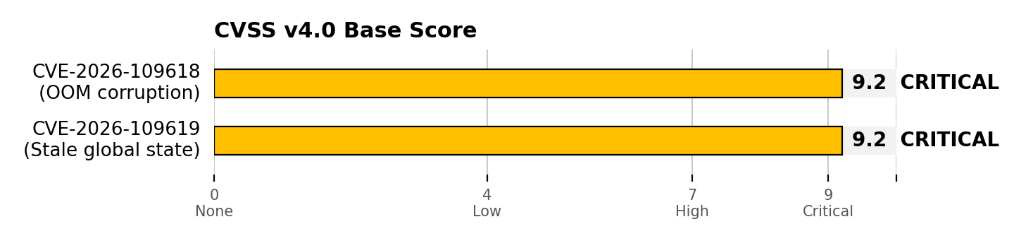
CVSS v4.0 base scores for both tracked CVEs.
Key Findings
- Both vulnerabilities affect PHP core request handling and error-state management; exposure is not limited to one CMS or application framework.
- Public technical research describes memory-corruption chains that can progress to unauthenticated remote code execution under affected runtime and worker-lifecycle conditions. A crash, error response or memory-state anomaly alone is not proof of command execution in a particular environment.
- Version fingerprinting and configuration inventory are useful for prioritization, but a version banner, successful HTTP response or service-instability signal is not by itself proof of exploitability or compromise.
- A public exposure assessment reports more than 22.6 million internet-facing instances as potentially affected. A separate, narrower exposure-dashboard figure of 2,195,922 results used later in this report reflects a single HTTP header query (X-Powered-By: PHP); the header identifies PHP’s presence only, not a version or patch state, so that figure cannot be read as a vulnerable-host count and should not be merged with the other total.
- Forum monitoring identified messaging on two criminal marketplaces/forums and a separate proof-of-concept post naming both CVEs. All three are reported as unverified collection results; see the Dark and Deep Web Forum Monitoring section for sourcing, confidence and handling.
- Researchers demonstrated unauthenticated remote code execution or memory disclosure against WordPress, Drupal, Joomla, MediaWiki, Roundcube, Magento, phpMyAdmin, Nextcloud, Laravel, Symfony and WHMCS. These are representative demonstration targets; the vulnerable code is in the PHP engine itself, so exploitation does not require any specific CMS or framework.
- Coordinated disclosure was disrupted on 20 October 2026: the CVE IDs leaked onto forums and social media roughly a day ahead of schedule (with an incorrect CVSS score of 10.0), and one container distributor broke the embargo by publishing patched images about six and a half hours before the coordinated release. PHP brought its release forward by a day in response. See the Discovery, AI-Assisted Research and Industry Coordination section.
Vulnerability Technical Analysis
CVE-2026-109618: Out-of-Memory (OOM) Corruption
PHP uses non-local error handling during out-of-memory events. The official advisory explains that an allocation failure can interrupt request processing while some request memory is reachable but not fully initialized. If the early exit is not properly accounted for, request shutdown may subsequently read or branch on invalid memory. This can result in memory corruption and unauthenticated remote code execution.
The PHP advisory identifies multiple classes of request construction that can make memory use diverge from the apparent request size, including multipart parsing edge cases, high header counts and nested input structures. The issue is especially serious where a SAPI proceeds into request shutdown after startup has failed. Apache mod_php is the highest-confidence example described by the vendor; other SAPIs must be evaluated against the applicable vendor analysis and package fixes.
CVE-2026-109619: Stale Global State
PHP contains global or subsystem state that can temporarily point into memory owned by a single request. If error handling or cleanup leaves such a pointer stale after the request heap is released, a subsequent request handled by the same worker may consume the state before normal initialization resets it. The result can include use-after-free, memory disclosure and remote code execution.
The official advisory discusses session upload-progress and fatal-error/backtrace paths among relevant producer/consumer cases. The exact route depends on worker lifecycle, SAPI, application or extension behavior and the point at which the fatal condition occurs. Disabling one feature can block a demonstrated path but does not remove every possible stale-state path.
High-Level Failure Sequence
| Stage | Security meaning |
|---|---|
| 1. Malformed or resource-intensive request | Unauthenticated input reaches early PHP parsing or a vulnerable error-handling path. |
| 2. Abnormal exit / fatal condition | OOM or another fatal path interrupts expected initialization and cleanup. |
| 3. Invalid or stale state persists | Internal request-owned memory is released while state may still reference it. |
| 4. Subsequent vulnerable operation | Cleanup or early processing accesses stale/invalid state; exploitability depends on the concrete path and worker lifecycle. |
| 5. Potential impact | Unauthenticated RCE and/or memory disclosure, under the confirmed attack conditions. |
The sequence above is a defensive conceptual model, not a reproduction procedure. Do not infer the exact CVE mapping of every subchain in the public technical notes without correlating it to the official patch and research disclosure.
Source-Code Areas for Defensive Review
Relevant source-code symbols include php_session_rfc1867_callback, php_session_decode, PHP_VAR_SERIALIZE_INIT/DESTROY, PHP_VAR_UNSERIALIZE_INIT/DESTROY, BG(serialize), BG(unserialize), PS(id), PS(http_session_vars) and EG(last_fatal_error_backtrace). These symbols are useful for comparing vulnerable and patched source and understanding lifecycle changes; they are not atomic indicators that a system has been exploited.
Affected Versions, Exposure and Threat Status
Upstream Fixed Releases
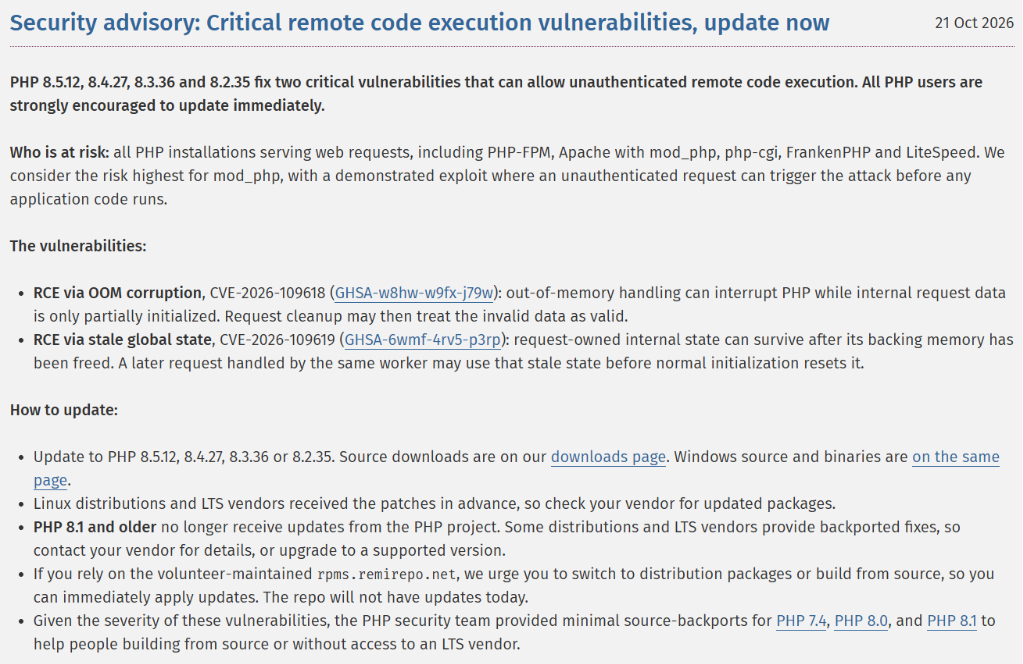
Official php.net security advisory, published 21 October 2026, naming GHSA-w8hw-w9fx-j79w (CVE-2026-109618) and GHSA-6wmf-4rv5-p3rp (CVE-2026-109619).
| PHP branch | Upstream fixed release | Action |
|---|---|---|
| 8.5.x | 8.5.12 | Update to 8.5.12 or later supported fixed release |
| 8.4.x | 8.4.27 | Update to 8.4.27 or later supported fixed release |
| 8.3.x | 8.3.36 | Update to 8.3.36 or later supported fixed release |
| 8.2.x | 8.2.35 | Update to 8.2.35; plan branch migration because 8.2 reaches EOL 31 Dec 2026 |
| 8.1, 8.0, 7.4 | No regular upstream support, but the PHP security team issued minimal source backports for these three branches given the severity | Apply the published backport, move to a supported branch, or confirm a vendor/LTS package build |
| Older than 7.4 | No upstream fix available in any form | Upgrade to a supported branch; no vendor backport should be assumed without direct confirmation |
The version table is for upstream source releases. Linux distributions and LTS vendors received the patches in advance of the public advisory, and may backport patches while retaining older upstream version numbers; validate the actual installed package build and vendor security bulletin rather than relying only on php -v or an exposed HTTP banner. The advisory separately cautions that the volunteer-maintained rpms.remirepo.net repository would not carry same-day updates, and recommends switching to distribution packages or building from source for anyone depending on it.
Systems and Applications in Scope
- All PHP runtimes serving web requests: Apache mod_php, PHP-FPM/FastCGI, php-cgi, FrankenPHP and LiteSpeed/LSAPI deployments.
- PHP-backed content management systems and application frameworks, because the vulnerable component is the PHP engine rather than CMS-specific business logic. Researchers have specifically confirmed exploitation against WordPress, Drupal, Joomla, MediaWiki, Roundcube, Magento, phpMyAdmin, Nextcloud, Laravel, Symfony and WHMCS, though these are representative targets rather than an exhaustive list.
- Container images, appliance bundles, hosting control panels, staging environments, forgotten subdomains, cron/job images and vendor-managed web workloads.
- Internet-facing services receive the highest urgency; internal-only services still require patching because request sources may include partners, compromised internal hosts or adjacent applications.
Public Threat Status
Independent technical write-ups covering this disclosure report working, researcher-demonstrated pre-authentication RCE and memory-disclosure exploitation against multiple real-world applications (listed above), using current container images of each at the time of testing. Separate threat-telemetry reporting described attempted exploitation beginning on 17 October 2026, ahead of the public release, and additional activity after disclosure. A national cyber advisory published during the same period noted that active exploitation had not been identified in its own reporting window. These reports reflect different sensors and observation periods. The prudent posture is to treat exploitation attempts as plausible and prioritize remediation without claiming that every observed request succeeded.
Public Research Timeline
The timeline below merges the disclosure history published alongside the official release with independent researcher timelines covering this disclosure. Dates differ slightly between sources because multiple research teams were working in parallel; both are reported here rather than reconciled into a single account.
| Date | Event |
|---|---|
| 2020 | An early, related PHP bug report (#78876, long multipart variables causing out-of-memory conditions) is filed; not recognized at the time as security-relevant. |
| 2024 | An externally funded security audit of PHP rediscovers related out-of-memory behavior; exploitability is not proven and the issue is not fixed at that time. |
| 30 July 2026 | A security research team begins a dedicated audit of PHP. |
| 1 August 2026 | That team identifies multiple independent paths to RCE, resurfacing the 2024 findings. A second, separate research team records its own first discovery around 19 to 21 August 2026. |
| 11 August 2026 | The first bug is reported to PHP and coordinated disclosure begins; another research group independently reports the same root cause the same day. |
| 14 August 2026 | A working RCE proof of concept is shared with the PHP security team. |
| 15 August 2026 | PHP confirms the proof of concept works as reported. |
| 21 August 2026 | A second bug is reported to PHP. |
| 24 August 2026 | The second research team reports its findings to the PHP security team. |
| 18 September 2026 | Further attack vectors for the same root cause are reported. |
| 21 September 2026 | PHP acknowledges the reports and begins developing a coordinated fix. |
| 20 October 2026, ~15:00 UTC | The two CVE IDs leak onto forums and social media with an incorrect release time and an incorrect CVSS score of 10.0; no technical details leak at this point. |
| 20 October 2026, 19:30 UTC | PHP brings its pre-announcement forward in response to the leak and moves the planned release date from 22 to 21 October 2026. |
| 20 October 2026, ~20:00 UTC | One research team mistakenly publishes, then deletes, a demonstration video; copies circulate on social media and accelerate independent proof-of-concept development. |
| 20 October 2026, 23:00 UTC | PHP begins sharing mitigation advice with a small number of critical infrastructure providers ahead of the public release. |
| 21 October 2026, 07:41 UTC | A container image distributor unilaterally breaks the coordinated embargo and publishes patched images, more than six hours before the planned release. |
| 21 October 2026, 14:00 UTC | PHP releases patched versions 8.5.12, 8.4.27, 8.3.36 and 8.2.35, and the vulnerabilities are publicly disclosed. |
| 22 October 2026 | This assessment consolidates the vendor advisory, independent research write-ups and this team’s own exposure, advisory and forum collection. |
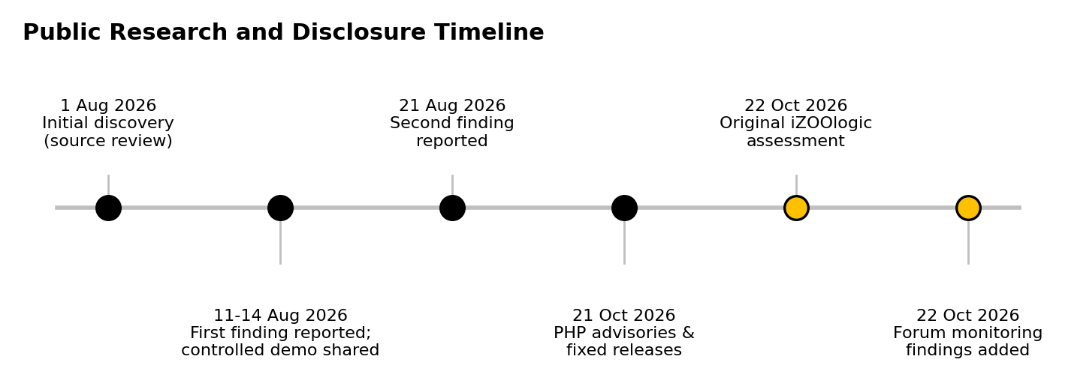
Simplified visual summary of key milestones from the fuller timeline above.
Discovery, AI-Assisted Research and Industry Coordination
According to independent technical write-ups covering this disclosure, the vulnerable code paths trace back further than this year’s research: a related bug (#78876) was filed against PHP in 2020, and a 2024 external security audit of PHP rediscovered related out-of-memory behavior without proving it was exploitable. These write-ups report that frontier AI models were used extensively during this year’s research to analyze PHP’s memory-management internals, adapt exploitation attempts across different PHP versions and configurations, and validate the eventual patch. The researchers describe this as materially lowering the practical effort needed to turn a long-standing design issue into a working, chainable exploit, framing the disclosure as a notable example of AI-assisted vulnerability research rather than a single, novel coding bug.
PHP’s own account states that it used externally funded access to a frontier AI model earlier in the year to scan its codebase, and has since added further AI-assisted tooling for validating reports and exploits. It also describes a broader organizational response: a dedicated ecosystem security function was created in May 2026, and additional dedicated security staff were brought on over the summer, alongside continued work from PHP’s existing volunteer security team.
Ahead of the public release, the PHP project worked with major cloud, hosting and content-delivery providers to prepare customer guidance and out-of-the-box mitigations for organizations unable to patch immediately. Distributions and LTS vendors received the fix in advance so they could package it ahead of disclosure.
Coordinated disclosure was disrupted in its final days. On 20 October 2026 at approximately 15:00 UTC, the two CVE IDs began circulating on forums and social media with an incorrect release time and an incorrect CVSS score of 10.0 (the confirmed score is 9.2); no technical details leaked at that point. PHP responded by moving its planned release forward from 22 to 21 October 2026. Around 20:00 UTC the same day, one research team mistakenly published, then deleted, a demonstration video; circulating copies are reported to have accelerated independent proof-of-concept development. Separately, at 07:41 UTC on 21 October, more than six hours ahead of the coordinated 14:00 UTC release, a container image distributor unilaterally published patched images, giving anyone who wanted it an early look at the fix in binary form while other PHP users were still waiting. PHP’s own post characterizes this as having disregarded weeks of coordinated-disclosure work by other parties.
Technical Exploit Analysis and Source-Code Findings
This section explains the relevant PHP request lifecycle and memory-management failure patterns at a conceptual, source-code-symbol level. The examples are simplified for defensive understanding and code review; no exploit payloads or step-by-step exploitation instructions are included. No tests were performed against client assets.
Exploit Mechanics and Code Correlation
CVE-2026-109618: OOM-triggered partial HashTable state
The PHP advisory describes an out-of-memory path where a non-local exit interrupts native code while request memory is only partially initialized. Cleanup may then process invalid state. Public technical analysis highlights a partial-insertion pattern in Zend HashTable code: element counters advance before the owned key allocation completes and before all bucket fields are initialized.

Why this matters: if the allocation bails out after the table counts change, cleanup may still treat the incomplete bucket as live. The public research connects this pattern to automatic request-variable registration from both ordinary POST parsing and multipart file metadata parsing. These parsing paths run during request startup, before the application script executes.
| Research element | Defensive significance |
|---|---|
| OOM / longjmp or fatal interruption | Look for unexplained memory-limit errors, startup failures and abrupt request termination; these are supporting signals, not unique IOCs. |
| Partially initialized HashTable bucket | The defect is in native PHP request parsing/cleanup, not a particular CMS plugin or application route. |
| mod_php startup failure handling | PHP’s request shutdown can still run after certain startup failures, allowing invalid request structures to reach teardown. This is a particularly important exposure path. |
| FPM / other SAPIs | The exact startup-failure path differs: FPM exits a child on startup failure. The OOM advisory says post-startup OOM paths can still be relevant to FPM; this distinction does not make FPM generally safe. |
CVE-2026-109619: stale global state and cross-request consumption
The stale-state issue follows a producer/consumer pattern. During one request, PHP publishes request-owned memory through subsystem or worker-level state. A fatal condition or diagnostic may interrupt the matching cleanup. The request heap is then released while state still references it. A subsequent request handled by the same persistent worker may reach an early input, session or diagnostic path before initialization replaces the stale state. Under affected conditions, this use-after-free can become memory disclosure or memory corruption.

| Phase | Technical interpretation | Evidence to seek | Producer request | A fatal/OOM/exception/timeout or state-setting operation occurs after request-owned state has been published. | PHP fatal/OOM logs, worker PID, request timing, app-level decode/error paths. |
|---|---|---|
| Cleanup gap | The paired reset/destructor does not run, or error state is repopulated after a reset. | Source review around bailout/catch paths; version and patch-level confirmation. |
| Request boundary | Request memory is released but a worker-level global still references it. | Worker lifecycle correlation; debugger/core analysis in a controlled lab. |
| Consumer request | The same worker touches stale state during processing that occurs before normal request initialization. | Near-time second request, multipart/session markers, diagnostics, abnormal cookie or response behavior. |
| Impact stage | Stale references are consumed to disclose memory or corrupt state; researcher demonstrations reached unauthenticated RCE. | EDR child-process/network telemetry and host artifacts; an HTTP error or worker crash alone is insufficient. |
Important source-review symbols include php_session_rfc1867_callback, php_session_initialize, php_session_decode, php_var_unserialize_init/destroy, php_var_serialize_init/destroy, PS(id), PS(http_session_vars), BG(unserialize), BG(serialize) and EG(last_fatal_error_backtrace). These are code-review pivots, not standalone compromise indicators. Public analysis also discusses fatal-error backtrace use-after-free and OPcache type-confusion paths in the context of CVE-2026-109619.
Publicly described exploitation and application impact
| Tracking ID | Research paths described publicly | Published demonstration claims |
|---|---|---|
| CVE-2026-109618 | OOM-corruption paths; request parsing and cleanup edge cases; related memory-disclosure paths. | Public technical research describes pre-authentication RCE demonstrations against selected PHP-backed applications and a process-memory-disclosure path. |
| CVE-2026-109619 | Stale global state, including fatal-error backtrace use-after-free and other early-consumer paths. | Public technical research describes pre-authentication RCE demonstrations for selected application/runtime combinations. These are deployment-specific findings. |
Public technical research reports successful pre-authentication RCE demonstrations against selected PHP-backed application deployments. These examples show that applications can reach affected PHP runtime paths; they do not mean every version or deployment of each application is automatically exploitable. The underlying flaw resides in PHP core.
Source-Code Hotspots for Defensive Review
| Source-code area | Role in the request lifecycle | Defensive review question |
|---|---|---|
| _zend_hash_str_add_or_update_i() | Adds or updates a hash-table bucket while PHP registers request variables. | Are element counters, bucket initialization and rollback consistent if key allocation exits abnormally? |
| php_session_rfc1867_callback() | Processes multipart upload-progress events during request parsing, before the application script runs. | Can OOM or another fatal path skip the matching cleanup and reset? |
| php_session_decode() | Decodes session data and handles failures around the serializer. | Does every bailout path destroy and clear decoder state before request memory is released? |
| php_var_serialize_init/destroy() and php_var_unserialize_init/destroy() | Manage nested serialization/deserialization bookkeeping and state held in globals. | Are nesting levels and data pointers reset on every normal and abnormal exit? |
| php_request_shutdown() and PG(modules_activated) | Control request shutdown and whether module teardown hooks execute. | Can a failed startup skip extension RSHUTDOWN while the request heap is still freed? |
| EG(last_fatal_error_backtrace) | Relevant to fatal-error/backtrace stale-state paths discussed for CVE-2026-109619. | Can diagnostics consume request-owned state before the next request has fully initialized? |
| SAPI request-startup / worker loop | Determines whether an affected worker is reused or terminated after failure. | Compare exact failure path and patch level for the active SAPI; do not infer safety from SAPI label alone. |
Exploit-Chain Reconstruction for Defenders
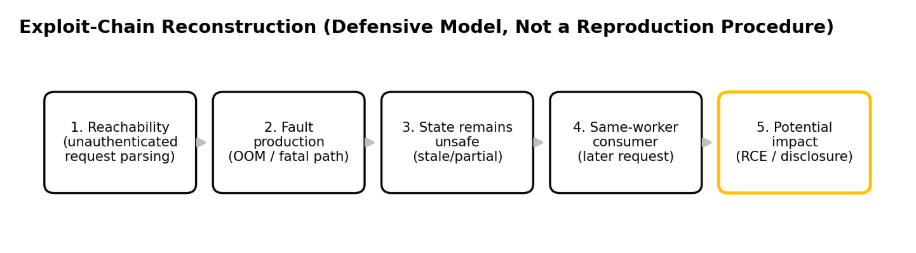
Five-stage defensive model of the failure chain. Conceptual representation only; not a reproduction procedure.
| Stage | Observed/research-described behavior | Defensive implication |
|---|---|---|
| 1. Reachability | Unauthenticated HTTP request parsing reaches PHP native input/session handling before the application script. | Patch the runtime; do not rely on application authentication or framework middleware. |
| 2. Fault production | Multipart parsing, request-variable creation or a post-startup stateful operation is interrupted by OOM/fatal handling. | Correlate odd multipart traffic with OOM/fatal events and backend failures. |
| 3. State remains unsafe | A partially initialized bucket or request-owned state is not properly reset before memory is released. | A vulnerable version plus a crash is a high-priority investigation clue, but requires corroboration. |
| 4. Same-worker consumer | A later request reaches teardown, session upload-progress, diagnostics or another early consumer before normal initialization. | Correlate request IDs, session-cookie hashes, worker PIDs, container IDs and short time windows. |
| 5. Impact | Public technical research describes memory disclosure and unauthenticated RCE in specific tested configurations. Outcomes should not be generalized to every deployment. | Confirm impact using endpoint/process telemetry, unexpected child processes, network egress and file-integrity evidence. |
The vulnerabilities and stated impacts are confirmed by official advisories and public technical research. No client assets were scanned or exploited for this report, and no client-specific runtime evidence was collected. Treat request anomalies as investigation triggers, not proof of compromise.
Indicators of Compromise and Defensive Telemetry
No reliable, universal network IOC set is established by the public technical materials. The CVEs are memory-safety flaws in the runtime, and a capable exploit can vary boundaries, field names, body shape and worker timing. The strongest detections correlate request characteristics with PHP/web-server failures and post-exploitation behavior.
Behavioral Indicators
| Signal | Example evidence | Confidence / caveat |
|---|---|---|
| Multipart request anomalies | multipart/form-data; unusually large filenames/metadata; excessive part headers or nested input structures; repeated unusual upload-progress fields. | Medium in combination; individual fields are legitimate in some applications. Request bodies are often not logged. |
| Pre-userland PHP failures | Allowed memory size exhausted; fatal errors; errors reported “in Unknown on line 0”; abnormal request-startup behavior. | Medium; generic errors are not CVE-specific. Some failures occur before log output. |
| Worker lifecycle anomalies | HTTP 500, truncated/empty responses, backend resets, repeated worker restarts or crash traces after suspicious multipart traffic. | Medium when temporally correlated; single network failures are not proof. |
| Process tree anomalies | php-fpm, apache2, httpd or lsphp spawning unexpected shells/interpreters/download tools. | High priority EDR investigation signal; validate against application job/maintenance behavior. |
| Post-exploitation persistence | New or modified web-root PHP files, scheduled jobs, systemd services, user accounts, SSH keys or unexplained outbound connections. | Strong incident indicators if unauthorized and temporally aligned; not unique to these CVEs. |
Error Strings and Code Symbols to Search
| Type | Search terms |
|---|---|
| Error/log patterns | Allowed memory size exhausted; in Unknown on line 0; Maximum execution time exceeded; SIGSEGV; Segmentation fault; worker exit/restart records. |
| PHP request / session context | PHP_SESSION_UPLOAD_PROGRESS; PHPSESSID; multipart requests followed by PHP errors or worker termination. |
| Source review / patch verification | php_session_rfc1867_callback; php_session_decode; PHP_VAR_SERIALIZE_INIT; PHP_VAR_UNSERIALIZE_INIT; BG(serialize); BG(unserialize); EG(last_fatal_error_backtrace). |
| Network / EDR context | Unexpected process children from PHP worker accounts; outbound traffic immediately after suspicious web requests; new executable or PHP files. |
Publicly Reported Network Indicators (Triage Only)
A public threat-telemetry report listed the following source IP addresses in observed activity. The report cautions that the addresses include shared anonymization infrastructure and are not exclusive to this threat. Use them as correlation pivots, not as a standalone blocklist.
| IP address | Reported observation date | Handling |
|---|---|---|
| 103.216.220.92 | 17 Oct 2026 | Correlate; shared infrastructure |
| 31.223.184.166 | 21 Oct 2026 | Correlate; not exclusive |
| 37.19.200.5 | 21 Oct 2026 | Correlate; not exclusive |
| 134.209.159.64 | 21 Oct 2026 | Correlate; not exclusive |
| 103.114.163.188 | 21 Oct 2026 | Correlate; not exclusive |
| 95.217.98.37 | 21 Oct 2026 | Correlate; not exclusive |
Reported IPs are shared infrastructure; correlate request and endpoint evidence before blocking or attributing activity.
External Exposure Context and Geographic Snapshot
A public exposure assessment is the primary cited exposure figure for this assessment: it reported more than 22.6 million internet-facing instances as potentially affected, based on its own scanning and classification methodology. A second, narrower dashboard figure is also presented below for additional geographic context; the two must not be conflated.
The dashboard figure of 2,195,922 results reflects a search against the HTTP response header X-Powered-By: PHP across an internet-wide scanning dataset. The X-Powered-By header, where present, indicates only that a response was generated by some PHP runtime; it does not report the PHP version, the SAPI in use, the patch level, or whether the vulnerable code paths described earlier in this report’s vulnerability and exploit analysis are reachable on that host. Many PHP deployments also suppress or alter this header by configuration, so the figure should be read as a lower-bound, header-based estimate of PHP’s footprint on the scanned dataset rather than as a census of PHP installations, and certainly not as a count of hosts vulnerable to CVE-2026-109618 or CVE-2026-109619.
Dashboard Screenshot and Transcribed Country Figures
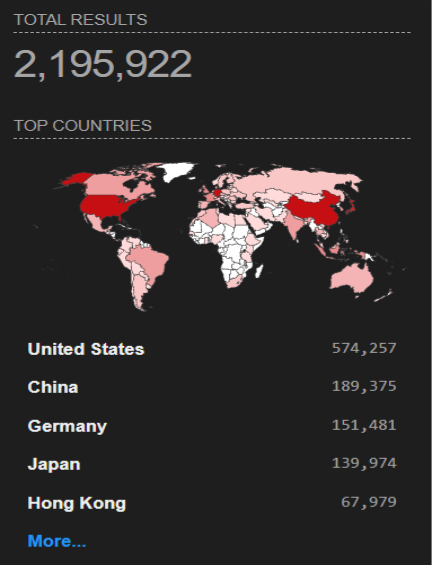 |
United States: 574,257 (26.15%)
China: 189,375 (8.62%) Germany: 151,481 (6.90%) Japan: 139,974 (6.37%) Hong Kong: 67,979 (3.10%) |
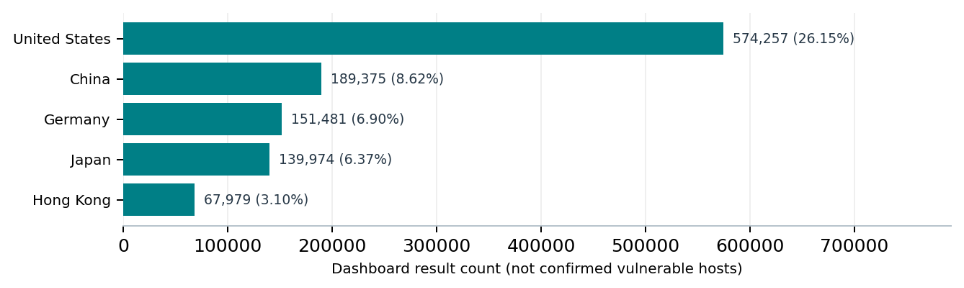
Country figures transcribed from the dashboard; percentages are calculated against the dashboard total of 2,195,922. Values represent dashboard “results” for an X-Powered-By: PHP header query only.
The underlying scan source, collection timestamp, deduplication method and regional index coverage are not documented alongside the dashboard itself. Treat this figure as a general PHP-footprint snapshot. It must not be used as evidence that 2,195,922 devices are vulnerable or exploitable, and it should not be merged with the 22.6 million figure cited above, which used a different methodology.
Top five countries account for 1,123,066 results (51.14% of the displayed total); the remaining 1,072,856 results (48.86%) are distributed across other countries or omitted categories. The reported geography may reflect index coverage, duplicated services, stale banners, cloud ranges or query-specific filters.
Threat-Hunting Logic and Detection Engineering
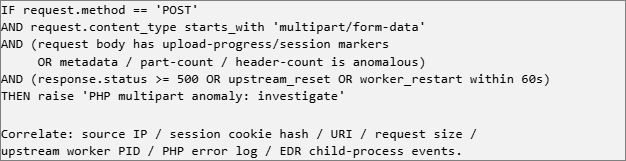
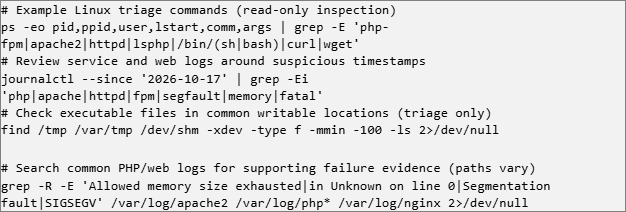
The following examples are starting points for defensive analytics, not exploit payloads. Field names differ across reverse proxies, WAFs and SIEMs. Where request bodies are not captured, use headers, status, backend errors, process telemetry and asset inventory; avoid enabling sensitive body logging globally without privacy review.
HTTP / Reverse-Proxy Correlation (Pseudocode)
Linux / EDR Process Hunting
Prioritize process creation events in which a PHP runtime or web-server worker unexpectedly launches a command shell, downloader or interpreter. The exact parent image may be php-fpm, apache2, httpd, lsphp or a container entrypoint. Exclude documented administration, deployment and application job behavior only after validating the command line and owner.
Detection Engineering Recommendations
- Create a runtime inventory of all PHP interpreters and web SAPIs, including container images and control-panel-managed PHP builds.
- Baseline expected worker child processes, outbound destinations and web-root changes before creating detections.
- Correlate a suspicious multipart request with the same backend worker’s errors, restart/crash telemetry and immediate post-request process activity.
- Search for anomalous PHP execution or modification even when request logs contain no obvious marker; payloads and input field names can vary.
- Keep package-specific strings as high-context supporting indicators only. Do not use them as primary block rules.
Evidence Preservation
Export raw proxy/WAF logs, relevant request metadata, PHP and web-server errors, system journal, process execution telemetry, file-integrity events and outbound DNS/network logs before rotation. Hash acquired files, preserve timestamps and document collection time and system timezone.
Mitigation and Remediation Plan
Upgrade to a PHP build containing the official fixes. PHP states that updating is the only complete and reliable mitigation for these flaws. Configuration workarounds reduce selected paths but do not make vulnerable installations safe.
Immediate Actions (0 to 24 Hours)
- Inventory the actual PHP runtime behind each web-facing service: PHP-FPM, Apache mod_php, CGI/FastCGI, FrankenPHP, LiteSpeed/LSAPI and packaged/container runtimes.
- Apply PHP 8.5.12, 8.4.27, 8.3.36 or 8.2.35 as applicable, or the equivalent fixed distribution/vendor package. For EOL branches, upgrade or verify an explicitly documented backport.
- Restart all affected workers/pools/services after patching. Confirm the new package is loaded by the web SAPI, not only by the CLI binary.
- If rapid patching is not possible for a highly exposed system, restrict ingress or temporarily isolate it; prioritize public sites and runtimes using mod_php.
- Preserve pre-patch logs and begin retrospective hunting from at least 17 October 2026, the earliest observation date in the public threat-telemetry reporting reviewed for this assessment.
Temporary Controls While Patching

Operational caution: memory_limit = -1 removes PHP’s per-request memory cap and can increase host-level memory-exhaustion risk. Treat it as a time-limited vendor-advised workaround, and enforce request-size and container/cgroup boundaries. Do not replace it with RLIMIT_AS or RLIMIT_DATA.
| Vulnerability | Interim control | Limitation |
|---|---|---|
| CVE-2026-109618 | Administratively enforce memory_limit=-1 where advised; constrain decoded request sizes at proxy/web server; limit multipart part/header counts, input nesting and upload sizes. | Not complete: underlying allocation failure can still trigger vulnerable paths. A low post_max_size reduces exposure only for request classes it actually rejects. |
| CVE-2026-109619 | Set session.upload_progress.enabled=0 at startup/server/pool level and restart all workers. For PHP 8.5, fatal_error_backtraces=0 blocks the confirmed backtrace path. | These controls block selected paths only. No generic configuration setting covers every stale-state producer/consumer. |
| Both | Fix attacker-reachable fatal errors, warnings/deprecations before request initialization and timeout paths; audit configuration overrides; consider reducing FPM worker request reuse if operationally suitable. | Defense in depth, not a substitute for a fixed runtime. |
Do not substitute RLIMIT_AS or RLIMIT_DATA for the memory controls above; the PHP advisory warns that these can cause allocation failures on the vulnerable path.
Validation After Patch
- Verify vendor package build and release notes against the fixed version table.
- Confirm service workers were restarted and the web runtime resolves to the updated binary or module.
- Re-run passive version/configuration inventory. Treat hidden banners as UNKNOWN, not “patched.”
- Confirm public ingress restrictions, request-size boundaries, EDR process monitoring and log retention are active.
Incident Response if Exploitation Is Suspected
A failed request, 500 response or worker crash alone is not proof of compromise. Escalate when suspicious request activity coincides with abnormal worker behavior, unexpected process execution, web-root changes, new persistence or unexplained outbound traffic.
| Phase | Recommended actions |
|---|---|
| 1. Contain | Restrict external access to affected service; isolate suspected instance where business impact permits. Preserve load balancer/WAF and host evidence before restarting or rebuilding. |
| 2. Preserve | Collect reverse-proxy logs, PHP error logs, system journal, EDR process tree, network/DNS telemetry, file metadata and relevant memory/core artifacts where available. Hash evidence and document timestamps. |
| 3. Hunt | Review PHP/web-worker child processes; suspicious external connections; recently created/modified PHP files; cron/systemd tasks; new users/SSH keys; application/plugin changes; secrets read from the application environment. |
| 4. Eradicate | Patch or rebuild from trusted images; remove unauthorized persistence; rotate credentials, API tokens and application secrets potentially accessible to the worker; review service-account scope. |
| 5. Recover | Reintroduce traffic only after patch verification, worker restart, exposure review and post-compromise checks. Increase monitoring for recurrence. |
| 6. Report | Record confirmed facts separately from indicators and hypotheses. Identify exposed time window, vulnerable package revisions, requests of interest, evidence of execution and remediation timestamps. |
Minimum Questions for the Client
- Which PHP packages, versions and SAPIs served each public application on 17 to 22 October 2026?
- Were any PHP worker restarts, fatal errors, OOM messages or 5xx spikes correlated with unusual multipart traffic?
- Did PHP worker processes spawn unexpected commands or create/modify web-accessible scripts?
- Were outbound connections initiated by web workers to new or unusual destinations?
- Can the operations team prove that all affected instances were updated and all old workers terminated?
Dark and Deep Web Forum Monitoring
This section reports collection results from routine dark and deep web monitoring. All three items below are analyst observations of third-party claims made on criminal or gray-market forums. None of the claims has been independently verified against source code, patch diffs or a controlled test, and none is treated as confirmed fact. Per standing analytic practice, labels and claims made by forum operators and posters are flagged explicitly where they are inconsistent with, or cannot be checked against, known tradecraft, rather than being carried into this report at face value.
Forum Notice: Scheduled Downtime Attributed to PHP Patching
A monitored forum (operating under the historical RaidForums branding) posted a service notice stating that the platform would remain offline until unspecified PHP security patches had been “fully deployed globally,” framed as a precautionary measure for platform security and stability. The notice drew visible community engagement (reactions and 282 views at the time of capture) and invited comments.
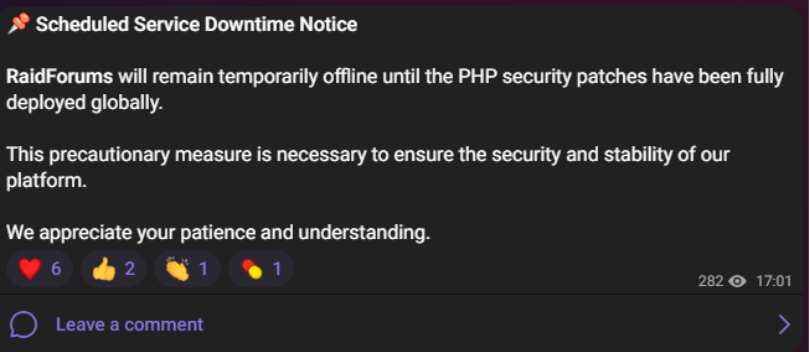
Monitored forum service notice, captured as part of routine collection.
The RaidForums brand has a documented history of law-enforcement seizure, rebranding and operator turnover, and forum operators on this class of platform routinely use infrastructure-downtime notices as cover for unrelated causes (law-enforcement action, backend compromise, extortion disputes, or planned exit activity) rather than genuine patching work. The stated rationale is a self-reported operator claim and is not independently corroborated. It should not be read as confirmation that the forum’s own infrastructure was built on a vulnerable PHP stack, or that the downtime was in fact caused by CVE-2026-109618 or CVE-2026-109619.
Forum Notice: Mirror Restoration and Patch Claim
A second monitored forum (“pwnforums”) posted a notice announcing that both its clearnet and onion mirrors were back online, naming a clearnet domain and an onion address, and stating that “some vulnerabilities have been patched” and that a vulnerability referred to in the post as “PHP2SHELL” had “indeed been patched.” The post had limited engagement (one reaction, 307 views) and was marked as edited after initial posting.
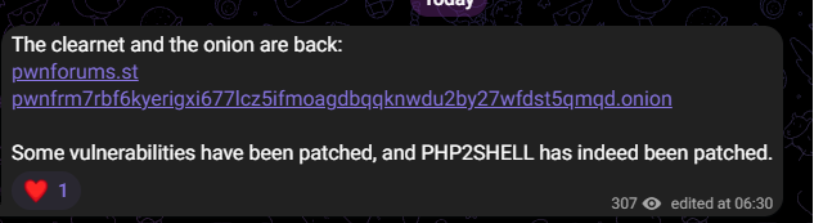
Monitored forum mirror-restoration notice, captured as part of routine collection.
Forum Post: Claimed Proof-of-Concept for CVE-2026-109618 / CVE-2026-109619
A post titled “POC PHP CVE-2026-109618 CVE-2026-109619,” authored by a forum member using the handle “Mr.Wizard” and posted in a forum’s “Malware” subsection, purports to share a working proof-of-concept exploit for both tracked CVEs. Posting metadata captured during monitoring is summarized below for attribution and actor-tracking purposes.

Thread header of the monitored forum post, cropped to title, author, timestamp and forum section. The post body, which contains an attached script, is not reproduced.
| Metadata field | Observed value |
|---|---|
| Post title | “POC PHP CVE-2026-109618 CVE-2026-109619” |
| Forum section | Malware |
| Author handle | Mr.Wizard |
| Author rank / reputation | “kilobyte” tier; +5 reputation; 40 posts |
| Account age (as displayed) | Joined 17 Mar 2018 (member ID 86273) |
| Stated activity tag | “coder” |
| Forum deposit / guarantor status | 0.000025 BTC on deposit; no autogarant standing shown |
| Post age at capture | Posted “yesterday” relative to collection |
The post’s text describes the script as targeting a stale cached pointer in PHP session handling that is not refreshed on a later stage of multipart upload processing, and states that the author validated the behavior against a specific PHP point release on Ubuntu. The post includes an attached script, described by the poster as a Python proof-of-concept that opens a network connection to a target and sends crafted multipart upload requests designed to trigger the condition.
Overall Assessment and Conclusion
CVE-2026-109618 and CVE-2026-109619 represent a critical risk because they affect PHP core request and error-state handling and may be reached before application-level safeguards run. Fixed releases are available, public technical research describes unauthenticated RCE demonstrations, and public threat telemetry reports exploitation attempts. Dark and deep web monitoring now also shows active community discussion of the CVEs and at least one public claim of a working exploit. The correct response is immediate package-level remediation, validation of the active web runtime, temporary controls and retrospective endpoint/network hunting.
Source-level analysis helps explain how abnormal memory handling may develop into stale-state consumption, but a client environment must be assessed using its installed package, active SAPI and correlated telemetry. Avoid disruptive exploit-style testing in production. The 22.6 million figure cited earlier is the better-documented exposure estimate; the geographic dashboard is retained as supplementary context only, reflecting an X-Powered-By: PHP header query whose 2,195,922 results still cannot be represented as affected or vulnerable PHP instances.
