
 HQ/EMEAFind out how we can help your business

In This Issue
01. Threat Landscape
Most of this week’s breaches did not start with a clever exploit. Denmark’s population register was emptied through a supplier account that, according to the person claiming the attack, was protected by the password 123456. Meta lost source code through one employee’s stolen credentials. ASOS lost customer data after someone posing as a trusted contact talked an employee out of a login. Where attackers did use a zero day, as in the new Ivanti Connect Secure chain, the first thing they went for was domain credentials.
Supply chains featured too. Ledger hardware wallets sold through one reseller carried a hidden implant that captured recovery phrases, with losses now put at up to $93 million. Attackers took over refrigeration controllers that maintenance firms manage remotely and heated freezers to 50 degrees Celsius at 350 or more French supermarkets. In Japan, Daiwa Securities said a contractor’s server was hacked and data on about 110,000 clients may have been taken. A firmware campaign on budget Android phones, Midnight Mimosa, shows the same problem on the device side.
We tracked 19 incidents, listed under Breached Organizations below. Eight have a stated cause: three involved stolen, leaked or socially engineered credentials, three came through a supplier’s hardware, managed devices or servers, and two through a software flaw that was exploited or left unpatched. Four have no disclosed entry path, and seven are claims by ransomware groups or leak forums that the organizations have not confirmed. Denmark’s register remains the largest incident by number of people, at about 8.8 million. By value, the Ledger thefts are the largest new loss this week.
What changed this week
- Ivanti Connect Secure. A previously unknown actor, tracked as UTA0576, chained three zero days from 3 October to take root on a fully patched VPN appliance. Ivanti patched two of the flaws (CVE-2026-104935) on 13 October and has not yet fixed the third. CISA listed it the same day with a federal deadline of 16 October. Sensors now log exploitation attempts from dozens of addresses, so opportunistic attacks have begun.
- Denmark’s register breach now has a reported cause. The person claiming it told the press they got in with a former employee’s leaked password, 123456, on an account at a small IT supplier, and a newspaper found at least three of the supplier’s accounts, including an administrator account, using that password. Authorities have not confirmed it as the entry method.
- ASOS confirmed that an employee was tricked into giving up a login by someone impersonating a trusted contact, and that more data was taken than first reported.
- The Scattered Spider ecosystem is under heavy pressure. A suspected key member of the Scattered LAPSUS$ Hunters collective was detained in Jordan on 29 September, the FBI says multiple suspects are in custody for the September breach of its jobs portal, and a Canadian ransomware negotiator was arrested on 8 October. The group’s single sign on voice phishing playbook is still in use.
- MAJIN ransomware, the encryptor used by the Majinahanashi group, rebranded its leak site on 2 October and is posting new victims, now including UK companies. A new sample carries a different note, with no email contact and a seven day deadline.
- Midnight Mimosa, an Android malware family, ships preinstalled in the firmware of low cost phones in more than 150 countries and cannot be removed like a normal app.
- Supply chain incidents widened. Ledger now puts the implant thefts at up to $93 million and has asked resellers across Southeast Asia and Hong Kong to suspend sales. The French refrigeration attack reached at least 350 stores, and many affected controllers were end of life. Daiwa Securities said a contractor’s server was breached and data on about 110,000 clients, including names and account numbers, may have been taken.
- Two new claims need checking. INC Ransom listed the Great Lakes Institute of Management in India on 13 October with about 73.7 GB of files, and a forum user and a Telegram channel are offering what they say is Indian defence design data for a missile program. Neither claim is confirmed.
- Two flaws are being exploited: the Ivanti chain and a maximum severity file upload flaw in the Bricksforge WordPress plugin (CVE-2026-85097), exploited from 7 October, a day before public disclosure. October Patch Tuesday on 13 October included one exploited Windows zero day.
Confidence in this assessment
Most of this issue rests on vendor and government statements and carries high confidence. Where it does not, the text says so. The main open points are:
- Denmark: the password detail comes from the person claiming the attack, partly checked by a newspaper, and authorities have not confirmed it. Documents seen by a broadcaster put the lookups between 10 and 20 September, found 12 days later. Reports of 21 days appear to count until discovery.
- ASOS: the company confirmed the social engineering. The group claiming the attack, Xuanye Group, is little known and its claims are unverified. The data platform provider says its own systems were not breached.
- Scattered Spider: the name is used loosely. The same people and methods now appear under Scattered LAPSUS$ Hunters and ShinyHunters, one incident response firm describes ShinyHunters as several clusters under one brand, and the UK National Crime Agency warns that others may reuse the Scattered Spider name. Treat any attribution to one of these names as provisional.
- MAJIN: researchers warn that some leak site listings may be unverified or fabricated, and the rebrand re listed older victims, so listing dates do not show new attacks.
- Midnight Mimosa: the researchers have not identified who put the malware into the firmware, and do not say the phone makers shipped it knowingly.
- Great Lakes and the defence data claim: both rest on posts by the claimants. We have seen no confirmation from the institute or from India’s defence research organization. Earlier claims about that organization in March 2025 and July 2026 were questioned by researchers, and one reported sample was dated 2020.
- Ledger: loss estimates range from $86 million to $93 million. Reports of implants in devices bought outside the reseller, at a European retailer and an airport shop, are not confirmed by Ledger, which says all confirmed cases involve the reseller.
- Ivanti: the severity label understates the chain. The advisory rates the authentication bypass as high (CVSS 8.6), while the chain gives unauthenticated root access and one of its flaws is still unpatched.
How the breaches happened
The 19 incidents fall into five groups, defined by what let the attackers in. Credentials and third parties account for most of the confirmed intrusions, and only one needed a zero day.
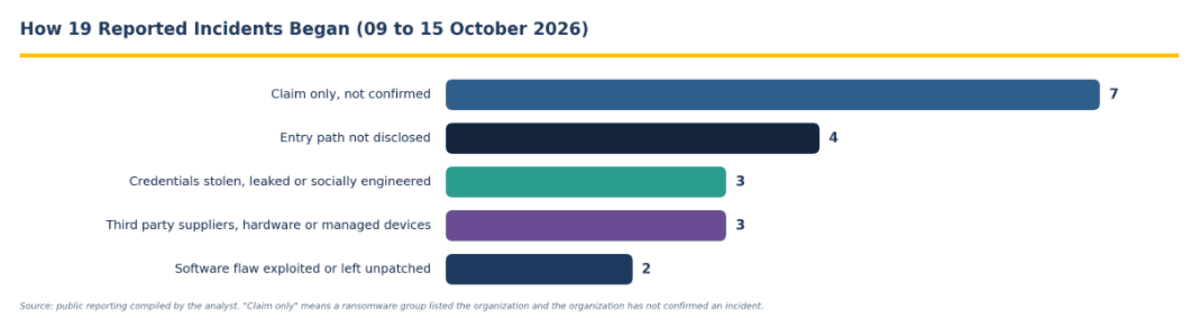
Figure 1. Initial access across 19 incidents reported or updated between 09 and 15 October 2026, plus one earlier financial sector incident.
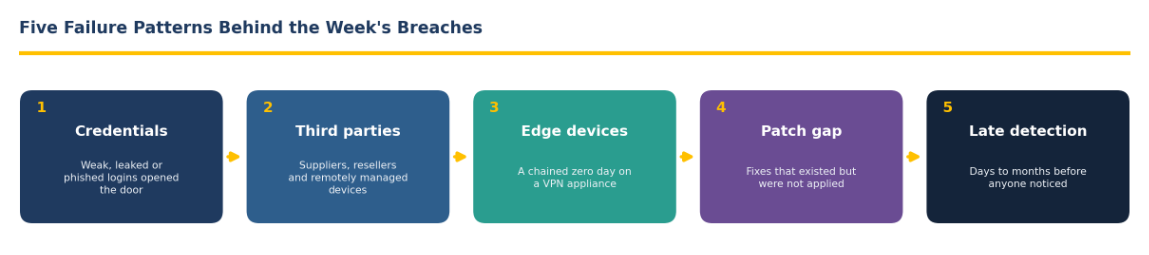
Figure 2. Five failure patterns behind the week’s breaches.
Credentials, not exploits
The Danish case is the clearest. A small IT company in Odense had legitimate search access to the national register. The person claiming the attack says they logged in with a former employee’s password, 123456, which had already appeared in a leak, and a newspaper found at least three of the company’s accounts, including an administrator account, using the same password. About 14 million automated searches followed. Authorities have not yet confirmed the password as the entry method. Meta says an outside group got into some of its GitHub repositories with one employee’s stolen credentials and took product source code and personal data on about 1,500 people, mostly employees. ASOS says an unauthorized party impersonated a trusted contact to obtain an employee’s login and then used it on third party platforms. None of these needed a software flaw.
Third parties and the things they manage
The Danish register was reached through a supplier, and the supplier’s own controls failed. Daiwa Securities says the intruders got into a contractor’s server that handled client inquiries, not Daiwa’s own systems. In France, attackers took over refrigeration controllers that maintenance firms manage remotely. Ledger says every confirmed loss in its case involved a signer sold through one Southeast Asian reseller, where someone along the distribution chain fitted a hardware implant. In each case the end customer relied on a supplier’s security that it could not see.
Edge devices and chained zero days
UTA0576 chained an authentication bypass, a file write that gives code execution and a local privilege escalation on a fully patched Ivanti Connect Secure appliance. They left no malware or web shell. They ran the whole chain again for every command, patched code in memory only and trimmed their traces from the logs, so Ivanti’s own integrity checker sees nothing. Once in, they went for Active Directory credentials, local administrator passwords and BitLocker recovery keys.
Fixes that existed, or did not
Researchers detailed authentication weaknesses in one of the refrigeration controllers in August and the maker has since patched it, but the maker says many affected units are end of life and no longer receive updates, and a news agency found at least 4,500 of its interfaces visible online. The Bricksforge flaw was exploited from 7 October, the day before it was disclosed, so defenders had no warning window. The FBI said on 9 October, announcing a further arrest linked to the ShinyHunters group, that its jobs portal incident occurred on a platform managed by a third party vendor. That fits last week’s statement that a contractor failed to install a patch.
Late detection
The Danish misuse was caught when a staff member noticed an unusually large search invoice, 12 days after the last query, not by security monitoring. Meta noticed its intrusion a few weeks before it disclosed it. iRhythm’s June intrusion only reached patients in October. In the French attack the attackers reportedly extended the defrost cycle from one hour to eight, which delays alarms.
Questions to ask your own team
- Which suppliers can reach your systems or query your data, and do their accounts use multifactor authentication, unique passwords and prompt removal of leavers?
- Could your help desk be talked into a password reset or a new MFA device by a convincing caller? What proves identity?
- Do you know which internet facing appliances and remotely managed devices you run, who manages them, and how you would tell if one had been taken over without leaving a file behind?
- If a critical flaw is exploited before a patch exists, what else limits the damage: segmentation, vaulted credentials, short lived service account secrets?
Breached organizations
Organizations are named as in public reporting. The list covers incidents first reported or materially updated between 09 and 15 October 2026, plus one financial sector incident from 5 October that our previous issue did not cover. Attacker claims are marked as claims, and counts are those reported by the organization unless marked otherwise. Check each name against your own suppliers and their suppliers.
| Organization | Sector, country and date | How it happened | Scale and status |
|---|---|---|---|
| Central Person Register (CPR) and its supplier Pays ApS | Government register, Denmark. Detected 2 Oct, disclosed 5 Oct, update 9 to 13 Oct | Attacker used a leaked former employee password (claimed to be 123456, not confirmed by authorities) on a supplier account with legitimate search access; at least three supplier accounts reportedly shared it | About 8.8 million people: names, addresses, CPR numbers. About 14 million automated searches between 10 and 20 Sep, found 12 days later through an unusually large search invoice. Supplier confirmed misuse on 9 Oct; police investigating |
| ASOS | Online retail, UK. Confirmed 7 Oct, updated 8 to 9 Oct | Employee tricked by someone impersonating a trusted contact; the login was used on third party data platforms. Xyance Group claimed it | Names, addresses, phone numbers, emails, dates of birth, customer numbers, search history. No card data or passwords, per ASOS. Platform provider says its own systems were not breached |
| Meta | Technology, US. Disclosed 13 Oct | Stolen credentials of one employee used on GitHub repositories | Product source code and personal data on about 1,500 people, mostly US employees. Meta says 99 percent of the data taken was code |
| Ledger hardware wallets sold through CryptoBilis | Crypto custody hardware, Southeast Asia. Implant confirmed 10 Oct, statement 13 Oct | Hardware implant fitted during distribution captured the 24 word recovery phrase during setup and sent it over LTE | At least $86 million stolen from hundreds of wallets (other estimates up to about $93 million). Ledger asked resellers across Southeast Asia and Hong Kong to suspend sales and says its own systems were not affected |
| French supermarkets (Intermarché, Coopérative U, Carrefour, Monoprix, E.Leclerc) | Retail, France. Night of 11 to 12 Oct | Remote takeover of internet exposed refrigeration controllers (Danfoss, Copeland and Dixell software) managed by maintenance firms; exact method not disclosed | At least 350 stores per one news agency, about 500 in other reports. Food destroyed and fires reported. Many controllers were end of life. No actor or claim |
| FBI (FBIJobs.gov portal) | US government. Update 8 to 9 Oct | Platform managed by a third party vendor; contractor missed a patch (5 Oct statement). A further arrest linked by the FBI to ShinyHunters | Staff and applicant data. Scope unconfirmed |
| Unnamed organization (an incident response firm customer) | Sector not disclosed. Investigated from 5 Oct | Ivanti Connect Secure zero day chain; theft of directory credentials and data | One confirmed case. Ivanti says a limited number of customers are affected |
| iRhythm Technologies | Medical devices, US. Notified from 2 Oct, filings 12 Oct | June 2026 intrusion, reported as affecting third party applications; attackers demanded payment | At least 368,173 people in two states (names, addresses, dates of birth, device and insurance numbers). One outlet reports about 8.2 million, which we have not adopted |
| IDC Frontier (IDCF Cloud) | Cloud provider, Japan. Confirmed 7 Oct, updated 8 to 9 Oct | Ransomware in its East Japan Region 1; entry not disclosed | 495 clients, including local governments. Four zones recoverable only from customers’ own backups. On 14 Oct investigators reported no evidence that data was taken out |
| TFG London (Hobbs, Whistles, Phase Eight) | Fashion retail, UK. Detected 11 Oct, disclosed 13 Oct | IT systems taken offline; entry not disclosed; no group has claimed it | Online orders delayed. No confirmed loss of customer data yet |
| Ahold Delhaize | Grocery retail, Netherlands and US. 12 to 14 Oct | Took systems offline to contain a security incident; entry not disclosed. The Dutch cyber agency saw no link to the French refrigeration attack | Online ordering at Albert Heijn and US brands disrupted; stores open; no indication yet that customer data was stolen |
| Daiwa Securities | Brokerage, Japan. Reported 5 Oct (not in our previous issue) | Unauthorized access on 2 to 3 Oct to a contractor’s server that handled client inquiries; Daiwa’s own systems not breached | About 110,000 clients (names, emails, account numbers); about 220,000 data items. Daiwa says the data cannot be used to trade |
| Tema Energy S.r.l. | Oil and gas equipment manufacturing, Italy. Claim seen 12 Oct | Listed on the MAJIN leak site (post dated 6 Oct), data release scheduled for 13 Oct | Claim only; not confirmed by the company |
| Great Lakes Institute of Management | Higher education, India. Listed 13 Oct | Listed on the INC Ransom leak site; entry path unknown; the post shows file counts but no sample in our capture | Claim only. About 18,976 files, 3,150 folders and 73.7 GB; countdown to publication. Not confirmed by the institute |
| Indian defence research organization (DRDO), SAAW documents | Defence research, India. Posts seen 14 to 15 Oct | A forum user and a Telegram channel (FracturedDB) say they are leaking design and technical data for a smart anti airfield weapon; offered as a free PDF | Claim only. Not confirmed; earlier DRDO claims in 2025 and July 2026 were questioned |
| Robert Hitchins Limited | Construction and property, UK. Claim seen 12 Oct | Listed on the MAJIN leak site; data release scheduled for 15 Oct | Claim only; not confirmed by the company |
| CFG Serramenti S.r.l. | Construction sector supplier, Italy. Claim seen 12 Oct | Listed on the MAJIN leak site; data release scheduled for 14 Oct | Claim only; not confirmed by the company |
| i2r Packaging Solutions Limited | Packaging, UK. Claim seen 15 Oct | Listed on the MAJIN leak site | Claim only; not confirmed by the company |
| KFC | Restaurants, US. Claim seen 10 to 12 Oct | Listed by the Gentlemen ransomware group; no evidence of an intrusion shown | Claim only; not confirmed by the company |
Notes. The Ahold Delhaize and TFG London entries are early statements with little detail. The Great Lakes, DRDO, Tema Energy, Robert Hitchins, CFG Serramenti, i2r Packaging and KFC entries are claims by attackers or forum users. Daiwa Securities was first reported on 5 October and is included because our previous issue did not cover it. The iRhythm figure of about 8.2 million comes from one outlet and does not match the state filings, which total 368,173. Store counts in the French incident vary: Les Mousquetaires reported about 150 Intermarché stores, Carrefour 80 and Monoprix about 5 percent of roughly 490 stores, while one news agency reported at least 350 stores and other outlets about 500.
02. Emerging Threats and Campaigns
Refrigeration controllers hijacked at French supermarkets
Overnight from Sunday 11 to Monday 12 October, attackers took remote control of refrigeration controllers in supermarkets across France and forced a continuous defrost cycle that pushed fridges and freezers as high as 50 degrees Celsius for about six hours. One news agency counts at least 350 stores and other outlets about 500. Les Mousquetaires, which owns Intermarché, said about 150 of its stores were affected, Carrefour said 80, and Monoprix said about 5 percent of its roughly 490 stores. Coopérative U and E.Leclerc also reported stores hit. Food was destroyed and fires broke out at several sites. The Paris prosecutor opened an investigation, and the prime minister asked the national cyber agency to lead it.
The main equipment is the AK-SM and AK-SC series made by Danfoss, which maintenance firms manage remotely, so it sits on the internet by design. The French cyber agency says the compromised systems also include software from Copeland and its Dixell brand. The maker says many affected units had reached end of life, no longer receive security updates or were running outdated firmware. Researchers had detailed authentication weaknesses in one of the controllers on 9 August, since patched, and a news agency found at least 4,500 of the maker’s interfaces visible online on 13 October. Investigators have not said how the attackers got in or who they are. No group has claimed the attack and nobody has demanded a ransom, which puzzles the investigators. Reports say the attackers extended defrost cycles from one hour to eight, which delays alarms. The Dutch cyber agency saw no link to the separate incident at Ahold Delhaize.
| Field | Detail |
|---|---|
| Victims | Intermarché and Netto (Les Mousquetaires), Coopérative U, Carrefour, Monoprix, E.Leclerc |
| Date | Night of 11 to 12 October 2026; alert from the French national cyber agency on 12 October |
| Equipment | Danfoss AK-SM and AK-SC controllers, plus Copeland and Dixell software, managed remotely by maintenance firms |
| Access | Remote takeover of internet exposed controllers; exact method not disclosed; many units end of life or on outdated firmware |
| Effect | Forced defrost to about 50 degrees Celsius for about six hours; food destroyed; fires at several stores |
| Scale | At least 350 stores per one news agency; about 500 in other reports; counts vary |
| Response | Paris prosecutor investigating; some stores back in operation by 13 October |
| Attribution | None; no claim and no ransom demand |
Recommendations
- List every remotely managed building and industrial controller, including those a supplier operates for you, and remove direct internet exposure.
- Require supplier remote access through a VPN or gateway with multifactor authentication, named accounts and logging, and write this into the contract.
- Apply controller updates, and replace models that no longer get security fixes.
- Run temperature and safety alarms on a path that the controller itself cannot silence or delay.
IDC Frontier: a cloud provider hit by ransomware
IDC Frontier, a SoftBank subsidiary, confirmed on 7 October that its IDCF Cloud East Japan Region 1 was hit by ransomware, starting at about 3:40 a.m. Japan time. The company isolated the region and halted its systems. About 495 client organizations, including local governments, were affected. On 8 October it said data in four zones can only be recovered from backups that customers hold themselves. The attacker has not been named. On 14 October the company said investigators had found no evidence that data inside the affected virtual servers was taken out of the network, although the investigation continues.
The lesson is concentration risk. A customer whose only copy of production data sat in that region may lose it permanently. Keep backups outside your cloud provider’s failure domain, test restoring from them, and check what your contract actually promises about recovery.
03. Threat Actor Activity
Scattered Spider and Scattered LAPSUS$ Hunters
Scattered Spider is a loose group of mostly young, native English speaking criminals from the online community known as The Com, in the United States and the United Kingdom. It became known for getting into large companies by telephone rather than by exploit: callers impersonate employees, contractors or vendors, talk a help desk into resetting a password or registering a new MFA device, and then work through single sign on, VPN and cloud consoles. A US Justice Department complaint in July 2026 credits the group with more than 100 intrusions and more than $100 million in ransom payments.
The name now covers less than it used to. The UK National Crime Agency says its July prosecutions effectively halted the group’s own activity, and the same people, methods and infrastructure now appear under other names. The most important is Scattered LAPSUS$ Hunters, a collective that says it combines Scattered Spider, LAPSUS$ and ShinyHunters. The other is the ShinyHunters brand itself, which one incident response firm describes as several clusters operating under a single name. The 2025 attacks on UK retailers and on Jaguar Land Rover were attributed to this collective. For defenders, recent Scattered Spider activity means the activity of this wider group.
Recent activity
The campaign to understand is the voice phishing of single sign on accounts that began in January 2026 and has not stopped. An incident response firm described it as a ShinyHunters branded campaign that uses evolved voice phishing to take SSO credentials and enroll attacker controlled devices into the victim’s multifactor authentication. The callers ring staff or the help desk while steering the victim through a live phishing page that copies the real login prompts, often built with phishing kits sold as a service against identity providers such as Okta, Google and Microsoft. Once inside, they sweep through every application the account can reach in a short burst, copy data from cloud applications and then demand payment. One security vendor counted more than 100 targeted enterprises, and a victim tracker lists dozens of 2026 claims in healthcare, telecom, education and hospitality. One analysis found that roughly 80 percent of the group’s claimed victims had earlier infostealer infections, so stolen logs are probably one source of the staff details that callers use.
In late September the group breached the FBI’s own jobs portal, on a platform that a third party vendor manages. The FBI says a contractor missed a patch, as covered under Threat Landscape. A ShinyHunters spokesperson told journalists the breach was not financially motivated and was a marketing exercise, which is the group’s own account and cannot be verified. Arrests followed quickly. Dutch police arrested a 24 year old in mid September, whom the FBI called one of the alleged leaders of ShinyHunters. A suspected key member of Scattered LAPSUS$ Hunters, described by one journalist as its technical operator and public face, was detained in Jordan on 29 September and is reported to be cooperating. On 5 October the FBI said that multiple suspects are in custody. On 8 October a Canadian ransomware negotiator was arrested in the United States on extortion charges, and the FBI director linked the case to the group, although no public court record names it. The FBI has also addressed the remaining members directly in a video message, telling them to reach out first.
The ASOS breach this week fits the technique. Someone impersonating a trusted contact obtained an employee’s login. The attack is claimed by a group calling itself Xuanye Group, and nothing public ties it to this ecosystem, so we treat it as the same technique and not the same actor.
| Attribute | Detail |
|---|---|
| Names | Scattered Spider, UNC3944, Octo Tempest, Muddled Libra, 0ktapus, Scatter Swine, Starfraud. The related collective is Scattered LAPSUS$ Hunters, and the ShinyHunters brand overlaps with both. Some aggregator lists add DEV-0971 and Storm-0971, which we could not confirm from a primary source; the US advisory gives Storm-0875 as one software vendor’s name |
| Assessed origin | English speaking individuals in the United States, the United Kingdom and elsewhere, part of The Com |
| Motivation | Financial gain through data theft, extortion and ransomware |
| Typical targets | Telecommunications and outsourcing firms at first; later retail, insurance, aviation, gaming, healthcare, education and financial services |
| Initial access | Voice phishing of staff and help desks, live phishing pages for SSO, SMS phishing, SIM swapping, MFA request flooding |
| Current playbook | Capture SSO credentials, enroll an attacker MFA device, sweep SaaS applications, copy data, extort |
| Tooling | Phishing kits sold as a service, remote access tools, cloud data theft; DragonForce ransomware on ESXi in earlier attacks |
| Extortion channels | Tor leak sites, Signal, Telegram |
| Status in October 2026 | Several arrests in September and October; brand reused by copycats; no public attribution of this week’s incidents |
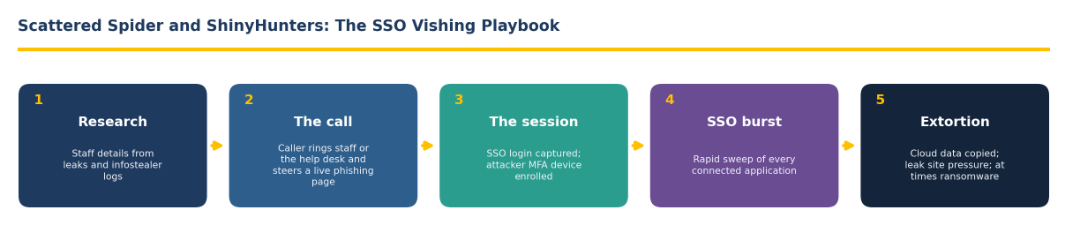
Figure 3. The SSO vishing playbook used under the Scattered Spider and ShinyHunters names (after incident response reporting).
Timeline of recent events
| Date | Event | Status |
|---|---|---|
| Jan 2026 | SSO vishing campaign under the ShinyHunters name: calls, live phishing pages, attacker MFA devices, SaaS data theft, extortion | Confirmed by incident responders |
| Mar 2026 | Group claims a campaign against Salesforce Experience Cloud sites | Claimed by the group |
| 1 Jul | US extradites an alleged Scattered Spider member arrested in Finland | Confirmed by the Justice Department |
| 16 to 17 Jul | Two leading members sentenced to 66 months each in the UK | Confirmed by the National Crime Agency |
| Mid Sep | Dutch police arrest a 24 year old described by the FBI as an alleged ShinyHunters leader | Confirmed by police and the FBI |
| Late Sep | FBI jobs portal breached on a platform run by a third party vendor | Incident confirmed by the FBI; motive is the group’s claim |
| 29 Sep | Suspected key member of Scattered LAPSUS$ Hunters detained in Jordan, reported to be cooperating | Press reports; the FBI declined comment |
| 5 Oct | FBI says multiple suspects are in custody | FBI statement |
| 8 Oct | Canadian ransomware negotiator arrested in the US on extortion charges; the FBI director links it to the group | Charges unspecified; link not on the public record |
| 6 to 9 Oct | ASOS breached by impersonating a trusted contact; claimed by Xuanye Group | Technique matches; actor not linked |
Hunting guidance
This group leaves few stable indicators. It uses fresh infrastructure for each campaign, so the useful signals are behaviours in identity and cloud logs.
| Signal | Where to look | Why it matters |
|---|---|---|
| Password reset followed within minutes by a new MFA factor | Identity provider and help desk logs | This is the point where the help desk call or live phishing page succeeds |
| New device enrolled from an unfamiliar network or country | MFA and device registration logs | The attacker’s device becomes a persistent second factor |
| One account touching many SSO applications in a short burst | SSO and application access logs | The sweep that follows a successful login |
| Large exports or downloads from cloud applications by one session | SaaS audit logs | Data theft for extortion |
| New remote access or management tools on endpoints or servers | Endpoint and software inventory | Used to keep access after the reset is noticed |
| A call or message from IT asking the user to read a code or sign in on a link | Staff reports and ticket records | The vishing step itself; report and record every case |
MITRE ATT&CK techniques
Technique IDs come from US government advisories on the group and our own mapping of the 2026 campaign behaviour.
| Tactic | ID | Technique | Observed procedure |
|---|---|---|---|
| Reconnaissance | T1598.004 | Phishing for Information: Spearphishing Voice | Calls staff and help desks to obtain credentials and resets |
| Initial Access | T1566.004 | Phishing: Spearphishing Voice | Steers a caller’s victim through a live phishing page |
| Initial Access | T1199 | Trusted Relationship | Abuses outsourced help desks and service providers |
| Initial Access | T1451 | SIM Card Swap (Mobile) | Takes over a phone number to receive codes |
| Credential Access | T1621 | Multi Factor Authentication Request Generation | Floods users with approval prompts |
| Persistence | T1556.006 | Modify Authentication Process: Multi Factor Authentication | Registers an attacker controlled MFA device |
| Persistence | T1078.004 | Valid Accounts: Cloud Accounts | Uses captured SSO sessions to reach cloud applications |
| Command and Control | T1219 | Remote Access Software | Installs legitimate remote access tools |
| Collection | T1530 | Data from Cloud Storage | Copies data from SaaS and cloud storage |
| Impact | T1486 | Data Encrypted for Impact | Deploys ransomware in some attacks, including on ESXi |
Recommendations
- Move staff and administrators to phishing resistant authenticators, and stop accepting one time codes or push approvals as the only factor for SSO.
- Allow new MFA device enrollment only from managed devices or trusted networks, and require a second approver for enrollment after a password reset.
- Give the help desk a script that does not depend on what the caller knows. Call back on a number held on file, require manager approval or video identity proofing for MFA changes, and make it acceptable to refuse. Apply the same rules to any outsourced help desk.
- Alert on the signals above, especially a reset followed by a new MFA device, and on one session touching many applications or exporting large volumes.
- Tell staff that IT will never ask them to read out a code or sign in through a link during a call they did not start, and make reporting easy.
- Watch for staff credentials in infostealer logs and reset them, since about four in five claimed victims reportedly had earlier infections.
- Prepare an extortion plan in advance, covering who decides, who speaks to law enforcement and how stolen data would be assessed, so that a leak site post does not force a rushed decision.
04. Ransomware and Data Leaks
MAJIN Ransomware (Majinahanashi group)
MAJIN is Windows ransomware that appends the .majin extension and drops a text note named README.txt. It is the encryptor used by the group researchers call Majinahanashi, which appeared in late June 2026 and runs a Tor leak site. The name joins two Japanese words, majin (genie) and ahanashi (story), and the leak site uses both forms. On 2 October the group rebranded the site as MAJIN RANSOM and began watermarking leak images with its name. Our link between the two names rests on the identical leak site address, the extension and the watermark. Researchers published two earlier samples in August, and the sample in this report is a different build.
The note in this sample is new. It opens with Dear Members of Management, says the infrastructure is completely compromised, claims sensitive files were also downloaded, and gives the victim exactly seven days to make contact before the data and the company’s name are published. Contact is through the TOX messenger only, and there is no email address or payment amount. The August version of the note read differently and also offered a Proton email address. The victim ID in the note, 14E757D6, also appears in an independent public write up of a MAJIN sample, so it identifies the build and not the victim.
The data theft claim is the groups. The sandbox run shows browser credential reads but no exfiltration activity, so the claim is neither confirmed nor ruled out here. The leak site does post proof images for some victims. When researchers asked how the group gets in, the operator gave an implausible answer (a USB device in 70 percent of cases), so initial access is unknown.
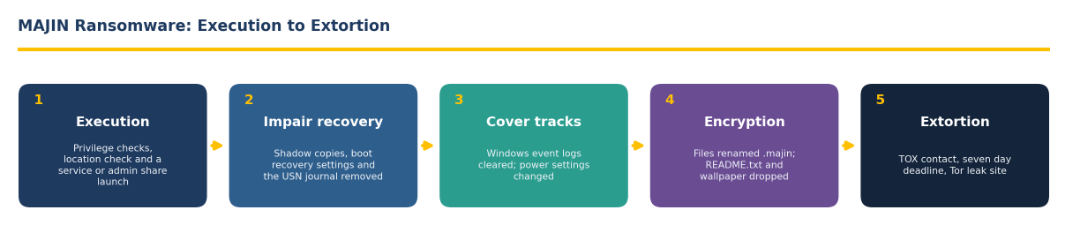
Figure 4. MAJIN ransomware flow from execution to extortion (assembled from sandbox behaviour signatures and published analysis).
Observed evidence
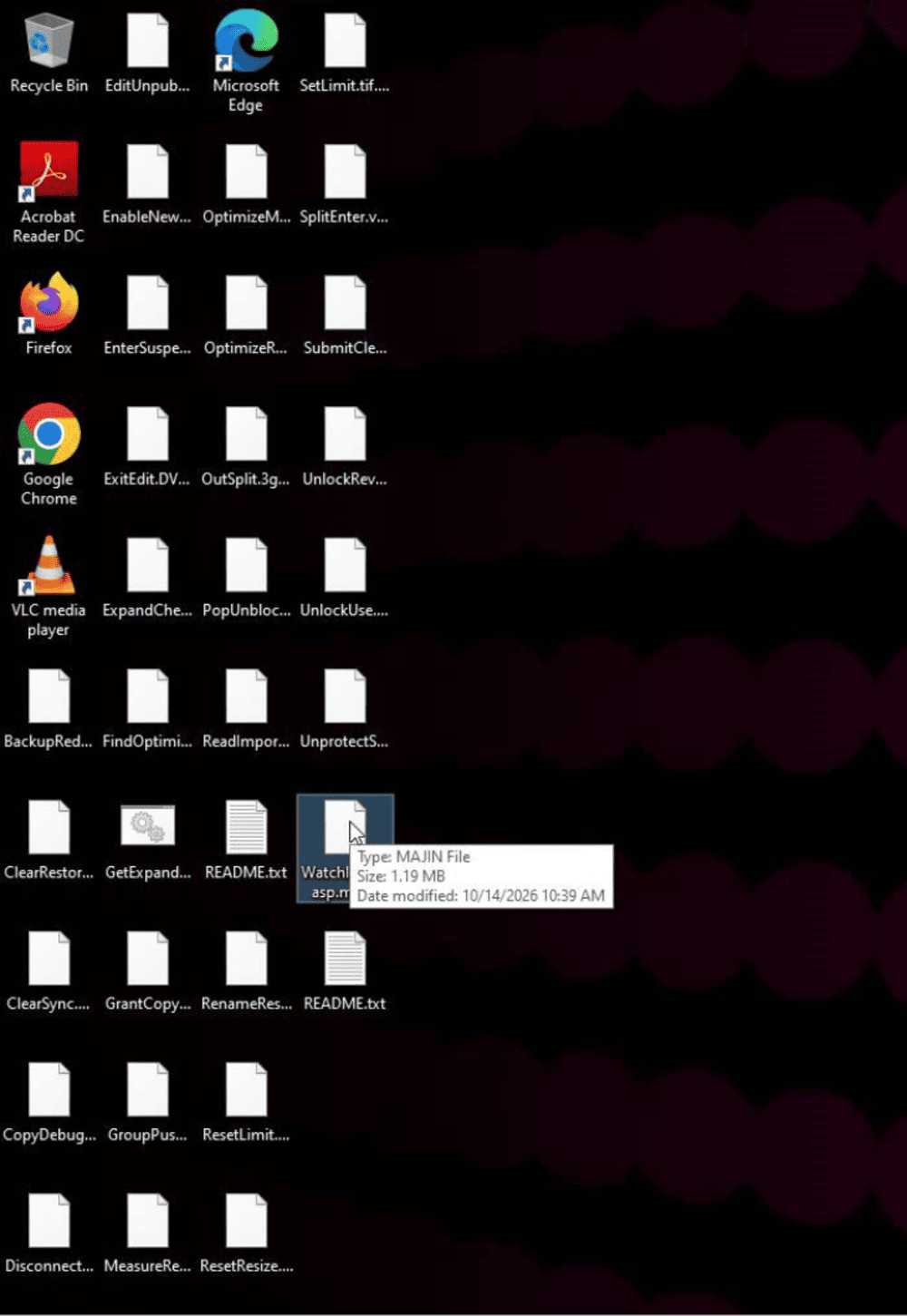
Figure 5. Sandbox desktop after execution: the MAJIN file type (a 1.19 MB encrypted file in the tooltip) and two README.txt notes.
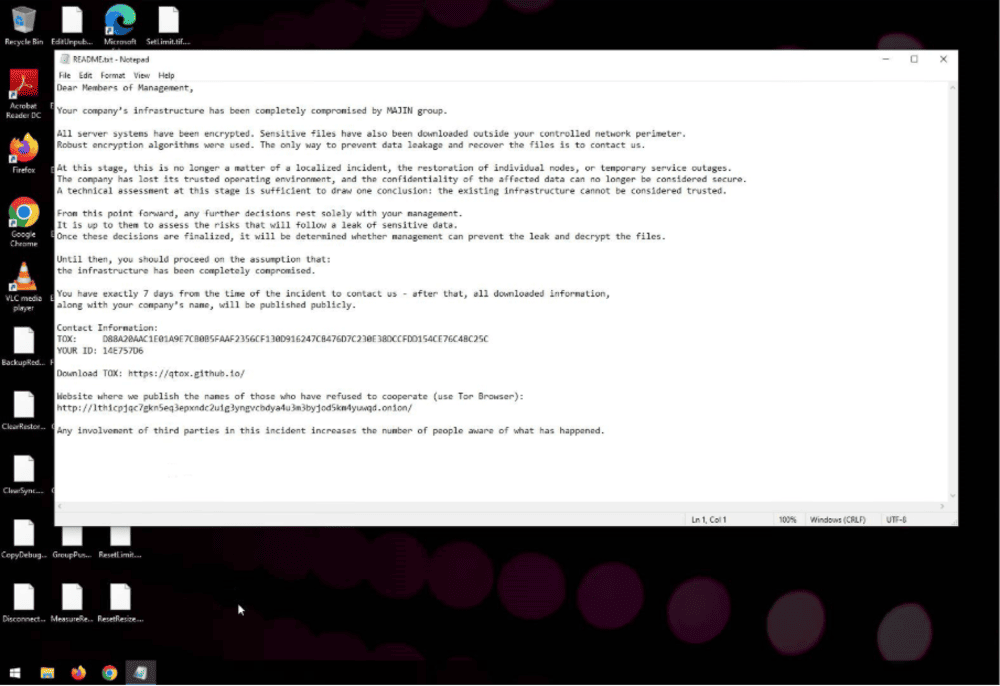
Figure 6. The README.txt ransom note opened in Notepad on the sandbox desktop.
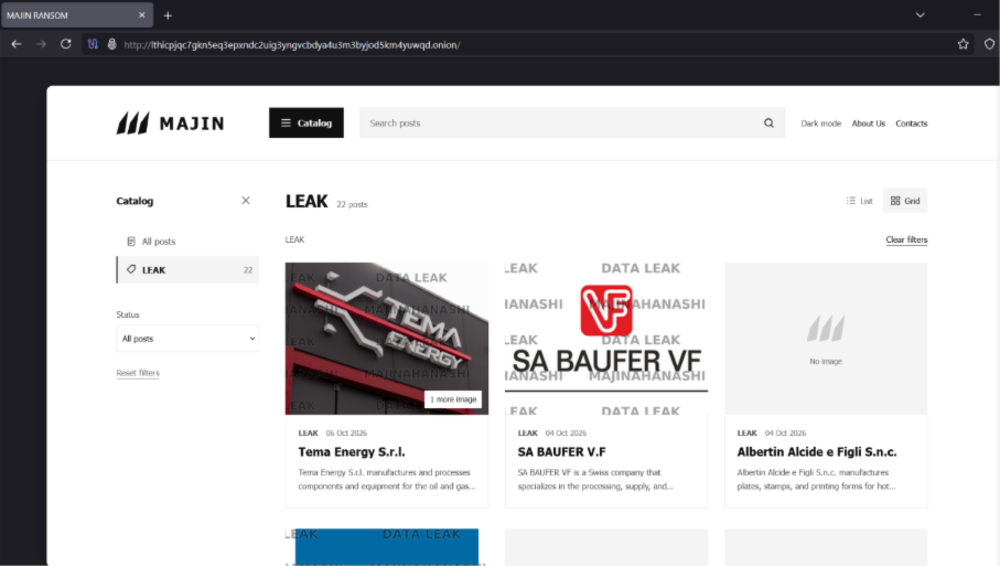
Figure 7. The rebranded MAJIN leak site, showing 22 posts and three claimed victims (a claim is not a confirmed breach).
Behavioural signatures
Sandbox analysis shows the sample deleting the NTFS change journal, clearing Windows event logs, deleting shadow copies and using the Volume Shadow Copy COM API, changing boot configuration with bcdedit, and changing power settings with powercfg. It checks the computer’s location in the registry, which fits the geofencing researchers describe, reads the hostname and domain, enumerates drives and physical storage, and reads browser profile data. It renames files in bulk, drops files in the System32, Windows and Program Files directories, and writes desktop.ini files. Researchers who analysed the August samples also report AES 256 encryption with a per file key wrapped by an embedded RSA key, a service named majinSvc, a lock screen headed SEIZED, and network filtering that can interfere with security agents. Those details are not in the sandbox report for this sample.
Recent leak site listings
The site showed 22 posts when we captured it. Trackers indexed several older listings again on 10 October, after the rebrand, with attack dates between June and August, so the number of new victims is smaller than the post count suggests. The posts below are claims. One tracker warns that listings attributed to this group may include unverified or fabricated victims. In August researchers found no victims in English speaking countries, yet the group now lists two UK companies, so a location check in the sample is not a safe basis for assuming you are out of scope.
| Organization | Sector, country and date | How it happened | Scale and status |
|---|---|---|---|
| Tema Energy S.r.l. | Italy | 6 Oct; data release scheduled 13 Oct | Claim; oil and gas equipment maker |
| SA BAUFER V.F | Switzerland | 4 Oct | Claim; Swiss processing and supply company |
| Albertin Alcide e Figli S.n.c. | Italy | 4 Oct | Claim; maker of plates, stamps and printing forms |
| Hysytech S.r.l. | Italy | 2 Oct | Claim; no evidence shown on the post |
| Robert Hitchins Limited | United Kingdom | Claim seen 12 Oct; data release scheduled 15 Oct | Claim; construction and property company |
| CFG Serramenti S.r.l. | Italy | Claim seen 12 Oct; data release scheduled 14 Oct | Claim; construction sector supplier |
| i2r Packaging Solutions Limited | United Kingdom | 15 Oct | Claim; packaging company |
MITRE ATT&CK techniques
The first group of rows is the sandbox mapping. The rows marked as added are our own, for behaviour the sandbox report shows but the mapping leaves out.
| Tactic | ID | Technique | Observed procedure |
|---|---|---|---|
| Execution | T1047 | Windows Management Instrumentation | Uses WMI for host information and commands |
| Persistence | T1653 | Power Settings | Changes power settings with powercfg |
| Defense Evasion | T1006 | Direct Volume Access | Accesses volumes directly |
| Defense Evasion | T1070.001 | Indicator Removal: Clear Windows Event Logs | Clears Windows event logs |
| Defense Evasion | T1070.004 | Indicator Removal: File Deletion | Deletes files, including the NTFS change journal |
| Credential Access | T1555.003 | Credentials from Password Stores: Credentials from Web Browsers | Reads user and profile data of web browsers |
| Credential Access | T1552.001 | Unsecured Credentials: Credentials In Files | Sandbox flagged reads of credential material in files |
| Discovery | T1217 | Browser Information Discovery | Enumerates browser information |
| Discovery | T1120 | Peripheral Device Discovery | Enumerates connected drives and storage |
| Discovery | T1012 | Query Registry | Reads system and location settings |
| Discovery | T1082 | System Information Discovery | Enumerates system information |
| Discovery | T1016 | System Network Configuration Discovery | Reads hostname and domain from the registry |
| Collection | T1005 | Data from Local System | Collects local data |
| Discovery (added) | T1614 | System Location Discovery | Checks the configured country, likely a geofence |
| Impact (added) | T1490 | Inhibit System Recovery | Deletes shadow copies and changes boot recovery settings |
| Impact (added) | T1486 | Data Encrypted for Impact | Encrypts files and appends .majin |
Indicators of compromise
| Indicator | Type | Context |
|---|---|---|
| 2c3c34f1df0b2af29b9a068e 7c87ffbd786a319a67b13d2b42 7e159a4e28656a | SHA256 | MAJIN sample analysed for this report |
| bd91d786841f5259430c1c90 b454d9f8bf510186fe4d32a0998 bd9b5a7916467 | SHA256 | Earlier published MAJIN sample (August) |
| e6ec7749e3d0f750fa53b 5a7619d1e5af57673d236338 b3a020d0f534ec5c15d | SHA256 | Earlier published MAJIN sample (August) |
| .majin | File extension | Appended to encrypted files |
| README.txt | Filename | Ransom note |
| 14E757D6 | Victim ID | Printed in the note; identifies the build, not the victim |
| D88A20AAC1E01A9E7CB0B5F AAF2356CF130D916247C8476D7C230 E38DCCFDD154CE76C48C25C | TOX ID | Operator contact in this note (transcribed from the capture; verify) |
| lthicpjqc7gkn5eq3epxnd c2uig3yngvcbdya4u3m3byjod5km4 yuwqd[.]onion | Tor address | Leak site (transcribed from the capture; matches the address published by researchers) |
| C:\Windows\Temp\majin.exe | File path | Dropper path in August samples; also ADMIN$\Temp\majin.exe for remote execution |
| Global\majinahanashi_Mutex | Mutex | Reported for August samples |
| majinSvc | Service name | Persistence service in August samples |
Recommendations
- Keep offline or immutable backups and test restoration. MAJIN removes shadow copies, boot recovery settings and the NTFS change journal.
- Alert on fsutil usn deletejournal, vssadmin delete shadows, bcdedit recovery changes, powercfg hibernate changes, clearing of the Security and System logs (Event IDs 1102 and 104) and mass file renaming.
- Hunt for majin.exe in Windows\Temp and on ADMIN$ shares, a service named majinSvc, the mutex above and the extension .majin, using the August indicators as a guide.
- Turn on tamper protection in endpoint security tools and restrict administrative shares, since researchers report that the encryptor targets security and backup processes.
- Watch for TOX client installs and traffic from servers, and for large outbound transfers before encryption, because the group claims to steal data first.
- Do not rely on geofencing to stay safe. Do not pay; preserve the note and a sample encrypted file, and involve incident response and the relevant national CERT.
INC Ransom: Great Lakes Institute of Management
On 13 October the INC Ransom group listed the Great Lakes Institute of Management, a business school in India with campuses in Chennai and Gurgaon, on its leak site. The listing reproduces the school’s public description and contact details and gives a revenue figure of $1 million, which is the group’s own number and cannot be verified. A first data post, labelled part 1, followed the same afternoon and shows 18,976 files in 3,150 folders, about 73.7 GB. A countdown of 7 days 11 hours was running when we captured it, which means the group intends to publish the data about a week later. We have seen no statement from the institute, and the capture shows no sample files, so the claim is unconfirmed.
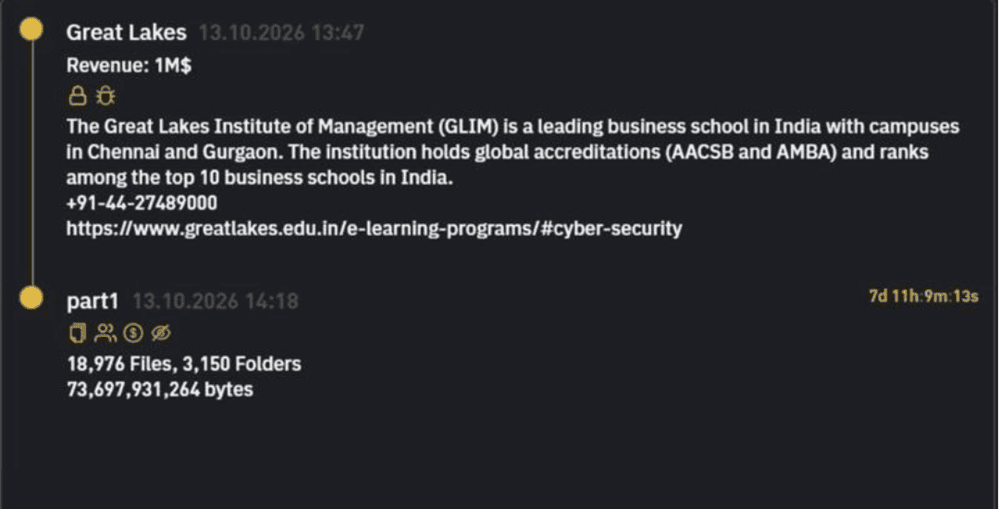
Figure 8. The INC Ransom leak site entry for Great Lakes and its first data post (a claim, not a confirmed breach).
INC Ransom, also tracked as GOLD IONIC, is a ransomware as a service operation that appeared in mid 2023. One tracker counts about 960 victims named on its leak site, 466 of them in the last 12 months and 39 in the last 30 days, with the latest on 12 October. It targets healthcare, education, industry and public administration, mostly in the United States and Europe, and in 2026 it has posted at least 20 law firms. Its encryptor has Windows and ESXi versions. In March 2024 the operators offered the source code for sale at about $300,000, and researchers link the Lynx ransomware to the same code. Affiliates of INC and Lynx were named in last week’s FortiBleed advisory as buyers of access from compromised Fortinet firewalls, and INC has a record of using Citrix flaws, so the exposed edge devices covered in recent issues are relevant to this group.
Initial access varies. Public reporting describes phishing, valid credentials bought from access brokers, and exploitation of internet facing products, including Citrix NetScaler (CVE-2023-3519 and the later Citrix Bleed flaw CVE-2025-5777), Fortinet EMS and SimpleHelp. Researchers have also seen remote access through RDP and remote management tools. Once inside, affiliates use common administration software and living off the land tools, dump credentials from backup servers, stage data with 7-Zip or WinRAR and send it to cloud storage with MEGAsync or rclone before they encrypt. In some investigations the first access could not be established, so initial access for this claim is unknown. One tracker found that about 23 percent of INC victims had employee credentials leaked in the year before they were listed, which is a pointer and not proof of how any one victim was entered.
| Attribute | Detail |
|---|---|
| Group | INC Ransom (GOLD IONIC); ransomware as a service; Lynx is a related variant |
| Active since | July 2023 |
| Encrypted file extensions | .inc and .ibc, as listed by a tracker; ransom notes named INC-README.txt in earlier cases |
| Typical sectors | Healthcare, education, industry, public administration, law firms |
| Initial access | Phishing, purchased credentials, RDP, exploitation of Citrix, Fortinet and SimpleHelp flaws |
| Tools | AnyDesk, PuTTY, Advanced IP Scanner, NETSCAN.EXE, AdFind, PsExec, Cobalt Strike, ScreenConnect, TeamViewer |
| Exfiltration | MEGAsync, rclone, Restic after staging with 7-Zip or WinRAR |
| This claim | Great Lakes Institute of Management, India; listed 13 Oct 2026; about 73.7 GB; unconfirmed |
Why this matters beyond the school
Business schools hold student and applicant records, parent and guarantor details, fee and education loan information, alumni data and corporate training and recruitment records. Banks and lenders with education loan, campus recruitment or executive training links to the institute should ask for confirmation of what, if anything, was taken. Students and alumni should expect targeted phishing that uses details from the files. The group publishes in stages, so check the leak site again when the countdown ends.
MITRE ATT&CK techniques
Technique IDs come from the public MITRE page on the group and vendor reports on INC activity. They describe the group, not this incident, where no technical detail is public.
| Tactic | ID | Technique | Observed procedure |
|---|---|---|---|
| Initial Access | T1566 | Phishing | Phishing for credentials or a first foothold |
| Initial Access | T1190 | Exploit Public-Facing Application | Citrix, Fortinet and SimpleHelp flaws |
| Initial Access | T1078 | Valid Accounts | Credentials from access brokers or earlier leaks |
| Discovery | T1046 | Network Service Discovery | NETSCAN.EXE and Advanced IP Scanner |
| Execution | T1047 | Windows Management Instrumentation | WMIC used to deploy the encryptor |
| Command and Control | T1219 | Remote Access Software | AnyDesk, PuTTY, ScreenConnect, TeamViewer |
| Collection | T1074 | Data Staged | Data staged before exfiltration |
| Exfiltration | T1567.002 | Exfiltration to Cloud Storage | MEGAsync and rclone |
| Impact | T1486 | Data Encrypted for Impact | INC encryptor on Windows and ESXi |
Indicators of compromise
| Indicator | Type | Context |
|---|---|---|
| .inc and .ibc | File extension | Appended to encrypted files, as listed by a tracker |
| INC-README.txt | Filename | Ransom note name in earlier cases; names can vary |
| incblog6qu4y4mm4zvw5nrmue6qbwtgjsxpw6b7ixzssu36tsajldoad[.]onion | Tor address | Leak site disclosures page (tracker data; verify) |
| incbacg6bfwtrlzwdbqc55gsfl763s3twdtwhp27dzuik6s6rwdcityd[.]onion | Tor address | Related INC site (tracker data; verify) |
| NETSCAN.EXE | Tool name | Internal network scanning |
| SystemSettingsAdminFlows.exe | Tool name | Native utility abused to switch off Windows Defender |
Recommendations
- Check your own exposure to the institute: education loans, campus recruitment, executive programs, joint events and shared data. Ask for a written statement of what was affected.
- Patch and monitor internet facing Citrix, Fortinet and remote management products, and reset credentials stored on them, because INC affiliates buy and use that access.
- Alert on remote access tools that nobody approved (AnyDesk, ScreenConnect, TeamViewer), on credential dumping from backup servers, and on large transfers to cloud storage from servers.
- Keep backups offline, protect the backup server’s credentials, and harden ESXi hosts, since INC has an ESXi encryptor.
- If your staff or customers are in the leaked set, warn them about phishing that quotes real details and about calls claiming to be from the school or a lender.
Other leak site and law enforcement news
The Gentlemen ransomware group listed KFC around 10 October. The post shows branding and a business description but no stolen files or technical evidence, and the company has not confirmed an incident. Germany took into custody a Russian national suspected of being a core member of the Qilin ransomware group after Japan extradited him on 2 October. Qilin remains active and has been linked to victims in more than 60 countries, so the arrest is good news without being a disruption.
05. Credential and Account Exposure
Weak and stolen logins behind this week’s breaches
Denmark’s Central Person Register breach has moved from a puzzle to a lesson in basic account hygiene. The register’s administrators said on 5 October that a Danish company’s lawful access had been abused. Since then the company, Pays ApS of Odense, has confirmed that its access was misused. A person claiming the attack told a Danish newspaper that they used a former employee’s password, 123456, which had already appeared in an earlier leak, and the newspaper found that at least three of the company’s accounts, including an administrator account, used it. Authorities have not confirmed the password as the entry method. Documents seen by a broadcaster say the lookups ran from 10 to 20 September and numbered about 14 million. They were found on 2 October, 12 days later, when a staff member noticed an unusually large invoice for searches. Some reports say 21 days, which appears to count the time until discovery. The company’s website is offline, police are investigating, and the minister has ordered a full security review and said the breach did not reach systems that use MitID.
Nothing in the register itself was exploited. The login was valid, the queries stayed inside what a private company may see, and it was a billing anomaly, not a security control, that exposed the activity. The person claiming the attack says they do not plan to sell or publish the data, which nobody can verify, so organizations should assume it will be used for fraud and for convincing phishing. Denmark’s MitID sign in means a name, address and CPR number alone do not let someone impersonate a citizen, but they make scams far more believable.
| Organization | Account taken over | How | What it reached |
|---|---|---|---|
| Supplier to the Danish register | Administrator and other staff accounts | Leaked former employee password reportedly reused on at least three accounts; no multifactor authentication reported | Search access to the national population register: 8.8 million people |
| ASOS | An employee account | Attacker impersonated a trusted contact to obtain the login | Customer data on third party platforms, including dates of birth and search history |
| Meta | An employee account on GitHub | Stolen credentials | Product source code and personal data on about 1,500 people |
| Ivanti Connect Secure customer | The appliance’s Active Directory service account | Credentials read from the compromised appliance | Directory data, local administrator passwords and BitLocker recovery keys |
Recommendations
- Block common and breached passwords, require multifactor authentication on every account that can reach customer or identity data, and make supplier accounts follow the same rule.
- Disable leavers’ accounts on the day they leave, and review supplier accounts for staff who no longer work there.
- Alert on query volume, speed and timing for accounts with lookup or export rights, and on administrator logins from new locations. A person noticing a spike is too slow.
- Give help desks a way to prove identity that does not depend on what a caller knows, and require checks before resetting passwords or MFA for staff with access to code or customer data.
- Keep personal data out of code repositories and scan for it, and rotate any secret that has sat next to code.
Ledger signers: recovery phrases captured by a hardware implant
Ledger confirmed on 10 October that one affected customer’s hardware wallet contained an unauthorized hardware implant, and said on 13 October that every confirmed fund loss in the incident involved a signer sold through CryptoBilis, a reseller serving Indonesia, Malaysia and the Philippines. The implant is a small circuit board hidden under the screen, with a microcontroller, an eSIM and an LTE connection. When the signer shows the 24 word recovery phrase during setup, the implant reads the words from the screen and sends them to the attackers over the mobile network. It does not touch the device’s secure element or software, and Ledger says its own systems were not affected. Someone along the distribution chain appears to have fitted the implant by hand.
On chain investigators estimate losses of at least $86 million across Bitcoin, Ethereum and Tron, with other estimates up to about $93 million. Ledger calls the number of affected devices limited but has not given a figure or said at what stage the implants were fitted. On 13 October it asked resellers and distributors across Southeast Asia and Hong Kong to suspend sales, and a large European electronics retailer has pulled Ledger devices from sale as a precaution. Commentators have posted photos of devices bought from a European retailer and a Singapore airport shop and suggested they also carry implants. Ledger is reviewing those reports but says every confirmed case involves the reseller, so they should be treated as unconfirmed. One analysis of the drained wallets suggests devices bought from the reseller since June may be affected, which is longer than the 90 days that Ledger’s advice covers. There is no software fix. Ledger’s advice is that anyone who set up a signer sold through the reseller should move assets to a new signer with a freshly generated recovery phrase.
| Field | Detail |
|---|---|
| Product | Ledger hardware wallet signers sold through the reseller CryptoBilis |
| Method | Hardware implant that reads the recovery phrase from the screen during setup and sends it over LTE |
| Confirmed | Implant found in one affected device on 10 October; all confirmed losses involve devices sold through the reseller (13 October) |
| Losses | At least $86 million; estimates up to about $93 million; no confirmed device count |
| Reseller response | Suspended sales of hardware wallets pending the investigation; Ledger asked resellers in Southeast Asia and Hong Kong to pause sales (13 October) |
| Fix | None in software; replace the device and move funds to a new recovery phrase |
Recommendations
- Buy hardware wallets only from the manufacturer or its listed official retailers, and treat any device from another channel as untrusted. Authorized resellers have now been affected, so check the packaging and the device.
- For wallets already set up on a device sold through the reseller, create a new recovery phrase on a verified device and move the funds.
- For custody clients, add device provenance and tamper checks to onboarding, and never reuse a recovery phrase that has been displayed on an untrusted device.
Midnight Mimosa: Android malware preinstalled in firmware
Researchers disclosed on 8 October a malware campaign they call Midnight Mimosa, found on low cost, multi brand Android phones built on MediaTek platforms. The malware ships in the firmware, so it is on the phone before the owner switches it on, and it cannot be uninstalled in the usual way. The core is a system app signed with the platform key, which Android therefore trusts. It appears under several names, including com.android.system.lite, com.android.sys.prot, com.android.sys.gmsprot and com.android.sys.bcprot. The researchers count thousands of affected handsets in more than 150 countries over roughly two years, with Western Europe and the Americas among the centres of gravity. Mexico, France, Italy, the United States and Germany lead the detections. We have seen nothing linking it to the Midnight Blizzard group covered in the previous issue; the similar name is a coincidence.
With system level privileges, the component can silently install and remove apps, grant permissions and load code supplied from a server. It sends the phone’s IMEI, Android ID, MAC address and timezone to its control server and gives itself Accessibility, notification and SMS permissions. The researchers found at least 32 disguised payload apps, such as weather tools, app lockers and note taking apps, and observed it turning off the Google Play Store while it installed them. The payloads load real ads in invisible windows to register fraudulent impressions and clicks, and some devices can be used as residential proxies, although in their tests the researchers could not confirm that traffic was actually being relayed. Some samples also record Google Play as the installer even though the apps did not come from Google Play, which can mislead inventory tools. The researchers describe the scheme as mainly designed to earn money. They also found 13 apps on Google Play under two developer accounts that contain the same ad fraud code.
Two points need care. The researchers have not established who put the malware into the firmware and do not say the phone makers shipped it knowingly, although some outlets have implied it. And the SMS and Accessibility permissions are a capability, not observed banking fraud. For a financial institution the risk is that a staff or customer phone with this firmware could read one time codes and notifications and run code on instruction, whatever its current purpose.
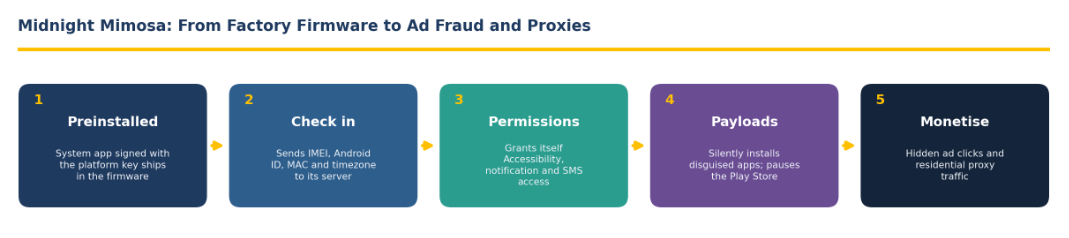
Figure 9. Midnight Mimosa from factory firmware to ad fraud and proxy traffic (after the researchers’ analysis).
| Attribute | Detail |
|---|---|
| Type | Android malware preinstalled in firmware; ad fraud, click fraud and residential proxy |
| Devices | Low cost, multi brand phones on MediaTek platforms; more than 150 countries |
| Core component | Platform signed system app, for example com.android.system.lite |
| Permissions | Accessibility, notification access and SMS |
| Data sent | IMEI, Android ID, MAC address, timezone |
| Operator | Not identified; code lineage reported as related to earlier Android fraud families |
| Removal | Not by normal uninstall or factory reset; needs firmware cleanup or disabling through the Android Debug Bridge |
MITRE ATT&CK techniques
Technique IDs are our own mapping to Mobile ATT&CK from the reported behaviour. Permissions listed show capability, not confirmed use.
| Tactic | ID | Technique | Observed procedure |
|---|---|---|---|
| Initial Access | T1474 | Supply Chain Compromise | Malware included in firmware before sale |
| Defense Evasion | T1629.003 | Impair Defenses: Disable or Modify Tools | Temporarily disables the Google Play Store during installs |
| Discovery | T1426 | System Information Discovery | Sends IMEI, Android ID, MAC address and timezone |
| Privilege and Collection | T1453 | Abuse Accessibility Features | Grants itself Accessibility access |
| Collection | T1517 | Access Notifications | Notification access permission |
| Collection | T1582 | SMS Control | SMS permission |
| Impact | T1643 | Generate Traffic from Victim | Hidden ad impressions and clicks |
| Command and Control | T1604 | Proxy Through Victim | Residential proxy component |
Indicators of compromise
| Indicator | Type | Context |
|---|---|---|
| com.android.system.lite | Package name | Core preinstalled component |
| com.android.sys.prot | Package name | Variant name |
| com.android.sys.gmsprot | Package name | Variant name |
| com.android.sys.bcprot | Package name | Variant name |
| api.weatherlive[.]world | Domain | Reported infrastructure |
| cgb.jingongbuxiao[.]com | Domain | Reported infrastructure |
| 5.ahd187[.]com | Domain | Reported infrastructure |
| cn.kw.lib.dx.DxFactory | Class name | Remote framework loader |
| kwlib.jar and kwlib.next | Filename | Loader and update artifacts |
Recommendations
- Do not allow unbranded or very cheap Android phones for work use, and check mobile device management inventories for the package names above.
- Where a staff phone is a banking or authentication device, require devices that pass platform integrity attestation, and treat SMS one time codes on unmanaged Android phones as weak.
- Tell customers and staff that a factory reset does not remove firmware malware, and that the fix is to replace the phone or have the firmware reinstalled by the maker.
- Block the listed domains and watch for unexpected traffic from mobile networks to unfamiliar domains.
06. Vulnerability Intelligence
Two exploited flaws are covered here. Both reached attackers before defenders had a fix: the Ivanti chain was used as a zero day for at least ten days before the patch, and the Bricksforge flaw was attacked the day before it was disclosed.
| Priority | CVE | Product and severity | Exploitation and fix |
|---|---|---|---|
| 1 Immediate | CVE-2026-104935 | Ivanti Connect Secure, rated high (CVSS 8.6); part of a chain that gives unauthenticated root access | Exploited since at least 3 Oct; CISA KEV 13 Oct, due 16 Oct; fixed in 22.8R2.5, 25.1.1.2, 25.1.3.0, 25.1.3.1; third flaw unpatched |
| 2 Immediate | CVE-2026-85097 | Bricksforge WordPress plugin, CVSS 9.8 or 10.0, unauthenticated file upload and code execution | Exploited from 7 Oct, before disclosure; fixed in 3.1.8.10 and 4.0.0 or later |
CVE-2026-104935: Ivanti Connect Secure Authentication Bypass and Code Execution
An incident response firm found the activity while investigating an incident at a customer it monitors, starting on 5 October. A previously unknown actor it tracks as UTA0576 had taken over a fully patched Ivanti Connect Secure appliance (version 22.8R2.4, then the latest). The attacker chained three zero days. An authentication bypass in welcome.cgi lets a request name a protected script in a header, so the appliance routes it to code that should need a login. A file upload handler in wu.cgi writes an uploaded file before checking it, and a race lets the attacker run the file before it is deleted. A privilege escalation in the dsinvoked service, which trusts a shared configuration store, turns that code execution into root. Ivanti tracks the first two under CVE-2026-104935 and patched them on 13 October. It is still working on a fix for the third. Sensor networks have since logged more than 100 exploitation attempts from about 50 addresses in three countries, a sign that other attackers are now using the public details.
What makes this case hard is the lack of leftovers. UTA0576 deployed no malware and no web shell. It sent every command through the exploit chain itself, patched library code in memory only, restored the configuration store and removed its entries from the debug and audit logs. Ivanti’s Integrity Checker Tool only compares files on disk, so it reports nothing. After getting in, the actor extracted credentials stored on the appliance, queried Active Directory for local administrator passwords (LAPS) and BitLocker recovery keys, captured LDAP traffic from the appliance, ran Kerberos tooling and password spraying, and sent the results out through the same channel. The researchers assess with low confidence that the motive is criminal rather than espionage and with medium confidence that the actor used large language models for exploit development. CISA added the flaw to its catalog on 13 October with a federal deadline of 16 October. Another security firm reports exploitation signs from 1 October.
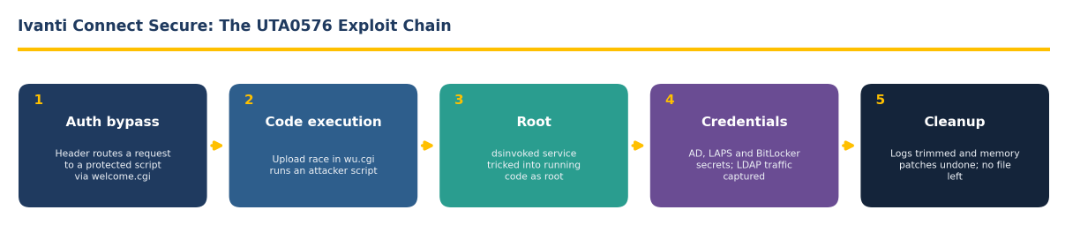
Figure 10. The UTA0576 exploit chain against Ivanti Connect Secure (after the discovering researchers).
| Field | Detail |
|---|---|
| CVE ID | CVE-2026-104935 (authentication bypass and remote code execution); the privilege escalation flaw has no fix yet |
| Affected product | Ivanti Connect Secure VPN appliances |
| Affected versions | 22.8R2.4 and earlier, 25.1.2.2 and earlier, 25.1.1.1 and earlier, as reported; one database lists 22.7R2.13 as affected, and sources differ on exact versions |
| Fixed versions | 22.8R2.5, 25.1.1.2, 25.1.3.0 and 25.1.3.1 |
| Severity | Rated high by the vendor (CVSS 8.6); the chain gives unauthenticated root level code execution |
| Exploitation status | Exploited from at least 3 October (signs from 1 October); CISA KEV, federal deadline 16 October; exploitation attempts from about 50 addresses logged by 14 October |
| Actor | UTA0576, previously unknown; low confidence criminal motive |
| Detection | Ivanti Integrity Checker Tool cannot see it; forensic and network analysis is needed |
Indicators of compromise
| Indicator | Type | Context |
|---|---|---|
| /dana-na/auth/url_default/welcome.cgi | URL path | Exploit entry point; look for many requests |
| X-DSCGI-PATH: /home/webserver/htdocs/dana/fb/smb/wu.cgi | HTTP header | Names a different script than the URL; a mismatch is the signal |
| X-DSCGI-PATH: /home/runtime/tmp/ followed by an MD5 value | HTTP header | Executes the uploaded script during the race |
| /data/.icscap/dsstatmond | File path | Renamed packet capture tool in a hidden directory |
| /data/.icscap/h.py | File path | Script that harvests credentials from captured traffic |
| /tmp/ml.py, /tmp/rq5.py, /tmp/mk.py, /tmp/rr.py | File path | LDAP and Kerberos tools, deleted after use |
| /tmp/sp_run.py, sp_out.txt, spray_hits.json | File path | Password spraying helper and output |
| 108.165.147[.]64 | IPv4 | Host used for the operation; ran an OpenVPN server from 30 Sep to 7 Oct |
The severity label deserves a warning. The vendor rates the patched flaw high, and CISA lists it as an authentication bypass by spoofing. Taken alone that sounds moderate. Combined with the unpatched third flaw it is a root level takeover that evades the vendor’s own checker. Treat it as critical, and note that a clean integrity check is not evidence of a clean appliance.
Recommendations
- Upgrade Connect Secure to 22.8R2.5, 25.1.1.2, 25.1.3.0 or 25.1.3.1 now, and plan for the further fix for the third flaw when Ivanti releases it.
- Hunt before and after patching. Look for requests to welcome.cgi with an X-DSCGI-PATH header that does not match the URL, files in /tmp and /data/.icscap, and lateral movement or odd LDAP and Kerberos activity that starts at the appliance.
- If you cannot rule out compromise, collect memory and disk images and network logs, because the integrity checker will not show it.
- Treat every credential the appliance held as exposed: the Active Directory service account, VPN and LDAP secrets, LAPS passwords and BitLocker recovery keys. Rotate them after the appliance is clean.
- Limit what the appliance’s service account can read in Active Directory, and put the VPN’s management and network position under monitoring.
CVE-2026-85097: Bricksforge WordPress Plugin Arbitrary File Upload
CVE-2026-85097 is an unauthenticated file upload flaw in the Pro Forms module of Bricksforge, an add on for the Bricks site builder for WordPress. It affects versions up to and including 3.1.8.9. The plugin checks a file’s type when it is first uploaded to a temporary folder, but later trusts the file details sent with a form submission. An attacker first obtains a valid nonce from a public AJAX endpoint, uploads a file that is both a valid GIF and PHP code, then submits a form whose url field ends in .php. The server then runs the attacker’s PHP, giving full control of the site without a login.
A WordPress security firm first saw exploitation at 21:47 UTC on 7 October, from 63 source addresses, before the flaw was public. The researcher’s disclosure and the CVE record followed on 8 October. One WordPress security firm scores the flaw 10.0, while another and the CVE record give 9.8, so the severity label depends on the source. The fix is in 3.1.8.10 for the 3.x line and 4.0.0 or later, and 4.0.1 is the current release. One source estimates the plugin is on about 6,000 sites, and another says it is the plugin’s third serious flaw in five weeks. The reach is small, but marketing sites are often built by agencies and rarely monitored, which makes them useful footholds and brand abuse platforms.
| Field | Detail |
|---|---|
| CVE ID | CVE-2026-85097 |
| Affected product | Bricksforge plugin for WordPress (Pro Forms module) |
| Affected versions | Up to and including 3.1.8.9 |
| Fixed versions | 3.1.8.10 (3.x), 4.0.0 and later; 4.0.1 current |
| Severity | Critical; CVSS 10.0 (one security firm), 9.8 (another firm and the CVE record) |
| Vulnerability type | Unauthenticated arbitrary file upload (CWE-434) leading to PHP code execution |
| Exploitation status | Exploited from 7 October 2026, before disclosure; 63 source addresses seen |
| Impact | Full site takeover, web shells, theft of site data and credentials |
Recommendations
- Update Bricksforge to 4.0.1, or 3.1.8.10 at minimum. If you cannot update, disable the plugin or its forms module.
- Check upload and temporary folders for PHP files and GIF or PHP polyglots, and logs for requests to the nonce AJAX endpoint followed by form submissions with a url ending in .php.
- If the plugin was exposed before 8 October, treat the site as compromised: look for web shells and new administrator accounts, and rotate database credentials, secret keys and passwords.
- Ask your agencies and hosting providers which plugins run on sites that carry your brand, and require prompt updates.
Also this week
October Patch Tuesday, on 13 October, fixed one exploited zero day, a Windows Shell mark of the web bypass tracked as CVE-2026-96951, which CISA lists. GitLab released a fix for another maximum severity flaw, CVE-2026-97229, which we have seen reported only at headline level. Chrome 155, covered last week, remains the current browser release.
07. Darkweb and Underground Activity
Xuanye Group and the ASOS claim
On 6 October ASOS customers received a push notification through the retailer’s own app, addressed to its data protection officer and IT team, saying the company’s data had been fully compromised and urging staff to make contact on Telegram. The sender called itself Xuanye Group and claimed to have stolen customer data but not payment details. ASOS later confirmed an employee had been tricked into giving up a login, and said customers first heard about the breach from the criminals. The group is little known, its claims are unverified, and a vendor commentator’s suggestion of a link to a specific data platform flaw is speculation. The platform provider says its own systems were not breached. The method is worth noting: using the victim’s own notification channel puts pressure on a company in front of its customers, and other extortion groups can copy it.
FracturedDB and majestyDB: a claimed leak of Indian defence documents
On or about 14 October a forum user called majestyDB posted a thread headed as a leak of confidential design and technical data for the Smart Anti Airfield Weapon (SAAW), a glide weapon developed by India’s defence research organization. The same text appeared on a Telegram channel called FracturedDB, which had 324 subscribers when captured, with a 3.7 MB PDF named SAAW_DRDO_06_2026. The post lists categories of content only: variants, specifications, configurations, connector details, avionics diagrams, target data, functions, mission planning and a launch and emergency release sequence. It names no price, and the download is offered free. The forum rank shown next to the name, Citizen, is a membership level and says nothing about credibility.
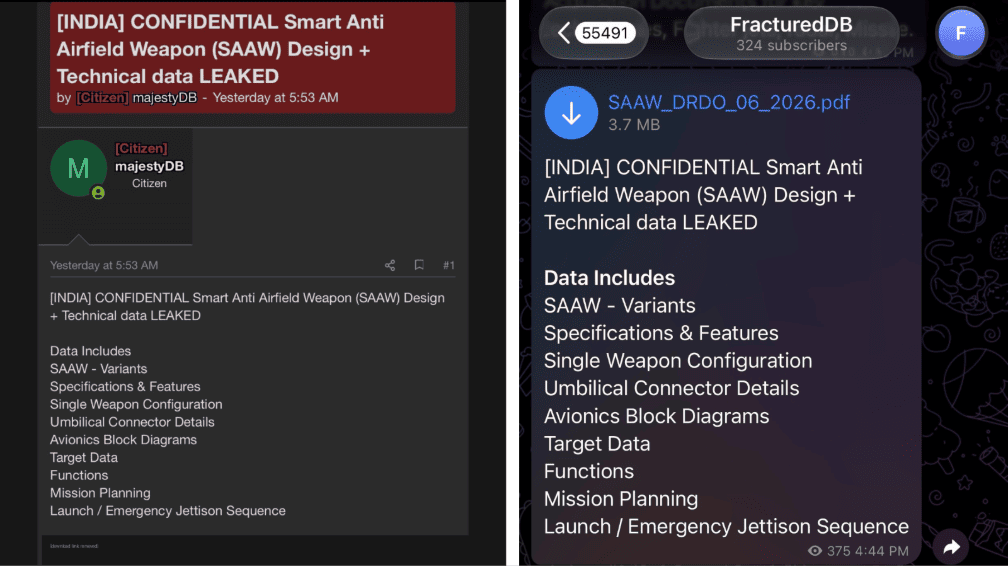
Figure 11. The forum thread (left, download link removed) and the Telegram channel post (right) claiming a leak of defence design data. Both are claims, not verified material.
We cannot verify any of it and have not opened the file. Three points argue for caution. First, the same organization has been the subject of earlier claims: a ransomware group said in March 2025 that it held 20 terabytes, which analysts traced to older material, and in July 2026 a seller offered 31 GB for $8,000 on another forum, with sample documents reportedly dated 2020 and the organization saying only that it was verifying the report. Second, a 3.7 MB file is small for design and technical data on a weapon, and the 06_2026 in its name may point to a June 2026 date, which does not match the 2020 samples from July, so the file may be a compilation or recycled material. Third, the timing follows the 23 September 2026 contract for 160 satellite guided versions of the weapon, so the posts may be seeking attention and not offering new material. We found no official statement about the October posts.
The practical risk for most organizations is not the data but the lure. A PDF distributed through a Telegram channel and presented as leaked military documents is a plausible delivery route for malware aimed at defence suppliers, researchers, journalists and anyone curious. Do not download or open it, and treat any message offering it as suspicious. Suppliers to the Indian defence sector should check their own exposure through official channels and not through the leak.
Recommendations
- Do not download or open files offered through the forum or channel, and block the channel links on corporate devices where policy allows.
- Warn staff in defence related and media roles that leaked document lures are a common way to deliver malware.
- If you supply the Indian defence sector, confirm with your customer and your own logs whether any of your documents could be involved, and report through the official channel.
- Treat unverified leak claims as leads. Record the claim, check whether the sample matches known older leaks, and wait for an official statement before acting.
Law enforcement
A Canadian ransomware negotiator was arrested in the United States on 8 October on extortion charges. On 9 October the FBI director announced the arrest of another suspected co conspirator of the ShinyHunters group, which the bureau holds responsible for the September breach of its jobs portal, and said the incident occurred on a platform managed by a third party vendor. Reports identify the arrested person as the negotiator, but no public court record yet names the group or the breach. It is the third arrest linked to the group in recent weeks, after one in the Netherlands in mid September and one in Jordan. The case puts the ransomware negotiation industry under scrutiny, because the suspect’s job was to sit between victims and the people extorting them.
Germany took a suspected core member of the Qilin ransomware group into custody after Japan extradited him on 2 October. No infrastructure takedown was announced, and Qilin has kept posting victims. Arrests do not remove capability. The techniques are public, the groups recruit replacements, and the same playbooks, such as help desk impersonation, are used by new crews. The more useful signal for defenders is the steady flow of leak site claims, such as the MAJIN and Gentlemen listings covered above, which are cheap for criminals to post and expensive for organizations to disprove.
08. Key Takeaways
- Check credentials before you check exploits. Eight of the 19 incidents have a stated cause, and three of those began with a stolen, leaked or socially engineered login. Remove leavers, block weak passwords and require multifactor authentication, for suppliers as much as staff.
- A supplier’s account is your account. Denmark’s register lost 8.8 million records through a small company’s administrator login, ASOS was reached through a third party platform, Daiwa Securities lost client data through a contractor’s server and French stores lost stock through controllers their maintenance firms manage. Know who can reach your data, and watch their volume.
- Edge appliances can be taken over without a trace. The Ivanti chain leaves no file for the vendor’s checker to find. Patch now, hunt for requests that do not match, and rotate every secret the appliance held.
- Fix what has a fix. A patch for the refrigeration controllers reportedly existed from September, and the Bricksforge flaw was attacked before anyone could patch. Update WordPress plugins, and ask agencies what runs on your brand’s sites.
- Help desks are an identity control. Scattered Spider’s playbook, now widely copied, works because a caller can talk their way past a script. Use callbacks, manager approval and managed devices for MFA changes.
- Trust hardware and firmware less than you do. Ledger devices from one reseller carried an implant, and budget Android phones ship with Midnight Mimosa. Buy from the maker, and do not use unbranded phones for banking or authentication.
- Test recovery. MAJIN removes shadow copies, boot recovery settings and the NTFS journal, and a Japanese cloud provider’s customers are learning that only their own backups count.
- Keep claims separate from evidence. The Xuanye, MAJIN, Gentlemen and INC listings, the claimed defence data leak, and any link between The Com and a given attack, are claims until corroborated.
Priority actions this week
| Priority | Action | Why now |
|---|---|---|
| Immediate | Upgrade Ivanti Connect Secure to 22.8R2.5, 25.1.1.2, 25.1.3.0 or 25.1.3.1; hunt for compromise and rotate every credential the appliance held | CVE-2026-104935 is exploited, on CISA KEV with a 16 October deadline, other attackers are now trying it, and the chain is only partly patched |
| Immediate | Update the Bricksforge WordPress plugin to 4.0.1, or 3.1.8.10 at minimum, and check upload folders for PHP files | CVE-2026-85097 was exploited a day before disclosure |
| Immediate | Inventory remotely managed devices and controllers, remove direct internet access and apply or replace unsupported firmware | Refrigeration controllers were hijacked at hundreds of French stores |
| This week | Enforce multifactor authentication, block common passwords and remove leavers on supplier and staff accounts that reach customer or identity data | A password reportedly set to 123456 opened a national register |
| This week | Add callbacks, manager approval and managed device rules to help desk password and MFA resets | ASOS and the Scattered Spider playbook both rely on impersonating a trusted contact |
| This week | Check mobile device inventories for the Midnight Mimosa package names and restrict unbranded Android phones | Firmware malware survives a factory reset |
| This week | Verify offline backups and alert on shadow copy, boot setting, USN journal and event log tampering | MAJIN removes all of them before it encrypts |
| For custody clients | Buy hardware wallets from the manufacturer only, and move funds from any device sold through the affected reseller to a new recovery phrase | At least $86 million was stolen through implants |
Disclaimer
This Report is provided for informational and security-awareness purposes only. The information presented is based on intelligence collected from publicly available sources, underground forums, dark web sources, third-party feeds, and other available data at the time of analysis.
Threat intelligence may be incomplete, outdated, unverified, or subject to change. References to threat actors, organizations, vulnerabilities, indicators, or incidents represent observed or reported information and should not be considered definitive attribution unless explicitly stated and supported by reliable evidence.
The information contained in this report should be independently validated before being used for security, operational, legal, or business decisions. iZOOlogic does not guarantee the accuracy, completeness, or timeliness of the information and shall not be held responsible for any actions or decisions taken solely based on this report.
This report is intended for authorized recipients and should be handled in accordance with applicable organizational security, confidentiality, and information-sharing policies.
