
 HQ/EMEAFind out how we can help your business

Executive Summary
What if anyone standing a few meters away could connect to an electric vehicle’s battery over Bluetooth without pairing, authentication, or encryption and issue commands that disable its power, modify its safety limits, or permanently change how its battery protection works?
Our analysis of the BAT-BMS Android application (com.bms.grenergy), published by Shenzhen Grenergy Technology Co., Ltd., identified a series of critical design weaknesses in its Bluetooth Low Energy (BLE) implementation. The application acts as a companion app for lithium Battery Management Systems (BMS) based on the widely cloned Jiabaida (JBD) / XiaoXiang protocol, a platform commonly found in low-cost e-rickshaws, e-bikes, and other light electric vehicles.
The application also contains multiple hardcoded secrets, including a factory unlock value (56 78), a default administrative password (123456), and a master password-clear backdoor (J1B2D4). If the underlying firmware accepts these commands, an attacker within typical Bluetooth range (approximately 10–30 meters) could potentially disable battery protection mechanisms, cut power to a moving vehicle, or manipulate voltage, current, and temperature calibration values. Since these configuration changes are written to non-volatile memory, they would persist even after the battery is powered off.
Even more concerning, every analysed device appears to expose identical Bluetooth identifiers and identical hardcoded credentials, meaning a single attack script could potentially target an entire fleet without customization.
While static analysis alone cannot confirm physical outcomes such as battery ignition or thermal runaway, weakening or disabling core battery protection mechanisms significantly increases the risk of unsafe operating conditions.
This report examines how these weaknesses were discovered, why they matter beyond a single application, and what they reveal about the broader security posture of Bluetooth-enabled Battery Management Systems deployed across today’s light electric vehicle ecosystem.
Key Findings
- Unauthenticated Bluetooth Communication – The application establishes BLE sessions without requiring pairing, encryption, or mutual authentication, allowing nearby devices to communicate directly with the BMS.
- Plaintext Safety-Critical Commands – All operational commands, including MOSFET switching and configuration updates, are transmitted as plaintext GATT write requests protected only by a non-cryptographic additive checksum.
- Hardcoded Factory Unlock Mechanism – The application contains a static factory-mode unlock sequence (56 78) that enables privileged configuration operations without user-specific authentication.
- Embedded Default Credentials and Backdoor Secrets – Static analysis identified a default password (123456) together with a hardcoded master password-clear sequence (J1B2D4), significantly weakening access control.
- Remote MOSFET Control – Safety-critical charge and discharge MOSFET switching commands are accessible through the BLE interface, potentially allowing interruption of vehicle propulsion if accepted by the target firmware.
- Modification of Battery Protection Parameters – Configuration interfaces permit modification of over-voltage, over-current, temperature, and hardware protection thresholds that are intended to safeguard lithium battery operation.
- Sensor Calibration Manipulation – Voltage, current, and temperature calibration parameters can be modified, potentially causing the Battery Management System to misinterpret actual operating conditions.
- Persistent Configuration Storage – Safety-related configuration changes target non-volatile EEPROM/Flash memory, allowing malicious modifications to survive reboot and power cycling.
- Fleet-Wide Exposure – Shared Bluetooth UUIDs, identical protocol implementation, and common hardcoded credentials enable the same attack methodology to scale across large numbers of compatible JBD/XiaoXiang-based battery systems.
Introduction
This research began from public reports that a Bluetooth BMS application could remotely stop electric rickshaws, and set out to determine the technical root cause. The subject is the decompiled APK of BAT-BMS (com.bms.grenergy). The methodology is purely static: the application was decompiled with JADX, every command-building class and the BLE transport layer were read by hand, each dangerous command was traced to the UI action that triggers it (to confirm reachability rather than dead code), and hardcoded byte frames were decoded to recover embedded ASCII secrets. No live device was attacked. The remainder of this report identifies the target, reconstructs the protocol, models the threat, and documents nine findings (V1–V9) with verbatim code evidence, followed by standardized vulnerability classification, remediation, and coordinated-disclosure guidance.
Research Objectives
This research was conducted to answer the following questions:
- Can publicly reported Bluetooth attacks against BAT-BMS be technically validated?
- How does the BAT-BMS application communicate with the Battery Management System?
- Are security controls such as authentication, encryption, or authorization implemented?
- Which safety-critical functions are remotely accessible?
- Could protocol weaknesses create physical safety risks?
- What mitigations should manufacturers implement?
Research Trigger & Public Reports
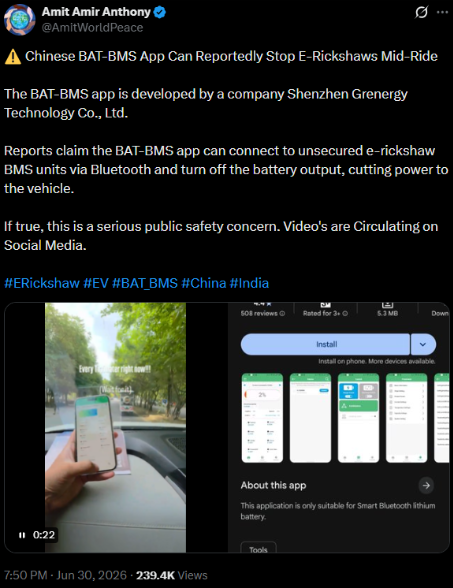
Publicly circulated reports and videos suggested that the BAT-BMS Android application could remotely interrupt electric rickshaw operation by issuing Bluetooth Low Energy (BLE) commands to the Battery Management System (BMS). These reports raised concerns regarding the absence of authentication controls protecting safety-critical battery management functions and prompted a technical investigation into the application’s communication architecture.
To assess the technical validity of these claims, the BAT-BMS Android application (package com.bms.grenergy) was statically reverse engineered using JADX. The analysis focused on reconstructing the proprietary BLE protocol, identifying authentication and authorization mechanisms, tracing command execution paths, and determining whether safety-critical battery management operations were exposed through the Bluetooth interface.
The findings presented in this report are derived exclusively from reverse engineering and static code analysis. Publicly available videos and social media discussions served only as the catalyst for the investigation and are not treated as technical evidence supporting the conclusions.
Target Identification & Attribution
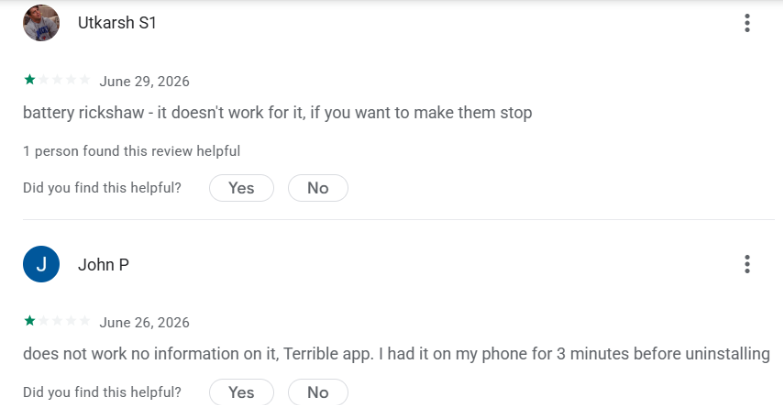
The application’s own Play Store listing identifies it as “BAT-BMS,” published by Shenzhen Grenergy Technology Co., Ltd., with 100K+ downloads confirming this decompiled package is the same app named in public reports. The in-app “about” strings and developer contact tie the hardware lineage to Dongguan Jiabaida (JBD), whose boards target e-bikes, e-rickshaws, wheelchairs, and light EVs. Two representative field reviews including one explicitly referencing a “battery rickshaw… if you want to make them stop” corroborate both the deployment context and the reported abuse.



System & Protocol Architecture
BMS Hardware / Firmware Architecture
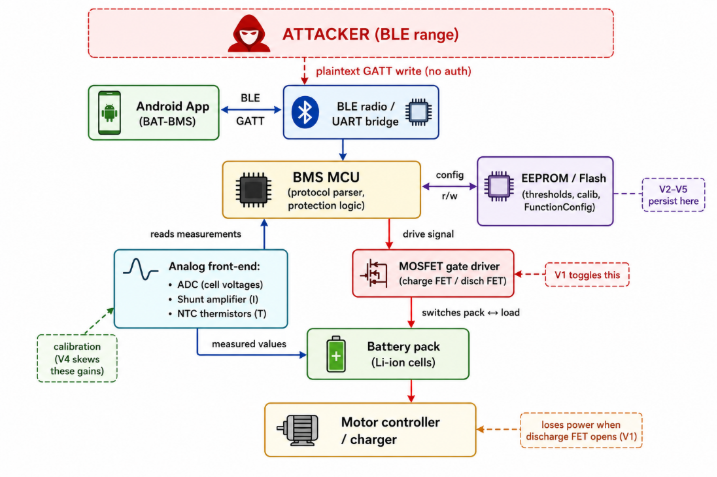
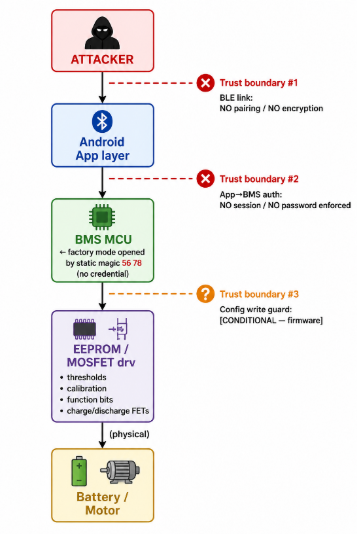
A BMS is the only safety authority between a lithium pack and the vehicle. It connects or disconnects the pack from the load (discharge MOSFET) and charger (charge MOSFET), enforces over-voltage/over-current/over-temperature limits, and measures cell voltage, current, and temperature through an analog front-end (ADC, shunt amplifier, NTC thermistors). Thresholds, calibration, and function bits live in EEPROM/Flash. The architecture below shows why a Bluetooth write can have a physical consequence: the protocol exposes the EEPROM configuration and the MOSFET driver to the same unauthenticated channel the attacker reaches.
Command Frame Format
Every command is a byte frame of the form DD | mode | cmd | len | content | checksum(2) | 77, where mode is 0x5A (write) or 0xA5 (read). The client’s frame builder constructs exactly this structure, confirming the start byte 0xDD, the mode/command/length header, the two-byte checksum, and the 0x77 terminator.

GATT Service & Characteristics
The app targets a single service, 0000ff00, with a notify characteristic (0000ff01) for responses and a write characteristic (0000ff02) for commands. These UUIDs are hardcoded and identical on every unit, which is what makes fleet-wide, one-to-many targeting possible.

Integrity Check an Additive Checksum, not Security
The only integrity mechanism is a 16-bit negated additive sum. It contains no key, nonce, or MAC, so any attacker recomputes it trivially; captured frames replay and forged frames are accepted. Even upgrading to a CRC would add no security, because a CRC is a public error-detection code only a keyed MAC over a monotonic counter would provide authenticity and replay protection.

Threat Model & Attacker Precondition
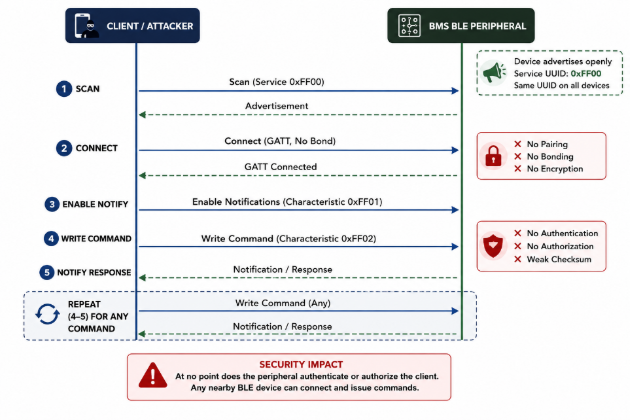
The attacker needs only a phone or laptop with a standard BLE radio, within ~10–30 m of the target no pairing, credentials, or prior access. The precondition is exactly the startup sequence the legitimate app performs: scan for the fixed service UUID, connect without bonding, enable notifications, and begin writing commands. No authentication handshake exists between connecting and issuing control commands.
Discovery (Scan for the Fixed Service UUID)

Connection (No Bonding / No Encryption)

Post-Connect: Notifications and Immediate Transaction

BLE Session Flow
Trust Boundaries
BLE Stack & Firmware-Interface Details
Android Bluetooth Permission Model
The manifest declares the legacy BLUETOOTH/BLUETOOTH_ADMIN permissions (capped at API 30) alongside the Android 12+ runtime permissions
BLUETOOTH_SCAN/CONNECT/ADVERTISE. Notably it also requests ACCESS_FINE_LOCATION even though BLUETOOTH_SCAN carries neverForLocation, and it requests BLUETOOTH_ADVERTISE despite acting as a central both are over-provisioned. None of these protect the peripheral; an attacker tool needs only the standard scan/connect permissions.

MTU Negotiation
The app never calls setMtu(), so the link uses the default 23-byte ATT MTU (20 usable bytes). Command frames fit one packet; longer responses fragment across multiple notifications, which is why the client implements reassembly. The library even warns when payloads exceed 20 bytes.


Notification Reassembly & Timing
The response handler reassembles fragmented notifications, detects frame start (0xDD / 0xFF), validates the declared length, and only then verifies the additive checksum. Because frames carry no sequence number and the client auto-retransmits, duplicate/replayed frames are indistinguishable from legitimate retries reinforcing the replay exposure.

Analysis
V1 – Instant Drivetrain Kill (Discharge MOSFET OFF)
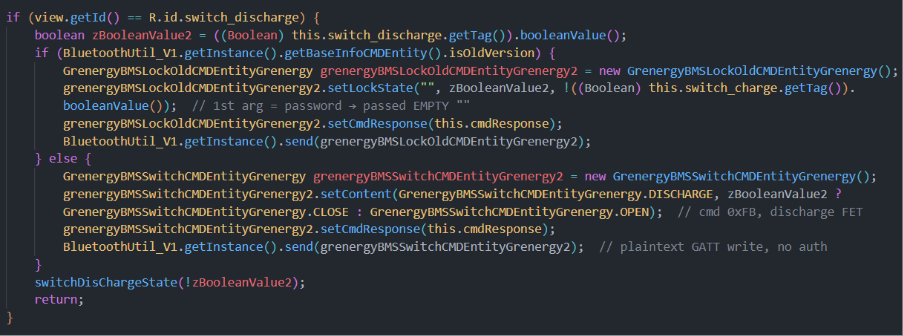
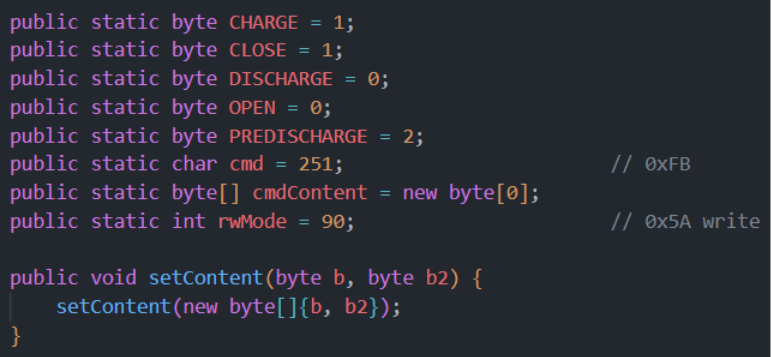
The discharge MOSFET sits in series with the motor controller. The “Discharge” toggle sends switch command 0xFB with the DISCHARGE flag over the unauthenticated channel; on legacy firmware the password argument is passed as an empty string and is ignored entirely. The command entity defines the CHARGE/DISCHARGE and OPEN/CLOSE constants and the 0xFB opcode.
If the firmware acts on the command over an unbonded link, opening the discharge FET removes drive power on a moving e-rickshaw a sudden loss of propulsion, repeatable at will. This matches the publicly reported behaviour but should be bench-confirmed.
V2 – Disabling Protection Functions & the Audible Alarm
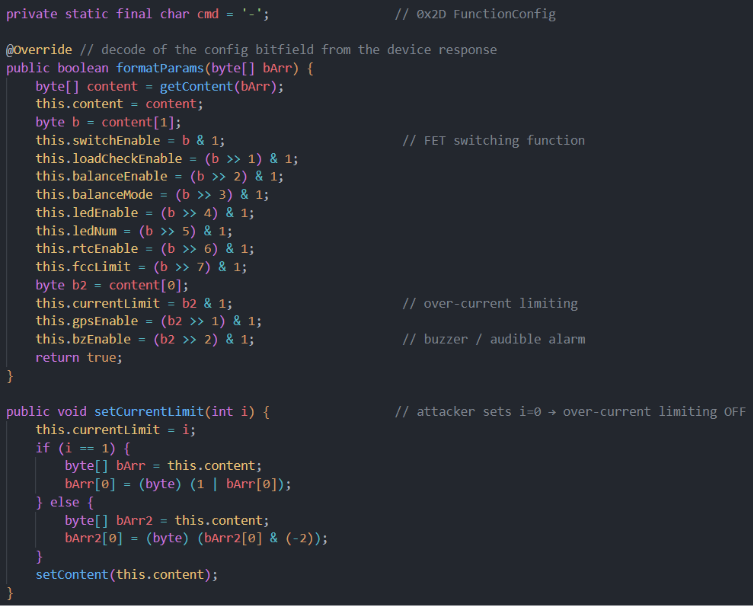
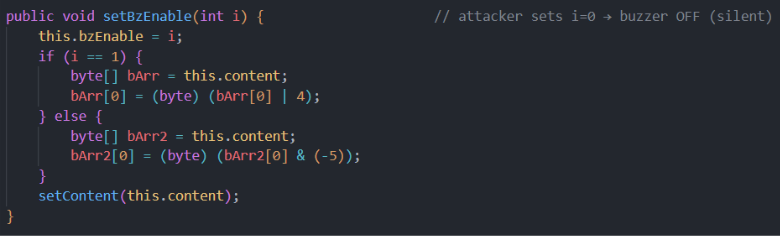
FunctionConfig (command 0x2D) is a bitfield controlling whole safety features. The client decodes the bitfield and exposes mutators that clear individual bits including over-current limiting and the buzzer and write the configuration back.
If the firmware applies the modified configuration, over-current limiting and the FET-switch protection would be disabled and the buzzer silenced, allowing the pack to be pushed toward an unsafe state with no audible warning. Being a configuration write, the change would persist.
V3 – Overwriting Hardware-Layer Protection Thresholds
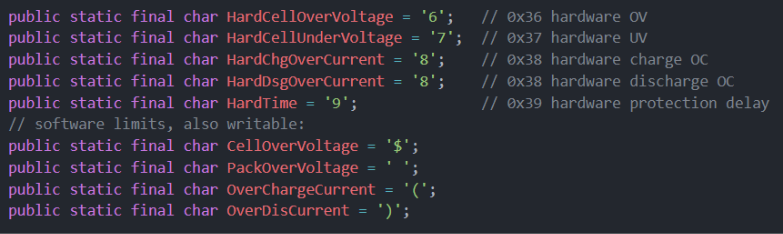
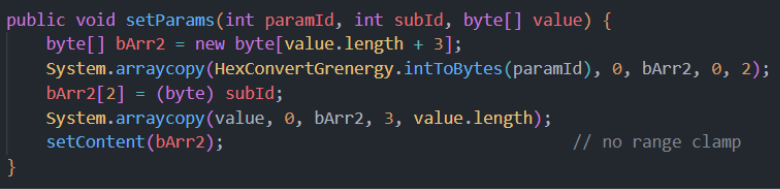
Beyond firmware limits, the protocol exposes the secondary hardware protection thresholds (HardCellOverVoltage, HardChg/DsgOverCurrent, HardTime) as ordinary writable parameters, written through a generic parameter command (0xFA) that performs no range clamping.
If accepted, raising the hardware over-voltage/over-current thresholds or extending HardTime would remove the analog last-ditch defense that exists to prevent a fire when firmware protection fails; combined with V2 this could neutralize both protection layers, creating conditions that may significantly increase the likelihood of sustained overcharge/over-current.
V4 – Corrupting Sensor Calibration (Blinding the BMS)
The calibration/gain values for voltage, current, and temperature sensing (VoltageAdjust, Current*Adjust, TempAdjust, SenseResistor) are defined and are read/written through the same unauthenticated 0xFA parameter channel.
If skewed calibration is accepted, the BMS would under-read true voltage/current and could believe the pack is nominal while it is actually over-voltage/over-current so its protections may not trip. The app UI would still show healthy values. This is the most insidious variant: a persistent, latent hazard that may significantly increase the likelihood of a later overcharge during ordinary charging.


V5 – Temperature-Protection Tampering
Over-temperature thresholds (ChgOverTemp/DisOverTemp) and the temperature-calibration value are writable through the parameter channel, and the temperature value builder applies no range clamp.
If accepted, raising the over-temperature thresholds or skewing TempAdjust so the pack always reads “cold” would disable thermal cut-off. A pack charging in hot ambient (typical for parked e-rickshaws) with no over-temperature intervention and (per V2) no buzzer would face conditions that may significantly increase the likelihood of thermal runaway.


V6 – Remote Shutdown / Stranding
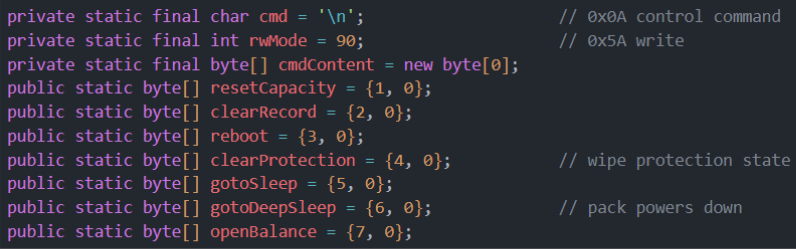
The control command (0x0A) selects an action via a body byte: reboot {3,0}, sleep {5,0}, deep-sleep {6,0}, clear-protection {4,0}, reset-capacity {1,0}. These are unauthenticated writes.
If accepted, an attacker sweeping a parking area or intersection could deep-sleep every pack in range, stranding a fleet simultaneously a denial-of-service with direct economic harm to drivers.
V7 – Unauthenticated Factory Mode (magic 56 78)
Configuration writes require “factory mode,” which is entered with a static magic value 56 78 no credential. The client wraps parameter writes in a factory-mode → write → close-factory-mode sequence.
Because 56 78 is a fixed value requiring no authentication, factory mode is not a protection it is merely the enabling step for the persistent-sabotage writes in V3–V5.


V8 – Hardcoded Backdoor & Default Credentials
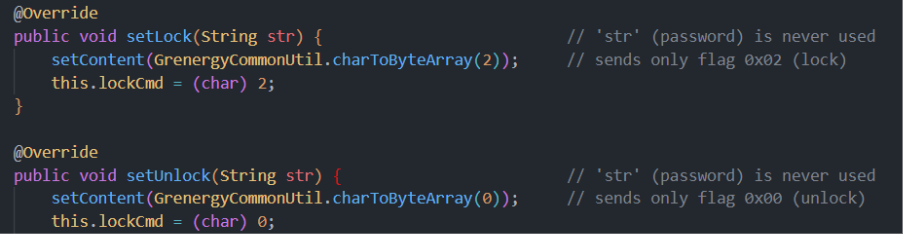
The app ships secrets that bypass the password entirely. The clear-password command carries a fixed payload decoding to ASCII “J1B2D4” (a master password-clear backdoor), the same value also appears pre-built as a full frame, and the password-check baseline embeds ASCII “123456.” On legacy firmware the lock/unlock command ignores the password argument outright.
Reversing the APK therefore yields working credentials for every device on the platform, and the “password” feature provides no meaningful protection.



V9 – Persistence & Fleet-Scale Uniformity
Two properties turn individual bugs into a systemic public-safety problem:
- Persistence. V2–V5 write to the BMS’s non-volatile configuration (thresholds, calibration, function bits) inside factory mode. Unlike the transient FET toggle in V1, these survive power cycles. An attacker can sabotage a parked vehicle and walk away; the pack becomes a time-bomb that detonates during a later ordinary charge/ride, with no attacker present and nothing obviously wrong in the app.
- Uniformity / scale. Every unit uses the same service UUID, the same frame format, the same factory magic (56 78), and the same default/backdoor secrets (123456 / J1B2D4). There is no per-device key. One script therefore works against all vehicles running this or any sibling JBD reskin compromising one teaches you how to compromise every one.
Root Cause Analysis
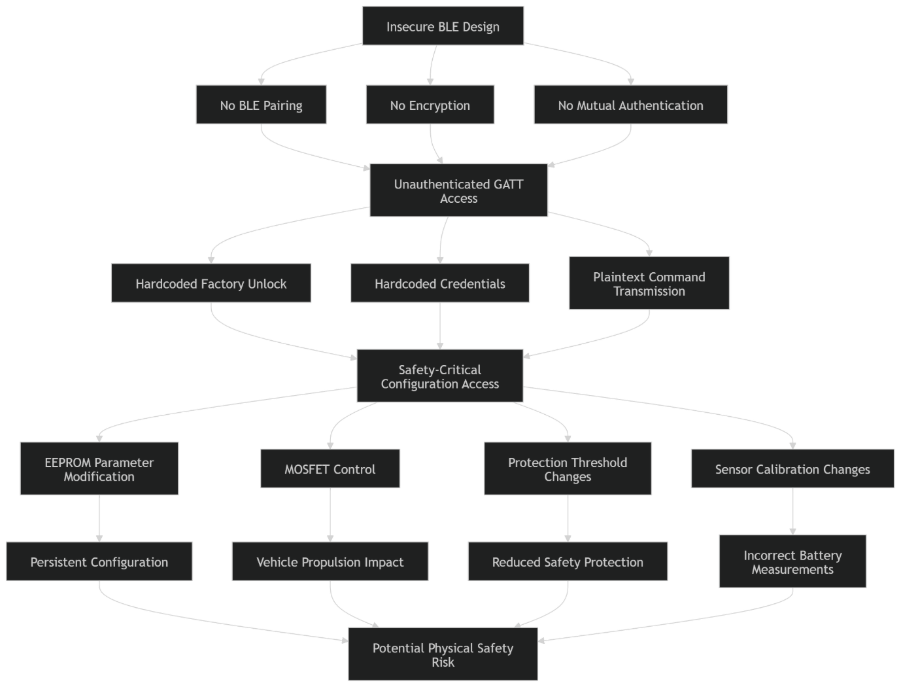
The identified vulnerabilities originate from multiple insecure architectural decisions rather than a single implementation flaw. The absence of authentication and cryptographic protection allows Bluetooth communication to directly influence safety-critical battery management functions.
Rather than enforcing layered security controls, the application implicitly trusts any Bluetooth device capable of establishing a connection. Safety-critical operations including EEPROM configuration writes, factory-mode activation, and MOSFET switching are exposed through the same communication channel without validating device identity, establishing encrypted sessions, or enforcing command authorization. The combination of hardcoded credentials, unauthenticated BLE communication, and unrestricted parameter modification creates a chain of weaknesses that ultimately exposes battery protection logic to unauthorized control.
Threat Scenarios
The identified weaknesses enable multiple realistic attack scenarios that require only Bluetooth proximity to a vulnerable Battery Management System. Although the final physical outcome depends on firmware behavior and hardware validation, the client application demonstrably constructs and transmits all required command sequences.
Scenario 1 – Remote Vehicle Stoppage
An attacker positioned near a moving electric rickshaw or parked vehicle scans for publicly advertised BAT-BMS Bluetooth services. After establishing an unauthenticated BLE connection, the attacker transmits the discharge MOSFET control command. If accepted by the target firmware, the Battery Management System disconnects battery output from the motor controller, resulting in an immediate loss of propulsion. Such an event could create a significant public safety hazard, particularly in dense urban traffic.

Scenario 2 – Fleet-Wide Denial of Service
Because compatible Battery Management Systems reuse identical Bluetooth UUIDs, protocol implementations, and factory credentials, a single attack workflow can be repeated across multiple vehicles within radio range. An attacker operating in a parking area, charging station, or fleet depot could sequentially connect to numerous vehicles and issue sleep or shutdown commands, causing widespread operational disruption.

Scenario 3 – Persistent Configuration Sabotage
Rather than immediately disrupting vehicle operation, an attacker may modify battery protection thresholds or sensor calibration values stored in non-volatile memory. These changes persist after Bluetooth disconnection and across power cycles. Drivers may continue operating the vehicle without any visible indication that battery protection mechanisms have been altered, increasing long-term operational risk.

Security Architecture Weakness
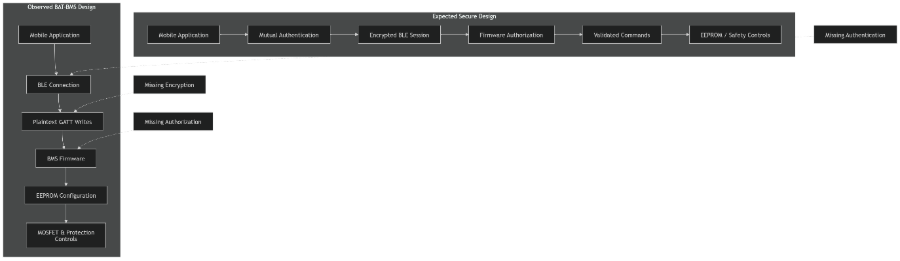
The BAT-BMS communication architecture lacks multiple security controls that are generally expected in safety-critical wireless systems. Rather than authenticating the connecting device and establishing an encrypted communication channel before permitting configuration operations, the application directly exposes command interfaces to any Bluetooth device within radio range. This architecture significantly reduces the effort required for unauthorized interaction with battery management functionality.
Real-World Impact Assessment
| Dimension | Assessment |
|---|---|
| Safety Impact |
Firmware acceptance of the identified commands could interrupt vehicle propulsion and weaken battery protection mechanisms, increasing operational risk. |
| Attack Complexity | Low. A commodity smartphone with BLE capability is sufficient. |
| Attack Range | Approximately 10–30 meters, depending on Bluetooth signal conditions. |
| Required Privileges | None. No pairing, authentication, or credentials are required. |
| Persistence | Configuration changes stored in EEPROM may survive reboot and power cycling. |
| Scalability | High. Shared UUIDs, protocol implementation, and hardcoded secrets enable attacks against multiple compatible devices. |
| Economic Impact | Fleet disruption may affect transportation services and driver revenue. |
| Detection Difficulty | High. Calibration manipulation and configuration changes may not produce immediately visible indicators. |
Vulnerability Summary
| ID | Vulnerability | CWE | Estimated CVSS | Severity | Primary Impact |
|---|---|---|---|---|---|
| V1 | Unauthenticated Discharge MOSFET Control | CWE-306 | 9.3 | Critical | Remote interruption of vehicle propulsion |
| V2 | Protection Function Manipulation | CWE-284 | 9.4 | Critical | Safety mechanisms can be disabled |
| V3 | Hardware Protection Threshold Modification | CWE-20 | 9.8 | Critical | Removal of hardware safety limits |
| V4 | Sensor Calibration Manipulation | CWE-693 | 9.8 | Critical | Incorrect voltage, current and temperature measurements |
| V5 | Temperature Protection Tampering | CWE-693 | 9.8 | Critical | Increased thermal safety risk |
| V6 | Remote Sleep / Shutdown Commands | CWE-306 | 8.8 | High | Fleet-wide denial of service |
| V7 | Unauthenticated Factory Mode Activation | CWE-798 | 9.8 | Critical | Privileged configuration access |
| V8 | Hardcoded Credentials and Backdoor Secrets | CWE-798 | 9.8 | Critical | Authentication bypass |
| V9 | Persistent Configuration Sabotage | CWE-668 | 9.1 | Critical | Long-term compromise of battery safety configuration |
MITRE ATT&CK Mapping
| ATT&CK Tactic | Technique | Relevance |
|---|---|---|
| Initial Access |
T1200 – Hardware Additions / T1091 – Replication Through Removable Media (Proximity Access Context) |
Bluetooth proximity to target device |
| Execution | T1071 – Application Layer Protocol | Proprietary BLE GATT command transmission |
| Credential Access | T1552.001 – Credentials in Files | Embedded default credentials and factory secrets |
| Defense Evasion | ATT&CK-ICS T0836 – Impair Defenses | Disabling battery protection mechanisms |
| Persistence | ATT&CK-ICS T0889 – Modify Program | Persistent EEPROM configuration changes |
| Impact | ATT&CK-ICS T0880 – Loss of Safety | Vehicle propulsion interruption and safety degradation |
CWE Mapping
| CWE | Name | Applies to |
|---|---|---|
| CWE-306 | Missing Authentication for Critical Function | Control/config/FET commands (V1, V6, V7) |
| CWE-798 | Use of Hard-coded Credentials | J1B2D4 backdoor, 123456 default (V8) |
| CWE-259 | Use of Hard-coded Password | Default PIN 123456 (V8) |
| CWE-1392 | Use of Default Credentials | Shipped default PIN (V8) |
| CWE-287 | Improper Authentication | Empty/ignored password (V1, V8) |
| CWE-294 | Authentication Bypass by Capture-Replay | Forgeable checksum, no nonce |
| CWE-319 | Cleartext Transmission of Sensitive Information | Unencrypted GATT writes; cleartext passwords |
| CWE-330 | Use of Insufficiently Random Values | Static factory magic / static secrets |
| CWE-602 | Client-Side Enforcement of Server-Side Security | “Factory mode”/password enforced only in app |
iZOOlogic recommendation on “Operation BlueShock”
A security assessment of the android application “BAT-BMS” identified multiple critical vulnerabilities affecting Bluetooth-enabled Battery Management Systems (BMS) based on the Jiabaida (JBD)/XiaoXiang platform. The identified weaknesses include unauthenticated Bluetooth communication, hardcoded credentials, unrestricted access to safety-critical functions, and insecure configuration mechanisms, which may allow nearby attackers to issue unauthorized commands, modify battery protection settings, or disrupt vehicle operation.
For Detailed Technical Analysis: https://izoologic.com/threat-advisory/operation-blueshock-unauthenticated-bluetooth-control-of-ev-battery-management-systems/
Android Application Details:
Name: BAT-BMS
Package ID: com.bms.grenergy
Published By: SHENZHEN GRENERGY TECHNOLOGY CO.LTD.
Downloads: 100K+
Email: [email protected]
Link: https://play.google.com/store/apps/details?id=com.bms.grenergy&hl=en
Developer Name: Qinguo Han
Developer Email: [email protected]
Developer Country: China
Recommendations for the BMS Manufacturers
- Implement Strong Authentication and Authorization: Require authentication between the mobile application and the Battery Management System (BMS) before permitting any safety-critical operation. Privileged functions should only be accessible to authenticated and authorized users.
- Secure Bluetooth Communications: Protect all Bluetooth communications using secure pairing, encrypted sessions, and industry-standard cryptographic mechanisms to prevent unauthorized access, command injection, replay attacks, and interception of sensitive communications.
- Eliminate Hardcoded Credentials and Backdoors: Remove all default passwords, factory unlock values, hardcoded credentials, undocumented maintenance mechanisms, and embedded secrets from both the mobile application and firmware.
- Implement Unique Device Identity: Provision each Battery Management System with a unique cryptographic identity during manufacturing to eliminate shared authentication material and prevent fleet-wide compromise.
- Restrict Access to Safety-Critical Functions: Prevent modification of battery protection thresholds, calibration parameters, EEPROM configurations, and MOSFET control functions unless performed through authenticated and authorized maintenance procedures.
- Validate and Protect Safety Parameters: Implement firmware-level validation of all configuration parameters and reject unauthorized, malformed, or unsafe values regardless of the requesting client application.
- Secure the Firmware Lifecycle: Implement secure boot, digitally signed firmware updates, production lock mechanisms, and protected debugging interfaces to maintain firmware integrity throughout the product lifecycle.
- Maintain Security Audit Logs: Record authentication attempts, privileged operations, configuration changes, firmware updates, and other security-relevant events to support forensic investigations, incident response, and regulatory compliance.
- Conduct Regular Security Assessments: Perform periodic secure code reviews, firmware security assessments, Bluetooth penetration testing, and independent third-party security audits throughout the product lifecycle.
- Adopt Security-by-Design Principles: Integrate cybersecurity considerations throughout the design, development, testing, deployment, and maintenance lifecycle of Battery Management Systems by following recognized secure development practices and industry standards.
Recommendations for National Cybersecurity and Transport Authorities:
- Coordinate Responsible Vulnerability Disclosure: Facilitate coordinated vulnerability disclosure between CERT-In, the affected application developer, Battery Management System manufacturers, electric vehicle manufacturers, importers, and other relevant stakeholders to ensure timely remediation, validation, and secure deployment of firmware and application updates.
- Issue National Security Advisories: Publish coordinated security advisories to inform electric vehicle manufacturers, battery suppliers, fleet operators, charging infrastructure providers, and vehicle owners regarding the identified security risks and recommended mitigation measures.
- Conduct a Nationwide Risk Assessment: Assess the deployment of affected Battery Management Systems across the electric mobility ecosystem to determine the potential impact on public safety, transportation services, and critical infrastructure.
- Strengthen Cybersecurity Requirements: Develop and enforce minimum cybersecurity requirements for Bluetooth-enabled Battery Management Systems, including secure authentication, encrypted communications, secure firmware updates, vulnerability management, and secure-by-design principles.
- Develop Sector-Specific Incident Response Guidelines: Establish standardized incident response procedures for cybersecurity incidents involving Battery Management Systems, connected electric vehicles, and other wireless automotive technologies to support coordinated investigation, containment, recovery, and reporting.
- Engage Industry Stakeholders: Collaborate with electric vehicle manufacturers, battery suppliers, importers, fleet operators, and standards bodies to promote the adoption of secure-by-design principles, secure Bluetooth implementations, and regular cybersecurity assessments for safety-critical automotive systems.
Immediate Recommendations for Electric Vehicle Owners
- Update firmware and mobile application updates only from the official vehicle or Battery Management System manufacturer as soon as security updates become available.
- Disable Bluetooth connectivity of the Battery Management System whenever it is not required for monitoring or maintenance, where supported by the manufacturer.
- Immediately report unexplained vehicle shutdowns, abnormal battery behaviour, or suspected unauthorized Bluetooth activity to the vehicle manufacturer or an authorized service centre.
- Request verification of Battery Management System firmware versions and battery protection settings during routine servicing to ensure that no unauthorized configuration changes have occurred.
- Follow security advisories, recall notices, and firmware update notifications issued by vehicle manufacturers, battery suppliers, and relevant government authorities.
- If compromise of the Battery Management System is suspected, discontinue use of the vehicle until it has been inspected and restored by an authorized service provider.
The identified weaknesses represent a systemic architectural security issue affecting Bluetooth-enabled Battery Management Systems that implement unauthenticated wireless management interfaces. While physical impact depends on firmware implementation and hardware behavior, the absence of authentication, encryption, and robust authorization substantially lowers the barrier to unauthorized interaction with safety-critical battery functions.
Given the widespread deployment of compatible Battery Management Systems across electric rickshaws, e-bikes, scooters, and other light electric vehicles, coordinated action by manufacturers, regulators, cybersecurity agencies, and fleet operators is recommended to reduce the risk of exploitation and strengthen the cybersecurity posture of the connected electric mobility ecosystem.
Conclusion
Static reverse engineering of the BAT-BMS Android application demonstrates that the client exposes safety-critical Battery Management System functionality through an unauthenticated Bluetooth Low Energy communication channel. The reconstructed protocol lacks fundamental security mechanisms including device authentication, encrypted communication, replay protection, and firmware-enforced authorization while simultaneously embedding hardcoded factory credentials and default passwords within the application.
These architectural weaknesses permit direct interaction with MOSFET switching, EEPROM configuration, battery protection thresholds, calibration parameters, and power management commands through ordinary BLE write operations. If accepted by the target firmware, these commands could enable unauthorized manipulation of battery protection logic, interruption of vehicle propulsion, persistent configuration sabotage, and large-scale attacks against fleets using compatible JBD/XiaoXiang Battery Management Systems.
Although the final physical impact remains firmware-dependent and requires hardware validation, the client-side attack surface identified during this research is technically verifiable and reproducible through static analysis. The findings demonstrate systemic weaknesses affecting protocol design rather than isolated implementation defects. Addressing these risks requires firmware-level authentication, encrypted BLE communication, per-device cryptographic identities, secure configuration management, and strict validation of all safety-critical commands before deployment within production electric vehicle ecosystems.
